The paper proposes a framework that could enhance Disaster Resilience Policy Coherence (DRPC) in the SADC region, strengthening decision-making processes and fostering synergies across sectors to support integrated and sustainable development.
A mixed-methods research design was applied to the study, with data collected through key informant interviews (KIIs), a survey questionnaire, and content analysis of key documents relating to disaster resilience. A meta-framework approach to framework development was utilized. The study involved 45 Key Informants from 11 SADC Member States (MS), 88 online survey respondents, and 12international and regional disaster resilience strategies and plans.
The findings informed the development of a framework to enhance DRPC to provide principles and guidelines that will help shape how the SADC Secretariat and MS approach disaster resilience and sustainable development. The proposed framework comprises four core components, namely a global framework for disaster resilience and sustainable development; key enablers for DRPC; disaster resilience (DR) contexts and disaster resilience and sustainable development outcomes.
The proposed framework stems from the application of disaster resilience policy coherence research in the context of the SADC region. It draws on both established international DRPC frameworks and the research’s unique insights and findings. The proposed SADC DRPC framework presents a new and unique structure that clarifies key concepts, variables, relationships and assumptions, facilitating easy comprehension and applicability at the regional level.
1. Introduction
The Southern African Development Community (SADC) region faces a range of interconnected challenges, including frequent natural hazards, widespread poverty, and escalating climate change impacts. Despite the existence of multiple international and regional frameworks promoting Sustainable Development (SD), Disaster Risk Reduction (DRR), and Climate Change Adaptation (CCA), efforts across these domains remain fragmented, often leading to duplication, competition for limited resources, and suboptimal outcomes. Addressing these persistent issues requires improved coherence among policies and strategies to effectively harness synergies, optimize resource utilization, and foster resilience in the region. Biesbroek (2021) noted that policy integration is increasingly considered as an important mode to govern climate change adaptation in a timely, adequate, and effective manner.
Policy coherence (PC), defined by Gutierrez et al. (2025) as the systematic alignment of multiple policy goals to minimize conflicts and maximize synergies, has been globally recognized as a critical approach to implementing integrated frameworks like the Sustainable Development Goals (SDGs), particularly SDG target 17.14. Within the SADC context, however, the realization of PC is impeded by significant institutional and operational barriers. This article responds directly to this challenge by proposing a comprehensive Disaster Resilience Policy Coherence (DRPC) Framework designed explicitly for the SADC region. Drawing from robust mixed-methods research, including KIIs, extensive surveys, and detailed document analysis, the framework encapsulates critical insights from stakeholders across various sectors and governance levels.
2. Theoretical grounding: strategic frameworks and policy coherence
While international, regional, and national frameworks are well-intentioned towards improving DR and promoting SD, they are often characterized by a lack of coherence (Kalonga et al., 2025). It is no surprise that PC is one of the means of implementing the SDGs through target 17.14, which calls for enhancing PC for SD (Niemenmaa et al., 2021). Related to the lack of coherence, especially in the SADC context, is the challenge of understanding the concept of PC itself. Browne et al. (2023) defined PC as a process of policymaking that systematically considers the pursuit of multiple policy goals in a coordinated way, minimizing trade-offs and maximizing synergies. By implication, DRPC involves ensuring strategies, goals, and frameworks for DRR, CCA, and SD are aligned and supportive of each other at various levels rather than conflicting. Strategic frameworks are structured approaches or lenses used to conceptualize, develop, and implement strategic plans (Cote, 2023).
Strategic frameworks are often developed and utilized by institutions, including businesses, non-profits, governments, and others, to guide their decision-making and actions towards achieving their goals (Partelow, 2023). Beyond the institutions, the development of frameworks is also common in academic research. Partelow (2023) noted that frameworks are common objects to huddle around in academic and practitioner communities, providing identity and guiding scholarly attention on important issues, stimulating cognitive energy, and providing fodder for discussion. A recent example of a framework developed within academic research is the PC framework for food security, CCA, and DRR in South Africa by Zembe et al. (2023). Partelow (2023) further alluded that the definition and purpose of a framework are likely to vary across disciplines and thematic fields and that there is no universal definition of a framework. It is in this context that this study proposes the SADC framework for DRPC, both as a proposed practitioner’s guide and an academic catalyst for related debate. The proposed framework will also play the role of a bridging tool for knowledge synthesis and communication, as alluded to by Partelow (2023).
Chipangura and Van Niekerk (2024) noted that political theories and theories related to disaster risk management are fundamentally interrelated and indispensable for comprehending disaster risk management. To be able to generate a sound framework, it’s important to look at existing frameworks related to the key themes under consideration. Inclusion and exclusion criteria for the selection of frameworks used were developed. Inclusion focused on global frameworks recognized and adopted by reputable international organizations such as the United Nations (UN) and Organisation for Economic Co-operation and Development (OECD) and addressing the core themes relevant to the study: Policy Coherence for Sustainable Development (PCSD), DRR, CCA, and SD, and from 2015 onwards (post-2015 development agenda). Exclusion was based on frameworks developed for institutions not considered international and with no relevance to themes under consideration: PCSD, DRR, CCA, and SD.
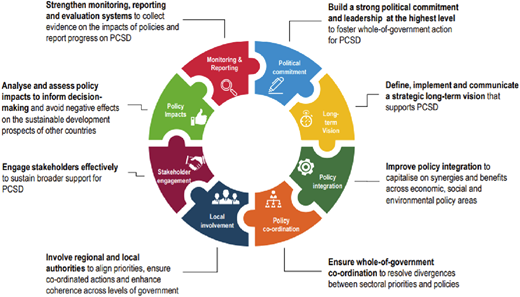
The first is PCSD, developed by the OECD, which addresses how different policy areas can be aligned and focuses on institutional coordination, integrated policy cycles, stakeholder engagement, monitoring, and evaluation. The OECD PCSD framework, as provided in Figure 1 below, is expressed through building blocks and is designed to ensure coherence across the policy cycle so that progress on one SDG does not undermine progress on another (OECD, 2019).
According to OECD (2018), these building blocks illustrate how different institutional mechanisms fit together and can contribute towards higher degrees of PC in terms of: (a) mobilizing whole-of-government action; (b) balancing economic, environmental, and social concerns; (c) reconciling short- and long-term priorities; (d) addressing potential negative impacts of domestic policies beyond borders; (e) ensuring co-ordinated and mutually supporting efforts across sectors; (f) involving subnational and local levels of government; (g) engaging key stakeholders beyond government; and (h) using monitoring and reporting systems to inform coherent policy making. There is no particular sequencing, but all eight must be in place for sustained progress towards PCSD. Musselli et al. (2020) noted that with the adoption of the Agenda 2030, a shift from Policy Coherence for Development (PCD) to PCSD was necessitated to move beyond the scope of aid and non-aid PC to coherence issues across multiple and sometimes conflicting policy objectives.
Based on Musselli et al. (2020), the PCSD framework, therefore, focuses on critical interlinkages (synergies or trade-offs) across multiple and sometimes conflicting development objectives across the economic, social, and environmental spheres (horizontal coherence). It requires coherent actions at the local, regional, and global levels (vertical coherence) (Musselli et al., 2020). Criticisms associated with the PCSD framework, as cited by Shawoo et al. (2023), acknowledged that some discourses of PCSD may be normatively undesirable, especially if they provide rhetorical cover for the continuation of unsustainable practices. Righettini and Lizzi (2021) also noted that scholars’ attention has been primarily focused on implementation, and that the attention devoted to the effective alignment between goals, instruments, and policy outcomes or impact evaluation remains relatively rare. Zeigermann (2020) argued that the PCSD concept is not appropriate in the sensitive context of violence and political transformation.
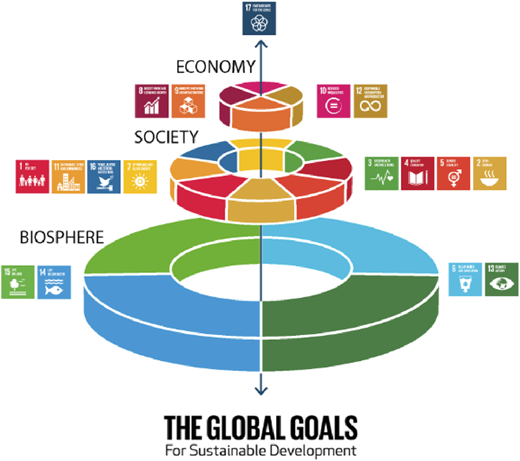
Second is the Social-Ecological Resilience Framework, which emphasizes adaptation, learning, and feedback across social and ecological domains (Folke et al., 2016). Literature on the social-ecological resilience framework is abundant, but most are outdated. Folke et al. (2016) present a perspective linking social ecological aspects to SDGs by challenging the stewardship of development in concert with the biosphere for people in diverse contexts and places as critical for long-term sustainability and dignity in human relations. The social-ecological resilience approach, as outlined in Figure 2, considers humans and nature as an integrated whole, not as separate parts, where humanity is embedded in the biosphere (Folke et al., 2016).
Core in this approach is the principle that people, irrespective of social and cultural contexts, coevolve with the planet, and our beliefs, perceptions, and choices shape our actions, technologies, and future in the biosphere in sustainable or unsustainable ways (Folke et al., 2016). This is also alluded to by Xu and Peng (2024), who noted that ecosystem services, which are an integral part of social ecological resources, make significant contributions to the 17 SDGs.
Critiques, including Oliveira et al. (2022), noted that social-ecological resilience modelling still does not have a unique framework for analysis, which creates methodological gaps in defining variables, linking indicators, and measuring data for DRPC. Stojanovic et al. (2016) also noted that the social-ecological systems concept neglects critique in the social sciences that certain elements of society are less amenable to conceptualization as systems and therefore undertheorize social entities and processes. Saja et al. (2021) further noted that systems thinking for conceptualizing social resilience can be further expanded to develop conceptual maps with multiple social resilience characteristics, providing a basis for defining and framing social resilience broadly and adapting it to a specific context.
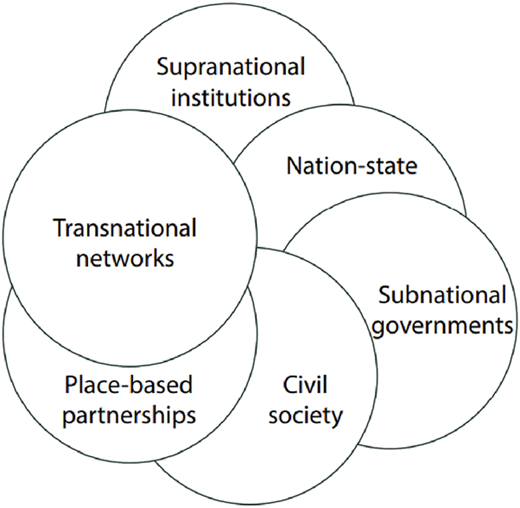
Thirdly, we look at the Multi-Level Governance (MLG) as illustrated in Figure 3 below. According to Saito-Jensen (2015), the MLG theory underscores a notion that states are no longer the monopolizing or even necessarily central actors of policymaking; instead, the power of government is increasingly shaped by and shared between actors operating at multiple levels. Figure 3 below presents a type of MLG referred to as “polycentric” where governance is typified by having multiple governing authorities at different scales rather than a centralized authority (Saito-Jensen, 2015). The central point for polycentric MLG is that the clear structures and hierarchies are blurred, or even disappear completely, due to the interactions among different governing bodies and actors (Saito-Jensen, 2015).
Nugent (2003) noted that MLG has been criticized for its weak explanatory ability, thereby lacking a theoretical focus and offering little in the way of explanatory power. Wurzel et al. (2019) also cited that MLG and polycentric governance concepts place different emphasis on the roles played by different types of leadership in climate governance. Wurzel et al. (2019) further noted the need for not exaggerating the differences between these three conceptual perspectives, noting that the state-centred theories attach proportionately greater emphasis and bias to state actors and inter-state relations over the other actors.
3. Research methods
3.1 Study design
This study applied a mixed-methods research design, with data collected through KIIs, conventional content analysis of policy documents relating to DR, and an online survey. Mixed-methods design is an approach that combines qualitative and quantitative research methodologies within a single study to draw on the strengths of both methods, providing a more comprehensive understanding of research questions (Ahmed et al., 2024). As noted by Creswell (2009), non-experimental investigations are generally more descriptive or exploratory and do not exhibit control over the studied variables. The study described the characteristics of a population, observed behaviours without intervention, or examined relationships between variables without manipulation, respectively. To produce the DRPC framework, a meta-framework approach to framework development was utilized. As illustrated by Partelow (2023), a meta-framework approach is based on the role of frameworks as bridging tools for knowledge synthesis and communication. Therefore, the meta-framework demonstrates how the mechanisms of framework development and use act as levers of knowledge flow across levels within a theory of science, doing so by enabling the communication and synthesis of knowledge (Partelow, 2023).
3.2 Sample and population
This study involved 45 Key Informants from 11 SADC MS, representing National Disaster Management Agencies (NDMAs), Departments responsible for Climate Change, Development planning, Agriculture and Environment among others, 88 online survey respondents from the SADC Secretariat staff, UN agencies, International Non-Governmental Organizations (INGOs), donors, and the private sector working in DRR, CCA, and SD sectors. KII participants were nominated by their institutions once they received the research participation invitation. There is no single sample size for mixed methods research; it depends on the specific research design, questions, and goals, requiring a combination of quantitative and qualitative sampling approaches. Based on Kaur (2016), with a mixed-method approach, the decision for choosing a sampling design depends on the research question. According to Kaur (2016 mixed-method research, the sample size is decided as the minimum sample size required for both quantitative and qualitative research. In this case, a combined 133 respondents purposely selected through professional and institutional affiliations were ideal for the study.
3.3 Data collection and analysis
Purposeful sampling was used to select the respondents and the key documents analyzed in the study. This approach used a non-random sampling technique where researchers deliberately select participants and documents based on specific characteristics, knowledge, or experiences that are relevant to the research question. This method aims to identify and select individuals and documents likely to provide valuable insights into the phenomenon being studied. Document analysis was used in the study; [1-12] international and regional SD, DR strategies, plans, and reports were analyzed to inform the proposed framework provided in section 4.5 below. The targeted documents were read in detail to gain familiarity before the identification of key patterns, themes, and main concepts. Summaries were generated that facilitated the drawing of key conclusions. KII was also summarized, and key themes, patterns, and concepts were generated in triangulation with information from the document analysis. Simple descriptive analysis, thematic analysis, and narrative analysis were used for data obtained from the semi-structured survey questionnaires.
3.4 Study biases
The researchers made introductory briefings on the research purpose, including clarity of key concepts to KII, and expectations with potential respondents to encourage participation. Use of multiple data collection approaches was applied to reach a wider audience. These dealt with limited knowledge of one of the key concepts, access, and non-responsiveness as potential biases in the study.
3.5 Ethical considerations
Study participation was based on anonymity and voluntary inclusion. This included the audio recordings during the interviews. Ethical approval was obtained from the North-West University (approval number NWU-0 1 4 1 2–2 0 - A 9), and participants were allowed to sign consent forms.
4. Study findings
This section examines the key findings, including the benefits of PC for resilience and SD in SADC, and introduces the proposed SADC DRPC framework.
4.1 Policy coherence as a key theme for the post-2015 development agenda
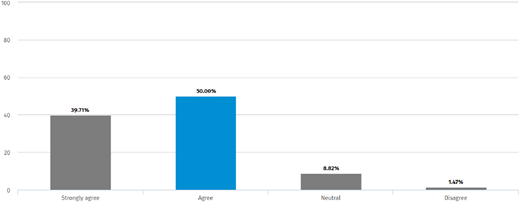
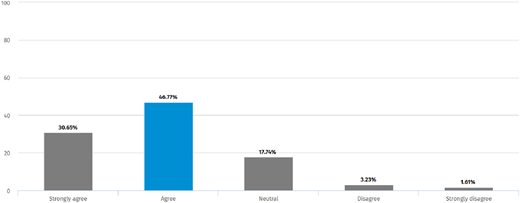
The study explored perspectives on whether PC is key to the post-2015 development agenda. Figure 4 below demonstrates respondents’ awareness of PC as an important theme for the post-2015 development agenda, with 89.71% strongly agreeing and agreeing to the notion that PC is a key theme for the post-2015 development agenda. The survey findings were corroborated by the KII referring to SDG Target 17.14 provisions on enhancing PCSD.
A food security expert with the SADC Secretariat shared a key perspective during the KII by saying, “The added value of SGDs is the emphasis on a more holistic and integrated approach to development, recognizing the interconnectedness of social, economic, and environmental challenges of our time, especially climate change and disasters”.
4.2 Policy incoherence as a key reason for the failure of the MDGs
It is important to recognize that the achievement of what is set out in global frameworks such as the MDGs is complex and that a single issue cannot independently be attributed to any success or failure of such frameworks. However, in the interest of harnessing lessons from past global frameworks and the MDGs in particular, the study considered respondents’ perspectives regarding policy incoherence and its contribution to MDG’s failure in part.
Figure 5 above indicates that 77.42% of the respondents agreed that the lack of PC affected the achievement of the MDGs. The KII confirmed the survey findings with key observations highlighting that incoherence within MDGs arose from a lack of coordination and a tendency for policies in one sector to undermine efforts in others. The key example provided was the competing and conflicting policies on aid and trade interests by developed countries in relation to their poor and developing counterparts. Based on the KII, although the MDGs had a priority on partnership for the goals, this did not effectively address the lack of coordination and integration across different policy areas. The KII respondents considered the fact that PC is deliberately included and better elaborated in the SDGs as a huge opportunity; however, it remains to be established how this can be achieved.
4.3 Envisaged benefits for a DRPC framework in SADC
It is common to think that absence equals need. In the context of the study, this could imply that the absence of a SADC framework on DRPC may highlight or reveal the need for such to be developed. Not always the case, as such, the study sought to validate, based on respondents’ perspectives, whether developing the proposed framework on DRPC was considered beneficial or not. Based on the findings presented in Table 1 above (where 1 = least beneficial and 5 most beneficial), the main benefit of a SADC DRPC framework would be enhanced integration of global, regional and national frameworks, seconded by fostering alignment across local, national and international actions, and third, and equally important, is overcoming fragmented policy action and fostering synergies across policy areas, among others.
4.4 Lessons from related research findings and the review of existing frameworks
The development of a regional DRPC framework is part of a wider study with two initial outputs focussing on DRPC, conceptual understanding, and analysis of existing case studies. Based on the DRPC conceptual framework, it is necessary to have a SADC-focused framework to enhance awareness of DRPC by providing a structured guide to integrated policy and institutional arrangements while promoting coordination across different sectors and levels, aligning policies, plans, and processes to achieve a more resilient and sustainable future. Likewise, the development of case studies on DRPC noted the added value of a dedicated SADC framework on DRPC.
Based on the review of existing frameworks, as provided in section 1 of this paper, there are several lessons that inform the SADC DRPC. Firstly, the few strategic and conceptual frameworks provide an overarching goal or objective that defines the overall change envisaged by the framework. Secondly, visualization of relationships across variables is a key common feature to illustrate how one aspect of the framework informs or influences the other components of the framework. The third aspect is clarification of key concepts, which focuses on unpacking the meanings of the concepts and themes covered by the frameworks. Fourth, most of the frameworks provide some form of institutional coordination arrangement that clarifies the key players engaged in the framework activities. A key feature of the reviewed frameworks is the definition of spatial scales, which entails the indication of the focus area or region prioritized by the phenomenon or process considered by the framework, for instance, national, sub-national, regional, continental, or global.
Lastly, based on the analysis is four key regional frameworks: the SADC Disaster Preparedness and Response Strategy and Fund (SDPRSF) (SADC, 2016), the SADC Climate Change Strategy and Action Plan (SCCSAP) (SADC, 2020b), the SADC Regional Resilience Framework 2020–2030 (SRRF) (SADC, 2020c), and the SADC Disaster Risk Management Strategy and Action Plan (SDRMSAP) (SADC, 2022) indicates gaps on connecting PC with DR. The SDPRSF is silent on PC while the other 3 highlight with limited and varied provisions for political commitment, institutional coordination, monitoring and evaluation (M&E), funding and resource mobilization mechanisms, thematic integration, and alignment with global development and DR frameworks such as the SDGs, the Sendai Framework for Disaster Risk Reduction (SFDRR), the Paris Agreement (PA), and the New Urban Agenda (NUA).
4.5 A proposed SADC DRPC framework
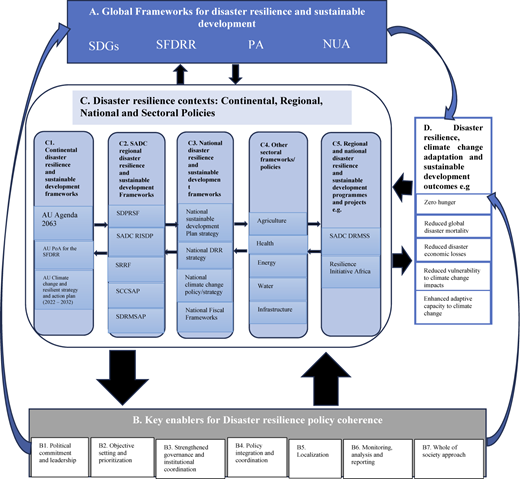
The proposed SADC DRPC Framework is grounded in a comprehensive synthesis of the literature review, the document analysis, the KII findings, and the online survey findings. This integrated framework, as presented in Figure 6, comprises four core components, namely (A) Global Frameworks for disaster resilience and SD; (B) Key enablers for DRPC; (C) Disaster resilience contexts; and (D) Disaster resilience and SD outcomes.
The blue arrows represent the iterative loop for the key components of the framework. This suggests that the SADC DRPC framework is based on a repetitive process of key components, generating a sequence of outcomes with each iteration. It means, therefore, every time global goals are set, such as the Sendai Framework (UNISDR, 2015) or the future equivalent, this will be influenced by the enablers and the context to influence the development outcomes. However, each component also influences the way the others behave; for example, the main outcomes will impact how the enablers interact with the global frameworks. The black arrows explain the interaction relations across the components. This means there is a two-way relationship within some of the components for example with the disaster resilience context while the continental DRR framework, like the African Union Commission Programme of Action for Sendai Framework (AUC PoA) (African Union, 2016) informs the SADC regional framework, such as the SADC Regional Resilience Framework, it also follows that the continental framework is informed by the regional ones.
As Partelow (2023) notes, frameworks are embedded within a broader theory of science, shaping how problems are understood and addressed. In the case of the proposed SADC DRPC Framework, it is informed by two interrelated theoretical foundations, one being Disaster Resilience (DR) and the other Policy Coherence (PC). This dual-theoretical lens is critical in Component A, which positions global frameworks as the normative and strategic anchors for advancing regional DR integrating internationally endorsed instruments such as the SDGs (UN, 2015), the SFDRR, the Paris Agreement on Climate Change (UNFCCC, 2017), and the New Urban Agenda (NUA) (UN-Habitat, 2017), the framework promotes vertical and horizontal alignment of policies across scales. This alignment is not merely procedural; it is essential for fostering systemic coherence across economic, environmental, and social domains.
It compels the SADC region to adopt a multi-sectoral, multilevel governance approach that transcends policy silos and enhances the region’s ability to design, implement, and monitor policies and projects that reduce risk while advancing SD. Thus, the global-to-local connectivity of this framework is pivotal in operationalising resilience in complex, resource-constrained contexts typical of the SADC region.
Component B of the proposed SADC DRPC Framework identifies and elaborates on key institutional and governance enablers essential for fostering coherence in DR policymaking and implementation. Subcomponent B1 centres on the foundational role of political commitment and leadership. Institutions are not the only explanatory factor for decision-making (Vitale et al., 2023). Without strong political will and strategic leadership across all levels of governance, efforts to mainstream PC into DR planning risk remaining rhetorical or fragmented (Joseph et al., 2022). This subcomponent underscores that effective leadership must extend beyond elected officials to include institutional actors, traditional authorities, civil society leaders, and youth advocates. These diverse actors collectively shape the political and social environment in which policies are formulated and implemented, influencing both the prioritization of resilience agendas and the mobilization of resources. In the absence of such leadership, PC becomes difficult to achieve, heightening the risk of disjointed responses to disasters and undermining long-term sustainable development goals.
Subcomponent B2 addresses the imperative of clear, inclusive, and strategic objective-setting and prioritization. It highlights that the alignment of DR efforts with SD requires a deliberate and participatory approach to defining objectives that are not only aligned across sectors but are also sequenced based on urgency, resource availability, and potential impact (ESCAP, 2018a). The framework calls for the use of SMART criteria, Specific, Measurable, Achievable, Relevant, and Time-bound, ensuring that goals are realistic and actionable (Glahn et al., 2007). Importantly, this process must be consensus-driven, involving a broad spectrum of stakeholders to reflect shared priorities and local realities. By anchoring planning in evidence-based prioritization and inclusive dialogue, the framework enhances transparency, accountability, and strategic coherence across DRR, CCA, and SD agendas.
Subcomponent B3 highlights strengthened governance and institutional coordination as a foundational pillar. Effective DRPC hinges on well-structured mechanisms that foster collaboration among global, continental, regional, and national actors, as well as inter-sectoral stakeholders (ESCAP, 2018b). This alignment ensures strategic coherence, reduces policy fragmentation, and mitigates the risk of conflicting or duplicative efforts. Without such coordination, policy environments become fragmented, leading to inefficiencies, increased costs, and sub-optimal outcomes.
Subcomponent B4 focuses on deliberate policy integration and coordination, two processes that are often conflated but serve distinct purposes. Policy integration refers to the merging or harmonization of policies into a cohesive whole to pursue unified objectives (OECD, 2023). This can involve either formal consolidation of policies or the alignment of implementation strategies. Policy coordination, on the other hand, entails the alignment of independent but related policies to ensure they function in synergy (Corinne et al., 2023). Both are essential to reduce sectoral silos and ensure that DR measures support, rather than undermine, broader SD goals.
B5 emphasizes the importance of localization, the adaptation of global policy agendas, such as the Sendai Framework and SDGs, to regional, national, and sub-national realities. Localization acknowledges the diversity of socio-economic, environmental, and governance contexts within SADC, ensuring that policies are not only technically sound but contextually relevant and implementable at the grassroots level (UN, 2024). Monitoring, analysis, and reporting (MAR) are addressed in B6, underscoring their central role in maintaining PC. Effective MAR systems provide critical feedback loops that help policymakers assess performance, identify inconsistencies, and make data-informed decisions. As the OECD (2023) asserts, robust MAR mechanisms are essential to ensure that PC is not merely aspirational but translated into tangible results at all levels.
Finally, B7 introduces a whole-of-society approach as a transformative enabler, shifting beyond the conventional whole-of-government paradigm. This approach recognizes that DR and SD require the active participation of all societal sectors, including government institutions, private enterprises, civil society, academia, and individuals. Broad-based stakeholder engagement ensures that policy formulation and implementation processes are inclusive, equitable, and reflective of diverse perspectives and needs. In doing so, it enhances legitimacy, accountability, and the overall effectiveness of D strategies. Collectively, Component B underscores that enabling conditions are not peripheral but central to building a coherent, responsive, and forward-looking DR icy landscape in the SADC region.
Component C of the framework addresses the diverse operational contexts in which DR and SD strategies are formulated and implemented. These DR contexts encompass the multi-layered policy and institutional environments at continental, regional, national, and programmatic levels within which coherent DRR, CCA, and SD interventions are pursued. At the continental level (C1), the AU provides a strategic umbrella under which SADC and other Regional Economic bodies align their priorities. The AU’s Agenda 2063, AUC (2015), articulates Africa’s long-term development vision, aiming for a peaceful, integrated, and resilient continent. It emphasizes inclusive and SD, offering a normative backdrop against which regional and national DR efforts are shaped. The AUC PoA operationalizes DRR commitments by contextualizing global DRR priorities within African realities, while the AU Climate Change and Resilient Development Strategy and Action Plan (2022–2032) provides a continent-wide roadmap for coordinated climate resilience efforts. These frameworks act as continental anchors for PC, offering shared goals and principles for alignment by SADC and its MS.
Component C2 focuses on the SADC regional context, where frameworks such as the Regional Indicative Strategic Development Plan (RISDP) (SADC, 2020a), the SDPRSF (SADC, 2016), the SCCSAP (SADC, 2020b), and the SRRF (SADC, 2020c), provide the structural scaffolding for regional DR programming. While these frameworks exist independently, the PC framework underscores the need for internal alignment among them and vertical coherence with both continental frameworks and international commitments. The goal is to prevent siloed responses and promote synergistic outcomes across environmental, social, and economic dimensions. C3 brings the focus to the national level, where DR and SD frameworks must interconnect to reinforce national and sub-national capacities. National DRR strategies typically aim to reduce the vulnerability of communities and infrastructure to hazards, while SD policies aim to balance economic, environmental, and social imperatives. Similarly, national CCA strategies are a key aspect in this context, guiding national planning to adjust to the actual or expected impacts of climate change to reduce vulnerability and enhance resilience to climate impacts. This may include strategies around climate-smart agriculture, climate-resilient infrastructure, and climate early warning systems. These frameworks not only bolster risk preparedness and recovery but also support broader development goals such as poverty reduction, equity, and environmental sustainability. The coherence between national and regional frameworks is vital to ensure downward harmonization and relevance to local realities.
Sub-component C4 deals with how other key sectoral sectors play a role in shaping national and regional DR. These also shape SD policies and strategies, influencing the enablers and the global frameworks, but also shape the envisaged SD and DR outcomes. DR does not happen in a vacuum, and beyond the typical DR strategies and policy, mainstreaming DR into various sectors is the logical approach to ensuring the desired impact. This involves integrating DRR and CCA into planning, policies, and investment decisions across different sectors and industries. For instance, the infrastructure is key for national and regional development, encompassing the creation, improvement, and maintenance of physical structures and services that are essential for a society’s functioning and economic growth. C4 focuses on how infrastructure systems can be able to withstand and recover from disruptions posed by hazards such as floods, ensuring continued functionality and reducing the impact of such adverse events.
The C5 sub-component concentrates on programmes and projects as sites of operational coherence. Here, the focus shifts from policy to implementation—how strategic intentions are translated into concrete, coordinated action. Regional and national programmes reflect the real-world application of DRR and SD policies, revealing both strengths and gaps in institutional coherence, inter-agency collaboration, and cross-sectoral coordination. These initiatives are crucial for demonstrating alignment across levels and sectors, particularly when evaluated through lenses of impact, scalability, and inclusivity.
In summary, Component C emphasizes the importance of contextual coherence across all levels of governance. It acknowledges that effective DR requires multi-scalar alignment from continental visions to national policies to on-the-ground projects, ensuring that interventions are not only technically robust but also politically, socially, and culturally grounded. This layered understanding is critical in the SADC region, where varying vulnerabilities and capacities demand tailored and harmonized approaches to DRR and SD.
Component D articulates the intended outcomes of DR and SD, emerging from the interplay of global frameworks, key enablers, and contextual application. This component captures the cumulative results of aligning DRR, CCA, and SD strategies through coherent and coordinated policy efforts. The outcomes reflect international benchmarks such as those articulated in the SFDRR, the Paris Agreement, and the SDGs, which call for significant reductions in disaster-related mortality, the number of people affected, and direct economic losses. CCA outcomes are also key within this component, and the focus is on reducing vulnerability and enhancing adaptive capacity to the impacts of climate change. These are critical indicators of the resilience and sustainability of communities, economies, and ecosystems.
From an analytical standpoint, Component D illustrates the “triple dividend” of integrating DR, PC, and SD. Firstly, resilience-building helps shield infrastructure, livelihoods, and social systems from shocks such as floods, droughts, and pandemics. This preserves development gains, minimizes post-disaster recovery costs, and accelerates long-term development. Secondly, coherent policies ensure that objectives in one sector (e.g. agriculture or housing) are not undermined by actions in another (e.g. water resource management or land use planning). This alignment improves efficiency, reduces redundancy, and enhances collective impact. Lastly, by embedding DRR and CCA within development planning, countries and regions create more robust, inclusive, and adaptive systems, ultimately delivering on the promise of economic growth, social equity, and environmental stewardship. Thus, Component D emphasizes that outcomes must be viewed not in isolation, but as interconnected results of systemic integration. Reducing disaster impacts and the impacts of extreme weather events is not just a technical goal; it is foundational to achieving SD in the SADC region. This approach ensures that policies are not only ambitious in scope but also practical and synergistic in execution, capable of responding to complex and compounding risks.
5. Discussion
The study benefited from respondents who were affiliated with relevant organizations actively involved in DR and SD. It is not surprising that respondents found PC as a core theme for the post-2015 development agenda. The SDGs represent a comprehensive set of goals with clearer targets compared to the MDGs. The SDGs are also applauded for being interconnected and having an adequate attempt towards providing a coherent approach to implementation. The provision of SDG 17.14 on enhancing PC is a game-changer to help the SADC Secretariat and MS move beyond current fragmented approaches to address complex, interconnected challenges in DR and SD. The envisaged benefits for a DRPC framework in SADC are enhanced learning and knowledge management for PC in the region, improved governance, overcoming fragmented policy action, and fostering synergies across policy areas, among others.
The proposed SADC DRPC framework has four components: global frameworks for DR and SD, key enablers for DRPC, DR contexts, and DR and SD outcomes. The proposed DRPC framework is an academic tool and practitioner’s guide to ensure that DR and SD policies across different sectors and levels of society are aligned and work together to enhance a community’s ability to withstand and recover from disasters. This framework promotes coordination, reduces redundancy, and ensures that DRR efforts are integrated into broader development planning. The key limitation of the study was the limited evidence of DRPC among the respondents and more widely in the region. This limited the depth of the respondent’s contributions during the KII. Suggested areas of further research suggested by the study are twofold: one, a DRPC monitoring and evaluation system, and the other is research related to defining post-2030 DRPC and SD elements.
It is important not to shy away or be naïve to potential challenges to the adoption and rollout of the proposed framework in SADC. Potential barriers to the adoption of a DRPC framework include a lack of political will, fragmented institutional capacity and coordination, insufficient financial resources, and a limited understanding of the framework’s benefits. Lack of accountability due to an absence of enforceable sanctions and incentives for proactive DRPC can also hinder effective adoption.
6. Conclusion
PC approaches are now gaining popularity outside the EU, where they originated, with considerable experience and application within SADC. However, for SADC, generally, PC is not adequately considered across many themes, let alone in the DR space, yet the regional context is characterized by disasters. Therefore, DRPC becomes more appropriate, as proven by the study, as an approach and policy tool for integrating the multiple dimensions of DR and SD at all stages of policy making and implementation. Since SADC MS are part of the UN, it is important to recognize the critical contribution of international strategic frameworks in shaping regional DR and SD agendas. SDGs become key in this regard, especially with target 17.14 calling for the enhancement of PC. The Sendai Framework and the Paris Agreement equally have the same influence in the DRR and CCA spheres.
Regardless of the SDGs’ efforts on PC, the guidance is biased towards SD, and the extent to which this is applied at the SADC level is characterized by limited clarity. Likewise, PC dimensions and applications are evident in the DR global frameworks; the SADC level applications are contestable, inclining towards inadequate DRPC. The SADC DRPC framework, as proposed in the study, therefore fills the gap that currently exists. Applying the framework will guide the SADC Secretariat and MS to fast-track the integration of DR policies with SD to enhance the well-being of people living in the region. The framework resonates well with SADC’s vision, mission, and objectives, including the core agenda of regional integration espoused within the RISDP. However, while the framework is a potential game-changer for SADC as far as DRPC is concerned, the challenges SADC faces cannot all be addressed by the framework alone. Effective results in applying the framework require strengthening of the SADC institutional capacity in terms of enhanced capacities to attain key milestones that define regional integration, including technical and financial resources to effectively coordinate the implementation of regional integration programs and projects; and to support the coordination of efficient delivery of regional DR and SD programmes.
Notes
African Union Programme of Action for the Implementation of the Sendai Framework for Disaster Risk Reduction (AUC, 2016).
African Union, Agenda 2063: The Africa We Want. Framework Document (AUC, 2015).
SADC Disaster Preparedness and Response Strategy and Fund 2016–2030 (SADC, 2016).
SADC Regional Indicative Strategic Development Plan (RISDP) 2020–2030 (SADC, 2020a).
SADC Climate Change Strategy and Action Plan 2020–2030 (SADC, 2020b).
SADC Regional Resilience Framework 2020–2030 (SADC, 2020c).
SADC Disaster Risk Management Strategy and Action Plan 2022–2030 (SADC, 2022).
United Nations, Transforming our World: the 2030 Agenda for Sustainable Development.” United Nations General Assembly.
The 2030 Agenda for Sustainable Development (UN, 2015).
The New Urban Agenda (UN-Habitat, 2017).
Sendai Framework for Disaster Risk Reduction 2015–2030 (UNISDR, 2015).
Driving Policy Coherence for Sustainable Development: Accelerating Progress on the SDGs (OECD, 2023).