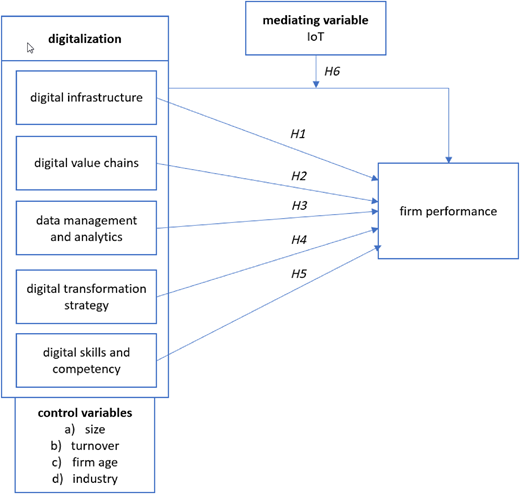
The Internet of Things (IoT) is currently acting as a critical component of the digitalization process by connecting physical devices to the digital world. It is assumed that IoT serves as both a driver and enabler of digitalization. Accordingly, this study investigates the significance of digitalization in enhancing small and medium-sized enterprises (SMEs) firm performance using IoT as a mediator.
Relying on a sample of 393 SMEs in Portugal, the study used a survey method and questionnaire to gather data, while utilizing the structured equations model to explore the relationship between the constructs of the research model.
The findings show that digital infrastructure and value chains are central to digitalization. Technology, data analytics, digital skills and transformation strategies directly and jointly enhance firm performance. The study also highlights the mediating role of IoT in this relationship and stresses the need to consider industry dynamics, digital readiness and strategic goals when assessing IoT’s impact on SME performance.
This study provides valuable insights into the core of digitalization, emphasizing the need for SMEs to effectively integrate digital infrastructure, digital value chains and IoT-driven technologies to drive performance and long-term success.
1. Introduction
Digitalization refers to the process of integrating digital technologies into various aspects of business operations, communication, and daily life. Caputo, Pizzi, Pellegrini, and Dabić (2021, p. 490) state that it involves “strategic transformations targeting organizational changes implemented through digitalization projects, with the goal of enabling major business improvements”. Therefore, digitalization goes beyond simply converting analog data to digital form; it involves rethinking and redesigning business models to leverage the capabilities of digital tools and platforms.
Empirical studies conducted by Clemente-Almendros, Nicoara-Popescu, and Pastor-Sanz (2024) and Skare, de Obesso, and Ribeiro-Navarrete (2023) report that digitalization has become an essential driver of growth and competitiveness for small and medium-sized enterprises (SMEs), fundamentally reshaping how they operate and engage with the market. Furthermore, the literature reports that digitalization is more important for SMEs than large companies because it offers them a unique opportunity to level the playing field and compete effectively in markets traditionally dominated by larger firms (Barragan & Becker, 2024; Kergroach, 2020). Unlike large companies, which often have established brand recognition, extensive resources, and complex infrastructure, SMEs operate with limited resources and face greater challenges in reaching customers and scaling their operations.
Digitalization often involves automating processes, collecting and analyzing data, and improving connectivity across various operations. IoT enables these capabilities by connecting devices, systems, and machinery, allowing real-time data collection and communication. This connectivity facilitates predictive maintenance, reducing downtime and costs by addressing issues before they escalate (Hsiao, 2024). Moreover, IoT supports the development of smart products and services, allowing SMEs to innovate and differentiate themselves in competitive markets. This ability to gather and analyze data from connected devices also opens opportunities for SMEs to enter new markets or create subscription-based models, providing steady revenue streams (Al-Zahrani, 2020). Another significant aspect of IoT in SME digitalization is its role in data-driven decision-making. IoT generates vast amounts of data that, when analyzed, provide insights into customer behavior, operational inefficiencies, and market trends.
Recently, the impact of digitalization on the financial performance of SMEs has become a research concern due to the increasing importance of digital technologies in the modern economy. Current quantitative studies like Luu, Le, Nam, and Van (2024) and qualitative case studies provided by Kallmuenzer, Mikhaylov, Chelaru, and Czakon (2024) demonstrate that digitalization is a powerful tool for SMEs, enabling them to achieve sustainable growth and profitability. Additionally, Kádárová, Lachvajderová, and Sukopová (2023) use panel data of SMEs in EU27 to demonstrate that COVID-19 acted as a catalyst for the digitalization of SMEs, pushing many businesses to adopt digital tools and strategies more rapidly than they might have otherwise. Furthermore, exploring the mediating roles in the impact of digitalization on the financial performance of SMEs is important because it helps to uncover the mechanisms through which digitalization influences financial outcomes. Understanding mediating roles can help in identifying specific areas where SMEs should focus their digitalization efforts to maximize financial returns. It can reveal which digital initiatives are most effective in improving financial performance and which ones require further support or adjustment. At this level we acknowledge the existence of three studies: Umar, Septian, and Pertiwi (2023) consider the mediating role of competitive advantage, Radicic and Petković (2023) identify that internal R&D has a moderating effect on product and process innovations which stimulates the development of new processes and products particularly in the context of non-R&D SMEs, and Merín-Rodrigáñez, Dasí, and Alegre (2024) concluded that business model innovation partially mediates the relationship between digital transformation and innovative SME performance by serving as a critical link through which digital transformation influences the effectiveness and competitiveness of SMEs.
These previous studies demonstrate that digital transformation typically entails the integration of new technologies, processes, and digital tools that can fundamentally reshape business operations. However, the specific impact of technologies that support the digitization process needs also to be explored. At this level, Zhao, Honigsberg, and Mandviwalla (2024) look to the role of technologies such as cloud, mobile, IoT, and data analytics in providing benefits to SME performance. However, when examining the broad landscape of emerging technologies, it becomes challenging to isolate the specific impact of the Internet of Things (IoT). This is because IoT adoption rarely occurs in a vacuum; instead, it is often implemented alongside or as a result of adopting complementary technologies such as cloud computing, big data analytics, or artificial intelligence (Kumar, 2023; Marengo, 2024; Saadia, 2021). These interconnected technologies create a synergistic ecosystem where the boundaries between individual contributions become blurred, making it difficult to attribute transformative outcomes solely to IoT. Furthermore, the findings provided by Grijalba, Hernández, Perez-Encinas, and Urda (2024) indicate that the effects of various digital tools, platforms, and their applications were not uniform, revealing significant differences in how they impact the financial performance of SMEs. This outcome underscores the complexity of digitalization, where the adoption of different technologies can lead to varying outcomes depending on the specific tool or platform in use.
This study addresses this research gap by exploring the specific role of IoT as a technology that can play a relevant mediating role between digitalization processes and SME performance. The goal is to understand through the lens of contingency theory the relevance of IoT as a mediating factor lies in its ability to amplify the benefits of digitalization. While digitalization provides the framework for integrating new technologies, IoT can add a layer of connectivity and intelligence that could drive more effective and efficient business operations. Accordingly, this connection may indicate that digital transformation is not just a superficial change but leads to tangible improvements in performance metrics. Accordingly, this study is relevant to understanding that not all digital tools are equally beneficial in all contexts, and the effectiveness of digitalization efforts is contingent on selecting the right combination of technologies that align with the specific needs and strategic goals of the SME. This non-uniform impact highlights the importance of a tailored approach to digital transformation, where businesses carefully evaluate and implement digital tools based on their unique operational and market environments. Understanding these variations also has practical implications for SMEs. It will encourage them to prioritize and invest in digital tools that offer the most significant potential for enhancing their financial performance. Moreover, this insight helps in avoiding a one-size-fits-all approach to digitalization, emphasizing the need for a strategic, selective adoption of technologies that best support the specific objectives of the business.
The remainder of this paper is structured as follows: First, we review the literature on the dimensions of the digitalization process and examine the potential role of IoT within these transformations. This section also serves as the foundation for the formulation of our research hypotheses. Next, we outline the methodological approach, detailing the procedures employed and the key characteristics of the sample. The subsequent section presents and discusses the results, highlighting their contribution to the existing body of knowledge. Finally, we conclude by summarizing the main findings, outlining key contributions and policy implications, and offering directions for future research.
2. Literature review and hypotheses development
Contingency theory in digitalization as advocated by Scott and Davis (2007) posits that the effectiveness of digital transformation strategies (like digitalization) depends on various internal and external factors (contingencies). This theory suggests there is no one-size-fits-all solution, and the success of digital initiatives depends on aligning them with specific organizational, environmental, and technological conditions. Accordingly, the relationship between digitalization and performance in SMEs is contingent upon certain factors, and IoT serves as a contextual variable, which optimizes and contextualizes the digital capabilities of SMEs, translating digitalization efforts into tangible performance outcomes. This perspective is critical in a digital economy where technologies like IoT are often promoted as universally beneficial, when in fact, their impact is highly context-dependent.
Digital infrastructure is fundamental for SMEs as it provides the backbone for all digital operations. Several sets of essential technologies such as cloud computing, data centers, and high-speed internet may help SMEs to perform their activities smoothly and efficiently. Accordingly, with robust digital infrastructure, SMEs can scale their operations, access advanced tools and services, and maintain continuous business processes without the limitations of physical constraints. This foundation supports everything from day-to-day operations to strategic initiatives, allowing SMEs to leverage digital technologies for growth and competitive advantage. Therefore, as reported by Nucci, Puccioni, and Ricchi (2023), effective digital infrastructure not only ensures operational reliability but also helps in managing costs and enhancing overall productivity.
Digital infrastructure has a positive effect on firm performance.
Digital value chains are fundamental in the digitalization process of SMEs because they create an integrated framework that supports and enhances the efficiency of all digital activities within a business. Digital value chains provide a holistic framework that integrates and optimizes all aspects of digital operations. Hausberg, Liere-Netheler, Packmohr, Pakura, and Vogelsang (2019) point out this comprehensive approach streamlines internal workflows by connecting various processes, such as procurement, production, and distribution, through digital technologies. As SMEs adopt digital tools and systems, a well-structured digital value chain becomes essential for maximizing productivity and performance. This structured approach integrates various digital processes, creating a seamless flow of information and operations across different functions within the business (Lee et al., 2024). Literature indicates that this integration significantly boosts operational efficiency, facilitating real-time data sharing and decision-making. As a result, organizations can implement more informed strategies and respond more rapidly to shifts in the market (Kraus, Kappl, & Schlegel, 2024). Ultimately, a robust digital value chain helps SMEs leverage their digital investments more effectively, driving overall performance and supporting sustained growth in a competitive environment.
Digital value chains have a positive effect on firm performance.
In recent years, there have been significant and growing developments in data management and analytics, driven by shifting corporate requirements and technology breakthroughs. Effective data management involves organizing, storing, and maintaining data systematically, ensuring its accuracy, security, and accessibility (Birkbeck, Nagle, & Sammon, 2022). This solid foundation allows SMEs to maintain a reliable and comprehensive data repository that supports various business functions. Analytics builds on this foundation by applying techniques to interpret and extract actionable insights from the data. Through analytics, Ragazou, Passas, Garefalakis, and Zopounidis (2023) report that SMEs can identify patterns, forecast trends, and understand customer behaviors, leading to more strategic decisions and process optimizations. This capability transforms raw data into valuable insights, helping SMEs to remain competitive in an increasingly digital environment.
Data management and analytics have a positive effect on firm performance.
A digital transformation strategy is pivotal in guiding SMEs through the complex process of digital transformation, which involves integrating digital technologies into all aspects of their operations. This strategic approach outlines a comprehensive plan for leveraging digital tools and innovations to drive business growth. The benefits of digitalization are manifold and become more accessible and impactful when rooted in a clear strategic framework. Digitalization enhances operational efficiency by automating repetitive tasks and improves decision-making by providing access to timely and accurate data through integrated analytics systems (Tian, Chen, Tian, Huang, & Hu, 2023). Customer engagement is another area significantly strengthened through digitalization. Digital platforms allow SMEs to interact with customers in personalized and efficient ways (Verhoef et al., 2021). Furthermore, digitalization opens up new avenues for innovation and market expansion. The goal of digital transformation strategy is to ensure that digital initiatives are aligned with business objectives and that resources are allocated effectively. Digital transformation strategies not only drive operational excellence but also foster a culture of continuous improvement and innovation, contributing significantly to the long-term success and sustainability of SMEs.
Digital transformation strategy has a positive effect on firm performance.
In the context of digital transformation, having a workforce equipped with the necessary digital skills ensures that employees can effectively use digital tools, software, and platforms to enhance productivity and streamline operations. Audrin, Audrin, and Salamin (2024) add that competency in digital skills also empowers employees to adapt quickly to new systems, reducing the learning curve and minimizing disruptions during the transition process. Moreover, digitally competent teams are better positioned to innovate as recognized by Mahmutaj and Jusufi (2023), as they can leverage data analytics, automation, and other advanced technologies to drive business growth and improve decision-making. This capability not only enhances operational efficiency but also enables SMEs to stay competitive in an increasingly digital marketplace. Additionally, the systematic literature review performed by van Laar, van Deursen, van Dijk, and de Haan (2017) concluded that investing in digital skills development fosters a culture of continuous learning and adaptability, which is crucial for sustaining long-term success in a rapidly evolving technological landscape.
Digital skills and competency have a positive effect on firm performance.
The relevance of the Internet of Things (IoT) in digitalization processes is significant, as IoT acts as a critical enabler of digital transformation across various industries (Kumar, Sindhwani, Behl, Kaur, & Pereira, 2024). As reported by Ding, Tukker, and Ward (2023), IoT facilitates the seamless flow of information across different business operations, enabling SMEs to optimize their processes, reduce inefficiencies, and make more informed decisions. The real-time data provided by IoT also enhances decision-making processes. The mediating role of IoT in the digitalization process may constitute a powerful catalyst for improving the performance of SMEs, enabling them to thrive in an increasingly connected and data-driven economy. Despite the literature acknowledging the pivotal role of IoT as a technological enabler in digital transformation, there remains a gap in understanding the specific mechanisms through which IoT mediates the digitalization process, especially within the context of SMEs. Moreover, the interdependencies between IoT adoption and the integration of other digital technologies are frequently overlooked, making it difficult to isolate IoT’s distinct contribution. This gap is particularly relevant for SMEs, which face unique challenges in resource allocation, strategic planning, and digital readiness compared to larger firms. As such, it is important to clarify and explore the mediating role of IoT in the relationship between digitalization and firm performance in SMEs, considering both technological and organizational factors. Accordingly, a new research hypothesis has been formulated:
IoT does mediate the relationship between digitalization and firm performance.
3. Methodology
3.1 Sample and data gathering
An initial sample of 3,923 Portuguese SMEs with SME Excellence status in 2022 was considered. This designation, awarded by IAPMEI, recognizes firms for strong financial performance, efficient management, innovation capacity, and sustained growth. Companies were invited to participate in a study on the role of IoT in organizational performance, provided they used IoT-supported technologies. Of these, 635 expressed willingness to participate, and 411 completed the survey between June and July 2024 (response rate: 64.72%). The survey targeted each SME’s CEO or General Manager. After excluding 18 incomplete responses, the final sample comprised 393 SMEs. Table 1 outlines the respondents’ profile. SMEs were classified according to the European Commission’s criteria (EC, 2021), defining medium-sized firms as those with fewer than 250 employees and turnover below €50 million. Firm age, a key control variable due to its impact on performance (Hadid & Hamdan, 2022), shows that over half the sample consists of companies aged between 5 and 15 years. Industry, another important control variable, influences firm strategy and outcomes due to differing competitive and regulatory environments. Using the classification from Wasim, Ahmed, Kalsoom, Khan, and Rafi-Ul-Shan (2024), 57% of the sample operates in the service sector, reflecting the dominant role of services in Portugal’s economy, as noted by Andrade (2020).
3.2 Variables
The dependent variable is firm performance (FP), the construct of which was previously validated in the study by Wasim et al. (2024). Therefore, FP is supported by items relating to return on investment, increase in sales, development of new products or services, and increase in the quality of customer service. Five independent variables are considered: digital infrastructure (DI), digital value chains (DVC), data management and analytics (DMA), digital transformation strategy (DTS), and digital skills and competency (DSC). DI is supported by Hussain, Jun, and Radulescu (2024) who explore the use of Internet and cloud infrastructure in the operations of the company; DVC is based on four factors provided by Qin, Xie, and Jia (2024) that influence value chains; DMA is based on Szukits and Móricz (2023) that use factors related to analytical decision making culture and data-driven decision making; DTS is supported on three dimensions (i.e. organizational culture, technology infrastructure, and strategic vision) acknowledged by Guo and Chen (2023), DSC considers the eight dimensions presented by Audrin et al. (2024). The mediating role of IoT considers the items presented by Wasim et al. (2024). All these variables use a uniform Likert scale of five levels: (1) Strongly Disagree; (2) Disagree; (3) Neither Agree nor Disagree; (4) Agree; (5) Strongly Agree. The items that support the constructs and the associated reliability statistics are presented in Table 2.
Table 3 presents all constructs’ descriptive statistics (mean and standard deviation) and a correlation matrix. This information is important for providing a foundational understanding of the data and relationships between variables. Descriptive statistics offer insights into the distribution, central tendency, and variability of the data, helping to identify potential issues like skewness or outliers that could impact the results. The correlation matrix is essential for examining the strength and direction of relationships between observed variables, which can inform model specifications and highlight issues like multicollinearity. We examined the Variance Inflation Factor (VIF) to complement the multicollinearity analysis. Marcoulides and Raykov (2019) indicated a high VIF (typically above 10) shows multicollinearity, meaning that an independent variable is highly correlated with others, potentially distorting regression coefficients. The higher value is 2.450 for the DVC construct, while a lower value emerges in the FP construct with a value of 1.192. These values are acceptable and indicate no multicollinearity issues.
3.3 Method and data analysis
Using a Structural Equation Modeling (SEM) approach to assess the impact of digitalization on SME performance, with a focus on the mediating role of the IoT, is highly relevant due to the complexity and interrelatedness of the variables involved. SEM allows the examination of both direct and indirect relationships between multiple variables simultaneously. In this study, digitalization is an exogenous latent variable that aims to capture the extent to which SMEs integrate digital technologies into their operations and strategy; IoT implementation is a mediating latent variable that reflects how SMEs are adopting and integrating IoT systems and the degree to which IoT contributes to data-driven operations; and firm performance is an endogenous latent variable that represents the outcomes of digitalization and IoT adoption. The model estimation is based on Partial Least Squares SEM (PLS-SEM), and model fit indicators and reliability and validity factors are used to assess the overall quality of the measurement and structural model, ensuring that the relationships among constructs are statistically consistent, and accurately represent the underlying theoretical framework. IBM SPSS Amos v.26 was adopted to perform the statistical analysis.
Digitalization involves the integration of digital technologies across different business processes, which can enhance performance, innovation, and customer engagement. However, the impact of digitalization on SME performance is not uniform and can vary depending on how well the digital tools are utilized and integrated within the firm’s operations (Kuang, Fan, Fan, Jiang, & Bin, 2023). Here, IoT can play a mediating role by enhancing the effects of digitalization. IoT enables real-time data collection, automation, and connectivity across devices, amplifying the benefits of digitalization and enabling data-driven decision-making. SEM is useful in this context because it can model the complex relationships between digitalization, IoT, and SME performance while accounting for potential mediating effects.
4. Empirical results and discussion
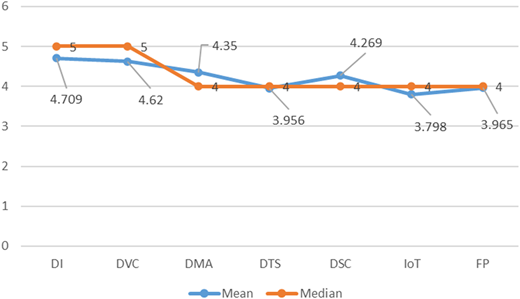
Figure 2 shows the importance of constructs considering the mean and median. The first two constructs (i.e. DI, and DVC) showed the highest score with a mean higher than 4.5, while the IoT construct received the lowest value (3.7). Only the first two constructs have a median of 5, while the median for the other construct is 4. These results are aligned with the findings provided by Omol (2024) and Slot, Fraikin, Damgrave, and Lutters (2022) and confirm that digital infrastructure and digital value chains form the core of the digitalization process.
Table 4 presents the overall results for all hypotheses presented in the structural model. The findings indicate a strong and positive influence of digital infrastructure on firm performance, highlighting its central role in driving effective digital transformation. Similarly, the relationship between digital value chain integration and firm performance is found to be robust, reinforcing the importance of interconnected systems and streamlined processes. The positive association between data management and analytics and firm performance also emerges as statistically significant, underscoring the value of leveraging data for strategic insights. Furthermore, digital transformation strategies and digital skills and competencies are both shown to positively influence firm performance, although with comparatively more moderate effects. These results collectively emphasize the multifaceted nature of digitalization and how various dimensions contribute to enhancing business outcomes. The mediation analysis reveals that the Internet of Things (IoT) plays a role in translating digitalization efforts into performance gains. However, this mediating effect is only modestly significant and should be interpreted with caution. The evidence suggests that IoT does not fully mediate the relationship between digitalization and firm performance but may serve as a partial enabler when appropriately aligned with other digital capabilities.
The findings confirm that the direct effects of technology, data analytics, digital competencies, and digital transformation strategy are deeply intertwined and collectively crucial for enhancing firm performance in the modern business landscape faced by SMEs. When these elements are effectively integrated, they create a synergistic effect that significantly enhances firm performance. Therefore, these results are aligned with the outcomes provided by Jiang, Yang, and Gai (2023) and Pfister and Lehmann (2023) which indicate SMEs that successfully harness these factors can expect to see improvements in efficiency, innovation, customer satisfaction, and financial performance, positioning themselves as leaders in their respective industries. The cross-sectoral nature of the sample strengthens the generalizability of the results, suggesting that while the specific applications of digital tools may vary, the underlying mechanisms that connect digital integration to firm performance are consistent. Despite this, we recognize differences between sectors of activity that require the results to be explored considering their specific contexts. In manufacturing SMEs, the integration of digital tools with production processes amplifies efficiency and innovation. Digital competencies in this sector may manifest through the upskilling of technical staff and the use of automation technologies, which align closely with the findings on synergistic effects and performance gains. In the retail sector, where customer experience and agility are paramount, digital transformation strategy combined with data analytics allows firms to better understand consumer behavior and create personalized offerings. Moreover, service SMEs need to establish a synergy between technology and strategy to cultivate a long-term adaptability approach.
Interpreting the mediation path between digitalization, IoT, and firm performance in SMEs from the lens of contingency theory emphasizes that the relationship among these factors is context-dependent and influenced by specific contingencies or situational variables. Digitalization, which involves integrating digital technologies into all aspects of a business, provides the foundational platform upon which IoT technologies can be effectively implemented. However, the relationship between digitalization, IoT, and firm performance is not straightforward. This may help explain the relatively weak mediating role of the IoT identified in the results. Contingency theory posits that there is no one-size-fits-all solution to organizational effectiveness; rather, the success of any strategy or technological adoption depends on the alignment between internal capabilities and external demands. Therefore, these benefits are not universally experienced across all SMEs. Instead, they are contingent upon the firm’s readiness to absorb and apply these technologies effectively. While IoT can significantly enhance operational efficiency, improve decision-making, and create new revenue streams as reported by Mashat, Abourokbah, and Salam (2024), these benefits are often mediated by the SME’s level of digital maturity. For SMEs with limited digital infrastructure or lacking digital competencies, the potential advantages of IoT may not be fully realized. These firms might struggle with integrating IoT data into their business processes, or they may lack the analytical capabilities needed to translate this data into actionable insights. Furthermore, insufficient analytical capabilities or a lack of digital literacy among staff can hinder the interpretation and application of IoT-generated data. In such cases, the mismatch between the technological potential of IoT and the organization’s absorptive capacity results in a poor contingency fit. This misalignment can reduce the effectiveness of IoT, not only diminishing performance gains but potentially introducing new inefficiencies or operational complexity, as the firm struggles to manage the added digital workload without the necessary capabilities. As a result, the expected improvements in firm performance might not materialize, or the impact may be less significant than anticipated.
The findings also expose that digital maturity is a prerequisite of IoT success. Scholars such as Vial (2019) and Liu, Yu, Rahayu, and Dillon (2023) emphasize that IoT alone does not guarantee performance gains. Its impact is heavily contingent on an organization’s digital maturity, including the presence of supportive infrastructure, skilled personnel, and integrated digital systems. Furthermore, Khin and Ho (2020) argue that without sufficient internal capabilities, IoT investments may lead to operational complexity rather than efficiency, particularly in resource-constrained SMEs. Moreover, the implementation of IoT in SMEs is often influenced by external factors such as industry characteristics, market competition, and regulatory environments (Shah, Madni, Hashim, Ali, & Faheem, 2024). These factors can either amplify or constrain the effectiveness of IoT in driving firm performance. Therefore, it can be concluded that “the level of digitalization that an SME adopts needs to be aligned with its internal capabilities and external environmental conditions” because digitalization alone may not lead to improved firm performance unless it is tailored to these contingencies. Therefore, it is essential to interpret the mediation path between digitalization, IoT, and firm performance carefully, considering the specific context of each SME, including its digital readiness, industry dynamics, and strategic goals.
The transferability of the findings related to Portuguese SMEs to other contexts depends on a nuanced understanding of both internal and external factors that shape digital transformation outcomes. The core insight that digital maturity is a foundational enabler of IoT success holds conceptual relevance across various national and industry settings. However, the practical realization of this synergy may differ substantially. We acknowledge that in ecosystems with greater digital maturity, such as those seen in advanced economies with strong digital infrastructure and government initiatives to foster innovation, the integration of IoT into business processes may be more streamlined and deliver greater performance advantages. These environments generally have qualified personnel, strategic vision, and comprehensive systems required to fully leverage the benefits of digital technologies. Consequently, the synergistic effects noted in Portuguese SMEs may also be equally or more significant in these settings. Conversely, in regions with limited digital readiness, financial constraints, or insufficient technical expertise, the integration of IoT may add more complexity rather than improve performance. This aligns with the concerns stated by Khin and Ho (2020), who caution that without adequate internal capabilities, IoT can burden operations rather than enhance them. Additionally, cultural elements may affect the relevance of these findings. The openness of organizations to adopt change, the leadership’s outlook on innovation, and their risk tolerance can differ widely among various regions and may affect how digital transformation strategies are crafted and executed. Even when digital solutions are available, their successful implementation depends heavily on how well they align with management perspectives and employee skills.
5. Conclusions
5.1 Final remarks
This study underscores the central role of digital infrastructure and digital value chains as foundational elements in the digitalization of Portuguese SMEs. The high scores attributed to digital infrastructure and digital value chains reflect their critical importance in enabling seamless data exchange, processing, and storage, which are essential for the functionality of digital services and applications. Furthermore, the study reaffirms the interconnectedness of various digitalization elements, such as technology, data analytics, digital competencies, and digital transformation strategy, and their collective impact on enhancing firm performance. The synergistic relationship between these components suggests that a comprehensive approach to digitalization, where all these elements are effectively integrated, can lead to significant performance improvements for SMEs in the current competitive business landscape.
5.2 Contributions and policy implications
A key contribution of this study lies in its nuanced understanding of the interplay between digitalization and firm performance, specifically within the SME context. Unlike prior research that treats digitalization as a uniform process, this study advances the field by empirically demonstrating the mediating role of IoT, revealing that its integration significantly shapes the effectiveness of digital initiatives. This perspective offers a novel contribution by showing that the benefits of digitalization are not automatic but contingent on how IoT is embedded within organizational processes. This insight is particularly valuable because it allows SMEs to better tailor their digital transformation strategies by recognizing that IoT can either amplify or mitigate the effects of digitalization based on how well it is integrated and utilized within the business.
A key policy implication of this study is the need for targeted support mechanisms to facilitate IoT adoption among SMEs. Given that IoT can significantly enhance the benefits of digitalization by improving efficiency, enabling real-time data analytics, and fostering innovation, governments should consider implementing policies that reduce barriers to IoT adoption. This could include financial incentives such as grants, subsidies, or low-interest loans to help SMEs invest in IoT technologies. Additionally, policies aimed at providing technical support and training programs can help SMEs develop the necessary skills to effectively integrate IoT into their operations. Moreover, this study underscores the importance of creating a robust digital infrastructure that supports IoT deployment. Policymakers must ensure that SMEs have access to reliable and high-speed internet, as well as the necessary cybersecurity measures to protect the vast amounts of data generated by IoT devices. Investment in digital infrastructure is essential for enabling SMEs to fully leverage the potential of IoT and, by extension, digitalization.
5.3 Limitations and future research directions
A primary limitation is related to the sample size and diversity. This study focused on Portuguese SMEs therefore, the findings might not be generalizable to other contexts, especially for countries that do not belong to the European Union. It is important to highlight that different regions or industries may experience varying levels of digitalization and IoT adoption, influenced by factors such as local infrastructure, regulatory environments, and market dynamics. This limitation suggests the need for future research to include more diverse and larger samples, encompassing SMEs from various industries and regions to enhance the generalizability of the results. Furthermore, the sample only considered “Excellence SMEs”. Despite being a potential limitation of this study, in practice the existence of a potential sample of more than 3,900 SMEs with this status indicates that obtaining this recognition is relatively easy for SMEs in Portugal.
Another potential limitation is the cross-sectional nature of the study, which might not fully capture the dynamic and evolving impact of digitalization and IoT over time. Digitalization and IoT adoption are processes that can have long-term effects on firm performance, which may not be fully realized or observable in a single snapshot. Future research could address this limitation by adopting longitudinal study designs to track the impact of digitalization and IoT on SME performance over extended periods, providing deeper insights into how these effects evolve.
This research might also have limitations related to the measurement of key variables. One pertinent question is how digitalization and IoT can be more accurately and comprehensively measured in the context of SMEs, given their complexity and multidimensional nature. This prompts further inquiry into what alternative metrics, frameworks, or methodological approaches could better capture the depth and nuances of these constructs. Another important question is how qualitative methods, such as case studies or interviews, might complement quantitative data to provide a more holistic understanding of the impact of digitalization and IoT on firm performance. Additionally, the findings raise the issue of potential omitted variables in the analysis, leading to the question of what other factors, such as organizational culture, leadership style, or external partnerships, might moderate or mediate the relationship between digitalization and performance in SMEs. It is also relevant that future studies explore how varying market conditions, such as industry competitiveness or regulatory environments, influence the effectiveness of digital initiatives. Furthermore, the study’s emphasis on the mediating role of IoT opens up new avenues for exploring whether this role is consistent across different sectors or firm sizes, and whether other technologies or capabilities could play a similar or even more significant mediating function.