


Artificial intelligence (AI) is acknowledged for its long-term impact as a general-purpose technology, but it is also reshaping the skills and competences required in the job market. As discrepancies in workforce skills between countries play an important role in shaping differences in AI absorption, this paper explores the impact of evolving AI skills on firm productivity at the macro level, using a panel of 15 countries over the period 2017–2022.
The study employs the Relative AI Hiring Index from the Stanford Institute for Human-Centered AI to track changes in the AI-skilled labor force. A two-stage procedure is used to evaluate its impact on productivity. First, we retrieve proxies for total factor productivity using production function-specific estimation methods. Second, panel regressions are used to evaluate the impact of the AI skills on productivity.
The results highlight short-term positive effects that emerge with a lag of a quarter, underscoring the necessity of continuously renewing investment in AI-skilled labor to achieve short-term benefits.
Given that AI is a relatively new technology, research on its impact on productivity, particularly through the enhancement of skills and competences in the job market, is rather scarce. The paper aims to improve the understanding of this phenomenon in the short term.
1. Introduction
Technological progress is widely recognized as a key driver of productivity growth, further contributing to our long-term prosperity and welfare. Similar to previously general-purpose technologies (GPTs) such as steam engines and electricity, artificial intelligence (AI) is considered the most promising GPT of the current era, with the potential to drive a new wave of productivity growth by automating cognitive tasks previously considered exclusive to humanity (Brynjolfsson, Rock, & Syverson, 2021). The recent rise of ChatGPT has further amplified interest in AI, particularly in Generative AI, and its applications across various industries.
According to the productivity J-curve hypothesis suggested by Brynjolfsson et al. (2021), the impact of GPTs on productivity often unfolds gradually and may initially result in temporary productivity declines following the introduction of new technologies, such as AI. This aligns with the well-known Solow paradox, which states, “You can see the computer age everywhere but in the productivity statistics” (Solow, 1987, p. 36). Recent research by Weber, Engert, Schaffer, Weking and Krcmar (2023) also indicates that despite AI’s potential, most recent AI initiatives have yet to demonstrate productivity gains.
Many recent studies have already highlighted the importance of intangible capital for productivity (Bavdaž et al., 2023; Brynjolfsson, 2022; Corrado, Hulten, & Sichel, 2009; De Ridder, 2024; Kim, Bounfour, Nonnis, & Özaygen, 2021; Nonnis, Bounfour, & Kim, 2023). However, existing classifications of intangible capital investments, both at macro and micro levels, fail to isolate AI-specific investments. For example, the widely used classification by Corrado, Hulten and Sichel (2005) categorizes intangibles into three macro categories (computerized information, economic competences and innovative properties) and eight intangible capital types [1], but it lacks a dedicated AI investment category. Consequently, AI-related investments are only partially captured within broader categories such as research and development (R&D) and software.
The literature has explored AI’s impact considering various specific aspects, such as machine learning or robotics, or through indirect proxies like patent publications. Moreover, AI’s economic impact is mediated through multiple channels, including optimizing business processes and resource efficiency, fostering innovation through greater access to knowledge and reshaping the labor market changes via new skills and task automation. Attempts to evaluate AI’s labor market effects have relied on job posting data, AI exposure metrics and case studies.
In this context, the role of AI in reshaping workforce skills and competences represents a critical channel for understanding its impact on productivity. While the beneficial effects of AI investment are generally expected to be a long-term phenomenon, labor market dynamics offer the potential for shorter-term productivity gains. The construction of databases based on job posting data provide insights into the evolution of workforce skills, shedding light on how changes within the AI-skilled labor force influence firms’ ability to leverage AI technologies.
This research aims to evaluate how movements in the AI-skilled workforce influence firm performance at the country level and how changes in the AI-skilled labor market impact productivity. Isolating AI-driven effects coming from the labor market is essential, as differences in workforce skills are a fundamental component of AI’s impact on firm productivity. To our knowledge, empirical evidence revealing such a linkage remains limited, as most studies using job posting data have focused on labor market outcomes and job creation, rather than on firm performance (Acemoglu & Restrepo, 2019; Acemoglu, Autor, Hazell, & Restrepo, 2022).
In this study, we employ LinkedIn’s Relative AI Hiring Index (RAIHI) as a proxy to capture the related AI-skilled labor force. Our dataset encompasses 15 countries and spans from 2016 to 2022 on a quarterly basis. Using panel regressions, we evaluate the impact of the RAIHI on productivity, measured with total factor productivity (TFP). Our method consists of a two-stage procedure. First, we retrieve TFP proxies by estimating quarterly production functions in capital and labor with production function-specific methods and obtain TFP proxies as residuals. This step allows us to account for the endogeneity of capital and obtain unbiased measures of TFP. The proxies obtained are then regressed on the RAIHI to evaluate the effect of AI skills on economic performance.
The remainder of this paper is organized as follows: Section 2 presents a literature review on AI and productivity. Section 3 outlines our theoretical framework, while Section 4 presents the econometric methodology and data. Section 5 contains some preliminary descriptive results, and Section 6 shows our empirical analysis and econometric results. Finally, Section 7 discusses the research findings and limitations, and Section 8 presents our conclusions.
2. Literature review
2.1 Why is AI important for firms’ productivity
AI is widely regarded as the next GPT. Like other disruptive technologies such as electricity and computers, it has the potential to revolutionize business models and economic systems, strongly impacting firms’ performance and productivity. However, unlike many previous GPTs, AI is an intangible asset and presents unique challenges in accounting and measurement.
Intangible assets are often underrepresented in national and business accounts. As noted by Corrado et al. (2009), certain expenditures on intangible assets are not capitalized as investments and do not contribute to gross domestic product (GDP) calculations as they should. Current accounting systems already inadequately capture many types of intangible assets, including AI-related investments, which are not specifically disaggregated.
This underscores AI’s crucial role in recent productivity discussions: AI-related investments may be a key factor behind the considerable slowdown in labor productivity growth observed in many Organization for Economic Co-operation and Development (OECD) countries over the past decades (Andrews, Criscuolo, & Gal, 2016; Goldin, Koutroumpis, Lafond, & Winkler, 2024).
Brynjolfsson et al. (2021) further emphasize the great amount of complementary investments required for GPTs to achieve their full potential. They indicate that unmeasured investments in AI and related technologies could amount to 10 times measured investment, resulting in 1% of GDP growth missing, which would almost entirely explain the productivity slowdown (Goldin et al., 2024).
2.2 The evolving concept of AI
Assessing AI’s impact on productivity is complicated by its inherent multifaceted nature, as well as the multiple channels through which it enhances firms’ performance. A clear and consistent definition of AI is needed. Broadly, AI refers to tasks performed by machines that are normally carried out by human intelligence. However, the boundary between what can be performed by a machine and a human being is somewhat subtle. This, along with the evolving nature of the technologies involved, means that definitions of AI are regularly updated and redefined.
The definition proposed by the OECD was recently revised to align with ongoing advancements: “An AI system is a machine-based system that, for explicit or implicit objectives, infers from the input it receives how to generate outputs such as predictions, content, recommendations, or decisions that can influence physical or virtual environments. Different AI systems vary in their levels of autonomy and adaptiveness after deployment” (OECD, 2024, p. 5).
Much of the existing literature treats AI’s impact aggregately, often using proxies such as patents, investments, interviews and survey data. This approach overlooks distinctions between different types of inputs and outputs, leaving gaps in understanding how AI specifically enhances productivity. In this research, we focus on the input represented by the competences of workers. We argue that understanding the evolution of workers’ skills is essential for grasping the reshaping of the labor market and its broader impacts. While AI is evolving in a relatively homogeneous way at the macro level in major countries due to its intangible and non-excludable characteristics that favor spillover effects, discrepancies in outcomes between countries may be primarily driven by differences in workers’ ability to leverage AI effectively. This approach highlights the importance of workforce training and development in maximizing the benefits of AI and the need for targeted policies to bridge these human capital gains.
Therefore, our work intersects with at least four strands of literature: AI in general, its impact on the labor market, its impact on productivity and the role of workers’ skills in enhancing performance and productivity. The next subsection provides an overview of the literature on each of these strands.
2.3 AI impact on productivity and labor
As mentioned earlier, several proxies have been used in the literature to measure the overall impact of AI, including patents, survey data and textual analysis of annual reports. All these studies report positive effects on various measures of firm productivity.
The literature on AI’s effects on the labor market can be divided into two categories: studies focusing on labor market outcomes and those examining productivity of firms. While our work belongs to the second category, many studies in the first category debate whether AI will lead to job losses through automation or increase job efficiency through augmentation (Acemoglu & Restrepo, 2019; OECD, 2023). Other studies, such as those based on job posting data, reveal shifts in the skills required, indicating that workers will need to reskill. However, Acemoglu et al. (2022) did not find a clear positive association with job creation at the industrial level.
Turning to studies on productivity, research highlights AI’s transformative potential rather consistently (Filippucci, Gal, & Schief, 2024), even if some suggest that expectations for productivity gains might be exaggerated (Acemoglu, 2024). For example, research on robotics (Acemoglu & Restrepo, 2020) shows positive impacts on productivity, similarly to studies based on patent activities (Behrens & Trunschke, 2020). Brynjolfsson, Li and Raymond (2023) found that using a GAI-powered conversational assistant could lead to a 14% increase in productivity for customer support agents, with novice and low-skilled workers experiencing the greatest improvements.
Finally, our work also intersects the literature on the impact of workers’ skills on performance and productivity (Abowd, Kramarz, & Margolis, 1999; Haltiwanger, Lane, & Spletzer, 1999; Mas & Moretti, 2009). Therefore, we bridge this literature with the literature on AI by evaluating whether workers with advanced AI skills provide firms with a competitive productivity advantage. In the next section, we incorporate AI skills into a standard economic framework to explore how augmenting workers’ skills with AI competences can impact firm performance.
3. Theoretical framework
Our model considers an aggregated-level production function of the Cobb–Douglas type enhanced by a labor efficiency term. The idea of augmenting a Cobb–Douglas function with a term representing technological advancements in labor has been widely explored in the literature (Hall & Jones, 1999; Mankiw, Romer, & Weil, 1992). This paper bridges that literature with studies that incorporate AI-related technological advancements into production functions (e.g. Damioli, Van Roy, & Vertesy, 2021). Accordingly, our augmented production function is expressed as follows:
In this equation, the subscripts i and t represent the country and time, respectively. Y represents the output, and K and L denote the traditional productive factors, fixed capital and labor, respectively. A can be interpreted as technological progress or as a TFP term not including labor quality effects due to AI, which are captured by the function in parentheses.
The labor quality function Q() reflects improvements in labor quality due to AI-related employment. Therefore, the labor quality function AIit can be considered a metric that assesses labor quality and efficiency, particularly skills related to emerging technologies, such as AI. In practice, AI is approximated using an index of AI employment, referred to as RAIHI. This index measures “the degree to which the hiring of AI talent is changing, more specifically whether the hiring of AI talent is growing faster than, equal to, or more slowly than overall hiring in a particular geographic region” (Maslej et al., 2023, p. 180).
In essence, our model assumes that skills and competences in AI enhance worker quality in a multiplicative manner, consistent with the classical Solow sense. This hypothesis is supported by recent literature suggesting that AI-related enhancements in the labor market positively impact firm productivity. These gains can arise from direct technological advancements, such as robotics, job automation or even to cultural shifts within organizations.
Expanding the model by log-differentiating the variables, we obtain:
where lowercase letters denote growth rates, and we have removed subscripts for simplicity.
Assuming a functional form for the function Q as follows:
with c being a constant, the growth rate of Q is:
which, when substituted in Equation (2), yields:
Equivalently, assuming that traditional TFP – not including AI-skilled labor unlike the term A in Equation (1) – is given by TFP = , Equation (3) can be rewritten as follows:
Put another way, Equation (4) relates traditional TFP, which is the residual term after accounting for labor and capital only, with the quality of labor due to AI skills. The remaining term in the equation captures other discrepancies and variations, representing the residual TFP after considering the impact of AI-enhanced labor quality.
4. Methodology and data
We estimate Equation (3) in two stages. In the first stage, we obtain TFP measures as the residual term from a Cobb–Douglas production function with capital and labor as the only productive factors. This estimation is performed using the methods proposed by Olley and Pakes (1996) and Levinsohn and Petrin (2003), designed to account for endogeneity in productive factors. In the second stage, this TFP measure is then used directly to estimate Equation (4).
Our sample consists of 15 countries: Australia, Belgium, Denmark, Finland, France, Germany, Israel, Italy, the Netherlands, Norway, Portugal, Spain, Sweden, the United Kingdom and the United States of America. These countries were selected based on the availability of data from all sources used. For a more homogenous dataset and to ensure robustness, we also performed the analysis on a subsample of 12 European countries, excluding Australia, Israel and the United States of America. This allowed us to focus on a more consistent regional dataset. We utilized quarterly country-level data ranging from the last quarter of 2016 to the last quarter of 2022, primarily due to data availability during this period.
The data used in this study originate from a combination of two sources: the AI Index Report 2023 published by the Stanford Institute for Human-Centered AI (Maslej et al., 2023) and the OECD quarterly and yearly national accounts, providing data on employment, GDP, gross fixed capital formation (GFCF), net fixed assets and the exchange rates. Specifically:
From the AI index report 2023 (Maslej et al., 2023), we utilize the RAIHI [2], which is built using LinkedIn’s data on skills and jobs. This index measures the rate of hiring in the AI field for each country compared to the overall hiring in that country. Specifically, it computes the percentage of LinkedIn members with AI skills on their profile who are hired in a given month, relative to the total number of workers and compares this to the overall hiring rate of that country. An index value of 1 indicates that AI hiring and overall hiring are growing at the same rate in that country for that month. Thus, the index provides a measure of how many new AI-skilled workers are being hired each month. To align the index with the rest of the dataset, we transform our data from monthly to quarterly by considering the three-month change in the index.
GDP growth is calculated as a growth rate based on seasonally adjusted volume data, represented as a percentage change from the previous quarter (source: OECD – Quarterly National Accounts).
Labor data represents the number of employed individuals, seasonally adjusted (source: OECD - Quarterly National Accounts).
Capital investment is the GFCF, measured in national currency, with chained volume estimates and a national reference year. These data are provided on a quarterly basis and are seasonally adjusted. This variable is employed to compute the capital stock using the perpetual inventory method (source: OECD - Quarterly National Accounts).
Yearly capital stock represents net fixed assets at constant prices, referenced to the previous year’s prices. The variable is used in conjunction with GFCF to compute the quarterly series of capital stock (source: OECD - Yearly National Accounts).
Exchange rates, used to harmonize capital investment and capital stock values, are the price of a country’s currency in relation to another country’s currency, measured in units of the national currency per US dollar (source: OECD – PPPs and exchange rates National Accounts).
As previously mentioned, we employed the perpetual inventory method to calculate the quarterly capital stock series, using yearly capital stock and quarterly capital formation data. The method can be expressed using the formula Kt = Kt-(1- δ)Kt-1+It, where Kt and Kt-1 represent the capital stock in period t and t-1, respectively. δ denotes the depreciation rate and It represents GFCF in period t. 2016Q4 is used as the base period, while the depreciation rate was computed for each year using the yearly capital stock series and the quarterly capital investment series. In practice, the yearly depreciation rate was determined with the formula:
Here, It denotes capital investment in year t, calculated as the sum of all investments made during the quarters within that year. Kt and Kt-1 stand for the capital stock in year t and year t-1, respectively. The yearly depreciation rate was subsequently transformed into a quarterly rate by dividing it by four.
5. Descriptive analysis
Figure 1 displays the trend in the RAIHI and smoothed GDP growth for the 15 countries. GDP growth roughly follows a similar pattern across all countries, with a notable decrease observed in 2020 due to the COVID-19 shock. After a recovery following the crisis, lower GDP growth is observed in 2022, caused by several events such as inflationary pressures and external geopolitical events.
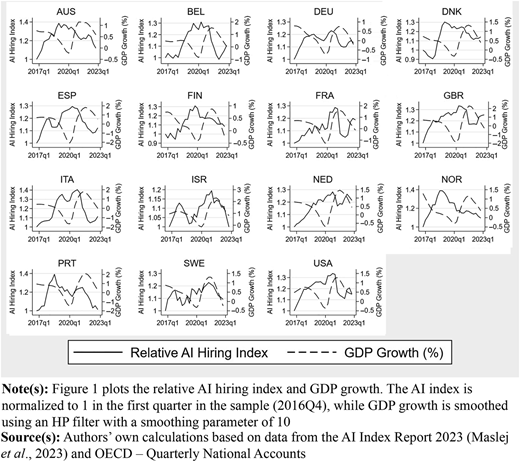
The changes within RAIHI, however, exhibit more pronounced differences among countries, even if common patterns are present. Except for Finland and Denmark, which showed negative growth in mid-2017, all other countries experienced positive growth in RAIHI since the beginning of the sample. All countries experienced a strong increase followed by a decrease in the final part of the sample, similar to what happened with GDP growth, but with different timing. In fact, the peak in AI hiring is observed during the pandemic, when GDP growth was negative, while the declining period in 2022 is common with GDP growth. Interestingly, this pattern suggests that investment in AI in the labor market during and before the pandemic might have played a role in the recovery after the shock and that some sort of lagged effect in AI investment might exist.
Table 1 shows the average values and standard deviation for the two variables across 15 countries. It reveals that Australia, the UK, the USA and Norway are the countries with the highest average AI hiring values. However, no apparent correlation with average GDP growth values is observed.
Relative AI index and GDP growth: mean and standard deviation
| RAIHI | GDP growth (%) | |||
|---|---|---|---|---|
| Mean | Standard dev. | Mean | Standard dev. | |
| AUS | 1.24 | 0.10 | 0.61 | 1.94 |
| BEL | 1.13 | 0.11 | 0.44 | 3.46 |
| DEU | 1.15 | 0.06 | 0.24 | 2.79 |
| DNK | 1.14 | 0.13 | 0.54 | 1.86 |
| ESP | 1.17 | 0.08 | 0.39 | 5.20 |
| FIN | 1.12 | 0.10 | 0.32 | 1.73 |
| FRA | 1.12 | 0.08 | 0.40 | 4.87 |
| GBR | 1.22 | 0.08 | 0.37 | 5.68 |
| ISR | 1.09 | 0.05 | 1.08 | 2.85 |
| ITA | 1.19 | 0.14 | 0.24 | 4.07 |
| NED | 1.17 | 0.08 | 0.54 | 2.28 |
| NOR | 1.20 | 0.10 | 0.48 | 1.66 |
| PRT | 1.17 | 0.11 | 0.59 | 4.58 |
| SWE | 1.13 | 0.06 | 0.51 | 2.34 |
| USA | 1.20 | 0.09 | 0.55 | 2.45 |
Note(s): The relative AI index is normalized to 1 in the first period. GDP growth is measured as quarterly GDP growth in percentage terms
Source(s): Authors’ own calculations based on data from the AI Index Report 2023 (Maslej et al., 2023) and OECD – Quarterly National Accounts
6. Econometric results
In the first stage, we obtain a TFP measure as the residual from the estimation of a logarithmic Cobb–Douglas production function. The results of the first stage are presented in Table 2, while the results of the second stage are presented in Table 3.
Estimation results. First stage
| (1) | (2) | (3) | (4) | |
|---|---|---|---|---|
| Full sample | European sample | |||
| OP | LP | OP | LP | |
| Labor | 0.355*** (0.0540) | 0.327*** (0.0437) | 0.669*** (0.0493) | 0.655*** (0.0781) |
| Fixed capital | 0.0774** (0.0351) | 0.0785*** (0.0226) | 0.0648*** (0.0249) | 0.0641* (0.0354) |
| Year dummies | Yes | Yes | Yes | Yes |
| Quarter dummies | Yes | Yes | Yes | Yes |
| Country dummies | Yes | Yes | Yes | Yes |
| Observations | 356 | 356 | 284 | 284 |
| Groups | 15 | 15 | 12 | 12 |
Note(s): ***, ** and * indicate significance at 1, 5 and 10 percent, respectively. t statistics are reported in parentheses. The dependent variable is GDP. The first two columns refer to the full sample of 15 countries, while the last two columns to the restricted sample of 12 European countries. Columns 1 and 3 use the Olley and Pakes (1996) method, while columns 2 and 4 the Levinsohn and Petrin (2003) method. All regressions include country, year and quarter dummies
Source(s): Authors’ own calculations based on data from the AI Index Report 2023 (Maslej et al., 2023) and OECD – Quarterly National Accounts
Estimation results. Second stage
| (1) | (2) | (3) | (4) | |
|---|---|---|---|---|
| Full sample | European sample | |||
| OP | LP | OP | LP | |
| AI hiring index growth | −0.111* (0.0602) | −0.111* (0.0602) | −0.118 (0.0751) | −0.118 (0.0751) |
| AI hiring index growth (t−1) | 0.0991** (0.0373) | 0.0991** (0.0373) | 0.0830* (0.0441) | 0.0830* (0.0441) |
| AI hiring index growth (t−2) | 0.00204 (0.0265) | 0.00197 (0.0265) | 0.00747 (0.0317) | 0.00752 (0.0317) |
| Constant | −0.963*** (0.264) | −0.911*** (0.264) | −1.8*** (0.294) | −1.88*** (0.294) |
| Year dummies | Yes | Yes | Yes | Yes |
| Quarter dummies | Yes | Yes | Yes | Yes |
| Country dummies | Yes | Yes | Yes | Yes |
| Observations | 326 | 326 | 260 | 260 |
| Groups | 15 | 15 | 12 | 12 |
| Hausman test | 0.00 | 0.00 | 0.00 | 0.00 |
| (p-value) | 1.00 | 1.00 | 1.00 | 1.00 |
| Breusch–Pagan RE test | 0.00 | 0.00 | 0.00 | 0.00 |
| (p-value) | 1.00 | 1.00 | 1.00 | 1.00 |
| Wooldridge serial corr. test | 41.578 | 41.620 | 34.125 | 33.767 |
| (p-value) | 0.00 | 0.00 | 0.0001 | 0.0001 |
| Breusch–Pagan heterosc. test | 0.81 | 0.99 | 2.06 | 1.98 |
| (p-value) | 0.3683 | 0.3192 | 0.1508 | 0.1589 |
| Multicoll. VIF | No | No | No | No |
| R-squared | 0.0493 | 0.0492 | 0.0446 | 0.0447 |
| AIC | 1682.532 | 1682.498 | 1373.574 | 1373.601 |
| BIC | 1727.975 | 1727.941 | 1412.741 | 1412.769 |
Note(s): ***, ** and * indicate significance at 1, 5 and 10 percent, respectively. t statistics are reported in parentheses. All regressions are estimated with Pooled OLS. The dependent variable is TFP, estimated with the Olley and Pakes (1996) method in columns 1 and 3, and with the Levinsohn and Petrin (2003) method in columns 2 and 4. All regressions include country, year and quarter dummies. The Hausman test assesses the null hypothesis that random effects are preferable to fixed effects. In the Breusch–Pagan RE test the null hypothesis is that random effects are not present. In the Wooldridge serial correlation test the null hypothesis is the absence of serial correlation. In the Breusch–Pagan heteroscedasticity test the null hypothesis is the absence of heteroscedasticity. The VIF, not reported in full due to space constraints, tests the presence of multicollinearity. The AIC and BIC are the Akaike and the Bayesian Information Criterion, respectively
Source(s): Authors’ own calculations based on data from the AI Index Report 2023 (Maslej et al., 2023) and OECD – Quarterly National Accounts
For robustness, we conduct the first-stage estimations using both the Olley and Pakes (1996) method, in columns (1) and (3) of both tables, and the Levinsohn and Petrin (2003) method, in columns (2) and (4).
In the second stage, the retrieved TFP measures are regressed on the RAIHI to estimate Equation (4). All estimates in both stages include country, year and quarter dummies. The first two columns of Tables 2 and 3 provide the estimation results for the full sample of 15 countries, while the latter two columns display the outcomes for the restricted sample of 12 European countries.
Our unbalanced panel dataset covers the period from 2016Q4 to 2022Q4 and includes 356 observations in the first stage and 326 in the second stage. For the same period, the restricted sample consists of 284 observations in the first stage and 260 in the second stage.
In Table 2, all estimates reveal a positive and statistically significant coefficient for the elasticities of labor and capital. In the full sample, labor is found to have an elasticity of approximately 0.35, while in the restricted sample, this elasticity is around 0.08 (0.06 in the restricted sample). The discrepancy between the two coefficients not summing up to one can be attributed to other potential factors affecting productivity, which we aim to explore in the second stage of our estimation.
Regarding the second stage of the estimation, after conducting the Hausman test and the Breusch–Pagan test for the presence of random effects, the model is estimated using pooled ordinary least squares. The Wooldridge test indicates the presence of serial correlation, which we address by clustering standard errors by country, while the Breusch–Pagan test does not reveal the presence of heteroscedasticity. Lastly, the goodness-of-fit tests reveal a preference for the restricted sample models, as they exhibit lower Akaike information criterion and Bayesian information criterion values, while the R-squared values remain consistent across all models.
Looking at the elasticities, our main result is that the coefficient of the RAIHI is consistently positive and statistically significant but only for the first lag. The contemporary effect is either non-significant or negatively significant in the full sample.
This finding supports the idea that investment in AI, much like other GPTs, yields beneficial effects only after a certain period of time, with immediate effects potentially being non-existent or even negative. However, it is noteworthy that this effect diminishes only after one period, as the second lag coefficients are once again non-significant in all our model specifications. We interpret this finding by hypothesizing that a sustained investment in AI-skilled workers is necessary to realize the full benefits of their skills and capabilities.
Furthermore, it is important to mention that our analysis primarily focuses on the short run, whereas GPT technologies typically have a more pronounced impact on the long term. Nevertheless, our results underscore the significance of continually enhancing the labor market with AI-skilled workers to realize short-term benefits.
7. Discussions
7.1 The productivity puzzle: the short-term impact of AI-skilled workforce
Our findings reveal the presence of short-term positive effects of AI workforce skills on productivity. This outcome highlights the importance of AI-skilled workers for both adoption and effective integration of AI, as well as for realizing its associated benefits. The beneficial effects manifest after a one-quarter lag, which aligns to some extent with the J-curve theory (Brynjolfsson et al., 2021; Bounfour et al., 2024), where GPTs benefits require time to materialize. However, given the short timeframe of our analysis, we are unable to capture long-term effects. Instead, we identify the conditions under which positive impacts occur in the short run.
Investment in AI-related talent has no impact or even negative consequences in the initial phase, followed by positive effects in the subsequent quarter, yet returning insignificant in the third period. This pattern indicates that the benefits of intangible investments in AI-related human capital are not immediate but manifest with a lagged effect. Put another way, firms need to continuously invest in AI skills to stay competitive. From a technological progress perspective, AI-related technologies are fast-evolving and may promptly make firms’ related prior investments obsolete. It also implicitly indicates the need for current businesses to closely monitor industry dynamics associated with AI.
Furthermore, embedded in the J-curve hypothesis, the importance of investing in relevant complementary factors suggests that a diverse range of complementary resources, beyond human capital, is required. For example, Mikalef and Gupta (2021) identified three primary groups of complementary resources: “tangible (i.e. data, technology, and basic resources), human skills (i.e. technical and business skills), and intangible resources (i.e. inter-departmental coordination, organizational change capacity, and risk proclivity)” (p. 8). Bounfour, Hoehn and Yang (2022, 2025) highlighted five dimensions from the competence perspective: technological, cognitive, interactional, strategic-organizational and ethical and societal. More practically, Lee, Kim, Choi and Kim (2022) argued that complementary technologies for AI are related to big-data processing and computing (database systems and cloud computing).
7.2 Practical implications for stakeholders and policymakers
The findings of our research present several practical implications for various stakeholders, especially from the perspective of firms, policymakers, and individuals.
For firms, it is vital to set realistic expectations regarding the impact of their AI innovations. Thus, to fully exploit its transformative potential, they must consistently invest in an AI-skilled workforce while balancing complementary resources and capacities. The adoption of a sustained, reasonable, long-term approach to AI investment is the key to mitigating challenges and catching opportunities. Particular attention should be dedicated to investment in intangible capital. To fully leverage AI’s potential, investment in complementary assets such as R&D and software is crucial. Among these complements, our results highlight the importance of training, which helps build a workforce that is well-prepared for the challenges of the AI revolution.
For policymakers, articulating a favorable environment for fostering AI innovation is essential. They should focus on balancing tax and competition policies to support AI-driven transformation by, for example, designing and implementing tax incentives or subsidies that encourage firms to invest in AI skills development and complementary technologies. Meanwhile, education systems, as the conventional supply of labor and talent, must be adapted by identifying and updating the related skills needed to succeed in modern AI-driven society.
Lastly, individuals should be proactively involved in AI advancements and rethink the AI-human relationship to remain agile. Related conflicts are inevitable, but it is important to recognize the benefits of AI.
7.3 Limitations and recommendations
While our research provides valuable insights into the short-term effects of AI-skilled labor on productivity, it faces inherent limitations, primarily related to data, which suggest opportunities for further research.
Our workforce skill index uses information from LinkedIn’s platform, which allows us to capture some dynamics coherently, but there are limitations to consider. The labor market may not always react promptly to the needs of firms, as pursuing related skills requires time and resources, leading to potential delays on the supply side. Moreover, the data’s representativeness is another concern. Some employee segments, particularly those in less digitized contexts, may be underrepresented, whereas others may be overrepresented (Babina, Fedyk, He, & Hodson, 2024). Furthermore, our sample is limited to 15 countries from 2016–2023, which may impact the robustness of our analysis. Lastly, accounting for the impact of COVID-19 presents challenges, and addressing these effects while obtaining data over a longer period may require additional effort. We anticipate that more comprehensive data and refined data collection methods will address these limitations in future research.
8. Conclusion
Our study investigated the relationship between AI advancements in employment and economic productivity. As organizations and economies worldwide strive to exploit the transformative power of AI, it is essential to understand the temporal dynamics of these investments and their resulting impacts. Our investigation reveals intriguing insights on the effect of AI investment, drawing parallels with the behavior of GPTs.
In particular, our approach highlights the importance of ongoing investment in AI talent to stay competitive in the ever-evolving landscape of technological advancements. Individuals equipped with the knowledge and expertise to exploit the potential of AI play an important role in driving innovation and productivity within organizations.
As our research suggests, the initial phase of this investment may not yield immediate and tangible returns in terms of productivity. The assimilation of AI technology and the development of a skilled workforce can be a gradual process. However, our findings confirm that the benefits of this investment can be realized over time. Considering the social complexity of AI transformation, it is essential to remember that the effects of AI adoption extend beyond one single organization and have broader implications for society as a whole. Fostering a workforce able to work with AI technologies allows not only for success in the short run but also contributes to the overall competitiveness of the economy. Investment in AI skills is an investment in the future, ensuring adaptability and capacity for advancing in an era characterized by rapid technological change.
In summary, our analysis highlights the need for a sustained commitment to nurturing AI skills in the workforce, acknowledging that while the road to realizing their full potential may be gradual, the destination promises substantial benefits, both for organizations and the whole society.
Notes
Software and databases (Computerized information), R&D, design, other intellectual property products (innovative property), brand, training and organizational capital (economic competences).
Full data from the report is accessible here: https://drive.google.com/drive/folders/1xvcWRgXNzZ7Y1OB5QdFlMMw9mkRHuPj6

