This study aims to analyze the territory as a distinctive factor through which the concept and practice of “Made in Italy” operates. Specifically, the study considers the role of local and sub-national entrepreneurial collaborations that preserve and enhance factors such as history, style and talent as the essence of Italian “quality” and as the pillar of Italian territorial capitalism.
The research examines this Italian phenomenon by investigating small and medium enterprises (SMEs) that successfully compete abroad (and also in the domestic market) with a “glocal” approach, adopting the entrepreneurial formula of industrial districts.
The results indicate that international expansion is becoming increasingly more complex (as is every growth/development strategy) but that “glocalism” could represent a potential driver for the success of internationalization strategies. Specifically, for SMEs operating in industrial districts, territorial capitalism could emerge as a unique competitive factor, because it is a component of local structural capital and global reputational capital, as in the case of “Made in Italy.”
In an increasingly globalized market environment, many companies look to foreign markets to maintain and expand competitive advantage and business performance. Once the companies embark on this endeavor, organizations are involved in governing and managing these networks of finance, production and communication and the distribution-related relationships that constitute globalization. The push to engage in international development is currently imperative for SMEs, which need to extend their business engagement beyond conventional local markets and identify and exploit their distinctive competitive advantage to be able to succeed. One possible way of achieving this is the close interaction with the local territories in which these enterprises reside.
Introduction
In the third globalization era in which we currently live (Bertoli and Valdani, 2018), enterprises operate in institutional environments that are becoming increasingly more complex and competitive because of several factors, of which, one of the most important is the prevailing intangible nature of today’s most competitive assets. Much of these dynamics, in fact, derives from the impact of new technologies, which have provided enhanced capacities for transportation, travel and communication with a direct influence on the circulation of knowledge, and the consequence has been the emergence of global markets (Levitt, 1983; Green et al., 2012; Kiss et al., 2012; Kinser, 2015). At first glance, these developments could undermine the reasons for the successful existence of local markets, products and firms, but localized dimensions can indeed be a privileged source of differentiation (Porter, 1986; Dossi et al., 1994; Schiele and Ebner, 2013). Moreover, given the way that globalization evolved, competition also exists among geographic areas and their abilities to guarantee specific operating conditions for enterprises (Di Cimbrini, 2008).
Thus, internationalization choices, starting with mere exportation, are becoming increasingly complicated and sophisticated, particularly for smaller enterprises that wish to extend their activities beyond the domestic market. However, from a cognitive point of view, the territorial dimension of business development also provides a basis on which knowledge is available locally, decoding market stimuli and discerning “common languages” from and within the total system (Ernst and Kim, 2002; Di Cimbrini, 2008; Hong et al., 2017). Small and medium enterprises (SMEs) in particular (i.e. according to European Union, enterprises with less than 250 employees) are well placed to obtain this new competitive advantage through their size and structure. In fact, SMEs are naturally oriented toward a tight interaction, collaboration and combination with their territories, communities and economies, continuously engaging in exploratory learning as well (Ahlström‐Söderling, 2003; Belussi et al., 2008; Fellnhofer, 2015; Shams, 2016b; Giacosa and Mazzoleni, 2016; Fernández-Esquinas et al., 2017).
Furthermore, when considering the uniqueness of the “Made in Italy” effect, to consolidate the presence of Italian SMEs on the worldwide market, development strategies and policies must accurately consider the factors connected to the territory. These can be, for example, entrepreneurial abilities, human and social capital and infrastructure nets (Schiuma and Lerro, 2008; Baldo, 2012; Salvador et al., 2014; Demartini and Del Baldo, 2015). To this end, the power of “Made in Italy” has emerged, with all the positive aspects that can be associated with this “label,” and the consolidation this power is mainly because of the distinctive equilibrium between specific technical-economic components (involving characteristic clusters of skills and knowledge) and specific territorial-cultural components (based on socio-historical consolidation). In fact, “Made in Italy” products, like every other “product” that is distinct, present both tangible (raw materials, production techniques and so on) and intangible (social methods of working, territory of origin and so on) feature elements (Lawless and Fisher, 1990; Peneder, 2002; Qureshi, 2017), clearly both positively or negatively.
Based on the above premises, this study analyzes territoriality as an element to describe and characterize “Made in Italy” within the globalization process. However, given this goal, there are significant challenges: Italian SMEs should aim to preserve their typical territorial specificities (as discussed) but, in a changing global environment, they may need to embrace collaborations with enterprises/territories that are further afield. In so doing, the SMEs should outsource activities with a lower value while maintaining and preserving all those factors (Italian culture, tradition, history, style and talent) that characterize Italian product excellence (Goodman et al., 1989). Thus, this research focuses on territorial capitalism (as local structural capital) as a strategic component of “Made in Italy” (as global reputational capital), aiming to highlight the most important connections from a structural (statics) and systemic (dynamics) point of view for the international success of Italian SMEs, which are very successful when they are active in aggregate forms.
Literature review
Contribution of small and medium enterprises to “Made in Italy”: Is small still beautiful?
In general, the “Made in Italy” concept refers to Italian handicraft and industrial products that have often excelled in international business competitions. In fact, many Italian products have been recognized as having a significant quality of workmanship, attention to detail, design form and so forth (Conti and Vacca, 2008; Fallan and Lees-Maffei, 2014; Iannilli, 2014).
The evidence of this excellence, when considering large enterprises, includes successful examples of “Made in Italy” such as Gucci, Prada and Armani in fashion; Ferrari, Maserati and Alfa Romeo in the automotive industry; and Ferrero, Barilla and Lavazza in the food industry (Brand Finance, 2018). When considering SMEs, successful examples of “Made in Italy” include MooRER (personal luxury goods, especially in Japan), Pantofola d’Oro (footwear, especially in the USA) and MGM Mondo del Vino (support for the wine industry, especially in Russia) and so on (Sace-Simest, 2018).
In truth, beyond the power of individual Italian brands that are currently well known throughout the world, the real essence of the “Made in Italy” concept, even from an industrial point of view, is based on the SMEs and, in particular, on the specific territoriality of their business structure (Shams, 2016a). First, the SMEs better represent the current “reincarnation” of handicraft producers from the past: for example, it is almost impossible to distinguish between micro-firms (that is, enterprises with less than ten employees) and artisan firms (Longoni and Rinaldi, 2008; Schilirò, 2017); second, SMEs constitute a large part of the Italian industrial structure (calculations based on Italian National Institute of Statistics [ISTAT] data). Thus, it is possible to affirm that:
Italian SMEs, especially when embedded in industrial districts, are the pillars of the success of “Made in Italy” (Fortis, 2007; Fortis, 2016) and that, always with reference to “Made in Italy”; and
small is (still) beautiful, not as an antidote (Schumacher, 1973) but as a competitive factor.
Many scholars have analyzed competitiveness in relation to “Made in Italy,” but the success of Italian SMEs (as highlighted above, SMEs are at the heart of “Made in Italy”) is not completely evident:
As is well known, the long-standing success of Italian exports was a puzzle. According to the Balassa indices, Italy is the only large OECD country still specialized in the export of “traditional” goods like textiles, clothing, furniture, shoes, jewellery, and so on, as well as mechanical equipment directly involved in the production cycle of these. This goes back to the 1970s, at least (Ninni et al., 2006, p. 8).
A unique aspect of “Made in Italy” is that most Italian firms do not operate in major sectors or in sectors where scale economies or science supremacy are critical success factors. In fact, many of the firms have significant strengths in (for example) a technology or brand, with an extraordinary influence on exports. This is particularly true in the most successful sectors of Italian internationalization (the 3Fs: food, fashion and furniture), showing a strong conceptual link with handicraft and the consequent development of specialized areas (e.g. industrial districts).
“Made in Italy” products can be considered complex commodities (Esposito, 2005) that involve a mix of factors connected to style, design, organization, and most of all, the culture of the territory of origin of the production. This process of the “socialization” of products and production is presumably one of the winning factors of “Made in Italy”; moreover, Becattini (1998) emphasizes that Italy had several industrial shortages with regard to capital and technology intensity, even though these were resolved through organizational innovation mechanisms (Christofi et al., 2019), while major competitive advantage has been achieved in lightly intensive production processes. In such socialization contexts, external economies of production emerge and have not only socio-economic benefits for the territory but also internal economies of production, when considering not the individual firm but rather the overall network/aggregation/district (Asheim, 1996; Rabellotti, 1997; Whitford, 2001; Galati et al., 2015; Belso‐Martínez et al., 2011; Diez-Vial and Fernández-Olmos, 2014; Galati et al., 2017; Nicotra et al., 2018).
In fact, “Made in Italy” products are usually realized in market niches, which, although small, are often more competitive than similar conditions might suggest. However, precisely because of their size, which is too small to justify higher investments (Rossi, 2014), these niches remain the prerogatives of SMEs, which are in turn capable of generating innovations to adapt their business to new trends (Guercini, 2004; Schilirò, 2011; Bertoli and Resciniti, 2012).
According to Becattini (1998), these capabilities are also possible, thanks to the diffused location of Italian SMEs in industrial districts and the consequent agglomerations of Italian SMEs in specific supply chain organized productions (Pironti et al., 2010) that ensure an extraordinary competitive advantage for “Made in Italy.” Such dimensions, naturally together with other dimensions, contribute to Italian territorial capitalism, which could become critical for the international success of “Made in Italy” (Bonomi, 2006a; Celaschi et al., 2009; Gaddi and Dell’Acqua Bellavitis, 2010).
Choices of small and medium enterprises in international, global and glocal marketing
In recent years, the idea of places (national, sub-national and local entities in a territorial configuration) has begun to interact with the concept of flows (goods, services, capital, people and knowledge) that traverse them. Moreover, such places have also begun to interconnect, establishing and developing networks and alliances (Bressi, 2003). To this end, the meaning of territorial economy, not only concerning boundaries but also concerning values, principles and cultures, has achieved salience, enhancing the connection of local actors’ activities with the institutional, social and anthropological elements of a specific place. This innovative conception of a territory has been highlighted by the diffusion of “glocalism” (Bauman, 2005), which can be understood as “[…] an alternative view, allowing description of the conjunction between de-territorializing processes and the territorial reconfiguration determined by globalization” (Salone, 2013, p. 208).
From an economic point of view, glocalism has also favored the development of new forms of internationalization that interact side-by-side with more traditional forms. In the global context, internationalization processes, at the beginning considered an élite phenomenon, have become a mass phenomenon, with globalization becoming interesting not only for large-scale multinational companies but also for SMEs (Julien et al., 1994; Audretsch, 2003; Nummela, 2004; Lee et al., 2012; Foghani et al., 2017), above all by deploying the increasingly more impactful functionalities of the internet (Galati et al., 2016).
As previously discussed, for SMEs, the territory can assume a strategic role, from a proactive and not only a limiting point of view. This dynamic is possible because the concept of the territory has evolved from a strictly physical and geographical meaning to an approach that also enhances, if not most of all, the related intangible resources. These can be imagined as the social capital that arises from the territorial combination of values, culture, organization, knowledge, creativity and so on (Wojan et al., 2007; Camagni and Capello, 2009; Storper and Scott, 2009; Camagni, 2017; Clarke and Gholamshahi, 2018).
Therefore, the local context becomes an open system of relationships for the production and diffusion of social capital, emerging as the essential differentiating factor of a territory and of the entrepreneurship that is present in this territory, working as an inextricable milieu that continuously takes-in and takes-out pieces of local and even global knowledge (Tregear and Cooper, 2016; Trippl et al., 2017; García-Villaverde et al., 2018).
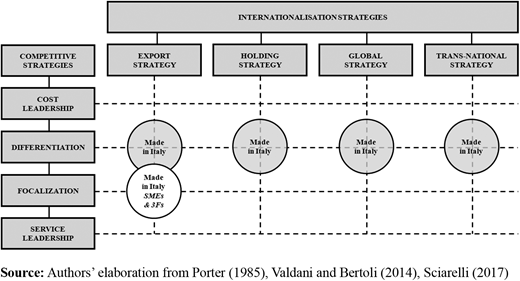
In this local–global evolution, a fluid connection inevitably exists between traditional competitive strategies on the one hand (cost leadership, differentiation, focus and service leadership; Porter, 1985; Sciarelli, 2017) and traditional internationalization strategies on the other hand (export, holding, global and transnational; Valdani and Bertoli, 2014), mainly by virtue of knowledge and relationship economies (Figure 1). In this complexity, the glocal environment operates not only in the form of the generic availability of technical intangibles (competence, experience, proximity and so on) but also in the form of developing reciprocal and pragmatic interactions in the territorial social capital (affinity, trust, cooperation and so on) (Pizzorno, 1999). Figure 1 illustrates the positioning, within the traditional schemes of international competition strategies, of the most likely international competition models for “Made in Italy,” which are focused on the quality, uniqueness and the reputation of a specific territorial capital.
The strategic choices presented above (most of all, the focus on export; more generally, differentiation for all the other choices) are appropriate for the Italian industrial system, whose main characteristic is an entrepreneurial structure with the presence of micro enterprises and SMEs. In fact, national statistical data highlight that in 2015 in Italy, only 3,666 of the 4,338,085 companies were large enterprises (0.08 per cent), 21,256 were medium (0,49 per cent), 176,332 were small (4,06 per cent) and 4,136,831 were micro-size enterprises (95,36 per cent) (calculations based on ISTAT data). These entities are increasingly adopting various development models that are more sensitive to “making global” the territorial knowledge about “Made in Italy” (Cooke et al., 2011; Strambach, 2012). Such milieu influences not only tangible but also intangible assets in association with territorial, social and economic flows, whose propagation, even outside a geographic area, connects all the operators in a “shared” supply chain from a cultural, organizational and entrepreneurial point of view (Rullani, 2006); this is true not only for already existing firms but also for start-ups (Colombelli and Quatraro, 2017).
Consequently, the internationalization process that runs along the nodes of such networks is a dynamic cognitive phenomenon that does not encounter barriers in physical nature. The uniqueness of a territory can move in a transnational space, effectively allowing enterprises to reside in their own notional or conceptual “territory of origin” while turning their vision toward increasingly more distant horizons (Lash and Urry, 1994). In the expansion of their extent of action, enterprises move knowledge along the pipelines of the supplier–customer chains or along their available communication channels (Rullani, 2006; Del Giudice, 2014; Castro, 2015). Thus, the enterprises are able to create networks, aggregations and even industrial districts, which Italy is renowned for (Goodman et al., 1989; Schmitz and Musyck, 1994; Rabellotti, 1995; Asheim, 1996; Chiarvesio et al., 2010). These new industrialization and internationalization models have facilitated the introduction of processes that promote knowledge sharing among all local actors in a given “place,” activating further processes of social modernization and technological innovation (Bencardino, 1997), in conjunction with the valorization of local productive resources and endogenous entrepreneurial qualities (De Rita and Bonomi, 1998; Camagni, 1999; Trigilia, 2005).
Territory-based knowledge as an intellectual capital asset in glocal marketing
In the knowledge-based economy, combinations of factors such as society, culture, people, communities and enterprises play a direct role in the patrimony of local competences that, while expanding environmental boundaries, can generate forms of bottom-up development (Bonomi, 2002; Moulaert and Sekia, 2003; Crevoisier and Jeannerat, 2009). Given the increasing intensity of competition, territory is not a secondary element in entrepreneurship and has become a source of active strength that can influence local, national and international competitiveness (Guatri and Vicari, 1994; Camagni, 2002; Dicken and Malmberg, 2009).
The concept of the territory as a tool of competition plays an active function in the incremental processes of knowledge building and is related to two main guidelines (Rullani, 2004). First, the territory functions as a repository of localized knowledge that is sharable by several stakeholders, and second, the territory serves as a catalyst for locally produced externalities based on the sharing of local contexts, symbols and codes that are implicit in that peculiar territorial milieu.
In fact, the patrimony of tangibles (morphology, natural resources, infrastructures, etc.) and intangibles (shared values, quality of life, reputation, etc.) of a territory expresses specific determinants that can greatly contribute to business success in international competition (for example, proximity efficiency, local services and contextual skills). These factors evidently influence productivity capabilities and differentiation abilities as competitive factors (Caroli, 2006; Jardon and Martínez-Cobas, 2019) and through innovative technological solutions of exploration and exploitation (Shams and Solima, 2019).
This territorial patrimony of tangibles and intangibles appears to be strategically decisive for Italian entrepreneurship. It is well known that the reputation of “Made in Italy” at the international level derives not only from human factors (e.g. the “Italian design genius”) but also from environmental factors (for example, the leather industry of Valdarno Superiore, Tuscany; the jewelry industry of Valenza, Piedmont; and the glasses industry of Belluno, Veneto).
Thus, combining the traditional and innovative categories of internationalization strategies with the evidence of the success of “Made in Italy” in specialized and territorially rooted production, an important consequence is evident; given the international competition, which is becoming increasingly more complex with the emergence of new and vast economic regions, the competitive advantage for SMEs, particularly in the case of “Made in Italy,” depends not only on specific firm resources but also on territorial resources, both tangible and intangible (Ezoji and Matta, 2019).
Naturally, the approach of Italian SMEs to territory is not univocal. Some SMEs invest in the strong identity of their own territory as a system of unique resources, relationships and knowledge (Cedrola, 2005). Other SMEs enhance the territory in relation to internationalization processes specifically by developing direct and/or indirect export activities with many collaborations in the local and potentially international value chains (Cantù and Gavinelli, 2008), thus enabling processes of enterprise co-creation (Shams and Kaufmann, 2016).
Focusing specifically on territorial capital as a competitive factor, in the scientific literature, there are several studies focusing on what a “territorial resource” truly is (Becattini, 1989; Becattini and Rullani, 1993; Becattini, 1999). As an intangible resource, territorial capital is a “relational good,” whereby the territory is formed as an organizational system of local actors who invest in the local cognitive patrimony (Vespasiano, 2005). This evidently agrees with the concept of social capital (Coleman, 1990; Putnam, 2000; Trigilia, 2005), arriving at developing the concept of “territorial social capital” (Celata and Coletti, 2014; Hvižďáková and Urbančíková, 2014; Sansone et al., 2015; Obrecht, 2016; Romano et al., 2017).
This concept refers to the overall set of social relations that exist in a specific territory. Thus, territorial capital is not an element available for transfer from one territory to another, because this kind of capital is strictly typical of a specific territory and, obviously, each territory is different. Moreover, this condition is even more true for Italy, where territorial differences, considering the “global” cultural dimension of the different areas of the country, are largely diffused.
Research design: aims and methods
Starting from the above premises, the current study aspires to highlight the possible contribution of territorial social capital – which is potentially embedded in the global set of intangible entrepreneurial resources – to the success of “Made in Italy” in international markets, especially to SMEs. The specific research question is the following: “Is territorial social capital a distinctive competitive factor for the international performance of SMEs active in the ‘Made in Italy’ markets?”
The discriminating variable for analysis is export activity, commonly used for measuring the success of the international performance of SMEs (Lu and Beamish, 2001; Fernández and Nieto, 2005; Zucchella and Siano, 2014), whose prevalence will give the main answer to the research question. The adopted methodology is quantitative, descriptive and both cross-sectional and longitudinal, to highlight the differences in space (global exports or industrial district exports) and time (globally speaking, from 2008 to 2017). In this respect, the evidence for the answer to the above research question will emerge from the comparison of the orientation to export the Italian global economy and the orientation to export the Italian district economy.
Some evidence from international competition practice
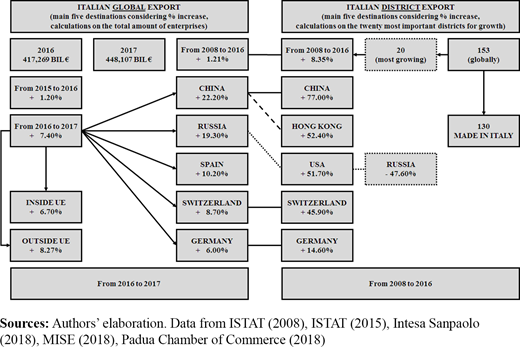
To shed light and extract raw data from the real economy on the role of the territory in the success of “Made in Italy” in international markets, a summary overview of the data focused on can be useful. In the following synoptic representation (Figure 2), several pieces of information, combined from different sources into a global framework, highlight the key importance of “industrial districts” for the Italian economy, with consequent specific considerations of their connection to “Made in Italy” export activity.
In fact, in our view, two fundamental aspects seem noteworthy. First:
[…] industrial districts are socio-territorial entities constituted by a community of enterprises and people, as well as by the territorial relations and socio-economic ties that such co-presence generates. These companies belong mainly to the same sector of economic activity, which defines its main industry, and they are characterized by being small and medium size (our translation from ISTAT, 2015).
The so-called “territorial relations and socio-economic ties” define, without a doubt, the essence of territorial social capital.
Second, the main part of the acknowledged Italian industrial districts (by law, these can change over time) concerns “Made in Italy” (130 over 141, according to ISTAT, ibidem). Thus, from our point of view, industrial districts are an important object of investigation for a coherent analysis that combines territorial social capital and “Made in Italy.”
Unfortunately, to the best of our knowledge, no detailed data are available to perform an analytical comparison between the dynamics of Italian global exports and Italian exports of “Made in Italy” from Italian industrial districts. Thus, we have produced an overall representation that combines and compares different data from different sources in different times, which, in our opinion, achieve a satisfactory and replicable investigation.
At least two pieces of evidence clearly emerge from the analysis. First, Italian industrial districts are mainly based around “Made in Italy” production, considering that 130 (ISTAT, 2015) of the 153 (Intesa Sanpaolo, 2017) industrial districts represent “Made in Italy,” at least according to the databases used; this is particularly true for the 20 fastest growing industrial districts (Intesa Sanpaolo, 2017). Second, the exports of Italian industrial districts in the period from 2008 to 2016 are higher than the exports from Italian enterprises in total (8.35 > 1.21). Naturally, the bias related to the different bases of calculations (8.35 per cent, considering only the 20 most growing industrial districts) can distort a coherent comparison, but two considerations seem useful. First, this is the only available comparison (to the best of our knowledge), and second, this is an even more interesting value when compared with the increase in the rate of the Italian GDP, which was 3.32 per cent from 2008 to 2016 and only 0.51 per cent when considering the average rate from 2008 to 2016 (Table I).
In other words, despite all the above-mentioned limits, Italian industrial districts focusing on “Made in Italy” in the period under analysis have been growing much faster than the rest of the Italian economy. Thus, considering other conditions equal, it is quite likely that the competitiveness of these districts could be because of the territorial capitalism underlying their global functioning, allowing us to answer “yes” to the fundamental research question of this study.
The investigation confirms previous studies in regard to the following aspects: the necessity/opportunity of collaboration among SMEs (most of all during the recent financial and economic crisis); evidence of “Made in Italy” as glocal competence (still popular in foreign markets); and the internationalization success of focused organizational aggregations (20 of the fastest growing Italian industrial districts) vs general production (the Italian global economy). The specific contribution of this research consists in the consideration of territorial social capital not only as a source of intangible resources for the enterprises in the territory (by virtue of their relational capital) but also as a strategic component of the structural capital of the next level of entrepreneurial aggregations (e.g. industrial districts). This dual contribution should be fruitful, most of all, if not exclusively, in the presence of strong characteristics, identity and image of these entrepreneurial aggregations (e.g. “Made in Italy”).
Limitations of the investigation and possible future research
The quantitative section of the research uses secondary data that are unfortunately not directly comparable because they are extracted from databases that refer to different time intervals. This limitation is because of the lack of authoritative secondary data on the export performance of industrial districts that specifically focus on “Made in Italy” – to the best of our knowledge. In fact, the different institutional reports that are normally available facilitate the investigation of only specific objectives and do not allow to create a general overview of this specific topic. In this respect, conceiving and implementing further research with the specific objective of retrieving primary data directly from the SMEs engaged in international competition by means of “Made in Italy” would be a helpful step forward in testing the potential contribution of territorial capitalism to this kind of competitiveness. Nevertheless, despite all the above limitations, the main result of this research, which shows the competitiveness of territory-based capitalism with the example of industrial districts focused on “Made in Italy,” is supported by clear evidence.
Regarding possible further research, one of the most intriguing future directions could be the investigation of the “spider” metaphor. In fact, a possible challenge for an enterprise active in the “Made in Italy” competition is to become a “fly” or a “spider” (Bonomi, 2006b). A “fly” perspective is substantially a transactional perspective, adopted by businesses that seek to add production, distribution and communication value from partners and markets to their commercial offers. In contrast, a “spider” perspective is substantially a relational perspective, adopted to co-create value for the global commercial offer with partners and markets.
Accordingly, the “spider” metaphor could be applicable not only to enterprises but also to districts and even to territories but only under conditions that evolve in the direction of a system that integrates enterprises, districts and territories into a unique network of resources, connections, competences, values and cultures (Saviolo, 2004). Evidently, this ambition also requires the fundamental participation by governmental institutions, which must supply all political incentives to enhance the various talent resources of the territory.
Theoretical and practical implications
From a speculative point of view, the territory is increasingly emerging as an asset for corporate social capital, together with the complexity of its players (Khojastehpour and Shams, 2019), not only when it is well recognized (in domestic markets) but also when it is far from the cultural point of view (in global markets), with all the necessary attention that needs to be paid to potential cross-cultural management problems. Furthermore, this is even more true both from a technical perspective (for example, industrial districts with all their business connections) and from a symbolic perspective (for example, the reputational power of “Made in Italy”).
From an applied point of view, professionals, managers and entrepreneurs, and most of all, the micro enterprises or SMEs focused on “Made in Italy,” must pay increasingly more attention to the overall relationships within the territory; in fact, they should consider not only the territory’s structural strengths (transportation, logistics, organization and so on) but also its reputational potential as territorial social capital in domestic and foreign markets. Naturally, this potential is also because of the interactions of these firms within the territory, which create a reputation with a “halo” effect from a top-down perspective and with a “synthesis” effect from a bottom-up perspective; most likely, this awareness about the relevance of the territory as a strategic competitive advantage could push operators to compete to gain more physical or virtual access to these territories that are capable of offering major opportunities in terms of territorial capitalism.
Conclusion
In recent decades, the evolution from an economy based on simple production to an economy based on complex interactions has demanded a renewal of business development models, causing crises in those enterprises that have not been able to overcome standardized production rules (Rullani, 2004). In the specific case of Italy, a focus on high-success production has highlighted that the concept of “Made in Italy” – not only for Italian enterprises but also, unfortunately, for those enterprises active in perpetuating the unfair practices of “sounding Italian” – can provide a strong reputation-based platform for competing in global markets, mainly through differentiation or focus strategies, even for SMEs.
In these scenarios, the specific value of Italian production throughout the world is mainly because of a strong sense of territorial imagination. This perception involves both a general territory (“Italy” as a reputational capital) and the social capacity to evoke positive emotions and imprint products with customs, lifestyle, culture (Imperatori, 2007) and a specific territory (e.g. the industrial districts), along with the social capacity to activate structural and relational resources. Naturally, knowledge networks in the territory play a key role in the concept of territorial social capital (Cantù and Gavinelli, 2008), enabling traditional and innovative interactions inside and outside enterprises and along value chains, supply chains and business networks, as well as inside and outside specific territories (Schmitz and Knorringa, 2000).
Author’s contribution: This article is a revised and expanded version of a paper entitled “Territorial capitalism and global competition: the “Made in Italy” challenge for SMEs” presented at the 11th Annual Conference of the EuroMed Academy of Business “Research Advancements in National and Global Business Theory and Practice,” University of Malta, Valletta, Malta, 12-14 September 2018. The article is the result of the common reflection of all the authors. In the editing phase, the “Introduction,” “Literature review” and “Conclusion” sections were written by Giuseppe Festa; the “The research design: aims and methods” and “Some evidence from international competition practice” sections were written by Matteo Rossi; the “Limitations of the investigation and possible future research” section was written by Ashutosh Kolte; and the “Theoretical and practical implications” section was written by Mario Situm.
Compliance with ethical standards: Yes.
Conflict of interest: The authors declare that they have no conflict of interest.