Skip to article sections
Purpose

The low use of the “buy online and pick-up in-store” (BOPIS) service for grocery shopping is a challenge for grocery retailers. Most BOPIS research investigates the general use of BOPIS services and overlooks the grocery retail industry. To address the gap in the literature, this study explored why grocery shoppers reject BOPIS services.

Design/methodology/approach

A conceptual model was developed using innovation resistance theory, perceived benefits of BOPIS and status quo bias theory. An international market research firm collected data from 400 South African grocery shoppers who did not use BOPIS.

Findings

The perceived enjoyment of BOPIS had the strongest negative effect on rejection intention, followed by convenience perceptions. Time-saving perceptions did not reduce rejection intention. In-store grocery shopping inertia was a key factor leading to rejection intention. Switching costs, sunk costs and in-store grocery shopping habits positively affected inertia. Gender moderated the effect of habit and sunk costs on inertia.

Research limitations/implications

This study’s main limitation is the cross-sectional design that calls for replication in other markets.

Practical implications

Marketing the shopping enjoyment and convenience of using a BOPIS service can decrease the intention to reject it. To lower inertia, grocery retailers must undo the shackles of switching costs, sunk costs and in-store shopping habits.

Originality/value

This study sheds light on the overlooked area of grocery shoppers’ rejection of BOPIS services, offering important insights for both theoretical and practical applications.

The strict regulations on movement and consumers’ health concerns about crowded environments during the COVID-19 pandemic forced retailers to enhance channel integration between traditional stores and online shopping channels (Joshi et al., 2024). One of the order fulfilment models that emerged was “buy online pick-up in-store” (BOPIS), a type of online-to-offline e-commerce (O2O) and click-and-collect (C&C) order fulfilment (Gielens et al., 2021). BOPIS offers advantages such as online shopping, such as convenience, saving time as store employees pack orders and avoiding long queues at the till. BOPIS grocery shopping services hold various advantages for grocery retailers. For example, it can increase shopper loyalty as it aligns with changes in grocery shoppers’ behaviour who are looking for new touchpoints that enable them to purchase groceries independent of time and location (Ponte and Sergi, 2024). Retailers can also benefit from BOPIS shopping through customers making additional purchases in-store (Risberg, 2023).

In spite of the advantages of C&C services such as BOPIS for grocery shoppers, only a tiny fraction of grocery shoppers are using it (Ponte and Sergi, 2024). Grocery shoppers’ resistance to BOPIS services can be one of three innovation resistance behaviours: outright rejection, postponement and oppositional behaviour. Postponement or opposition behaviour can lead to adopting BOPIS in the future (Talwar et al., 2020). Outright rejection is the most potent form of innovation resistance – a straightforward refusal to adopt the innovation (Talwar et al., 2020). Therefore, grocery retailers must understand which factors contribute to grocery shoppers’ rejection of BOPIS services to mitigate it.

Recently, Yen (2023) called for more research on understanding the adoption of grocery services emerging from channel integration. Unlike online and mobile grocery shopping research, the use of BOPIS services for grocery shopping has not yet attracted the attention of researchers to solidify a theoretical foundation to explain the use of this service by grocery shoppers. BOPIS shopping research is fragmented into different contexts or investigates general BOPIS use behaviour. For example, Wang et al. (2024) investigate BOPIS food delivery but do not focus on a specific product category. Natarajan et al. (2023), Yao et al. (2023), Che et al. (2022) and Kim et al. (2021) investigated the general use of BOPIS for shopping. Zhang and Wang (2021) and Chang et al. (2018) focused on the use of BOPIS in the travel industry, while Wu et al. (2015) focused on catering services. Considering the latest research on BOPIS shopping, a vital question remains unanswered:

RQ1.

Why would grocery shoppers reject using a BOPIS service?

The research question can be refined by focusing on in-store shoppers, as using a grocery retailer’s BOPIS service presents advantages for them. Therefore, the study aims to investigate BOPIS service rejection by in-store grocery shoppers.

The study’s contributions are as follows. The study’s findings would address the literature gap and provide insights for grocery retailers to mitigate in-store shoppers’ rejection of the BOPIS service. Resistance behaviour is driven by status quo bias, which manifests as inertia (Polites and Karahanna, 2012). This study will identify the role of in-store inertia in in-store shoppers’ rejection of BOPIS grocery shopping services and, vital for theory development and practical relevance, investigate the determinants of inertia in in-store grocery shopping.

The remainder of this article is organised as follows. The next section provides an overview of BOPIS shopping research in general. This is followed by the theoretical foundations and the formulation of the conceptual model that was empirically tested. After that, the research methodology and analysis plan are elucidated, followed by the results of the data analysis and the study’s findings. The study concludes with the theoretical contributions, the managerial implications, the limitations of the study, and directions for future research.

Perceived benefit in a shopping context can be described as the sum of the advantages or satisfactions that meet the customers’ needs and wants derived from a shopping channel (Wu, 2003). Shopping in physical stores has various benefits, such as shopping enjoyment, products can be inspected, less uncertainty when purchasing a product and a shopper can take possession of the product (Hsiao, 2009). Online shopping has distinct benefits such as convenience, increased product selection, ease of shopping and enjoyment (Forsythe et al., 2006). BOPIS is a hybrid omni-channel model that offers shoppers a seamless blend between online and offline channels (Joshi et al., 2024). BOPIS enables grocery shoppers to enjoy the benefits of online shopping and in-store shopping, such as physically inspecting products and collecting the product at a preferred store.

Status quo bias (SQB) theory has emerged as a prominent theory that explains consumers’ resistance to adopting new information systems (Lee and Joshi, 2017). According to Samuelson and Zeckhauser (1988), SQB theory attempts to articulate why people prefer to stay in their current situations or statuses rather than adopt a different (perhaps better) course of action.

SQB behaviour manifests as inertia, an attitudinal tendency to maintain the status quo when faced with alternatives. Inertia reflects an attachment to and persistence of current behavioural patterns (i.e. the status quo), in spite of the availability of a superior option (Polites and Karahanna, 2012). According to Polites and Karahanna (2012), inertia comprises cognitive, affective and behavioural-based inertia. Cognitive-based inertia occurs when a person consciously continues with the status quo even though they know it might not necessarily be the best, most efficient or most effective way of doing things. On the other hand, affective-based inertia implies that an individual continues with the status quo just because it would be stressful to switch to the alternative, because they enjoy or feel comfortable using it, or because they have developed a strong emotional attachment to the current way of doing things. Finally, behaviour-based inertia implies that the status quo will continue simply because it is what the individual has always done.

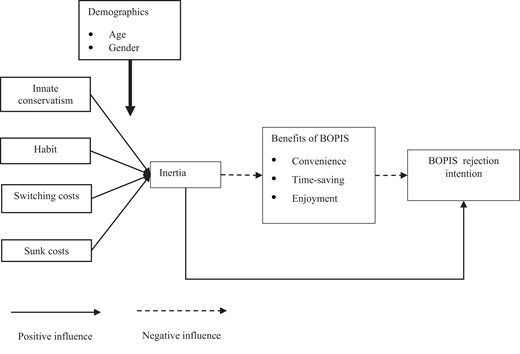
The conceptual model in Figure 1 is based on the theoretical foundations discussed in the previous section. The model illustrates the impact of BOPIS benefits and in-store grocery shopping inertia affecting rejection intention, the effect of inertia on the perceived benefits of BOPIS and the determinants of in-store shopping inertia. Finally, age and gender were tested as moderators of the relationship between inertia and its determinants.

Prior research reported that using BOPIS for shopping has various benefits, including instant gratification (Lee et al., 2020), perceived time savings (Lee et al., 2020), convenience (Gielens et al., 2021) and enjoyment of the BOPIS shopping experience (Chen and Chi, 2021). Three reported benefits of BOPIS – perceived convenience, perceived time savings and perceived enjoyment of shopping – were included in the study. We excluded instant gratification as a benefit, as the in-store shopper, like the BOPIS user, also takes ownership of the groceries in the store.

According to Chowdhury (2023), shopping convenience is a crucial factor influencing behavioural intention in an O2O context. In grocery shopping, BOPIS provides consumers the convenience of browsing and purchasing items online, followed by the flexibility to collect their orders at a nearby physical store. Based on the discussion above, the following hypothesis was developed:

H1.

The perceived convenience of BOPIS negatively affects rejection intention.

As consumers seek more efficient ways to navigate their daily responsibilities, time-saving has become a significant driver of preferences and choices (Kumar and Kashyap, 2018). In this study, the time-saving benefit refers to the reduced effort and time spent on grocery shopping using the retailer’s BOPIS service (Kasuma et al., 2020). BOPIS services offer time-saving by placing the grocery order online and not having to walk through the grocery retail aisles to put products in the trolley. Also, the grocery retailer packs the order, and the customer can pick it up at the dedicated counter instead of standing in a queue. The time-saving benefit should reduce shoppers’ intention to reject using a grocery retailer’s BOPIS service. Therefore, we hypothesised that:

H2.

The perceived time-saving of BOPIS negatively affects rejection intention.

Shopping enjoyment is the degree to which the shopping experience is seen as pleasurable in its own right, independent of any potential adverse effects on the anticipated performance outcomes (Cai and Xu, 2006). Perceived shopping enjoyment in this study refers to the perceived pleasure an individual experiences when using BOPIS to purchase groceries. The BOPIS service of a grocery retailer creates shopping enjoyment through a streamlined online ordering and payment process, the opportunity to quickly acquire purchased items when in-store, and the satisfaction of avoiding in-store hassles such as long queues at checkout points (Kim et al., 2017). Based on the discussion above, the following hypothesis was developed:

H3.

The perceived enjoyment of BOPIS negatively affects rejection intention.

In-store grocery shopping inertia represents attachment to and persistence of in-store grocery purchasing, even though the retailer has a BOPIS service. Inertia contributes to resistance, as it is the persistence of continuing with the status quo. Past research indicates that consumer inertia positively influences innovation resistance behaviour (Polites and Karahanna, 2012). Thus, we hypothesised that:

H4.

In-store shopping inertia positively affects rejection intention.

Grocery shoppers with higher levels of in-store shopping inertia would have limited interest in learning about the benefits of BOPIS (Polites and Karahanna, 2012). In line with cognitive dissonance theory, they will trivialise their perceptions of BOPIS benefits to justify their continuance of in-store shopping. The higher a grocery shopper’s in-store shopping inertia, the more their installed grocery shopping inertia will negatively affect their perceived benefits of BOPIS services (Polites and Karahanna, 2012). The following hypotheses were developed for the study:

H5a.

In-store grocery shopping inertia negatively affects the perceived convenience of BOPIS.

H5b.

In-store grocery shopping inertia negatively affects the perceived time-saving of BOPIS.

H5c.

In-store grocery shopping inertia negatively affects the perceived enjoyment of BOPIS.

Consumers’ ingrained habits primarily cause resistance to using new products or services (Labrecque et al., 2017). Verplanken and Aarts (1999, p. 104) define a habit as “learned sequences of acts that have become automatic responses to specific cues and are functional in obtaining certain goals or end-status.” Considering the characteristics of habit, in-store grocery shopping habits relate to the behavioural-based inertia component. Therefore, we hypothesised that:

H6.

The habit of in-store grocery shopping positively affects in-store shopping inertia.

The sunk cost effect is the tendency to persist in an activity even when it no longer makes sense because of the effort, time and money already invested (Arkes and Blumer, 1985). In the present study, sunk costs refer to the time, money and effort invested in learning how to do grocery shopping in-store. Prior research indicates that the perceived sunk costs associated with the status quo encourage inertia development (Gong et al., 2020). This is because sunk costs relate to the cognition dimension of inertia. Therefore, we hypothesised that:

H7.

In-store grocery shopping sunk costs positively affect in-store shopping inertia.

Switching costs refer to a one-time cost consumers link to switching from one alternative to another (Burnham et al., 2003). Switching costs to BOPIS for an in-store grocery shopper can be defined as the perceived disutility a grocery shopper would incur from switching from purchasing groceries in-store to using BOPIS (Kim and Kankanhalli, 2009). Individuals will only depart from the status quo for a new alternative if the benefit outweighs the switching costs (Li et al., 2016). Switching costs relate to the cognitive component of inertia. Therefore, we hypothesised that:

H8.

Switching costs for in-store grocery shoppers positively affect in-store shopping inertia.

Hirschheim and Newman (1988) define innate conservatism as a reluctance to change the status quo. Conservatism is the tendency of individuals to value and preserve long-standing traditions and social systems while being cautious, reluctant and gradual in implementing any changes (Sharma et al., 1994). According to Van Tonder (2017), conservative individuals have a traditional and cautious approach to life. Therefore, they may be less open to new products or services such as BOPIS because they prefer familiar and conventional behaviour. In line with this reasoning, we hypothesised that:

H9.

The innate conservatism of in-store grocery shoppers positively affects in-store shopping inertia.

According to Gray et al. (2017), a greater understanding of inertia and its causes could enhance businesses’ understanding of consumers’ switching processes. To advance our understanding of the effect of these determinants on in-store grocery shopping inertia, we further investigate age as a potential moderator of the effects of the determinants on inertia.

Age differences in consumer behaviour continue to be reported in retail (e.g. Kamath et al., 2019; Liébana-Cabanillas et al., 2021; Rather and Hollebeek, 2021). The literature on consumer behaviour shows that younger consumers are more open to change than older consumers and, therefore, more willing to try new products and services (Rašković et al., 2016). Lee and Li (2023) believe that older consumers stick with their routines and are generally satisfied with their daily activities. Older consumers maintain the status quo for reasons such as biological ageing, the decline in cognitive activities, social-emotional selectivity and aversion to change (Lambert-Pandraud et al., 2005).

According to Amrouche et al. (2023), younger consumers aged 20–29 prefer mobile shopping, while older consumers aged 30–59 prefer e-commerce shopping. Individuals aged 60 and older prefer in-store shopping as their first choice. These results suggest that younger shoppers may be more receptive to using the BOPIS service offered by grocery retailers than older shoppers, as using BOPIS services offers a new experience and challenges the status quo (Baykal, 2020).

Based on the discussion, the following moderation hypotheses were developed:

H10a.

Age positively moderates the positive effect of habit on inertia.

H10b.

Age positively moderates the positive effect of sunk costs on grocery shopping inertia.

H10c.

Age positively moderates the positive effect of switching costs on inertia.

H10d.

Age positively moderates the positive effect of innate conservatism on in-store inertia.

We further investigate gender as a potential moderator of the determinants of in-store shopping inertia. BOPIS grocery shopping services require using one of the retailer’s online shopping services to place an order. An accepted viewpoint is that males are likelier to do online shopping than females because females perceive online shopping as impersonal, less involving and lacking in social sensory experience (Meyers-Levy and Loken, 2015). Gray et al. (2017) state that men have a positive attitude towards online shopping, even in an omnichannel situation, compared to female shoppers. With both genders’ increased use of internet technology, researchers argue that gender differences in technology use have contracted, but the differences persist (Hauk et al., 2018). Therefore, it is vital to investigate if gender is a boundary condition for the determinants of in-store shopping inertia.

According to Dennis et al. (2018), men exhibit different shopping styles than women. Men are needs-driven and focused on minimising the time spent making a purchase. Analogously, women emphasise the emotional and social-experiential aspects of shopping. Likewise, Jain et al. (2021) reported that men are more concerned with the functional utilities when shopping, which include transaction speed, convenience and efficiency, while women are more concerned with the experiential and relational utilities than men. Thus, men’s focus on instrumentality (Baykal, 2020) would make them more open to considering the BOPIS service of a grocery retailer to complete grocery shopping more efficiently than going into the store to purchase groceries.

Based on the discussion, the following moderation hypotheses were developed:

H11a.

Gender moderates the positive effect of habit on inertia, so the positive effect is weaker for males than females.

H11b.

Gender moderates the positive effect of sunk costs on inertia, so the positive effect is weaker for males than females.

H11c.

Gender moderates the positive effect of switching costs on inertia, so the positive effect is weaker for males than females.

H11d.

Gender moderates the positive effect of innate conservatism on inertia, so the positive effect is weaker for males than females.

The target population for the study was non-BOPIS grocery shoppers, 18 years and older, who purchase groceries in-store at one of the three leading grocery retailers in South Africa (Pick and Pay, Shoprite Checkers and Woolworths). At the time of the data collection, only these grocery retailers in South Africa offered BOPIS.

Respondents indicated the retailer from whom they prefer to purchase groceries. The retailer’s name was included in each statement measuring the beliefs regarding the variables in the conceptual model. The respondents also had to be one of the persons in the household responsible for grocery shopping to ensure that the respondents were personally faced with the decision to use BOPIS or not (Van Hove, 2022).

Qualtrics collected a sample of 400 respondents from the study population in May 2023. The respondents were asked to indicate their agreement with the statements on a five-point Likert-type scale (1 = strongly disagree to 5 = strongly agree). The multi-item scale used to measure each variable in the conceptual model is available as a supplementary file.

SMARTPLS version 4 was used to assess the measurement model and test the hypotheses. The use of PLS-SEM was justified as it prioritises prediction over the explanation of theoretical models, leading to improved managerial recommendations (Guenther et al., 2023). Additionally, the moderate to high outer loadings in Table 1 confirm that the residual variance of items has no particular meaning for the focal construct or other constructs in the model (Guenther et al., 2023).

The validity and reliability of the measurement model were evaluated according to guidelines provided by Hair et al. (2019). The internal consistency reliability of the multi-item scales was assessed using Cronbach’s alpha and composite reliability (CR). Evidence for internal consistency reliability is an index value of at least 0.7. Convergent validity requires that each item’s outer loading be above 0.7 and statistically significant and that the constructs’ average variance extracted (AVE) be above 0.5. This study evaluated the multi-item scales used in the survey for discriminant validity using heterotrait–monotrait (HTMT) ratios of correlations. The benchmark for discriminant validity in a measurement model is the ratio of correlations that do not exceed 0.85.

The structural model was assessed using a three-step process, which involved testing for collinearity, estimating path coefficients and interpreting the model’s in-sample predictive accuracy through the coefficient of determination (R2) (Hair et al., 2019). The process feature in SmartPLS version 4.0 was used to test the moderation effects of age and gender. Age and gender were tested separately as moderators, because the moderation hypotheses did not state, for example, that the moderation effect of gender depends on the age of non-BOPIS grocery shoppers.

The majority of respondents were female (63%), and most respondents were 25–34 (28%) and 35–44 (22%) years old. Because more females are involved in grocery shopping than males (Mortimer et al., 2016), the sample skewness towards female grocery shoppers does not threaten the validity of the results. The mean age of respondents was 38.32 (SD = 13.99). The respondents’ education levels varied, with 39.3% having completed secondary school, 32.3% obtaining a certificate or diploma, 18.5% obtaining a bachelor’s degree, and 6.8% obtaining a postgraduate degree. Almost 50% of the respondents preferred grocery shopping at Shoprite Checkers (49.3%), followed by Pick n Pay (45%). Only 5.7% of respondents indicated that they preferred shopping at Woolworths. The sample’s low percentage of Woolworths customers is acceptable, as the retailer targets the upper-income shopper. The representation of the grocery retailers in the sample is reflective of their 2023 revenue (BUSINESSTECH, 2024). More detailed information on the sample is available as a supplementary file.

Table 2 presents the results of the measurement model. As can be seen in Table 1, most outer loadings were higher than 0.7, and all outer loadings were statistically significant. Furthermore, each construct’s internal consistency reliability and AVE were acceptable. The outer loading of HAB4, SWC1 and TS2 was less than the ideal (0.7), but did not threaten the construct measures’ internal consistency reliability and convergent validity. For this reason, the items lower than 0.7 were not excluded from the measurement model.

As can be seen from Table 2, all ratios were less than 0.85. The highest HTMT ratio was between the rejection intention and perceived enjoyment (0.835).

Based on the results in Tables 2 and 3, it can be concluded that the measurement model exhibits adequate internal consistency reliability, convergent validity and discriminant validity to continue assessing the structural model.

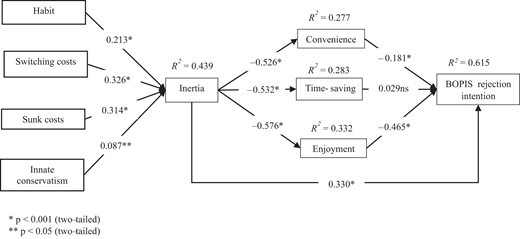
The highest VIF was between perceived enjoyment and rejection intention (2.139). Thus, multicollinearity and common method bias did not threaten the results of the structural model assessment. Figure 2 shows the empirical results of the main effects in the conceptual model. The predictive accuracy of the conceptual model explaining BOPIS rejection intention was 61.5%, and the R2 of in-store grocery shopping inertia was 43.9%.

The perceived convenience of BOPIS (−0.181; p = 0.000) and the perceived enjoyment (−0.465; p = 0.000) of BOPIS grocery shopping negatively and statistically significantly influenced rejection intention. However, the perceptions of time-saving did not statistically significantly affect rejection intention (p = 0.565). Thus, H1 and H3 were accepted, and H2 was rejected.

In-store grocery shopping inertia positively and statistically significantly influenced BOPIS rejection intention (0.330; p = 0.000). Thus, H4 was accepted. H5a, H5b and H5c were accepted. Inertia had the most substantial negative effect on perceived enjoyment (−0.576; p = 0.000), followed by its effect on time-saving perceptions (−0.532; p = 0.000) and convenience perceptions (−0.526; p = 0.000).

The habit of in-store grocery shopping positively and statistically significantly influenced inertia (0.213; p = 0.000). Switching costs and sunk costs also positively and statistically significantly influenced inertia (0.326 [p = 0.000] and 0.314 [p = 0.000], respectively). Innate conservatism had a weak positive and statistically significant effect on inertia (0.087; p = 0.038). Thus, H6, H7, H8 and H9 were accepted.

The statistical results in Table 3 (see Model 1) show that the interaction effects, including age, were not statistically significant. Therefore, H10a, H10b, H10c and H10d were all rejected.

Table 3 (Model 2) shows that the interaction effects (gender × innate conservatism, and gender × switching costs) were not statistically significant. Thus, H9c and H9d were rejected. However, the interaction effects (gender × sunk costs, and gender × habit) were statistically significant (−0.117, p = 0.020; 0.103, p = 0.023, respectively).

Simple slope results show that habit’s effect on inertia was positive and statistically significant for females (0.330; p = 0.000), and the effect for males was not statistically significant (p = 0.329). H9a was accepted, because it can be concluded that the effect of habit on inertia was weaker for males than for females.

The effect of sunk costs on inertia was positive and statistically significant for males (0.475; p = 0.000) and females (0.237; p = 0.000). Thus, H9b was rejected, as the “sunk costs – inertia” relationship was not weaker for males than for females.

The study aimed to investigate the factors contributing to in-store grocery shoppers rejecting BOPIS services because of inertia towards in-store shopping. The researchers tested the moderating effect of consumer demographics (age and gender) on the effect of innate conservatism, habit, switching costs and sunk costs on in-store grocery shopping inertia.

The study’s findings show that the negative effect of perceived enjoyment of BOPIS grocery shopping services on rejection intention was stronger than the negative effect of convenience perceptions on rejection intention. This finding contradicts Kim et al. (2020), who state that the utilitarian aspect of BOPIS influences behavioural intention more strongly than hedonic motivations. A possible explanation for the contradiction in our study compared to Kim et al. (2020) is that enjoyment could be more influential than utilitarian factors in the pre-adoption stage of technology-based service (Sharif and Raza, 2017).

Unexpectedly, the respondents’ time-saving perceptions of BOPIS did not reduce BOPIS rejection. A possible explanation for the non-significant effect is that BOPIS does not eliminate the time spent driving to the grocery store.

Gender moderated the relationship between in-store shopping habits and inertia. The effect of habit on inertia was positive and statistically significant for females but not for males. This result can be linked to the goal-directed shopping behaviour of males (Henderson et al., 2021).

The results showed that the effect of sunk costs on inertia was weaker for females than for males, the opposite of what was hypothesised. This finding does not align with the belief that men prefer shopping options that are fast and convenient (Joshi et al., 2024; Mortimer et al., 2016).

Age did not moderate the effect of innate conservatism, the habit of shopping in-store for groceries, switching costs and sunk costs on in-store grocery shopping inertia. Gender did not moderate the effect of innate conservatism and switching costs on in-store shopping inertia. The non-significant moderation effects present evidence of the robustness of these factors influencing inertia.

The study’s theoretical contributions are the following. Our study focuses on the emerging phenomenon of BOPIS grocery shopping services. Most innovations fail because of rejection behaviour (Joachim et al., 2018). Only a focused study on the rejection of BOPIS by in-store shoppers can provide the much-needed insights to understand their decision-making (Talwar et al., 2020). While Pozzi (2012) and Nakano (2023) investigated the role of inertia when making grocery purchasing decisions in a multichannel setting, this study presents unique insights into the effect of in-store shopping inertia on the rejection behaviour of BOPIS grocery shopping services. Therefore, the study’s main theoretical contribution is the presentation of much-needed research into grocery shoppers’ rejection of BOPIS services.

The study presents novel findings about the influences of in-store grocery shopping inertia and perceived BOPIS benefits on rejection intention. Natarajan et al. (2023, p. 2550) state, “BOPIS customers have been identified to be time-pressed, price-conscious, innovative and, most importantly, young.” The time-saving benefit of BOPIS grocery shopping services might not be a benefit that lowers rejection intention. Instead, in the pre-adoption stage of BOPIS grocery services, hedonic benefits might be more important than utilitarian benefits in reducing rejection intention. The strong negative effect of in-store shopping inertia on the perceived benefits of BOPIS underscores the profound impact of inertia as a pivotal individual characteristic that markedly shapes the perceived benefits of BOPIS services.

The third theoretical contribution is the identification of determinants of in-store grocery shopping inertia. Switching costs had the strongest influence on in-store shopping inertia, followed by in-store shopping habits and sunk costs. The strong influence of switching costs, followed by sunk costs and habit, is in line with prior research (e.g. Cambra-Fierro et al., 2020; Godefroid et al., 2023; Haridasan et al., 2021; Liang et al., 2014). The weak influence of innate conservatism was unexpected, as various authors, such as Chaouali and Souiden (2019), Hsieh and Lin (2018) and Kim and Kankanhalli (2009), describe SQB as an outcome of innate conservatism. In this study, the emphasis was on innate conservatism as an individual characteristic and not on the conservatism of an individual to experiment with different grocery buying options. It might be the case, similar to findings that general self-efficacy is less critical in adopting new technology than system-specific self-efficacy (Hasan, 2006), that innate conservatism when shopping might be a stronger factor influencing inertia.

The study’s last contribution is the moderation analysis results based on gender and age. Including gender and age as moderators of the determinants of in-store grocery shopping inertia presents valuable theoretical contributions (Meyers-Levy and Loken, 2015; Sharma et al., 2012). Contrary to the initial argument that the “sunk costs – inertia” relationship is stronger for females than males, the study’s results showed that sunk costs were stronger for male shoppers than female shoppers. The selectivity hypothesis could explain the stronger influence of sunk costs on inertia, where males respond more to salient cue heuristics when making decisions (Meyers-Levy and Loken, 2015). As hypothesised, in-store shopping habits positively influenced in-store grocery shopping inertia, which was stronger for females than males. The stronger influence of habit on females’ inertia aligns with the view that females find in-store shopping more practical and emotionally satisfying than males (Meyers-Levy and Loken, 2015). The “expected” and “unexpected” results highlight the importance of reporting gender differences in different contexts.

The findings of this study offer several managerial implications for retailers. Grocery retailers should focus on communicating the enjoyment benefit of BOPIS shopping through consumer education and marketing campaigns highlighting this benefit. The visual element in mass media can be used to grab consumers’ attention and influence their behaviour by demonstrating how grocery shoppers derive pleasure from using BOPIS. For example, an advertisement can show increased pleasure for a shopper when they pay at a dedicated counter for BOPIS shoppers, compared to standing in a queue. Relatable scenarios shown in mass media advertisements can help communicate the convenience benefit. For example, the advertisement can show a working parent ordering groceries during a lunch break and picking up the order at the retailer without any hassles.

To reduce in-store grocery shopping inertia, retailers must focus on mitigating the primary contributing factors. The shackle of switching costs can be broken by using the retailer’s loyalty programme to incentivise in-store shoppers to try the BOPIS service. The effect of switching costs on inertia can be disrupted by offering a trial incentive to use the service or by partnering with local influencers and bloggers to promote the BOPIS service.

The “sunk costs–inertia” relationship can be weakened for both genders by using targeted promotions, in-store educational initiatives, social proof and influencers. As the effect of sunk costs on inertia depends on the gender of the customer shopping in the grocery store, each gender can be targeted by addressing the needs of that specific gender.

To disrupt the positive effect of in-store grocery shopping habits on inertia for females, retailers can use social media to distribute social proof that using BOPIS services is beneficial for purchasing groceries for households. Retailers can also consider partnering with influencers who resonate with female store shoppers. Additionally, grocery retailers can collect feedback from female shoppers to understand their preferences and identify areas for improvement.

The data for the empirical study were collected in South Africa. In the future, the study can be replicated in other countries to confirm the robustness of the results. Specifically, future studies must investigate the non-significant influence of the time-saving benefit on rejection intention and the moderation effects of gender and age. Because switching costs had the strongest influence on inertia, it would be valuable to investigate which switching costs lead to inertia.

Laukkanen (2016) used a logistic regression analysis to identify customer demographics and innovation perceptions that influence different types of resistance behaviour. Future BOPIS grocery shopping research can follow Laukkanen (2016) by using different types of logistic regression analysis to identify consumer demographics and BOPIS perceptions that lead to adoption vs rejection or postponement of this grocery shopping service.

Investigating the postponement of using BOPIS could be another interesting avenue for future research. A longitudinal study could provide more evidence of whether postponers eventually adopt BOPIS services or reject them.

Amrouche
,
N.
,
Pei
,
Z.
and
Yan
,
R.
(
2023
), “
Service strategies and channel coordination in the age of e-commerce
”,
Expert Systems with Applications
, Vol.
214
, p.
119135
.
Arkes
,
H.R.
and
Blumer
,
C.
(
1985
), “
The psychology of sunk cost
”,
Organizational Behavior and Human Decision Processes
, Vol.
35
No.
1
, pp.
124
-
140
.
Baykal
,
B.
(
2020
), “Generational differences in omnichannel experience: rising new segment: gen Z”, in
Dirsehan
,
T.
(Ed.),
Managing Customer Experiences in an Omnichannel World: Melody of Online and Offline Environments in the Customer Journey
,
Emerald Publishing
,
Leeds
, pp.
117
-
132
.
Burnham
,
T.A.
,
Frels
,
J.K.
and
Mahajan
,
V.
(
2003
), “
Consumer switching costs: a typology, antecedents, and consequences
”,
Journal of the Academy of Marketing Science
, Vol.
31
No.
2
, pp.
109
-
126
.
Businesstech
(
2024
), “
The biggest retailers in South Africa: Shoprite vs Woolworths vs spar vs pick n pay
”,
available at:
The biggest retailers in South Africa: Shoprite vs Woolworths vs spar vs pick n payLink to the cited article. (
accessed
28 April 2025).
Cai
,
S.
and
Xu
,
Y.
(
2006
), “
Effects of outcome, process and shopping enjoyment on online consumer behaviour
”,
Electronic Commerce Research and Applications
, Vol.
5
No.
4
, pp.
272
-
281
.
Cambra-Fierro
,
J.
,
Melero-Polo
,
I.
,
Patrício
,
L.
and
Sese
,
F.J.
(
2020
), “
Channel habits and the development of successful customer-firm relationships in services
”,
Journal of Service Research
, Vol.
23
No.
4
, pp.
456
-
475
.
Chang
,
Y.W.
,
Hsu
,
P.Y.
and
Yang
,
Q.M.
(
2018
), “
Integration of online and offline channels: a view of O2O commerce
”,
Internet Research
, Vol.
28
No.
4
, pp.
926
-
945
.
Chaouali
,
W.
and
Souiden
,
N.
(
2019
), “
The role of cognitive age in explaining mobile banking resistance among elderly people
”,
Journal of Retailing and Consumer Services
, Vol.
50
, pp.
342
-
350
.
Che
,
T.
,
Ji
,
M.
,
Zheng
,
X.
and
Feng
,
B.
(
2022
), “
Dissatisfaction toward O2O websites: expectation disconfirmation and justice perspective
”,
Asia Pacific Journal of Marketing and Logistics
, Vol.
34
No.
1
, pp.
190
-
208
.
Chen
,
Y.
and
Chi
,
T.
(
2021
), “
How does channel integration affect consumers’ selection of Omni-channel shopping methods? An empirical study of U.S. Consumers
”,
Sustainability
, Vol.
13
No.
16
, p.
8983
.
Chowdhury
,
R.
(
2023
), “
Impact of perceived convenience, service quality and security on consumers’ behavioural intention towards online food delivery services: the role of attitude as mediator
”,
SN Business and Economics
, Vol.
3
No.
1
, p.
29
.
Dennis
,
C.
,
Brakus
,
J.J.
,
Ferrer
,
G.G.
,
McIntyre
,
C.
,
Alamanos
,
E.
and
King
,
T.
(
2018
), “
Revisiting gender differences: what we know and what lies ahead
”,
Journal of International Marketing
, Vol.
26
No.
4
, pp.
38
-
53
.
Forsythe
,
S.
,
Liu
,
C.
,
Shannon
,
D.
and
Gardner
,
L.C.
(
2006
), “
Development of a scale to measure the perceived benefits and risks of online shopping
”,
Journal of Interactive Marketing
, Vol.
20
No.
2
, pp.
55
-
75
.
Gielens
,
K.
,
Gijsbrechts
,
E.
and
Geyskens
,
I.
(
2021
), “
Navigating the last mile: the demand effects of click-and-collect order fulfillment
”,
Journal of Marketing
, Vol.
85
No.
4
, pp.
158
-
178
.
Godefroid
,
M.-E.
,
Plattfaut
,
R.
and
Niehaves
,
B.
(
2023
), “
How to measure the status quo bias? A review of current literature
”,
Management Review Quarterly
, Vol.
73
No.
4
, pp.
1667
-
1711
.
Gong
,
X.
,
Zhang
,
K.Z.K.
,
Chen
,
C.
,
Cheung
,
C.M.K.
and
Lee
,
M.K.O.
(
2020
), “
Transition from web to mobile payment services: the triple effects of status quo inertia
”,
International Journal of Information Management
, Vol.
50
, pp.
310
-
324
.
Gray
,
D.M.
,
D’Alessandro
,
S.
,
Johnson
,
L.W.
and
Carter
,
L.
(
2017
), “
Inertia in services: causes and consequences for switching
”,
Journal of Services Marketing
, Vol.
31
No.
6
, pp.
485
-
498
.
Guenther
,
P.
,
Guenther
,
M.
,
Ringle
,
C.M.
,
Zaefarian
,
G.
and
Cartwright
,
S.
(
2023
), “
Improving PLS-SEM use for business marketing research
”,
Industrial Marketing Management
, Vol.
111
, pp.
127
-
142
.
Hair
,
J.F.
,
Risher
,
J.J.
,
Sarstedt
,
M.
and
Ringle
,
C.M.
(
2019
), “
When to use and how to report the results of PLS-SEM
”,
European Business Review
, Vol.
31
No.
1
, pp.
2
-
24
.
Haridasan
,
A.C.
,
Fernando
,
A.G.
and
Balakrishnan
,
S.
(
2021
), “
Investigation of consumers’ cross‐channel switching intentions: a push‐pull‐mooring approach
”,
Journal of Consumer Behaviour
, Vol.
20
No.
5
, pp.
1092
-
1112
.
Hasan
,
B.
(
2006
), “
Delineating the effects of general and system-specific computer self-efficacy beliefs on is acceptance
”,
Information and Management
, Vol.
43
No.
5
, pp.
565
-
571
.
Hauk
,
N.
,
Hüffmeier
,
J.
and
Krumm
,
S.
(
2018
), “
Ready to be a silver surfer? A meta-analysis on the relationship between chronological age and technology acceptance
”,
Computers in Human Behavior
, Vol.
84
, pp.
304
-
319
.
Henderson
,
C.M.
,
Steinhoff
,
L.
,
Harmeling
,
C.M.
and
Palmatier
,
R.W.
(
2021
), “
Customer inertia marketing
”,
Journal of the Academy of Marketing Science
, Vol.
49
No.
2
, pp.
350
-
373
.
Hirschheim
,
R.
and
Newman
,
M.
(
1988
), “
Information systems and user resistance: theory and practice
”,
The Computer Journal
, Vol.
31
No.
5
, pp.
398
-
408
.
Hsiao
,
M.-H.
(
2009
), “
Shopping mode choice: physical store shopping versus e-shopping
”,
Transportation Research Part E: Logistics and Transportation Review
, Vol.
45
No.
1
, pp.
86
-
95
.
Hsieh
,
P.J.
and
Lin
,
W.S.
(
2018
), “
Explaining resistance to system usage in the pharmacloud: a view of the dual-factor model
”,
Information and Management
, Vol.
55
No.
1
, pp.
51
-
63
.
Jain
,
N.K.
,
Gajjar
,
H.
and
Shah
,
B.J.
(
2021
), “
Electronic logistics service quality and repurchase intention in e-tailing: catalytic role of shopping satisfaction, payment options, gender and returning experience
”,
Journal of Retailing and Consumer Services
, Vol.
59
, p.
102360
.
Joachim
,
V.
,
Spieth
,
P.
and
Heidenreich
,
S.
(
2018
), “
Active innovation resistance: an empirical study on functional and psychological barriers to innovation adoption in different contexts
”,
Industrial Marketing Management
, Vol.
71
, pp.
95
-
107
.
Joshi
,
A.
,
Pani
,
A.
,
Sahu
,
P.K.
,
Majumdar
,
B.B.
and
Tavasszy
,
L.
(
2024
), “
Gender and generational differences in Omnichannel shopping travel decisions: what drives consumer choices to pick up in-store or ship direct?
”,
Research in Transportation Economics
, Vol.
103
, p.
101403
.
Kamath
,
P.R.
,
Pai
,
Y.P.
and
Prabhu
,
N.K.P.
(
2019
), “
Building customer loyalty in retail banking: a serial-mediation approach
”,
International Journal of Bank Marketing
, Vol.
38
No.
2
, pp.
456
-
484
.
Kasuma
,
J.
,
Kanyan
,
A.
,
Khairol
,
M.
,
Sa’ait
,
N.
and
Panit
,
G.
(
2020
), “
Factors influencing customers intention for online shopping
”,
International Journal of Modern Trends in Business Research
, Vol.
3
No.
11
, pp.
31
-
41
.
Kim
,
H.W.
and
Kankanhalli
,
A.
(
2009
), “
Investigating user resistance to information systems implementation: a status quo bias perspective
”,
MIS Quarterly
, Vol.
33
No.
3
, pp.
567
-
582
.
Kim
,
E.
,
Park
,
M.C.
and
Lee
,
J.
(
2017
), “
Determinants of the intention to use buy-online, pickup in-store (BOPS): the moderating effects of situational factors and product type
”,
Telematics and Informatics
, Vol.
34
No.
8
, pp.
1721
-
1735
.
Kim
,
Y.
,
Wang
,
Q.
and
Roh
,
T.
(
2021
), “
Do information and service quality affect perceived privacy protection, satisfaction, and loyalty? Evidence from a Chinese O2O-based mobile shopping application
”,
Telematics and Informatics
, Vol.
56
, p.
101483
.
Kim
,
K.
,
Han
,
S.L.
,
Jang
,
Y.Y.
and
Shin
,
Y.C.
(
2020
), “
The effects of the antecedents of ‘buy-online-pick-up-in-store’ service on consumer’s BOPIS choice behaviour
”,
Sustainability
, Vol.
12
No.
23
, p.
9989
.
Kumar
,
A.
and
Kashyap
,
A.K.
(
2018
), “
Leveraging utilitarian perspective of online shopping to motivate online shoppers
”,
International Journal of Retail and Distribution Management
, Vol.
46
No.
3
, pp.
247
-
263
.
Labrecque
,
J.S.
,
Wood
,
W.
,
Neal
,
D.T.
and
Harrington
,
N.
(
2017
), “
Habit slips: when consumers unintentionally resist new products
”,
Journal of the Academy of Marketing Science
, Vol.
45
No.
1
, pp.
119
-
133
.
Lambert-Pandraud
,
R.
,
Laurent
,
G.
and
Lapersonne
,
E.
(
2005
), “
Repeat purchasing of new automobiles by older consumers: empirical evidence and interpretations
”,
Journal of Marketing
, Vol.
69
No.
2
, pp.
97
-
113
.
Laukkanen
,
T.
(
2016
), “
Consumer adoption versus rejection decisions in seemingly similar service innovations: the case of the internet and mobile banking
”,
Journal of Business Research
, Vol.
69
No.
7
, pp.
2432
-
2439
.
Lee
,
K.
and
Joshi
,
K.
(
2017
), “
Examining the use of status quo bias perspective in is research: need for re-conceptualizing and incorporating biases
”,
Information Systems Journal
, Vol.
27
No.
6
, pp.
733
-
752
.
Lee
,
E.T.
and
Li
,
X.
(
2023
), “
Breaking status-quo inertial use of incumbent payment to adopt mobile payment: a contingency perspective
”,
International Journal of Human–Computer Interaction
, Vol.
40
No.
16
, pp.
4275
-
4287
.
Lee
,
Y.
,
Choi
,
S.
and
Field
,
J.M.
(
2020
), “
Development and validation of the pick-up service quality scale of the buy-online-pick-up-in-store service
”,
Operations Management Research
, Vol.
13
Nos
3-4
, pp.
218
-
232
.
Li
,
J.
,
Liu
,
M.
and
Liu
,
X.
(
2016
), “
Why do employees resist knowledge management systems? An empirical study from the status quo bias and inertia perspectives
”,
Computers in Human Behavior
, Vol.
65
, pp.
189
-
200
.
Liang
,
A.R.-D.
,
Lee
,
C.-L.
and
Tung
,
W.
(
2014
), “
The role of sunk costs in online consumer decision-making
”,
Electronic Commerce Research and Applications
, Vol.
13
No.
1
, pp.
56
-
68
.
Liébana-Cabanillas
,
F.
,
Singh
,
N.
,
Kalinic
,
Z.
and
Carvajal-Trujillo
,
E.
(
2021
), “
Examining the determinants of continuance intention to use and the moderating effect of the gender and age of users of NFC mobile payments: a multi-analytical approach
”,
Information Technology and Management
, Vol.
22
No.
2
, pp.
133
-
161
.
Meyers-Levy
,
J.
and
Loken
,
B.
(
2015
), “
Revisiting gender differences: what we know and what lies ahead
”,
Journal of Consumer Psychology
, Vol.
25
No.
1
, pp.
129
-
149
.
Mortimer
,
G.
,
Fazal E Hasan
,
S.
,
Andrews
,
L.
and
Martin
,
J.
(
2016
), “
Online grocery shopping: the impact of shopping frequency on perceived risk
”,
The International Review of Retail, Distribution and Consumer Research
, Vol.
26
No.
2
, pp.
202
-
223
.
Nakano
,
S.
(
2023
), “
Customer demand concentration in online grocery retailing: differences between online and physical store shopping baskets
”,
Electronic Commerce Research and Applications
, Vol.
62
, p.
101336
.
Natarajan
,
T.
,
Ramanan
,
D.V.
and
Jayapal
,
J.
(
2023
), “
Does pickup service quality explain buy online pickup in-store service user’s citizenship behavior? Moderating role of product categories and gender
”,
The TQM Journal
, Vol.
35
No.
8
, pp.
2547
-
2571
.
Polites
,
G.L.
and
Karahanna
,
E.
(
2012
), “
Shackled to the status quo: the inhibiting effects of incumbent system habit, switching costs, and inertia on new system acceptance
”,
MIS Quarterly
, Vol.
36
No.
1
, pp.
21
-
42
.
Ponte
,
D.
and
Sergi
,
D.
(
2024
), “
E-grocery delivery channels: acceptance of the click and collect solutions
”,
Technology Analysis and Strategic Management
, Vol.
36
No.
10
, pp.
2833
-
2845
.
Pozzi
,
A.
(
2012
), “
Shopping cost and brand exploration in online grocery
”,
American Economic Journal: Microeconomics
, Vol.
4
No.
3
, pp.
96
-
120
.
Rašković
,
M.
,
Ding
,
Z.
,
Škare
,
V.
,
Ozretić Došen
,
Đ.
and
Žabkar
,
V.
(
2016
), “
Comparing consumer innovativeness and ethnocentrism of young-adult consumers
”,
Journal of Business Research
, Vol.
69
No.
9
, pp.
3682
-
3686
.
Rather
,
R.A.
and
Hollebeek
,
L.D.
(
2021
), “
Customers’ service-related engagement, experience, and behavioral intent: moderating role of age
”,
Journal of Retailing and Consumer Services
, Vol.
60
, p.
102453
.
Risberg
,
A.
(
2023
), “
A systematic literature review on e-commerce logistics: towards an e-commerce and Omni-channel decision framework
”,
The International Review of Retail, Distribution and Consumer Research
, Vol.
33
No.
1
, pp.
67
-
91
.
Samuelson
,
W.
and
Zeckhauser
,
R.
(
1988
), “
Status quo bias in decision making
”,
Journal of Risk and Uncertainty
, Vol.
1
No.
1
, pp.
7
-
59
.
Sharif
,
A.
and
Raza
,
S.A.
(
2017
), “
The influence of hedonic motivation, self-efficacy, trust and habit on adoption of internet banking: a case of developing country
”,
International Journal of Electronic Customer Relationship Management
, Vol.
11
No.
1
, pp.
1
-
22
.
Sharma
,
S.
,
Shimp
,
T.A.
and
Shin
,
J.
(
1994
), “
Consumer ethnocentrism: a test of antecedents and moderators
”,
Journal of the Academy of Marketing Science
, Vol.
23
No.
1
, pp.
26
-
37
.
Sharma
,
P.
,
Chen
,
I.S.N.
and
Luk
,
S.T.K.
(
2012
), “
Gender and age as moderators in the service evaluation process
”,
Journal of Services Marketing
, Vol.
26
No.
2
, pp.
102
-
114
.
Talwar
,
S.
,
Talwar
,
M.
,
Kaur
,
P.
and
Dhir
,
A.
(
2020
), “
Consumers’ resistance to digital innovations: a systematic review and framework development
”,
Australasian Marketing Journal (AMJ)
, Vol.
28
No.
4
, pp.
286
-
299
.
Van Hove
,
L.
(
2022
), “
Consumer characteristics and e-grocery services: the primacy of the primary shopper
”,
Electronic Commerce Research
, Vol.
22
No.
2
, pp.
241
-
266
.
Van Tonder
,
E.
(
2017
), “
Passive innovation resistance – a conservative consumer perspective
”,
European Business Review
, Vol.
29
No.
6
, pp.
642
-
663
.
Verplanken
,
B.
and
Aarts
,
H.
(
1999
), “
Habit, attitude, and planned behaviour: is habit an empty construct or an interesting case of goal-directed automaticity?
”,
European Review of Social Psychology
, Vol.
10
No.
1
, pp.
101
-
134
.
Wang
,
O.
,
Perez-Cueto
,
F.J.A.
and
Scrimgeour
,
F.
(
2024
), “
E-commerce food choice in the west: comparing business-to-consumer, online-to-offline food delivery service, and click and collect
”,
Electronic Commerce Research
,
In press
.
Wu
,
S.I.
(
2003
), “
The relationship between consumer characteristics and attitude toward online shopping
”,
Marketing Intelligence and Planning
, Vol.
21
No.
1
, pp.
37
-
44
.
Wu
,
T.-J.
,
Zhao
,
R.-H.
and
Tzeng
,
S.-Y.
(
2015
), “
An empirical research of consumer adoption behavior on catering transformation to mobile O2O
”,
Journal of Interdisciplinary Mathematics
, Vol.
18
No.
6
, pp.
769
-
788
.
Yao
,
P.
,
Sabri
,
M.F.
,
Osman
,
S.
,
Zainudin
,
N.
and
Li
,
Y.
(
2023
), “
Consumers’ continued intention to use online-to-offline (O2O) services in omnichannel retail: differences between to-shop and to-home models
”,
Sustainability
, Vol.
15
No.
2
, p.
945
.
Yen
,
Y.-S.
(
2023
), “
Channel integration in grocery retailers via mobile applications
”,
Marketing Intelligence and Planning
, Vol.
41
No.
4
, pp.
427
-
441
.
Zhang
,
X.
and
Wang
,
T.
(
2021
), “
Understanding purchase intention in O2O e-commerce: the effects of trust transfer and online contents
”,
Journal of Theoretical and Applied Electronic Commerce Research
, Vol.
16
No.
2
, pp.
101
-
115
.

The supplementary material for this article can be found online.
Published by Emerald Publishing Limited. This article is published under the Creative Commons Attribution (CC BY 4.0) licence. Anyone may reproduce, distribute, translate and create derivative works of this article (for both commercial and non-commercial purposes), subject to full attribution to the original publication and authors. The full terms of this licence may be seen at Link to the terms of the CC BY 4.0 licenceLink to the terms of the CC BY 4.0 licence.

Data & Figures

Figure 1.
A conceptual model shows how demographics and behavioural factors influence inertia and BOPIS rejection intention.The conceptual framework begins with four factors influencing inertia: innate conservatism, habit, switching costs, and sunk costs. Each has a direct positive influence on inertia, represented with solid arrows. A demographic box above, containing age and gender, also points directly to inertia. From inertia, two arrows extend. One solid arrow indicates a positive influence on B O P I S rejection intention. One dashed arrow leads to a box titled benefits of B O P I S, listing convenience, time saving, and enjoyment, implying a negative influence. From this benefits box, a dashed arrow also points to B O P I S rejection intention, indicating the benefits reduce the likelihood of rejection. A final solid arrow shows that inertia directly increases B O P I S rejection intention. A legend at the bottom defines solid arrows as positive influence and dashed arrows as negative influence.

The research model

Source: Authors’ own figure

Figure 1.
A conceptual model shows how demographics and behavioural factors influence inertia and BOPIS rejection intention.The conceptual framework begins with four factors influencing inertia: innate conservatism, habit, switching costs, and sunk costs. Each has a direct positive influence on inertia, represented with solid arrows. A demographic box above, containing age and gender, also points directly to inertia. From inertia, two arrows extend. One solid arrow indicates a positive influence on B O P I S rejection intention. One dashed arrow leads to a box titled benefits of B O P I S, listing convenience, time saving, and enjoyment, implying a negative influence. From this benefits box, a dashed arrow also points to B O P I S rejection intention, indicating the benefits reduce the likelihood of rejection. A final solid arrow shows that inertia directly increases B O P I S rejection intention. A legend at the bottom defines solid arrows as positive influence and dashed arrows as negative influence.

The research model

Source: Authors’ own figure

Close Figure 1.
Figure 2.
A diagram illustrating the relationships between status quo bias factors, inertia, perceived benefits and BOPIS rejection intention, with coefficients and R-squared values indicating statistical results.The diagram is a structural equation model showing consumer behavioural influences on B O P I S rejection intention. At the top, habit, switching costs, sunk costs, and innate conservatism are shown with directional arrows pointing to inertia. Each arrow is annotated with standardised coefficients, indicating the strength of influence. Inertia has an R squared value of 0.439 and connects to three benefit variables: convenience, time saving, and enjoyment. These paths also display negative coefficients. Each benefit variable connects further to B O P I S rejection intention, which is presented with an R squared value of 0.615. Coefficients for all paths are provided, and statistical significance is indicated with one asterisk for a p-value less than 0.001 and two asterisks for a p-value less than 0.05, both two-tailed. Solid and dashed arrows represent positive and negative influences respectively.

Structural model results (main effect)

Source: Authors’ own figure

Figure 2.
A diagram illustrating the relationships between status quo bias factors, inertia, perceived benefits and BOPIS rejection intention, with coefficients and R-squared values indicating statistical results.The diagram is a structural equation model showing consumer behavioural influences on B O P I S rejection intention. At the top, habit, switching costs, sunk costs, and innate conservatism are shown with directional arrows pointing to inertia. Each arrow is annotated with standardised coefficients, indicating the strength of influence. Inertia has an R squared value of 0.439 and connects to three benefit variables: convenience, time saving, and enjoyment. These paths also display negative coefficients. Each benefit variable connects further to B O P I S rejection intention, which is presented with an R squared value of 0.615. Coefficients for all paths are provided, and statistical significance is indicated with one asterisk for a p-value less than 0.001 and two asterisks for a p-value less than 0.05, both two-tailed. Solid and dashed arrows represent positive and negative influences respectively.

Structural model results (main effect)

Source: Authors’ own figure

Close Figure 2.
Table 1.

Assessment of the measurement model

ConstructsItemsOuter loadingsCronbach’s
LoadingsSig.alphaAVECR
Innate conservatismIC10.8060.0000.5580.6930.818
IC20.8580.000
HabitHAB10.8420.0000.7420.5710.840
HAB20.8060.000
HAB30.7500.000
HAB40.6010.000
Sunk costsSC10.9030.0000.9440.8550.959
SC20.9310.000
SC30.9340.000
SC40.9290.000
Switching costsSWC10.5600.0000.8120.6370.872
SWC20.8530.000
SWC30.8860.000
SWC40.8490.000
InertiaINERT10.8960.0000.8640.7860.917
INERT20.8800.000
INERT30.8840.000
Perceived conveniencePC10.8510.0000.7460.6630.855
PC20.8270.000
PC30.7630.000
Perceived enjoymentENJOY10.8600.0000.8260.7390.895
ENJOY20.8140.000
ENJOY30.9030.000
Perceived time-savingTS10.7730.0000.8230.5910.877
TS20.5940.000
TS30.8380.000
TS40.8020.000
TS50.8130.000
Rejection intentionRI10.8960.0000.8640.7880.917
RI20.9350.000
RI30.8280.000
Source(s): Authors’ own table
Table 2.

HTMT ratios

 ConstructHABINERTICPCPEPTSRISCSWC
HAB         
INERT0.503        
IC0.1080.251       
PC0.4210.7150.094      
PE0.4600.6140.1500.700     
PTS0.3800.6210.0840.8170.796    
RI0.4990.7700.0520.7540.8350.672   
SC0.5240.5690.1840.4370.3070.2810.458  
SWC0.1760.5370.2120.3910.2790.3750.4080.292 
Note(s):

HAB = habit; INERT = inertia; IC = innate conservatism; PC = perceived convenience; PE = perceived enjoyment; PTS = perceived time-saving; RI = rejection intention; SC = sunk costs; SWC = switching costs

Source(s): Authors’ own table
Table 3.

Regression results for the moderation effects

Independent variableModel 1: moderator = age-standardised coefficient (p-value two-tailed)Model 2: moderator = gender-standardised coefficient (p-value two-tailed)
Innate conservatism0.075 (0.084)0.077 (0.071)
Habit0.214 (0.000)0.209 (0.000)
Sunk costs0.330 (0.000)0.339 (0.000)
Switching costs0.320 (0.000)0.327 (0.000)
Age0.082 (0.038) 
Age × innate conservatism−0.078 (0.078) 
Age × habit0.013 (0.819) 
Age × sunk costs0.064 (0.275) 
Age × switching costs−0.046 (0.360) 
Gender −0.036 (0.337)
Gender × innate conservatism 0.004 (0.926)
Gender × habit 0.103 (0.023)
Gender × sunk costs −0.117 (0.020)
Gender × switching costs 0.028 (0.527)
R20.4320.430
Source(s): Authors’ own table

Supplements

References

Amrouche
,
N.
,
Pei
,
Z.
and
Yan
,
R.
(
2023
), “
Service strategies and channel coordination in the age of e-commerce
”,
Expert Systems with Applications
, Vol.
214
, p.
119135
.
Arkes
,
H.R.
and
Blumer
,
C.
(
1985
), “
The psychology of sunk cost
”,
Organizational Behavior and Human Decision Processes
, Vol.
35
No.
1
, pp.
124
-
140
.
Baykal
,
B.
(
2020
), “Generational differences in omnichannel experience: rising new segment: gen Z”, in
Dirsehan
,
T.
(Ed.),
Managing Customer Experiences in an Omnichannel World: Melody of Online and Offline Environments in the Customer Journey
,
Emerald Publishing
,
Leeds
, pp.
117
-
132
.
Burnham
,
T.A.
,
Frels
,
J.K.
and
Mahajan
,
V.
(
2003
), “
Consumer switching costs: a typology, antecedents, and consequences
”,
Journal of the Academy of Marketing Science
, Vol.
31
No.
2
, pp.
109
-
126
.
Businesstech
(
2024
), “
The biggest retailers in South Africa: Shoprite vs Woolworths vs spar vs pick n pay
”,
available at:
The biggest retailers in South Africa: Shoprite vs Woolworths vs spar vs pick n payLink to the cited article. (
accessed
28 April 2025).
Cai
,
S.
and
Xu
,
Y.
(
2006
), “
Effects of outcome, process and shopping enjoyment on online consumer behaviour
”,
Electronic Commerce Research and Applications
, Vol.
5
No.
4
, pp.
272
-
281
.
Cambra-Fierro
,
J.
,
Melero-Polo
,
I.
,
Patrício
,
L.
and
Sese
,
F.J.
(
2020
), “
Channel habits and the development of successful customer-firm relationships in services
”,
Journal of Service Research
, Vol.
23
No.
4
, pp.
456
-
475
.
Chang
,
Y.W.
,
Hsu
,
P.Y.
and
Yang
,
Q.M.
(
2018
), “
Integration of online and offline channels: a view of O2O commerce
”,
Internet Research
, Vol.
28
No.
4
, pp.
926
-
945
.
Chaouali
,
W.
and
Souiden
,
N.
(
2019
), “
The role of cognitive age in explaining mobile banking resistance among elderly people
”,
Journal of Retailing and Consumer Services
, Vol.
50
, pp.
342
-
350
.
Che
,
T.
,
Ji
,
M.
,
Zheng
,
X.
and
Feng
,
B.
(
2022
), “
Dissatisfaction toward O2O websites: expectation disconfirmation and justice perspective
”,
Asia Pacific Journal of Marketing and Logistics
, Vol.
34
No.
1
, pp.
190
-
208
.
Chen
,
Y.
and
Chi
,
T.
(
2021
), “
How does channel integration affect consumers’ selection of Omni-channel shopping methods? An empirical study of U.S. Consumers
”,
Sustainability
, Vol.
13
No.
16
, p.
8983
.
Chowdhury
,
R.
(
2023
), “
Impact of perceived convenience, service quality and security on consumers’ behavioural intention towards online food delivery services: the role of attitude as mediator
”,
SN Business and Economics
, Vol.
3
No.
1
, p.
29
.
Dennis
,
C.
,
Brakus
,
J.J.
,
Ferrer
,
G.G.
,
McIntyre
,
C.
,
Alamanos
,
E.
and
King
,
T.
(
2018
), “
Revisiting gender differences: what we know and what lies ahead
”,
Journal of International Marketing
, Vol.
26
No.
4
, pp.
38
-
53
.
Forsythe
,
S.
,
Liu
,
C.
,
Shannon
,
D.
and
Gardner
,
L.C.
(
2006
), “
Development of a scale to measure the perceived benefits and risks of online shopping
”,
Journal of Interactive Marketing
, Vol.
20
No.
2
, pp.
55
-
75
.
Gielens
,
K.
,
Gijsbrechts
,
E.
and
Geyskens
,
I.
(
2021
), “
Navigating the last mile: the demand effects of click-and-collect order fulfillment
”,
Journal of Marketing
, Vol.
85
No.
4
, pp.
158
-
178
.
Godefroid
,
M.-E.
,
Plattfaut
,
R.
and
Niehaves
,
B.
(
2023
), “
How to measure the status quo bias? A review of current literature
”,
Management Review Quarterly
, Vol.
73
No.
4
, pp.
1667
-
1711
.
Gong
,
X.
,
Zhang
,
K.Z.K.
,
Chen
,
C.
,
Cheung
,
C.M.K.
and
Lee
,
M.K.O.
(
2020
), “
Transition from web to mobile payment services: the triple effects of status quo inertia
”,
International Journal of Information Management
, Vol.
50
, pp.
310
-
324
.
Gray
,
D.M.
,
D’Alessandro
,
S.
,
Johnson
,
L.W.
and
Carter
,
L.
(
2017
), “
Inertia in services: causes and consequences for switching
”,
Journal of Services Marketing
, Vol.
31
No.
6
, pp.
485
-
498
.
Guenther
,
P.
,
Guenther
,
M.
,
Ringle
,
C.M.
,
Zaefarian
,
G.
and
Cartwright
,
S.
(
2023
), “
Improving PLS-SEM use for business marketing research
”,
Industrial Marketing Management
, Vol.
111
, pp.
127
-
142
.
Hair
,
J.F.
,
Risher
,
J.J.
,
Sarstedt
,
M.
and
Ringle
,
C.M.
(
2019
), “
When to use and how to report the results of PLS-SEM
”,
European Business Review
, Vol.
31
No.
1
, pp.
2
-
24
.
Haridasan
,
A.C.
,
Fernando
,
A.G.
and
Balakrishnan
,
S.
(
2021
), “
Investigation of consumers’ cross‐channel switching intentions: a push‐pull‐mooring approach
”,
Journal of Consumer Behaviour
, Vol.
20
No.
5
, pp.
1092
-
1112
.
Hasan
,
B.
(
2006
), “
Delineating the effects of general and system-specific computer self-efficacy beliefs on is acceptance
”,
Information and Management
, Vol.
43
No.
5
, pp.
565
-
571
.
Hauk
,
N.
,
Hüffmeier
,
J.
and
Krumm
,
S.
(
2018
), “
Ready to be a silver surfer? A meta-analysis on the relationship between chronological age and technology acceptance
”,
Computers in Human Behavior
, Vol.
84
, pp.
304
-
319
.
Henderson
,
C.M.
,
Steinhoff
,
L.
,
Harmeling
,
C.M.
and
Palmatier
,
R.W.
(
2021
), “
Customer inertia marketing
”,
Journal of the Academy of Marketing Science
, Vol.
49
No.
2
, pp.
350
-
373
.
Hirschheim
,
R.
and
Newman
,
M.
(
1988
), “
Information systems and user resistance: theory and practice
”,
The Computer Journal
, Vol.
31
No.
5
, pp.
398
-
408
.
Hsiao
,
M.-H.
(
2009
), “
Shopping mode choice: physical store shopping versus e-shopping
”,
Transportation Research Part E: Logistics and Transportation Review
, Vol.
45
No.
1
, pp.
86
-
95
.
Hsieh
,
P.J.
and
Lin
,
W.S.
(
2018
), “
Explaining resistance to system usage in the pharmacloud: a view of the dual-factor model
”,
Information and Management
, Vol.
55
No.
1
, pp.
51
-
63
.
Jain
,
N.K.
,
Gajjar
,
H.
and
Shah
,
B.J.
(
2021
), “
Electronic logistics service quality and repurchase intention in e-tailing: catalytic role of shopping satisfaction, payment options, gender and returning experience
”,
Journal of Retailing and Consumer Services
, Vol.
59
, p.
102360
.
Joachim
,
V.
,
Spieth
,
P.
and
Heidenreich
,
S.
(
2018
), “
Active innovation resistance: an empirical study on functional and psychological barriers to innovation adoption in different contexts
”,
Industrial Marketing Management
, Vol.
71
, pp.
95
-
107
.
Joshi
,
A.
,
Pani
,
A.
,
Sahu
,
P.K.
,
Majumdar
,
B.B.
and
Tavasszy
,
L.
(
2024
), “
Gender and generational differences in Omnichannel shopping travel decisions: what drives consumer choices to pick up in-store or ship direct?
”,
Research in Transportation Economics
, Vol.
103
, p.
101403
.
Kamath
,
P.R.
,
Pai
,
Y.P.
and
Prabhu
,
N.K.P.
(
2019
), “
Building customer loyalty in retail banking: a serial-mediation approach
”,
International Journal of Bank Marketing
, Vol.
38
No.
2
, pp.
456
-
484
.
Kasuma
,
J.
,
Kanyan
,
A.
,
Khairol
,
M.
,
Sa’ait
,
N.
and
Panit
,
G.
(
2020
), “
Factors influencing customers intention for online shopping
”,
International Journal of Modern Trends in Business Research
, Vol.
3
No.
11
, pp.
31
-
41
.
Kim
,
H.W.
and
Kankanhalli
,
A.
(
2009
), “
Investigating user resistance to information systems implementation: a status quo bias perspective
”,
MIS Quarterly
, Vol.
33
No.
3
, pp.
567
-
582
.
Kim
,
E.
,
Park
,
M.C.
and
Lee
,
J.
(
2017
), “
Determinants of the intention to use buy-online, pickup in-store (BOPS): the moderating effects of situational factors and product type
”,
Telematics and Informatics
, Vol.
34
No.
8
, pp.
1721
-
1735
.
Kim
,
Y.
,
Wang
,
Q.
and
Roh
,
T.
(
2021
), “
Do information and service quality affect perceived privacy protection, satisfaction, and loyalty? Evidence from a Chinese O2O-based mobile shopping application
”,
Telematics and Informatics
, Vol.
56
, p.
101483
.
Kim
,
K.
,
Han
,
S.L.
,
Jang
,
Y.Y.
and
Shin
,
Y.C.
(
2020
), “
The effects of the antecedents of ‘buy-online-pick-up-in-store’ service on consumer’s BOPIS choice behaviour
”,
Sustainability
, Vol.
12
No.
23
, p.
9989
.
Kumar
,
A.
and
Kashyap
,
A.K.
(
2018
), “
Leveraging utilitarian perspective of online shopping to motivate online shoppers
”,
International Journal of Retail and Distribution Management
, Vol.
46
No.
3
, pp.
247
-
263
.
Labrecque
,
J.S.
,
Wood
,
W.
,
Neal
,
D.T.
and
Harrington
,
N.
(
2017
), “
Habit slips: when consumers unintentionally resist new products
”,
Journal of the Academy of Marketing Science
, Vol.
45
No.
1
, pp.
119
-
133
.
Lambert-Pandraud
,
R.
,
Laurent
,
G.
and
Lapersonne
,
E.
(
2005
), “
Repeat purchasing of new automobiles by older consumers: empirical evidence and interpretations
”,
Journal of Marketing
, Vol.
69
No.
2
, pp.
97
-
113
.
Laukkanen
,
T.
(
2016
), “
Consumer adoption versus rejection decisions in seemingly similar service innovations: the case of the internet and mobile banking
”,
Journal of Business Research
, Vol.
69
No.
7
, pp.
2432
-
2439
.
Lee
,
K.
and
Joshi
,
K.
(
2017
), “
Examining the use of status quo bias perspective in is research: need for re-conceptualizing and incorporating biases
”,
Information Systems Journal
, Vol.
27
No.
6
, pp.
733
-
752
.
Lee
,
E.T.
and
Li
,
X.
(
2023
), “
Breaking status-quo inertial use of incumbent payment to adopt mobile payment: a contingency perspective
”,
International Journal of Human–Computer Interaction
, Vol.
40
No.
16
, pp.
4275
-
4287
.
Lee
,
Y.
,
Choi
,
S.
and
Field
,
J.M.
(
2020
), “
Development and validation of the pick-up service quality scale of the buy-online-pick-up-in-store service
”,
Operations Management Research
, Vol.
13
Nos
3-4
, pp.
218
-
232
.
Li
,
J.
,
Liu
,
M.
and
Liu
,
X.
(
2016
), “
Why do employees resist knowledge management systems? An empirical study from the status quo bias and inertia perspectives
”,
Computers in Human Behavior
, Vol.
65
, pp.
189
-
200
.
Liang
,
A.R.-D.
,
Lee
,
C.-L.
and
Tung
,
W.
(
2014
), “
The role of sunk costs in online consumer decision-making
”,
Electronic Commerce Research and Applications
, Vol.
13
No.
1
, pp.
56
-
68
.
Liébana-Cabanillas
,
F.
,
Singh
,
N.
,
Kalinic
,
Z.
and
Carvajal-Trujillo
,
E.
(
2021
), “
Examining the determinants of continuance intention to use and the moderating effect of the gender and age of users of NFC mobile payments: a multi-analytical approach
”,
Information Technology and Management
, Vol.
22
No.
2
, pp.
133
-
161
.
Meyers-Levy
,
J.
and
Loken
,
B.
(
2015
), “
Revisiting gender differences: what we know and what lies ahead
”,
Journal of Consumer Psychology
, Vol.
25
No.
1
, pp.
129
-
149
.
Mortimer
,
G.
,
Fazal E Hasan
,
S.
,
Andrews
,
L.
and
Martin
,
J.
(
2016
), “
Online grocery shopping: the impact of shopping frequency on perceived risk
”,
The International Review of Retail, Distribution and Consumer Research
, Vol.
26
No.
2
, pp.
202
-
223
.
Nakano
,
S.
(
2023
), “
Customer demand concentration in online grocery retailing: differences between online and physical store shopping baskets
”,
Electronic Commerce Research and Applications
, Vol.
62
, p.
101336
.
Natarajan
,
T.
,
Ramanan
,
D.V.
and
Jayapal
,
J.
(
2023
), “
Does pickup service quality explain buy online pickup in-store service user’s citizenship behavior? Moderating role of product categories and gender
”,
The TQM Journal
, Vol.
35
No.
8
, pp.
2547
-
2571
.
Polites
,
G.L.
and
Karahanna
,
E.
(
2012
), “
Shackled to the status quo: the inhibiting effects of incumbent system habit, switching costs, and inertia on new system acceptance
”,
MIS Quarterly
, Vol.
36
No.
1
, pp.
21
-
42
.
Ponte
,
D.
and
Sergi
,
D.
(
2024
), “
E-grocery delivery channels: acceptance of the click and collect solutions
”,
Technology Analysis and Strategic Management
, Vol.
36
No.
10
, pp.
2833
-
2845
.
Pozzi
,
A.
(
2012
), “
Shopping cost and brand exploration in online grocery
”,
American Economic Journal: Microeconomics
, Vol.
4
No.
3
, pp.
96
-
120
.
Rašković
,
M.
,
Ding
,
Z.
,
Škare
,
V.
,
Ozretić Došen
,
Đ.
and
Žabkar
,
V.
(
2016
), “
Comparing consumer innovativeness and ethnocentrism of young-adult consumers
”,
Journal of Business Research
, Vol.
69
No.
9
, pp.
3682
-
3686
.
Rather
,
R.A.
and
Hollebeek
,
L.D.
(
2021
), “
Customers’ service-related engagement, experience, and behavioral intent: moderating role of age
”,
Journal of Retailing and Consumer Services
, Vol.
60
, p.
102453
.
Risberg
,
A.
(
2023
), “
A systematic literature review on e-commerce logistics: towards an e-commerce and Omni-channel decision framework
”,
The International Review of Retail, Distribution and Consumer Research
, Vol.
33
No.
1
, pp.
67
-
91
.
Samuelson
,
W.
and
Zeckhauser
,
R.
(
1988
), “
Status quo bias in decision making
”,
Journal of Risk and Uncertainty
, Vol.
1
No.
1
, pp.
7
-
59
.
Sharif
,
A.
and
Raza
,
S.A.
(
2017
), “
The influence of hedonic motivation, self-efficacy, trust and habit on adoption of internet banking: a case of developing country
”,
International Journal of Electronic Customer Relationship Management
, Vol.
11
No.
1
, pp.
1
-
22
.
Sharma
,
S.
,
Shimp
,
T.A.
and
Shin
,
J.
(
1994
), “
Consumer ethnocentrism: a test of antecedents and moderators
”,
Journal of the Academy of Marketing Science
, Vol.
23
No.
1
, pp.
26
-
37
.
Sharma
,
P.
,
Chen
,
I.S.N.
and
Luk
,
S.T.K.
(
2012
), “
Gender and age as moderators in the service evaluation process
”,
Journal of Services Marketing
, Vol.
26
No.
2
, pp.
102
-
114
.
Talwar
,
S.
,
Talwar
,
M.
,
Kaur
,
P.
and
Dhir
,
A.
(
2020
), “
Consumers’ resistance to digital innovations: a systematic review and framework development
”,
Australasian Marketing Journal (AMJ)
, Vol.
28
No.
4
, pp.
286
-
299
.
Van Hove
,
L.
(
2022
), “
Consumer characteristics and e-grocery services: the primacy of the primary shopper
”,
Electronic Commerce Research
, Vol.
22
No.
2
, pp.
241
-
266
.
Van Tonder
,
E.
(
2017
), “
Passive innovation resistance – a conservative consumer perspective
”,
European Business Review
, Vol.
29
No.
6
, pp.
642
-
663
.
Verplanken
,
B.
and
Aarts
,
H.
(
1999
), “
Habit, attitude, and planned behaviour: is habit an empty construct or an interesting case of goal-directed automaticity?
”,
European Review of Social Psychology
, Vol.
10
No.
1
, pp.
101
-
134
.
Wang
,
O.
,
Perez-Cueto
,
F.J.A.
and
Scrimgeour
,
F.
(
2024
), “
E-commerce food choice in the west: comparing business-to-consumer, online-to-offline food delivery service, and click and collect
”,
Electronic Commerce Research
,
In press
.
Wu
,
S.I.
(
2003
), “
The relationship between consumer characteristics and attitude toward online shopping
”,
Marketing Intelligence and Planning
, Vol.
21
No.
1
, pp.
37
-
44
.
Wu
,
T.-J.
,
Zhao
,
R.-H.
and
Tzeng
,
S.-Y.
(
2015
), “
An empirical research of consumer adoption behavior on catering transformation to mobile O2O
”,
Journal of Interdisciplinary Mathematics
, Vol.
18
No.
6
, pp.
769
-
788
.
Yao
,
P.
,
Sabri
,
M.F.
,
Osman
,
S.
,
Zainudin
,
N.
and
Li
,
Y.
(
2023
), “
Consumers’ continued intention to use online-to-offline (O2O) services in omnichannel retail: differences between to-shop and to-home models
”,
Sustainability
, Vol.
15
No.
2
, p.
945
.
Yen
,
Y.-S.
(
2023
), “
Channel integration in grocery retailers via mobile applications
”,
Marketing Intelligence and Planning
, Vol.
41
No.
4
, pp.
427
-
441
.
Zhang
,
X.
and
Wang
,
T.
(
2021
), “
Understanding purchase intention in O2O e-commerce: the effects of trust transfer and online contents
”,
Journal of Theoretical and Applied Electronic Commerce Research
, Vol.
16
No.
2
, pp.
101
-
115
.

Languages

or Create an Account

Close subscription notice
Close access options