Several governments in developing countries have attempted via policies and programmes to improve access to low-cost housing (LCH) finance for low-income house owners, but sustainability has been an issue. Therefore, sustainable LCH (SLCH) financing framework may mitigate issues hindering LCH financing sustainability in developing countries. There is a paucity of studies about SLCH financing through a framework in Nigeria. Thus, the study investigated the barriers facing low-income earners (LInEs) accessing SLCH finance and developed a framework for promoting Nigerian SLCH financing.
The research employed a soft system methodology (SSM) to understand Nigeria’s LCH financing sustainability. The adopted method permitted a substitute to enhance LCH financing sustainability part way through a developed framework. The study conducted interviews across seven cities in Nigeria with selected practitioners.
The results were presented using the SSM seven steps. Findings reveal the state and barriers facing LInEs in accessing SLCH finance. Also, findings show that there is a need for a finance framework. It would improve sustainability, especially for intending low-income house owners across Nigeria’s cities. Findings include a framework to reposition LCH financing sustainability to promote homeowners for intending low-income house owners across Nigeria’s cities.
Besides the developed LCH financing sustainable framework, housing policymakers and developers can employ SLCH financing to improve low-income intending house owners in Nigeria. This may be the first study to develop a SLCH financing framework using SSM in a developing economy.
1. Introduction
Housing provision is a global agenda for all governments, especially for a growing population and economic urbanisation like Nigeria. The United Nations (2016) emphasised that housing is a basic need and significant to mankind. Goal 11 of the United Nations’ Sustainable Development Goals (SDGs) emphasis on “cities and human settlements inclusive, safe, resilient, and sustainable” (United Nations, 2020). This corroborated the United Nations General Assembly (1968) and the World Bank Press Release (2017). The United Nations General Assembly (1968) stated that Article Nos. 25 of the Universal Declaration of Human Rights acknowledges the right to shelter as part of the right to a satisfactory standard of living. The World Bank Press Release (2017) affirmed that healthy shelters had influenced the labour force, education and public health outputs. The right to affordable and adequate housing provision may not be achieved in Nigeria before 2030 except it is treated as the top major pillar of the welfare states (Kemeny, 2001). The pillars are housing, health, social security and education. Shelter is key among the pillars regarding synergy with other welfare variables.
Despite the benefits of housing provision to humanity, world urbanisation is increasingly taking place in cities and slums of developing countries. Slums are overcrowded and evidence of shelter shortage. The 2019 world population was estimated at 7.7 billion, and about one billion are expected to live in city slums. By 2030, it is estimated to rise to 8.5 billion, and about two billion are expected to live in slums (Ross et al., 2020). The World Bank reported that 55% of the world’s urban slum population is in Africa (Ilesanmi et al., 2020). Ghana has a wide gap between house prices and income across different clusters (Acheampong et al., 2015). This is complicated by the inaccessibility of low-income earners (LInEs) to access mortgage finance because of non-availability of cash for down-payment and high payment-to-income ratios. This is the major challenge with LInEs. LInEs in the Philippines are not exempted from the inaccessibility of housing finance (Llanto, 2007). Nigeria is a top contributor to this percentage (Ebekozien et al., 2021a, b). By 2030, five billion of the earth’s population is expected to live in urban locations (Umar, 2020). This is a threat to cities, especially in Africa, because records show that the continent is leading (UN-Habitat, 2011). The LInEs in urban locations are the worst hit (Ebekozien, 2021; Friesen et al., 2018). The term “LInEs” is used to describe workers and self-employed individuals whose annual income is NGN100,000 (US$1/NGN870) (Nigerian National Housing Policy FGN, as cited in Gambo et al., 2021) and (i.e. below the equivalent of the salary grade level of 01–06 in the civil service) (Ogunnaike, 2017). Wahab (2006) and Ebekozien et al. (2022a, b) affirmed that more than half of the Nigerian population falls below the poverty line (US$1 per day). Adedeji and Olotuah (2012) affirmed that most workers in the public and private sectors and many self-employed Nigerians earn below the minimum wage.
To reduce the housing shortage, especially for the disadvantaged, global governments have implemented several policies and programmes to make shelter accessible and affordable. In South Africa, Ganiyu et al. (2017) affirmed that the housing finance system suffered setbacks during the political unrest before 1994. High housing loan default rates were recorded, especially for mortgage banks that provided housing loans to low- and medium-income earners (Pillay and Naude, 2006; Aigbavboa, 2013). In Nigeria, the informal construction sector mostly develops low-cost housing (LCH) for the low-income group. For this study, individuals or companies that engage in unenumerated or free construction activity, including the self-help construction of slum residents, are grouped in the informal construction sector. The supposed developed LCH for LInEs in urban locations by officially recognised organisations such as building contractors is unaffordable to LInEs (Ebekozien et al., 2021a, b). The twin issues of population and urbanisation explosion confront Nigeria. A paradigm shift in housing provision is necessary to proffer solutions to the problems of sustainable urbanisation (World Bank, 2015). This is in reaction to Habitat III and the New Urban Agenda’s report (World Bank, 2015). Oyediran (2019) found that Nigeria’s housing deficit remains a subject of concern despite institutional interventions. This includes the citizens, government (federal and state) and housing sector stakeholders. There are still issues of housing finance accessibility for the LInEs, double-digit inflation, affordability of houses, high construction cost, unemployment and reduced inflow of foreign capital. This study focuses on issues associated with access to housing finance for purchasing and constructing houses for the LInEs in Nigeria. Oyediran (2019) suggested formulating road maps for housing provision. This aligns with the study’s motivation to investigate SLCH financing and develop a framework to promote access to housing loans to purchase and construct LCH for the LInEs across Nigeria’s cities.
Globally, policymakers are getting more interested in homeownership for all, but there are issues. One critical issue is how government rule can promote housing finance accessibility for the LInEs, especially in developing nations. Ganiyu et al. (2017) asserted that financial institutions’ failures are due to failed home mortgages and a global housing recession raised difficult issues regarding pro-ownership public subsidies’ viability. Still, homeownership demand remains high (Davis, 2012; Drew and Herbert, 2012; Ebekozien et al., 2022a, b). The argument is that owning a home remains part of the expectation of the communities. Thus, the government must play a role regardless of the scarce resources. The government action toward LInEs regarding homeownership may stimulate the mortgage sector and, by extension, the economy. Several governments in developing countries have attempted via policies and programmes to improve access to low-cost housing (LCH) finance for low-income house owners, but sustainability has been an issue. Therefore, SLCH financing framework may mitigate issues hindering LCH financing sustainability in developing countries. This study adopted Li and Tsoi (2014) description of “sustainable housing financing.” It implies that housing loans and other supportive funds via government revenue are provided by government to developers/clients to construct homes. Studies about SLCH financing via a framework developed by soft system methodology (SSM) are uncommon in Nigeria. A methodology is a systematic approach to undertaking stubborn, multifaceted issues (Checkland and Poulter, 2020; Ebekozien et al., 2022a, b). It is a cyclical learning method that uses models of human tasks to investigate with the participants in the real-world issue and their insights into that circumstance to offer measures via a developed model. The study would advance literature regarding SLCH financing in the context of a developing nation like Nigeria. Thus, the need to investigate the barriers facing LInEs in accessing SLCH finance and develop a framework for promoting Nigerian SLCH financing via SSM. The following objectives will be used to achieve the study’s aim:
To determine the state of SLCH financing in Nigeria.
To investigate the barriers facing LInEs in accessing SLCH finance in Nigeria.
To develop a framework for promoting SLCH financing via SSM.
2. Literature review
2.1 Overview of Nigerian housing deficit and programmes
Scholars like Amaefule (2017), Bureau of Public Service Reform (BRSR) (2017), Oyediran (2019) and Ebekozien et al. (2021a, b) found a dearth of LCH across Nigeria’s cities. Urbanisation and population growth were ranked high as the root cause of inability of the LCH supply to meet the demand (Oyediran, 2019), especially in cities, resulted in housing shortage. In 2018, the Population Commission put Nigeria’s populace at 198 million (This Day, 2018). It was reported to grow from 17.3% in 1967 to 49.4% in 2017. This geometric figure calls for concern. The World Urbanisation Prospects predicts that by 2050, about 70% of Nigerians will inhabit urban locations. Iwuagwu and Iwuagwu (2015) opined that there is no viable plan by the government and other stakeholders to manage this inevitable projection. The Nigerian Bureau of Statistics estimated 18 million as the housing deficit in Nigeria (Ebekozien et al., 2021a, b). On the other hand, the top management of the Federal Mortgage Bank of Nigeria (FMBN) estimated 22 million housing units as the housing deficit (Akinradewo and Adedokun, 2020). BRSR (2017) argued that estimated 108 million Nigerians are technically displaced. This is worrisome despite several efforts of past and present governments to bridge the gap, including other stakeholders. It corroborated the World Bank’s (2015) report that Sub-Saharan Africa is experiencing a growing slum population and rapid urbanisation.
The Nigerian Government introduced several policies and programmes from 1960 to date, yet the housing deficit, especially LCH in urban locations, is increasing in cities. Examples of past policies to promote housing include National LCH Scheme (1975–1980). It was planned to target 202,000 LCH units across the country but 30,000 LCH units were built. The Shagari’s LCH Programme (1980–1985) targeted 160,000 LCH units for the first phase and 20,000 units for the second phase but constructed 47,234 units for the first phase, as presented in Table 1. Table 1 shows the major housing policy and programme, programme target and achievement level of each identified major period. The second phase was cut short because of the political instability of the military coup of 1983. For the National Housing Programme (1994–1995), 121,000 LCH units were planned but built 5,500 LCH units. The National Prototype Housing Programme (2000–2003) planned 10,271 housing units via the public–private partnership but built 4,440 housing units. For the Presidential Housing Mandate Scheme (PMHS) (2004–2006) was targeted at 500 units across the 36 state capitals and the federal capital territory but only began in a few states. For Ogun State, 100 housing units were built (Ebekozien et al., 2021a, b). Besides these schemes falling short of expectations, they were hijacked by the alleged corrupt system. The current ongoing initiative (Family Homes Fund) is a housing initiative envisioned to develop 500,000 homes in five years (Odoyi and Riekkinen , 2022). This is targeted at LInEs. It will be difficult for many LInEs to meet the required contribution of 10% equity, except the LInEs have other sources of income. Most LInEs are weak in savings because of the low income and compounded with high inflation (22.04%) (Central Bank of Nigeria, 2023). The buyer ought to contribute 10% equity, while the Family Home Fund Limited contributes 40% with five years moratorium on principal and interest, and the accredited financial institution contributes 50% (Oyediran, 2019). Also, this is a “no-go area” for the LInEs because of the strict requirements that might not be fulfilled.
One common challenge is affordability, sustainability and the inability to bridge the demand-supply gap of housing needs. Several factors have been attributed, as previously identified by Oyediran (2019). One critical factor is the inability to access housing loans for either house purchase or construction, especially for LInEs. This is a warning and, simultaneously, an opportunity for housing stakeholders to offer LCH to the growing population in urban locations. Where a corporate or private organisation has failed to provide adequate and affordable shelter, the government should do so as a social good via policies and programmes. A few that were established were not sustained because of the absence of a framework. This is the study’s motivation. There is a need for more academic studies and development in the field of SLCH financing in Nigeria. Obia (2016) and Ebekozien et al. (2021a, b) opined that some urban locations like Abuja and Lagos failed in their potential for sustainable shelter provision, especially for the LInEs. Odoyi and Riekkinen (2022) acknowledged that funding is a major policy mechanism for housing development. The Nigerian housing policy strategy on funding, especially for the LInEs may need to be fixed and contribute to the increasing demand and supply gap. Accessibility, affordability and sustainability of housing financing for LCH loans in Nigeria’s environment have not been conducive.
2.2 Low-cost housing financing models for sustainable housing delivery
Several governments in developing countries have attempted via policies and programmes to improve access to LCH finance for low-income house owners. Ganiyu et al. (2017) identified subsidies, grants, mortgages with one-digit interest loans, and sufficient down payments to LInEs as part of a government effort to promote home ownership. The reason is to mitigate the lack of substantial equity stake, one of the major issues confronting low-income households. Ganiyu et al. (2017) identified financing models that offer LInEs housing loans. This includes mortgage payment subsidies, down payment grants, mortgage interest deductions and credit enhancement. In Kenya, Feather and Meme (2019) found that Savings and Credit Cooperative Organisations (SACCOs), a type of housing finance for the LInEs, is a potential model for deposit-based lending. Also, in Nairobi, the Community Led Infrastructure Finance Facility (CLIFF) promotes LInEs homeownership via direct employment or community involvement in low-cost housing delivery (Smith and Brown, 2019). The CLIFF model encourages LInEs to save for their housing, but sustainability might be challenging because of irregular livelihoods to pay back the housing loans. Also, Jones and Stead (2020) examined Reall’s global network model. The model, in collaboration with its partner organisations in Pakistan, Mozambique, Nepal, Philippines and India, promotes homeownership for potential LInEs in urban Asia and Africa. The collaboration has enhanced LInEs access to conventional housing financing because of the partnership with mortgage institutions and state-owned banks to manage homeowner instalment plans (Jones and Stead, 2020). African Governments have attempted to make housing provision within the dominant development model. Still, the connection that responds to policy initiatives, market and the citizen, especially the LInEs, needs to be stronger (Mitlin and Bartlett, 2020). Addressing these concerns requires an all-inclusive approach. They suggested extensive upgrading of informal urban settlements, formal titling to enhance the value of individual plots, government critical role in various financing models. These are pertinent to improve the financing model for sustainable LInEs housing delivery.
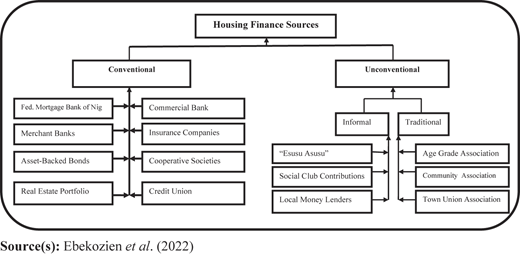
Similarly, Figure 1 summarised the sources of housing finance in developing countries. Grants and loans are components of a down payment grant. The loans can be amortising to ease the repayment patterns. Ergungor (2010) opined that some assistance programmes use down payment grants instead of loans. Regarding mortgage payment subsidies, Collins (2013) avowed that they reduce charges to be paid by the beneficiary (mostly restricted to developers with insufficient capital to access housing loans) for a housing project. Davis (2012) described mortgage interest deduction as a subsidy for home ownership and mostly used in the USA. It is the largest support for house owning there. This involves offering grants to municipal government, non-profit outfits, and private developers to assist in building and rehabilitating LCH. Credit enhancement as a housing finance model does not give direct financing for LCH but can be used to overcome financing hindrances. It improves the credit-worthiness of the beneficiary by mitigating or eradicating some identified financial threats (Jaffee and Quigley, 2009).
Despite several related studies, housing finance problems remain, especially in LCH, persists. Oladapo (2001) found lax cost management as an issue affecting LCH life cycle development and proposed a framework to manage it. Besides the insignificant in-depth of the LCH financing issue, the developed framework was based on reviewed literature. Luca (2017) identified seven encumbrances faced by the LInEs in attempting to address housing need. This includes access to finance, mortgage focusing on high-end market, high land cost in urban locations, delays in project completion, unqualified building professionals, building materials quality and bottlenecks in the building approval process. Garba et al. (2017) stated that previous research was conducted to mitigate the housing deficit encumbrances and provide policy directions for arresting the deficit monster, yet the issue remains. A good financing housing model should be sustainable. The term sustainability is multifaceted. It incorporates social, environmental and economic aspects (Odoyi and Riekkinen, 2022). Financing is key to influencing housing sustainability to address the three aspects (social, environmental and economic sustainability of housing) (Asfour, 2022). Thus, housing financing should focus on policies related to basic housing needs. The SSM mechanism is one way to achieve this goal. It is a mechanism that systematically proffers answers to complicated issues (Ebekozien et al., 2022a, b), such as the persistent housing financing crisis for LInEs.
3. Research method
3.1 Background
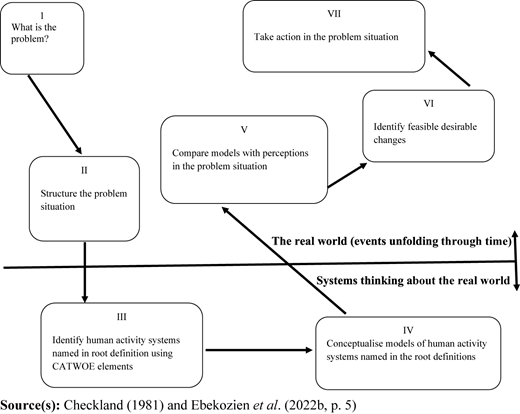
A SSM is a systematic approach to undertaking stubborn, complex issues (Checkland and Poulter, 2020; Ebekozien et al., 2022a, b). Checkland (1981) reported that it was in the late 1970s that Peter Checkland developed the mechanism. It is a cyclical learning method that uses models of human tasks to investigate with the participants (housing financing stakeholders) in the real-world issue (SLCH financing problems) and their insights into that circumstance to offer measures via a developed model. It is a qualitative method that can relate critical thinking to non-systematic conditions. The mechanism permits the researchers and the interviewees to gain insight into matters via investigation. Likewise, to apply steps to enhance it, as adapted in Figure 2. Ganiyu et al. (2017) adopted a similar qualitative approach in developing housing financing concepts in South Africa, but the SSM approach was not applied. Similarly, Ebekozien et al. (2022a, b) utilised the approach to developing a framework for building maintenance in Malaysia’s LCH. Checkland (1981) identified the steps involved (Figure 2).
The framework is accomplished through comprehensive virtual interviews with LCH financing participants. They are Ministry of Housing Senior Staffers, building managers/housing developers, academic housing experts, mortgage banks staffers, and LInEs in Benin City, Jos, Lagos, Kano, Federal Capital Territory (FCT), Kaduna, and Port Harcourt. Table 2 illustrates the details. These are top-rank urban locations in Nigeria (Ebekozien et al., 2021a, b). Besides ensuring that at least one participant represents each cluster to enhance generalisation and wider acceptance of findings, the researchers adopted a minimum of ten years of working experience to select the participants. The study achieved saturation. Table 2 reveals the interviewees’ rank and years of experience. The participants were residents and experts in their various fields. It shows the interviewees are knowledgeable regarding Nigeria’s LCH financing. The researchers adopted a purposive sampling technique and conducted it from November 2022 to January 2023. The interview questions were: what is the state of Nigeria’s LCH financing? How sustainable is the practice? What are the barriers facing SLCH financing? Can a SLCH financing framework guide key stakeholder? What are key stakeholders’ roles in ensuring a SLCH financing framework and expected results?
The researchers employed a thematic analysis to analyse the collected data from seven urban locations. At the 32nd interviewee, the study achieved saturation because there was no new concept. The 35 documents were manually analysed and aligned with Ibrahim et al. (2022) in developing the codes. They used the method to generate the initial coding for their study. First, the transcripts were coded and categorised into sub-themes. Second, the sub-themes were used at this stage, and new concepts were identified. The study’s objectives were generated from the categories. This aligns with Jaafar et al. (2021). The study utilised member checking, triangulation and researchers’ reflexivity as the validity techniques (Creswell and Creswell, 2018). Ninety codes were generated and re-organised based on reference, frequency and occurrence. The research developed eight sub-themes from the 90 codes. From the eight categories, three themes were generated. The interview presented a sound insight, customer, action, transformation, worldview, owner and environment (CATWOE) technique. The processes led to the proposed and developed framework to improve SLCH financing in Nigeria. They are described in the next section.
4. Findings
This section describes CATWOE via the seven steps approach.
Steps 1 and 2: Problem situation and organising
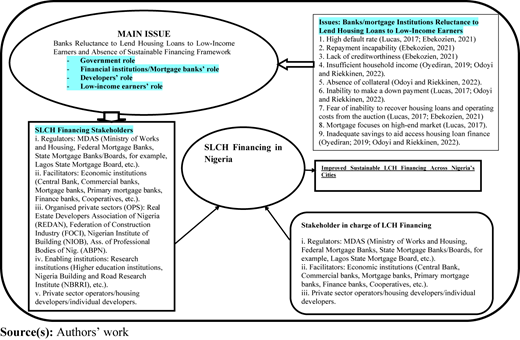
As previously stated, the study investigates the barriers to SLCH financing (banks’ reluctance to lend housing loans to LInEs). It develops a framework that would promote access to housing loans to purchase and construct LCH. A framework has become germane due to the obstinate supposed issues associated with LCH financing as one of the top root causes of affordable housing shortage, especially LCH. The study developed a robust viewpoint to organise the problem. Thus, identifying the first step in aligning with CATWOE is pertinent. Figure 3 identifies the issues from the complex LCH financing situation. The key issues, including LCH financing and other stakeholders, are identified. This aligns with Ebekozien et al. (2022a, b). They utilised the same approach and identified the task involved.
Figure 3 describes the key stakeholders of SLCH financing as regulators, facilitators and private sector operators. Refer to Figure 3 (P1-P7, P17-P20 & P33-P35) for the regulators. For the facilitators, refer to Figure 3 (P7, P8-P14, P22, P26 & P29-P35). The last is the private sector operators. This includes housing developers/individual developers (P18, P20 & P33-P35). Findings reveal that the National Housing Policy has a limited provision for promoting LInEs homeownership. This is complicated by the lax supervisory role of the Central Bank of Nigeria to the primary mortgage institutions regarding the enforcement and implementation of housing loans to eligible contributors (P15, P20, P29, P33 & P34). The allegation was rebuffed by one of the mortgage bank participants. Participant P11 says, “ …. we don’t need to apportion blame to A or B, but most times, these guys are ineligible to be given the housing loans. The creditworthiness of many is minus zero. This is a “red flag” for the banks ….” The absence of a sustainable financing framework to manage the system may have enhanced the complicated process (P5, P6, P12, P16-P21, P27, P28 & P30-P35). Participant P6 says, “ …. to bridge LCH gap in urban locations, SLCH financing framework is pertinent and should be backed by law. Thus, reviewing the National Housing Policy and the primary mortgage institutions” framework regarding LCH financing for the LInEs is long overdue. The government provision of seed money is inevitable to bridge LCH gap, especially in cities ….” Thus, a SLCH financing framework is pertinent.
Step 3: Root definition via CATWOE components
Stage 3 involves identifying the human task stated in the root definition via the CATWOE analysis. The CATWOE analysis is a component of the SSM processes that identifies the actors, expected transformation, worldwide view, ownership and environmental constraint, as illustrated in Table 3. It encompasses the main parties. They are clients (intending house owners), actors (stakeholders), transformation, worldwide view, ownership and environmental restriction in LCH financing. The analysis of SLCH financing is presented in Table 3.
Step 4: Conceptual framework
Findings show Nigeria’s poor state of SLCH financing (major). Most LInEs allege that LInEs are excluded from the housing finance initiatives because of the requirements such as a 10% down payment and a minimum of N30,000 (US$1/N870) repayment monthly. Meanwhile, some states are still paying N18,000 monthly. Findings agree with Fabiyi (2018), who reported that the state governors struggled to pay the minimum wage of N18,000 per month. Participants P1, P5 and P7 rebuffed the allegation. They claim that there is an internal mechanism in their states to enhance access to housing finance once the person is a regular salary earner. But a quick check shows something needs to be implemented for the LInEs homeownership. Participants P11, P17 and P31 identify the absence of an institutional framework as a possible cause of the poor state of SLCH financing. In step 4, the researchers proposed a framework and structured it using the CATWOE approach to address the issue holistically, as acknowledged in Figure 3 and Table 3. It is designed based on “transformation” component in the analysis. It shows that the Central Bank of Nigeria should enforce and implement the primary mortgage institutions in recapitalising. This includes providing short/long-term funding to housing developers and individuals (P7, P13, P26, P30, and P32); revamping the National Housing Trust Fund to be accessible to low-income earners (P3, P111, P23, P28, and P34); and encourage and support housing cooperatives and housing associations to access mortgage for their members (P1, P2, P16, P22, and P35), as presented in Table 2. The conceptual framework reveals the cause of lax SLCH financing and identifies the parties, as presented in Figure 3. Findings identify high default rate, absence of collateral, fear of inability to recover loan and operating costs from the auction, repayment incapability, lack of creditworthiness, insufficient household income, down payment issues, mortgage focusing on the high-end market, and inadequate savings to aid access to finance for housing loans as the root causes of reluctance by banks/mortgage institutions to lend housing loans to low-income earners, and by extension, affects SLCH financing across major cities in Nigeria. The housing developers and mortgage bank staffers emphasised that besides irregular income associated with the LInEs, it is difficult to manage them because of the weak collateral that may not be equivalent to the housing loan. Participants P5, P17, P21, P29 and P34 state the absence of an institutional framework for the National Housing Trust Fund to operate and the absence of LCH in the National Housing Policy to address the needs of the LInEs in the urban locations as the barriers hindering SLCH financing. These are germane to proffering solutions to improve LCH delivery system for LInEs across Nigeria’s cities. Accessible, affordable and SLCH financing via a SLCH financing framework can bridge the gap between demand and supply of LCH and improve LCH financing across Nigeria’s cities.
Step 5: Compare framework with insights into the problem matter
The modified framework is equated with the real-present matter. The research developed six constructs, as presented in Table 4. Table 4 summarised the analysis.
Step 6 Identify solutions that can bring changes
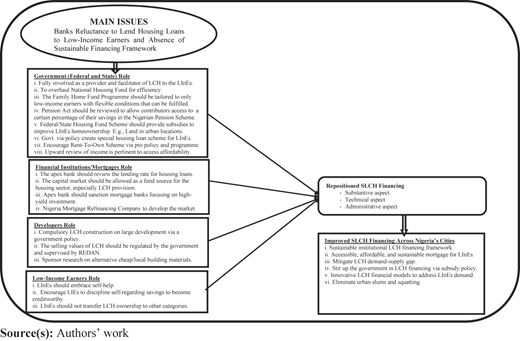
The demand for urban houses would continue to grow because Nigeria is experiencing population growth and urbanisation. Housing delivery, especially the LCH should reach the scale regarding sustainability and affordability levels (P31 and P34). The persistent banks’ reluctance to lend housing loans to LInEs across Nigeria’s cities is of concern to many (majority). Issues of persistent banks’ reluctance to lend housing loans to LInEs prompted a SLCH financing framework to promote access to housing loans to purchase and construct LCH for the LInEs across Nigeria’s cities (P2, P17, P22, and P35). Four sub-themes were generated in developing the LCH financing framework, as presented in Figure 4. This includes the government role, financial institutions/mortgages’ role, developers’ role and LInEs’ role.
Step 7: Act on the issue condition
Figure 4 shows that the items/constructs: LInEs should embrace self-help (P8, P18, P22-P28 & P33-P35), encourage LInEs to discipline self-regarding savings to become creditworthy (P3, P12, P23, P33 & P35) and LInEs should not transfer LCH ownership to other categories (P1-P4, P12, P14 & P29-P32) were integrated to develop “Low-income earners role.” One pertinent point is that government at all levels (federal, state and local governments) should be involved as a provider and facilitator of LCH to the LInEs. Participants agree that LCH financing should be all-inclusive, and the government should take the lead. Participant P33 says, “ …. we should not equate government role with other stakeholders regarding LCH provision. It is a social responsibility on the part of government to provide shelter, may not be for homeownership. Still, for affordable and accessible rent …. housing policies and programmes tailored towards LInEs homeownership are key but missing in the present schemes ….”
Regarding the financial institutions/mortgages’ role, findings agree that this construct will influence SLCH financing system. The sub-constructs include the apex bank should review the lending rate for housing loans (P6, P8-P13, P22-P26, P29, & P32). Capital market should be allowed as a source of funds for the housing sector, especially LCH provision ((P2, P7, P25, & P30), apex bank should sanction mortgage banks focusing on high yield investment ((P3, P17, P22-P27, & P29-P32), and the Nigeria Mortgage Refinancing Company to develop the market (P4, P11, P20, P24-P27, & P30-P35) were integrated to generate “financial institutions/mortgages” role’. Participant P25 says, “ …. with the two-figure digit, LInEs can’t honour the repayment agreement if managed to secure the housing loans. Perhaps, the reasons for high default from this category of people because of the lack of creditworthiness ….” This is an issue that this framework attempts to proffer measures, as highlighted in Figure 4.
Findings show that the appropriate authorities should supervise financial institutions/mortgage banks and programmes such as Family Home Programme and the Housing Fund Scheme. The Family Home Programme is a special Federal Government of Nigeria initiative via the Family Homes Fund. Nigeria Sovereign Investment Authority and the Federal Ministry of Finance support the scheme. The programme targets 500,000 LCH units for the LInEs. Regarding the Housing Fund Scheme, the supervision has become germane because majority of the LInEs contributors to the National Housing Fund scheme are denied their housing units. The outcome would mitigate bribery and corruption, restore system transparency and promote SLCH financing. If corruption is curbed, contributions to the National Housing Fund Scheme offer LInEs Nigerians an affordable path to own their homes. Besides the Rent-To-Own scheme approach to reduce the financial burden on government and mortgage institutions, income increase will greatly enhance savings (P12, P26, P31, and P32). The rent-to-own scheme allows the beneficiary to take ownership of the building, and pay and own the property in monthly rental payments until the person retires from service. The beneficiary can liquidate the facility anytime the financial capacity is there.
Participant P31 says, “ …. Improved SLCH financing will eliminate urban slums and squatting, stir up the government in LCH financing via subsidy policy, and mitigate LCH demand-supply gap. …” The developed framework emphasises sustainable institutional LCH financing and innovative LCH financial models to address LInEs demand. SLCH financing has been one of the critical encumbrances to housing provision for the LInEs, especially in developing countries like Nigeria. Feasible measures of the main issues (banks’ reluctance to lend housing loans to LInEs) are identified in Figure 4. These issues are barriers to SLCH financing in Nigeria. It emphasises three aspects for SLCH financing to be transposed for efficiency and performance. This includes substantive, technical and administrative aspects. Regarding the substantive aspect, the regulators include MDAS (refer to Figure 3), and facilitators include economic institutions (refer to Figure 3) in conjunction with the private sector operators, will improve access to housing loans for the purchase and construction of low-cost houses for the low-income earners across Nigeria’s cities. The positive influence of the proposed overhaul of the National Housing Fund and the review of the Pension Reform Act 2014 to accommodate and promote LInEs home ownership cannot be overstated in this framework (P4, P9, P12 & 34). For the administrative aspect, the partnership of the apex bank with the Nigeria Mortgage Refinance Company and encouraging housing cooperations and housing associations to access housing loans on behalf of their members will promote access to housing loans for the purchase and construction of low-cost houses for the LInEs across Nigeria’s cities (P8, P14, P22, P28, and P35).
5. Discussion
The challenges to meeting the financial needs of LInEs to become homeowners are a global phenomenon, but the problem continues, especially in developing countries like Nigeria. Findings reveal that besides the poor state of SLCH financing, leading to a housing shortage across major cities, there is an absence of a framework to enhance SLCH financing and promote access to housing loans to purchase and construct LCH for the LInEs across Nigeria’s cities. Findings agree with Acheampong et al. (2015), Garba et al. (2017), Luca (2017), Oyediran (2019), Ebekozien (2021), Ebekozien et al. (2021a, b) and Odoyi and Riekkinen (2022). Odoyi and Riekkinen (2022) corroborated the submission of Ebekozien (2021) and Ebekozien et al. (2021a, b). Ebekozien (2021) and Ebekozien et al. (2021a, b) identified housing finance as one of the critical issues that stakeholders should address to bridge the demand-supply gap. The issue of housing finance inaccessibility is critical in most developing countries. In Ghana, LInEs inaccessibility to mortgage finance widens the gap between house prices and income (Acheampong et al., 2015). Odoyi and Riekkinen (2022) avowed that housing funding, especially for the LInEs, is a major policy mechanism for housing development through the proper organisation of financial mortgage institutions. The Nigerian housing policy strategy on funding, especially for the LInEs, is faulty and contributed to the increasing urban slums and squatters, including the wide demand and supply gap.
Findings identified high default rate, repayment incapability, lack of creditworthiness, fear of inability to recover loan and operating costs from the auction, insufficient household income, lack of collateral, down payment issues, mortgage focusing on the high-end market, and inadequate savings to aid access to finance for housing loans as the barriers facing LInEs in accessing LCH finance in Nigeria. Managing some of these barriers could be challenging for unconventional housing finance sources such as community finance institutions, “Esusu Asusu”, local money lenders and town union associations. The Reall’s global network model is not exempted from these encumbrances (Jones and Stead, 2020). They affirmed that making shelters affordable for LInEs demands huge financial measures and robust de-risking efforts. Reall’s and CLIFF model’s homeownership sustainability is relative, especially in Africa, with high record of default in housing loans (Ebekozien et al., 2022a, b). Thus, these barriers are the root causes of banks/mortgage institutions’ reluctance to lend housing loans to LInEs, and by extension, affect SLCH financing across major cities in Nigeria. Findings agree that sustainability of housing finance is a threat if sourcing is only from unconventional sources.
The government role cannot be over-emphasised for enhanced and sustainable LInEs housing finance. The government’s key role is formulating policies and programmes for efficient housing markets (Llanto, 2007). Findings agreeing with (Luca, 2017; Oyediran, 2019; Garba et al., 2017; Ebekozien, 2021; Ebekozien et al., 2021a, b; Odoyi and Riekkinen, 2022) found that housing delivery differs the expectation regarding sustainability and affordability, especially for the LInEs. This may become a threat, if necessary, action is not taken to mitigate it because of the growing annual urbanisation rate of 3.5% over the past 20 years (Oyediran, 2019). Ebekozien (2021) found that the lacuna in the National Housing Policy aids many housing developers in circumventing LCH development as obtainable in countries like Malaysia. The mandatory construction of LCH in prime construction would have bridged the LCH demand-supply gap. Odoyi and Riekkinen (2022) found housing funds as one of the top strategic themes to strengthen affordable housing development. They affirmed that these housing policy strategies, including funding, have not positively impacted solving LCH issues in Nigeria. The government (federal and state) should embrace housing provision as a welfare scheme, especially LCH for the LInEs. Findings suggest that the state government should develop policies such as tax waivers to encourage housing developers to build LCH for LInEs at a regulated price. It should be a requirement for high-income building project approval. However, Feather and Meme (2019) found that community financial institutions have greatly assisted underdeveloped housing prospective borrowers in accessing housing finance. In some instances, LInEs are more concerned about the sustainability of their livelihoods to enable them to “pay the bills” than homeownership (Smith and Brown, 2019).
Findings reveal a need for an all-inclusive mechanism to revamp SLCH financing through a feasible framework, as illustrated in Figure 4. The main constructs integrated into the model to achieve enhanced SLCH financing and promote access to housing loans for the purchase and construction of LCH for the LInEs across Nigeria’s cities are government role, financial institutions/mortgages’ role, developers’ role and LInEs role. Findings agree that the government should be the leading stakeholder in SLCH financing for LInEs via a viable framework. This is indisputable because of the role of policies and programmes that can promote home ownership (Ebekozien, 2021). In Africa, including Nigeria, government (federal and state) role in various financing models is pertinent to improve financing models for sustainable LInEs housing delivery (Mitlin and Bartlett, 2020). Findings show that initiatives of the connection with the citizen and market need to be stronger, enhancing the housing demand-supply gap. This is one of the study’s motivations via the framework to address the germane issue and enhance sustainable housing financing model to improve LInEs housing delivery. Also, the supervisory role of the apex bank should be strengthened to avoid the threat to Sustainable Development Goal 11 “cities and human settlements inclusive, safe, resilient, and sustainable” (United Nations, 2020). Findings agree with Oyediran (2019) and found that the lending rate in Nigerian financial institutions has yet to make it worthwhile for the LInEs housing delivery drive. Ebekozien et al. (2022a, b) corroborated Oyediran (2019) and found that LInEs preferred unconventional sources of housing finance to conventional sources because of accessibility and repayment plans. The challenge is that housing projects require large capital, and many of these unconventional sources need more capacity for such funds. Examples of unconventional sources are Esusu Asusu, social club contributions, local money lenders, age grade association, community association and town union association.
On the developers’ role, findings agree that the housing developer’s role should be well defined as a key stakeholder in the housing sector. Three key sub-constructs emerged. This includes compulsory LCH construction on large development via a government policy, selling values of LCH should be regulated by government and supervised by REDAN, and sponsoring research on alternative cheap/local building materials. Regarding LCH construction on large-scale development, this is a familiar housing policy in developing countries because Malaysia has developed her LCH via this mechanism. Results aligned with Ebekozien et al. (2018). They discovered that the Malaysian Government construct houses for LInEs via policy to access mortgage and regulations favouring LInEs. Example is the compulsory LCH construction imposed on the housing developers with regulated selling prices to eligible LInEs. Sanctions for developers circumventing the policy are weighty and enforceable (Ebekozien et al., 2018). As presented in Figure 4, the framework integrates three aspects to transpose SLCH financing and promote access to housing loans to purchase and construct LCH for the LInEs across Nigeria’s cities.
6. The study’s theoretical and practical implications
Regarding the study’s theoretical implications, the reviewed literature reveals a paucity of SLCH financing. The adopted SSM was used to develop the framework. This is novel in the history of housing financing models in developed and developing countries. This mechanism is a problem structuring method pertinent to proffering solutions to the LCH financing issues that have persisted in developing countries using Nigeria as a case study. The SSM permitted the interviewees to suggest a workable framework from the participants’ perspectives. This study would fill the existing methodological gap as reviewed. Also, the study proposed a framework that aided the developed framework. This aligns with Checkland (1981) and Ebekozien et al. (2022a, b), as illustrated in Figures 3 and 4. Thus, both frameworks are part of the study’s contribution to the body of knowledge. Theoretically, the study highpoints SLCH financing measures and a framework developed.
This research confirms the poor state of SLCH financing in Nigeria, leading to a housing shortage across major cities, especially homes for the LInEs. The study’s developed framework is inclusive because the role expected from the key stakeholders formed part of the constructs. Thus, collaboration is required to yield the expected outcomes. Hence, due to the recommended measures, the study’s findings are meaningful to housing policymakers, mortgage institutions, developers and LInEs. This includes the selling values of LCH should be regulated by the government (federal and state) and supervised by REDAN (national and state), LInEs should not transfer LCH ownership to other categories, and the apex bank should review the lending rate for housing loans. The developed framework provides a pertinent direction for optimising SLCH financing via an implementable framework. Besides the framework guiding practicing stakeholders in promoting SLCH financing, it is a regulatory framework that strengthens public housing institutions and challenges corruption head-on (Ebekozien et al., 2021a, b).
7. The study’s limitations and areas for future research
Besides utilising a qualitative method via SSM mechanism as a limitation, the research covered seven cities across Nigeria, and saturation was achieved. The extensive literature review reduced the coverage impact on the study’s results. Thus, the results could be adapted and applied to developing nations with similar LCH financing scenarios. Also, future study should consider validating the study’s developed framework via a quantitative approach.
8. Conclusion
This research explored the state of SLCH financing. The study developed a framework to enhance SLCH financing and promote access to housing loans for purchasing and constructing LInEs in Nigeria via SSM. The study results reveal that the barriers connected with LCH financing are still obstinate. Thus, inaccessibility to LInEs housing finance is top on the barriers that have enhanced LCH demand-supply gap in Nigeria. Given these encumbrances and the prevailing housing policies and programmes, including the housing market and finance circumstances, the study calls for innovative all-inclusive mechanisms for financing LCH for the LInEs in Nigeria. Findings show the need for a viable framework to proffer answers to the obstinate SLCH financing. This may threaten Goal 11 of the SDGs if not addressed. To proffer measures to address the barriers, a viable all-inclusive framework was developed via collaboration with key stakeholders to enhance SLCH financing, as illustrated in Figure 4.
The framework aims to enhance SLCH financing and promote access to housing loans to purchase and construct LCH. It will improve the state of SLCH financing, especially for housing policymakers, developers, mortgage banks’ staffers and intending house owners in Nigeria. It is a collaborative approach driven by the government. The framework defines the expectations of the four key stakeholders (government [federal and state], financial institutions, housing developers, and LInEs) to achieve improved SLCH financing across Nigeria’s cities. The proposed sustainable institutional LCH financing framework could offer an innovative LCH financial model to address LInEs demand, eliminate urban slums and squatting, mitigate LCH demand-supply gap, and improve accessible, affordable and sustainable mortgages for LInEs.
The authors convey special thanks to the participants for providing scholarly contributions to enhance the findings of this study and also to Dr S. S. Umar (Rector, Auchi Polytechnic) and his team for creating an enabling environment to contribute to this research. The authors appreciate the comments, suggestions and recommendations provided by the anonymous reviewers, which honed and strengthened the quality of this manuscript during the blind peer-review process.
Funding: The research was funded by the Faculty of Engineering and the Built Environment and CIDB Centre of Excellence (05-35-061890), University of Johannesburg, South Africa.