
Skip to article sections
Purpose

The demand for sustainability is reshaping project governance in construction and other project-based industries, yet current entrepreneurial project management (EPM) processes remain inadequately theorised in relation to long-term environmental and social value creation. This paper addresses this important literature gap by proposing a sustainable entrepreneurial project management (S-EPM) framework that integrates entrepreneurial theory and sustainability logic across the project lifecycle.

Design/methodology/approach

This paper adopts a theory-building design grounded in a critical and integrative literature review to advance sustainable entrepreneurial project management. The literature searched was guided by the following keywords: entrepreneurial project management, sustainability theory, project governance and lifecycle management across major academic databases and screened for conceptual relevance. This is followed by synthesising through iterative coding and comparison to develop the S-EPM framework.

Findings

The review shows that sustainability is best understood not as an external constraint or end-state but as a governing logic that regulates entrepreneurial discretion under uncertainty. The resulting S-EPM framework underscores how the intersection of entrepreneurial mindset and sustainability logic operates through project entry and formulation, project performance and project exit and transition. This logic highlights important mechanisms such as continuous justification, stakeholder co-creation, adaptive learning and resilience-oriented governance relevant in contemporary project management.

Originality/value

This paper contributes a novel S-EPM framework that moves beyond the mere intersection of entrepreneurship and sustainability by identifying sustainability-governed entrepreneurial value creation as the framework's core logic. This S-EPM framework offers a distinct theoretical lens for emphasising the relevance of project governance, long-term value creation and sustainability-oriented leadership in complex project environments.

Project-based organisations are increasingly operating in environments shaped by sustainability pressures, rapid technological change, evolving regulation, and rising stakeholder expectations (Martinsuo and Anttila, 2022; Rahman et al., 2025; Sparrevik et al., 2021). These dynamics expose the limits of conventional project management approaches that remain grounded in assumptions of predictability, control, and efficiency. Such assumptions are increasingly difficult to sustain in contemporary projects environments characterised by fragmentation, long time horizons, systemic risk, and interdependent stakeholder environments, particularly in large-scale and sustainability-sensitive settings (Childs et al., 2022; Gil-López et al., 2022).

In response, two prominent streams of academic scholarship have developed in parallel: entrepreneurial project management (EPM) and sustainability-oriented project management. EPM foregrounds adaptability, innovation, opportunity recognition, and decentralised decision-making, offering a more dynamic alternative to conventional project management paradigms (Cook, 2017; Mbiru et al., 2024). Whereas sustainability-oriented research, by contrast, calls for projects to move beyond short-term economic performance and contribute to long-term environmental integrity, social well-being, and economic resilience (Silvius and Schipper, 2025). Despite their shared concern with contemporary project challenges, these streams of the literature have rarely been integrated into a coherent theoretical model to advance contemporary project management discourse.

The absence of this integration in project management creates a clear theoretical gap. Existing EPM scholarship underscores innovation, flexibility, and opportunity-driven value creation, yet offers limited guidance on how entrepreneurial discretion should be constrained or redirected when environmental, social, and intergenerational responsibilities are at stake (Pachón and Velosa García, 2024). Conversely, sustainability-oriented project management frameworks often underplay the uncertainty, speed, and experimentation that characterise entrepreneurial project environments (Mbiru et al., 2023). As a result, project management theory still lacks a compelling justification of how entrepreneurial agility and sustainability imperatives can be reconciled across the project lifecycle.

This paper proposes a Sustainable Entrepreneurial Project Management (S-EPM) framework through a critical and integrative literature review. Rather than simply combining two adjacent bodies of work, the paper argues that sustainability should be understood as a governing logic that regulates entrepreneurial project behaviour, decision-making, and value realisation over time. The central claim is intentionally selective: S-EPM is best explained through the continuous justification of entrepreneurial action against long-term environmental, social, and economic consequences. This provides the paper with a more explicit and analytically biased lens than a broad checklist-style integration.

The paper is guided by the following question: how can sustainability be theorised as a governing logic within entrepreneurial project management across the project lifecycle? To address this question, the study adopts a theory-building approach based on a structured critical literature review. The review identifies the current state of research, isolates the unresolved tension between entrepreneurial agility and sustainability accountability, and synthesises a lifecycle-based conceptual framework. The resulting framework explains how entrepreneurial and sustainability logics interact across project entry and formulation, project performance, and project exit and transition phases.

The contribution of the paper is threefold. First, it reconceptualises sustainability as a structuring logic that reconfigures entrepreneurial project practices rather than as a constraint or end-state. Second, it extends EPM scholarship by offering a distinct conceptual architecture centred on sustainability-governed entrepreneurial value creation. Third, it provides a lifecycle-based framework that can guide future empirical work on project governance, stakeholder legitimacy, adaptive learning, and long-term value in complex project settings.

The remainder of the paper is structured as follows. Section 2 outlines the review methodology and article selection process. Section 3 presents the results of the integrative analysis, leading to the development of the theoretical foundation and the S-EPM framework and its lifecycle structure. Section 4 discusses the theoretical and practical implications of the framework. Section 5 concludes the paper followed by an outline of the study's limitations and directions for future research.

This study adopts a theory-building design grounded in a critical and integrative literature review. The review was designed to address a conceptual rather than empirical question: how can sustainability be theorised as a governing logic within entrepreneurial project management across the project lifecycle? A critical integrative approach was appropriate given that the relevant knowledge base is fragmented across project management, entrepreneurship, sustainability, project governance, and construction management, requiring interpretation, comparison, and conceptual synthesis rather than descriptive aggregation. The review followed a structured and transparent protocol comprising three interrelated stages –planning, conducting, and reporting – adapted from established review guidelines (Okoli, 2015). In the planning stage, the scope of the review was defined guiding by the research question seeking to examine how EPM and sustainability principles can be theoretically integrated. This ensured alignment between the research objectives and the subsequent analytical process.

The review stage involved a comprehensive literature search across multiple academic databases, including Scopus, Web of Science, and Google Scholar, to ensure broad interdisciplinary coverage. Search strings combined keywords such as “entrepreneurial project management”, “sustainable project management”, “project sustainability”, “project management principles”, and “construction project management” using Boolean operators. The search focused on peer-reviewed journal articles, book chapters, and high-quality conference proceedings published in English between 2015 and 2026.

The selection process was informed by PRISMA (Preferred Reporting Items for Systematic Reviews and Meta-Analyses) principles to enhance transparency in article identification, screening, and inclusion (Page et al., 2021). An initial pool of approximately 321 records was identified across databases. After removing duplicates and conducting title and abstract screening, 96 articles were retained for full-text assessment. Following eligibility screening, 52 articles were included in the final synthesis based on their conceptual relevance, theoretical contribution, and alignment with the study's focus. In addition, four foundational documents published by the Project Management Institute (PMI, 2017, 2021, 2023, 2024) were incorporated to reflect established professional standards and contemporary developments in project management practice. Article quality was assessed based on conceptual clarity, theoretical contribution, and relevance to the research objectives.

Data extraction was conducted using a structured template to capture key themes, theoretical perspectives, and conceptual linkages across the selected studies. The analysis followed a reflexive thematic approach, combining deductive and inductive coding strategies (Braun and Clarke, 2006). Initial coding was guided by established constructs in entrepreneurship and sustainability, followed by iterative refinement through constant comparison to identify emergent themes and relationships.

In the reporting stage, the synthesised insights were integrated to develop the S-EPM framework. This involved identifying core principles, underlying mechanisms, and their organisation across three interrelated project lifecycle phases: entry and formulation, performance, and exit and transition. This integrative synthesis enables the development of a theoretically coherent framework in which sustainability operates as a governing logic shaping EPM practice.

Contemporary project environments are characterised by a persistent tension between the need for entrepreneurial adaptability and the growing imperative for sustainability-oriented accountability. EPM emphasises flexibility, innovation, and opportunity-driven value creation, whereas sustainability theory introduces longer-term considerations of environmental integrity, social legitimacy, and systemic responsibility. This unresolved tension provides the point of departure for the theoretical development that follows, guiding the integration of entrepreneurial and sustainability logics within a unified explanatory framework.

Entrepreneurial project management has emerged as a response to this tension, offering a project management approach that prioritises adaptability, opportunity recognition, and innovation in increasingly uncertain and dynamic environments (Sajid et al., 2021). Departing from traditional plan-driven and control-oriented approaches, EPM emphasises flexibility, decentralised decision-making, and opportunity-oriented value creation, enabling projects to adapt to evolving conditions rather than merely execute predefined plans (Popowska, 2020). This shift reflects a broader reorientation of project management scholarship toward entrepreneurial logics that privilege experimentation, learning, and strategic judgement (Cook, 2017; Di Muro et al., 2021; Mbiru et al., 2020).

A pivotal conceptual contribution was made by Cook (2017), who reframed project leadership as an entrepreneurial function centred on innovation, opportunity navigation, and sensemaking under uncertainty. Subsequent work by Mbiru et al. (2020), Tamberg et al. (2021) and Mbiru et al. (2023), among others, further operationalised EPM by mapping entrepreneurial capabilities such as proactiveness, risk-taking, and innovativeness onto core project management practices. Collectively, this literature positions EPM as a mechanism for enhancing the strategic relevance and transformative potential of projects, particularly in dynamic and resource-constrained contexts.

Despite these advances, EPM scholarship remains predominantly oriented toward economic value creation, innovation performance, and competitive advantage. Broader societal, environmental, and intergenerational considerations are often treated as contextual factors rather than integral components of entrepreneurial project logic. As a result, EPM offers limited theoretical guidance on how entrepreneurial agility can be reconciled with sustainability imperatives that extend beyond short-term performance. This limitation points to the need for a more explicit integration of sustainability theory into EPM. However, while EPM strengthens adaptability and opportunity-driven action, it remains limited in its capacity to account for the long-term environmental, social, and systemic consequences of project decisions. This limitation highlights the need for a complementary theoretical perspective that can govern and orient entrepreneurial behaviour towards sustainability objectives.

Sustainability theory provides this complementary perspective by introducing a normative and systems-oriented lens through which project decisions can be evaluated in terms of long-term environmental integrity, social legitimacy, and economic viability (Han, 2021; Ruggerio, 2021). Rather than a static objective, sustainability is inherently multidimensional and dynamic, requiring the integrated consideration of environmental, social, and economic systems over extended temporal and spatial scales (Van Zanten and Van Tulder, 2021).

To address this complexity, sustainability scholarship has developed several conceptual lenses. Among these, the five interrelated concepts of choice, values, clarity, scale, and systems thinking provide a robust theoretical foundation for sustainability-oriented decision-making (Albakri and Wood-Harper, 2025; Broman and Robèrt, 2017; Harrington, 2016). Choice highlights the inevitability of trade-offs, requiring explicit decisions about what is sustained, for whom, and over what time horizon (Malakar et al., 2024). Values foreground the normative and ethical dimensions of sustainability, recognising that sustainability priorities are socially constructed and context dependent (Fry and Egel, 2021).

Clarity addresses the risk of sustainability becoming ambiguous or symbolic by emphasising the need for explicit definitions, boundaries, and performance criteria (Adolph and Beckmann, 2024). Scale draws attention to the spatial and temporal reach of sustainability interventions, acknowledging that actions effective at one level may generate unintended consequences at another (Röck et al., 2021). Systems thinking integrates these dimensions by framing sustainability as a set of interconnected relationships across social, environmental, and economic systems, enabling attention to feedback loops and long-term effects (Van Zanten and Van Tulder, 2021).

Together, these concepts form a coherent sustainability lens that is particularly salient for project-based organising (Ebekozien et al., 2024; Harrington, 2016). Projects, despite being temporary and resource constrained, can generate long-lasting impacts through their outputs, decisions, and institutional arrangements (Pirozzi et al., 2023). Within project management, sustainability is commonly operationalised through economic, environmental, and social dimensions, which must be addressed holistically rather than in isolation (Wijewickrama et al., 2026).

When compared, EPM and sustainability theory reveal a fundamental theoretical tension. EPM foregrounds opportunity recognition, speed, adaptability, and proactive value creation, whereas sustainability introduces normative commitments, temporal extension, and systemic accountability. This tension creates a productive space for reconceptualising how projects are governed, justified, and evaluated over time. Rather than viewing entrepreneurial and sustainability logics as competing, this paper positions them as complementary, forming the basis for an integrated theoretical framework capable of explaining how projects can simultaneously pursue agility, innovation, and long-term sustainable value.

Taken together, these perspectives suggest that neither entrepreneurial adaptability nor sustainability considerations alone are sufficient; rather, there is a need for an integrated approach in which entrepreneurial action is guided and constrained by sustainability-oriented principles across the project lifecycle.

The central theoretical challenge is not whether entrepreneurship and sustainability are both relevant to projects, but how entrepreneurial discretion should be governed when project decisions generate long-term environmental, social, and economic consequences. Existing studies tend to juxtapose these logics: EPM explains how projects remain adaptive and opportunity seeking under uncertainty, whereas sustainability theory explains why project decisions should remain accountable to broader systems, values, and time horizons (Frese and Gielnik, 2023; Gomes Silva et al., 2022).

This paper therefore adopts an intentionally selective position. Rather than building a comprehensive hybrid of all entrepreneurial and sustainability constructs, it proposes a single unifying lens: sustainability-governed entrepreneurial value creation. Under this view, entrepreneurial behaviours such as innovation, experimentation, decentralised judgement, and opportunity recognition remain essential, but they must be continuously justified against systemic effects, normative commitments, and long-term value consequences. Sustainability is thus not treated as a project outcome to be added at the end, but as a governing logic that reshapes what counts as legitimate entrepreneurial action throughout the project lifecycle. This distinct theoretical lens addresses the criticism that conceptual frameworks become operational checklists when they fail to explain why particular actions matter. Building on this theoretical integration, the following sub-section presents the S-EPM framework as a structured response to this tension.

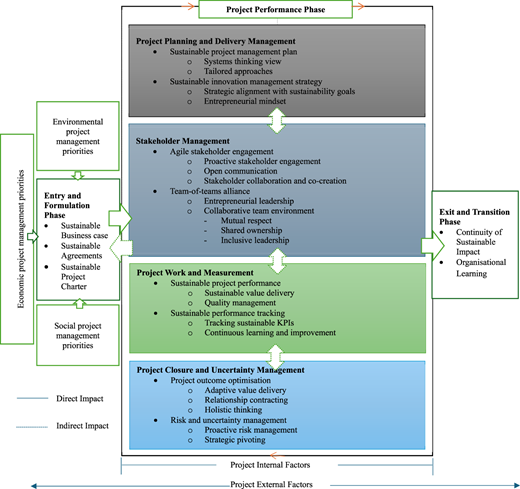
The S-EPM framework (see Figure 1) is organised around a single governing logic—continuous justification of entrepreneurial action in relation to long-term environmental, social, and economic value. This logic provides the framework with theoretical partiality: it underscores the question of how entrepreneurial project behaviour is strategically adaptive while also remaining systemically and ethically defensible over time. The framework is structured across three lifecycle phases: project entry and formulation, project performance, and project exit and transition. The framework is situated within broader internal and external project conditions, acknowledging that entrepreneurial action and sustainability outcomes are shaped by organisational capability, project governance systems, regulation, stakeholder pressure, and socio-economic context (PMI, 2021; Rahman et al., 2025).

3.4.1 Project performance phase

The project performance phase is the analytical core of the S-EPM framework because it is where entrepreneurial action is repeatedly tested against sustainability commitments. It comprises four interrelated domains: project planning and delivery management, stakeholder management, project work and measurement, and project closure and uncertainty management. These domains operate iteratively rather than sequentially, allowing project teams to combine experimentation, learning, and adaptation with accountability for long-term environmental, social, and economic value (Faraji et al., 2022; PMI, 2021).

3.4.1.1 Project planning and delivery management

Project planning and delivery management translates strategic intent into action while retaining adaptability in execution. Within S-EPM, planning is not a one-off design exercise but an ongoing process that integrates systems thinking, tailored approaches, and sustainability-aligned innovation. The core issue is not simply whether projects innovate, but whether innovation remains aligned with long-term value commitments and can therefore be continuously justified under uncertainty (Aulia et al., 2023; Moreno-Monsalve et al., 2023). This component comprises two interrelated elements: the Sustainable Project Management Plan and the Sustainable Innovation Management Strategy, which together align strategic intent, operational execution, and sustainability outcomes.

3.4.1.1.1 Sustainable project management plan

The Sustainable Project Management Plan translates strategic intent into adaptive execution by embedding sustainability across environmental, social, and economic dimensions (Carboni et al., 2024; Mokbel et al., 2024). It is underpinned by systems thinking and tailoring approaches. Systems thinking enables project managers to consider broader organisational and societal impacts, supporting informed decision-making under complexity (Sparrevik et al., 2021). Tailoring recognises contextual variability and uncertainty, allowing planning approaches to be adapted through agile or hybrid methods in alignment with organisational capabilities, regulatory conditions, and resource constraints (Schmidtner et al., 2023).

3.4.1.1.2 Sustainable innovation management strategy

Within the S-EPM framework, innovation is aligned with sustainability objectives to ensure long-term environmental, social, and economic value (Pachón and Velosa García, 2024; Silvius and Schipper, 2025). This strategy is guided by strategic alignment and an entrepreneurial mindset. Innovation initiatives are evaluated based on their contribution to sustainability goals and long-term value creation (Abhayawansa et al., 2021). An entrepreneurial mindset supports adaptability and innovation while balancing experimentation with ethical responsibility, systems awareness, and learning-oriented behaviours in uncertain project environments (Afeltra et al., 2023).

3.4.1.2 Stakeholder management

Within the S-EPM model, stakeholder management is positioned as a core mechanism for long-term value creation, emphasising inclusivity, ethics, and transparency (Shaukat et al., 2022). Moving beyond instrumental views, S-EPM frames stakeholders as long-term partners in co-creating social, environmental, and economic value (Malik et al., 2022). This sustainability-oriented perspective requires continuous and adaptive engagement that reflects systemic interdependencies and evolving priorities. Accordingly, stakeholder management in S-EPM is operationalised through two interrelated components: agile stakeholder engagement and a team-of-teams alliance (Dugbartey and Kehinde, 2025; Patrício and Franco, 2022).

3.4.1.2.1 Agile stakeholder engagement

In complex project environments, stakeholder expectations are dynamic and context-dependent (Eisman et al., 2021). Agile stakeholder engagement addresses this by promoting flexible, responsive, and value-driven interaction grounded in inclusivity and participation (Shaukat et al., 2022). Early and continuous involvement enables adaptation to feedback, collaborative risk mitigation, and socially legitimate outcomes in entrepreneurial contexts (Dugbartey and Kehinde, 2025). This approach is enacted through proactive engagement, open communication, and stakeholder collaboration. Proactive engagement ensures early identification of key stakeholders; open communication supports transparency and trust, and co-creation fosters shared ownership and more resilient outcomes (Gerlak et al., 2023; Kujala et al., 2022).

3.4.1.2.2 Team-of-Teams alliance

The team-of-teams alliance reframes internal stakeholder management by emphasising decentralised coordination, leadership, and cross-functional collaboration in sustainability-oriented projects (Mukherjee and Albrecht, 2025). While entrepreneurial projects rely on agility, sustainability challenges require networked structures that enable diverse expertise and coordinated action (Arshad et al., 2024). This approach fosters interconnected teams with shared purpose and decision autonomy, enhancing responsiveness and collective intelligence (Lanteri, 2021). Within S-EPM, this alliance is enabled through entrepreneurial leadership and a collaborative team environment. Leadership promotes adaptability, learning, and alignment with sustainability goals, while collaboration supports shared ownership, transparency, and coordination (Asad et al., 2024; Nauman et al., 2022). These practices strengthen trust, reduce silos, and enhance the capacity to manage complexity and deliver sustainability-aligned outcomes.

3.4.1.3 Project work and measurement

The Project Work and Measurement component gives operational substance to the S-EPM framework's governing logic. Sustainable project performance is assessed not only by immediate outputs, but also by how work processes, resource decisions, and quality criteria contribute to enduring value (Asad et al., 2024; Cheng et al., 2025; Ofori, 2023). This component comprises two interrelated elements: sustainable project performance and sustainable performance tracking.

3.4.1.3.1 Sustainable project performance

Sustainable project performance extends success beyond outputs to include ethical conduct, stakeholder value, and long-term impact (Zada et al., 2024). Within S-EPM, performance is also assessed by alignment with integrity, adaptability, and sustainability objectives (Eyieyien et al., 2024). Broadly, sustainable project performance is underpinned by sustainable value delivery and quality management. Sustainable value delivery aligns outputs with long-term economic, environmental, and social benefits, supported by stakeholder-informed priorities and systems thinking (Van Zanten and Van Tulder, 2021). Quality management on the one hand, expands beyond technical compliance to include transparency, resilience, and stakeholder trust, integrating sustainability criteria across both processes and outcomes through continuous evaluation and feedback (Reza et al., 2025; Zhao et al., 2023).

3.4.1.3.2 Sustainable performance tracking

Sustainable performance tracking in S-EPM extends beyond traditional metrics to capture environmental, social, and organisational contributions, supporting accountability and adaptive learning (Kerzner, 2022). It is operationalised through sustainability key performance indicators (KPIs) and continuous learning. Sustainability KPIs include indicators such as carbon footprint, resource efficiency, and social impact, combining quantitative tools and qualitative insights for comprehensive performance evaluation (Mio et al., 2022; Ofori, 2023). Continuous learning embeds reflection and stakeholder feedback into project processes, enabling teams to adapt strategies, refine decisions, and enhance long-term value creation (Bernal Torres et al., 2021; Suriyankietkaew et al., 2022).

3.4.1.4 Project closure and uncertainty management

In S-EPM, project closure is a strategic, reflective process rather than a procedural endpoint, designed to consolidate outcomes, ensure sustainability, and manage uncertainty (Caibula et al., 2021). S-EPM integrates outcome optimisation with forward-looking uncertainty management, comprising two sub-components: project outcome optimisation and risk and uncertainty management.

3.4.1.4.1 Project outcome optimisation

Project outcome optimisation ensures enduring value by aligning results with entrepreneurial intent and sustainability objectives (Guo and Zhang, 2022). This includes three interrelated mechanisms: adaptive value delivery, relationship contracting, and holistic thinking. Adaptive value delivery considers outcomes as evolving contributions continuously reassessed against stakeholder needs, regulatory shifts, and emerging sustainability priorities (Moghaddasi et al., 2025). Relationship contracting extends closure into long-term partnerships, maintaining collaboration, trust, and shared responsibility among stakeholders for ongoing monitoring and enhancement of benefits (Abeysekera, 2022). Holistic thinking situates closure within broader socio-economic and ecological systems, integrating project outputs with organisational strategies, community development, and global sustainability goals (Aghajani et al., 2023). By combining adaptive, relational, and systems-oriented approaches, S-EPM ensures closure strengthens both stakeholder legitimacy and the long-term impact of sustainability-driven projects.

3.4.1.4.2 Risk and uncertainty management

Projects often unfold amid ambiguity, volatility, and incomplete information, with sustainability integration adding long-term, systemic, and multi-stakeholder complexity (Fey and Kock, 2022). SEPM addresses uncertainty not by eliminating it, but by building adaptive capacity and resilience through two key mechanisms: proactive risk management and strategic pivoting. Proactive risk management recognises that sustainability risks span longer horizons, affect multiple stakeholders, and involve complex interdependencies (Blak Bernat et al., 2023). Strategic pivoting enables projects to reassess direction, value, and relevance (Kirtley and O'Mahony, 2023). This may involve adjusting benefit scopes, repurposing deliverables, or initiating follow-up actions based on stakeholder feedback and emergent insights (Phungula, 2021).

3.4.2 Project entry and formulation phase

The project entry and formulation phase is the point at which entrepreneurial ambition is initially justified against broader sustainability priorities. It encompasses early activities such as conceptual development, feasibility analysis, agreement formation, and chartering. In S-EPM, this phase matters because it sets the normative and strategic parameters that later guide entrepreneurial action. The business case, project agreements, and project charter are therefore not merely administrative artefacts; they are the first mechanisms through which sustainability-governed entrepreneurial value creation is defined and authorised (Nicholas and Steyn, 2021; PMI, 2023).

3.4.2.1 Sustainable business case

The sustainable business case frames the underlying problem or opportunity in terms that extend beyond short-term economic feasibility (Camilleri, 2022). It evaluates organisational goals, stakeholder priorities, resource constraints, and environmental and social implications, thereby enabling early strategic choices about what type of value will be pursued and how that value will be justified over time (Kerzner, 2021).

3.4.2.2 Sustainable project agreements

Sustainable project agreements provide the legal and governance architecture through which commitments to ethical practice, environmental stewardship, social responsibility, and adaptive accountability are formalised (Brauch, 2017). In uncertain settings, these agreements are especially important because they distribute obligations, clarify expectations, and create governance conditions that keep entrepreneurial action aligned with sustainability commitments as project conditions evolve (Mahmoud and Beheiry, 2021).

3.4.2.3 Sustainable project charter

The sustainable project charter formally authorises the project while embedding sustainability into its initial purpose, scope, governance, and performance expectations (Spadaro et al., 2022). By linking strategic intent to environmental, social, and economic priorities, the charter creates a coherent platform for later adaptation, stakeholder engagement, and performance evaluation (Martinsuo and Anttila, 2022). It therefore functions as an ethical and strategic anchor rather than simply as a start-up document.

3.4.3 Project exit and transition phase

The Exit and Transition Phase marks the point where project deliverables are converted into lasting outcomes and strategically positioned for long-term impact (Ndombi, 2021). Beyond administrative closure, it ensures structured handover to operational teams, users, or communities, embedding outputs into systems that support ongoing use and adaptation (Kiani Mavi et al., 2024). This phase secures a project's legacy through two interdependent mechanisms: continuity of sustainable impact and organisational learning.

3.4.3.1 Continuity of sustainable impact

The primary aim is to ensure that project outcomes deliver enduring economic, environmental, and social benefits (Goh et al., 2023). Exit is reframed as the start of the project's broader value trajectory (Ndombi, 2021), embedding deliverables into ongoing practices or infrastructure to sustain impact. Assessing alignment with original objectives, such as service improvement, operational efficiency, or innovation uptake, helps evaluate effectiveness and informs adjustments to enhance relevance, equity, and accessibility for diverse stakeholders (Adewumi et al., 2024). By prioritising sustainable impact, S-EPM positions project exit as a strategic handover that fosters systemic change, institutional learning, and resilience (Ibrahim et al., 2024).

3.4.3.2 Organisational learning

Organisational learning captures and institutionalises knowledge to build long-term capability, adaptability, and sustainable growth (Akwaowo and Kalio, 2021). Learning extends beyond documentation to embed insights into practices, policies, and decision-making, considering knowledge as a strategic asset that enhances resilience and informs future initiatives (Patel, 2025). Mechanisms include structured debriefings, post-implementation reviews, stakeholder training, and mentorship programs, translating tacit and explicit knowledge into actionable improvements (Doskočil and Lacko, 2018). Clear articulation of decision rationales, such as covering resources, stakeholder engagement, and risk management, supports continuity and further refinement of practices (Zuniga-Teran et al., 2022). Organisational learning thus drives continuous improvement, long-term value creation, and sustainable maturity, making knowledge a dynamic outcome of S-EPM projects (Zada et al., 2024).

Collectively, the S-EPM framework illustrates how sustainability-oriented principles and entrepreneurial capabilities can be systematically integrated across the project lifecycle. The three interrelated phases – entry and formulation, performance, and exit and transition – do not operate as discrete stages but as an interconnected system through which sustainability-governed decision-making is continuously enacted. While the framework provides a structured representation of this integration, its broader significance lies in how it reconceptualises project management as a dynamic process in which entrepreneurial action is guided by long-term environmental, social, and systemic considerations.

This section interprets the S-EPM framework in relation to the theoretical tension identified earlier between entrepreneurial adaptability and sustainability-oriented accountability. Building on the preceding conclusions, it explains how the framework advances project management theory by positioning sustainability as a governing logic that shapes entrepreneurial decision-making across the project lifecycle. In doing so, the framework provides a structured basis for reconciling short-term opportunity-driven behaviour with long-term value creation and systemic responsibility.

Rather than treating sustainability and entrepreneurship as parallel or additive perspectives, the S-EPM framework adopts a theoretically selective integration in which sustainability constrains, guides, and legitimises entrepreneurial action. This positioning redefines entrepreneurial behaviour in project management contexts by embedding it within a system of continuous justification, where decisions are evaluated not only for immediate performance but also for their longer-term environmental, social, and organisational consequences. As such, sustainability functions not as an external objective, but as an internal organising principle that shapes how opportunities are identified, assessed, and enacted.

By reconceptualising project management as a dynamic process in which entrepreneurial action is guided by long-term environmental, social, and systemic considerations, we highlight several important theoretical implications. First, the framework responds to limitations in EPM scholarship (Gil-López et al., 2022; Mbiru et al., 2024; Sajid et al., 2021; Tamberg et al., 2021) by demonstrating that entrepreneurial capabilities, such as agility, innovation, experimentation, and decentralised judgement, remain necessary but are insufficient in isolation when projects generate enduring environmental and social impacts. By introducing sustainability-governed entrepreneurial value creation as the core explanatory logic, the framework advances a more bounded and accountable conception of entrepreneurial action in project environments. This shifts the EPM interface from opportunity exploitation towards responsibility-aware value creation, thereby offering a more theoretically distinctive alternative to broad hybrid or integrative models.

Second, the framework contributes to sustainability-oriented project management literature (Bulmer et al., 2022; Nasr and Nusair, 2025; Shaukat et al., 2022; Zada et al., 2024) by explaining how sustainability becomes operational within project governance rather than remaining a normative aspiration or retrospective evaluation criterion. Entry artefacts justify the project, performance mechanisms continuously test entrepreneurial action, and exit processes stabilise learning and durable impact. This lifecycle explanation offers a clearer account of why particular practices matter and how they come together theoretically.

While the S-EPM framework is primarily conceptual, it carries important practical implications for project management practice, particularly in sustainability-intensive and uncertainty-driven contexts such as construction and infrastructure development. It encourages project organisations to consider sustainability as a structuring logic rather than as an add-on or compliance requirement. It suggests that project leaders should begin by explicitly defining what forms of value require continuous justification, then align planning, stakeholder engagement, performance tracking, and transition arrangements around that logic. In construction and infrastructure settings, this orientation can support better decisions on innovation, legitimacy, resilience, and long-term impact.

The framework does not prescribe a single method or toolset. Instead, it provides an interpretive architecture that organisations can use to reflect on how entrepreneurial behaviours and sustainability commitments are negotiated over time. This flexibility is particularly important in volatile project environments, where adaptive action is necessary but must remain ethically and systemically defensible. In this way, the S-EPM framework extends project management scholarship by providing a coherent explanatory lens through which projects can be understood not only as vehicles for delivery, but as mechanisms for sustainability-oriented transformation.

This paper addressed a central challenge in contemporary project management: how to reconcile entrepreneurial agility with the imperative for sustainability-driven, long-term value creation. Through an integrative synthesis of entrepreneurial project management and sustainability theory, it developed the S-EPM framework, offering a coherent, lifecycle-oriented conceptualisation of project-based organising under complexity and uncertainty. The distinct contribution of this paper lies in considering sustainability as the governing logic of entrepreneurial project behaviour rather than as a secondary outcome or external constraint.

The paper demonstrated that while EPM provides critical strengths, such as adaptability, innovation, and opportunity responsiveness, it remains limited when applied in isolation, particularly in project-based industries where environmental, social, and ethical considerations are increasingly central. By embedding sustainability principles, including systems thinking, values-based decision-making, clarity of purpose, and multi-scalar awareness, the S-EPM framework extends EPM beyond short-term economic performance toward enduring and responsible value creation. In doing so, the framework responds directly to calls within the literature for project management approaches that are simultaneously strategic, flexible, and sustainability-oriented (Mbiru et al., 2021; Sankaran et al., 2021).

By foregrounding sustainability-governed entrepreneurial value creation, the framework offers a selective and theoretically coherent account of how projects can remain adaptive, innovative, and opportunity seeking while also remaining accountable to broader environmental, social, and economic considerations. In doing so, it provides a stronger basis for future empirical research on project governance, legitimacy, learning, and long-term value creation in complex project-based settings.

While this study offers a theoretically grounded framework for integrating sustainability and entrepreneurial project management, several limitations should be acknowledged. First, the framework is developed through a critical integrative literature review rather than empirical investigation. Although appropriate for theory-building, it does not provide direct evidence of how the proposed mechanisms operate in practice. Future research should therefore empirically examine the S-EPM framework across different project contexts, industries, and national contexts, particularly through qualitative case studies and longitudinal designs.

Second, the review is necessarily selective in scope as the focus on conceptual relevance and theoretical contribution may have excluded adjacent perspectives or emerging research streams. Expanding future work to incorporate insights from other theoretical lenses such as institutional theory, organisational change, and systems innovation may further strengthen and extend the framework's generalisability.

Finally, further research is needed to examine how sustainability as a governing logic is operationalised in practice, including how trade-offs are managed, performance is assessed, and organisational capabilities evolve over time. Quantitative and mixed-method approaches could complement qualitative insights by testing relationships between sustainability-governed entrepreneurial practices and project outcomes.
Abeysekera
,
I.
(
2022
), “
A framework for sustainability reporting
”,
Sustainability Accounting, Management and Policy Journal
, Vol. 
13
No. 
6
, pp. 
1386
-
1409
, doi: .
Abhayawansa
,
S.
,
Adams
,
C.A.
and
Neesham
,
C.
(
2021
), “
Accountability and governance in pursuit of sustainable development goals: conceptualising how governments create value
”,
Accounting, Auditing and Accountability Journal
, Vol. 
34
No. 
4
, pp. 
923
-
945
, doi: .
Adewumi
,
A.S.
,
Opoku
,
A.
and
Dangana
,
Z.
(
2024
), “
Sustainability assessment frameworks for delivering environmental, social and governance (ESG) targets: a case of building research establishment environmental assessment method (BREEAM) UK new construction
”,
Corporate Social Responsibility and Environmental Management
, Vol. 
31
No. 
5
, pp. 
3779
-
3791
, doi: .
Adolph
,
J.
and
Beckmann
,
M.
(
2024
), “
Corporate sustainability strategy: from definitional ambiguity toward conceptual clarification
”,
Business Strategy and the Environment
, Vol. 
33
No. 
5
, pp. 
4708
-
4729
, doi: .
Afeltra
,
G.
,
Alerasoul
,
S.A.
and
Strozzi
,
F.
(
2023
), “
The evolution of sustainable innovation: from the past to the future
”,
European Journal of Innovation Management
, Vol. 
26
No. 
2
, pp. 
386
-
421
, doi: .
Aghajani
,
M.
,
Ruge
,
G.
and
Jugdev
,
K.
(
2023
), “
An integrative review of project portfolio management literature: thematic findings on sustainability mindset, assessment and integration
”,
Project Management Journal
, Vol. 
54
No. 
6
, pp. 
629
-
650
, doi: .
Akwaowo
,
R.R.
and
Kalio
,
T.-I.S.
(
2021
), “
Organisational learning and learning organization: a review of theories
”,
International Journal of Research and Innovation in Social Science
, Vol. 
5
No. 
8
, pp. 
562
-
575
.
Albakri
,
M.
and
Wood-Harper
,
T.
(
2025
), “
Revisiting critical systems thinking: enhancing the gaps through sustainability and action methodologies
”,
Systems Research and Behavioral Science
, Vol. 
42
No. 
1
, pp. 
157
-
170
, doi: .
Arshad
,
K.
,
Hussain
,
N.
,
Ashraf
,
M.H.
and
Saleem
,
M.Z.
(
2024
), “
Air pollution and climate change as grand challenges to sustainability
”,
Science of the Total Environment
, Vol. 
928
No. 
1
, 172370.
Asad
,
M.
,
Bait Ali Sulaiman
,
M.A.
,
Ba Awain
,
A.M.S.
,
Alsoud
,
M.
,
Allam
,
Z.
and
Asif
,
M.U.
(
2024
), “
Green entrepreneurial leadership, and performance of entrepreneurial firms: does green product innovation mediates?
”,
Cogent Business and Management
, Vol. 
11
No. 
1
, 2355685, doi: .
Aulia
,
I.N.
,
Soelton
,
M.
,
Hanafiah
,
A.
,
Thoullon
,
M.S.
,
Paijan
,
P.
,
Karyatun
,
S.
and
Saratian
,
E.T.P.
(
2023
), “
Entrepreneurial planning strategy at Meruya Utara-Kembangan-Jakarta
”,
ICCD
.
Bernal Torres
,
C.A.
,
Paipa Galeano
,
L.
,
Jarrah Nezhad
,
Y.
,
Agudelo Otálora
,
L.M.
and
Millán
,
J.
(
2021
), “
Continuous improvement and business sustainability in companies of an emerging market: empirical analysis
”,
Journal of Industrial Engineering and Management
, Vol. 
14
No. 
4
, pp. 
771
-
787
, doi: .
Blak Bernat
,
G.
,
Qualharini
,
E.L.
,
Castro
,
M.S.
,
Barcaui
,
A.B.
and
Soares
,
R.R.
(
2023
), “
Sustainability in project management and project success with virtual teams: a quantitative analysis considering stakeholder engagement and knowledge management
”,
Sustainability
, Vol. 
15
No. 
12
, 9834, doi: .
Brauch
,
M.D.
(
2017
),
Contracts for Sustainable Infrastructure
,
International Institute for Sustainable Development
,
Geneva
.
Braun
,
V.
and
Clarke
,
V.
(
2006
), “
Using thematic analysis in psychology
”,
Qualitative Research in Psychology
, Vol. 
3
No. 
2
, pp. 
77
-
101
, doi: .
Broman
,
G.I.
and
Robèrt
,
K.-H.
(
2017
), “
A framework for strategic sustainable development
”,
Journal of Cleaner Production
, Vol. 
140
No. 
1
, pp. 
17
-
31
, doi: .
Bulmer
,
E.
,
Roca
,
M.R.
and
Blas
,
J.
(
2022
), “
Sustainable leadership in project management: the need for a new kind of leadership
”,
Highlights of Sustainability
, Vol. 
1
No. 
14
, pp. 
224
-
232
, doi: .
Caibula
,
M.N.
,
Militaru
,
C.
,
Tamas
,
R.
,
Dumitrache
,
C.
and
Dumitrache
,
R.
(
2021
), “
The particularities of the closing processes of project in the context of sustainability requirements
”,
Postmodern Openings
, Vol. 
12
No. 
1
, pp. 
115
-
127
, doi: .
Camilleri
,
M.A.
(
2022
), “
Strategic attributions of corporate social responsibility and environmental management: the business case for doing well by doing good
”,
Sustainable Development
, Vol. 
30
No. 
3
, pp. 
409
-
422
, doi: .
Carboni
,
J.
,
Duncan
,
W.R.
,
Gonzalez
,
M.
,
Pace
,
M.
,
Smyth
,
D.
and
Young
,
M.
(
2024
),
Sustainable Project Management: the GPM Practice Guide
,
GPM Global
,
Novi
.
Cheng
,
P.
,
Wu
,
S.
and
Xiao
,
J.
(
2025
), “
Exploring the impact of entrepreneurial orientation and market orientation on entrepreneurial performance in the context of environmental uncertainty
”,
Scientific Reports
, Vol. 
15
No. 
1
, 1913, doi: .
Childs
,
M.
,
Turner
,
T.
,
Sneed
,
C.
and
Berry
,
A.
(
2022
), “
A contingency theory approach to understanding small retail business continuity during Covid-19
”,
Family and Consumer Sciences Research Journal
, Vol. 
50
No. 
3
, pp. 
216
-
230
, doi: .
Cook
,
C.
(
2017
), “The entrepreneurial project manager”, in
Levin
,
G.
(Ed.),
Best Practices and Advances in Program Management Series
, (1st ed.) ,
Auerbach Publications
.
Di Muro
,
P.
,
Lecoeuvre
,
L.
and
Turner
,
R.
(
2021
), “
Ambidextrous strategy and execution in entrepreneurial project-oriented organizations: the case of Pagani supercars
”,
International Journal of Project Management
, Vol. 
39
No. 
1
, pp. 
45
-
58
, doi: .
Doskočil
,
R.
and
Lacko
,
B.
(
2018
), “
Risk management and knowledge management as critical success factors of sustainability projects
”,
Sustainability
, Vol. 
10
No. 
5
, 1438, doi: .
Dugbartey
,
A.N.
and
Kehinde
,
O.
(
2025
), “
Optimizing project delivery through agile methodologies: balancing speed, collaboration and stakeholder engagement
”,
World Journal of Advanced Research and Reviews
, Vol. 
25
No. 
1
, pp. 
1237
-
1257
, doi: .
Ebekozien
,
A.
,
Aigbavboa
,
C.O.
,
Thwala
,
W.D.
,
Hafez
,
M.A.
and
Samsurijan
,
M.S.
(
2024
), “
Sustainable development goals under threat: the impact of inflation on construction projects
”,
Engineering, Construction and Architectural Management
, Vol. 
31
No. 
13
, pp. 
323
-
341
, doi: .
Eisman
,
A.B.
,
Quanbeck
,
A.
,
Bounthavong
,
M.
,
Panattoni
,
L.
and
Glasgow
,
R.E.
(
2021
), “
Implementation science issues in understanding, collecting and using cost estimates: a multi-stakeholder perspective
”,
Implementation Science
, Vol. 
16
No. 
1
, 75, doi: .
Eyieyien
,
O.G.
,
Idemudia
,
C.
,
Paul
,
P.O.
and
Ijomah
,
T.I.
(
2024
), “
Strategic approaches for successful digital transformation in project management across industries
”,
International Journal of Frontiers in Engineering and Technology Research
, Vol. 
7
No. 
1
, pp. 
1
-
11
.
Faraji
,
A.
,
Rashidi
,
M.
,
Perera
,
S.
and
Samali
,
B.
(
2022
), “
Applicability-compatibility analysis of PMBOK seventh edition from the perspective of the construction industry distinctive peculiarities
”,
Buildings
, Vol. 
12
No. 
2
, 210, doi: .
Fey
,
S.
and
Kock
,
A.
(
2022
), “
Meeting challenges with resilience–how innovation projects deal with adversity
”,
International Journal of Project Management
, Vol. 
40
No. 
8
, pp. 
941
-
950
, doi: .
Frese
,
M.
and
Gielnik
,
M.M.
(
2023
), “
The psychology of entrepreneurship: action and process
”,
Annual Review of Organizational Psychology and Organizational Behavior
, Vol. 
10
No. 
1
, pp. 
137
-
164
, doi: .
Fry
,
L.W.
and
Egel
,
E.
(
2021
), “
Global leadership for sustainability
”,
Sustainability
, Vol. 
13
No. 
11
, 6360, doi: .
Gerlak
,
A.K.
,
Guido
,
Z.
,
Owen
,
G.
,
McGoffin
,
M.S.R.
,
Louder
,
E.
,
Davies
,
J.
,
Smith
,
K.J.
,
Zimmer
,
A.
,
Murveit
,
A.M.
,
Meadow
,
A.
,
Shrestha
,
P.
and
Joshi
,
N.
(
2023
), “
Stakeholder engagement in the co-production of knowledge for environmental decision-making
”,
World Development
, Vol. 
170
, 106336, doi: .
Gil-López
,
Á.
,
Arzubiaga
,
U.
,
Román
,
E.S.
and
De Massis
,
A.
(
2022
), “
The visible hand of corporate entrepreneurship in state-owned enterprises: a longitudinal study of the Spanish national postal operator
”,
International Entrepreneurship and Management Journal
, Vol. 
18
No. 
3
, pp. 
1033
-
1071
, doi: .
Goh
,
C.S.
,
Su
,
F.
and
Rowlinson
,
S.
(
2023
), “
Exploring economic impacts of sustainable construction projects on stakeholders: the role of integrated project delivery
”,
Journal of Legal Affairs and Dispute Resolution in Engineering and Construction
, Vol. 
15
No. 
3
, 04523026, doi: .
Gomes Silva
,
F.J.
,
Kirytopoulos
,
K.
,
Pinto Ferreira
,
L.
,
,
J.C.
,
Santos
,
G.
and
Cancela Nogueira
,
M.C.
(
2022
), “
The three pillars of sustainability and agile project management: how do they influence each other
”,
Corporate Social Responsibility and Environmental Management
, Vol. 
29
No. 
5
, pp. 
1495
-
1512
, doi: .
Guo
,
K.
and
Zhang
,
L.
(
2022
), “
Multi-objective optimization for improved project management: current status and future directions
”,
Automation in Construction
, Vol. 
139
No. 
1
, 104256, doi: .
Han
,
H.
(
2021
), “
Consumer behavior and environmental sustainability in tourism and hospitality: a review of theories, concepts, and latest research
”,
Journal of Sustainable Tourism
, Vol. 
29
No. 
2
, pp. 
1
-
22
.
Harrington
,
L.M.B.
(
2016
), “
Sustainability theory and conceptual considerations: a review of key ideas for sustainability, and the rural context
”,
Papers in Applied Geography
, Vol. 
2
No. 
4
, pp. 
365
-
382
, doi: .
Ibrahim
,
A.
,
Zayed
,
T.
and
Lafhaj
,
Z.
(
2024
), “
Enhancing construction performance: a critical review of performance measurement practices at the project level
”,
Buildings
, Vol. 
14
No. 
7
, 1988, doi: .
Kerzner
,
H.
(
2021
),
Project Management: A Systems Approach to Planning, Scheduling, and Controlling
,
John Wiley & Sons
,
Hoboken, NJ
.
Kerzner
,
H.
(
2022
),
Innovation Project Management: Methods, Case Studies, and Tools for Managing Innovation Projects
,
John Wiley & Sons
,
Hoboken, NJ
.
Kiani Mavi
,
N.
,
Brown
,
K.
,
Fulford
,
R.G.
and
Goh
,
M.
(
2024
), “
Critical success criteria for construction projects: a systematic literature evaluation
”,
Engineering, Construction and Architectural Management
, Vol. 
1
No. 
1
, pp. 
1
-
47
, doi: .
Kirtley
,
J.
and
O'Mahony
,
S.
(
2023
), “
What is a pivot? Explaining when and how entrepreneurial firms decide to make strategic change and pivot
”,
Strategic Management Journal
, Vol. 
44
No. 
1
, pp. 
197
-
230
, doi: .
Kujala
,
J.
,
Sachs
,
S.
,
Leinonen
,
H.
,
Heikkinen
,
A.
and
Laude
,
D.
(
2022
), “
Stakeholder engagement: past, present, and future
”,
Business and Society
, Vol. 
61
No. 
5
, pp. 
1136
-
1196
, doi: .
Lanteri
,
A.
(
2021
), “
Strategic drivers for the fourth industrial revolution
”,
Thunderbird International Business Review
, Vol. 
63
No. 
3
, pp. 
273
-
283
, doi: .
Mahmoud
,
H.
and
Beheiry
,
S.
(
2021
), “
Sustainability inclusion in construction contracts index
”,
Journal of Legal Affairs and Dispute Resolution in Engineering and Construction
, Vol. 
13
No. 
4
, 04521033, doi: .
Malakar
,
Y.
,
Walton
,
A.
,
Peeters
,
L.J.
,
Douglas
,
D.M.
and
O'Sullivan
,
D.
(
2024
), “
Just trade-offs in a net-zero transition and social impact assessment
”,
Environmental Impact Assessment Review
, Vol. 
106
No. 
1
, 107506, doi: .
Malik
,
S.
,
Roosli
,
R.
and
Yusof
,
N.A.
(
2022
), “
Institutional stakeholder collaborations (ISCs): a conceptual framework for housing research
”,
Journal of Housing and the Built Environment
, Vol. 
37
No. 
1
, pp. 
213
-
239
, doi: .
Martinsuo
,
M.
and
Anttila
,
R.
(
2022
), “
Practices of strategic alignment in and between innovation project portfolios
”,
Project Leadership and Society
, Vol. 
3
No. 
1
, 100066, doi: .
Mbiru
,
J.E.
,
Wickham
,
M.D.
and
Ayentimi
,
D.T.
(
2020
), “
Introducing an entrepreneurial project management model
”,
The Journal of Modern Project Management
, Vol. 
7
No. 
4
, pp. 
192
-
212
.
Mbiru
,
J.E.
,
Wickham
,
M.D.
and
Ayentimi
,
D.T.
(
2021
), “
Entrepreneurial project initiation processes for social enterprises in a developing economy context
”,
Journal of Social Entrepreneurship
, Vol. 
12
No. 
2
, pp. 
1
-
27
, doi: .
Mbiru
,
J.E.
,
Ayentimi
,
D.T.
and
Wickham
,
M.
(
2023
), “
Does entrepreneurial project monitoring and controlling process matter in social enterprises? Evidence from a developing African country
”,
International Journal of Project Management
, Vol. 
41
No. 
1
, 102435, doi: .
Mbiru
,
J.E.
,
Wickham
,
M.
and
Ayentimi
,
D.T.
(
2024
), “
Entrepreneurial project initiation processes for social enterprises in a developing economy context
”,
Journal of Social Entrepreneurship
, Vol. 
15
No. 
1
, pp. 
236
-
262
, doi: .
Mio
,
C.
,
Costantini
,
A.
and
Panfilo
,
S.
(
2022
), “
Performance measurement tools for sustainable business: a systematic literature review on the sustainability balanced scorecard use
”,
Corporate Social Responsibility and Environmental Management
, Vol. 
29
No. 
2
, pp. 
367
-
384
, doi: .
Moghaddasi
,
S.
,
Kordani
,
K.
,
Sarvari
,
H.
and
Rashidi
,
A.
(
2025
), “
Redefining project management: embracing value delivery offices for enhanced organizational performance
”,
Buildings
, Vol. 
15
No. 
7
, 1176, doi: .
Mokbel
,
A.K.I.S.
,
Abdullah
,
H.H.
and
Mohd Suki
,
N.
(
2024
), “
Linking entrepreneurial competencies, innovation and sustainable performance of manufacturing SMEs
”,
Asia-Pacific Journal of Business Administration
, Vol. 
16
No. 
1
, pp. 
21
-
40
, doi: .
Moreno-Monsalve
,
N.
,
Delgado-Ortiz
,
M.
,
Rueda-Varón
,
M.
and
Fajardo-Moreno
,
W.S.
(
2023
), “
Sustainable development and value creation, an approach from the perspective of project management
”,
Sustainability
, Vol. 
15
No. 
1
, 472, doi: .
Mukherjee
,
A.
and
Albrecht
,
J.C.
(
2025
), “
Exploring the influence of collective conscience in multi-generational agile project teams: a sociological insight
”,
Procedia Computer Science
, Vol. 
256
No. 
1
, pp. 
1665
-
1672
, doi: .
Nasr
,
N.M.N.
and
Nusair
,
R.E.
(
2025
), “
Sustainable project management: integrating environmental considerations into project planning
”,
Eurasian Journal of Humanities and Education Research
, Vol. 
1
No. 
1
, pp. 
16
-
31
.
Nauman
,
S.
,
Bhatti
,
S.H.
,
Imam
,
H.
and
Khan
,
M.S.
(
2022
), “
How servant leadership drives project team performance through collaborative culture and knowledge sharing
”,
Project Management Journal
, Vol. 
53
No. 
1
, pp. 
17
-
32
, doi: .
Ndombi
,
C.L.
(
2021
), “
Project exit strategies, stakeholders management, and project sustainability of donor-funded livelihood projects in Kilifi county, Kenya
”,
University of Nairobi. Nairobi, Kenya, available at:
 https://erepository.uonbi.ac.ke/handle/11295/155700
Nicholas
,
J.M.
and
Steyn
,
H.
(
2021
),
Project Management for Engineering, Business and Technology
, (6th ed.) ,
Routledge
,
London
.
Ofori
,
G.
(
2023
), “
Get construction project performance parameters right to attain sustainable development goals
”,
Sustainability
, Vol. 
15
No. 
18
, 13360, doi: .
Okoli
,
C.
(
2015
), “
The view from giants’ shoulders: developing theory with theory-mining systematic literature reviews
”,
SSRN Working Paper Series
.
Pachón
,
M.L.
and
Velosa García
,
J.D.
(
2024
), “
Towards effective business sustainability: unveiling the role of entrepreneurial competencies in project management
”,
International Conference on Project Management
,
Bogota, Colombia
.
Page
,
M.J.
,
McKenzie
,
J.E.
,
Bossuyt
,
P.M.
,
Boutron
,
I.
,
Hoffmann
,
T.C.
,
Mulrow
,
C.D.
,
Shamseer
,
L.
,
Tetzlaff
,
J.M.
,
Akl
,
E.A.
and
Brennan
,
S.E.
(
2021
), “
The PRISMA 2020 statement: an updated guideline for reporting systematic reviews
”,
BMJ
, Vol. 
372, n71
.
Patel
,
S.
(
2025
), “
Exploring the dynamics of knowledge transfer between university technology transfer offices and venture capitalists in New Zealand
”,
The University of Auckland. Auckland, available at:
 https://researchspace.auckland.ac.nz/items/2d1957cb-9a21-4fa3-af67-c16354e23e8a
Patrício
,
L.
and
Franco
,
M.
(
2022
), “
A systematic literature review about team diversity and team performance: future lines of investigation
”,
Administrative Sciences
, Vol. 
12
No. 
1
, 31, doi: .
Phungula
,
K.I.
(
2021
), “
Assessing the effectiveness of housing reconstruction and rehabilitation measures for disaster affected communities in KZN
”,
Durban University of Technology. Durban, available at:
 https://openscholar.dut.ac.za/server/api/core/bitstreams/1240276f-8cca-4625-b7ea-4f08353a4b0c/content
Pirozzi
,
M.
,
Quagliarini
,
A.
,
Apponi
,
F.
,
Brusciotti
,
F.
,
Buzzi
,
C.
,
Mendicino
,
A.
,
Milani
,
C.
and
Raguso
,
D.
(
2023
), “
Sustainable project management: a multidimensional value-based approach
”,
PM World Journal
, Vol. 
12
No. 
6
, pp. 
1
-
20
.
PMI
(
2017
),
The Standard for the Project Management and a Guide to the Project Management Body of Knowledge (PMBOK Guide)
, (6th ed.) ,
Project Management Institute (PMI)
,
Newtown Square, PA
.
PMI
(
2021
),
The Standard for the Project Management and a Guide to the Project Management Body of Knowledge (PMBOK Guide)
, (7th ed.) ,
Project Management Institute (PMI)
,
Newtown Square, PA
.
PMI
(
2023
),
Process Groups: A Practice Guide
,
Project Management Institute (PMI)
,
Newtown Square, PA
.
PMI
(
2024
),
The GPM® Sustainability Competence Standard
,
Project Management Institute (PMI)
,
Newtown Square, PA
.
Popowska
,
M.
(
2020
), “
Corporate entrepreneurship: a literature review and future research perspectives
”,
International Journal of Contemporary Management
, Vol. 
19
No. 
1
, pp. 
61
-
87
, doi: .
Rahman
,
M.L.
,
Ayentimi
,
D.
,
Wickham
,
M.
and
Swarts
,
K.
(
2025
), “Contemporary project management: a macro environmental analysis”, in
Strang
,
K.D.
and
Vajjhala
,
N.R.
(Eds),
International Program and Project Management – Best Practices in Selected Industries
,
Springer
, Vol. 
31
, pp. 
1
-
18
.
Reza
,
J.R.D.
,
Alcaraz
,
J.L.G.
,
Ramírez
,
C.S.
,
López
,
J.A.G.
,
Vargas
,
A.R.
and
Álvarez
,
J.L.R.
(
2025
), “
Achieving strategic goals by continuous improvement and lean manufacturing implementation: a structural equation model-system dynamics approach
”,
Sustainable Futures
, Vol. 
9
, 100551, doi: .
Röck
,
M.
,
Baldereschi
,
E.
,
Verellen
,
E.
,
Passer
,
A.
,
Sala
,
S.
and
Allacker
,
K.
(
2021
), “
Environmental modelling of building stocks–an integrated review of life cycle-based assessment models to support EU policy making
”,
Renewable and Sustainable Energy Reviews
, Vol. 
151
No. 
1
, 111550, doi: .
Ruggerio
,
C.A.
(
2021
), “
Sustainability and sustainable development: a review of principles and definitions
”,
Science of the Total Environment
, Vol. 
786
No. 
1
, 147481, doi: .
Sajid
,
M.
,
Zaidi
,
S.
,
Haq
,
S.
,
Chugtai
,
M.
and
Ahmed
,
A.
(
2021
), “
Linking entrepreneurial orientation to project success in construction projects
”,
Journal of Project Management
, Vol. 
6
No. 
2
, pp. 
61
-
72
, doi: .
Sankaran
,
S.
,
Jacobsson
,
M.
and
Blomquist
,
T.
(
2021
), “
The history and future of projects as a transition innovation: towards a sustainable project management framework
”,
Systems Research and Behavioral Science
, Vol. 
38
No. 
5
, pp. 
696
-
714
, doi: .
Schmidtner
,
M.
,
Schidek
,
A.
and
Timinger
,
H.
(
2023
), “
Methods of tailoring for project management
”,
International Conference on Engineering, Technology and Innovation
,
Landshut
.
Shaukat
,
M.B.
,
Latif
,
K.F.
,
Sajjad
,
A.
and
Eweje
,
G.
(
2022
), “
Revisiting the relationship between sustainable project management and project success: the moderating role of stakeholder engagement and team building
”,
Sustainable Development
, Vol. 
30
No. 
1
, pp. 
58
-
75
, doi: .
Silvius
,
G.
and
Schipper
,
R.
(
2025
), “Considering sustainability in construction project management”, in
Developing a Body of Knowledge for Green Construction Project Management
,
World Scientific
, pp. 
171
-
204
.
Spadaro
,
I.
,
Pirlone
,
F.
and
Candia
,
S.
(
2022
), “
Sustainability charter and sustainable mobility
”,
TeMA-Journal of Land Use, Mobility and Environment
, Vol. 
19
, pp.
115
-
129
.
Sparrevik
,
M.
,
De Boer
,
L.
,
Michelsen
,
O.
,
Skaar
,
C.
,
Knudson
,
H.
and
Fet
,
A.M.
(
2021
), “
Circular economy in the construction sector: advancing environmental performance through systemic and holistic thinking
”,
Environment Systems and Decisions
, Vol. 
41
No. 
3
, pp. 
392
-
400
, doi: .
Suriyankietkaew
,
S.
,
Krittayaruangroj
,
K.
and
Iamsawan
,
N.
(
2022
), “
Sustainable leadership practices and competencies of SMEs for sustainability and resilience: a community-based social enterprise study
”,
Sustainability
, Vol. 
14
No. 
10
, 5762, doi: .
Tamberg
,
T.
,
Kuura
,
A.
and
Soosaar
,
R.
(
2021
), “
Project management and entrepreneurship competences
”,
Central European Economic Journal
, Vol. 
8
No. 
55
, pp. 
25
-
43
, doi: .
Van Zanten
,
J.A.
and
Van Tulder
,
R.
(
2021
), “
Improving companies' impacts on sustainable development: a nexus approach to the SDGS
”,
Business Strategy and the Environment
, Vol. 
30
No. 
8
, pp. 
3703
-
3720
, doi: .
Wijewickrama
,
M.
,
Karunarathna
,
A.S.W.
and
Duodu
,
B.
(
2026
), “
Unlocking sustainability through reverse logistics in construction: a systematic literature review
”,
Engineering, Construction and Architectural Management
, Vol.
1
No. -
29
, doi: .
Zada
,
M.
,
Khan
,
J.
,
Saeed
,
I.
,
Zada
,
S.
and
Yong Jun
,
Z.
(
2024
), “
Linking sustainable leadership with sustainable project performance: mediating role of knowledge integration and moderating role of top management knowledge values
”,
Journal of Knowledge Management
, Vol. 
28
No. 
6
, pp. 
1588
-
1608
, doi: .
Zhao
,
L.
,
Gu
,
J.
,
Abbas
,
J.
,
Kirikkaleli
,
D.
and
Yue
,
X.-G.
(
2023
), “
Does quality management system help organizations in achieving environmental innovation and sustainability goals? A structural analysis
”,
Economic research-Ekonomska istraživanja
, Vol. 
36
No. 
1
, pp. 
2484
-
2507
, doi: .
Zuniga-Teran
,
A.A.
,
Fisher
,
L.A.
,
Meixner
,
T.
,
Le Tourneau
,
F.-M.
and
Postillion
,
F.
(
2022
), “
Stakeholder participation, indicators, assessment, and decision-making: applying adaptive management at the watershed scale
”,
Environmental Monitoring and Assessment
, Vol. 
194
No. 
3
, 156, doi: .
Published by Emerald Publishing Limited. This article is published under the Creative Commons Attribution (CC BY 4.0) license. Anyone may reproduce, distribute, translate and create derivative works of this article (for both commercial and non-commercial purposes), subject to full attribution to the original publication and authors. The full terms of this licence may be seen at Link to the terms of the CC BY 4.0 licence.

Data & Figures

Figure 1

Sustainable entrepreneurial project management framework

Figure 1

Sustainable entrepreneurial project management framework

Close modal

Supplements

References

Abeysekera
,
I.
(
2022
), “
A framework for sustainability reporting
”,
Sustainability Accounting, Management and Policy Journal
, Vol. 
13
No. 
6
, pp. 
1386
-
1409
, doi: .
Abhayawansa
,
S.
,
Adams
,
C.A.
and
Neesham
,
C.
(
2021
), “
Accountability and governance in pursuit of sustainable development goals: conceptualising how governments create value
”,
Accounting, Auditing and Accountability Journal
, Vol. 
34
No. 
4
, pp. 
923
-
945
, doi: .
Adewumi
,
A.S.
,
Opoku
,
A.
and
Dangana
,
Z.
(
2024
), “
Sustainability assessment frameworks for delivering environmental, social and governance (ESG) targets: a case of building research establishment environmental assessment method (BREEAM) UK new construction
”,
Corporate Social Responsibility and Environmental Management
, Vol. 
31
No. 
5
, pp. 
3779
-
3791
, doi: .
Adolph
,
J.
and
Beckmann
,
M.
(
2024
), “
Corporate sustainability strategy: from definitional ambiguity toward conceptual clarification
”,
Business Strategy and the Environment
, Vol. 
33
No. 
5
, pp. 
4708
-
4729
, doi: .
Afeltra
,
G.
,
Alerasoul
,
S.A.
and
Strozzi
,
F.
(
2023
), “
The evolution of sustainable innovation: from the past to the future
”,
European Journal of Innovation Management
, Vol. 
26
No. 
2
, pp. 
386
-
421
, doi: .
Aghajani
,
M.
,
Ruge
,
G.
and
Jugdev
,
K.
(
2023
), “
An integrative review of project portfolio management literature: thematic findings on sustainability mindset, assessment and integration
”,
Project Management Journal
, Vol. 
54
No. 
6
, pp. 
629
-
650
, doi: .
Akwaowo
,
R.R.
and
Kalio
,
T.-I.S.
(
2021
), “
Organisational learning and learning organization: a review of theories
”,
International Journal of Research and Innovation in Social Science
, Vol. 
5
No. 
8
, pp. 
562
-
575
.
Albakri
,
M.
and
Wood-Harper
,
T.
(
2025
), “
Revisiting critical systems thinking: enhancing the gaps through sustainability and action methodologies
”,
Systems Research and Behavioral Science
, Vol. 
42
No. 
1
, pp. 
157
-
170
, doi: .
Arshad
,
K.
,
Hussain
,
N.
,
Ashraf
,
M.H.
and
Saleem
,
M.Z.
(
2024
), “
Air pollution and climate change as grand challenges to sustainability
”,
Science of the Total Environment
, Vol. 
928
No. 
1
, 172370.
Asad
,
M.
,
Bait Ali Sulaiman
,
M.A.
,
Ba Awain
,
A.M.S.
,
Alsoud
,
M.
,
Allam
,
Z.
and
Asif
,
M.U.
(
2024
), “
Green entrepreneurial leadership, and performance of entrepreneurial firms: does green product innovation mediates?
”,
Cogent Business and Management
, Vol. 
11
No. 
1
, 2355685, doi: .
Aulia
,
I.N.
,
Soelton
,
M.
,
Hanafiah
,
A.
,
Thoullon
,
M.S.
,
Paijan
,
P.
,
Karyatun
,
S.
and
Saratian
,
E.T.P.
(
2023
), “
Entrepreneurial planning strategy at Meruya Utara-Kembangan-Jakarta
”,
ICCD
.
Bernal Torres
,
C.A.
,
Paipa Galeano
,
L.
,
Jarrah Nezhad
,
Y.
,
Agudelo Otálora
,
L.M.
and
Millán
,
J.
(
2021
), “
Continuous improvement and business sustainability in companies of an emerging market: empirical analysis
”,
Journal of Industrial Engineering and Management
, Vol. 
14
No. 
4
, pp. 
771
-
787
, doi: .
Blak Bernat
,
G.
,
Qualharini
,
E.L.
,
Castro
,
M.S.
,
Barcaui
,
A.B.
and
Soares
,
R.R.
(
2023
), “
Sustainability in project management and project success with virtual teams: a quantitative analysis considering stakeholder engagement and knowledge management
”,
Sustainability
, Vol. 
15
No. 
12
, 9834, doi: .
Brauch
,
M.D.
(
2017
),
Contracts for Sustainable Infrastructure
,
International Institute for Sustainable Development
,
Geneva
.
Braun
,
V.
and
Clarke
,
V.
(
2006
), “
Using thematic analysis in psychology
”,
Qualitative Research in Psychology
, Vol. 
3
No. 
2
, pp. 
77
-
101
, doi: .
Broman
,
G.I.
and
Robèrt
,
K.-H.
(
2017
), “
A framework for strategic sustainable development
”,
Journal of Cleaner Production
, Vol. 
140
No. 
1
, pp. 
17
-
31
, doi: .
Bulmer
,
E.
,
Roca
,
M.R.
and
Blas
,
J.
(
2022
), “
Sustainable leadership in project management: the need for a new kind of leadership
”,
Highlights of Sustainability
, Vol. 
1
No. 
14
, pp. 
224
-
232
, doi: .
Caibula
,
M.N.
,
Militaru
,
C.
,
Tamas
,
R.
,
Dumitrache
,
C.
and
Dumitrache
,
R.
(
2021
), “
The particularities of the closing processes of project in the context of sustainability requirements
”,
Postmodern Openings
, Vol. 
12
No. 
1
, pp. 
115
-
127
, doi: .
Camilleri
,
M.A.
(
2022
), “
Strategic attributions of corporate social responsibility and environmental management: the business case for doing well by doing good
”,
Sustainable Development
, Vol. 
30
No. 
3
, pp. 
409
-
422
, doi: .
Carboni
,
J.
,
Duncan
,
W.R.
,
Gonzalez
,
M.
,
Pace
,
M.
,
Smyth
,
D.
and
Young
,
M.
(
2024
),
Sustainable Project Management: the GPM Practice Guide
,
GPM Global
,
Novi
.
Cheng
,
P.
,
Wu
,
S.
and
Xiao
,
J.
(
2025
), “
Exploring the impact of entrepreneurial orientation and market orientation on entrepreneurial performance in the context of environmental uncertainty
”,
Scientific Reports
, Vol. 
15
No. 
1
, 1913, doi: .
Childs
,
M.
,
Turner
,
T.
,
Sneed
,
C.
and
Berry
,
A.
(
2022
), “
A contingency theory approach to understanding small retail business continuity during Covid-19
”,
Family and Consumer Sciences Research Journal
, Vol. 
50
No. 
3
, pp. 
216
-
230
, doi: .
Cook
,
C.
(
2017
), “The entrepreneurial project manager”, in
Levin
,
G.
(Ed.),
Best Practices and Advances in Program Management Series
, (1st ed.) ,
Auerbach Publications
.
Di Muro
,
P.
,
Lecoeuvre
,
L.
and
Turner
,
R.
(
2021
), “
Ambidextrous strategy and execution in entrepreneurial project-oriented organizations: the case of Pagani supercars
”,
International Journal of Project Management
, Vol. 
39
No. 
1
, pp. 
45
-
58
, doi: .
Doskočil
,
R.
and
Lacko
,
B.
(
2018
), “
Risk management and knowledge management as critical success factors of sustainability projects
”,
Sustainability
, Vol. 
10
No. 
5
, 1438, doi: .
Dugbartey
,
A.N.
and
Kehinde
,
O.
(
2025
), “
Optimizing project delivery through agile methodologies: balancing speed, collaboration and stakeholder engagement
”,
World Journal of Advanced Research and Reviews
, Vol. 
25
No. 
1
, pp. 
1237
-
1257
, doi: .
Ebekozien
,
A.
,
Aigbavboa
,
C.O.
,
Thwala
,
W.D.
,
Hafez
,
M.A.
and
Samsurijan
,
M.S.
(
2024
), “
Sustainable development goals under threat: the impact of inflation on construction projects
”,
Engineering, Construction and Architectural Management
, Vol. 
31
No. 
13
, pp. 
323
-
341
, doi: .
Eisman
,
A.B.
,
Quanbeck
,
A.
,
Bounthavong
,
M.
,
Panattoni
,
L.
and
Glasgow
,
R.E.
(
2021
), “
Implementation science issues in understanding, collecting and using cost estimates: a multi-stakeholder perspective
”,
Implementation Science
, Vol. 
16
No. 
1
, 75, doi: .
Eyieyien
,
O.G.
,
Idemudia
,
C.
,
Paul
,
P.O.
and
Ijomah
,
T.I.
(
2024
), “
Strategic approaches for successful digital transformation in project management across industries
”,
International Journal of Frontiers in Engineering and Technology Research
, Vol. 
7
No. 
1
, pp. 
1
-
11
.
Faraji
,
A.
,
Rashidi
,
M.
,
Perera
,
S.
and
Samali
,
B.
(
2022
), “
Applicability-compatibility analysis of PMBOK seventh edition from the perspective of the construction industry distinctive peculiarities
”,
Buildings
, Vol. 
12
No. 
2
, 210, doi: .
Fey
,
S.
and
Kock
,
A.
(
2022
), “
Meeting challenges with resilience–how innovation projects deal with adversity
”,
International Journal of Project Management
, Vol. 
40
No. 
8
, pp. 
941
-
950
, doi: .
Frese
,
M.
and
Gielnik
,
M.M.
(
2023
), “
The psychology of entrepreneurship: action and process
”,
Annual Review of Organizational Psychology and Organizational Behavior
, Vol. 
10
No. 
1
, pp. 
137
-
164
, doi: .
Fry
,
L.W.
and
Egel
,
E.
(
2021
), “
Global leadership for sustainability
”,
Sustainability
, Vol. 
13
No. 
11
, 6360, doi: .
Gerlak
,
A.K.
,
Guido
,
Z.
,
Owen
,
G.
,
McGoffin
,
M.S.R.
,
Louder
,
E.
,
Davies
,
J.
,
Smith
,
K.J.
,
Zimmer
,
A.
,
Murveit
,
A.M.
,
Meadow
,
A.
,
Shrestha
,
P.
and
Joshi
,
N.
(
2023
), “
Stakeholder engagement in the co-production of knowledge for environmental decision-making
”,
World Development
, Vol. 
170
, 106336, doi: .
Gil-López
,
Á.
,
Arzubiaga
,
U.
,
Román
,
E.S.
and
De Massis
,
A.
(
2022
), “
The visible hand of corporate entrepreneurship in state-owned enterprises: a longitudinal study of the Spanish national postal operator
”,
International Entrepreneurship and Management Journal
, Vol. 
18
No. 
3
, pp. 
1033
-
1071
, doi: .
Goh
,
C.S.
,
Su
,
F.
and
Rowlinson
,
S.
(
2023
), “
Exploring economic impacts of sustainable construction projects on stakeholders: the role of integrated project delivery
”,
Journal of Legal Affairs and Dispute Resolution in Engineering and Construction
, Vol. 
15
No. 
3
, 04523026, doi: .
Gomes Silva
,
F.J.
,
Kirytopoulos
,
K.
,
Pinto Ferreira
,
L.
,
,
J.C.
,
Santos
,
G.
and
Cancela Nogueira
,
M.C.
(
2022
), “
The three pillars of sustainability and agile project management: how do they influence each other
”,
Corporate Social Responsibility and Environmental Management
, Vol. 
29
No. 
5
, pp. 
1495
-
1512
, doi: .
Guo
,
K.
and
Zhang
,
L.
(
2022
), “
Multi-objective optimization for improved project management: current status and future directions
”,
Automation in Construction
, Vol. 
139
No. 
1
, 104256, doi: .
Han
,
H.
(
2021
), “
Consumer behavior and environmental sustainability in tourism and hospitality: a review of theories, concepts, and latest research
”,
Journal of Sustainable Tourism
, Vol. 
29
No. 
2
, pp. 
1
-
22
.
Harrington
,
L.M.B.
(
2016
), “
Sustainability theory and conceptual considerations: a review of key ideas for sustainability, and the rural context
”,
Papers in Applied Geography
, Vol. 
2
No. 
4
, pp. 
365
-
382
, doi: .
Ibrahim
,
A.
,
Zayed
,
T.
and
Lafhaj
,
Z.
(
2024
), “
Enhancing construction performance: a critical review of performance measurement practices at the project level
”,
Buildings
, Vol. 
14
No. 
7
, 1988, doi: .
Kerzner
,
H.
(
2021
),
Project Management: A Systems Approach to Planning, Scheduling, and Controlling
,
John Wiley & Sons
,
Hoboken, NJ
.
Kerzner
,
H.
(
2022
),
Innovation Project Management: Methods, Case Studies, and Tools for Managing Innovation Projects
,
John Wiley & Sons
,
Hoboken, NJ
.
Kiani Mavi
,
N.
,
Brown
,
K.
,
Fulford
,
R.G.
and
Goh
,
M.
(
2024
), “
Critical success criteria for construction projects: a systematic literature evaluation
”,
Engineering, Construction and Architectural Management
, Vol. 
1
No. 
1
, pp. 
1
-
47
, doi: .
Kirtley
,
J.
and
O'Mahony
,
S.
(
2023
), “
What is a pivot? Explaining when and how entrepreneurial firms decide to make strategic change and pivot
”,
Strategic Management Journal
, Vol. 
44
No. 
1
, pp. 
197
-
230
, doi: .
Kujala
,
J.
,
Sachs
,
S.
,
Leinonen
,
H.
,
Heikkinen
,
A.
and
Laude
,
D.
(
2022
), “
Stakeholder engagement: past, present, and future
”,
Business and Society
, Vol. 
61
No. 
5
, pp. 
1136
-
1196
, doi: .
Lanteri
,
A.
(
2021
), “
Strategic drivers for the fourth industrial revolution
”,
Thunderbird International Business Review
, Vol. 
63
No. 
3
, pp. 
273
-
283
, doi: .
Mahmoud
,
H.
and
Beheiry
,
S.
(
2021
), “
Sustainability inclusion in construction contracts index
”,
Journal of Legal Affairs and Dispute Resolution in Engineering and Construction
, Vol. 
13
No. 
4
, 04521033, doi: .
Malakar
,
Y.
,
Walton
,
A.
,
Peeters
,
L.J.
,
Douglas
,
D.M.
and
O'Sullivan
,
D.
(
2024
), “
Just trade-offs in a net-zero transition and social impact assessment
”,
Environmental Impact Assessment Review
, Vol. 
106
No. 
1
, 107506, doi: .
Malik
,
S.
,
Roosli
,
R.
and
Yusof
,
N.A.
(
2022
), “
Institutional stakeholder collaborations (ISCs): a conceptual framework for housing research
”,
Journal of Housing and the Built Environment
, Vol. 
37
No. 
1
, pp. 
213
-
239
, doi: .
Martinsuo
,
M.
and
Anttila
,
R.
(
2022
), “
Practices of strategic alignment in and between innovation project portfolios
”,
Project Leadership and Society
, Vol. 
3
No. 
1
, 100066, doi: .
Mbiru
,
J.E.
,
Wickham
,
M.D.
and
Ayentimi
,
D.T.
(
2020
), “
Introducing an entrepreneurial project management model
”,
The Journal of Modern Project Management
, Vol. 
7
No. 
4
, pp. 
192
-
212
.
Mbiru
,
J.E.
,
Wickham
,
M.D.
and
Ayentimi
,
D.T.
(
2021
), “
Entrepreneurial project initiation processes for social enterprises in a developing economy context
”,
Journal of Social Entrepreneurship
, Vol. 
12
No. 
2
, pp. 
1
-
27
, doi: .
Mbiru
,
J.E.
,
Ayentimi
,
D.T.
and
Wickham
,
M.
(
2023
), “
Does entrepreneurial project monitoring and controlling process matter in social enterprises? Evidence from a developing African country
”,
International Journal of Project Management
, Vol. 
41
No. 
1
, 102435, doi: .
Mbiru
,
J.E.
,
Wickham
,
M.
and
Ayentimi
,
D.T.
(
2024
), “
Entrepreneurial project initiation processes for social enterprises in a developing economy context
”,
Journal of Social Entrepreneurship
, Vol. 
15
No. 
1
, pp. 
236
-
262
, doi: .
Mio
,
C.
,
Costantini
,
A.
and
Panfilo
,
S.
(
2022
), “
Performance measurement tools for sustainable business: a systematic literature review on the sustainability balanced scorecard use
”,
Corporate Social Responsibility and Environmental Management
, Vol. 
29
No. 
2
, pp. 
367
-
384
, doi: .
Moghaddasi
,
S.
,
Kordani
,
K.
,
Sarvari
,
H.
and
Rashidi
,
A.
(
2025
), “
Redefining project management: embracing value delivery offices for enhanced organizational performance
”,
Buildings
, Vol. 
15
No. 
7
, 1176, doi: .
Mokbel
,
A.K.I.S.
,
Abdullah
,
H.H.
and
Mohd Suki
,
N.
(
2024
), “
Linking entrepreneurial competencies, innovation and sustainable performance of manufacturing SMEs
”,
Asia-Pacific Journal of Business Administration
, Vol. 
16
No. 
1
, pp. 
21
-
40
, doi: .
Moreno-Monsalve
,
N.
,
Delgado-Ortiz
,
M.
,
Rueda-Varón
,
M.
and
Fajardo-Moreno
,
W.S.
(
2023
), “
Sustainable development and value creation, an approach from the perspective of project management
”,
Sustainability
, Vol. 
15
No. 
1
, 472, doi: .
Mukherjee
,
A.
and
Albrecht
,
J.C.
(
2025
), “
Exploring the influence of collective conscience in multi-generational agile project teams: a sociological insight
”,
Procedia Computer Science
, Vol. 
256
No. 
1
, pp. 
1665
-
1672
, doi: .
Nasr
,
N.M.N.
and
Nusair
,
R.E.
(
2025
), “
Sustainable project management: integrating environmental considerations into project planning
”,
Eurasian Journal of Humanities and Education Research
, Vol. 
1
No. 
1
, pp. 
16
-
31
.
Nauman
,
S.
,
Bhatti
,
S.H.
,
Imam
,
H.
and
Khan
,
M.S.
(
2022
), “
How servant leadership drives project team performance through collaborative culture and knowledge sharing
”,
Project Management Journal
, Vol. 
53
No. 
1
, pp. 
17
-
32
, doi: .
Ndombi
,
C.L.
(
2021
), “
Project exit strategies, stakeholders management, and project sustainability of donor-funded livelihood projects in Kilifi county, Kenya
”,
University of Nairobi. Nairobi, Kenya, available at:
 https://erepository.uonbi.ac.ke/handle/11295/155700
Nicholas
,
J.M.
and
Steyn
,
H.
(
2021
),
Project Management for Engineering, Business and Technology
, (6th ed.) ,
Routledge
,
London
.
Ofori
,
G.
(
2023
), “
Get construction project performance parameters right to attain sustainable development goals
”,
Sustainability
, Vol. 
15
No. 
18
, 13360, doi: .
Okoli
,
C.
(
2015
), “
The view from giants’ shoulders: developing theory with theory-mining systematic literature reviews
”,
SSRN Working Paper Series
.
Pachón
,
M.L.
and
Velosa García
,
J.D.
(
2024
), “
Towards effective business sustainability: unveiling the role of entrepreneurial competencies in project management
”,
International Conference on Project Management
,
Bogota, Colombia
.
Page
,
M.J.
,
McKenzie
,
J.E.
,
Bossuyt
,
P.M.
,
Boutron
,
I.
,
Hoffmann
,
T.C.
,
Mulrow
,
C.D.
,
Shamseer
,
L.
,
Tetzlaff
,
J.M.
,
Akl
,
E.A.
and
Brennan
,
S.E.
(
2021
), “
The PRISMA 2020 statement: an updated guideline for reporting systematic reviews
”,
BMJ
, Vol. 
372, n71
.
Patel
,
S.
(
2025
), “
Exploring the dynamics of knowledge transfer between university technology transfer offices and venture capitalists in New Zealand
”,
The University of Auckland. Auckland, available at:
 https://researchspace.auckland.ac.nz/items/2d1957cb-9a21-4fa3-af67-c16354e23e8a
Patrício
,
L.
and
Franco
,
M.
(
2022
), “
A systematic literature review about team diversity and team performance: future lines of investigation
”,
Administrative Sciences
, Vol. 
12
No. 
1
, 31, doi: .
Phungula
,
K.I.
(
2021
), “
Assessing the effectiveness of housing reconstruction and rehabilitation measures for disaster affected communities in KZN
”,
Durban University of Technology. Durban, available at:
 https://openscholar.dut.ac.za/server/api/core/bitstreams/1240276f-8cca-4625-b7ea-4f08353a4b0c/content
Pirozzi
,
M.
,
Quagliarini
,
A.
,
Apponi
,
F.
,
Brusciotti
,
F.
,
Buzzi
,
C.
,
Mendicino
,
A.
,
Milani
,
C.
and
Raguso
,
D.
(
2023
), “
Sustainable project management: a multidimensional value-based approach
”,
PM World Journal
, Vol. 
12
No. 
6
, pp. 
1
-
20
.
PMI
(
2017
),
The Standard for the Project Management and a Guide to the Project Management Body of Knowledge (PMBOK Guide)
, (6th ed.) ,
Project Management Institute (PMI)
,
Newtown Square, PA
.
PMI
(
2021
),
The Standard for the Project Management and a Guide to the Project Management Body of Knowledge (PMBOK Guide)
, (7th ed.) ,
Project Management Institute (PMI)
,
Newtown Square, PA
.
PMI
(
2023
),
Process Groups: A Practice Guide
,
Project Management Institute (PMI)
,
Newtown Square, PA
.
PMI
(
2024
),
The GPM® Sustainability Competence Standard
,
Project Management Institute (PMI)
,
Newtown Square, PA
.
Popowska
,
M.
(
2020
), “
Corporate entrepreneurship: a literature review and future research perspectives
”,
International Journal of Contemporary Management
, Vol. 
19
No. 
1
, pp. 
61
-
87
, doi: .
Rahman
,
M.L.
,
Ayentimi
,
D.
,
Wickham
,
M.
and
Swarts
,
K.
(
2025
), “Contemporary project management: a macro environmental analysis”, in
Strang
,
K.D.
and
Vajjhala
,
N.R.
(Eds),
International Program and Project Management – Best Practices in Selected Industries
,
Springer
, Vol. 
31
, pp. 
1
-
18
.
Reza
,
J.R.D.
,
Alcaraz
,
J.L.G.
,
Ramírez
,
C.S.
,
López
,
J.A.G.
,
Vargas
,
A.R.
and
Álvarez
,
J.L.R.
(
2025
), “
Achieving strategic goals by continuous improvement and lean manufacturing implementation: a structural equation model-system dynamics approach
”,
Sustainable Futures
, Vol. 
9
, 100551, doi: .
Röck
,
M.
,
Baldereschi
,
E.
,
Verellen
,
E.
,
Passer
,
A.
,
Sala
,
S.
and
Allacker
,
K.
(
2021
), “
Environmental modelling of building stocks–an integrated review of life cycle-based assessment models to support EU policy making
”,
Renewable and Sustainable Energy Reviews
, Vol. 
151
No. 
1
, 111550, doi: .
Ruggerio
,
C.A.
(
2021
), “
Sustainability and sustainable development: a review of principles and definitions
”,
Science of the Total Environment
, Vol. 
786
No. 
1
, 147481, doi: .
Sajid
,
M.
,
Zaidi
,
S.
,
Haq
,
S.
,
Chugtai
,
M.
and
Ahmed
,
A.
(
2021
), “
Linking entrepreneurial orientation to project success in construction projects
”,
Journal of Project Management
, Vol. 
6
No. 
2
, pp. 
61
-
72
, doi: .
Sankaran
,
S.
,
Jacobsson
,
M.
and
Blomquist
,
T.
(
2021
), “
The history and future of projects as a transition innovation: towards a sustainable project management framework
”,
Systems Research and Behavioral Science
, Vol. 
38
No. 
5
, pp. 
696
-
714
, doi: .
Schmidtner
,
M.
,
Schidek
,
A.
and
Timinger
,
H.
(
2023
), “
Methods of tailoring for project management
”,
International Conference on Engineering, Technology and Innovation
,
Landshut
.
Shaukat
,
M.B.
,
Latif
,
K.F.
,
Sajjad
,
A.
and
Eweje
,
G.
(
2022
), “
Revisiting the relationship between sustainable project management and project success: the moderating role of stakeholder engagement and team building
”,
Sustainable Development
, Vol. 
30
No. 
1
, pp. 
58
-
75
, doi: .
Silvius
,
G.
and
Schipper
,
R.
(
2025
), “Considering sustainability in construction project management”, in
Developing a Body of Knowledge for Green Construction Project Management
,
World Scientific
, pp. 
171
-
204
.
Spadaro
,
I.
,
Pirlone
,
F.
and
Candia
,
S.
(
2022
), “
Sustainability charter and sustainable mobility
”,
TeMA-Journal of Land Use, Mobility and Environment
, Vol. 
19
, pp.
115
-
129
.
Sparrevik
,
M.
,
De Boer
,
L.
,
Michelsen
,
O.
,
Skaar
,
C.
,
Knudson
,
H.
and
Fet
,
A.M.
(
2021
), “
Circular economy in the construction sector: advancing environmental performance through systemic and holistic thinking
”,
Environment Systems and Decisions
, Vol. 
41
No. 
3
, pp. 
392
-
400
, doi: .
Suriyankietkaew
,
S.
,
Krittayaruangroj
,
K.
and
Iamsawan
,
N.
(
2022
), “
Sustainable leadership practices and competencies of SMEs for sustainability and resilience: a community-based social enterprise study
”,
Sustainability
, Vol. 
14
No. 
10
, 5762, doi: .
Tamberg
,
T.
,
Kuura
,
A.
and
Soosaar
,
R.
(
2021
), “
Project management and entrepreneurship competences
”,
Central European Economic Journal
, Vol. 
8
No. 
55
, pp. 
25
-
43
, doi: .
Van Zanten
,
J.A.
and
Van Tulder
,
R.
(
2021
), “
Improving companies' impacts on sustainable development: a nexus approach to the SDGS
”,
Business Strategy and the Environment
, Vol. 
30
No. 
8
, pp. 
3703
-
3720
, doi: .
Wijewickrama
,
M.
,
Karunarathna
,
A.S.W.
and
Duodu
,
B.
(
2026
), “
Unlocking sustainability through reverse logistics in construction: a systematic literature review
”,
Engineering, Construction and Architectural Management
, Vol.
1
No. -
29
, doi: .
Zada
,
M.
,
Khan
,
J.
,
Saeed
,
I.
,
Zada
,
S.
and
Yong Jun
,
Z.
(
2024
), “
Linking sustainable leadership with sustainable project performance: mediating role of knowledge integration and moderating role of top management knowledge values
”,
Journal of Knowledge Management
, Vol. 
28
No. 
6
, pp. 
1588
-
1608
, doi: .
Zhao
,
L.
,
Gu
,
J.
,
Abbas
,
J.
,
Kirikkaleli
,
D.
and
Yue
,
X.-G.
(
2023
), “
Does quality management system help organizations in achieving environmental innovation and sustainability goals? A structural analysis
”,
Economic research-Ekonomska istraživanja
, Vol. 
36
No. 
1
, pp. 
2484
-
2507
, doi: .
Zuniga-Teran
,
A.A.
,
Fisher
,
L.A.
,
Meixner
,
T.
,
Le Tourneau
,
F.-M.
and
Postillion
,
F.
(
2022
), “
Stakeholder participation, indicators, assessment, and decision-making: applying adaptive management at the watershed scale
”,
Environmental Monitoring and Assessment
, Vol. 
194
No. 
3
, 156, doi: .

Languages

or Create an Account

Close Modal
Close Modal
