This study aims to assess the applicability of the Bayesian belief network (BBN)-based conceptual information processing model for quality assurance (QA) within real-world reverse logistics supply chains (RLSCs) of demolition waste (DW) and to observe how it supports decision-making related to information processing for QA.
A multiple-case study strategy was adopted, focusing on two RLSCs in South Australia (SA). Focus group discussions were conducted within case studies to obtain expert-elicited probabilistic inferences for parametric learning in BBN-based modelling. A series of analyses was conducted using GeNIe software, including sensitivity analysis, root cause analysis and scenario analysis based on macro-, meso- and micro-level epistemic uncertainties.
The study confirmed that the BBN-based model is a useful decision-support tool for internal stakeholders in RLSCs. QA was most sensitive to micro-level workflow uncertainties and health and safety concerns, especially those related to the waste processor. Notably, RLSCs with small and medium-scale organisations were more vulnerable to epistemic uncertainties at all levels. Macro-level uncertainties emerged as root causes that propagate through the system and affect QA outcomes.
This is the first empirical application of a developed BBN-based information processing model specifically designed for QA in RLSCs of DW. This study contributes by demonstrating how this model can be operationalised as a decision-support tool, providing empirical insights into how epistemic uncertainties propagate through real-world supply chains.
1. Introduction
The construction industry is a significant contributor to a country's national economic development. Despite its economic significance, the construction industry has a plethora of negative environmental consequences, especially as it utilises a significant amount of global natural resources and produces large volumes of solid waste. Previous studies found that the construction industry accounts for 40% of all waste generated worldwide, primarily due to construction, renovation and demolition activities (Ginga et al., 2020). Of all the waste categories, demolition waste (DW) accounts for more than 70% (Chen et al., 2021). Even if most waste types in DW could be reprocessed (e.g. concrete, metal, timber, bricks, etc.), they are often directed to landfill, creating many detrimental effects for the environment, the economy, public health and society (Bertino et al., 2021).
In this context, reverse logistics supply chains (RLSCs) have captured the construction industry's attention as a viable approach for providing infrastructure to manage. The RLSC is a process that focuses on moving materials and related information from the point of the dismantling of buildings to the point of new construction to recapture the value of waste that would otherwise be disposed of in landfills (Tennakoon et al., 2022). In this regard, RLSCs follow a more sustainable approach by diverting waste from landfills and converting it into useable products to be introduced to the secondary market after reprocessing (Chen et al., 2024). To ensure the effectiveness of these operations, previous studies have emphasised the importance of information sharing across the supply chain, as it enhances the collaboration between internal stakeholders in RLSCs, thereby supporting the delivery of quality products on time and at a reduced cost (Jayasinghe et al., 2019; Wu et al., 2022).
However, RLSCs of DW do not benefit from a well-organised information flow (Chileshe and Rameezdeen, 2024; Wu et al., 2022). This is mainly due to the complex nature of the supply chain, which involves many stakeholders operating in dispersed locations, and difficulties in predicting the location, time and quantity of waste (Chileshe and Rameezdeen, 2024). As useful information is the key ingredient for decision making, internal stakeholders in RLSCs find it difficult to make the right decisions at the right place and time due to the information deficiency (Wu et al., 2022). According to organisational information processing theory (OIPT), circumstances in which the useful information required to make decisions is lacking are known as “uncertainties” (Galbraith, 1973), which were later referred to as “epistemic uncertainties” (Khanmohammadi, 2021). The theory posits that epistemic uncertainties create information processing needs (IPNs) to which organisations should respond by adopting appropriate information processing mechanisms (IPMs) to achieve the organisational performance.
Due to the deficiency in useful information, various epistemic uncertainties have negatively affected the operational performance of RLSCs of DW, especially the quality assurance (QA) of the supply chain, resulting in the reprocessed products being of inferior quality (Rahimi and Ghezavati, 2018; Wijewickrama et al., 2025). However, producing quality reprocessed products is the make-or-break concern for reverse logistics (RL) implementation in the construction industry (Chen et al., 2024; Jayasinghe et al., 2019). Given this importance, previous studies have mainly adopted qualitative approaches, applying the central tenets of OIPT to the context of RLSCs of DW to find epistemic uncertainties within the supply chain, along with IPMs that could be undertaken in response to them (van den Berg et al., 2020; Wijewickrama et al., 2022).
These epistemic uncertainties do not appear isolated but propagate and make cause-and-effect relationships (Flynn et al., 2016) and thereby systematically affect the information-centric QA in RLSCs. Taking this into consideration, Wijewickrama et al. (2025) developed and empirically validated an information processing model for QA in RLSCs through establishing the interrelationships between epistemic uncertainties, following the Bayesian belief network (BBN) modelling approach. However, in BBN-based modelling, the development and validation of a model would not be sufficient for holistic knowledge creation unless applied in real-world scenarios (Aslantas et al., 2025). Acknowledging this, Wijewickrama et al. (2025) specifically pointed out the need for future research to apply the information processing model in actual contexts of RLSCs of DW to assess its practical applicability, which has been overlooked in existing research. While addressing this gap, the current study aims to assess the applicability of the BBN-based conceptual information processing model for QA within real-world RLSCs of DW and to observe how it supports decision-making related to information processing for QA.
This study focuses on empirically applying and operationalising an existing model rather than proposing a new theoretical framework. Therefore, the case study research strategy was followed to assess the applicability of this information processing model for QA within real-world reverse supply chain contexts. The operational performance and vulnerability to uncertainty can vary significantly depending on the size of the organisations within a supply chain (Naughton et al., 2020). Therefore, two real-life cases of RLSCs of DW in South Australia (SA) were used for the study: one comprising a small and medium-scale demolisher and waste processor and the other comprising a large-scale demolisher and waste processor. The choice to do this study in SA was attributed to the timely and contextually relevant setting available in the state for research on RLSCs of DW, given its highest recovery rates in Australia. Furthermore, SA is acknowledged as a state that adopts the best approaches and enforces statutory reforms to create a sustainable environment (Green Industries South Australia [GISA], 2020). Given these considerations, conducting this study in a setting recognised for strong waste management practices is justifiable and would contribute to building a high-quality knowledge base.
2. The information-centric quality assurance in RLSCs of DW
In the construction industry, the RLSC starts from the end-of-life (EoL) phase of a building, where DW is collected and sorted after dismantling. Various reprocessing strategies, such as reuse, recycling and remanufacturing, are then applied to manage this waste at materials recovery facilities (MRFs), aiming to reintroduce the reprocessed products into the forward supply chain (FSC) (van den Berg et al., 2020). Therefore, in general, two organisations are involved in each of the building dismantling and on-site processing and off-site processing phases in an RLSC of DW, making a dyadic supply chain.
Despite significant efforts to promote RL, the issue of poor-quality reprocessed products continues to inhibit its adoption in the construction industry (Chen et al., 2024). Therefore, Wijewickrama et al. (2021) emphasised that “process”, “people”, “policy” and “technology” should be integrated to create a quality assurance system (QAS) for RLSCs of DW. Interestingly, the authors Wijewickrama et al. (2021) asserted that information is the source that integrates these four aspects. Thus, an information-centric environment should be available for QA in RLSCs of DW. On the contrary, when each aspect of the QAS (i.e. process, people, policy and technology) is underperforming, the required useful information for QA would not be processed and shared between the other aspects, thus creating information deficiencies (Wijewickrama et al., 2022).
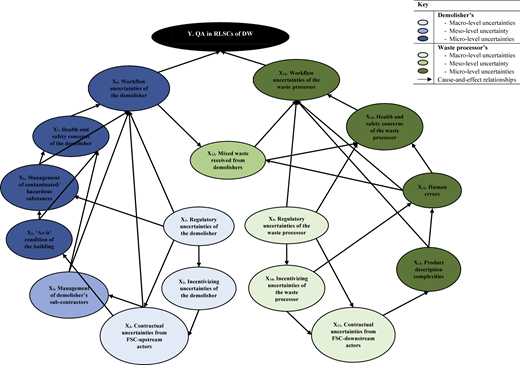
As per the tenets of OIPT, the information-deficient situations are known as epistemic uncertainties, which will lead to the creation of IPNs (Galbraith, 1973). These epistemic uncertainties of a supply chain originate from multiple levels, namely, macro-, meso- and micro-levels (Flynn et al., 2016; Xu and Song, 2022). Macro-level uncertainties stem from the ineffective external environment's influence; micro-level uncertainties from the internal organisational environment; and meso-level uncertainties due to interactions with stakeholders within the supply chain. Most previous studies on OIPT, irrespective of the industry context, have predominantly adopted qualitative approaches to identify uncertainty sources and interpret how organisations respond to them through different IPMs. For instance, within the context of RLSCs of DW, prior studies identified 16 epistemic uncertainties, comprising six macro-level uncertainties, two meso-level uncertainties and eight micro-level uncertainties via case studies and interviews (van den Berg et al., 2020; Wijewickrama et al., 2021, 2022). Although these qualitative studies provide rich contextual insights on individual epistemic uncertainties within the supply chains, broader supply chain research has widely acknowledged that process-related information deficiencies and resultant uncertainties do not exist independently but do have interactions (Flynn et al., 2016; Khanmohammadi, 2021). Furthermore, it has been recognised that, in supply chain environments, these uncertainties do not remain confined to a single actor but propagate across the supply network (Rezapour et al., 2015). However, prior OIPT-based empirical studies have not explicitly investigated these interdependencies. Therefore, there is a need for conceptualising epistemic uncertainties as an interconnected system and to adopt appropriate modelling approaches to capture the dependencies and propagation pathways. Taking the first step in addressing this need, Wijewickrama et al. (2025), in the context of RLSCs of DW, identified the causal relationships among the above 16 epistemic uncertainties and developed an information processing model for QA, as shown in Figure 1.
This conceptual model consisted of a set of variables, i.e. the epistemic uncertainties in the form of chance nodes and a set of directed arcs or links demonstrating the causal relationships between these nodes. The root nodes (i.e. any node without parents) of the model are the “X1. Regulatory uncertainties of the demolisher” and “X9. Regulatory uncertainties of the waste processor”. The leaf node (i.e. any node without children) is the operational performance criterion, i.e. “Y. QA in RLSCs of DW”, which is also known as the objective node.
Although Wijewickrama et al. (2025) have conceptualised causal relationships among epistemic uncertainties in RLSCs of DW through an OIPT lens, the model was not operationalised as a decision-support tool applied within real-world RLSCs. In supply chain contexts, similar to risk propagation (Wicaksana et al., 2022), the disruptions and information deficiencies propagate across multi-tier stakeholders, creating cascading effects that influence the overall supply chain performance (Habibi et al., 2025; Flynn et al., 2016). However, limited attention has been given to examining these multi-tier uncertainty propagation dynamics within the RLSCs of DW, particularly from the information processing perspective. This gap further highlights the need for using the modelling approaches that can capture interdependencies and propagation pathways across the supply chain. Considering this, the current study applies the causal model developed by Wijewickrama et al. (2025), which was largely conceptual and has been operationalised to: (1) model interdependencies among multi-level uncertainty sources and their combined effects; (2) quantify the likelihood of epistemic uncertainties and (3) diagnose causal influence pathways that explain how upstream information deficiencies propagate into downstream operational performance outcomes.
Addressing this gap, the current study adopts BBN modelling as an appropriate technique to operationalise the developed information processing model for QA in the RLSC context. Herein, BBN modelling overcomes key limitations of previous OIPT-based empirical work in three ways. First, it enables quantification of uncertainty occurrence probabilities, thereby providing a measurable basis to assess the severity of information deficiencies. Second, it captures causal interdependencies among uncertainties across levels and actors, allowing uncertainty propagation to be examined as a system rather than as isolated factors. Third, BBN inference supports diagnostic decision-making through sensitivity analysis, root-cause analysis and scenario analysis, enabling decision-makers to identify what epistemic uncertainties are significant in lowering QA outcomes. Therefore, by converting a conceptual model into an operational probabilistic decision-support model, BBN modelling strengthens both the theoretical application and practical usefulness of the OIPT-based information processing model for QA, which is the primary focus of this study.
3. Methodology
The study was steered through the case study research strategy. Yin (2018) mentioned that case studies hold a unique role in evaluation research, primarily because they help clarify cause-and-effect relationships in real-world interventions that are too complex to be effectively examined through surveys or experimental methods. Therefore, this strategy was suitable for the current study as it enables explaining causal links in a contemporary phenomenon that needs an in-depth investigation. The unit of analysis of this research was “an RLSC of DW” in a dyadic configuration. The number of cases was determined based on the literal and theoretical replication expected to be achieved through the study (Yin, 2018). Literal replication refers to auguring similar results, while theoretical replication refers to auguring contrasting results for known conditions. This study adopted a multiple-case design based on Yin's replication logic, where case selection was guided by theoretical replication rather than statistical generalisation (Yin, 2018). Herein, Yin (2018) highlighted that the simplest multiple-case design can involve two or more cases, and replication-based designs can be justified through a small number of carefully selected cases that enable analytical generalisation. Accordingly, considering the purpose for undertaking the study, two dissimilar cases were considered sufficient to assess the applicability of the proposed model under different organisational contexts. This decision was also influenced by the restricted availability and accessibility of eligible RLSCs of DW in the South Australian context. The selected two cases included one RLSC with a large-scale demolisher and waste processor (Case I) and the other with a small and medium-scale demolisher and waste processor (Case II). This selection reflects the study's aim of achieving theoretical replication.
The procedure followed by Kanyoma et al. (2021) to form a supply chain for a case study was used in this study. First, two waste processors (large-scale and small/medium-scale) were identified as focal firms. Second, they nominated their key input customers (i.e. demolishers) who annually supplied the highest volumes of waste for reprocessing. Finally, these identified demolishers were invited to participate in creating the two dyad supply chains for the study. The organisation's size was determined based on its number of employees and annual revenue (Gilfillan, 2018). An organisation with up to 199 employees and an annual turnover of A$250 million or less is considered a small and medium-sized organisation. If the organisation employs 200 or more employees with an annual turnover of above A$250 million, it is considered a large-scale organisation. Table 1 summarises the details of the two cases and the respondent profiles from the focus group discussions conducted as part of the data collection.
The following subsections outline the step-by-step data collection and analysis process conducted for the two case studies.
3.1 Parametric learning process
The development process of a BBN-based model involves two steps: structural learning and parametric learning (Jayasinghe, 2019; Madihi et al., 2025). Herein, as the first step, the graphical representation of dependencies between the variables should be developed (i.e. the qualitative step), which is known as the “structural learning” step. The study by Wijewickrama et al. (2025) has already completed this step by developing a causal map for information processing related to QA in RLSCs and transforming it into a BBN-based model. The current study moves to the second step: parametric learning, which involves quantifying cause-and-effect relationships in the model by assigning probabilities to each variable, typically based on expert elicitation.
Manual calculation of the current and adjusted probabilities of variables in a complicated BBN-based model can be challenging; thus, several software tools have been developed to make parametric learning in BBN models more practical and efficient. Among them, GeNIe software (version 3.0) is widely used due to its versatility and user-friendly interface (Aslantas et al., 2025; Qazi, 2025). Therefore, it was used in the current study.
3.1.1 Defining the status of chance and objective nodes
Before starting probability elicitation in a BBN-based model, each chance node and objective node must be clearly defined by assigning it a set of possible states. These states should be mutually exclusive (only one can happen at a time) and collectively exhaustive (they cover all possible outcomes) (Jayasinghe, 2019). Typically, nodes are given two or three states to keep the probability elicitation process manageable for experts (Madihi et al., 2025). For example, a node might have just “Yes” and “No” as its two states, which is common in many previous studies (Aslantas et al., 2025; Librantz et al., 2021). In this study, the chance nodes representing epistemic uncertainties and the objective node, which is QA in the RLSC of DW, were also assigned the states “Yes” and “No”. Herein, “Yes” represents the presence of the relevant epistemic uncertainty, whereas “No” indicates a condition where the uncertainty is absent or adequately controlled through existing IPMs. For instance, the “Yes” state of the epistemic uncertainty “mixed waste received from demolishers” means a real operational condition where waste processors frequently receive mixed or contaminated waste due to limited on-site sorting at the demolition sites. In contrast, the state “No” of the same uncertainty represents a condition where DW is adequately segregated and delivered with negligible contamination. Therefore, these states reflect real operational boundary conditions, and these definitions also support the evidence-setting strategy adopted in analyses such as sensitivity and scenario analyses, which are explained in section 3.1.4.
When building the BBN model using GeNIe software (version 3.0), these states are defined during the model creation, and the total probability across all states of a node must always add up to 1.
3.1.2 Data collection through conditional probability tables (CPTs)
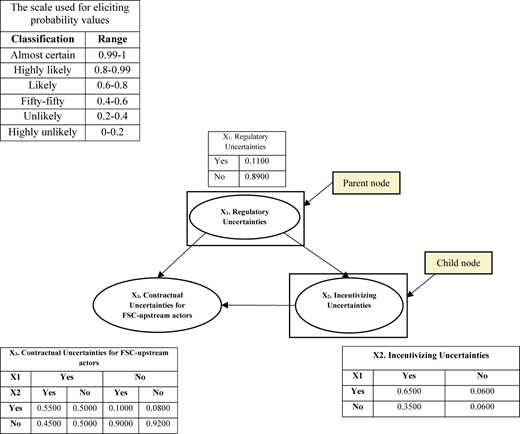
To apply the information processing model, it was necessary to obtain probabilistic inferences (i.e. deriving probabilities of variables in the model) using the conditional probability tables (CPTs). Each CPT represents the probabilities of a variable (child node) given the states of its parent nodes. For example, Figure 2 shows the CPTs for “X1. Regulatory uncertainties of the demolisher”, “X2. Incentivising uncertainties of the demolisher” and “X3. Contractual uncertainties from FSC upstream actors” of Case I.
Zhang (2017) identified two ways for completing CPTs: focus group discussions or expert interviews. This study used focus groups, commonly used for probabilistic inference, as they encourage interaction and shared insights (Jayasinghe, 2019; Librantz et al., 2021). As Librantz et al. (2021) noted, there is no minimum required number of experts for probability elicitation. Previous studies that used focus groups for probabilistic inference have incorporated different numbers of participants: five (Jayasinghe, 2019) and four (Librantz et al., 2021). Therefore, in this study, four experts participated in Case I (large-scale organisations), and three in Case II (small and medium-scale organisations). The profile of the focus group participants is presented in Table 2.
As shown in Table 2, all focus group participants held senior operational or managerial roles with substantial industry experience (15–30 years), which demonstrates their expertise in waste management. During the focus groups, participants received a guideline with CPTs for each variable in the BBN model and were asked to complete them collaboratively using a probability scale as shown in Figure 2. Participants were required to justify their probabilities using practical reasoning and case experience. These focus group discussions facilitated open interactions, and where disagreements emerged, they were addressed through facilitated discussions. Accordingly, the final completed CPTs with probabilities were based on consensus expert judgement rather than majority voting. Each focus group discussion lasted around two hours, which is an acceptable duration for a focus group discussion (Gibbs, 1997).
3.1.3 Making probabilistic inferences
Probabilistic inferences are needed to compute the marginal probabilities of the variables in a BBN-based model (Aslantas et al., 2025). Herein, “marginal probability” means the probability of the occurrence of a particular variable at a specific state. In this study, the probability of an epistemic uncertainty occurring derived through the calculation of probabilistic inferences was termed the “prior marginal probability”.
The method of deriving prior marginal probabilities depends on whether the variable is a parent or child node. For root variables with no parent nodes, the prior marginal probabilities are the same as the input probabilities. For example, in Figure 2, parent node X1 has input probabilities that directly serve as its prior marginal probabilities. However, the prior marginal probability of X2 and X3 could not be derived directly; thus, it should be calculated using Eq. (1).
In the case where a binary variable Y has two binary parent variables Y1 and Y2, the marginal probability of Y = Yes can be computed using the following formula:
Here, y1 and y2 represent the possible states “Yes” and “No” of the parent variables Y1 and Y2, respectively.
In this study, the GeNIe software (version 3.0) was used to automatically compute prior marginal probabilities for all child chance nodes, eliminating the need for manual calculations.
3.1.4 Computation of epistemic uncertainty propagation of the BBN-based model
After computing prior marginal probabilities of the chance nodes and the objective node, the BBN-based model was ready for various analyses to understand the propagation of epistemic uncertainties. These analyses required the computation of posterior marginal probabilities, easily performed using the GeNIe software. Herein, a posterior marginal probability refers to the probability of each variable being in a particular state when the set of evidence variables has been observed by specifying observed states (Jayasinghe, 2019). The posterior marginal probability can be calculated using Eq. (2).
Here, P(B) is the prior probability of B; P(A) is the observed probability of A; P(A/B) is the conditional probability of A if the variable B has occurred and P(B/A) is the posterior marginal probability of B given A.
The study compared prior and posterior marginal probabilities in three types of analysis, as explained below, with the findings presented in the following section.
Sensitivity analysis: Explored how changes in the states of the 16 epistemic uncertainties influence QA outcomes in RLSCs of DW, identifying the most sensitive uncertainties affecting performance.
Root Cause Analysis: Used back-propagation in the BBN model to determine the key underlying uncertainties responsible for QA failure in RLSCs of DW.
Scenario Analysis: Assessed the influence of macro-, meso- and micro-level uncertainties through forward propagation to evaluate their overall significance in determining QA in RLSCs of DW.
4. Findings of the study
This section presents the cross-case analysis of the multiple-case evidence. The significant epistemic uncertainties based on their probability of occurrence and impact on the QA of each supply chain were first identified. This was followed by a sensitivity analysis and a root cause analysis of the epistemic uncertainties. Finally, the significance of macro-, meso- and micro-level epistemic uncertainties for QA is explained.
4.1 Significant epistemic uncertainties depend on the probability of their occurrence
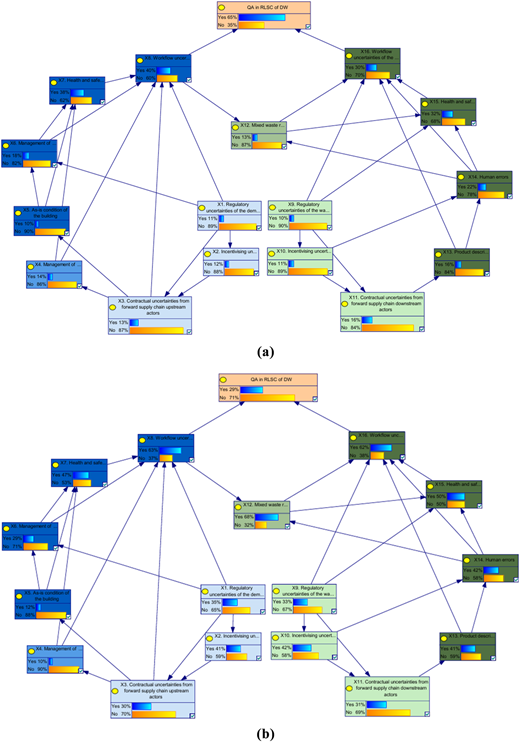
Figure 3 presents the BBN-based conceptual information processing model for QA in Case I (a) and II (b), respectively, including the prior marginal probabilities of each epistemic uncertainty generated through GeNIe software.
As shown in Figure 3(a), “workflow uncertainties of the demolisher (X8)” had the highest marginal probability of occurring (0.3954) in Case I, followed by “health and safety concerns of the demolisher (X7)”, for which the probability was 0.3835. In contrast, in Case II, “mixed waste received from demolishers (X12)” was the epistemic uncertainty with the highest marginal probability of occurring at 0.6756. “Workflow uncertainties of the demolisher (X8)” (0.6299) had the next highest marginal probability of occurring, followed by “workflow uncertainties of the waste processor (X16)” (0.6221). Notably, both these workflow uncertainties were directly linked to “Y. QA in RLSCs of DW”.
When comparing the two cases, the prior marginal probabilities of almost all epistemic uncertainties in Case II are higher than those in Case I, except for “management of the demolisher's subcontractors (X4)”, which has slightly less probability in Case II (0.1010) compared to Case I (0.1392). Case I overall showed a higher probability of achieving a high QA level under the existing uncertainty condition, while Case II demonstrated only a 0.2883 probability for high QA. This finding is admissible as the existing higher probabilities of epistemic uncertainties in Case II have accumulated and have significantly contributed to reducing the overall probability of achieving high QA.
In Case I, “as-is condition of the building (X5, 0.0957)” had the lowest marginal probabilities of occurring among all epistemic uncertainties, which is also the second lowest (0.1224) in Case II. The “management of demolisher's sub-contractors (X4)” had the lowest marginal probability of occurring in Case II at 0.1010 among all the epistemic uncertainties, while the “regulatory uncertainties of the waste processor” (X9, 0.1000), which is a macro-level uncertainty, had the second lowest probability of occurring in Case I.
4.2 Sensitivity analysis
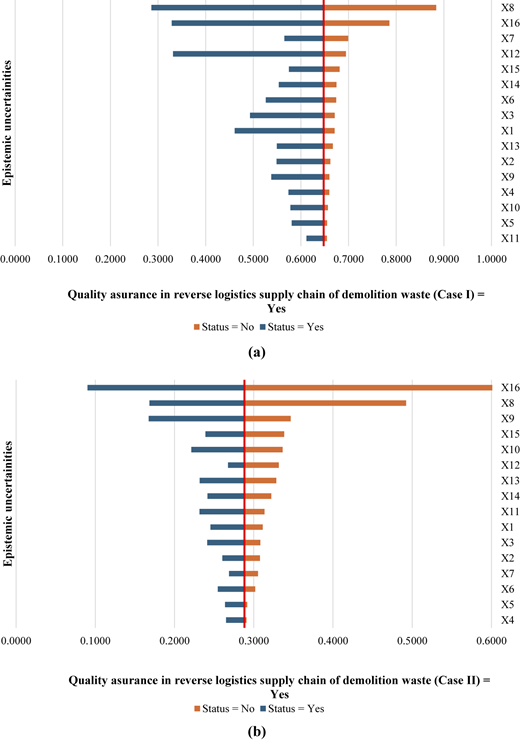
A sensitivity analysis was conducted to evaluate the influence of various epistemic uncertainties on the probability of achieving QA in the RLSC of DW in Cases I and II. Figure 4 (a) and (b) shows the Tornado Diagrams of these sensitivity analyses, which visually present the impact of “Yes” and “No” conditions of each uncertainty over the target outcome (Y. QA in RLSC of DW = Yes). The vertical axis of these diagrams lists the uncertainties of each case, ranked by their level of influence. The vertical line at the middle of these diagrams represents the baseline (posterior) probability of QA = Yes. In Case I, the baseline probability is approximately 0.6477, while in Case II it is 0.2883. These are the marginal probabilities of QA = Yes under current model conditions. The horizontal bars of these diagrams reflect how much the baseline probability of each case would increase or decrease when the corresponding variable(s) change status. The length of each bar indicates the magnitude of influence. The direction and colour of the bars indicate the effect of each epistemic uncertainty: orange bars represent an increase in the likelihood of achieving QA when the uncertainty is set to “No”, while blue bars represent a decrease when it is set to “Yes”.
As shown in Figure 4, QA was most sensitive to “workflow uncertainties of the demolisher (X8)” in Case I and “workflow uncertainties of the waste processor (X16)” in Case II. Moreover, “workflow uncertainties of the waste processor (X16)” was the second-highest sensitive epistemic uncertainty to QA in Case I and “workflow uncertainties of the demolisher (X8)” was the second in Case II. According to the BBN-based conceptual model's arrangement, workflow uncertainties of the demolisher and waste processor were the only epistemic uncertainties directly linked to the objective node of QA. Therefore, the high sensitivity of QA to workflow uncertainties was admissible. In addition, “health and safety concerns of the waste processor (X15)” was an influential epistemic uncertainty to which QA was the most sensitive in both Cases I and II. While the “health and safety concerns of the demolisher (X7)” was significant in Case I, they did not appear within the top 10 epistemic uncertainties of Case II. Notably, the majority of the top five uncertainties of both cases were the waste processors' epistemic uncertainties. These findings indicated that QA in RLSCs was most sensitive to epistemic uncertainties of waste processing organisations, irrespective of whether they were large scale or small and medium scale.
4.3 Root cause analysis
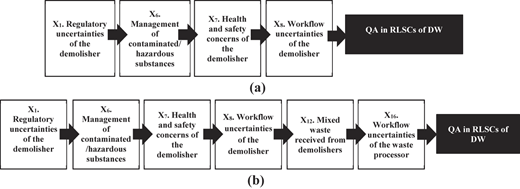
For root cause analysis, the posterior marginal probabilities of uncertainties were used, which were arrived at through the concept of back-propagation, given Y. QA in RLSC of DW = No. Accordingly, Figure 5 shows the critical path of epistemic uncertainties for QA in Case I (a) and Case II (b).
When the “QA in RLSC of DW (Y)” had a “No” status (i.e.100% or 1.000), “workflow uncertainties of demolisher (X8)” was the most likely cause to present in Case I, whereas in Case II, this is “workflow uncertainties of waste processor (X16)”. Herein, Case II “mixed waste received from demolishers (X12)” was the cause that significantly increased “workflow uncertainties of the waste processor (X16)”. Notably, it was found that “workflow uncertainties of the demolisher (X8)” was the significant root cause of “mixed waste received from demolishers (X12)”. Furthermore, “health and safety concerns of the demolisher (X7)” was the most likely cause of “workflow uncertainties of the demolisher (X8)” in both Cases I and II. When “workflow uncertainties of the demolisher (X8)” had a “Yes” status (i.e. 100% or 1.000), the most likely cause to present was the “management of contaminated/ hazardous substances (X6)” in both cases. Hereafter, “regulatory uncertainties of the demolisher (X1)” became the root cause of the critical path of both cases. Therefore, the critical paths of epistemic uncertainties concluded with “regulatory uncertainties of the demolisher (X1)”. Considering the findings from both contexts (Cases I and II), it is evident that QA in RLSCs of DW, regardless of whether the supply chain is large-scale or small-scale, is significantly affected by workflow uncertainties from both the waste processor and the demolisher. Notably, the waste processor's workflow uncertainties are largely compounded not by their own macro- or micro-level uncertainties but by the demolisher's uncertainties, particularly due to receiving mixed waste streams.
4.4 Scenario analysis: significance of macro-, meso- and micro-level epistemic uncertainties for QA in RLSCs of DW
Table 3 shows the cross-case analysis of changes in the prior marginal probability of QA of RLSC of DW = Yes according to different scenarios of macro-, meso- and micro-level uncertainties of the demolisher, waste processor and both in each case. Herein, each uncertainty category was tested under extreme conditions, where “State = Yes” represented the presence of uncertainty (worst-case scenario) and “State = No” represented its absence (best-case scenario). The impact of each uncertainty category was assessed by comparing posterior marginal probabilities of achieving QA against the prior marginal probability.
When considering all three classifications of epistemic uncertainties, irrespective of the demolisher or waste processor, QA was highly susceptible to macro-level uncertainties in both cases, especially in Case II. In case I, when the demolisher's macro-level uncertainties are present, the QA of the supply chain was reduced by 34.4%, while the presence of the same category of uncertainties of the waste processor caused a 17.8% reduction. When macro-level uncertainties of both demolisher and waste processor were active simultaneously, the impact was severe, with QA probability decreasing by 52.5% in Case I. On the contrary, the absence of macro-level uncertainties marginally improved QA; by 5.2% (demolisher), 2.4% (waste processor and 7.6% (both combined). Similarly, in Case II, the impact of macro-level uncertainties on QA was more explicit. The presence of demolisher's uncertainties decreased QA by 23.2%, while the presence of those of waste processors caused a 42.1% reduction. When both uncertainties are present, the QA was dropped by 59.8%. In contrast, the absence of macro-level uncertainties significantly improved QA, with an increase of 9.8% from demolisher's uncertainties, 21.5% from waste processor's uncertainties and 32.5% from both combined. These results show that demolisher's macro-level uncertainties have a greater impact on QA than those from the waste processors in large-scale supply chains of DW management, while the reverse is true in small-scale supply chains. However, the compounded effect of both demolishers' and waste processors' macro-level uncertainties on QA is more significant in both cases, especially in Case II, which includes small-scale organisations.
When considering meso-level uncertainties, the results illustrate an even more significant effect, primarily in Case I. The presence of demolisher's meso-level uncertainty in Case I reduced QA by 11.4%, while the waste processor's uncertainty reduced it by 48.8%. The presence of both demolisher's and waste processor's meso-level uncertainties has led to a maximum reduction of QA level of the supply chain by 55.8%, which is also a reduction greater than at the macro-level. The best scenario caused modest QA improvements in Case I, with 1.8% due to the demolisher's uncertainty, 7.2% due to the waste processor's uncertainty and 8.9% when both were absent. In Case II, the worst-case scenario caused an 8.0% reduction in QA probability when the demolisher's meso-level uncertainty was present and a 7.2% drop for the waste processor. When both meso-level uncertainties were present, the reduction was 16.3%. The best-case improvements in QA were less than those of macro-level and micro-level, but still, it is positive, as such 0.9% due to the absence of demolisher's meso-level uncertainty, 15.0% due to waste processor's uncertainty and 15.9% due to the absence of both. These outcomes highlight that the waste processor's meso-level uncertainties exert much greater influence on QA than the demolisher's, irrespective of whether it is a large-scale or small-scale supply chain.
The micro-level uncertainties show the most significant influence over the QA, mainly due to the direct connections between the workflow uncertainties and the objective node of QA. In Case I, the presence of the demolisher's micro-level uncertainties reduced QA by 55.8%, while the waste processor's ones reduced it by 46.8%. Conversely, in the best-case scenario, QA increased gradually; by 36.5% due to the absence of demolisher's micro-level uncertainties, 21.4% due to the absence of waste processor's ones and 54.4% when all the micro-level uncertainties were absent. In Case II, the worst-case scenario for waste processors' micro-level uncertainties alone led to a reduction of 70.2% of QA probability, compared to 41.6% for the demolisher. The absence of these uncertainties in the best-case scenario produced a massive rise in QA, as such 70.8% for the demolisher, 110.6% for the waste processor and a significant 246.8% increase when all micro-level uncertainties were absent. In both cases, when all the micro-level uncertainties were present, the QA probability plummeted to 0.0000, indicating total failure of the QA system in the supply chain. Conversely, when all of them were absent, the QA probability rose to 1.0000, reflecting complete success in the system. These results clearly emphasise that micro-level uncertainties in the RLSC are directly determinative of QA outcomes. Thus, supply chains must be especially cautious and proactive in addressing these uncertainties as much as possible.
Overall, the scenario analysis produced interesting patterns of findings in how epistemic uncertainties influence information-centric QA in RLSCs of DW. First, this analysis emphasised that QA in RLSCs of DW is a highly interconnected outcome rather than being affected by isolated uncertainties. Therefore, the combined influence of uncertainties at the same level (e.g. macro or micro) produces a compounded effect on QA that is much stronger than individual uncertainties. Second, a consistent cross-case finding is observed at the meso-level of both supply chains, irrespective of the size; as such, the waste processor's meso-level uncertainty exerts a substantially stronger influence on QA than that of the demolisher. Third, although macro and meso-level uncertainties strongly influence QA through propagation, micro-level uncertainties in RLSCs are most performance proximal as they occur within the organisational workflow context. Finally, the scenario analysis highlights that the small and medium-scale supply chains exhibit more vulnerability and stronger QA volatility under similar uncertainty exposure, while the large-scale supply chains show relatively greater stability.
5. Discussion
The RLSCs of DW, whether they comprised large-scale or small and medium-scale demolishers and waste processors, were vulnerable to the 16 epistemic uncertainties in the information processing model for QA. The study found that the epistemic uncertainty exposure varied depending on organisational context and maturity-related characteristics of RLSCs. Even if previous studies often noted that small and medium-scale organisations are exposed to higher uncertainty (Baporikar et al., 2016; Sopha et al., 2021), the current study expands this understanding, showing that the maturity of small and medium-scale organisations is not reflected only in uncertainty exposure but also in their capacity to prevent uncertainty escalation and downstream propagation. Herein, Case I, which represents the large-scale demolisher and waste processor, reflects a more structured and formalised operational environment, and therefore demonstrates a higher probability of QA. In contrast, Case II, which represents small and medium-scale organisations, demonstrated lower operational stability and a much lower baseline probability of QA, indicating higher vulnerability to uncertainty accumulation and propagation. Therefore, from an RLSC maturity perspective, this study highlights that less mature RLSCs have weaker information processing capability to mitigate epistemic uncertainties, making QA more susceptible to uncertainty amplification and cascading effects.
Of all the epistemic uncertainties, RLSCs with small and medium-scale organisations were more susceptible to the waste processor's meso-level uncertainty, that is, “mixed waste received from demolishers”. However, RLSCs with large-scale organisations were not significantly impacted by this issue. This meso-level uncertainty was ranked among the top six most sensitive epistemic uncertainties for QA in RLSCs of DW, regardless of organisational size. The compounding effect of the demolisher's epistemic uncertainties generated bulk mixed waste, which, if transported to an MRF, significantly increased the waste processor's micro-level uncertainties. Previous studies have criticised mechanical demolition for creating large volumes of unsorted waste that are difficult to manage (Bertino et al., 2021; Tennakoon et al., 2022). Such contaminated waste is often not accepted for reprocessing; instead, it is directly dumped illegally or in landfills. However, certain small and medium-scale organisations engaged in DW management adopt fast-track approaches to demolition and unprofessionally send mixed waste to MRFs to avoid paying extremely high landfill disposal levies (Wijewickrama et al., 2021). If mixed waste is received and accepted into MRFs, low-quality products would be the output, thus ending the waste processor's business. Therefore, mixed waste received from demolishers is not merely an operational issue commonly reported in the literature. Rather, the proposed model reinforces it as a meso-level epistemic uncertainty amplifier that converts upstream demolisher-side uncertainties into downstream waste processor workflow uncertainties; thereby increasing the likelihood of QA failure in RLSCs of DW. This amplification effect is likely to be more compounded in less mature RLSCs with weak process formalisation and limited information processing capability.
Almutairi (2022) noted that organisations reduce operational costs, often by outsourcing tasks to specialised third-party contractors for greater efficiency. Similarly, this study found that most demolishers, regardless of their size, sub-contracted their work due to limited job continuity and cost reduction motives. However, “management of the demolisher's sub-contractors”, a demolisher's meso-level uncertainty, had the least vulnerability, of all epistemic uncertainties, of occurring in RLSCs with small and medium-scale organisations. Notably, this uncertainty is higher for the large-scale demolisher in Case I than in Case II. The least vulnerable epistemic uncertainty experienced by large-scale demolishers and waste processors was “as-is condition of the building”. This is understandable, as large-scale demolishers typically work on major projects that undergo rigorous approval processes; they should have adequate information about the as-is condition of the buildings before commencing the job (van den Berg et al., 2020). Hence, the low vulnerability to this micro-level uncertainty in Case I, compared to the higher vulnerability in Case II's small- and medium-scale demolisher, is justifiable.
Across both cases, QA was most affected by macro-level uncertainties when all three categories of epistemic uncertainty were considered. Generally, the regulatory and policy instruments are designed to apply consistently across all the organisations operating within the same industry context (Brandão et al., 2021). Therefore, any deficiencies in regulatory instruments should, in principle, be equally experienced by all supply chains in the RL industry, regardless of their size. However, the study noted that macro-level uncertainties such as “regulatory uncertainties of the waste processor” and “regulatory uncertainties of the demolisher” had a lower probability of occurrence in Case I compared to Case II. This indicates that since macro-level uncertainties originate externally to RLSCs, in principle, their impact should be similar across different supply chains. However, in reality, small and medium-scale organisations experience these uncertainties more severely than large-scale counterparts, as their weaker information processing capability reduces their ability to successfully respond to those uncertainties.
Sopha et al. (2021) highlighted the need in uncertainty propagation theory to understand the root causes of uncertainties to implement appropriate mechanisms to mitigate them and enhance performance. In the context of RLSCs of DW, this study found that demolisher's uncertainties were more significant than those of waste processors, making them root causes influencing QA. As an RLSC of DW is an interrelated process, the operational performance of off-site waste processing relies heavily on the effectiveness of building dismantling and on-site processing (Tennakoon et al., 2022). Generally, the dismantling work is more technical, as it handles the bulk of EoL salvageable waste (Bertino et al., 2021). Thus, managing demolisher's uncertainties can help reduce waste processor uncertainties and improve overall QA. Therefore, these findings advance uncertainty propagation theory within the context of RLSCs of DW by demonstrating that, although uncertainty-driven IPNs originate at multiple levels within the supply chain, their critical path propagation is shaped by the operational arrangement and interdependencies within the supply chain. Accordingly, upstream demolisher uncertainties act as initiating conditions, while exacerbating downstream waste processor uncertainties.
In the information processing model, all macro-level uncertainties of both demolishers and waste processors appeared as root causes of the remaining uncertainties. Of all three levels, macro-level uncertainties were found to be the most crucial for managing QA in RLSCs of DW. However, these were also the hardest to address, mainly for two reasons: first, they stem from lapses in the influencing strategies of external stakeholders (Wijewickrama et al., 2022), which are beyond the control of internal stakeholders in RLSCs of DW. Second, rather than responding to IPMs, these macro-level uncertainties are more responsive to the strategies that external stakeholders could undertake, which will take a prolonged time to plan and implement (Brandão et al., 2021).
6. Implications of the study
This study provides important implications for both theory and practice, which are discussed in detail in the following subsections.
6.1 Implications for theory
This study builds on the existing OIPT underpinnings by applying and operationalising a previously developed BBN-based information processing model in the context of RLSCs of DW. This study empirically demonstrated how epistemic uncertainties propagate through an interdependent RLSC and systematically influence the information-centric QA. In OIPT, epistemic uncertainties represent information deficiencies that lead to the creation of IPNs, for which appropriate IPMs are required to maintain expected operational performance (Galbraith, 1973). Previous OIPT-based studies are largely qualitative and mainly identify uncertainties and describe their effects across different organisational contexts (e.g. van den Berg et al., 2020; Yan et al., 2023). Unlike these studies, the current study, through an OIPT lens, operationalises epistemic uncertainties as a causal system in which even a small increase in upstream uncertainties can trigger substantial increases in downstream uncertainties, ultimately resulting in a higher impact on QA. Given this, the applied BBN-based QA model explicitly reveals uncertainty propagation pathways across macro, meso and micro-level uncertainty sources in RLSCs.
Furthermore, the integration of BBN modelling with OIPT in this study provides a methodological-theoretical contribution beyond what conventional qualitative discussions could add. While qualitative approaches are valuable for identifying uncertainty sources and interpreting contextual meanings, the adopted BBN-based approach enables probabilistic inference and causal diagnosis by: (1) quantifying uncertainty occurrence probabilities; (2) identifying the most influential uncertainties through sensitivity analysis; (3) tracing root causes via back-propagation and (4) enabling scenario analysis of the combined effect of macro, meso and micro-level uncertainties. Therefore, these capabilities allow theory development to move beyond descriptive confirmation towards causal explanation of epistemic uncertainty impacts on information-centric QA in RLSCs.
6.2 Implications for practice
This study confirmed that the BBN-based information processing model desirably provides decision support to the internal stakeholders in the industry as an information processing tool for QA. After inferencing probabilities using subjective data (i.e. experts' elicitations), internal stakeholders in RLSCs could use this model to understand the impact of epistemic uncertainties through doing different types of analyses. The key success of the practical implementation of the BBN-based information processing model may depend not only on the proposed process but also on the organisation's level of formality in uncertainty management. The organisations should use this model as a supporting tool for decision-making in parallel with the other approaches for quality improvements.
Generally, every organisation implements QA, but at different levels of formality. The BBN-based information processing model can support the quality management (QM) teams to understand what and how much of each epistemic uncertainty they could encounter confronting their QM efforts, and thereby what appropriate IPMs they could undertake in response to those. Wijewickrama et al. (2022) found different IPMs that can be undertaken in response to the epistemic uncertainties in RLSCs of DW. According to this study, with respect to macro-level uncertainties, even if they often arise due to reasons that are beyond the control of internal supply chain organisations, they can still be confronted through undertaking internally developed IPMs such as developing internal policies and procedures, thorough planning and goal setting, and establishing business partnering arrangements. Similarly, from the meso-level perspective, the demolishers and waste processors can undertake different IPMs in response to their corresponding meso-level uncertainties. For example, to address the waste processor's meso-level uncertainty of “mixed waste received from demolishers”, waste processors can operationalise waste acceptance criteria and differentiated gate fees by setting explicit contamination thresholds, while offering discounted rates for source-separated waste. From the micro-level perspective, demolishers' uncertainties, such as “as-is condition of the building” and “management of contaminated/hazardous substances”, can be reduced through mandatory pre-demolition audits, collection of building documents and asbestos registers, and structured site visits. Herein, the organisations can use the BBN-based model to establish internal performance thresholds for QA and test how strengthening specific IPMs improves QA outcomes under different uncertainty scenarios. In this way, the model supports practitioners to move from generic improvement intentions towards evidence-based prioritisation of IPMs.
The level of uncertainties encountered by an organisation could change due to the changes in influence from stakeholders or competitors, market forces and continuous business development efforts (Settembre-Blundo et al., 2021). Therefore, periodical maintenance and updating of the model is important; if not, it cannot provide useful outcomes to support decision-making effectively. It is worth mentioning that when the initial BBN-based model is constructed in a recognised software like GeNie, which was used for the current study, less effort and time are required to modify and revise the model. Leerojanaprapa (2014) further exposed two ways of maintaining the model. First, even if there is no change to the model structure, the probabilities of epistemic uncertainties should be updated with time. This must be carried out internally at a defined interval by the QM team. Second, if the QM team finds the organisation has been exposed to a new epistemic uncertainty, the model structure should be reviewed at their consensus. The new model structure could be revised using the same software; however, the CPTs should be updated with new epistemic uncertainties.
7. Limitations and future research directions
This study is not deprived of limitations, which are worth noting. For this model to be a widely accepted standard tool in the industry, more applications are needed to improve its maturity, with a long learning cycle time. In this study, the applicability of the BBN-based information processing model was assessed within real-world reverse supply chain contexts through probabilistic elicitation based on experts' opinions. The model application can also be done through learning algorithms from historical data, experts' views or both. Models developed using historical data offer the advantage of rapid inference and learning by defining multiple criteria for each variable, which is a limitation when relying solely on expert elicitation. Although RLSCs of DW are a promising industry in SA, no historical data were available from the industry to develop the model based on learning algorithms. On this note, conducting the same study using learning algorithms within developed contexts of RLSCs in China and Hong Kong, where historical data are available, would be an interesting future research area.
Furthermore, a BBN-based model could be extended to a decision-support software incorporating a well-documented and interoperable interface to improve the ease of use of the tool. Yet this has not come under the scope of the current study; thus, it could be considered an interesting area for future research. Zhang (2017) mentioned that when the BBN-based model was developed as an industry tool, no prior knowledge about complicated probability theory was required from the potential users. Furthermore, due to the flexibility of the Bayesian approach, future research can integrate the BBN-based model with other techniques such as BIM, the geographic information system, multi-agent systems and neural networks (Hon et al., 2021). This combination could bring the essence of artificial intelligence and machine learning to the field of RLSC in the construction industry. It also improves the applications of the BBN-based model, as the combined application could take advantage of each method, thereby providing powerful tools to tackle complex information processing issues in the RLSCs of DW.
Although this study provides practical insights for improving QA decision-making in RLSCs of DW, these implications should be interpreted cautiously. The findings of this study are derived from two case studies in SA and are fully based on expert-elicited probabilistic modelling. The purpose of selecting these two cases in SA was not to achieve statistical generalisability, but to support analytical generalisation, where findings are generalised to theory rather than to a population of RLSCs (Yin, 2018). Herein, SA also provided an appropriate empirical setting due to its relative maturity in adopting RL operations for DW, as explained in Section 1. However, since contextual factors such as regulatory instruments, landfill levy structures, and industry maturity differ across regions and countries, the broader policy and societal implications of this study should be considered as indicative rather than directly generalisable, and further empirical applications across different contexts are required to validate its wider applicability.
8. Conclusions
Driven by the objective of achieving quality in reprocessed products, the recent study by Wijewickrama et al. (2025) developed and empirically validated an information processing model for QA in RLSCs of DW. This study, as a progression from this, aimed to assess the practical applicability of this model and to observe how it supports decision-making related to information processing for QA. To achieve this aim, the model was applied in two real-life cases of RLSCs of DW: one comprising a small and medium-scale demolisher and waste processor and the other comprising a large-scale demolisher and waste processor.
The current study found that, compared to RLSCs with large-scale organisations, RLSCs with small and medium-scale organisations were more vulnerable to macro-, meso- and micro-level uncertainties for QA. Of all the uncertainties, the RLSCs of DW, including small and medium-scale organisations, were most susceptible to the waste processor's meso-level uncertainty: “mixed waste received from demolishers”. It was also found that “mixed waste received from demolishers” was one of the top six epistemic uncertainties to which the QA was most sensitive in RLSCs of DW. Furthermore, “workflow uncertainties of the demolisher”, “workflow uncertainties of the waste processor” and “health and safety concerns of the waste processor” were the remaining epistemic uncertainties to which QA was most sensitive in RLSCs of DW. Among the top highly sensitive epistemic uncertainties, most were related to the waste processor. The study found that of all three levels of epistemic uncertainties, macro-level uncertainties were more important to manage to enhance QA, as they were the root causes of the remaining meso- and micro-level uncertainties. As an RLSC of DW was an interrelated process, the operational performance of the building dismantling and on-site processing phase determined the effectiveness of the subsequent off-site waste processing phase. On this note, the current study found that compared to the waste processor's epistemic uncertainties, the demolisher's ones were more significant; thus, most appeared in the critical path of epistemic uncertainties influencing QA. In shedding light on this, the current study raised the need to manage the demolisher's epistemic uncertainties, thus minimising the waste processor's uncertainties, ultimately enhancing QA in RLSCs of DW.
Overall, the proposed BBN-based information processing model provides practical implications as a decision-support tool for QA by facilitating organisations in RLSCs to assess and respond to epistemic uncertainties. From a research perspective, the study highlights the need for further empirical applications to improve model maturity and explore extensions towards making the model a software-based decision tool. More broadly, the enhanced reliability of decision-making towards QA in RLSCs of DW may contribute to better resource recovery and enhanced circular economy outcomes, while supporting wider environmental and social sustainability.