This study develops a macroeconomic model with two distinct agent types: rentiers and entrepreneurs, where only the latter invest in capital. We explore how this heterogeneity affects macroeconomic stability and policy feasibility.
The model features a short-run static setup with heterogeneity embedded in the IS curve (goods market equilibrium). The main short-run tool is comparative statics. In the medium run, only the debt-to-GDP ratio evolves, while in the long run both agent shares and debt dynamics vary. We conduct dynamic analysis using a continuous-time differential equation system, assessing equilibrium and stability via classical dynamic systems theory. Numerical simulations use the Runge-Kutta method.
In the short run, a higher share of rentiers reduces the utilization rate, with real interest rates amplifying this effect. In the medium run, the debt-capital ratio follows a motion equation with agent shares exogenous. In the long run, agent shares evolve through an evolutionary game dynamic responding to return differentials between capital and government bonds. The interior solution, with both groups coexisting, is a saddle-path or, without a jumping variable, a knife-edge solution.
This is among the first papers to explicitly model dynamic heterogeneity between rentiers and entrepreneurs in debt-financing and investment, underscoring its relevance to macroeconomic dynamics.
1. Introduction
Most mainstream modern macroeconomic literature has focused on monetary policy as the main stabilization mechanism. This mechanism operates, from a practical point of view, within the inflation target regime, primarily based on the so-called ’science of monetary policy’ [see Clarida, Gali, and Gertler (1999)], where the interest rate serves as the main policy instrument. Despite not being the preferred macroeconomic stabilization mechanism in mainstream macroeconomics, fiscal policy has continually been used as a key tool by policymakers in response to the business cycle, particularly during the recent pandemic. A crucial issue that arises from this is the potential interplay between monetary and fiscal policy, which can impact debt dynamics and income distribution over time.
While fiscal deficits are considered a crucial macroeconomic instrument within the Post-Keynesian tradition, less attention has been given to debt dynamics. One of the pioneer’s works to address the potential interaction of the interest rate with the debt dynamic and the income distribution in a Kaleckian framework was You and Dutt (1996). In this paper, the authors argue that expansionary fiscal policy, which leads to increased government debt, has an ambiguous effect on income distribution and only under certain conditions induces a redistribution of income in favor of capitalists. On the other hand, their model suggests a clear redistribution of income in favor of capitalists when the increase in debt results from an autonomous slowdown in growth. Their model has a long-run stable steady state equilibrium that ensures a non-explosive debt-GDP trajectory.
More recently, Ko (2019) has examined the same issue addressed by You and Dutt (1996) within a similar Kaleckian framework, but with a more in-depth focus on the dynamics of the debt-capital ratio. The author’s main findings include the positive short-run effect of expanded budget deficits on the capacity utilization rate, which reinforces the case for active fiscal policy; the potential role of capital taxes in improving capacity utilization; and the positive long-run effects of expanded budget deficits under certain conditions. Ko (2019) does not explore the distributional effects of the interplay between fiscal policy and interest rates in depth, despite using a model framework similar to that of You and Dutt (1996). Additionally, this author does not examine the possibility of explosive debt-capital ratio dynamics in more detail.
In this paper, we aim to contribute to the literature by addressing a similar issue to that examined by You and Dutt (1996) and Ko (2019): specifically, the interplay between debt dynamics and interest rates within a Kaleckian framework. A key innovation of our model is the explicit exploration of heterogeneity within the capitalist class. We build a model featuring both rentiers and entrepreneurs, where the latter are the only ones engaged in capital investment, while the former derive income from financing government debt. Modeling this heterogeneity allows us to gain different insights into the role of rentiers in the economy. Additionally, we explore the long-run dynamics of this heterogeneity in an evolutionary game setup.
Evolutionary dynamics are useful tools for understanding the emergence of macro behaviors from agent interactions, where the learning process of these agents is based on the success and failure of their strategies. Lima and Silveira (2015), Silveira and Lima (2017), and Martins, Silveira, and Lima (2021) provide examples of this approach addressing macroeconomic issues.
The model developed here is demand-driven in the post-Keynesian sense. The economy is not at its full-employment level, and capacity utilization endogenously adjusts to clear the goods market. Prices are fixed for simplicity’s sake. Workers’ propensity to save is lower than that of rentiers and entrepreneurs, and the economy is a closed economy. To keep the model tractable, we approach both fiscal and monetary policy as discretionary.
In summary, we addressed the role of rentiers in the debt financing process, their impact on the utilization capacity rate and growth, as well as the debt stability conditions in the long run under different situations.
2. Demand side and the short run adjustment
A crucial element of our model is the division of the economy into three distinct classes: workers, entrepreneurs, and rentiers. The entrepreneurs obtain their income exclusively from the real economy. At the same time, rentiers earn their income (exclusively) from the return on government-supplied bonds that pay the same interest rate used to operate the monetary policy. The goods markets operate in imperfect competition, and the entrepreneurs have markup power over the product, as is usual in the neo-Kaleckian literature, making wages settled by the entrepreneurs. Therefore, the income share of entrepreneurs and rentiers in the economy can be expressed as follows:
where π is the total income share earned by capitalists in general, πk, is the profit share of entrepreneurs, and πr is the earnings share of rentiers.
Since workers, entrepreneurs, and rentiers, all consume a constant share of their income, we can write a consumption function (normalized by the capital stock) in the following equation:
where c1, c2, c3 are the marginal propensities to consume from the income of workers, entrepreneurs, and rentiers; θ is the tax rate over income, which is the same for all classes; u is the capacity utilization rate (the output divided up by the potential output); r is the interest rate that yields the government bond, and b is the government debt as a proportion of the capital stock [1].
Assuming c1 = 1, with no savings from workers, c3 = c2 = c, with both rentiers and entrepreneurs having the same propensity to consume, we have the following aggregated consumption function:
In the Kaleckian tradition, the standard practice of assuming no savings for workers is equivalent to assuming that workers consume a smaller proportion of their income compared to rentiers and entrepreneurs. On the other hand, assuming that rentiers and entrepreneurs have the same saving/consumption rate has a crucial qualitative implication: any effect of r on the multiplier κ disappears.
It’s important to note that r acts as a source of redistribution in favor of rentiers. Therefore, in the presence of different consumption rates among rentiers and entrepreneurs, this discrepancy could influence the multipliers either positively or negatively, depending on the relative sizes of their propensities to consume. However, assuming only one propensity to consume helps us avoid inconvenient non-linearities without compromising the essence of the question under investigation.
In this economy, only entrepreneurs invest. Therefore, a fraction λ of the capitalists are entrepreneurs, and a fraction 1 − λ are rentiers. This is a closed economy and the inverse capital-output rate is normalized to one. Given that, the aggregated demand can be expressed in terms of the capacity utilization rate (u) as follows:
where I is the investment and G the government expenditure.
Entrepreneurs invest in a Kaleckian manner, taking into consideration the utilization capacity rate (acceleration effect) and the autonomous investment decision as a proxy of Keynesian animal spirits. This is a reduced form of the so-called Kalecki-Steindl investment function [see Dutt (1984), Amadeo (1986) and Dutt (1987)]. Another key feature of the aggregated investment function is the parameter λ, representing the fraction of entrepreneurs in the economy. When λ equals one, we obtain a standard Kaleckian model without accounting for investment decision heterogeneity. Conversely, with the extreme hypothesis of λ equals zero (1 − λ = 0), there is no investment in capital. We will initially treat this share as a constant and exogenous variable. However, we will revisit this assumption later when we make λ an endogenous variable based on the comparison between the return on capital and bonds.
where gk is the capital accumulation rate.
Note that the capital accumulation equation differs marginally from the Neokaleckian version proposed by Bhaduri and Marglin (1990), where gi ≡ I/K = i0 + i1.π + δ.u. Here, we could have used profit share as an argument for the investment function, culminating in the addition of an autonomous component for u*. The comparative dynamics would not have changed much, except for the addition of the autonomous component of demand and the mitigation of the effect of du*/dπk (or changing its sign). However, it would contradict Kaleckian theory to assume that λ can change while π remains constant. Therefore, to avoid double counting, we prefer the first approach, as in equation (5).
The government expenditures-capital ratio, a discretionary variable, is expressed as follows:
Solving the model in terms of u we find the following IS schedule:
or
with
Since we’re only interested in the case where u* > 0, we need to ensure that both is positive as well as λ.i0 + γ − (1 − c).r.b.(1 − θ) > 0. The denominator condition is a version of the well-known Keynesian stability condition, which implies that investment must be less sensitive to changes in utilization than savings. The numerator conditions suggest that the components of autonomous demand should be sufficiently large to counteract the negative effect of rentiers’ savings on aggregate demand.
This IS schedule is a negative function of the real interest rate r similar to what occurs in works like Lima and Setterfield (2008) and Drumond and Porcile (2012):
The key distinction here lies in the fact that, unlike those authors, we do not need to include the real interest rate directly in the investment function to verify a negative connection between r and u. In this context, r influences the utilization rate because of the rentiers’ role in the economy. Since rentiers do not invest in capital goods and their propensity to consume is smaller than that of workers, the net effect of an increase in their income due to an increase in r is negative on aggregate demand and the utilization rate.
Similarly to equation (8), the effect of an increase in the debt ratio is a reduction in the degree of capacity utilization in the short term.
With regard to a shock of a change in the tax rate, the effect cannot be determined unambiguously. This is because there is a decrease in the Keynesian multiplier (dκ/dθ < 0) followed by an increase in the autonomous component arising from the redistribution of income from the rentier side to the real side of the economy entrepreneurs.
The last result is particularly important in the context of our model. By setting the demand as we did, we can demonstrate a clear connection between the fraction of entrepreneurs (λ) in this economy and the rate of capacity utilization.
As we mentioned in equation (7b), the capacity utilization rate has two connections to the variable (λ). One is through the Keynesian multiplier, and the other is through the autonomous demand components. Thus, we have:
Since the numerator of equation (11), λ.i0 + γ − (1 − c).r.b.(1 − θ) > 0 is positive as mentioned early and ∂κ/∂λ is also positive as demonstrated below, an increase in the share of entrepreneurs in the economy increases the utilization capacity rate.
The economic intuition here is straightforward: an exogenous increase in the number of entrepreneurs leads to a rise in the investment rate and aggregate demand, given that rentiers do not invest in capital goods. This implies that any variable influencing the number of rentiers/entrepreneurs could potentially impact short-run economic performance. Furthermore, the medium/long-run performance will also be affected by λ since the investment function is demand-driven.
This has important implications for achieving full employment—or more precisely, a level of capacity utilization (u) consistent with full employment—echoing the political aspects raised by Kalecki (1943, 2003). Beyond emphasizing the central role of the government in assuring full employment amid the fundamental antagonism between capital and labor, Kalecki also highlights tensions within the capitalist class itself. As the economy approaches full employment and wages and prices begin to rise, the conflict between productive capitalists and rentiers intensifies. This underscores a crucial point: full employment is not merely an economic objective, but a politically contentious one, as it may reduce the income share of unproductive capital, such as rentiers.
This dynamic is captured—albeit in simplified form—in our investment function, where the share of entrepreneurs (i.e. capitalists investing in productive activities) contributes positively to the investment rate, thereby increasing capacity utilization and employment levels. It is also worth noting that in the same texts, Kalecki expresses a clear preference for deficit financing through borrowing rather than taxation, as the latter could negatively impact private investment and consumption. This brings us to a key issue addressed in our paper: the existence of a financing mechanism—driven in our model by rentiers—that enables the government to sustain deficits is fundamental to modern capitalist economies. At the same time, however, the inherent tension between rentier interests and productive investment introduces an additional layer of complexity to the government’s role in guaranteeing full employment.
Both demand and growth regimes are wage-led in this model, The first effect of an increase in the capitalists’ profit share is the negative impact on the Keynesian multiplier, as follows:
Resulting in the following partial derivative that describes the wage-led demand regime:
To verify the negative effect of πk on capital accumulation in the wage-led growth regime, first, note that the short-run equilibrium, denoted by , can be stated as follows:
Thus, the following partial derivative describes the wage-led growth regime result:
The previously discussed wage-led regimes align with the standard results of the Kalecki-Steindl model, derived from the investment function assumed here. Specifically, the Kalecki-Steindl result emerges as a particular case of our model when λ = 1. The innovation in our approach lies in incorporating the role of rentiers within this Kaleckian framework. Consequently, the next step of our research involves analyzing the dynamics of the debt-capital ratio while maintaining λ as an exogenous variable.
3. Debt dynamics with the share of entrepreneurs/rentiers constant
In this section, we explore the government debt dynamics, a key building block of our model. As in the previous section, we maintain the assumption of constant shares of entrepreneurs and rentiers in the overall population. Like Ko (2019), we linked the public debt dynamics using the following accounting identity [2], as follows:
Here, B represents government debt, G stands for government expenditure, and T denotes total taxes. The government issues a single bond, which yields a return determined by the same interest rate set by the central bank as its monetary policy instrument. Normalizing B by the capital stock (something analogous to the debt GDP ratio, since we assume a fixed proportion output technology), we have . Differentiating with respect to time, considering , and plugging in the expressions for , u, and into , we obtain the following motion equation:
We can find the steady-state value for the debt-capital ratio defining . Thus, we have:
The economically feasible value for the steady-state debt ratio is b* > 0. To satisfy this condition, we must have and also λ.[i0 + δ.u(b*) − r] > 0. The first condition tells us that the fiscal policy needs to run in deficit to reach positive values of b* and that we will see in the next step that there’s no need to run in surplus as a condition to stabilize in debt-ratio dynamics. For the second condition, as λ lies between zero and one, it needs to have g > r. In other words, the growth rate must be greater than the interest rate. For the sake of simplicity, here and from now on, we will define Ψ = λ.[i0 + δ.u(b*)] − r > 0.
To analyze the effect of the increasing λ, we have:
Since Ψ and g − θ.u(b*) are positive expressions and ∂u/∂b* < 0 is straightforward to note the positive numerator and the ambiguous denominator. However, taking the terms into account, the denominator is more likely to be positive. Another effect to point out is the effect of increasing the interest rate over the debt ratio. As can be seen below, we have the unambiguous positive effect, since we have as mentioned earlier γ − θ.u > 0, ∂u/∂r < 0 and Ψ > 0:
Now, looking at the stability condition, we must fulfill the following condition:
So, using the previous conditions Ψ > 0, b* > 0, we can find the negative sign, checking the negative sign of , which is the case, as can be seen below:
and if we also fulfill the following condition .
Note that Ψ > 0 is the usual stability condition in models with public debt dynamics, such as Blanchard, Chouraqui, Hagemann, and Sartor (1990). It means that the income growth rate must be greater than the real interest rate. Another economic meaning comes from . The first element, , represents the rate of taxation loss by the capacity utilization decreasing. The second element, , represents the rate of induced investment lost, by rentier’s income share increasing (by debt increasing).
In this model, the difference between the real income growth rate and the real interest rate must be positive and greater than the rate of taxation loss plus the rate of induced investment lost for the debt dynamic to be stable.
Two extremum cases can be checked now. What happens when λ goes to unity or zero? Could the debt be stable when no more capitalists stay in the room?
As can be seen, we can only have positive values for , when λ → 0. It means, that the debt dynamics become unstable. On the other hand, if we have only entrepreneurs and no more rentiers, we can find:
To guarantee stable convergence, the value of the second term must be greater than the value of the first one. This will be the case for small values of initial b(0). For huge debt values, the model changes the stability behavior and becomes unstable. Thus, the initial condition matters.
4. Evolutionary dynamics and the long run
We will approach the transition dynamics and the long-run equilibrium of the share of rentiers and entrepreneurs as an evolutionary game process. Evolutionary dynamics can help us understand how certain macro behaviors emerge from repeated interactions, where agents imperfectly learn through the success and failure of their strategies. More details about evolutionary dynamics can be found in Weibull (1995), Vega-Redondo (1996), Samuelson (1997), and Gintis (2009).
Replicator dynamics determine the learning process driving the adjustment of λ. As highlighted by Sandholm (2009), under replicator dynamics, the percentage growth rate of the population of agents utilizing each strategy is proportional to the excess of the strategy’s payoff over the population’s average payoff. Economically, this can be interpreted as a model of imitation. In macroeconomics, similar evolutionary game approaches have been employed in works such as those by Lima and Silveira (2015), Silveira and Lima (2017), and Martins et al. (2021).
The share of entrepreneurs adjusts over time in a dynamic game in which rentiers and entrepreneurs continuously adapt their strategies based on a learning process driven by replicator dynamics. The decision to become a rentier or an entrepreneur is determined by the comparative yields from these two approaches over time. When the return on capital surpasses that on bonds, individuals are more likely to adopt the entrepreneurial strategy; conversely, when the return on bonds is higher, the rentier strategy becomes more attractive.
Replicator dynamics, as described by Weibull (1995), imply that the frequency of a specific strategy in the population increases when it has an above-average payoff. Assuming entrepreneurs’ payoffs are equal to Le and rentiers’ payoffs are equal to Lr, the rate of change of the share of entrepreneurs (λ) in this economy can be described as follows:
where represents the average payoff among all agents. By definition, the average payoff is given by . Therefore, the following replicator dynamics can be derived:
In terms of our model, entrepreneurs’ payoffs are the return on capital given by πk.u(λ, b), and rentiers’ payoffs are the return on bonds given by r. Plugging this into (27), we have the following dynamics:
Using the condition, we can find two trivial solutions where λ could be 0 or 1. If λ → 1 in the long run, it means that the heterogeneity disappears, with entrepreneurs dominating the economy, which leads us back to the standard Kaleckian model. When λ → 0, it implies that the model’s heterogeneity also disappears, but in favor of rentiers. While an economy populated only with entrepreneurs could sound plausible (despite being unrealistic), an economy populated only with rentiers surely sounds like an anomaly.
We can explore interior solutions for λ (polymorphic equilibria) using equation (28), which can generate at least one interior non-trivial solution for λ* with πku* = r. This leads us to the following condition:
First, in the steady-state we can state the u* as:
where u1 = (1 − c).(1 − θ) and u2 = 1 − [1 − (1 − c).πk].(1 − θ).
Note that both u1 and u2 must be positive values. Balancing the payoffs and using (29b), we can find the simple linear relation:
where λ0 = (r.u2 − πk.γ)/(πk.i0 + r.δ) and λ1 = (πk.u1.r)/(πk.i0 + r.δ).
Note that λ0 could assume any value (positive or negative) and λ1 must be positive. Now, we can use the steady-state value for b
plugging the previous results for λ* and u* into it and solving algebraically for b*, we get the following polynomial at the end.
where η0 = δ.u1.λ1.r; ; η2 = [δ.(γ + r) + i0.u2].λ0 + (θ.i0 + γ.δ).λ1 − (u2 + θ.u1).r; η3 = (θ.i0 + γ.δ).λ0 + γ.(θ − u2).
Some considerations on equation (32). This is a polynomial of degree 3. By the Fundamental Theorem of Algebra, it has three roots (real or complex).
Therefore, there are three possible equilibria that balance the model’s payoffs. However, although equality of the payoffs is a necessary condition for finding an equilibrium within the interval [0, 1], it is not sufficient to guarantee that the equilibrium found lies within this interval. In the next section, we will assume the existence of an equilibrium value and verify the stability condition. After that, in Section 5, we will explore a numerical simulation.
5. Stability conditions and steady-state implications
The pair of differential equations (18b) and (28) summarize the dynamics of the model. By exploring both equations, we can find the following four partial derivatives:
Now, knowing that the system is non-linear, we can linearize it around the steady state and represent it using the following matrix equation. We’ll use this to check the stability of the interior value of λ* (which is between 0 and 1).
where
is the Jacobian matrix evaluated at the fixed points.
Next, we analyze the signs of the elements of the Jacobian matrix. As shown below, J11 > 0, J12 < 0, J21 < 0, and J22 < 0. Therefore, we have tr(J*)⋛0 and det(J*) < 0. In other words, this represents a saddle path equilibrium.
Using the four previous derivatives, we can examine the behavior of the model for the other two equilibrium values of λ*. When λ* = 1, the elements J11, J12, J21, and J22 become:
Note that to reach λ → 1, equation (28) tells us that πku > r. Thus, we can ensure that both J11 and J12 are negative. As for J21 and J22, they will maintain the same signs (assuming small effects of ). At this point, the trace becomes negative, and the determinant could be positive. With these conditions satisfied, we have a stable steady state when the economy is fully populated by entrepreneurs.
In the opposite corner, when λ* = 0, both J11 and J12 become negative. However, the elements J21 and J22 are likely to become positive, which results in a positive trace and a negative determinant. This leads to an unstable steady state when the economy is fully populated by rentiers
To summarize the dynamics that the evolutionary game can provide, we have three possible equilibrium setups. If λ approaches 0, it converges to a steady-state value, but debt explodes. If λ approaches 1, it converges to the steady state, and debt also stabilizes in a stable equilibrium. Finally, for an interior equilibrium of λ between 0 and 1, we have a saddle path equilibrium. In the absence of a jump variable that guarantees the model will necessarily converge to long-run stability, this represents a knife-edge equilibrium, highly dependent on the initial conditions of the economy and the prior macroeconomic policy framework.
Reflecting further on the saddle point, we encounter some fundamental issues. The equilibrium point represents a situation in which neither λ nor b changes over time. As we have seen, λ has two corner solutions that are unaffected by the difference in payoffs between fixed capital and financial capital. However, an interior solution for λ exists if, and only if, the payoffs are exactly equal.
For the debt-capital ratio, b, it remains stable only if , that is, if gk > r. Since r is exogenous, achieving both gk > r and πu = r simultaneously becomes a knife-edge condition.
In this framework, the interest rate is exogenous, while the profit rate depends on the degree of capacity utilization. This raises an important question: in a model like this, the interest rate should arguably be treated as a policy variable—determined by the policymaker and set with a long-term perspective aimed at aligning with the profit rate—in order to achieve a stable interior equilibrium.
That said, although we chose not to model this mechanism directly for the sake of simplicity, there is a clear role for the government in both equalizing payoffs and ensuring the conditions for a stable equilibrium. This is, in fact, strongly aligned with Kalecki’s original insights, where stability (and full employment) does not emerge from market forces alone. Future research could explore this further by incorporating more detailed monetary and fiscal policy mechanisms capable of overcoming the knife-edge issue discussed above.
6. Numerical simulation and phase diagram
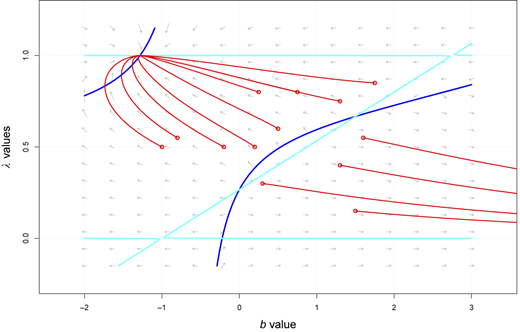
In this section, we will explore some of the analytical results described previously using a numerical approach that helps us plot a phase portrait for the model, as well as the trajectories of the key model variables, given a set of parameters and initial values (b0, λ0), using the Runge-Kutta method for numerical integration.
The parameters used in the simulation are shown in Table 1.
The numerical simulation generates three interior solutions, which are saddle fixed points for b* and λ* (only two of these points are visible in Figure 1). These points are , , and with corresponding , , and . The first two points are visible on the graph because they fall within the range λ ∈ [0, 1]. Therefore, only two of the three non-trivial fixed points (0 < λ < 1) are economically meaningful.
Thus, the phase portrait shows that all the interior fixed points are saddle points. Any deviation in the debt ratio (either higher or lower) for a given value of λ will reinforce the rise (or fall) in the debt level. In other words, any deviation in the capitalists’ share for a given level of debt will reinforce this movement. Why does this occur?
In terms of the capitalists’ share, the dynamic will only stabilize at the interior solution if the payoffs equalize.However, since the interest rate and mark-up are exogenous, the only way to equalize the payoffs is by adjusting the degree of capacity utilization. The problem is that a slight upward (or downward) deviation in λ leads to an increase (or decrease) in the degree of utilization, which further widens the payoff gap, reinforcing the movement.
With regard to debt dynamics, a fundamental point is that taxation is endogenous (i.e. it depends on u, while government spending is fixed. Therefore, as u increases, the budget shifts from a deficit to a surplus. Simultaneously, as both λ and u increase, the GDP growth rate also rises. If the GDP growth rate exceeds the interest rate, the potential steady state for b* becomes negative and stable.
On the other hand, if λ and u decrease, the budget moves into deficit, and the GDP growth rate also decreases. If the growth rate falls below the interest rate, the debt cannot stabilize. This scenario represents a sort of capitalist ruin.
7. Conclusion
In this paper, we explore the debt dynamics in a Kaleckian model. The key innovation here is that we explicitly address this issue by modeling economic heterogeneity, where entrepreneurs invest in the real economy while rentiers derive income exclusively from public debt. The model is wage-led but introduces a new element in terms of income distribution and economic performance, specifically regarding capacity utilization and growth.
In the short run, an exogenous rise in the share of rentiers reduces capacity utilization and growth. This occurs because only entrepreneurs invest in capital goods. Additionally, an exogenous increase in the interest rate lowers capacity utilization. This operates through the wage-led mechanism, as workers have a higher propensity to consume than rentiers. Consequently, an exogenous rise in the interest rate transfers income to rentiers, reducing aggregate demand.
When analyzing debt dynamics (assuming that the shares of rentiers and entrepreneurs in the economy are exogenous), we find the usual result that the economy’s growth rate must exceed the real interest rate to ensure debt stability. A new insight here is that a rentier share approaching one may generate instability.
When the shares of rentiers and entrepreneurs vary over time, we find an unstable steady state when rentiers dominate the economy. This is an intuitive result, as an economy without capital accumulation does not make sense in our model. Conversely, the corner solution, where the economy is entirely dominated by entrepreneurs, is stable but can be seen as a particular case (similar to the standard Kaleckian growth model without considerations for the debt financing process).
Finally, the model presents a set of interior solutions where both rentiers and entrepreneurs coexist. For all economically meaningful values of λ*, we obtain a saddle-path solution. This type of solution resembles a knife-edge case, as no jumping expectations variable ensures a unique and stable equilibrium regardless of the initial conditions and parameters.
This result echoes some of Kalecki’s original contributions, particularly Kalecki (1943, 2003), where stability (and full employment) does not emerge from market forces alone. Moreover, this knife-edge situation highlights the fact that deficit financing through borrowing plays a key role in capitalist economies, but also generates tensions between entrepreneurs (capitalists engaged in productive investment) and rentiers—an issue mentioned by Kalecki (1943), even if not explicitly modeled through a rentier/entrepreneurial variable. This tension suggests that an excessively large share of rentiers in the economy has significant potential to generate macroeconomic instability, while the absence of any borrowing mechanism can also be detrimental. In this sense, the role of the government in adjusting policy variables—such as the interest rate and broader macroeconomic policy—becomes a central mechanism not only for achieving full employment, but also for ensuring long-run macroeconomic stability.
The author(s) would like to thank the anonymous reviewers for their valuable comments and suggestions, which helped improve the quality of this manuscript.
Erratum: It has come to the attention of the publisher that the article, Iwai Drumond, C.E. and Costa Santos, J.F. (2025), “Debt dynamics in a Kaleckian model: entrepreneurs, rentiers, and the role of heterogeneity”, EconomiA, Vol. 26 No. 2. https://doi.org/10.1108/ECON-03-2025-0048, was published with an incomplete version of the condensed review process statement. The statement should read “This article is part of the special issue Selecta 2024, featuring the best papers from the 52nd Brazilian Economic Meeting. It was nominated by the conference’s scientific committee. Following an invitation to submit, the paper underwent a condensed review process, with a single referee recommending minor revisions.” The error was introduced in the editorial process and has now been corrected in the online version. The publisher sincerely apologises for this error and for any inconvenience caused.
Notes
Realize that , for K/Yp = 1, which is assumed in all over the model.
The analysis here is very similar to the debt-GDP equation presented in Blanchard et al. (1990), however, the key difference is that we are expressing it in terms of the capital stock.