


Ecologically habitat is an area of a particular species wherefrom its play every relationship with the surrounding. Therefore, every species hold habitat that supports to survive its life. The large terrestrial herbivore animal elephant (Elephas maximus) requires deferent kind of habitat for their biological behaviour. Forest habitat one of the landscapes entire their home range is very much responsible for selecting suitable habitat. The nature of habitat selection by an elephant is deeply concerned with landscape attributes.
The present study started in this opinion. The study area Panchet Forest Division (PFD) has 28 forest patches are not in same size. Generally, forest patches are the most suitable habitat for elephant in every forest landscape as well as in PFD. But which forest patch will be highly suitable that depends on ecological function of other geospatial attributes like patch shape complexity, patch core, road intervention intensity, amount of water body and composition of the forest. The present study measures these attributes by different sequential steps such as field inquiry, satellite image processing and GIS application by using ERDAS 9.3 and ArcGIS 10.3 version software.
After measuring these attributes value, Habitat Suitability Index is assessed through combined weighted principle method and prepared a suitability map. This map signifies that Joypur-I and II, Upper Peardoba, Brindabanpur, Kalabagan forest patches have good condition for elephant to prefer as a suitable habitat in PFD.
Spatial classification of elephant habitat in PFD helps society and managing authority. It facilitates better management and reducing the chance of human – elephant frequent contact.
1. Introduction
The qualities, as well as quantity of geospatial attributes, determine the habitat preference of an individual or herd of wild animal (Cushman, 2006; Cushman et al., 2008). Elephant, the largest terrestrial animal in this world, is very socialized and an intelligent species (Sukumar, 2003; Chatterjee et al., 2020). They accommodate themselves with changing environment through their biological assimilation (Murwira and Skidmore, 2005). Studies on movement, home range and habitat use pattern have shown significant variation in different habitat and ecological condition (Viljoen and Bothma, 1990; Eltringham, 1980; Moss, 1988). Requiring larger home range, elephant contracts different types of habitat within. Normally, they select habitat for resting and migrated from one habitat to another habitat by considering microclimate, food efficiency and also anthropogenic activities (Baskaran et al., 2011).
In eastern India, especially many western districts (Bankura, Paschim Medinipur, Purulia, Burdwan) of West Bengal now become elephant extended home range since 1980 from Dalma Wild Life Sanctuary, Jharkhand. Observational record about elephant stays time in PFD in Bankura district increasing year by year (Kulandaivel, 2010). This experience depicts that the forest patch of this particular area supports better condition before than (Mandal and Chatterjee, 2019). According to Chatterjee and Mandal (2020), this forest division becomes a resting ground of elephant at present. One of the most reasonable causes is forest cover enhancement during past four decades in this region. After implementation of Joint Forest Management in 1982, several social forestry programs are launched (Banerjee, 2007). As a result of it, vacant or barren land altered into forest land that leads amount of forest area and forest becomes more patchy in nature (Mandal and Chatterjee, 2020a, 2020b).
Since the beginning of 20th century wild elephant has not appeared in Bankura district (O’ Malley, 1908). A small population of elephants of Dalma sanctuary (Jharkhand state) has to make deep foray eastward into the state of West Bengal, using small patches of regenerating forest (Sukumar, 2003; Mandal et al., 2015). Since before three decades, this region had become a favorable habitat for elephant that has been understood by the records and the incident, i.e. sudden appearance of elephant herd in this division frequently. The dry deciduous sal (Shorea robusta) forest patch in study area is becoming a fine resting place for elephant (Baskaran et al., 2013; Kulandaivel, 2010; Chowdhury et al., 1997). Forest patches support their hiding condition, source of huge food and also support body metabolism. In a fragmented landscape, forest fragment and existing local vegetation play significant role of elephant colonization (Kumar et al., 2010). Normally, the forest patches are not homogeneous in composition, structure and efficiency in this region. These factors are completely responsible for habitat selection by elephant (Mandal and Chatterjee, 2018). It was found that elephant mostly encountered in the edge of agricultural land and forest patch (Koirala et al., 2016; Sundaram et al., 2003). As result of it, the forest duelers face maximum conflict by frequent movement of elephant from forest habitat to crop land. In spite of that, the existing forest patch has a significant role in ecology of elephant in this region (Chatterjee, 2016). The present study investigates the quality of forest habitat in response of habitat structure, composition and several ecological factors.
The main scope of the study is to clarify the forest patch wise elephant habitat suitability measurement under PFD. For that purpose, the present study investigates forest landscape and its ecological phenomenon related to the elephant habitat performance in the study area. This colonizing pattern and habitat selection are corresponding to several factors such as forest composition and its physical structure. In the question of habitat suitableness, forest patches play a vital role. Forest patch structural composition and its existing plant species composition determine their ecological behavior like foraging, resting, hiding and corridor selection. In this viewpoint, the study tries to investigate and to measure the compositional quality by geospatial methods of isolated forest patch for understanding the habitat qualities.
2. Materials and methods
2.1 Study area
PFD is one of the most affected divisions among three forest division under Bankura district in respect of elephant movement and elephant driving. Former, this was a soil conservation division but after 1980 it was transferred as a forest division. The latitudinal extension of PFD is 22°53 N to 23°12 N and 87°03E to 87°42E. Total area of the PFD is 1355.62 sq km. Out of the total area only reserved forest is12.90 sq km and protected forest is 335.11 sq km. The study area is the extended part of Chottonagpur plateau and also beginning part of Gangetic alluvial plain. Therefore, it is an ecologically enriched zone between plateau and plain. The character of the natural vegetation is tropical dry deciduous dominated by sal (Shorea robusta) forest. The PFD is consisting of 5 forest ranges and 21beats (Table 1 and Figure 1).
Forest Administrational hierarchy under PFD in Bankura district
| Name of the range | Onda | Taldangra | Bankadaha | Bishnupur | Jaypur |
|---|---|---|---|---|---|
| Name of the Beat | Onda Krishnanagar Chingoni Chagulia | Taldangra Asna Panchmura | Bankadaha Amdahara Peardoba Uparsol Amdangra | Bishnupur-I Bishnupur-II Heraparbat Basudevpur Chaugan | Jaypur Machantala Kuchiakol Adhkata |
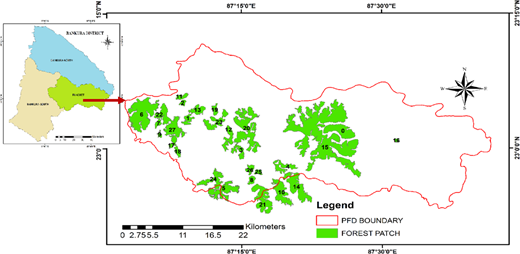
Location map of the study area with distinct 28 forest patches under PFD with patch ID
Location map of the study area with distinct 28 forest patches under PFD with patch ID
2.2 Database and data source
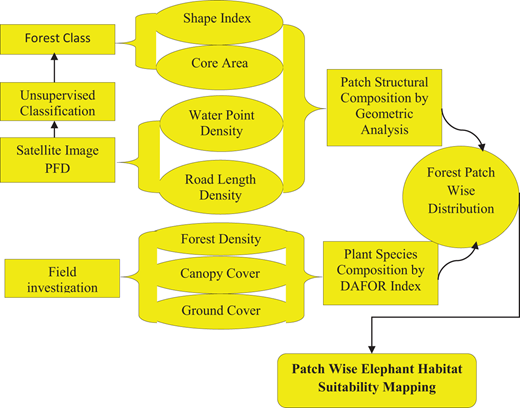
The present study following the sequential steeps to rich the final aims (Figure 3). At first IRS, LISS-III, P6 2019 satellite image of the study area is collected from National Remote Sensing Centre, ISRO, Department of Space, Hyderabad. This land use landcover image is reclassified through an unsupervised method by using ERDAS Imagine 9.3 v software. Only forest class map is extracted from this reclassified image to demarcate the forest patches. This forest class map overlapped with Google image 2019 to verify the demarcation accuracy. From this map, distinct 28 forest patches are identified and named as the nearest village name due to investigation interest. Similarly, other factors such as water source, road or network lines are digitized from Google map 2019 for quality analysis. For collecting habitat compositional information stepwise micro-level field survey was done from every forest patches by grid sampling method randomly. The information collecting process is strictly followed by DAFOR indexing through 100 m/100 m grid quadrat inside the selected forest patch. These grid-wise sample information are sum up for understanding vegetation composition qualities such as microclimate, density of the forest, health of the trees, ground coverage or habitat undergrowth and canopy cover for individual forest patch. After getting the distribution, simple weighted method is applied for getting the final map.
2.3 Methods
The present study modified the concept of habitat suitability index (HSI) by (Schamberger et al., 1982; Romero-Calcerrada and Luque, 2006) to quantify the suitability of elephant habitat in this region. Seven parameters such as patch shape, patch core, road density, number of water source density, forest density, percentage of canopy cover and percentage of ground coverage or habitat undergrowth are included to quantify elephant HSI. Each parameter also divided into sub-parameters those are directly and relatively relate to nature of elephant habitat interaction. Patch shape, patch core, road length density and water point density these parameters are quantified through geometric analysis in ArcGIS 10.3 v and FragState 4.2 v software.
Shape index (SI) (McGarigal and Marks, 1994)
Adjusted by circle p is perimeter of the patch and a is area of the patch. When SI is 1 the patch is circular and increasing value indicates more irregular from circle standard.
Shape index measured the fragmentation nature of the forest patch. Highly fragmented forest patch offers low quality of habitat for elephant. Therefore, continuous forest habitat with low shape complexity is always better for good habitat quality.
Structural core areas have been measured from demarcated 28 forests patches under PFD at specified edge depth at 300 m.
Core Area (CA) (McGarigal and Marks, 1994)
= core area (m2) of patch i based on specified- edge depth at 300 m or buffer distance.
At fixed edge depth the value of CA defines several habitat qualities. Practically patch has a larger core is meaning that it offers better condition for elephant habitation.
Road Length Density (RLD)
lir = length of the road into the forest patch in (m); and
A = area of individual forest patch in m2.
Transport network line plays as a disturbing role for animal habitat movement and colonization. Elephant also avoids this type of landscape for their habitat selection. Therefore, forest patches with high road density become less suitable for elephant habitat preference.
Water Point Density (PWD)
w = number of water point source inside the forest patch; and
A = area of individual forest patch in m2.
Water is an important factor for elephant body metabolism. One elephant daily requirement of water is 150 litre. So the amount and density of water body in a forest habitat is an essential factor for habitat suitability.
Forest density
Densely forest supports several ecological functions of elephant to select shelter for resting and hiding. Highly dense forest has a good capacity for better habitat condition than poorly dense forest.
Canopy cover in percentage. To measure this parameter a conical shape cylinder is used. Manually overhead focus has been made by this cylinder and approximate canopy cover is recorded at a different point in the same grid. Randomly several eye estimations are done by this cylinder within the sampling grid and measure the average percentage of canopy cover:
N = total number of count.
Ground coverage or habitat. Undergrowth in percentage100 m/100 m grid is divided into 20 m/20 m sub-grids to get ground coverage information. Undergrowth percentage information is observed from each sub-grid by eye estimation. Then all subgrids percentage values are sum up and average to find out the total percentage of ground cover for the min grid (Figure 2).
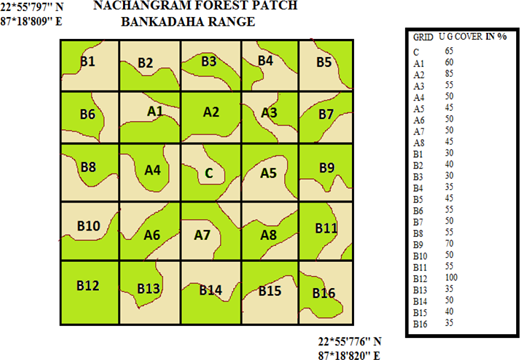
Ground cover matrix in a sampling site of forest patch nearest in Nachangram forest Bankadaha Range
Ground cover matrix in a sampling site of forest patch nearest in Nachangram forest Bankadaha Range
ABCg = Total grids of the matrix;
gcaA1 = Ground cover area of single subgrid in the matrix by eye estimation; and
A = Total area of the all grid.
Total 45 sample sites are chosen from each and every forest patch under PFD. Individual parameter value is calculating for each forest patch by sum up grid sample information of that particular forest patch. After that, a suitable class range is set up for each parameter. Finally, according to the range value of particular parameter individual map is prepared to understand the elephant behaviour interaction with parameter characters.
3. Results and discussions
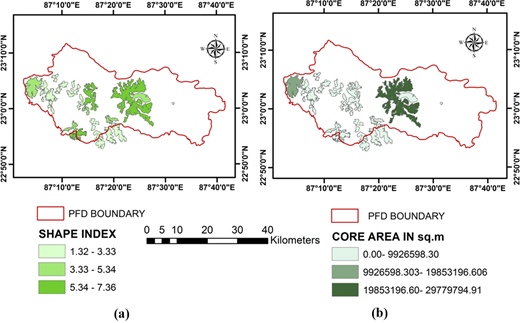
Huge amount of field information and image analysis represents the quantity cum quality of these forest habitat patches in PFD. At first forest patch shape complexity is measured by SI and prepared a map [Figure 4(a)]. The largest patch Joypur-i has high SI represents more complexity. But this forest patch also has high CA at 300 m edge depth [Figure 4(b)]. Elephant preferred this forest patch for their habitat than other surroundings forest patch but in this area, their movement becomes unsafe due to high anthropogenic encroachment (Chatterjee, 2016). Habitat core plays a significant role in area sensitive species from any kind of disturbances from surroundings (Kumar et al., 2010). High fragmented habitat may be having minimum core than less fragmented habitat (Forman, 1995; Fernando et al., 2008). Whatever it, a large core area supports elephants for safe resting and hiding (Leuthold, 1977; Smith et al., 2011; Garmendia et al., 2013). It has been found that Peardoba, Joypur-i and ii, Sibdanga and Taldangra forest habitat hold a large amount of core than others forest patches in PFD and minimum CA has found in Chatrakrishnanagar, Piaribandh, Metiala, Chakshyampur and Jembadia.
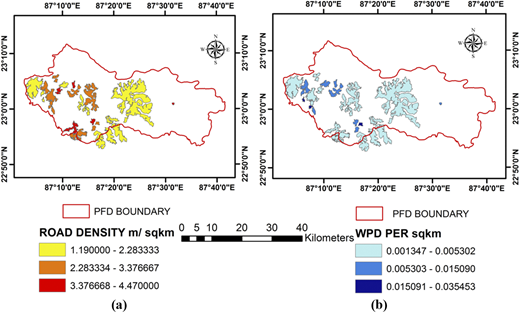
Vehicle transport network line plays as a disturbing role in wildlife ecology (Forman, 2012; Fernando et al., 2008). Elephant also avoids this type of landscape and become alert when they cross the road (Santra, 2003). In the study area NH-60, SH-2 and so many district road including PMGSY (Pradhan Mantri Gram SadakYojona) extent across through the habitat. South-eastern railway line from Kharagpur to Adra section and Bankura to Gokulpur extent railway line crosses into forest habitat hare and there. Therefore, high road density forest patch becomes less suitable for habitat quality (Roy et al., 2010; Chanda, 1996). In the study area Chatrakrishnanagar, West nakaijuri, Metiala, Chakshyampur forest patch is found high network density. Less density found in Bindabanpur, Kalabagan, Jaypur-i and ii, Upper Peardoba [Figure 5(a)]. Water is an important factor for elephant body metabolism. So water body presence in a habitat is essential for habitat suitability (Chamaille-Jammes et al., 2007). To restore elephant population and enhancing habitat quality water reserves have been created in several elephant sanctuaries (De Beer and Van Aarde, 2008) in North Bengal and also South India (Mukherjee et al., 2019). Among the entire forest habitat under PFD Joypur-i and ii, Kalabagan, Peardoba, Chandabelia forest patch hold higher number but low density of water body and high density found in Krishnasingpur, Nakaijuri and Chakshympur [Figure 5(b)]. The elephants in Africa travel about 40 km only to drink water in dry season (Chamaillé-Jammes et al., 2013). So it is a great matter of thinking for habitat selection by elephant.
Forest is the second dominant land use after agriculture in this district. Social forestry and joint forest management programme tremendously increased forest area, since 1970 (Singh, 2006). Densely forest supported elephant to get shelter for resting and hiding (Singh et al., 2002). Maximum forest patch of PFD dominated by sal tree, but their density is different. Like Joypur-i and ii, Kalabagan, Brindabanpur, Peardoba and Chandabelia forest density is high and low density is found in Metiala, Chakshyampue and Asthasol [Figure 6(a)]. Shadowiness is very essential condition that depends on canopy cover within a forest habitat. Especially elephant likes shadow when they are resting in the forest at day time (Sukumar, 2003). Not only resting but it also makes hiding from any disturbances and under forest thermal condition. Field information represents that Joypur-i and ii, Peardoba, Kalabagan, Taldangra Bhaluka and Brindabanpur forest patch have high percentage of canopy cover [Figure 6(b)].
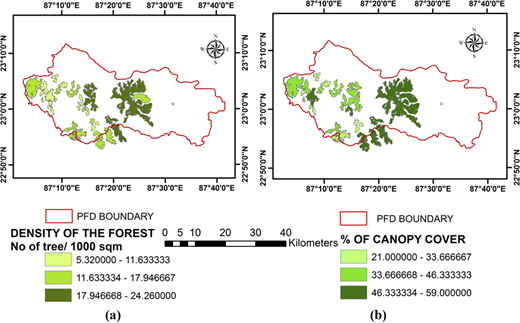
Distribution maps of forest density and canopy cover under PFD among 28 forest patches
Distribution maps of forest density and canopy cover under PFD among 28 forest patches
Undergrowth of forest means the lower portion of the tree from surface to specific height. It is understood that the quality of the forest depends on shrubs and creepers circumstance in the forest cover (Hernandez-Stefanoni, 2005). Undergrowth of the forest plays a fundamental role as a fodder, as a resting place and as a hidden place for animal species as well as elephant (Desai and Hedges, 2010). Further, it enhanced the micro climatic condition of the forest habitat patch (Mandal and Chatterjee, 2020a, 2020b). Naturally, densely forest has better under growth condition. In Joypur-i and ii, Kalabagan, Peardoba forest patches under growth condition is better than other forest patches in PFD (Table 2).
Forest patch wise master table of different parameters calculating values
| FID | Patch name | % of ground coverage | % of canopy cover | Road density m/ sq.km | Density of the forest No. of tree/1000 sq.m | Shape index | Core area in sq.m | WPD per sq.km |
|---|---|---|---|---|---|---|---|---|
| 0 | Joypur-II | 54 | 57 | 2.1 | 13.8 | 4.35 | 5053611.78 | 0.002824935 |
| 1 | West Nakaijuri | 60 | 41 | 3.75 | 11.87 | 2.63 | 263512.12 | 0.005140176 |
| 2 | Jambedia | 45 | 32 | 3.22 | 7.05 | 1.74 | 60594.81 | 0.004056383 |
| 3 | Uppersole | 51 | 52 | 2.12 | 9.23 | 3.85 | 85541.76 | 0.003607181 |
| 4 | Peardoba-ii | 45 | 56 | 1.23 | 20.29 | 3.6 | 128831.82 | 0.004303981 |
| 5 | Upperpart Arrha | 37 | 21 | 2.98 | 15.32 | 6.6 | 1801829.7 | 0.002752029 |
| 6 | Taldangra | 53 | 38 | 1.36 | 17.37 | 3.8 | 11046878.57 | 0.001618662 |
| 7 | Sibdanga East | 42 | 27 | 1.59 | 11.21 | 1.83 | 95141.08 | 0.00908186 |
| 8 | Sabrakona | 32 | 29 | 2.36 | 8.64 | 1.4 | 339258.77 | 0.015090136 |
| 9 | Pearbandh | 36 | 41 | 1.98 | 7.94 | 2.39 | 274.16 | 0.018826339 |
| 10 | Peardoba-i | 61 | 57 | 2.15 | 15.98 | 3.3 | 2593695.91 | 0.004404891 |
| 11 | Matiala | 35 | 24 | 2.79 | 6.45 | 1.94 | 47330.73 | 0.005301649 |
| 12 | Majuriprasadpur | 36 | 35 | 1.98 | 5.32 | 3.07 | 258142.57 | 0.001347461 |
| 13 | Krishnasingpur | 31 | 25 | 1.19 | 10.21 | 2.08 | 819628.75 | 0.007260831 |
| 14 | Kalabagan | 56 | 47 | 1.71 | 21.94 | 3.01 | 4361352.22 | 0.002988429 |
| 15 | Jaypur-I | 71 | 59 | 1.87 | 24.26 | 7.36 | 29779794.91 | 0.001704084 |
| 16 | Chatrakrishnanagar | 25 | 21 | 4.47 | 8.21 | 1.32 | 0 | 0.006771012 |
| 17 | Chakshyampur upper | 32 | 26 | 3.12 | 9.21 | 2.15 | 37944.1 | 0.035453097 |
| 18 | Chakshyampur lower | 35 | 24 | 2.68 | 6.32 | 1.69 | 142470.55 | 0.012502985 |
| 19 | Chakmuktapur | 49 | 38 | 3.51 | 11.87 | 1.75 | 149752.74 | 0.012072903 |
| 20 | Chandabalia | 58 | 42 | 2.32 | 18.57 | 5.44 | 3768282.01 | 0.002445186 |
| 21 | Brindabanpur | 61 | 51 | 1.35 | 15.68 | 2.96 | 2780911.92 | 0.00209927 |
| 22 | Bhaluka | 47 | 46 | 2.58 | 11.25 | 2.62 | 1237023.09 | 0.008557442 |
| 23 | Bitjfaria | 52 | 46 | 2.91 | 12.36 | 3.14 | 757292.41 | 0.00780132 |
| 24 | Barkhulia | 44 | 36 | 3.64 | 13.68 | 4.08 | 169545.05 | 0.004412467 |
| 25 | Asthasol | 41 | 31 | 2.44 | 6.58 | 1.32 | 104777.1 | 0.021191553 |
| 26 | Amdangra | 38 | 29 | 3.67 | 12.64 | 1.68 | 286813.37 | 0.00863518 |
| 27 | Bhaluka east | 56 | 51 | 3.12 | 9.23 | 1.89 | 1321432.54 | 0.001661348 |
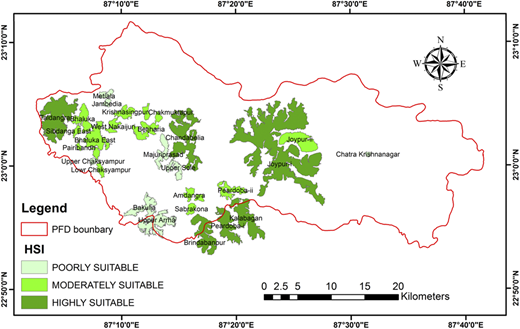
After the description of each parameter against 28 forest patches in PFD, the present study sum up the all criteria to find out the suitability index by a simple weighted method modified by (Gong et al., 2012). Each and every parameter quantify value is converted into weightage value in three-point scale against each and every forest patches. Weighted value is putting up on the basis of parameter ecological function and the range of perimeter value. As for example in case of SI, the habitat quality is high when the value is low. So, low SI value scored high range in scale. In the weighted scale 3 represent high quality, 2 represent moderate and 1 is low quality. At last, all parameter weighted values against each forest patch is sum up and prepared a suitability index map (Figure 7).
3.1 Suitable habitat forest patch
Out of 28 forest patches in PFD Joypur-i forest, Brindabanpur forest, Chandabila forest, Taldangra forest, Kalabagan and Peardoba-i forest patches have highly suitable environment for elephant colonization. Habitat suitable condition for elephant in these forest patches has been found better because all parameters conditions are good. Accordingly, the next forest patches such as Joypur-ii, Amdangra, Asthsole, Barkhulia, Peardoba-ii, Sabrakona, Western Nakaijuri, Jambedia, Metiala have moderately suitable for elephant habitat. The poor habitat condition is found in Pearibandh, Sibdanga, Bhaluka, Chatrakrishnaagar, Chakshyampur upper, Uppersole and lower forest patches.
4. Conclusion
Elephant cannot stay in the forest for long time due to other essential ecological work and performance. Forest is the only important part of their habitat where they can get resting and hiding facilities. Therefore, qualities of the forest attract them to stay here to rest there. Suitable forest patches in their entire home range acting as a colonizing zone. After completing our analysis, we shall predict that Jaypur-i, Kalabagan, Taldangra, Chandabelia, Peardoba-i and Brindabanpur forest patches have better condition for better habitat use of migrated elephant as well as residential elephant. Surroundings of these forest patches elephant movement will be frequent than other parts of PFD. The fragmentation level of these suitable forest patch is low in respect of considering other forest patches under PFD. But these suitable patches structurally fragmented or complexable. It leads more contact between elephant and nearest society (Hartter et al., 2011). It is interesting to know that nearest villages of these forest patches are faced maximum incident of elephant movement than other villages of the study area because of these forest patches have better condition that supports elephant for their habitat preferences. Especially the agricultural activities in between two forest patches will be highly damaged by frequent elephant movement (Talukdar and Barman, 2003) from one patch to another forest patch. To control or minimize the haphazard movement of elephant in these forest patches a scientific land use method is essential (Mandal and Chatterjee, 2020a, 2020b).
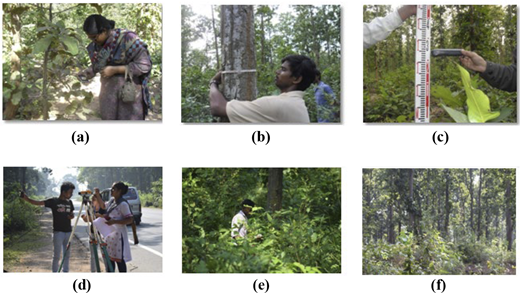
Field investigation by different types of equipment in different sample site in PFD
Field investigation by different types of equipment in different sample site in PFD
The authors are thankful to the Department of Geography and Environment Management, Vidyasagar University for infrastructural assistance during this study. The authors are very thankful to those people who helped us to take primary field data form forest core areas. They are thankful to the field staff and divisional forest officers help us to provide habitat level information.

