By using the lens of effectuation and causation, this paper aims at exploring how the team is formed in high-tech academic spinoffs, by looking specifically at decisional heuristics in an academic context. Indeed, the team composition is a critical issue for the subsequent growth of the academic new venture: on the one hand, the scientific-centred knowledge of the academic entrepreneurs is one of the main elements that lay the foundation for the new venture; on the other hand, it has been widely recognized that the lack of market-related knowledge and experience often has detrimental effects on performance. Decisive is then to explore how team decisions pertaining to the team formation process are taken.
A qualitative methodology based on multiple case studies is adopted under an abductive approach.
Results shed light on how decisions pertaining to team formation are taken by academic entrepreneurs and with what effects on team composition, a fundamental element to foster the growth of academic new ventures. Specifically, this study derives some propositions about the adoption of effectuation and causation in the team formation process, their occurrence and sequence in the light of the scientific context in which academic new ventures spin out and the effects on the team composition.
This study contributes to the debate on academic entrepreneurs’ decisional heuristic and the use of effectuation or causation in the early stages of an academic new venture, by focusing on the team formation process. This study specifically considers three temporal micro-phases – the selection of founders before inception, the appointment of top management teams, and the integration of early employees after the inception – and whether the academic context influences the decisional heuristics. Managerial implications are also derived.
1. Introduction
To analyse entrepreneurial decision-making in the context of high uncertainty and in relation to new venture creation, Sarasvathy (2001) introduced the effectuation logic as a possible alternative to the causation logic. Effectuation is a mean-driven approach, actor-dependent and focused on the controllable aspects of an unpredictable future. Conversely, causation is a goal-oriented approach, effect-dependent and focused on the predictable aspects of the future. In line with the entrepreneurial cognitive approach, effectuation and causation are presented as decision-making heuristics that focus on the entrepreneur as an individual and his/her decisions under uncertain conditions and within unpredictable environments (Mitchell et al., 2007; Gregoire and Cherchem, 2020). These heuristics analyse the ways in which discrete decisions are made and allowed to capture the underlying factors (Langley et al., 2013; McKelvie et al., 2020), even in the context of new venture creation. Following prior research (i.e. Visintin and Pittino, 2014), Academic spin-offs (ASOs) are new ventures that originate from individuals conducting scientific research within universities – historically specialized in the production and preservation of knowledge (Perkmann et al., 2013) – and have at least one academic among the founders. Since ASOs embody technologies based on cutting-edge scientific research whose commercial applications are relatively opaque at the beginning (Reymen et al., 2017), academic entrepreneurs struggle to pursue market opportunities identification (Gubeli and Doloreux, 2005), especially if too immerse in their scientific academic domain (Armano and Scagnelli, 2012; Lockett et al., 2005) – identifiable as a knowledge corridor that heavily influences their knowledge, experience and network (Ronstadt, 1988; Gruber et al., 2013), and that is somehow distant to the “commercial culture” of the targeted market (Rasmussen, 2011, p. 96). Integrating into the team non-academic profiles having the knowledge necessary to compete and grow in the targeted market is a difficult task for academic entrepreneurs (Visintin and Pittino, 2014; Mathisen and Rasmussen, 2019). The team then tends to be centred around academic profiles and technological competencies (Ensley and Hmieleski, 2005), while the lack of non-academic knowledge and experience often limits ASOs’ growth and performance (e.g. Ensley and Hmieleski, 2005; Visintin and Pittino, 2014). Decisive is then to explore ASOs’ team formation process (Nikiforou et al., 2018). As suggested by the entrepreneurial literature (e.g. Van de Ven et al., 1984) and the cognitive literature (Mitchell et al., 2002, 2007), the role of academic entrepreneurs (Cerver Romero et al., 2021; Hannibal et al., 2016) and the way they think, act and take decision is pivotal within such process. However, to date, a limited number of studies investigated academic entrepreneurs’ decisional heuristics. While some authors found that effectuation is preferred in new venture creation and in cases of highest uncertainty (e.g. Hannibal et al., 2016), other authors (e.g. Villani et al., 2018) offered arguments for the prevalence of rational, causative decision models when science-based ASOs are involved. To shed light on these few and ambivalent findings, we analyse the process of team formation in ASOs by focusing on micro-level decisions (Mathisen and Rasmussen, 2019). The paper then aims at investigating the occurrence of effectuation and causation heuristics, and how their manifestation may impact the integration of non-academic profiles in ASOs’ teams, by looking at three micro-phases of the team formation process (Mathisen and Rasmussen, 2019; Perry et al., 2012), namely, the formation of the founders’ team before the inception, the appointment to the top management team and the integration of early-employees into the team after the inception. An abductive approach is adopted (Dubois and Gadde, 2002), coherently with the theory-enlarging perspective we embrace. Through the collection of narratives (Pentland, 1999) from a purposeful sampling of high-tech ASOs, we grasp the occurrence of causation and/or effectuation, in decisions related to the team formation process as a unit of analysis. Results show that the degree of embeddedness within the academic context does matter in driving the decision-making heuristic of the academic entrepreneurs, with consequences on the resulting team composition. We then answer the call for a temporal and processual perspective in the empirical analysis of ASOs (Nikiforou et al., 2018), for the integration of effectuation into academic entrepreneurship literature (Arend et al., 2015), and for the adoption of a cognitive approach to a particular entrepreneurial context – the academic one (Mathisen and Rasmussen, 2019; Mitchell et al., 2007).
The paper proceeds as follows. Section 2 presents the literature review and the research questions. Section 3 focuses on the research design and methodology; Section 4 shows the results, which are discussed in the following Section 5. Conclusions, limitations and implications of the study are highlighted in Section 6.
2. Theoretical framework
2.1 Effectuation and causation heuristics
Under a cognitive perspective, it is fundamental to study “the knowledge structures that people use to make assessments, judgments or decisions involving opportunity evaluation and venture creation and growth” (Mitchell et al., 2002, p. 97) and, hence, the examination of cognitions relating to entrepreneurial decision-making (Mitchell et al., 2007). Among the decision-making heuristics, Mitchell et al. (2007) identified effectuation as distinct from causation. Through the lens of effectuation and causation, we are able to analyse the ways in which discrete decisions are made and capture the underlying logic of such decisions (McKelvie et al., 2020). Effectuation as a process theory is a mean-driven approach, actor-dependent and focused on the controllable aspects of an unpredictable future. In her seminal work, Sarasvathy (2001) presented effectuation as focused on the individual entrepreneur, his/her characteristics and way of taking decisions under uncertain conditions and within unpredictable environments. Specifically, Sarasvathy (2001) recognized that “entrepreneurs begin with three categories of “means”: they know who they are, what they know, and whom they know – [that is to say] their own traits, tastes, and abilities; the knowledge corridors they are in; and the social networks they are a part of” (Sarasvathy, 2001, p. 250), and entrepreneurs tend to create opportunities on the bases of the means they possess and exploit preferably the resources on their hands, due to the uncertain future conditions of the new venture creation process. Effectuation is thus aligned with emergent and non-predictive strategies (Wiltbank et al., 2006) since it is based on leveraging existing relationships and resources. Given that in new venture creation the objectives are not clearly envisioned, and the technology applications are opaque at the beginning (Reymen et al., 2017), “a venture will [then] develop along the lines of the means or expertise that are a part of the entrepreneur’s personal repertoire, a part of the way they think and make sense of an evolving situation” (Mitchell et al., 2007, p. 9). Effectuation allows to “remain flexible, take advantage of the environment contingencies as they arise, and learn as they go” (Perry et al., 2012), still pursuing higher innovation performance (Roach et al., 2016). Opposed to, but not in contrast with, causation is goal-oriented, effect-dependent and focused on the predictable aspects of the future. It is based on intentionality and it is consistent with a planned strategy approach (Mintzberg, 1978), according to which resource acquisition is a structured process led by opportunity identification and evaluation of entrepreneurial stages (Fisher, 2012; Shane, 2000). As a consequence, “this causal rationality typically involves the examination of multiple alternatives and then the determination of the optimal alternative” (Mitchell et al., 2007, p. 8). Hence, entrepreneurs are supposed to be able to clearly identify opportunities emerging from the surrounding environment and evaluate the best mean among many to reach predetermined objectives (Shane and Venkataraman, 2000).
Overall, the two heuristics are not in contrast nor mutually exclusive but can be complementary and/or sequential (Gregoire and Cherchem, 2020; McKelvie et al., 2020). Among the elements that can influence their adoption, the stage of the entrepreneurial project and the conditions under which it unfolds are pivotal. For example, Sarasvathy (2001) posited that the effectuation model is preferable in early stages decisions, due to founders’ limited ability to capture the external information needed to take decisions based on a structured causation process. Other studies (e.g. Hauser et al., 2020; Reymen et al., 2015) evidenced the predominance of a flexible heuristic in the earliest phases of new ventures, “with a transition to more planning-based decision making over time as both the new venture and its market mature” (Reymen et al., 2015, p. 374). With regards to a technology-based new venture, the effectuation approach is predominant under conditions of greater uncertainty or resource shortage – such as the creation of the value proposition in the business model development (Reymen et al., 2017).
2.2 Academic entrepreneurs and academic spin-offs
The characteristic that distinguishes ASOs from other new ventures is being founded by individuals currently or formerly employed within the university, i.e. academic entrepreneurs, who decide to commercialize the results of their academic and scientific research activities (Visintin and Pittino, 2014). The role of the academic entrepreneur has been recognized as pivotal in driving the growth and performance of ASOs (Mathisen and Rasmussen, 2019). Overall, it is widely recognized that the abidance within the academic context, while affecting positively the ignition of innovative processes (Agarwal and Shah, 2014; Ben-Hafaïedh et al., 2018), is likely to limit the subsequent growth (Armano and Scagnelli, 2012; Ensley and Hmieleski, 2005) and to restrain the integration of non-academic knowledge and competences-enlarging strategies (Colombo and Piva, 2012) that are fundamental to face critical junctures (Gubeli and Doloreux, 2005; Vohora et al., 2004). Academic entrepreneurs are indeed used to institutional logic that is far from the market and commercial domain (Rasmussen, 2011), being immersed into a context devoted to advancing, producing and storing knowledge for its own sake (Perkmann et al., 2013; Villani et al., 2018), which could hinder the identification and exploitation of market-related opportunities (Mathisen and Rasmussen, 2019) and the founding of a new venture (Marvel et al., 2020), ultimately affecting the full technological transition from the university lab to the market (Huynh et al., 2017; Villani et al., 2018). The scientific and academic domain can then be portrayed as a knowledge corridor in which academic entrepreneurs develop their knowledge and experience (Ronstadt, 1988; Gruber et al., 2013). The prior knowledge and the ability to assimilate external knowledge are idiosyncratically proper to each individual (Gruber et al., 2013) and provide a cognitive framework under which the entrepreneurial processes unfold, playing a key role in exploiting opportunities or in completely missing them (Ronstadt, 1988). Academic entrepreneurs strongly rely on their prior academic knowledge to create opportunities and face difficulties in breaking bonds with the academic and research communities (Murray, 2004). These specific cognitive conditions may limit them in assimilating external market-related knowledge if compared to non-academic entrepreneurs (Nordman and Melén, 2008). Thus, based on the different institutional contexts they belong to (Roche et al., 2020), academic and non-academic entrepreneurs may differ significantly in their decisions and behaviours.
However, few empirical studies focused on how decisions are taken in ASOs creation [1], and ambivalent results are emerging (for reviews see Gregoire and Cherchem, 2020; Perry et al., 2012; McKelvie et al., 2020). On the one hand, some studies (Maine et al., 2015; Hannibal et al., 2016) agree that academic entrepreneurs tend to focus mainly on the use of existing resources and means at disposal, especially in early decisions. The creation of ASOs is then “linked to the inventor-founders’ means in the form of expertise and curiosity to create new knowledge” (Hannibal et al., 2016, p. 367) and “closely tied academic networks may act as key antecedents (means) to recognize opportunities” (Hannibal et al., 2016, p. 367) – in line with the effectuation heuristic. In addition, “the effectuation logic enables founders to employ their academic role identities as means in leveraging new entrepreneurial opportunities” (Hannibal, 2017, p. 261). Conversely, other studies (Villani et al., 2018; Wang et al., 2021) portray academic entrepreneurs as agents specialized in exploiting opportunities that are identifiable from the surrounding environment (in line with Shane and Stuart, 2002). As they remain engaged in universities and scientific mindset and norms, academic entrepreneurs “should be more “planned” than traditional entrepreneurship” (Wang et al., 2021, p. 629) due to the practices of basic research and scientific cognitive frame in problem-solving they are used to (Villani et al., 2018). Being “highly influenced by the lab logics, which identify linear models of development with specific phases, from basic research all the way to more applied stages, using causal-effect sequences” (Villani et al., 2018, p. 174), academic entrepreneurs would then be more prone to rely on a causation heuristic in the creation of ASOs. Despite the conflicting results, overall the studies recognize the importance of the strong bond with the domain of belonging – that is, the knowledge corridor formed within the university – but it is not clearly envisioned how it influences the occurrence of decisional heuristics.
2.3 Team formation process in ASOs
In the context of ASOs, the team formation process is pivotal (Cerver Romero et al., 2021; Nikiforou et al., 2018) – so as the related bunch of decisions on “how first-time founders recombine different facets of old domain knowledge from academic research to navigate the new domain of entrepreneurship” (Cohen and Munshi, 2017, p. 131). A part of the academic literature agrees on the necessary integration of non-academic members within the team (Sciarelli et al., 2021; Tagliazucchi et al., 2021) or the board (Ferretti et al., 2020) to foster growth, to reach the credibility threshold (Rasmussen et al., 2011), to find appropriate market applications for cutting-edge technologies derived from the scientific research (Visintin and Pittino, 2014) and to enhance the commercial success of ASOs (Ben-Hafaïedh et al., 2022; Lockett et al., 2005). Without any claim of systematic reviewing, we scrutinize the debate around the academic team formation process to date (see Table 1). The contributions are selected on the basis of recent reviews (Cerver Romero et al., 2021; Mathisen and Rasmussen, 2019; Nikiforou et al., 2018), integrated with an adhoc search for empirical contributions published in high-impact journals in the field of technology entrepreneurship, selected by following the ranking provided by Ratinho et al. (2015).
Scholars’ attention has mainly focused on the evolution of competencies: from managerial competencies (e.g. Clarysse and Moray, 2004) to specific sets of industry-related competencies (Rasmussen et al., 2011, 2015), till different kinds of experiences of new team members (Vanaelst et al., 2006). The role of academic entrepreneurs emerges as fundamental also at the team formation level (Clarysse and Moray, 2004; Grandi and Grimaldi, 2003). The presence of tenure-tracked academic entrepreneurs appears to be negatively correlated to ASOs’ growth when they are excessively immersed in the academic context (Armano and Scagnelli, 2012). Overall, the contributions claim the importance of integrating knowledge and experience from diverse contexts (Rasmussen et al., 2011; Vanaelst et al., 2006; Vohora et al., 2004; Yusubova et al., 2020). The way in which this integration is accomplished may follow different paths (Miozzo and Di Vito, 2016), ranging from the further development of founders’ network (Grandi and Grimaldi, 2003; Rasmussen et al., 2015), to looking at external providers (Rasmussen et al., 2011) or by pivoting on internal learning effects (Clarysse and Moray, 2004), while scarce is the use of external recruitment (Miozzo and Di Vito, 2016). The importance to slacken the scientific and academic knowledge corridor emerges as a factor to sustain ASOs’ growth over time, since if “the academic may perceive a potential opportunity to exploit a technological invention, they may need help from […] a surrogate entrepreneur to identify the market for it” (Lockett et al., 2005, p. 984). Similarly, other studies confirm that the “prior entrepreneurial experience and private sector work experience significantly influence university professors’ ability to identify and develop business ideas based on their research” (Gabrielsson et al., 2012, p. 226). Despite that, academic entrepreneurs seem more prone to group with people with whom they share a common research experience and academic background (Visintin and Pittino, 2014).
Based on the literature review, we found that no previous studies focused on the decisional heuristics (Gregoire and Cherchem, 2020; Perry et al., 2012) applied to such an important process, as team formation. Overall considered, the review confirms that the domain within which the academic entrepreneurs develop their knowledge, networks, norms and within which the new venture is rooted, does matter in influencing decision-making processes. However, how the academic context cognitively affects decision-making is a relatively understudied issue. We observed, in particular, that the extant literature shows some indeterminacy in the temporal articulation of the academic entrepreneurial process – considered at a single point in time (McKelvie et al., 2020) – while a more fine-grained time fragmentation and more attention to temporality issues are desirable (Perry et al., 2012; McKelvie et al., 2020). Further effort is then required in disentangling micro-level phases (Mathisen and Rasmussen, 2019), especially in the team formation process – given the importance of related decisions to foster ASOs growth. We then focus on the sequence and occurrence of effectuation and causation in relation to the team formation process, and on the cognitive constraints associated with the academic domain represented as a knowledge corridor. The research questions that we address are the following: how do academic entrepreneurs cognitively face decision-making heuristics related to ASOs’ team formation process in their transition from the university lab to the market? How does the academic entrepreneur’s own scientific knowledge corridor affect such decision-making heuristics, and which are the effects on the resulting team composition?
3. Methodology
A qualitative methodology based on multiple case studies is adopted, as it facilitates the comprehension of complex phenomena (Yin, 2009) and the targeting of an under-researched entrepreneurial process within a particular context (Eisenhardt, 1989). To unfold the process of team formation, inspired by previous explorative empirical research (e.g. Cohen and Munshi, 2017; Parmentola and Ferretti, 2018) and in line with the theory-enlarging perspective, we adopt an abductive process of analysis (Dubois and Gadde, 2002) – that is composed of different steps. Such an approach allows combining the elements that emerged from the literature framework with the evidence from the case studies (Dubois and Gadde, 2002).
First, we specifically consider three temporal phases to tackle micro-level processes of team formation over time (Mathisen and Rasmussen, 2019). The three phases are the establishment of the Founders’ Team (FT), defined as the group of people who create the new venture, who may or may not have formal executive roles (Beckman and Burton, 2008) after the inception; the appointment of managerial roles to the Top Management Team (TMT), defined as the group of people that hold executive titles, independently by the fact that they were also founders or that they joined later the new venture (Beckman and Burton, 2008) after its inception; the employees-integration phase of the team (EMP) when new members are integrated into the team for the first time after that TMT has been formed. We draw on a purposeful sampling (Eisenhardt, 1989) of 14 high-tech ASOs founded between 2014 and 2017, for a total of 24 interviews collected. All the ASOs came from the same parent institution, a European polytechnic that specialized in scientific and technical fields and was strongly devoted to research. The choice to select ASOs from a single institution allowed to neutralize any contextual elements that could influence the cognitive decision-making of academic entrepreneurs. The sample selection was based on the following criteria. Having the purpose to collect meaningful information, an initial shortlist of ASOs was provided by personnel of the technology transfer office (TTO) of the parent institution. The list included ASOs whose academic entrepreneurs were more likely to share their experience and that paid particular attention to the team formation process, according to the TTO staff who had supported their creation process. In order to deal with the retrospective bias, the oldest limit to the new venture inception was set to 4 years old. Since we investigated three phases of team formation, two of them after inception and one immediately before, we excluded all ASOs that were dealing with the process of incorporation at the time of data collection and included only operating ASOs. We considered foremost those ASOs not recently involved in other empirical research, to increment the possibility of collecting rich and meaningful interviews. The selection was then restricted to those ASOs for whom secondary sources describing the team were available, specifically company website and LinkedIn pages, to allow the triangulation of data. We identified 32 potential ASOs; all potential participants belonged to disciplines related to science and engineering, but this did not represent a significant limitation in the field of investigation, as confirmed by other empirical studies (e.g. in Ferretti et al., 2020 the majority of ASOs belong to disciplines related to science and engineering but no significant impact on results was found). The academic entrepreneurs were then contacted by email, and the participation in the study of at least two founders was asked for each ASO. At the end of the sample selection process, and based on the positive responses obtained, the sample consists of 14 ASOs. Unfortunately, not for all ASOs, we have been granted the availability of more than one interviewee: in those cases, the interviews were longer and with a greater use of reinforcement questions to corroborate the collected information. The information gathered from the 24 interviews proved to be sufficient for the purposes of the study, and the saturation criterion of the concepts underlying the qualitative methodology adopted was deemed as satisfied (Shah and Corely, 2006). The characteristics of the ASOs involved and the number of interviews for each of them are detailed in Table 2.
Second, a narrative approach (Pentland, 1999) was chosen to collect rich data accounting for the process under investigation and an open-ended semi-structured interview protocol was administered. After a description of ASO’s activities and of the reasons or opportunities that led to its creation, the interviews focused on the team formation process along the three identified micro-phases. Respondents were asked to tell how co-founders were chosen and the reasons guiding co-founders’ selection; how managerial roles were appointed and the reasons why the founders and/or external persons were indicated as part of the TMT; how the first employees were selected or were going to be selected, and the academic entrepreneurs’ view about the integration of non-academic team members. Interviews were conducted face-to-face and lasted approximately 40–60 min each, within the ASOs, own headquarters outside the parent institution or within the departmental structures. Given the explorative nature of the study, the validity issues were tackled in three ways (Miller et al., 1997). Interviewees were asked to report for facts and chronological reconstruction of team formation processes, in order to reduce cognitive bias. The interviewer used the reformulation technique to iteratively reconstruct the decision-making processes in the own words of the interviewees. The narratives from more than one founder were compared when possible. This also allowed us to seek clarification and explanation and to revise interpretations that emerged from previous colloquia. The narratives were triangulated with secondary sources of data, collecting information about the team composition through ASOs’ Website and LinkedIn. Finally, the venue for confidentiality treatment of data helped in enhancing the trustworthiness of the information provided by the respondents. All the interviews were audiotaped and verbatim transcribed. In order to capitalize on the immediacy of data, notes were created on the observations gathered by the interviewer immediately after each interview. The demographic characteristics of the interviewees, their role in the team and their academic position, as well as their academic or industrial domain of belonging, are illustrated in Table 3. Individual’s academic position is categorized based on the highest academic role held by each interviewee at the time, namely, master student, PhD graduate, postdoc position, (untenured) senior research and (tenured) professor.
Third, the corpus of texts was analysed to identify contrasting cases and analogous practices in the team formation process. Narratives were then coded to identify the decision-making heuristics, by tracking the distinguishing elements derived from the literature and applying them to reach and meaningful pieces of text. The coding was performed by the two authors independently and discussed in case of conflicting results till reaching unanimity of interpretation. Each case was analysed individually and subsequently compared to the other in the sample. The comparison of different cases provided a stronger base for the theory-enlarging purpose of the study (Eisenhardt, 1989; Yin, 2009). The analysis ended by collapsing similarities and differences into emerging themes – summarized in the suggested propositions, based on an iterative go and forth between theory and emerging results.
The codes were created on the base of the construct by Chandler et al. (2011) who identified causation as a unidimensional construct and effectuation as a multidimensional formative construct based on pre-commitment, flexibility, experimentation and affordable loss, and Reymen et al. (2015) who proposed a more fine-grained coding for the concept of causation than Chandler et al. (2011) and a clearer distinction between the two heuristics (Table 4). Academic entrepreneurs using effectuation then focus on affordable loss (Chandler et al., 2011), on unused resources and on investing limited – affordable, according to Chandler et al. (2011) – personal effort and sacrifice (Reymen et al., 2015). Actions are based on broad visions and rough plans leaving details open (Reymen et al., 2015) and driven by a trial-and-error process (Chandler et al., 2011), by using preferably a given set of means (Chandler et al., 2011; Reymen et al., 2015). Pre-commitment is used to manage uncertainty (Chandler et al., 2011), so as flexibility in changing and adapting any – rough – plans to accommodate external events (Reymen et al., 2015). Following personal preferences and leveraging on own relationships or networks to exploit opportunities are also elements typically related to the effectuation heuristic (Reymen et al., 2015). Conversely, entrepreneurs who use causation take actions based on a set of pre-determined goals and on expected outcomes/returns (Chandler et al., 2011; Reymen et al., 2015), by carrying out systematic analysis and competitive positioning analysis (Reymen et al., 2015). The causation heuristic is related to carefully designed processes and planned steps/milestones (Chandler et al., 2011) and to the selection of the best option based on organizational needs – also in terms of personnel (Reymen et al., 2015).
We also assessed the permeability of the academic and scientific knowledge corridor and its influence on decision-making heuristic. In line with previous empirical research (Muller, 2010; Roche et al., 2020), for the sake of this study, we assume that the higher the individual academic role and university affiliation, the greater the time spent within the academic domain and the cumulative experience within it, and the stronger the individual’s academic and scientific knowledge corridor. In addition, two other elements have been taken into account: whether, at each micro-phase of the team formation process, also candidates not already in personal contact with the founders and coming from a non-academic context have been considered (Huynh et al., 2017) as an empirical cue indicating the adoption of intentional competence-enlarging strategies (Colombo and Piva, 2012); and whether academic entrepreneurs have been moving towards markets unrelated to the academic context rather than targeting preferably markets which were similar in terms of knowledge and logics to the scientific and academic domain (Colombo and Piva, 2012; Villani et al., 2018). The recruitment of members external to the scientific and academic context and the attempt to go beyond the captive market of academic users have been considered as proxies for academic entrepreneurs’ intention to move away from the scientific and academic knowledge corridor by addressing the opportunity recognition activity through a more heterogeneous set of cognitive resources.
4. Results
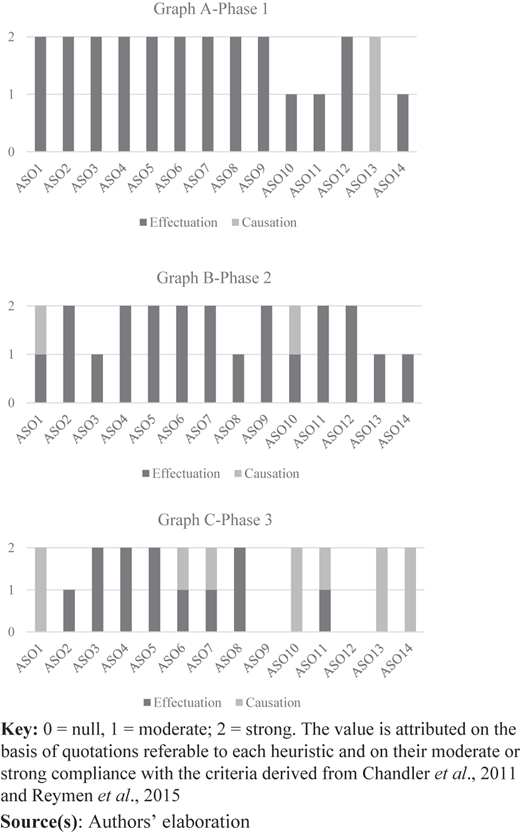
Drawing on the above-mentioned studies (i.e. Chandler et al., 2011; Reymen et al., 2015), the narratives were analysed and the quotations were identified on the basis of the heuristics adopted. As for the effectuation heuristic, the cherry-picking of founders from the research group that gave life to the technology incorporated in the new venture is frequent, and such decision is clearly based on means at disposal, pre-commitment and avoiding risks related to surrogate entrepreneurs. Similarly, the observed decision to appoint in the TMT only individuals already present in the FT (see, for example, a quotation from ASO10_1 in Table 4) reflects both the academic entrepreneurs’ personal preference and willingness to avoid the perceived risk of stiffening the organizational structure with non-academic individuals, and ultimately the pre-commitment and pledge of the academic founders (as in the quotation from ASO11_1 in Table 4) as guaranteeing for their choice as TMT members. Conversely, academic entrepreneurs that focus on milestones and objectives to be reached in the medium and long term (see, for example, a quotation from ASO14_1 in Table 4), and on the competence needs to be fulfilled to reach pre-determined technological or commercial goals, or that refers to competitive positioning as driving elements to decisions pertaining the team formation process, are exhibiting a heuristic of causation. The emerging results on the predominant decisional heuristic for each ASO are summarized in Figure 1.
Based on narratives of the respondents then validated through secondary sources, the resulting team compositions for the three micro-phases are summarized in Table 5, the evolving team composition by background (technical vs non-technical to infer if the heterogeneity if competencies have been pursued) and founders’ academic roles are also presented.
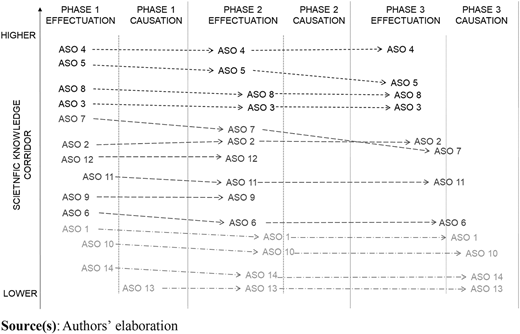
Finally, Figure 2 depicts the sequence of decisions from left to right and relates them to the stickiness of the scientific knowledge corridor, decreasing by starting from the upper edge of the graph towards the lower one.
In the comparative analysis of the cases, it is possible to highlight three groupings (Figure 2). The first comprises ASOs highly immersed in the academic and scientific knowledge corridor that remain anchored to a logic of effectuation (ASO4, ASO5, ASO8 and ASO3) along all the three micro-phases of the team formation process. A higher stickiness to the academic and scientific knowledge corridor has been associated with ASOs which have cherry-picked FT or TMT members exclusively from the academic context of belonging: it is the case of FTs that comprise all the members of the research group that developed the technology incorporated into the new venture (e.g. ASO7, ASO10 and ASO11). A higher stickiness is also related to the choice of targeting only the captive market formed by universities and research laboratories (e.g. ASO4 and ASO5). The second group comprises ASOs moderately immersed in the academic and scientific knowledge corridor (ASO2, ASO9 and ASO12), and for whom a shift from effectuation to causation has been observed (ASO6, ASO7 and ASO11). For example, a lower stickiness – than the previous group – has been associated with ASOs having in the FT a non-academic profile (e.g. ASO9 and ASO6) and that lately shows the use of both heuristics (e.g. ASO6). A lower stickiness is also associated with the choice of targeting the captive market of universities and research institutes only as a first entry step, in order to assess technology applications before entering the industrial market (e.g. ASO7). The third group collects ASOs having the lowest stickiness to the academic and scientific knowledge corridor and that approached a causation logic earlier, already from the second phase (ASO1, ASO10 and ASO14), and in one case since the first one (ASO13). For example, ASO1, whose FT is based only on academic personnel, lowered its stickiness to the academic and scientific knowledge corridor by appointing in the TMT members from a corporate venture capitalist. The lowest stickiness is exhibited by the ASOs whose FT is composed of master students (ASO13 and ASO14) having spent less time within the academic domain and then being less influenced by its logic. In both cases, the causation logic was detected in the first phase and became dominant in the third one.
By looking at the three micro-phases overall, we found that in the FT phase, the adoption of a pure effectuation logic is largely dominant (Figure 1). In fact, at the top side of Figure 2, we find ASOs strongly immersed in their scientific knowledge corridor having founders only with academic profiles – frequently with tenured positions or exhibiting years of experience and accumulation of knowledge exclusively within the academic domain – and ASOs targeting solely the captive market of universities and research institutes (e.g. ASO3, ASO4, ASO5 and ASO8). Decision-making logic in line with effectuation emerges also for ASOs having a moderate stickiness to the academic and scientific knowledge corridor, then presenting a slightly higher heterogeneity in team composition. It is the case of ASOs with non-academic profiles included in the teams but still close to the university domain (e.g. ASO7: the non-academic profile was actually hired as a mentor for the ASOs by the parent institution itself) or selected based on personal acquaintance (e.g. ASO2 in which the non-academic profile in the FT is a person who, after accomplisehed a PhD being supervised by the other founder, did leave the academic career and was employed in the industry). The lowest stickiness to the academic and scientific knowledge corridor (ASO10, ASO14 and ASO13) in the FT phase is bacause of the founders’ individual academic position and affiliation (with no tenure-tracked position, thus implying less years spent exclusively into the academic domain). These ASOs adopted a diluted effectuation logic, if compared to ASOs more immersed in the academic context, and only in one case (ASO13), a pure causation logic has been adopted since the selection of FT members, based on careful planning with the intention to fulfil the competencies shortage.
In the TMT phase, the effectuation logic is overall predominant (Figure 1), with some exceptions (ASO1 and ASO10). The inclusion of members different from founders is rare and, if new members are appointed, it is mainly related to successful financial deals. Hence, in cases where private (e.g. ASO8, ASO12 and ASO 14) or corporate (e.g. ASO1) investors enter the TMT, the lower stickiness to the academic and scientific knowledge corridor also affects the heuristics towards a less pervasive use of effectuation (e.g. ASO1, using both effectuation and causation; ASO14, showing moderately intensive use of effectuation logic). Though, very often the TMT composition mirrors the FT or emerges as a subset of it (e.g. ASO11). FT and TMT then show a consistent overlap in terms of team composition (Table 5), almost regardless of the higher or lower degree of stickiness to the scientific and knowledge corridor. Even ASO13, the only one that built the FT under a causation logic, leveraged on its bunch of founders to define its TMT, in line with the means-driven approach of effectuation. Though, in this second phase, there are ASOs that slowly and slightly moved towards causation logics in concomitance with a lowering stickiness to the scientific knowledge corridor (Figure 2). The elements driving causation are twofold: on the one hand, the choice to appoint non-tenured profiles as members of the TMT, such as PhD graduates, which are less immersed in the academic context, instead of professors who, after having founded the ASO, decided to stay only as advisors (e.g. ASO6 and ASO11); on the other hand, the entry of non-academic investors in TMT. For example, in ASO1, a member designated by a corporate venture capital entered the TMT immediately after the inception.
In the third phase, namely, the employees-integration phase, a greater differentiation emerges (Figure 1), especially in those teams having lower stickiness to the academic and scientific knowledge corridor (Figure 2). Conversely, a stronger attachment to the academic context is associated almost exclusively with the adoption of effectuation. For example, ASO5 selected the first employees based only on founders’ academic relationships and personal preferences for managing and interacting with individuals having similar profiles. These ASOs also remained more anchored to the scientific captive market (e.g. ASO4 declared to target only research laboratories). Differently, some ASOs broke away from decision-making logics of pure effectuation and integrated some elements of causation, due to a moderate level of attachment to the academic and scientific knowledge corridor in the previous phases. As the effect of the knowledge corridor decreases, there is a stronger adoption of causation logic. For example, ASO7 presented a mixed approach: after having identified the existence of competencies shortage in the team, with a typical causation approach, even if tried to hire external members, first employees then came from the parent institution, in line with effectuation logic (similarly to ASO11 and ASO6). Conversely, when FTs were already scarcely immersed in the academic domain (e.g. ASO14 and ASO13) or when there was the entry of corporate venture capital (e.g. ASO1) a pure causation logic is likely to be adopted in early employess integration.
5. Discussion
The present contribution analyses three micro-phases in ASO's team formation process to grasp the heuristics adopted (Mathisen and Rasmussen, 2019) in relation to the stickiness of the academic and scientific knowledge corridor. Causation and effectuation – as proposed by Sarasvathy (2001) – are suitable to investigate the team formation process in ASOs due to the initial high commercial uncertainty, the unclear technological applications and high innovativeness context (Agarwal and Shah, 2014; Ben-Hafaïedh et al., 2018; Murray, 2004). They also allow to take into consideration the role of the academic entrepreneurs – of paramount importance in the entrepreneurial literature (e.g. Van de Ven et al., 1984), their cognition (Mitchell et al., 2002, 2007) and the peculiar academic context in which ASOs born (Perkmann et al., 2013; Rasmussen, 2011). The results are in line with the prevailing literature (McKelvie et al., 2020) and highlight that ASOs decisions are more related to effectuation in the first phase of FT formation process, similarly to what was found for non-academic contexts. Before the inception of academic new ventures, then, “inventors rely primarily on their own ability to exploit their invention commercially. […]. Other inventors recognize their “shortcomings” and bring on “who they know” to run these venture activities” (Hannibal et al., 2016, p. 367) – typical elements of the effectuation logic (Chandler et al., 2011; Reymen et al., 2015). In the second phase of TMT appointment, ASOs tend to leverage on resources immediately at hand to face contingencies – in line with previous empirical research on academic new ventures (e.g. Hannibal et al., 2016) and technology-based new ventures (e.g. Reymen et al., 2015) – and to adopt mainly spontaneous and unplanned logics (Wiltbank et al., 2006) resambling effectuation. The TMT composition usually recalls that of the FT, bringing the same variety of knowledge previously created, leveraging on the pre-commitment of the founders, without taking the risk of integrating external subjects. Coherently with the seminal work of Sarasvathy (2001) and previous contributions focusing on non-academic context (Hauser et al., 2020; Reymen et al., 2015), also for ASOS, the causation logic surges mainly lately, in the third phase of employees-integration, when uncertainty is low, and especially if the academic knowledge corridor has been slackened. Overall, results confirm that effectuation and causation are not mutually exclusive but can occur in sequence and even in a mixed fashion.
Results show that the prevalence of effectuation is mainly associated with the presence of a strong scientific knowledge corridor effect. Effectuation is favoured by the idiosyncratic nature of the academic and scientific knowledge corridor (Gruber et al., 2013), which is associated with a strong preference for similarity and uncertainty-reduction behaviours. When taking initial decisions on FT composition, academic entrepreneurs rely on their current networks of knowledge, the pre-commitment of the researchers and professors who developed the technology in the lab and their personal preference to work with peers. Founders who are deeply immersed – sticky – in a scientific knowledge domain then tend to identify those opportunities – and react to contingencies – based on experience and competencies they cumulatively acquired in research and laboratory activities (Roche et al., 2020; Muller, 2010). Therefore, decisions tend to envision and face those challenges principally related to technology issues, while it is frequent that technological applications remain opaque (Reymen et al., 2017). This knowledge corridor cognitively shapes decisions not only related to the team but also about which market to target. Not surprisingly, we observed that ASOs are often spontaneously oriented to address the markets of peers, so that the initial users are engaged in research centres and activities in the same scientific field. Conversely, the causation decision logic is likely to be associated with academic entrepreneurs who have weaker bonds with the scientific knowledge corridor.
A low degree of stickiness to the scientific knowledge corridor is associated with the adoption of heuristics of causation in the team formation process.
Results suggest that the adoption of effectuation has a different impact on team composition compared with causation. Expanding on previous results, we highlight a strong overlapping between the research group and newly created ASO’s FT (Ensley and Hmieleski, 2005; Visintin and Pittino, 2014), suggesting that the preference for FT composition that mirrors the homogeneity of the research group in terms of disciplinary background, scientific knowledge and cognitive patterns can be reasonably explained by the prevalent adoption of effectuation. In the FT and TMT phases, the team composition is usually limited to subjects perceived as familiar and easily to be engaged with, coherently with an effectuation logic. Hence, the ASOs team “is like a research group, where you are used to work tied together, but with a certain professionalism. We try to work in a certain way, that we have learned in research” [ASO7_1]. Given that academic entrepreneurs tend to connect with peers who share the same research interests and backgrounds, the team formation process would result in cognitively homogeneous teams. Conversely, the presence of individuals having weaker bonds with the academic domain, such as master students or former PhD students with no tenured academic positions, seems to favour the emergence of teams that, since the inception, are more heterogeneous in composition and with a greater knowledge variety. In general, causation surfaces when decisions about team composition rely more on an explicit analysis of the educational background and industry experiences of the members to select as founders, appoint as managers and integrate as employees, while the emphasis on academic background lowers.
The adoption of heuristics of causation is associated with the formation of more heterogeneous teams.
Lastly, results highlight that for academic entrepreneurs the team members’ selection “to some extent, it was not only a question of what needed, but of what we are able to supervise” [ASO8_1]. This explains why ASOs are often reluctant to embed team members with skills belonging to other-than-technical knowledge domains in early phases: “at the beginning [ASOs] look at the technical skills; later also at soft skills” [ASO3_2]. The combination of a higher stickiness to the scientific and academic domain and a personal preference for peers extends over time the prevalence of decisions associated with effectuation. This implies that for a time, sometimes even long, the original team composition is preserved, and scientists with a technical background are required to accomplish managerial and non-technical tasks for whom they are not trained for, neither have experience. The knowledge contamination with non-academic profiles is then guaranteed by coaches or mentors, who can support the training process on the field of academic entrepreneurs and co-founders (Marvel et al., 2020), but without formally entering the team. ASOs tend to enlarge or move away from the knowledge corridor when the new emerging contingencies, mainly shaped as new market-side challenges, cannot be faced by using only the scientific and technical competencies inscribed in the academic and scientific knowledge corridor. Only when a new set of opportunities and challenges is finally envisaged, the integration of new team members from different domains and knowledge-based practices arises as a fundamental juncture (Gubeli and Doloreux, 2005; Vohora et al., 2004), and even academic entrepreneurs who are deeply rooted in their knowledge corridor change their heuristics and open to causation. Differently, we observe that academic entrepreneurs who are more peripheral to the scientific academic domain – due to their individual university affiliation and position (Muller, 2010; Roche et al., 2020) – show a greater attitude and ability to screen earlier a wider range of opportunities and to react or anticipate also challenges that are not consistent with their imprinting domain (Colombo and Piva, 2012; Roche et al., 2020). They also show a greater propensity towards a more precocious integration of heterogeneous and non-academic knowledge into ASOs team, by using decisional patterns closer to causation.
The later the time heuristics of causation are adopted, the later the formation of more heterogeneous teams.
6. Conclusion
Within the academic debate, there is a quite vast consensus that, among decisional heuristics, effectuation does fit better in highly uncertain and innovative contexts, such as in new technology-based venture creation. However, the few studies that adopt this perspective to the academic entrepreneurship domain provide conflicting results, leaving room for further empirical studies. To the best of our knowledge, no contributions directly addressed the issue of decisional heuristics in team formation process, despite being seen as a fundamental foothold for the future success and growth of ASOs. We then address the call for a comparative analysis of effectuation and causation heuristics in entrepreneurship literature (Arend et al., 2015) within the context of ASOs (Mathisen and Rasmussen, 2019), for the use of a temporal and processual perspective (Nikiforou et al., 2018) and for the adoption of a cognitive approach in the particular academic entrepreneurial context (Mitchell et al., 2007).
Although it is known that the integration of different knowledge favours ASOs’ growth (Ben-Hafaïedh et al., 2018; Sciarelli et al., 2021; Tagliazucchi et al., 2021), past empirical contributions showed how this integration is arduous and how little is pursued (Nikiforou et al., 2018). By bringing the attention to the academic entrepreneur (Van de Ven et al., 1984) and the decision-making logic he/she adopts (Mitchell et al., 2002, 2007), and how he/she is influenced by the academic context in which cumulates experience and knowledge (Ronstadt, 1988; Gruber et al., 2013), the present paper offers a contribution to how-questions about ASOs team formation process. This contribution is threefold. First, it depicts at a micro-level how effectuation and causation approach alternate and intertwine in decisions concerning ASOS’ team formation. As Sarasvathy (2001) states, effectuation and causation are both “integral parts of human reasoning that can occur simultaneously, overlapping and intertwining” (p. 245), and we highlight a better understanding of how they interact. Second, for new ventures stemming from the academic context, the initial high uncertainty – mainly related to unclear technological applications and market opportunities – leads to the preferential adoption of effectuation, especially earlier for the FT and TMT formation. Third, the paper offers support for a more careful investigation of the relationship between decision-making heuristics and the stickiness of academic entrepreneurs to the own scientific knowledge corridor. The pervasiveness of the academic institutional logics, the constraining effect of knowledge and experience cumulated only within this domain, and the reluctance to extend the cognitive belonging outside the academic networks do influence the decision-making heuristics and affect the processes of new venture creation and, more specifically, the process of team formation, that is so central in integrating non-academic knowledge to pursue commercial success and growth.
Findings help to know some important factors that affect team-related decisions, thus suggesting some managerial implications. Once accepted that team composition and the integration of market-related knowledge and experience are a cornerstone for the growth of ASOs, interventions should be addressed to limit the constraints associated with an excess of cognitive dependence on the academic domain at the individual level. For example, universities and parent institutions should favour exchange and collaborations between academic and non-academic people, favour the incardination of individuals who are less immersed in the academic context on the base of their own individual position and affiliation. Based on results showing the importance that different heuristics and team structures may have at various micro-phases of ASOs team formation process, universities and parent institutions should design incentive mechanisms accordingly. For example, interventions could incentive the inclusion of non-academic members during the FT phase or the integration of managers with industry experience and market-based knowledge in the TMT phase. Additionally, the creation of training programmes supporting researchers and students in their first entrepreneurial activities could allow to avoid possible pitfalls and favour conditions for academic team members to relax their embedding into the academic and scientific knowledge corridor. These elements would favour the earlier adoption of more structured tools for opportunity identification and market analysis and also the adoption of heuristics based on the causative decision model. Overall, we believe that the ability of universities to establish wide and richly connected entrepreneurial ecosystems gives ASOs the opportunity to accelerate the formation of heterogeneous teams and to enlarge the set of market opportunities that could be identified and exploited.
The study is not exempted from limitations, which open further venues in processual research on ASO’s team formation. Firstly, we have a limited sample size based on one single parent institution, a polytechnic institution specialized in science and technology. Secondly, the results would have been even more robust with more than one interview for all ASOs. Thirdly, due to the exploratory nature of the paper and as a qualitative case study, the generalizability of the results is limited. In addition, whether the academic entrepreneur is a novice or expert in the founding of ASOs, or has previously participated in ASOs, could influence his/her heuristics. Nevertheless, we believe that our study provides an important cornerstone for future research. Firstly, the paper suggests that a careful specification of the time span used when empirically studying the early stages of ASOs does matter, since effectuation and causation can overlap even in a very short time period: further longitudinal studies should dive into these issues of decision-making processes. Secondly, the paper offers a further reflection on how to measure effectuation and causation, with some new insights about the opportunity to integrate the scales currently used for causation heuristics. Thirdly, a larger set of ASOs samples, from different universities or cross-countries, would certainly enrich and expand our contribution. These refinements in the operationalization of constructs could support future large-scale research to test the proposed propositions on decision-making processes within ASOs by integrating qualitative and quantitative methodologies.
The authors thank the hosting university that allowed and supported data collection.
The authors are grateful to the anonymous reviewers for their valuable comments.
Note
We examined the most recent empirical contributions published in high-impact journals in the field of technology entrepreneurship (selected on the basis of Ratinho et al., 2015), using as baseline the most recent reviews on effectuation studies (Gregoire and Cherchem, 2020; Perry et al., 2012; McKelvie et al., 2020).
References
Competing Interests
Disclosure statement: No conflict of interests is reported by the authors.