


Following the Agenda 2030 for Sustainable Development, the main challenge for the agrofood sector is to innovate food production, offering sustainable, smart and safe solutions. The future of food production will be oriented more and more towards sustainable industries with high technological content to guarantee food safety and food security. It implies that a change not only in the way food is conceived, but also in the way it is produced, processed and consumed is needed. The aim of the present study is to investigate the role of innovation, sustainability, smartness and health within the agrofood industry.
A literature review was conducted using 596 academic documents written in English language and published in peer-reviewed scientific journals as well as in conference proceedings. The relevant articles were analyzed using both a bibliometric and a systematic approach.
The results confirm the role of innovation and sustainability as key drivers in the food industry. The main findings concern the benefits deriving from the adoption of digital technologies, the ever-increasing involvement of consumers in health and environmental issues and the introduction of the open innovation concept in the agrofood industry.
This study jointly considers the dimensions of innovation, sustainability, smartness and health in the agrofood sector, demonstrating how they are strongly interdependent.
1. Introduction
Today, the agrofood industry faces challenges including environmental sustainability, food security and safety, growing pressures from consumers and increasing competitiveness (Della Corte et al., 2018). In such a context, innovation is considered fundamental in order to survive in most markets (Bigliardi and Galanakis, 2020). The increasing importance of innovation in this industry is due, on the one hand, to the recent changes the sector faced (Bresciani, 2017; Vrontis et al., 2016), and, on the other hand, to new challenges (i.e. the latest disruptive technologies such as Internet of things (IoT) and big data) (Della Corte et al., 2018; Rialti et al., 2019; Santoro et al., 2017). Both technological and nontechnological innovations play an important role in the growth of agricultural productivity (OECD, 2013a, b). Some innovations help firms to better deal with production uncertainties and increase profits. Innovation is also fundamental to achieving sustainability and improving the environmental performance of firms and the quality of products. Indeed, in recent times, the concept of innovation has been increasingly studied in relation to the concept of sustainability (Caiazza and Bigliardi, 2020; Caiazza and Chaudhuri, 2019). Such binomial is extremely relevant in the agrofood sector due to its close connection to the environment, both from the point of view of the exploitation of natural resources and from the one of pollution and associated risks. The future source of competitive advantage for the agrifood sector lies in being able to demonstrate that it meets the highest standards of sustainability in all its forms (i.e. economic, environmental and social) (Assets.gov.ie, 2021).
In recent years, the agrofood sector has been making good progress in embracing, in addition to innovation, also technology (Thöni and Tjoa, 2017). It is expected that, in the period to 2030, new digital innovations and data capture and analysis techniques will emerge. These will lead to several improvements, such as transparency along the food chain, as well as to different changes, such as the way we manage natural assets, produce, process and distribute food and its by-products (Barba et al., 2022; Kumar et al., 2020).
Finally, while in the past the food industry was focused on the cost minimization of production line and little attention was given to consumer needs, nowadays the food chain is reversed, with the consumers telling producers what they want to eat (Bigliardi and Filippelli, 2022; Volpentesta et al., 2018). As a consequence, the agrofood sector is facing the urgent need for innovations and consumer demands for health.
All these considerations have been confirmed in the Agenda 2030 for Sustainable Development, that has highlighted the importance of considering the topics not only of innovation and sustainability but also those of smartness and health in order to have an overall picture of the relevance of the agrofood industry worldwide (United Nations, 2015).
Based on these premises, this article aims to study how the concepts of innovation, sustainability, smartness and health can be declined in the context of the agrofood sector. The rationale behind this choice is threefold. Firstly, food is an essential part of our daily lives, but simultaneously it is a major contributor to environmental issues. Secondly, the future of food production will be oriented more and more towards sustainable industries with high technological content to guarantee food security and food safety. These increasingly important concepts suggest that the challenge of the food of the future is to meet quality requirements in different areas, involving a change not only in the way of conceiving food, but also in its production, process and consumption. Therefore, industrial technologies play a fundamental role in achieving these new goals, offering and studying innovative solutions and methods for the food industries of the future (Caiazza, 2017). Thirdly, Italy boasts a worldwide leadership position and a high degree of excellence in terms of technological innovation and quality of products and services in agrofood. The main challenge for this sector will be, on the one hand, to innovate food production, offering smart, sustainable and safe solutions, while preserving the values of the tradition and craftsmanship typical of Made in Italy, and, on the other, to make new technologies accessible also to SMEs which, due to their small size, often have difficulty accessing innovation. To this end, our paper is organized as follows: after this introduction, the first section is devoted to introducing the main information regarding the agrofood industry, while the second section provides an overview of the investigated concepts. The third section presents a literature review based on bibliometric techniques followed by a thorough discussion of how the four investigated constructs relate with the agrofood industry. Discussion and conclusions conclude the paper, by providing suggestions for future research avenues.
2. The background
The agrofood industry is influenced by a variety of factors, such as, among others, the population's growth (FAO, 2009), the competition (Läpple et al., 2015), the availability of limited resources (Preschitschek et al., 2011), the climate changes and their effects on food security (Knickel et al., 2009). Thus, in order to increase the production of food, it is essential for companies operating in this sector to promote innovation throughout their supply chains (Roucan-Kane et al., 2013). A diversity of innovations can be identified in the agrofood industry, mainly product innovations (e.g. products with a new functionality or taste) or process innovations (e.g. new processes aimed at efficiency improvements). In the food industry in general, according to Bigliardi and Galanakis (2020), innovation can be classified into five groups, namely, radical, market breakthrough, incremental, technological breakthrough and sustainability-driven innovations.
Innovation is widely recognized by both the OECD and businesses as the main driver of long-term sustainable growth and a priority for future success. Even if survival is the goal of any organization, during recent decades, both academics and practitioners agreed in stating that simply bringing new products to the market is not sufficient to gain and maintain competitive advantages (Caiazza, 2016; Caiazza et al., 2019). In particular, environmental constraints may hinder companies' growth (De Medeiros et al., 2014). Among the different functional areas of an organization, innovation is recognized to allow companies to reach a greater level of sustainability in their activities (Hansen et al., 2009; Hansen and Grosse-Dunker, 2012). Thus, over the last few years, the concepts of innovation and sustainability have been studied together in general, and in the agrofood industry in particular, due to its close association with the environment all along the value chain up to the provision of food to consumers (Bigliardi et al., 2021). The ability of agrofood sector to innovate is important in dealing with the challenges of sustainability. Taking into consideration innovation and sustainability jointly, an innovation can take the form of traditional innovation, that is an innovation that contributes to an improvement in sustainability (such as process innovation), or a form which generates greater sustainability per se (e.g. the introduction of a new product using different raw materials) (Steiner, 2008). Food production contributes to climate change, water scarcity and the destruction of biodiversity. Thus, agrofood firms, while intensifying production, must avoid environmental degradation through pollution, greenhouse gas emissions and deforestation. To do that, they have to extend the reuse of materials, bioenergy and more efficient use of energy and water in production processes of foods.
Sustainability was defined as business policies and practices that “meet the needs of the present without compromising the ability of future generations to meet their own needs” (World Commission on Environment and Development, 1987, p. 8). The sustainability revolution (Edwards, 2005) has created a deep shift in people's consciousness, that sees sustainability as the strategic imperative of the new millennium. From the corporate point of view, sustainability is seen as fueled by substantial public interest, changes in legislation and pressure from stakeholders, and the concern for the company's reputation have led even the most reluctant managers to undertake sustainability efforts. Specifically, companies appear to be carrying out sustainability initiatives for a wide variety of reasons: to brand and image strategies, to cut costs, to differentiate themselves from competitors and so on (Bigliardi et al., 2021).
Sustainability has become the strategic imperative of the new millennium. The growing number of papers investigating this issue confirms its relevance: a search on the database Scopus with the word “sustainability” shows that the number of papers has increased from about 54,000 in 2010 to more than 280,000 in 2021, with a growing trend of articles published per year. The available literature has investigated different issues, but two important streams refer to the definition of the term sustainability and to its classification. As far as sustainability definition is concerned, we still lack a comprehensive one. This is a foundational challenge to further investigate the field since a definition may help implementers (Caiazza, 2015; Caiazza and Stanton, 2016). As for sustainability classification, the one generally recognized shows the concept of sustainability as composed of three pillars: environmental, economic and social (also known informally as planet, profits and people). The environmental pillar is the one that usually gets the most attention. It is also called planet since companies have found that producing a positive impact on the planet could be rewarded by a positive financial impact. Thus, they are focusing on reducing packaging waste, water usage and their overall effect on the environment. A large number of companies stress the importance of the economic pillar of sustainability: to be sustainable, a company has to be profitable. Issues that fit under the economic pillar include proper governance and risk management. Finally, the social pillar refers to the fact that a sustainable company should have the support and approval of its employees, stakeholders and the community it operates in. As for the employees, companies have to refocus on retention and engagement strategies, including more responsive benefits such as better maternity and paternity benefits, and learning and development opportunities. As for the community, companies have adopted fundraising, sponsorship, scholarships and investment in local public projects. Since companies aim at creating long-term value, sustainability must be integrated with the company's strategy. However, literature shows that many of them struggle to link their sustainability efforts with their strategic objectives, resulting in uncoordinated sustainability activities.
In addition to innovation, agrofood companies in order to compete have also to become smarter and smarter and to improve their ability to know how to fully exploit the generated information (Kumar et al., 2020). Collecting and transforming more and more data into strategic and useable information is not a process in itself sufficient to ensure greater rationality in economic decisions. The agrofood sectors are ideally suited to take full advantage of information and communication technologies (ICTs) in all the stages of value chain for both specific activities (supply, processes, marketing, distribution, sales, retail, etc.) and support activities (technology transfer). ICTs in the agrofood industry aim to enable firms to become more efficient in realizing managerial purposes using data available throughout the value chain. This allows a natural metamorphosis of business models, production processes and redefinition of relationships between the members of the chain. Existing and emerging technologies represent significant opportunities for the agrofood industry. For instance, technological innovation and precision agriculture (e.g. sensors, drones, robots) may help companies to improve their productivity, quality and sustainability. Similarly, other technologies (e.g. big data, machine learning, Internet of things) may lead companies to new ways to produce, source, process, package, distribute food, including waste management (Barba et al., 2022). Specifically, in the decades between 2020 and 2030, greater advancements in the use of technology and data in the agrofood industry are expected.
Finally, food security and nutrition are key components, particularly the link between food and health. Thus, a third challenge the agrofood industry is facing is related to the health issue. The concept of health linked to the agrofood industry can be studied from two different perspectives: the reduction of health problems and the preservation of health through food safety. In developed countries, an increasing number of people have health problems due to their lifestyle which has changed a lot in the last decades. In fact, globalization has brought about both social and economic changes, which, in turn, had an impact on society, leading to pervasive modifications in people’s eating habits and behaviors (for instance, eating out of home, personalized diets, consumer preferences, e-commerce). Food safety is a topical issue as well since it is related to both the health dimension and the social-economic dimension. In the agrofood sector, it is appropriate to talk about both food safety and food security, because the former refers to aspects related to hygiene and healthiness of food, while the latter is related to economic and social aspects, connected to the importance of having enough food and of good quality for the entire world population (Carvalho, 2006).
To summarize, in implementing both technological and no-technological innovations in agrofood industry, firms have to consider the trends of sustainability, smartness and health proposed in the “2030 Agenda” from the United Nations (United Nations, 2015).
3. Research methodology
In order to present a thorough review of the current literature around the topics of innovation, sustainability, health and smartness in the agrofood industry, a detailed bibliometric analysis was carried out. The bibliometric approach applied to the study of the state of the art allows to uncover and articulate the underlying structure of the research field and trace its evolution overtime (Pritchard, 1969). The first step of the bibliometric analysis consists in the selection of the sample of articles belonging to the topic under investigation. To this end, we initially selected the keywords to be used in the research on the Scopus scientific database. We combined keywords related to the concepts of innovation, sustainability, health and smartness with keywords related to the sector we want to investigate, that is, the agrofood sector. In Table 1, the keywords used to identify each concept are presented.
Keywords used in the search phase
| Topic | Keywords |
|---|---|
| Sustainability | “sustainab*” “sustainability” “sustainable development” “circular economy” “circular*” |
| Smartness | “smart*” “ICT*” “Information and communication technolog*” |
| Innovation | “innovation” “innovativ*” |
| Health | “health*” |
| Agrofood sector | “agrofood” “agro-food” “agrifood” “agri-food” |
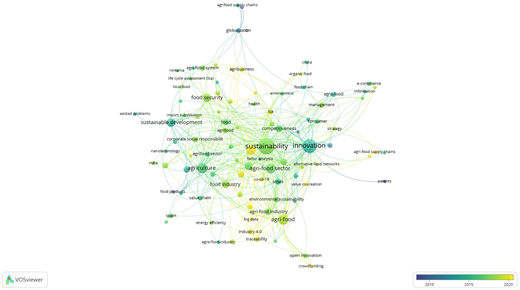
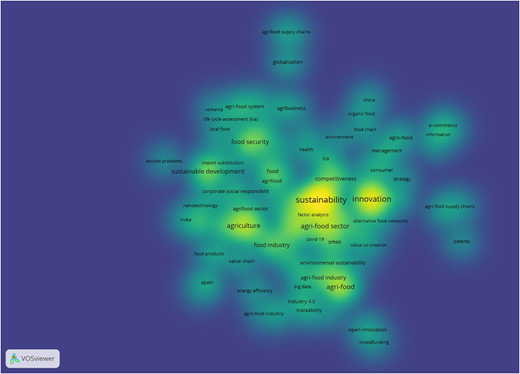
Considering the scope of the analysis, we have included only articles, reviews and conference papers in English, published on academic journals or international conferences in the Scopus subject area named “business, management and accounting.” The application of these criteria resulted in 596 articles, which represent the sample on which the bibliometric analysis has been conducted [1]. This kind of analysis can facilitate the mapping of large volumes of scientific literature (Gonzales-Torres et al., 2020), and anticipates a similar form of systematic literature reviews and rigorous techniques (Tang et al., 2018). To conduct the bibliometric analysis, we used the VOSviewer software, an open access tool developed by Nees Jan van Eck and Ludo Waltman at the Centre for Science and Technology Studies at Leiden University, that contains the basic functionality needed for this analysis. Even if other computer software exist that can also help in bibliometric mapping, VOSviewer focuses on the bibliometric map's graphical representation and helps to easily assess and interpret the bibliometric maps due to its large display function and has been widely used in various studies to assess different articles and visualize the data networks (Liao et al., 2018). Vosviewer is used for generating, visualizing and evaluating the networks in bibliometrics, and provides three different visualizations, namely, network, overlay and density visualization. Network visualization has shown to be a powerful method to analyze a large variety of bibliometric networks, ranging from networks of co-authorship relations between researchers or networks of co-occurrence relations between keywords. For instance, as far as co-authorship is concerned, nodes represent authors, and the size of a node is related to the number of papers each author has published on the topic or the number of times an author has been cited. In general, the closer the authors are located in the visualization, the more strongly they are related to each other. In an overlay visualization, the color of a node indicates a certain property of the node. For example, it can be used to show the development over time and the verification of the recent trends in the academic field. The items are colored differently based on year of publication (average for the cluster): those terms that appeared recently are more yellow, as demonstrated in the color bar shown in the corner. Finally, the density plot represents the number of times that a keyword is used, and it is especially useful for drawing attention to the most important areas in the map. Each node has a color that depends on the number of items in the neighborhood of the node. The keywords in red color area appear more frequently, while the keywords in green color area appear less frequently.
In the following, the text mining functionality of VOSviewer was used to construct and determine the co-occurrence networks of the keywords of the various papers, where co-occurrence is defined as the network of links between terms in the keyword lists of the studied papers. To use the software, we extracted data from Scopus to a CVS file, exporting the citations information, bibliographical information, abstracts, keywords and other related info.
4. Results
The results of the literature analysis are divided into three subcategories (namely, year and published journals, author and keywords), as detailed below. Each of these subsections provides some relevant information relating to the body of literature surrounding innovation, sustainability, smartness and health in the agrofood industry.
4.1 The four topics over time and over journals
Figure 1 shows the publication trend displaying the number of papers plotted against years. We can notice a significant growing interest in the topics under investigation since 2009, reaching a peak in 2021 with 123 publications.
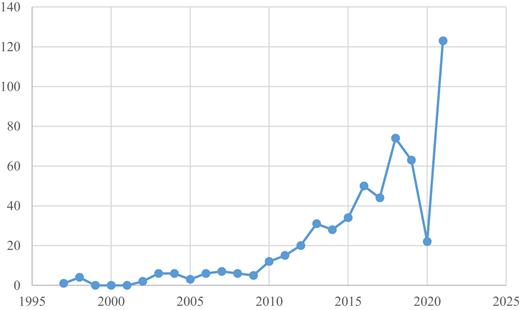
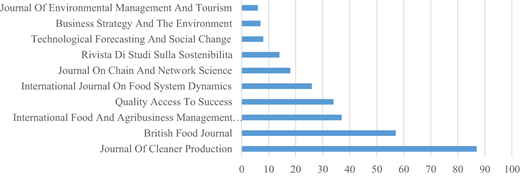
Most of the 596 papers are classified as “article” (507, corresponding to the 85,1%), and the remaining are conference papers (53, 8.9% out of the total) and reviews (36, that is 6% out of the total). As far as the source “journal” is concerned, the main academic outlets across which the papers are distributed are shown in Figure 2, limited to the top ten sources.
4.2 Who is researching these topics?
Using the VOSviewer software, we conducted a co-authorship analysis, which is a tool used to identify the key organizations and scientists, as well as examine their association. Overall, 159 different authors have provided contributions to this literature. Table 2 shows the top ten authors and their affiliations.
Top 10 most influent authors by documents
| Author | N° of papers | Affiliation | Country |
|---|---|---|---|
| Dentoni, D. | 6 | Wageningen University and Research | Netherlands |
| Notarnicola, B. | 5 | Universy of Bari | Italy |
| Fiore, R. | 4 | University of Foggia | Italy |
| SporlederT.L. | 4 | The Ohio State University | United States |
| Wubben, E.F.M. | 4 | Wageningen University and Research, Wageningen | Netherlands |
| Migliore, G. | 4 | Università degli Studi di Palermo | Italy |
| Boccia, F. | 4 | Parthenope University of Naples | Italy |
| Skalkos, D. | 4 | University of the Aegean | Greece |
| Ianuario, S. | 4 | Università degli Studi di Napoli Federico II | Italy |
| Caiazza, R. | 4 | Parthenope University of Naples | Italy |
The documents' publication characterized the most significant ten authors, as well as another set of top ten authors whose citations were most potent in Figure 3 and Table 2. Based on Table 2, the most potent authors were Dentoni D. and Notarnicola B. (six and five documents, respectively). Figure 3 shows the network visualization of authors' co-occurrence network of all papers collected in this study. Each circle in the figure represents one author name, and its size is related to the number of papers each author has published on this topic. In general, the closer the authors are located in the visualization, the more strongly they are related to each other based on bibliographic coupling. The network visualization of the authors shows nine clusters, and the color means the same cluster, where authors cited each other and are strongly related.
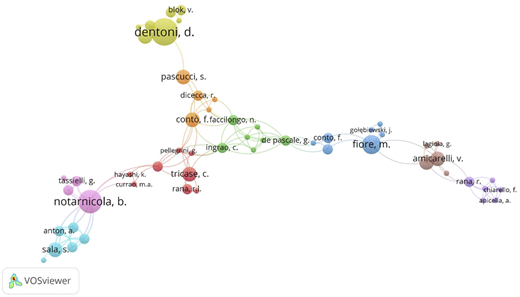
It is noted that the most influential authors belong mostly to Italian universities. This evidence is confirmed by the results on the top-performing organizations (based on the number of papers contributed), shown in Table 3. Of the 10 organizations which published the largest number of articles, 8 are in Italy.
Top 10 contributing organizations
| Organization | Country | N° of papers |
|---|---|---|
| Wageningen University and Research | Netherlands | 43 |
| Parthenope University of Naples | Italy | 18 |
| Alma Mater Studiorum University of Bologna | Italy | 16 |
| University of Foggia | Italy | 14 |
| University of Bari | Italy | 12 |
| University of Catania | Italy | 11 |
| University of Naples Federico II | Italy | 11 |
| University of Palermo | Italy | 11 |
| University of Salento | Italy | 10 |
| Aristotle University of Thessaloniki | Greece | 9 |
The result is confirmed also by the results of network analysis, shown in Figure 4, where the links among the countries are also shown. The countries were ranked by number of documents. Using the co-authorship analysis, the trending collaboration among the most influential countries was assessed, thus identifying opportunities in discovering new information and knowledge through collaboration.
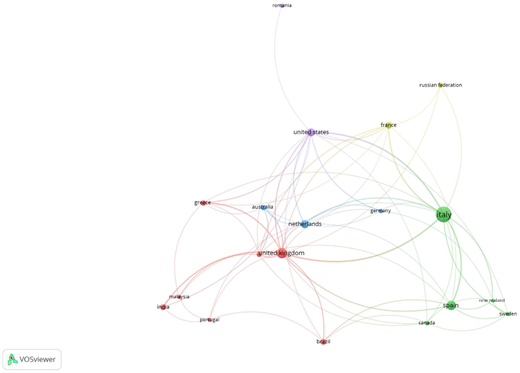
Analysis of citation network identifying the origin of a country for diverse authors
Analysis of citation network identifying the origin of a country for diverse authors
4.3 Keywords analysis
As far as the keywords are concerned, the top 20 keywords selected by the authors are summarized in Table 4. Since the articles in the sample refer to 4 distinct topics within the food sector (i.e. innovation, sustainability, smartness and health), we studied also the distribution of keywords based on them. To achieve this result, the overall keywords were manually selected and inserted in one of the four clusters above. Keywords not strictly related to any of the 4 topics were not taken into account. The topics of innovation and sustainability in the agrofood sector have received considerable attention, as demonstrated by the large number of keywords related to them. On the other hand, the topics of health and smartness have been still poorly addressed. This may be motivated by the fact that their relationship with the agrofood sector started to be thoroughly studied after the publication of the Agenda 2030 in 2015.
20 most recurring keywords
| Keyword | Frequency | Keyword | Frequency |
|---|---|---|---|
| Sustainable development | 113 | Circular economy | 26 |
| Sustainability | 83 | Environmental impact | 25 |
| Innovation | 81 | Decision-making | 24 |
| Agriculture | 69 | Food products | 24 |
| Supply chains | 45 | Agrifood supply chains | 22 |
| Food supply | 44 | Agrifood system | 22 |
| Food industry | 36 | Consumer | 22 |
| Life cycle | 35 | Food security | 22 |
| Human | 33 | Life cycle assessment (LCA) | 22 |
| Agrifood | 29 | Information management | 21 |
| Agri-food sector | 28 | Environmental sustainability | 19 |
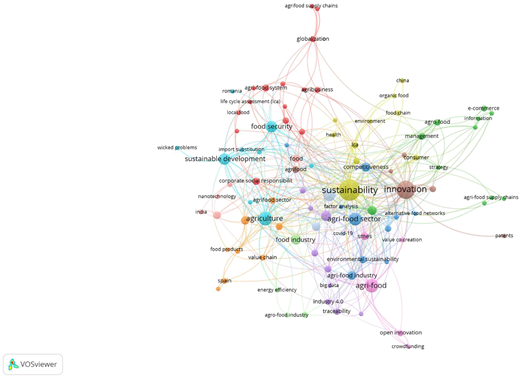
To reveal new trends and tendencies and derive future directions of the research, we constructed cluster analysis for the keywords, using the abstracts of papers extracted from the Scopus database. The network analysis of the top high occurrence keywords is presented in Figure 5. In the co-occurrence network visualization presented in Figure 5, the keywords were clustered into twelve groups of words that most often appear together. As expected, the keywords “innovation” and “sustainability” have a highest frequency and are strictly correlated each other. The most closely associated words to “innovation” are “network,” “patents,” “competitiveness” and “business models,” but also “ict” and “information.” Similarly, the most closely associated words to “sustainability” are “circular economy,” “competitiveness,” “food security,” but also “big data,” “ict” and “open innovation.” Both the topics show a relationship with the keywords “covid-19” and “food waste.” As far as the other topics investigated, both smartness- and health-related keywords had lower frequency. “Health” is closely associated with “food security,” “marketing,” “willingness to pay” and “environment,” while keywords related to smartness resulted were associated with keywords such as “e-commerce,” “food safety” and “supply chain.”
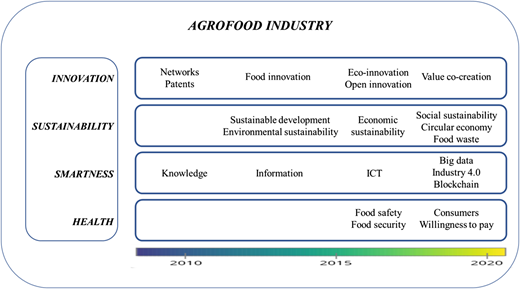
The overlay visualization is shown in Figure 6. From 2009 to 2012, research was mainly about patents, networks and knowledge. After 2012, the research had an evolution and took two main directions: one is referred to “innovation,” the other to “sustainable development.” From 2015 to 2018, in addition to “sustainability” (comprising also the economic dimension of sustainability and not only the environmental one), “health” and “ict” appeared as keywords, together with “eco-innovation,” “open innovation,” “food security” and “business models.” Finally, in the last three years, research moved towards topics such as “value co-creation,” “crowdfunding,” “circular economy,” “social sustainability,” “food waste,” “big data,” “industry 4.0,” “traceability,” “blockchain,” “consumers,” “willingness to pay” and “covid-19.” Table 5 summarizes the keywords appeared during different periods.
Keywords that appeared during different periods
| Period | Keywords |
|---|---|
| Until 2012 | innovation, patents, networks, knowledge, food products, … |
| 2013–2015 | innovation, sustainable development, environmental sustainability, information, supply chain management, … |
| 2015–2018 | sustainability, eco-innovation, open innovation, health, ict, food safety, food security, business models, lca, … |
| 2018–2021 | value co-creation, crowdfunding, social sustainability, circular economy, food waste, big data, Industry 4.0, traceability, blockchain, consumers, willingness to pay, covid-19, … |
Finally, the density plot represents the number of times that a word is used within the abstracts and is shown in Figure 7. The keywords in yellow-colored area appear more frequently; on the contrary, the keywords in green-colored area appear less frequently. For the full counting methodology, the two most common words are innovation and sustainability.
According to these trends of evolution, the concepts of innovation, sustainability, smartness and health are deeply discussed in the following section.
5. Discussion
5.1 Innovation
Innovation in the food industry comes in different forms: incremental, product or process, social and so on. In the extant literature, numerous classifications of innovation have been proposed and applied. Initial studies on innovation have exploited the classification of innovation proposed byClarysse et al. (1998), distinguishing between technological and no-technological innovations, and further classifying innovation into product and process innovations, and organizational and market innovations, respectively (e.g. Avermaete et al., 2004; Brewin et al., 2009; Gray et al., 2006; Walsh and Lodorfos, 2002). More recently, other classifications have been proposed. For instance, Bigliardi and Galanakis (2020) proposed an overview of the main classifications of innovation. Specifically, they identified two main classification approaches, based on the type of innovation and on the nature of innovation, thus deriving 5 types of innovations: radical innovation (i.e. something new for both the company and the market, associated with radical or fundamental changes), market breakthrough innovation (i.e. the creation of a new market that the innovator can dominate), incremental innovation (i.e. changes in food products that do not offer consumers superior benefits, and that, in general, do not create significant additional demand for the company's products), technological breakthrough innovation (i.e. the adoption of a completely new technology, but without providing superior consumer benefits) and sustainability-driven innovation (i.e. innovations that neither show novel technological advances nor meet new consumer needs, but are driven by the urgent need for sustainability). Each type of innovation is related to the other topics investigated in the paper. For example, the Walkers Crips innovation is focusing on sustainability by adopting more sustainable and 100% recyclable packaging. Similarly, New Covent Garden bringing chilled soup to market for the first time using a technology-driven innovation, while Bird's-eye demonstrated a focus on health by introducing steaming pouching that permits cooking in the bag technology. In particular, research stressed that innovation allows companies to reach a greater level of sustainability in their activities (e.g. Hansen et al., 2009; Hansen and Grosse-Dunker, 2012).
In addition to the types of innovation characterizing the sector, researchers investigated the success factors of innovation (e.g. Fortuin et al., 2007) and stressed in particular the importance of networks and knowledge (e.g. Batternik et al., 2010; Spena and Colurcio, 2010; Viaggi and Cuming, 2012). Moreover, studies investigated also the role of patents and regulatory factors affecting the development of innovations in the agrofood industry.
Research on innovation has grown over the time, taking into consideration different forms of innovation such as eco-innovation (e.g. González-Moreno et al., 2019; Sala et al., 2017). Networks have been confirmed as success factors, and their relevance has been further stressed. From simple networking, agrofood companies started establishing systematic relationships with their partners, thus moving towards the open innovation model (e.g. Ammirato et al., 2021; Cillo et al., 2019; Steiber et al., 2020).
The industry has recently undergone profound changes in terms of innovations, and as a result, the 21st-century system is extremely different from the previous one. Specifically, food is changing more and more from a trivial consumer good need to a food that fulfils basic human needs, such as for human health and the preservation of the environment. The role of consumers in developing innovation has been studied in recent years. Thus, phenomenon such as co-creation and crowdfunding started acquiring attention by researchers (e.g. Nazzaro et al., 2019).
5.2 Sustainability
In terms of sustainability, over the last decades, its role in agrofood companies' strategies has increased both in terms of brand image and added value. In this industry, all actors involved in the supply chain affect the total sustainability; indeed, the whole food system has an impact on climate change, starting from the agricultural processing to distribution (e.g. Dentoni and Peterson, 2011). Based on the general definition of sustainability, a sustainable food system can be defined as a food system that delivers food security and nutrition for all in a way that the economic, social and environmental bases to generate food security and nutrition for future generations are not compromised (e.g. Fabbrizzi et al., 2014). Sustainability has been investigated over time according to its three pillars, according to which it is profitable throughout (economic sustainability) (e.g. De Luca et al., 2018), it has a positive or neutral impact on the natural environment (environmental sustainability) (e.g. Allegra and Zarba, 2018) and it has broad-based benefits for society (social sustainability) (e.g. Hruba, 2018). Arcese et al. (2015) further classified the main issues on sustainability in the agrofood industry in three macro-areas: socio-economic, production and consumption. As for the socio-economic perspective, due to the latest institutional changes, social and environmental sustainability became key factors in the institutional legitimacy of corporations. As a consequence, in the last decade, the literature on this issue has grown, and the concept of sustainability has achieved legitimacy among stakeholders. As for the production perspective, nowadays production systems face a variety of challenges, ranging from supplying food to a worldwide population to supplying energy and reducing CO2 emissions. Indeed, it is estimated that agrofood production generates 29% of worldwide emissions of greenhouse gases (GHG) (Rivera et al., 2014). Finally, as for the consumption perspective, researchers agree in stating that improvements in traditional supply chains can help reduce losses, lower prices and increase diversity of choice. More recently, in addition to the concept of sustainability, researchers started investigating circular economy (e.g. Merli et al., 2018; Principato et al., 2019; Toop et al., 2017).
Moreover, analysing the papers in the sample, it emerged that a highly debated issue within the sustainability context is related to the wastes produced all along the agrofood chain (e.g. Bigliardi and Galanakis, 2020; Dora et al., 2021; Santagata et al., 2021). A great quantity of waste generated during production or harvesting; in fact, at this stage, many of the machines used are not particularly efficient or are characterized by a great dispersion of food at the time of harvesting (e.g. just think of the machines that harvest the tomatoes). Unfortunately, this is not the only time when waste occurs: the phases of transport and storage, in fact, are very critical for the safety of food. Finally, we must not forget the hygiene factor, in fact, several products are partly or completely discarded to ensure hygiene standards for the final consumer. It has been pointed out that in undeveloped countries, the greatest waste is in the phase of collection and treatment within the factories (the fault of inadequate equipment and infrastructure), and that in developed countries the greatest waste is in the final part of the food supply chain (i.e. the retailer) and on the consumer side (due to the large availability of these goods). Food waste has also been investigated after the COVID-19, with particular reference to the changes the pandemic has brought in terms of food waste perception and behavior (Amicarelli and Bux, 2021).
5.3 Smartness
The literature has moved from the analysis of knowledge (e.g. Viaggi and Cuming, 2012) to information (e.g. Zou and Li, 2010), embracing the topics related to digitalization, such as big data, Industry 4.0, traceability and blockchain (e.g. Singh et al., 2018; Fu et al., 2020). Indeed, in recent times, the agrofood sector had to face important challenges both in the food field, such as an ever-increasing demand for food or the need to ensure food safety, and in the social and environmental field, having to manage problems related to climate change and environmental protection. In order to handle the complexity of all these issues, the agrofood industry has exploited the influence of Industry 4.0 in the manufacturing sector by adopting strategies based mainly on digitization, specifically on ICTs and IoT (Miranda et al., 2019). For this reason, the term Agrofood 4.0 was coined (Belaud et al., 2019). Such new technologies impact all stages of the agrofood chain, from cultivation to production processes, from packaging to sale, from distribution to consumption (Domenech et al., 2014). The use of ICT in agriculture has become very popular in recent years. It allows to collect data and information to be provided to the farmer in order to increase the productivity of crops. Some examples of ICT solutions in the field of agriculture are the use of satellites that constantly monitor the Earth's surface and provide useful information to efficiently manage crops (precision farming) as well as to correctly position tractors (Poppe et al., 2013). The main problems related to the adoption of ICT in rural segments are related to the difficulty for farmers to understand such technologies and to effectively exploit them as well as the cost of equipment, which is generally high (Mahant et al., 2012). Shifting along the food value chain, at the logistics level, ICT allows to track and trace food products, while retailers are able to provide the final consumer with information about the product simply by connecting their smartphones to it (Poppe et al., 2013). An important role played by ICT is to contribute to ensuring food safety through the use of computers, software and networks to collect, analyze and share relevant information about products. Traceability tools allow to control products along the whole supply chain, not only to trace them but also to monitor their status, avoiding potential deterioration (Bouzembrak et al., 2019). To do this, the IoT is of paramount importance. In fact, IoT technology allows to connect physical objects to each other through the Internet, facilitating their interaction and exchange of information (Atzori et al., 2010). In particular, IoT is able to guarantee food safety while preserving product quality through constant monitoring. Thanks to this technology, it is possible to identify factors capable of contaminating the product, and all stakeholders in the value chain, such as farmers, retailers and consumers, can benefit from it (Rajakumar et al., 2018). IoT applications, such as RFID (Radio-Frequency IDentification) systems, are used in logistics to monitor shelf life and ensure product freshness (Chen et al., 2014), while consumers can scan the barcode on the product packaging to obtain information about it (Beker et al., 2016).
5.4 Health
As for the health trend, the most common issues concern health benefits deriving from food products, food safety and food security (e.g. Polimeni et al., 2014). From food production to final consumption, that is, from farm to fork, it is necessary to invest in food safety in order to prevent the occurrence of food-borne diseases (Wang et al., 2016). A major global challenge is to reduce microbiological dangers related to the presence of toxins or chemicals that can contaminate food. Great attention should also be paid to the so-called emerging contaminants (such as organ stannic biocides, brominated flame retardants and perfluorinated organic compounds) reported by scientific literature for food but not yet considered by law information (Lopez-Gomez et al., 2009). Thus, investing in food safety means reducing the risk of sudden loss of confidence (e.g. for the brand or for the whole chain) for accidental events and to prevent future problems (e.g. persistent contaminants, bioaccumulable contaminants and emerging contaminants). To ensure food safety and to safeguard the agrofood sector from recurring crises, the European Union has adopted the “safety-of-action strategy from the camps to the table” aimed at ensuring a high level of health protection in the field of food. Finally, a recurring theme is food security. In 2009, FAO defined four pillars of food security: availability, access, utilization and stability (FAO, 2009).
In recent years, consumers have become more aware of the close relationship between diet and health, and thus the health aspect has become a key driver in the choice of food products (e.g. D'Amico et al., 2016). In the eyes of consumers, today food no longer has the mere function of feeding and ensuring the acquisition of all essential nutrients, but it is also intended as a means of preventing disease and improving health, both physical and mental (Young, 2000). The greater attention to one's own health and consequently the growing interest in healthier food products are motivated by several factors, including the increase in the cost of health care and in the average age of the world's population, which makes it necessary to prevent diseases in order to ensure a better quality of life (Kotilainen et al., 2006). Several studies have revealed the presence of a multitude of bioactive compounds (also called nutraceuticals), such as polyphenols, useful to prevent many diseases due to their antioxidant, anti-inflammatory and anti-tumour properties. In fact the term nutraceutical, introduced in 1989, was born from the fusion between nutrition and pharmaceutical and indicates any food or food component that can bring medical benefits to the health (Brower, 1998; Bigliardi, 2019). Most of the bioactive compounds originate from nonedible by-products, often used as animal feed or disposed of because they are considered production waste (Arjeh et al., 2020). Another emerging trend is that of functional foods, that is, foods that have a beneficial effect on health beyond their traditional basic nutrient functions (Bagchi and Nair, 2016). In these foods, one or more components have been eliminated, replaced or enhanced in order to improve their beneficial properties. Examples of functional foods are yoghurt with added probiotics, drinks with added vitamins or cereals with added fiber. The health benefits of functional foods are threefold: direct benefits, improved living conditions and reduced risk of disease (Bigliardi and Galati, 2013).
Figure 8 shows the general framework summarizing the content of the previous lines and underlying the paper.
6. Conclusions
This study conducted a literature review on innovation, sustainability, smartness and health in the agrofood sector. A literature review was performed using academic documents written in English and published in peer-reviewed journals or in international conferences. The relevant articles were analyzed using the bibliometric networks to investigate the relationships between authors, countries and content. What emerges from the study of these concepts is that they are closely interconnected. In fact, in recent years, the agrofood sector has been subject to major changes in terms of innovations that completely changed its structure compared to the last century.
Specifically, this study confirmed that innovation is a key success factor for the sector investigated, and may take different forms. Each of this form is related to the other topics examined in the paper. The agrofood industry strongly relies on the affirmation on a global scale of sustainable models of production and consumption which are able to meet the growing needs of the world's population and to ensure competitiveness in the respect of the environment. The environmental problems companies are facing and the increasing rates of innovation are inducing firms to operate in a multi-stakeholder context. Moreover, markets are increasingly demanding sustainable agrofood products, as well as additional information about the environmental and healthy qualities of the products that consumers use.
To meet such expectations, modern strategy requires the use of sophisticated tools that allow to improve the monitoring of the environmental traits of agrofood products in order to understand how these products can be made more sustainable. Specifically, the optimization of environmental impacts of agrofood products along their life cycles, including the stages of their innovation process to disposal stages, represents the main issue of sustainability. Indeed, it has been observed that the environmental impact of products is caused not only by industrial processes or product usage, but also by natural traits of raw materials and other inputs, such as extraction methods, transportation modes, storage processes, as well as final disposal. Consequently, smartness, referred to as the ICTs, is becoming more and more essential as a means for accurate and reliable sources of information to support decision-making and information flow management. Digitization has played a fundamental role throughout the food value chain, from agriculture to sale. The use of new technologies such as ICT or IoT has allowed not only to generate innovation in the sector but also to tackle issues related to sustainability. As an example, we can consider the use of sensors, drones and satellites in agriculture to optimize soil resources, to minimize the use of chemical pesticides and to eliminate most of the waste, thanks to the biotechnological control of production.
Among the drivers that contributed to such changes, one of them is the consumer. In fact, consumers are increasingly attentive to both their health and the environment. Today, consumers do not consider eating only as a way to feed themselves, but as a means through which they can improve their physical and mental well-being. For this reason, the binomial food health has become a topic of fundamental importance that companies operating in the food industry have had to address. In this field, the concept of food safety has been particularly relevant. It involves the prevention of food-related diseases caused by risks and dangers that occur throughout the supply chain. It involves both the concept of sustainability and smartness. In fact, in order for food to preserve its organoleptic qualities, it must be handled safely throughout the whole production process, from farm to fork. In order for this to happen, sustainable packaging is used, which maintains or improves the hygienic and sanitary safety of the food. In addition, new digital technologies promote the traceability of the food product, allowing constant quality control and preventing it from being subject to deterioration or contamination.
From the study, it also emerged the relevance of collaboration, thus confirming previous studies results (Ammirato et al., 2021): while previously companies carried out their innovation and marketing processes with an unidirectional relationship, more recently, and specifically with the introduction of the open innovation concept, companies have reconceptualized their processes into a bidirectional relationship (Chesbrough, 2006). Open innovation offers opportunities to generate shorter innovation cycles of products, services and techniques and reduced R&D costs, in addition to meeting the shortage of resources (Gassman and Enkel, 2004). Open innovation can represent a new paradigm for the development of agribusiness (Dong et al., 2013); therefore, it is assuming increasing importance in theory and in practice (Gassman and Enkel, 2004). Actors involved in this process are mainly customers/consumers, suppliers and start-ups as external stakeholders, and employees as internal stakeholders. Specifically, consumers and customers provide input and ideas into the process of innovation. Similarly, suppliers are often required to make changes in the raw materials or components, depending on the receipt of specific information. In such a context, finding the right partner is the most relevant challenge for agrofood companies.
As far as future researches are concerned, they can be derived from the limitations of the study. As first, the literature review we proposed adopted a bibliometric approach; thus, a potential future avenue could be that of analyzing in a systematic way all the contributions available, highlighting which articles focus on just one pillar, on more than one or on all of them. Moreover, we only considered contributions belonging to the “business, management and accounting” section of the Scopus database; different results could be obtained without limiting the scope of the research to just one area of interest. Finally, based on the theoretical framework previously hypothesized and shown in Figure 8, a further development of our study may consist in a confirmative research aiming at exploring the relationships existing between the topics investigated, as well as the role and relative importance of each trend investigated.
Note
To conduct the study the following query has been entered: TITLE-ABS-KEY (“agrofood” OR “agro-food” OR “agrifood” OR “agri-food”) AND (TITLE-ABS-KEY ( “innovation” OR “innovativ*” ) OR TITLE-ABS-KEY (“sustainab*” OR “sustainability” OR “sustainable development” OR “circular economy” OR “circular*”) OR TITLE-ABS-KEY (“smart*” OR “ICT” OR “Information and communication technolog*” OR “ICT*”) OR TITLE-ABS-KEY (“health*” ) AND ( LIMIT-TO ( SRCTYPE , “j” ) OR LIMIT-TO ( SRCTYPE , “p” ) AND ( LIMIT-TO ( SUBJAREA , “BUSI” ) AND ( LIMIT-TO ( DOCTYPE , “ar” ) OR LIMIT-TO ( DOCTYPE , “cp” ) OR LIMIT-TO ( DOCTYPE , “re” ) AND ( LIMIT-TO ( LANGUAGE , “English” )

