The purpose of this study is to theorise “rotations”. Through the theory of rotations, the authors explain how consumers manage the tensions they encounter when putting objects they collect to use.
This study analyses data from 41 interviews with digital music and sneaker collectors through the lens of DeLandian assemblage theory.
Consumers use collected objects to benefit from their useful functions and they manage the tensions of these uses by assembling “rotations” of objects. Rotations are extracted from within a wider collection and are updated to balance desires to preserve and use the same objects.
This research develops insights germane to digital music and sneaker collecting contexts. However, it offers transferable implications. These concern objects being desirable to collect for their functional uses in addition to their special meanings, that objects’ capacities for such uses can be eroded because of use, and that digital and physical object materialities can result in rotations operating at different scales and speeds of consumption.
The practitioner implications engender opportunities for objects that are primarily valued for their useful functions to find roles in collections via rotational use alongside more traditional collectables that are valued for their meanings.
This study contributes to marketing scholarship by accounting for contexts in which collected objects are used by consumers. Moreover, it contributes to research that uses assemblage theory as a lens by conceptualising a recursive loop relationship that can drive cascading changes between multiple consumption assemblages.
Introduction
Collecting theories explain that consumers remove collected objects from use to preserve their elevated symbolic status (Belk et al., 1989; Saridakis and Angelidou, 2018; Spaid, 2018). In doing so, consumers protect objects from wear, often through enshrinement in specialised displays or storage (Scaraboto et al., 2016). However, many consumers put the objects they collect to use. For instance, Vogue’s “Devoted” video series chronicles fashionistas who wear the designer pieces they collect (Vogue, 2023). Likewise, in Pokémon Go, players collect digital creatures and use them in competitive battles with others (Mardon and Belk, 2018).
Although recent marketing studies acknowledge that consumers put various collected objects to use (e.g. Abarashi and Edirisngha, 2022; Scaraboto et al., 2016), this collecting-use dynamic is undertheorised. Prior studies discuss consumer collecting motivations, their interactions with their objects and how collecting involves social relationships (Lee et al., 2022; Saridakis and Angelidou, 2018; Spaid, 2018). However, there is limited insight into why consumers use objects they collect and how they navigate their uses. Further, while research on digital collecting is emerging (Lee et al., 2022), even less is known about how use impacts these objects’ collection by consumers.
We contend that if use appears antithetical to collecting, given that “profane” functional uses betray an object’s “sacred” symbolic status (Belk et al., 1989; Spaid, 2018), then consumers can face tensions when they put objects they collect to use. Understanding these tensions can help marketers enhance value for consumers through better-informed managerial choices around collected objects (Mardon and Belk, 2018). Therefore, we ask:
Why and how do consumers use the objects they collect?
Why and how do consumers manage the tensions associated with using collected objects?
We answer these questions by studying sneaker and digital music collecting. While we first explored these contexts to discern differences in collected object use across physical and digital materialities (Arcuri and Veludo-de-Oliveira, 2018; Mardon and Belk, 2018), we observed an unexpected similarity: collectors in both contexts earmark a rotating set of objects for use by separating them from their wider collections. Specifically, many sneaker collectors set aside five-to-eight pairs near entranceways or wardrobes that they plan to wear in the next week. Likewise, digital music collectors rotate songs in and out of playlists from wider collections of hundreds to thousands of tracks. Based on this observation, we develop the transferability of this research by studying why and how consumers rotate collected objects as part of putting them to use across both contexts.
Towards this end, we turn to DeLanda’s (2006) assemblage theory to serve as our “method theory” to extend collecting studies in marketing (Lukka and Vinnari, 2014). DeLandian assemblage theory enables us to analyse how and why consumers manage the tensions of collected object use by assembling rotations – sets of objects that are earmarked for specific purposeful use by separation from a wider collection. We find that consumers’ routine assemblies of rotations, such as songs in playlists and sneakers in separate spaces, serves two purposes:
Rotations make it easier to put collected objects to use; and
Rotations help consumers to manage the potential degradation of these objects’ usefulness and meanings when they are put to use.
Our study contributes to two areas of marketing scholarship. Firstly, we extend collecting theories through our use of DeLanda’s (2006) assemblage theory. This lens enables us to illustrate that not all collectables are removed from use (cf. Belk et al., 1991) and demonstrate why and how rotations help consumers manage tensions associated with the use of physical and digital objects. We do so to build on Abarashi and Edirisngha’s (2022, p. 1898) identification of “rotation” as a curatorial activity by theorising why and how it occurs. Secondly, we extend assemblage studies in marketing (e.g. Huff et al., 2021; Rokka and Canniford, 2016) by showcasing a recursive loop relationship that can drive cascading changes between multiple consumption assemblages. We show how objects in rotations are caught between collections that demand their preservation and other consumption assemblages that are enhanced by their functional uses. To begin, however, we offer a theoretical background for our study.
Theoretical background
Domain theory: collecting theories
Collecting comprises the selective acquisition and possession of objects that generate a greater meaning when assembled as a “collection” (Belk et al., 1991). A collection’s greater meaning emerges from the thematic connections between the objects collected (Spaid, 2018). Collectors update these meanings as they interact with their objects, friends and family, interest groups, and the material contexts in which their collections are kept, like specialised displays or storage (Abarashi and Edirisngha, 2022; Woodward and Greasley, 2017).
Prior research stresses multiple distinctions with hoarding when defining collecting (Table 1). While both result in the accumulation of objects, those that are collected are considered valuable, while hoarded objects are not (Zaky et al., 2022). Objects that no longer fit a collection’s meanings are dispossessed (Abarashi and Edirisngha, 2022); however, such removals are antithetical to hoarding, where objects are retained for their potential future usefulness (McKinnon et al., 1985). Collecting is considered a hobby (Saridakis and Angelidou, 2018). Hoarding, by contrast, is commonly described as a behavioural disorder or a response to supply shortages (Lee et al., 2022; Zaky et al., 2022). An implicit link to social acceptance shapes a final difference: hoarding is shameful, but collecting is about achievement (Keinan and Kivetz, 2011).
More recently, scholars have explored the collectability of digital objects (Lee et al., 2022; Mardon et al., 2023). Mardon and Belk (2018) highlight that digital collections are important to study as marketers continue to address these objects’ abundance and fungibility by limiting their accessibility when marketing them to consumers. Examples include items and characters in games, like those exclusive to time-based events (e.g. Pokémon Go’s “Community Days”), and images/videos in non-fungible token form (Liandis et al., 2024). Given their digital nature, these objects are collected, accessed, and used by consumers via device screens and software (Zwick and Dholakia, 2006).
Mindful of how collecting literature develops insights by comparing physical and digital contexts (e.g. Arcuri and Veludo-de-Oliveira, 2018; Mardon and Belk, 2018), and our investigation of collected object use, we now review research relevant to this topic.
The (non) use of collected objects
Marketing literature considers collections of objects that are removed from use due to their elevated symbolic status. Specifically, foundational theories position collected objects as bearing a “sacredness” that transcends the “profane” realm of consumption (Belk et al., 1989). This designation is reflected by consumers’ separation of these objects from others that see use through enshrinements in display cases or specialised storage (Belk et al., 1991; Scaraboto et al., 2016). Such separations play a practical purpose: to keep objects in pristine condition by shielding them from the risks of physical wear through use (Abarashi and Edirisngha, 2022). The prototypical collection is thus composed of objects liberated from their utilitarian functions to preserve their greater symbolic significance as a set (Belk et al., 1991; Spaid, 2018). These concepts therefore suggest that consumers face tensions when they put collected objects to use.
Indeed, nascent research increasingly recognises these tensions, at least when consumers use physical objects. For instance, consumers feel uneasy while using books, shoes, and bags they have collected (Abarashi and Edirisngha, 2022; Arcuri and Veludo-de-Oliveira, 2018; Scaraboto et al., 2016). Nonetheless, current studies stop short of theorising why and how consumers use the objects they collect, despite these usage-related tensions. These studies are also yet to account for how such tensions might be managed. Similarly, less is known about the collecting tensions associated with the use of digital objects, as physical wear does not degrade their condition. Hence, we ask for both physical and digital collecting:
Why and how do consumers use the objects they collect?
Why and how do consumers manage the tensions associated with using collected objects?
We next review research that helps us think about these questions.
Curatorial activities, use, and the act of “rotation”
Consumers undertake curatorial activities that span the acquisition, possession, and dispossession of collected objects (Spaid, 2018). Acquisitions drive the changing composition and meanings of a collection as new objects are incorporated (Belk et al., 1991). For instance, acquisitions drive the development of consumers’ expertise on the aesthetics, themes, and histories of objects (Arcuri and Veludo-de-Oliveira, 2018; Saridakis and Angelidou, 2018). This expertise informs subsequent “hunts”, in which consumers scour malls, conventions, and online platforms to secure new acquisitions for their collections (Mardon and Belk, 2018).
Consumers undertake further curatorial activities once an object is in their possession. These can span organising, labelling, and cleaning; photo taking and sharing on social media; and appreciation of a collection by viewing and interpreting it (Scaraboto et al., 2016). For digital objects, curatorial activities can extend to editing these objects, such as their appearance or metadata (Mardon and Belk, 2018; Mardon et al., 2023). Finally, dispossession activities emerge when collectors grow bored with an object, need to liquidise it for cash, or it no longer matches the meanings of the wider collection. Most often, these activities revolve around selling it on secondary markets (Liandis et al., 2024). Across these activities, collectors continually rediscover and reconstruct the meanings of their collection and its objects (Abarashi and Edirisngha, 2022).
In light of curatorial activities and our first research question, consumers use collected objects because use enables them to continually discern and reconstruct the meanings of the wider collection. That is, consumers put objects to use to develop detailed knowledge, setting the scene for maintenance, organisation, and reflecting on their interlinked meanings. In turn, these activities inform subsequent acquisitions and dispossessions of objects (Abarashi and Edirisngha, 2022; Scaraboto et al., 2016).
However, we argue that prior studies’ emphasis on the meanings of collections misses other roles that collected object use might play in consumers’ lives. For instance, consumers draw from their collections to wear the right sneakers to match the functional requirements of activities (e.g. weather conditions) or they listen to certain songs to manage bodily performances at the gym or while driving. Common to these examples is that consumers use collected objects for their functions that enhance other forms of consumption, not just through their meanings but also their utilitarian benefits. Given that functional uses are not always premised on the symbolic meanings that objects develop, these uses are not accounted for by present collecting scholarship.
Turning attention to our second research question, certain curatorial activities may explain how consumers navigate the tensions of collected object use. Cleaning and proper storage, for instance, helps consumers keep physical degradation at bay (Scaraboto et al., 2016). Restricting objects’ uses is also a strategy mentioned in prior studies (Abarashi and Edirisngha, 2022; Woodward and Greasley, 2017). However, how consumers restrict their uses is undertheorised and is limited to physical collectables. Noting the contemporary prevalence of digital collections, how consumers manage tensions in these contexts is also understudied.
Important to our research, Abarashi and Edirisngha (2022, p. 1898) identify a novel curatorial activity they term “rotation,” in which consumers rotate their uses of objects over time. In their study, participants rotated which handbags they use day-to-day, reinvigorating each bag’s meanings and reminding themselves of those forgotten about in storage. Although these authors usefully identify this activity, given other focuses in their study, they did not theorise why and how acts of rotating occur. Hence, in this article, we extend Abarashi and Edirisngha’s (2022) seminal research by theorising why and how rotating collected objects can enable their uses by consumers.
In the following sections, we consider “rotation” not only as an activity carried out by consumers, but also “rotations” which are assemblies of objects earmarked for use by their separation from a wider collection towards specific purposes. To simplify our terms, we refer to rotating as the activity identified by Abarashi and Edirisngha (2022) and rotations as the assemblies of objects this activity produces. These terms ground how we study collected object use and how consumers manage the tensions of such uses. We next turn to DeLanda’s (2006) assemblage theory to guide our analytical approach.
Method theory: DeLandian assemblage theory
Recent studies have used assemblage perspectives to explore the various agencies that shape collecting. Abarashi and Edirisngha (2022) draw on Latour’s (2005) Actor-Network Theory (ANT) to trace how humans and nonhumans influence the evolution of collections, while Woodward and Greasley (2017) use Bennett’s (2010) iteration of the assemblage concept to explain how collections evoke memories and feelings. These studies reveal how collections cannot be reduced to individual psychology and discretion, but are influenced by communities, families, the weather, storage spaces, and collected objects themselves.
Both ANT and Bennett’s (2010) perspectives can trace a lineage to Deleuze and Guattari’s (1987) seminal concept of the “assemblage”. By viewing contexts in terms of assemblages, scholars analyse how they are (re)constructed by the shifting relations between heterogeneous entities (Rokka and Canniford, 2016). Assemblage perspectives expand the entities that researchers study, particularly to those that elude marketing theories as their influences lie beyond human awareness (Franco et al., 2022).
We draw on DeLanda’s (2006) “assemblage theory” to understand rotations and collected object use. DeLanda’s emphasis on assemblages (and their components) as having capacities is particularly useful. Capacities describe the potential for an assemblage to interact with other assemblages (DeLanda, 2006, p. 7). DeLanda’s capacities apply well to our context in which consumers consider the potential consequences of use in response to anticipated interactions between their objects and other assemblage components (e.g. bodies, moods, other objects, spaces, the weather). DeLanda’s concepts suit our purposes as they focus on the possibilities for assemblages to evolve (the “virtual”) compared to approaches like ANT that operate as sensibilities that trace how assemblages have emerged (the “actual”) (Schneider-Kamp et al., 2024).
Two kinds of capacities are commonly highlighted by marketing research: expressive and material. Expressive capacities describe an assemblage’s potential to be interpretable by other assemblages (e.g. meanings, symbols). Material capacities describe the potential for an assemblage to combine with other assemblages (Epp et al., 2014). For instance, a knife has the expressive capacities to be interpreted as a “tool” when in a kitchen assemblage, or a “weapon” when encountering an aeroplane assemblage. The same knife has the material capacity to cut foodstuffs in a kitchen assemblage or cause harm when combined with an aeroplane assemblage. By analysing assemblages’ capacities, we can study how the meanings of collected objects (expressive capacities) may be altered when they are put to their functional uses outside of collection assemblage contexts (material capacities).
We also use DeLandian assemblage theory to extend prior studies that conceptualise different relationship types between assemblages. Some assemblages are completely nested within another assemblage, like Russian Dolls (Hoffman and Novak, 2018), while other assemblages intersect, meaning that a selection of components is shared by multiple assemblages (Rokka and Canniford, 2016). Products, for instance, are assemblages nested within market assemblages (Huff et al., 2021). Likewise, influencers can be caught between intersecting assemblages of consumer communities and brands that demand “honest” versus “favourable” product reviews (Scaraboto and Fischer, 2015). We aim to extend these studies by exploring how both types of relationships can concurrently influence consumption contexts, due to components becoming part of multiple assemblages (“relations of exteriority”, DeLanda, 2006). As we will demonstrate, rotations are assemblages nested within collection assemblages that are premised on the preservation of their objects. At the same time, rotations intersect with other consumption assemblages that are enhanced through the use of collected objects. We next introduce the contexts and methods that ground our study.
Research contexts and methods
We explore sneaker and digital music collecting through interviews to study rotations. Our choice to study these contexts emerged as we collected and analysed our data, and as we sought to make comparisons that enhance our theoretical work’s transferability. We began by studying digital music collecting. Our interest emerged from many of these collections reaching thousands of songs in size due to digital music’s heightened accessibility and consumers’ migration of songs from physical media to digital formats (Dholakia et al., 2015; Giesler, 2008). We wondered what such large scales may mean for collected object use. Our initial data quickly revealed that compiling and updating playlists (as “rotations”) enables consumers to manage what songs they listen to within their large collections.
Our study of sneaker collecting is situated within “sneakerhead” culture (Denny, 2021). “Sneakerhead” refers to enthusiasts who collect and wear sneakers. Although we initially assumed that physical collections do not encounter scale considerations like digital objects, we decided to study this second context after noting two aspects that paralleled our digital music data: (1) sneakerheads indeed can amass large collections of objects, to hundreds of pairs; and (2) sneakerheads earmark five-to-eight pairs for use in the next week by placing them near home entranceways or wardrobes. This latter activity, known to sneakerheads as managing a “rotation”, paralleled playlist creation and management.
Interviews
Semi-structured interviews were conducted by the first author or a research assistant in participants’ homes or public locations. Interviews averaged about one hour. Home interviews with sneakerheads enabled the interviewer to ask these participants to demonstrate how they rotated their sneakers in their naturalistic settings in which this process occurs, as well as to take photos (Epp and Price, 2010). Digital music interviews were not location dependent as participants could showcase their rotations on device screens and provide screenshots to the interviewer via messaging apps (Mardon et al., 2023).
Interviews began with grand-tour questions that elicited the meanings and uses of participants’ collections and objects (McCracken, 1988). As our focus on collected objects’ functional uses emerged, we updated our questions to ask participants about the consumption contexts in which these objects became useful. Recruitment began through the networks of the research team and continued through snowball sampling. For both contexts, we sought variation in age and gender, and scales of digital music and sneaker collections. In total, we interviewed 20 digital music collectors and 21 sneaker collectors (Table 2).
Data analysis
Analysis unfolded in two stages through Atlas.ti software. Firstly, initial data from both contexts were open coded (Strauss and Corbin, 1990). Secondly, we axially coded emerging concepts such as “functional use”, “wear-out”, and “preservation” among our textual and visual interview data as it was iteratively collected. These informed our selection of DeLanda’s (2006) assemblage theory as our method theory, allowing us to discern transferable aspects between our two contexts. During our analyses, we also noticed differing sociomaterial influences that shaped participants’ assemblies of digital music versus sneaker rotations. We note these in Table 2 by outlining spatial and social aspects of homes in the case of sneakers, and digital devices and apps for digital music.
Finally, we became mindful that to develop the transferability of our findings to span two contexts, not only would our findings need to stabilise for each context, but what was theoretically transferable would need to stabilise too. Ultimately, our findings and framework stabilised when we reached saturation after 41 total interviews across both contexts. It is at this point that codes in our data and theoretical interpretations using DeLandian assemblage theory were no longer radically changing due to iterative data collection and analysis procedures.
Assembling rotations
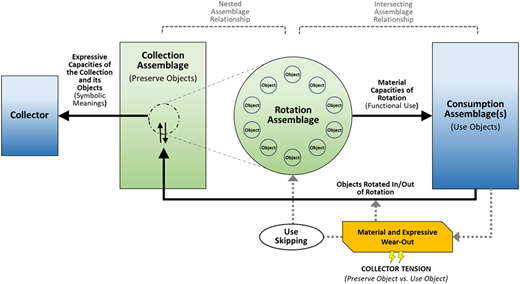
In our framework (Figure 1), rotations are assemblages that comprise a set of objects that are extracted from a wider collection. As such, rotation assemblages are nested within collection assemblages (Huff et al., 2021; Hoffman and Novak, 2018). At the same time, rotation assemblages intersect with other consumption assemblages (Rokka and Canniford, 2016; Scaraboto and Fischer, 2015) when collectors put them to their functional uses in other contexts. In this way, a rotation’s (and its objects’) material capacities enhance other consumption assemblages.
However, tensions emerge for consumers due to rotations being caught between their collection and other consumption assemblages. The logic of collection assemblages is to preserve objects so their meanings for their collector can persist (expressive capacities). By contrast, the collector’s other consumption assemblages benefit from using the same objects, which is made apparent when they are assembled into a rotation (material capacities). We find that these conflicting logics lead to consumers managing two forms of use-contingent object degradation that go beyond physical wear. We label these degradation forms as expressive and material wear-out. To mitigate both forms of wear-out and preserve their objects’ capacities, consumers either rotate an object out of their rotation or skip its rotational use in particular moments. We illustrate our framework in the following sections.
Collection assemblages
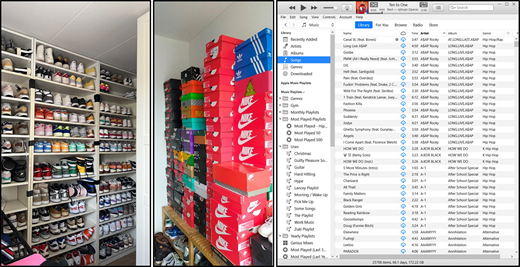
A collection assemblage comprises not only the objects collected but also the heterogeneous entities that influence collecting activities (Abarashi and Edirisngha, 2022; Woodward and Greasley, 2017). In the sneaker context, spatial constraints at home, custom shelving, and family members were notable influences. These influences heighten when dwellings are small and as the size of a collection increases. For instance, Reggie’s collection of 120+ pairs is stored in a walk-in closet he shares with his wife in their townhouse. Storage in this location keeps the main areas of their home tidy and navigable. Given this closet’s tight quarters, and so his wife has room for her items, Reggie has installed custom shelves to pack his sneakers tightly together. He has even discarded these sneakers’ original boxes to fit in more pairs, and he must use a ladder to reach those stored towards the ceiling (Figure 2, left panel). Other participants who lived in small dwellings (apartments, townhouses) also negotiated with family to accommodate their collections. Some negotiate effectively and can display their collections in living rooms (Gary, 70 pairs), while others must relegate their collections to storage rooms (Bruno, 55 pairs) or garages (Trevor, 86 pairs; Figure 2, middle panel).
Irrespective of how they are stored, collected objects possess expressive capacities. That is, the objects–both individually and as a wider collection–carry symbolic meanings that are interpretable to their collector. Our sneakerheads illustrated how their objects reminded them of cherished memories. Often, these situated them within periods of sneaker history. Wilt recalls memories of his Nike Air Max 90’s original release. Meanwhile, Tessa remembers camping outside of a store to secure an exclusive Air Max 1 pair:
Wilt: The Air Max 90 is my favourite. High school was when I first saw them come out. I had to trade for them with a friend. You could see right through it, that air window was totally new when the shoe came out, it was magical […].
Tessa: The Air Max 1 “Elephant”, that one is famous. It came out at Patta [a sneaker store] in Amsterdam to celebrate its 10-year anniversary since its original release in 2007. My sister and I camped outside the store for more than a day. It’s the most special shoe I’ve had so far.
Our digital music participants shared similar sentiments about the songs they collected. Importantly, these collections are not influenced by physical spatial limitations – rather, they are shaped by an assemblage of devices, internet connections, and the apps that render digital music collections visible (Figure 2, right panel). These objects resided on smartphones and laptops, which enabled participants’ collections to be accessible while commuting, exercising, and working. Participants recounted home listening sessions using Hi-Fi systems (Daniel, Mina) and ear/headphones when not wanting to disturb family (Aaron, Finn). Car audio systems served those who drive to work (Melody, Trey) and participants used ear/headphones while on public transport (Darcy, Keira). Participants also found portable speakers useful for group listening sessions while exercising (Ethan) and working with colleagues (Lachlan).
Like sneakers, songs not only establish connections to cultural knowledge (e.g. artists, genres) but also autobiographical meanings, which enable collectors to make sense of past and present memories and identities. Participants commonly discussed how songs reflect different life stages and relationships. Ethan, for instance, discusses songs with linkages to his wife, while Grant talks about songs tied to his European travels:
Ethan: Every time I add new songs, it’s like a different part of our relationship, where more recent songs are when we were more mature in our relationship. These songs all have particular meanings.
Grant: You know the song “One” by U2, I can tell you I have listened to it 400 times with a mate driving in our beat-up Volvo station wagon through Holland into Denmark. I can tell you landscapes and the things we did as we sang that song at the top of our lungs, driving this Volvo around Europe!
In both contexts, participants stated they wanted to preserve the meanings of their objects by avoiding their uses. Yet, they still felt compelled to use them as their functions are useful and enjoyable. In what follows, we demonstrate how assembling rotations enables consumers a practical, albeit imperfect, way to manage these conflicting logics.
Assembling rotations from within collection assemblages
Participants routinely assembled objects from collections to put them to use. Taking inspiration from sneakerhead vernacular, we label these assemblies rotations. Our sneakerheads explained two benefits of rotations. Firstly, separating objects into rotations enables convenient access for daily use, as individually selecting pairs from a wider collection is cumbersome. Roger explains this benefit:
Roger: We have a separate space in the bedroom. It’s convenient, when you get dressed in the morning you can easily choose your shoes. Otherwise I’d have to go to the storage room, stare at a heap of choices, and pull a pair out of its box […] Instead, I just lay out what I want to wear on Sunday.
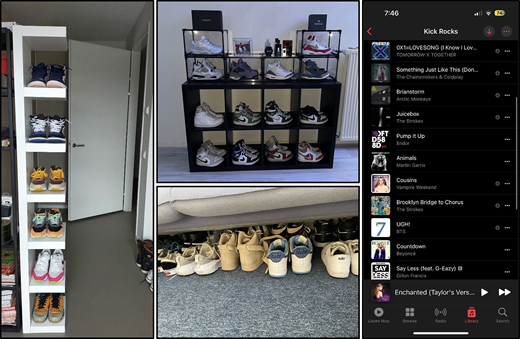
Rotations reduce the number of objects under consideration, making it easier to select a pair to use. All Roger needs to do is devote time on a Sunday to pre-select and unbox the pairs he wants to wear that week. Other participants noted similar effort-saving benefits. These ranged from avoiding daily walks between storage and wardrobes (Keith, Bruno), climbing shelving stepladders (Reggie), to placing pairs by entranceways for convenient access when heading out (Lloyd, Owen). Even Jason, who lived in a cramped city apartment, places pairs near his front door by stashing them under his couch (Figure 3, middle-bottom panel).
Secondly, rotations also allow compromises with family when it comes to the display of sneakers in prominent locations at home. Instead of displaying full collections in large space-eating shelving, participants can hide their holdings in storage and show off the pairs they will wear that week. For instance, Bert (100 pairs) has installed shelves near his home’s entranceway that have space for six pairs to use and display. These sneakers stand proudly adjacent to his wife’s and kids’ pairs on the floor (Figure 3, left panel). Similarly, Keith has shelving in his family’s entranceway to display his rotation of eight pairs from his collection of 50 (Figure 3, middle-top panel). Cheekily, above his rotation shelving, he displays rarer pairs in transparent boxes to his partner’s annoyance.
Assembling music rotations also yielded two benefits for participants. Firstly, although spatial constraints do not apply to digital music, playlists address digital storage and monthly data limitations of participants’ devices. In particular, only syncing playlists and not full collections frees up storage space on smartphones and lowers the risk of exceeding mobile data plan limits each month. These concerns emerged when talking about listening situations away from home. For instance, the runners in our data (Bob, Candace, Patrick) all ensured their smartphones synced their playlists before their runs. As Patrick puts it, “playlists help because of my download limit. My phone syncs that stuff so I don’t have to stream songs over 4G”.
Secondly, playlists also enable convenient use, saving participants the trouble of scrolling through hundreds, even thousands, of songs on screens for something to listen to. As Darcy (3,000 songs) explains, “Keeping music in playlists is easier, it’s easy to see what music I’m into and queue it up”. This convenience extended into an aspect exclusive to digital music rotations: participants can more easily trust apps to shuffle songs for playback. This trust stems from rotations being purposefully assembled with songs that suit specific activities. As these songs are “pre-approved” (Patrick), participants do not need to queue songs moment-to-moment or devise an order in advance. This is important when attention is required elsewhere, like when driving, working or exercising:
Leo: Shuffle mode is more convenient, like if you are driving […] While I’m working it’s on shuffle [e.g., welding].
Candace: If I’m running it’ll be in a playlist and I don’t have to search for songs. I’ve got [my phone] on my armband and I don’t want to touch it while running, it’s not practical.
Suiting specific consumption contexts drives rotation assembly. As we explain next, such assemblies reflect how participants plan to leverage a rotation’s material capacities to enhance intersecting consumption assemblages.
Using rotations to enhance intersecting consumption assemblages
A rotation’s material capacities describe how combinable it is with other assemblages through the useful functions it can contribute. In this way, rotations intersect with other consumption assemblages to produce outcomes consumers desire (Epp et al., 2014). When deciding what pairs to rotate in, sneakerheads consider the functional requirements of upcoming activities. Bert, as a teacher, for instance, chooses sneakers that he tolerates getting scuffed by his Grade 5 students. Meanwhile, Trevor considers seasonal weather conditions and how his sneakers influence how he can be affectionate with his partner:
Bert: Because of my job I have four-five shoes that I put on regularly within my rotation. Although the children understand they need to watch the sneakers of their teacher, I have sneakers in the rotation that are allowed to get a little dirty.
Trevor: Tonight I’m going to an open studio art night in Amsterdam, so I’ve got the Yeezy insulated boot in my rotation now. On Valentine’s Day [earlier in the week], I was wearing these Balenciaga’s. They give me an extra half inch of height, so when I wear them, I can kiss my girlfriend on the forehead easier […].
As Bert and Trevor explain, the uses of collected objects require practical considerations of the sociomaterial environments that they and their sneakers will encounter. From teaching energetic schoolchildren, dressing up on Valentine’s Day, to suiting cold weather across a week, rotations require the assembly of pairs that address the consumption circumstances anticipated by consumers.
Another influence on rotation assembly is the timescale to which these assemblages operate (Franco et al., 2022). Sneaker rotations combined with other consumption assemblages across multiple days, typically one week. This timescale was reflected in how sneakerheads talked about their rotations and the assemblages these enhanced. For instance, rotations enhance assemblages that feature varying activities, moods, and weather conditions across a week. Lucas and Penelope explain:
Lucas: These are the shoes I put on the easiest. If the weather is muddy, I don’t go out with my good Jordans […] I’ll wear that Timberland pair, unless it’s warm and it’s bulky to pair with shorts […] Then I think activity, if it’s work [restaurant server] I’ll wear those Vans.
Penelope: My rotation choices depend on what I’m doing […] For weekends I have special pairs ready, like when I go out with girlfriends to dinner, like those blue [Nike] Dunks. But if it is raining I put on my normal [Nike] Air Force Ones, those are allowed to get a little dirty. I also work out five days a week and I believe that exercising goes better when I look good […].
Lucas’ rotation covers his weekly needs in school, social, and work-oriented assemblages. Two pairs of Jordan sneakers were in his rotation if he wanted to wear these coveted pairs to school or social events. However, in inclement weather, Lucas defers to a pair of Timberland sneakers that are more durable and waterproof. On days when he works at a restaurant, he wears a pair of Vans, which he does not mind scuffing. Similarly, Penelope sets aside sneakers to enhance gym workouts during weekdays and to look good while out with friends on weekends. Like Lucas, Penelope sets aside specific sneakers for poor weather, ensuring her rotation can adapt to her other consumption assemblages’ weekly needs.
Our digital music participants also assembled rotations to leverage their songs’ material capacities to enhance the functioning of other consumption assemblages. The most common were rotations assembled to enhance exercise and work assemblages. Rotations readied bodies and cleared participants’ minds while doing these activities. As examples, Melody and Leo describe uses that shape which songs they rotate into their rotations:
Melody: Music I know that is really fast, up-beat kind of stuff […] like Beyoncé, cause she’s telling you ‘You can do it!’.
Leo: If I’m welding an intricate material, like stainless-steel, slower music slows my heart rate and allows me to concentrate […] My faster playlist, if I was changing a car engine, gearbox, or clutch, allows me to work at a faster rate. It’s like a rhythm when you work on a car, you match your pace to the song’s beat […].
While Melody and Leo leverage their rotations’ material capacities at the gym and work, other participants combine their rotations with other assemblages. Keira uses her rotations to stimulate her moods when commuting. Similarly, Ethan’s breakdancing playlists get his crew’s bodies to execute different kinds of manoeuvres during performances:
Keira: When I’m on the train, my commute is an hour and a half, so I’m always listening to music […] If it’s about relaxing, it’s my upbeat R&B playlist. If I’m sad, I’ll listen to slow music that reminds me of family and home, which gives me comfort.
Ethan: If you feel like doing a particular style of breakdancing, say ‘footwork’, there’s particular music that triggers that. Dubstep playlists or really hype hip-hop help trigger high-intense moves like spinning […].
Like all our digital music participants, Keira’s and Ethan’s rotations varied in timescale. As above, Keira’s playlist needed to span a work commute of 90 minutes, while Ethan’s playlists covered performances of 10–15 minutes. These durations corresponded to the length of activities central to the assemblages both wanted to enhance. By contrast, sneaker rotations typically cover a week’s worth of use, with pairs worn on a daily basis.
This timescale consideration aligned with the frequency that rotations tend to be updated across our two contexts. In particular, our sneakerhead participants fell into a weekly update pattern given the physical effort required to move shoes in and out of storage. Thanks to the ubiquity and ease of use of smartphones, our digital music participants could instead apply immediate updates to their playlists as desired.
As participants continued to curate and refresh their rotations before putting them to use, many recounted that the usefulness and meanings of objects within them can erode. That is, through repeated use, objects can become less effective to propel bodies, offer comfort, and withstand weather as expected. Realisations like these prompted participants to manage two forms of “wear-out”, as we next explain.
Managing material and expressive wear-out
Material wear-out occurs when the capacities of an object to combine with, and enhance, other assemblages decline due to repeated use. This concept captures when continued rotational use erodes an object’s functional benefits. For instance, Brad talks about how sneakers become less comfortable over time:
Brad: It’s walking comfort. I’ll wear pairs less as they get worn-out, they look good of course, but they get harder on my feet […] It’s not so fun for getting to work […].
As in Brad’s example, material wear-out is reflected by his sneakers becoming less potent to add comfort to his commuting and work assemblages, even though they are still meaningful to him. Almost all our sneakerhead participants described the erosion of their sneakers’ functional benefits in this way. Some added that routinely worn sneakers also become less resistant to cold weather (Vance, Penelope), and can become slipping hazards when it is wet and their outsoles are worn down (Jason). When sneakers’ material capacities fade, they are seldom rotated back in and later are retired from use.
While physical wear erodes sneakers’ material capacities, it is a different story when it comes to digital music. As digital files are not prone to physical degradation, material wear-out manifests as the declining potency of songs to usefully stimulate moods and bodies into desired states. Bob explains:
Bob: When you’re running, when you have a good pump-up song, I find you naturally lift your effort. From when it stops matching the purpose of the activity or mood […] I’ll get it off my playlist […].
As above, overuse can reduce a song’s usefulness to enhance Bob’s running performance. When such situations emerge, participants like Bob rotate these songs out as they no longer suit the functional purposes of their playlists.
By contrast, expressive wear-out occurs when accumulating use erodes an object’s special meanings to its collector, such as through boredom (Abarashi and Edirisngha, 2022). That is, while material wear-out concerns the declining utility of collected objects, expressive wear-out is the erosion of their capacities to be meaningful for collectors. Sticking with digital music, Grant explains that developing routine familiarity can dilute an object’s meanings:
Grant: I can picture now the footpath walking in London. I can tell you the colour of the trees, the cracks in the footpath […] But it means less. You listen to every nuance, and you strip a song of its magic […].
For Grant, repeated listens can diminish a song’s meaningfulness that enables him to fondly remember past life stages. Like Grant, sneakerhead Adrienne reflects on how putting a certain sneaker pair to repeated use can rob it of its special meanings:
Adrienne: Like these Off-White sneakers, I wear them only on special occasions […] They’re limited and have a cool story behind them, not many people have them, so you have to be careful when you wear them […] If you use them all the time, then are they really special?.
Adrienne is cautious about repeated use as this risks making a pair of exclusive Off-White sneakers feel quotidian. Such establishments of everyday familiarity can breed consumer contempt for their collected objects. When such risks emerge, participants tend to remove these objects from rotational use.
However, if a consumer wants to keep an object in rotation for later use, they can manage wear-out by practising use skipping. Taking inspiration from digital music apps, we conceptualise use skipping as a consumer bypassing an object’s use as part of a rotation in a particular moment. We find that use skipping helps consumers mitigate the erosion of a collected object’s material and expressive capacities, and in some cases, allows the possibility for these to be restored. For instance, sneakerheads conserve their sneakers’ material capacities by use skipping. Consider Lucas’ example:
Lucas: That Billie Eilish one. It’s suede, so they get worn faster in the rain […] I’m more careful about wearing this pair […] So if the weather does not work, I’ll try to wear it another time […].
Lucas explains how he often skips the use of suede sneakers waiting in his rotation, as they are not watertight and easily ruined by wet weather. Given that rain is a year-round risk in the Netherlands, Lucas delays his uses until days he is certain the weather will be dry. As such, use skipping enables him to prolong the material capacities of his suede pairs to suit social events, as dressing stylishly boosts his confidence.
Similarly, our digital music participants note how skipping can fend off the decline of a song’s material capacities. This possibility emerges from beliefs that abstaining from the object’s uses in a present moment may restore its usefulness when future usage situations arise:
Patrick: If you’ve heard that song more recently than you would’ve liked you might just skip it. Like you’re getting sick of the song and you’ve had it on the playlist for a couple of months. But since it still fits running, instead of removing it I’ll skip the song […] It’s not that I dislike the song anymore, I’m just bored of it at that moment.
For Patrick, when his music app queues a song that is becoming less potent to enhance his runs, use skipping enables him to retain it in his playlist for future runs in which it might become useful again.
Participants also engaged in use skipping to manage expressive wear-out. Rather than upholding the functional longevity of objects, skipping instead safeguards their meanings. Bruno explains in terms of sneakers that are highly coveted by sneakerheads:
Bruno: There’s some sneakers in my rotation that I chicken out at the last minute, when I say to myself I’ll wear them this time. These are those super exclusive and expensive pairs like Off-White collaboration pairs or those Tiffany and Co. [Nike] Dunks. Serious collectors might have a problem with me wearing them, though I’ve worn Off-White pairs a few times on special occasions, but still […].
As above, Bruno skips the uses of sneakers to avoid eroding their special meanings. In fact, he often hesitates to wear his most exclusive pairs despite placing them into his rotation, reflecting his (and other collectors’) worries that mundane use of these sneakers is blasphemous in sneaker culture. Bruno can only muster the courage to use these pairs when rotated in for special occasions like birthdays or graduations.
Similarly, preserving an object’s expressive capacities via use skipping also features in digital music rotations. Keira offers a relatable reflection on her skipping experiences:
Keira: I’m always skipping it. It’s odd because you make a playlist of your favourite songs, but most of the time you don’t want to listen to particular songs. Sometimes if you haven’t listened to it in a while, I’m reminded of why I added it. So it ends up a ‘surprise’ again after a long time.
Kiera explains that skipping songs helps her avoid repeated exposure, so she can still cherish them in future. She also reflects that these songs might even become a “surprise” when she rediscovers their meanings after a prolonged period of non-use (Abarashi and Edirisngha, 2022). In this manner, use skipping not only can thwart the erosion of an object’s expressive capacities, but it may even restore these capacities in the process too.
Across these findings, we have developed a framework that explains why and how consumers assemble rotations to put objects they collect to use. Moreover, we illustrate why and how consumers manage the tensions of doing so. In sum, our framework reveals three features of rotations. Firstly, rotations are assembled from, and are nested within, collection assemblages that aim to preserve objects’ expressive capacities. Secondly, rotations and their objects are put to use to leverage their material capacities to enhance a consumer’s other consumption assemblages. Finally, use can result in the material and expressive wear-out of objects, which consumers manage by rotating objects in/out of a rotation or by skipping their uses in particular moments. At stake, respectively, is the erosion of these objects’ usefulness and special meanings. To conclude, we next discuss the theoretical and managerial implications of our study and future research directions.
Discussion
An assemblage theory perspective on collecting
We join recent studies that use sociomaterial perspectives to develop insights on collecting (Abarashi and Edirisngha, 2022; Woodward and Greasley, 2017). While these studies usefully unpack collecting contexts into their parts through Latourian ANT or Bennett’s assemblage concept (Franco et al., 2022), we use DeLanda’s (2006) assemblage theory to highlight that collections can give rise to rotations that enable object use. We leverage this insight as part of answering our two research questions.
Firstly, our study offers a pathway to explain why and how consumers use objects they collect. We spotlight that consumers assemble collected objects into rotations to put them to quick and convenient uses, and in so doing, leverage their material capacities to enhance other consumption assemblages (Epp et al., 2014; Huff et al., 2021). That is, consumers put collected objects to functional use to benefit other parts of their lives, such as consumption assemblages germane to running, commuting, and working. This insight extends prior research that suggests that use might enable collectors to discern and update an object’s meaningful interlinkages within a collection (Abarashi and Edirisngha, 2022). In our framework, we consider such meanings in terms of an object’s expressive capacities. Hence, we highlight that both a collected object's expressive and material capacities can drive its uses by consumers.
Additionally, with a focus on material capacities, we revisit the conceptualisation of collected objects as being removed from use (Belk et al., 1991). Under this conceptualisation, objects are shielded from use to preserve their special meanings through non-use or limited use (Belk et al., 1989). While we corroborate that utilitarian use can erode objects’ special meanings, our data suggests that protection from physical wear is only one part of the story. Use can also lead to repeated exposures that breed consumer contempt for their objects. This insight enables us to extend Abarashi and Edirisngha’s (2022) study of collectors’ continual reconstructions of their objects’ meanings. We establish that there can be a point at which reflections can become destructive to meaning reconstruction. That is, the more consumers engage with an object on an everyday basis, the greater the possibility that doing so may erode its expressive capacities (Belk et al., 1989). This means that while use is indeed a reality of collections (Arcuri and Veludo-de-Oliveira, 2018; Scaraboto et al., 2016), consumers must manage the resulting tensions that often accompany use.
Secondly, assemblage theory helps us explain why and how consumers manage the tensions of collected object use by assembling rotations. In so doing, we extend studies that infer that cleaning and proper storage helps consumers deal with such tensions by spotlighting another way this can be managed (Scaraboto et al., 2016; Woodward and Greasley, 2017). We specifically build on Abarashi and Edirisngha’s (2022) identification of “rotation” by showing how and why this curatorial activity can balance the benefits of use with mitigating the risks of eroding objects’ material and expressive capacities. This insight enables us to show that rotations can help consumers enjoy both their objects’ special meanings and the useful functions they can add to the other consumption assemblages in their lives.
Collections, object use, and physical/digital materialities
Assemblage theory not only helps us discern conceptual elements of rotations that transfer between physical and digital collecting, but also differences in how these materialities can shape collecting dynamics. This aspect of our study enables us to extend prior research that showcases the variety of entities that influence physical collections (Abarashi and Edirisngha, 2022; Woodward and Greasley, 2017) by highlighting different dynamics that can emerge among components implicated by digital collections and their rotational uses.
Firstly, by considering physical and digital materialities in the same empirical study (cf. Mardon and Belk, 2018), we connect contemporary research on the affordances of digital technologies to collecting studies (see Belk, 2013; Mardon et al., 2023). In so doing, we substantiate some differences in the kinds of entities that shape digital collections (and rotations), and the dynamics in which these assemblies can change versus their traditional physical counterparts. We show that digital collections and rotations rely on the affordances of devices, internet connections, and the apps that render these holdings visible and intelligible to collectors (Mardon et al., 2023; Zwick and Dholakia, 2006). These entities afford distinct possibilities for collecting and using digital objects. For instance, digital object holdings can be immediately accessed and updated almost anywhere thanks to the ubiquity of smartphones, Wi-Fi/cellular connections, and streaming services (Dholakia et al., 2015). Yet, we show that these same holdings can be constrained by data storage and monthly internet limits. These limits lead many in our data to only sync rotations and not full collections to devices. We contrast such insights with our sneaker data that corroborates the known influences of homes, family members, and spatial constraints on physical collections (Arcuri and Veludo-de-Oliveira, 2018; Belk et al., 1991). However, we add that these entities can limit how easily and immediately consumers can access and enjoy physical collections and rotations versus their digital equivalents.
Secondly, and consequently, we reveal different timescale dynamics between physical and digital collections (Franco et al., 2022). For instance, our participants’ music consumption was at scales of minutes to hours, with it being possible to quickly update these rotations due to the immediacy afforded by digital devices and apps (Dholakia et al., 2015). Sneaker rotations were slower, consumed over a week, with rotating pairs requiring time to move them between entranceways, wardrobes, and shelving. Based on these comparisons, we observe that managing digital objects can be “faster” than their physical counterparts in collecting contexts (Mardon and Belk, 2018). Such timescale considerations can inform how we understand not only how quickly rotations of different kinds of objects are assembled, but also how effortlessly and frequently they can be used and managed by consumers.
In this way, we call attention to the temporalities of both rotations and collections as a prevalent time-related aspect in our study on collected object use (see Southerton, 2006). We add this consideration to others in marketing research, like momentary or prolonged accelerations and decelerations of time that consumers experience during acts of consumption (Husemann and Eckhardt, 2019; Woermann and Rokka, 2015). By comparison, our work spotlights the frequencies with which consumers practically revisit and update how they plan to consume. As in our study, unpacking the mutable temporalities of rotations and collections across materialities helps us understand how often consumers may reassemble rotations over time (e.g. hourly, daily, weekly) to support their uses of collected objects during later anticipated acts of consumption.
Thirdly, prior research notes that ease of acquisition and fungibility mean consumers can easily amass large numbers of digital objects (Giesler, 2008; Mardon and Belk, 2018). The implication being that, according to Belk (2013, p. 491), digital collections may require “sorting on the way out to provide the sense of coherence that defines a collection.” Our study substantiates Belk’s insight for digital music rotations as these comprise objects sorted out of wider collections. In particular, we find that sorting establishes coherence based on objects’ expressive capacities through the meanings they hold for collectors, and material capacities to enhance other consumption assemblages. The implication of this insight is that collection coherence (or “seriality”, Bianchi, 1997) not only emerges through the assembly of the full collection and what it means. Rather, additional coherences can emerge when a subset of these objects is assembled together for utilitarian purposes as a rotation, such as sneakers for use in the next week or a playlist curated to enhance a particular consumption activity.
We also extend Belk’s (2013) thinking by showing that sorting can also apply to physical collections in the case of sneakers. Sneaker rotations are also extracted from wider collections, enabling senses of coherence to emerge for consumers, especially as a collection’s size reaches hundreds of pairs. Our observations extend current theories that posit that collection coherence only emerges when consumers acquire, dispossess, or reflect on their objects (Abarashi and Edirisngha, 2022; Belk et al., 1991). We, however, demonstrate that coherence can also be continually worked on when collectors assemble and reassemble rotations from within collections.
Contributions to assemblage theory
Our study contributes to assemblage theory research by exploring collecting as a context that features both nested and intersecting relationships between multiple consumption assemblages (Huff et al., 2021; Scaraboto and Fischer, 2015). By situating rotations as assemblages caught between a wider collection assemblage and intersecting with other consumption assemblages, we reveal novel possibilities that emerge when multiple assemblages become conjoined.
Firstly, we extend Scaraboto and Fischer (2015) by establishing that objects can be caught between multiple assemblages alongside consumers, bringing about tensions in conjoined consumption contexts. We conceptualise how such tensions can emerge: the expressive capacities of an object as contextualised within one assemblage (its meanings in a collection; Belk et al., 1989), can be at odds with its material capacities that intersect with other assemblages (its rotational uses that risk degradation). For consumers, conflicts between assemblages can make consumption across multiple domains feel difficult to manage. This insight is a reminder that while individual assemblages are contexts in their own right, if researchers do not account for other conjoined assemblages, they may miss the effects of components on consumers that cut across contextual boundaries (Franco et al., 2022; Hoffman and Novak, 2018). In DeLanda’s (2006) terms, this means that researchers may miss the affects of components’ “relations of exteriority” on the focal assemblage they are studying.
Secondly, our study enables us to explain how new developments can spark cascading changes across multiple consumption assemblages. Although prior research suggests that changes in one assemblage can spark changes in others, the change processes uncovered to date are either linear or bidirectional. Huff et al. (2021), for instance, chart how product-oriented innovations scale up to wider community and market assemblages. That is, these changes cascade up in scale in a linear fashion, given these authors’ purposes to trace the emergence of new markets. Meanwhile, Hoffman and Novak (2018) leave possibilities open for technology assemblages and consumer experience assemblages to bidirectionally influence each other in Internet of Things contexts.
We extend these studies by revealing that changes can recur as a feedback loop between multiple consumption assemblages. Specifically, when consumers extract different subsets of objects from collections to put them to use in other assemblages, this can trigger further updates when they try to avoid eroding the meanings and usefulness of these objects due to overuse risks. A consequence is that rotation assemblages persist in flux and tend not to achieve prolonged periods of stability (or “territorialization”; DeLanda, 2006) in comparison to other consumption assemblages in prior research (e.g. Eagar et al., 2022; Franco et al., 2024). Given aims to achieve a balance between preservation and use, consumers must regularly manage rotations. This curatorial activity offers a variety of managerial implications, as we next explain.
Managerial implications
Managers establish the uniqueness of new releases to heighten their collectability. A common strategy is for managers to tell the story of an object, such as details about its design process and inspirations, and/or control its availability to foster exclusivity (Diaz Ruiz and Cruz, 2023; Mardon and Belk, 2018). Indeed, for digital music and sneakers, it is standard practice for artists and designers to tell narratives about the creation of their new releases (Denny, 2021). Similarly, brands in the tourism and hospitality industries also tell stories that heighten the desirability of exclusive attractions, like lodging (e.g. ice hotels) and limited-time menu items (e.g. bacon ice cream), such that the experiences of these are in many senses collectable (Belk et al., 1991; Keinan and Kivetz, 2011). Common to these examples is that managers traditionally focus on developing an object’s expressive capacities to heighten its collectability.
Our study adds that managers can also heighten the capacities of objects that are not as storied or exclusive, those that are mainly premised on their utilitarian functions, to encourage their collectability. We spotlight the roles of “functional” music and “beater” sneakers among our participants (pairs bought to be worn and walked in rather than preserved). Functional music has been increasingly put to use by consumers in recent years (Meaker, 2023). Our data suggests that such songs are valued for their material capacities to stimulate bodies and moods to enhance study, commuting, work, social, and exercise assemblages. Beater pairs parallel functional music, where sneakerheads defer to beaters for their material capacities to work with inclement weather or enhance assemblages that benefit from walking comfort. As such, these pairs step in when functional considerations preclude the rotational uses of others that are traditionally collected and premised on their expressive capacities (e.g. retro models, luxury collaborations). Usage as part of intersecting consumption assemblages can moreover enable these objects to develop autobiographical meanings among consumers. For instance, songs and sneakers used for exercise can become tied to personal achievements, while those that accompany commutes can become cherished reminders of life stages. This means that managers can promote the material capacities of their objects for rotational uses in the knowledge that doing so can also develop these objects’ expressive capacities over time.
Building further on these potentials, managers across industries can identify which of their offerings may serve the equivalent “functional” or “beater” role in customers’ rotations. In many car-oriented consumer cultures, for instance, the term “daily driver” denotes a car that serves versatile functional transport purposes for its owner (Carter, 2024), such as in conjoined family and work assemblages (e.g. school drop-offs, groceries, commuting). Such material capacities can enable a car enthusiast’s other sportier, classic, or luxury cars to avoid mundane wear-and-tear, so they more exclusively enhance leisure-oriented assemblages like road trips and car meets. With this in mind, managers can consider developing and communicating the value of functionally-oriented offerings in light of their uses to specifically bear the burdens of everyday use, in place of a consumer’s more novel and expression-oriented collected objects.
Accordingly, wear-out risks mean that value creation must also be considered in light of prolonging collected objects’ expressive and material capacities. That is, managers can benefit from supporting the meanings and useful functions of collectables beyond their initial design and sale to consumers. Maintenance and repair can indeed prolong the life of an object in a collection (e.g. Scaraboto et al., 2016). However, we add that helping consumers manage their rotations also works towards the same objective, particularly in contexts in which the number of objects in a collection can become large.
Taking inspiration from digital music apps, managers can create value by helping consumers manage their rotations and the expressive and material wear-out of objects. For example, online guides enable consumers to create “smart playlists” that temporarily cycle out songs from a rotation that have recently been played (e.g. Brookes, 2023). Rotations like these enforce a period of non-use that our study suggests can better sustain a song’s meanings and potency to spur action. Managers working in other collecting contexts can learn from these features that consumers program into music apps. Indeed, the “Unboxed” app (Link to Do sneakers right with UnboxedLink to the Homepage) not only enables consumers to create a virtual representation of their sneaker collection, but it can also track what pairs they have rotated in and out of their rotation. Notably, Unboxed notifies consumers about which pairs have not been worn in a while and are worthy of rotating back in. In doing so, Unboxed ensures that objects enjoy non-use periods that may prolong their expressive and material capacities.
In light of smart playlists and specialised apps, managers may also have the opportunity to devise offerings that can similarly help consumers create virtual representations of their collections and rotations, and thus manage wear-out. However, such offerings must remain mindful of the idiosyncrasies of other kinds of collected objects that see use, like video/board games, home appliances (e.g. toasters), sports jerseys, and retro technologies. For instance, video and board game uses are often social and may require managing wear-out at the level of families and households, beyond individual collectors. How might managers create value for these customers and their relations in such cases? Not only do such contextual questions present managerial opportunities, but they also suggest future research directions, as we next explain.
Future research directions
Although we have studied two contexts to enhance our study’s transferability, we are mindful that aspects of digital music and sneaker collecting may not readily extend to other contexts. Both feature objects that are mostly affordable, fit everyday use purposes, and are associated with younger consumers (Denny, 2021). On these bases, future research can explore how our rotations framework may transfer to contexts featuring objects that are more expensive, see specified usage situations, and are of interest to a greater variety of consumers. Potential contexts include the collection of musical instruments, luxury jewellery, and antique furniture. For most consumers, rotations may not be necessary in these contexts as acquiring large numbers of these objects is rarely feasible, meaning these collections may remain at smaller, more manageable scales. Future research can therefore map out a fuller variety of theoretical and managerial implications beyond those we have developed from our two focal contexts.
While our study shows how rotations can enable additional forms of coherence within collections in light of object-use patterns (cf. Belk, 2013), we call for further research on how rotation dynamics enable consumers to discover new interlinkages between their objects (Abarashi and Edirisngha, 2022). These discoveries likely propel the “novelty” of collections (Bianchi, 1997) by which rotations serve as another means through which object interlinkages can be dynamic and continually exciting for consumers. Specifically, we suspect that the material and expressive capacities of rotations as whole assemblages may alter over time, changing what kinds of objects are iteratively rotated in and out.
For instance, Melody, one of our participants, explained how her gym workout playlist slowly transformed into a playlist that contained “sing-songy songs” that encapsulated her relationship with her best friend. This was due to this playlist finding karaoke-adjacent uses in her car when the two began to commute to the gym together. Extending our framework’s terms, this rotation began to intersect with another consumption assemblage, sparking changes to both the functional uses and meanings of its objects. Considering this example, future research may benefit from unpacking various possibilities for rotations to evolve as they intersect with different assemblages over time. This research has the potential to discern further dynamics between rotational object use and collecting. These dynamics may reveal extended possibilities for managers to create value by tapping into the continually evolving coherences and novelty of collections, and the rotations they contain (Abarashi and Edirisngha, 2022).
Finally, our research establishes avenues to explore a fuller variety of relationships between conjoined consumption assemblages. Future research might develop insights into the (in)stability of consumption contexts and the possible outcomes these may produce for consumers (Eagar et al., 2022; Epp et al., 2014). We highlight recursive relationships that emerge among assemblages that are nested and intersect (Huff et al., 2021; Scaraboto and Fischer, 2015). Ultimately, we show how these relationships trend towards continual changes in consumption contexts that are managed by consumers. We therefore wonder: what arrangements between multiple assemblages are meaningful to study in future research due to the challenges and opportunities they present to consumers, marketers, and society at large?
Home technology assemblages, for example, can be considered as agglomerations of intersecting smaller-scale assemblages of devices, software, and users (Hoffman and Novak, 2018). In turn, these assemblages are nested within grander-scale assemblages that include Internet-oriented infrastructures, servers and user data, artificial intelligences, and the human professionals that maintain these systems (Novak and Hoffman, 2023). Although the consequences of home technology assemblage disruptions for consumers have been explored in recent research (Franco et al., 2024), less is known about what may unfold when grander-scale technology assemblages are disrupted. Given warnings of the potential consequences of interdependent technical infrastructure failures and cyber attacks on nations (World Economic Forum, 2022), such considerations will be important research areas for marketers who wish to safeguard consumers from catastrophic possibilities.
In conclusion, our study has offered a theorisation of rotations through the lens of DeLanda’s (2006) assemblage theory. By studying digital music and sneaker rotations, we seek to motivate continued research on collecting. These include studies that develop new insights from the idiosyncrasies germane to contemporary collecting contexts, some of which may enable productive revisitations of collecting’s most taken-for-granted concepts.
Since the submission of this paper, the following author has updated their affiliation: Rohan Venkatraman is in the Marketing Discipline Group, Deakin University, Australia. The authors would like to thank Robin Canniford, colleagues at the University of Melbourne, session participants at the 2024 Consumer Culture Theory Conference, as well as the editors and three anonymous reviewers for their helpful comments on earlier versions of this paper. The authors also thank Ires van Hout, Rick Bosma, Vay Roze, and Esmee Schut for their assistance with the data collection.