Brand extensions represent an essential growth strategy, allowing companies to remain relevant in increasingly demanding markets. An important success factor for brand extensions that prior research has widely studied and discussed is the perceived fit between an extension and the brand/the parent brand’s products. The purpose of this study is to systematically review and summarize the construct of perceived fit and, thus, to explore what exactly perceived fit is and what role it plays in brand extension research.
This literature review systematically analyzes 102 empirical and conceptual articles that extend perceived fit research.
This study identifies nine perceived fit dimensions (manufacturing fit, physical fit, situational fit, satisfying fit, complementing fit, targeting fit, servicing fit, pricing fit and conceptual fit) and provides a thorough overview of perceived fit research findings. Furthermore, it derives future research directions.
This study advances the perceived fit literature by identifying future research potential in terms of methodology, underlying theories, perceived fit conceptualization and operationalization, research context and research focus.
By outlining the dimensions of perceived fit and the factors that influence the impact of the construct, this study shows how perceived fit needs to be incorporated into product management to maximize extension and parent brand outcomes.
This study provides a comprehensive, state-of-the-art review of the conceptualization and effects of perceived fit and provides guidance for future research.
1. Introduction
With the rising costs of introducing new products and the increasing competitive pressure, many brands are struggling to remain relevant in the market. Brand extensions are a vital growth strategy that builds on a brand’s equity to broaden its product portfolio and, thus, market share (Bhat and Reddy, 2001; Völckner and Sattler, 2006). The term “brand extension” refers to the use of an established brand name to introduce a new product (Boush and Loken, 1991; Völckner and Sattler, 2006) either in an existing product category (so-called line extensions) or in a new product category (so-called category extensions) (Aaker and Keller, 1990; Carter and Curry, 2013; Reddy et al., 1994).
Both line and category extensions provide a wide range of benefits. Line extensions, on the one hand, can add variety to the product range in a resource-saving way, serve short-term market developments and effectively address diverse and evolving consumer needs (Kapferer, 2012). For example, the body care brand Dove has recently launched a new fragrance for its deodorant sprays, the alcohol brand Captain Morgan has introduced a nonalcoholic version of its rum and software brand Microsoft has released a premium version of its Teams platform with extra functions. Category extensions, on the other hand, are particularly attractive because they enable brands to enter new product categories at lower risk. Compared with products from new brands, category extensions benefit from the image of an already established brand and therefore simplify product trial and acceptance (Aaker and Keller, 1990). Examples include training weights from the furniture brand IKEA or the mixed reality headset from the electronics brand Apple.
With about half of all new products failing two years after their introduction (Victory et al., 2021), a wealth of research has addressed brand extension success factors (e.g. Reddy et al., 1994; Völckner and Sattler, 2006). One success factor whose importance research has rated as particularly high is the perceived fit between an extension and the parent brand/parent brand’s products. A large body of research has demonstrated that this perceived fit leads to better evaluations of both line and category extensions (e.g. Boush and Loken, 1991; Broniarczyk and Alba, 1994; Dens and de Pelsmacker, 2010b). In the context of category extensions, a high perceived fit has been associated with increased extension perceived quality (Dacin and Smith, 1994), extension purchase intention (Taylor and Bearden, 2002), parent brand evaluation (Mathur et al., 2012) and parent brand image (Milberg et al., 1997). For line extensions, a high perceived fit has been shown to reduce the risk of brand name dilution (Loken and John, 1993), enhance the perceived value of the extension (Dall’Olmo Riley et al., 2015) and increase retailer acceptance (Völckner and Sattler, 2006). Despite the high practical relevance of perceived fit in brand management, the research field remains fragmented and faces several conceptual and methodological challenges. A systematic literature review can help address these issues by synthesizing existing knowledge.
First, the terminology used to describe perceived fit is inconsistent. Research applies terms such as typicality (Loken and John, 1993), relatedness (Herr et al., 1996), or similarity (Smith and Park, 1992). This lack of terminological clarity makes it difficult to identify relevant research articles and oversee the current state of conceptual and empirical research. A systematic literature review helps to synthesize previous knowledge and deepen the understanding of the construct beyond terminological difficulties.
Secondly, while research proposes various theoretical frameworks to explain the impact of fit on brand extensions and their parent brands, the field heavily relies on categorization theory. As a result, alternative explanatory approaches, such as schema congruity theory, remain underexplored (Bhat and Reddy, 2001). A systematic literature review can reveal previously little-considered perspectives and expand the theoretical foundation of the construct.
Thirdly, studies show strong disagreement on how to define and measure the perceived fit and its dimensions (e.g. Schmitz et al., 2023; Völckner and Sattler, 2006). They apply various items in many different combinations to measure the perceived fit, which makes it difficult to compare research findings. A systematic literature review can organize measurement approaches, identify parallels and support standardization.
Fourthly, research on perceived fit is extensive and multifaceted, as it encompasses numerous empirical effects with a variety of variables (Deng and Messinger, 2022). Both researchers and practitioners face significant challenges in understanding how perceived fit affects extension and parent brand outcomes and how the fit can be strategically managed. A systematic literature review can provide a comprehensive overview of the empirical effects of perceived fit and the variables involved.
This systematic literature review addresses the above-mentioned issues in perceived fit research and provides guidance for empirical work and practice. Specifically, it clarifies the theoretical foundations of perceived fit, shows how existing research has conceptualized and operationalized perceived fit to date and examines in which context perceived fit is relevant. Furthermore, the systematic literature review identifies inconsistencies in previous research, reveals underexplored areas and offers detailed future research directions.
In doing so, the review synthesizes and brings structure to a heterogeneous field in which methodological approaches, theoretical perspectives, conceptualizations and empirical findings have evolved in parallel rather than cumulatively. It offers an integrative perspective that serves as a robust knowledge base, enabling research findings to be systematically related to one another and compared. The review clarifies the scope and boundaries of perceived fit research, thereby increasing transparency within the literature and providing a clear orientation.
These contributions translate into substantial benefits for both researchers and practitioners. For researchers, it develops a precise roadmap for systematically advancing the complex and fragmented research field of perceived fit. It highlights underexplored perspectives, clarifies conceptual ambiguities and lays the groundwork for in-depth academic investigation. For practitioners, the study translates academic insights into actionable knowledge. It helps to better evaluate extension strategies, anticipate consumer responses and make more confident decisions in brand and product management across diverse market contexts.
2. Procedure
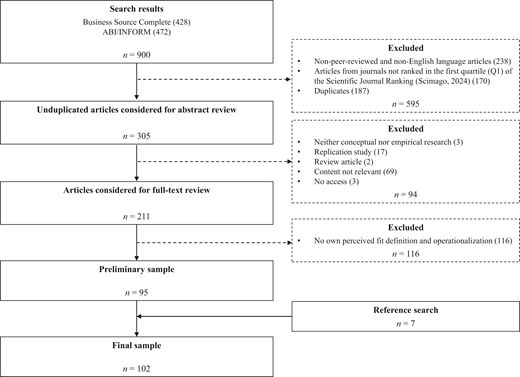
Our methodological approach follows Tranfield et al. (2003), who provide a five-stage process for conducting systematic literature reviews in the business and management area (see search process in Figure 1).
In the first step, we systematically identified relevant research. To address inconsistent terminology, we began with a scoping study to identify relevant keywords and synonyms for perceived fit (Grant and Booth, 2009; Tranfield et al., 2003). We then combined these synonyms with both the terms “brand extension” and “line extension,” with the former generally being the term for category extensions in research, to create the search string (“fit” OR “similarity” OR “distance” OR “congruity” OR “congruency” OR “consistency” OR “typicality” OR “relatedness”) and (“brand exten*” OR “line exten*”). Given that different databases can yield different sets of relevant studies, we aligned our database selection with prior systematic reviews (Dempsey-Brench and Shantz, 2022; Ego, 2023; Schmitz et al., 2023). Following this review practice, which also includes work in brand management and brand extension research, we used Business Source Complete and ABI/INFORM for the database search, both of which belong to the major databases in the management field (Mukendi et al., 2020). The search was conducted in April 2025 using search field tags to specify English-language and peer-reviewed journal articles, yielding 900 search results.
In the second step, we assessed study quality. In line with Tranfield et al. (2003) and Zahoor and Al-Tabbaa (2020), we applied a quality filter based on journal ratings. Given the size and heterogeneity of the perceived fit literature, journal rankings provide a transparent means of focusing the review on studies that offer substantial contributions to the field and demonstrate methodological robustness, as they reflect established and rigorous peer-review standards. Accordingly, we only included high-quality articles from journals listed in the first quartile (Q1) of the Scientific Journal Ranking (Scimago, 2024). As a result, we arrived at 305 unduplicated articles from 72 leading marketing and consumer psychology journals.
In the third step, we examined these articles for their suitability for our sample based on predefined inclusion and exclusion criteria in a two-stage screening process conducted by two independent researchers (Tranfield et al., 2003; Xiao and Watson, 2017). The screening followed a sequential logic, with different inclusion criteria applied at the abstract and full-text levels. Overall, the inclusion criteria required that studies be empirical or conceptual research that examines perceived fit in the context of brand extensions and make a substantive conceptual and/or methodological contribution to the perceived fit literature. These criteria were chosen to ensure that the final sample captures relevant research that meaningfully advances understanding of perceived fit rather than merely referencing the construct. In the first stage (abstract screening), we applied the first inclusion criterion and retained only empirical and conceptual studies addressing the role of perceived fit in the context of brand extensions. We excluded announcements, replication studies, review articles and contributions not relevant to the topic. This stage resulted in 211 articles. In the second stage (full-text screening), we applied the second inclusion criterion by requiring that studies provide an original definition and/or operationalization of perceived fit, thereby making a significant contribution to the field. Accordingly, we excluded articles that do not define and operationalize perceived fit and those that merely adopt existing definitions and operationalizations. This stage resulted in 95 articles. We then added seven additional articles through a reference search, arriving at a final sample of 102 articles. Table 1 gives an overview of all included articles.
In the fourth step, we systematically extracted data from all included studies using standardized digital extraction forms implemented in Excel (Palmatier et al., 2018; Tranfield et al., 2003). The extraction forms consisted of multiple worksheets and predefined columns to ensure consistency across studies and to allow for structured comparison of the extracted information. Specifically, we recorded methodological characteristics of each study, including the type of contribution (conceptual vs empirical), the research approach (quantitative vs qualitative), the research design (e.g. experiment vs interviews), the type of sample (consumers vs managers) and the geographical context. In addition, we extracted detailed information on how perceived fit was conceptualized, including the terminology used, formal definitions, measurement items and the research contexts examined (line vs category extensions and products vs services). Furthermore, we documented the underlying theoretical perspectives applied in each study. Finally, we extracted the research effects in which perceived fit was examined, distinguishing whether perceived fit was modeled as an independent variable, mediator, or dependent variable, and recorded all independent, mediating, and dependent variables involved in these effects.
In the fifth step, we analyzed the extracted data by systematically comparing studies across the predefined extraction categories and identifying similarities, differences, recurring patterns, as well as points of divergence. In addition, we examined how frequently specific elements appeared across studies, which allowed us to identify dominant research streams, underrepresented perspectives and areas that would benefit from further empirical attention. Building on this structured comparison, we synthesized the findings by organizing and integrating insights across studies, thereby developing a coherent overview of the state of research on perceived fit and deriving key directions for future research (Palmatier et al., 2018; Tranfield et al., 2003).
3. Findings and discussion
3.1 Perceived fit methodology
Methodologically, research on perceived fit shows several commonalities. Firstly, apart from one conceptual contribution (1.0%), all articles in the sample are empirical (99.0%). These empirical studies are primarily quantitative (experiments or surveys), with only three additionally using qualitative methods (Aaker and Keller, 1990; Athanasopoulou et al., 2015; Deng and Messinger, 2022) and another three incorporating secondary data (Carter and Curry, 2013; Swaminathan et al., 2001; Wang and Liu, 2020).
Secondly, perceived fit research is strongly dominated by consumer perspectives. Of the 101 empirical articles, 95 examine consumers (94.1%), while only six consider managers (5.9%). Just two of these six focus exclusively on managers (Athanasopoulou et al., 2015; Smith and Andrews, 1995).
Thirdly, most studies were conducted in North America, with 54 accounting for 65.9%, followed by 14 in Asia (17.1%), 11 in Europe (13.4%) and three in cross-regional settings (3.7%) (see Table 1 for an overview of research design, sample and geography).
3.2 Perceived fit conceptualization
3.2.1 Perceived fit definition.
Disagreement remains in research on how to name the construct of perceived fit; we uncovered 11 different terms used to describe it. While “fit” (n = 77) and “similarity” (n = 32) appear most frequently (in 75.5% and 31.4% of the articles, respectively), the remaining terms are applied only occasionally: “(in)congruity” (n = 7), “consistency” (n = 5), “distance” (n = 3), “typicality” (n = 2), “relevance” (n = 1), “congruence” (n = 1), “overlap” (n = 1), “coherence” (n = 1) and “relatedness” (n = 1). Almost one-quarter of the articles (n = 25) use two or three different terms that either appear to be synonyms or cannot be distinguished sharply from each other, as the definitions do not show significant differences. This causes difficulty in comparing research findings from different articles and in tracking fit results within a study.
A total of 39 of the 102 articles (38.2%) create their own perceived fit definition in a brand extension context. The remaining articles in the sample either apply existing definitions or use no definition at all. To obtain an overview of the existing definitions, we extracted all fit definitions from our sample (see examples in Table 2) and examined them for similarities. The definitions commonly refer to the degree of similarity and/or the degree of shared associations. Though similar in content, the definitions are rather generic and imprecise in their wording. Mostly fit synonyms are used to define the construct (e.g. “similarity,” “match,” “closeness,” “consistency”). In addition, there are no further explanations as to how exactly the extension should resemble the brand and its products or which associations should be shared. Thus, the definitions provide little insight into what exactly a fit is and what it consists of.
3.2.2 Perceived fit dimensions.
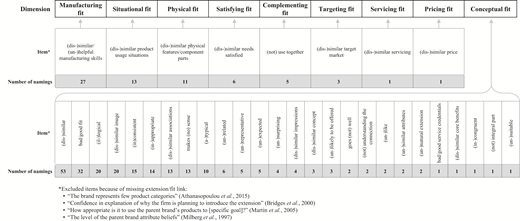
While the existing perceived fit definitions are rather vague, the items used in empirical articles to measure perceived fit provide more insight into the characteristics of the construct. However, with 95 articles creating their own operationalization of perceived fit, the items used to measure fit are rather diverse and inconsistent. Indeed, research applies 34 different items either individually or in various combinations. A total of 20 articles measure fit with a single item (21.1%), 74 articles use two to seven items (77.9%) and one article even uses 10 items (1.1%). Concrete definitions of the items are mostly missing, and precisely the items requiring a high degree of additional explanation appear most frequently: (dis-)similar (n = 53) and bad/good fit (n = 32). In addition, only one study has empirically derived the items (Deng and Messinger, 2022). Otherwise, there is often a lack of justification as to why specific items were selected or combined in a certain way. Research results are, therefore, difficult to compare.
For the existing fit dimensions, we first extracted the items from perceived fit scales in research literature, then identified similarities between these items, grouped them accordingly and, finally, derived the perceived fit dimensions. The 34 items could be grouped into nine superordinate dimensions (see Figure 2):
Manufacturing fit: The degree to which the extension and the parent brand’s products require the same manufacturing skills.
Physical fit: The degree to which the extension and the parent brand’s products have the same physical features/component parts.
Situational fit: The degree to which the extension and the parent brand’s products have the same usage situations.
Satisfying fit: The degree to which the extension and the parent brand’s products satisfy the same needs.
Complementing fit: The degree to which the extension and the parent brand’s products can be used together in certain usage situations.
Targeting fit: The degree to which the extension and the parent brand’s products have the same target market.
Servicing fit: The degree to which the extension and the parent brand’s products require the same servicing.
Pricing fit: The degree to which the extension and the parent brand’s products have the same price level.
Conceptual fit: The degree to which an extension corresponds to the parent brand concept. The term “brand concept” refers to the extent to which the extension shares parent brand–specific abstract meanings. These meanings result from a certain interplay of attributes, benefits and the company’s marketing effort and help differentiate a brand from competitors (Kirmani et al., 1999; Monga and John, 2010; Park et al., 1991).
Dimensions 1–8 deal with the fit between the extension and the parent brand’s products and are each created from one item. Only dimension 9 addresses the fit between the extension and the parent brand itself and consists of 26 items. Although the dimension of conceptual fit is most frequently found in research and seems to have a particularly high relevance in the measurement of fit, it is the most unclear. It consists of fit synonyms that are not defined and give much room for interpretation.
Apart from Dimitriu and Warlop (2022), who provide a service-specific item, no dimensions or items are developed for specific contexts. The items are transferred from one context to another without modification or additional research. However, fit dimensions and items are not universally applicable. For example, with fit being considered almost exclusively in the context of category extensions (category extension, n = 86; category and line extensions, n = 12; line extensions, n = 4), the dimensions are primarily tailored to this extension type. However, complementary fit, for example, is not applicable to line extensions, as line extensions, by definition, are in the same product category as the core product and are typically not purchased to be used in combination with other products in the category.
In addition, most articles deal with products rather than services (products, n = 80; products and services, n = 17; services, n = 4) and mix different categories (e.g. electronics, fast-moving consumer goods [FMCG], sports and outdoors, clothing and accessories, transport, hospitality and leisure) without having a specific focus in the study. This leads, on the one hand, to dimensions such as servicing fit not being reasonable for products that are consumed quickly and do not require maintenance (i.e. FMCG) and, on the other hand, to dimensions appropriate for the physical properties of a good (e.g. manufacturing fit or physical fit) but not for service extensions.
3.3 Underlying theories
Research uses nine theories to explain the role of fit in brand extension research. A total of 48 articles (about half the articles) do not use any theory to explain fit (see overview of theories in Table 1). The theories are used for two purposes.
Construal level theory, comparison theory and structure-mapping theory explain why consumers put more or less weight on fit in extension evaluation. Construal level theory (Huang et al., 2017; Kim and John, 2008) and structure-mapping theory (Peev and Kumar, 2023) deal with how consumers cognitively process individual extensions. They suggest that consumers who process information abstractly (vs concretely) or focus more on similarities (vs differences) place more weight on fit. In contrast, the comparison theory looks at how an extension is evaluated in the context of alternative options. It proposes that consumers assign the most value to the factor that is not shared among the alternatives. Thus, if the alternatives come from different brands (the same brand), the perceived fit becomes more (less) important in consumers’ evaluations (Zheng et al., 2019).
Categorization theory (e.g. Boisvert and Ashill, 2018; Broniarczyk and Alba, 1994), schema congruity theory (e.g. Jung and Tey, 2010; Liang and Fu, 2021), associative network theory (e.g. Morrin and Jacoby, 2000; Pina et al., 2010), accessibility–diagnosticity theory (Chang et al., 2011; Meyvis and Janiszewski, 2004), dissonance theory (Cutright et al., 2013) and inclusion/exclusion model (Miniard et al., 2018) explain the level of fit. All but one of these theories (including the most widely used theory, categorization theory, n = 41) assume that a high fit has a positive effect on consumer extension evaluation. Only schema congruity theory (n = 7) proposes that extensions with a moderate fit might be evaluated better than those with a high or low fit (e.g. Gierl and Huettl, 2011). Both categorization theory and schema congruity theory hold that consumers evaluate brand extensions by trying to assign them to existing mental categories or schemas (Deng and Messinger, 2022; Loken and John, 1993). According to categorization theory, the higher the perceived fit, the greater the chances of successfully categorizing an extension into the parent brand’s category and of transferring favorable beliefs and attitudes from the parent brand to the extension (Boush, 1997). Schema congruity theory assumes that the evaluation differs depending on the cognitive effort required to assign an extension to the parent brand schema. While high-fit extensions arouse only little consumer interest and low-fit extensions are difficult to assign to the parent brand schema, moderate-fit extensions can usually be integrated with some cognitive effort, giving consumers a feeling of success and the extension a good evaluation (Meyers-Levy et al., 1994).
3.4 Perceived fit research results
Perceived fit itself occurs in research as an independent variable, a dependent variable and a mediator. The variables considered together with perceived fit address five categories: extension (70 variables), parent brand (34 variables), consumer (22 variables), competitor (four variables) and retailer (one variable).
Perceived fit research examines parent brand and extension outcomes. Accounting for more than half the effects (52.5%), extension evaluation is by far the most studied dependent variable. While in general the majority of effects (86.5%) deal with extension outcomes, effects of perceived fit on the parent brand are relatively less researched (13.0%).
3.4.1 Perceived fit as independent variable.
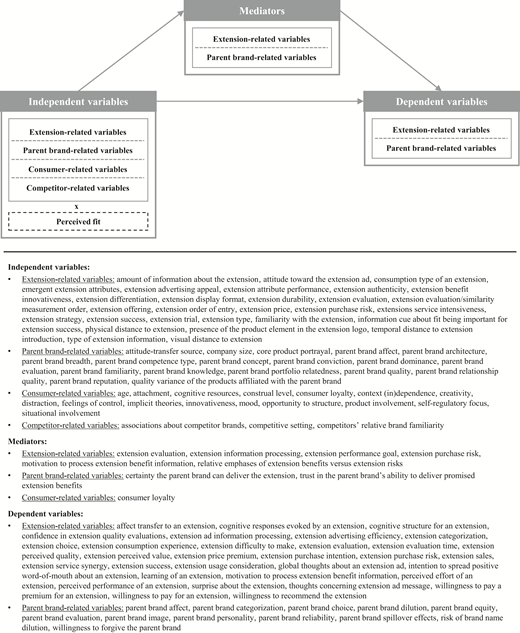
Research has concentrated on examining perceived fit as an independent variable. Figure 3 shows the variables used in direct and indirect effects of fit as an independent variable, as well as in interaction effects of fit (see Supplementary Table 1 for individual effects).
Most research focuses on the effect of perceived fit on extension evaluation. While a substantial number of articles (n = 46) reports a direct positive effect of perceived fit on extension evaluation, a smaller group of studies suggest that this effect may be indirect, operating through mediators such as certainty that the parent brand can deliver the extension (Smith and Andrews, 1995), extension information processing (Huang et al., 2017), extension purchase risk (Milberg et al., 2010; Milberg et al., 2013) and relative emphases of extension benefits versus extension risks (Chang et al., 2011).
In contrast to the predominant view that high fit positively influences extension evaluations, several studies identify an inverted U-shaped relationship, indicating that both low and high fit lead to worse outcomes than a moderate fit. Meyers-Levy et al. (1994) provide evidence for exactly this inverted U-shaped relationship between fit and extension evaluation. While Maoz and Tybout (2002) find this connection under conditions of high involvement, Jung and Tey (2010) observe that in addition to high involvement, high innovativeness is also necessary for the U shape to occur (for both better extension and parent brand evaluations). Kim et al. (2014) show that consumers with a strong brand relationship quality prefer moderate-fit extensions to those with a high or low fit.
The inverted U-shaped relationship between perceived fit and extension evaluation illustrates that the influence of fit is not consistent across all situations, but can vary depending on specific conditions. Building on this insight, a large body of research has explored interaction effects, examining the circumstances under which the impact of perceived fit becomes stronger or weaker. Although interaction effects have been widely studied, only four findings have been replicated across multiple articles. Fit is more important for extension evaluation when advertising appeals are emotional rather than informative (Dens and de Pelsmacker, 2010a, 2010b), when fit is measured before rather than after extension evaluation (Barone, 2005; Zhang and Sood, 2002), when product involvement is high rather than low (Dens and de Pelsmacker, 2010a; Huber et al., 2013), and when innovativeness is low rather than high (Klink and Smith, 2001; Salinas and Pérez, 2009). All other interaction effects have been identified in single studies only, using a wide range of variables. As a result, the field is broad and lacks a clearly defined research focus.
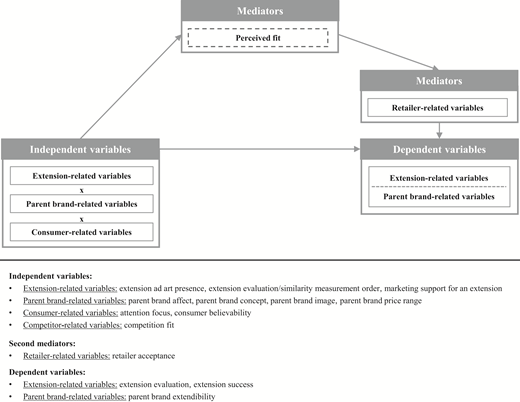
3.4.2 Perceived fit as mediator.
Figure 4 shows the variables used in effects with perceived fit as a mediator (see Supplementary Table 2 for individual effects). Compared with perceived fit’s impact as an independent variable, its influence as a mediator has been studied considerably less in brand extension research. However, even in this smaller group of articles, the primary focus remains on how fit influences extension evaluations. Across all effects reviewed, perceived fit consistently has a positive effect on consumers’ extension evaluations. This holds true regardless of whether the independent variable is competition fit (Peev and Kumar, 2023), parent brand affect (Yeung and Wyer, 2005), parent brand concept (Pontes et al., 2024), parent brand image (Salinas and Pérez, 2009) or parent brand price range (Pontes, 2018). Interestingly, one article finds a double mediation that is also the only effect in which a retailer-related variable occurs. As marketing support for the extension increases, so does its fit, which in turn leads to greater acceptance by retailers and ultimately greater success for the extension (Völckner and Sattler, 2006).
3.4.3 Perceived fit as dependent variable.
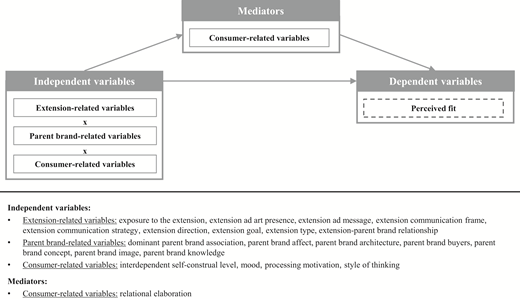
While the impact of perceived fit on various extension and parent brand outcomes has been studied extensively, scant research has explored how perceived fit itself can be influenced. Figure 5 shows the variables used in direct, indirect and interaction effects on fit (see Supplementary Table 3 for individual effects).
The findings suggest that perceived fit can be positively influenced by different brand-, product- and consumer-related factors. These include consistent extension direction (Dawar and Anderson, 1994), goal (Martin et al., 2005) and product category (Carter and Curry, 2013); frequent exposure to an extension (Klink and Smith, 2001); art presence in extension ads (Hagtvedt and Patrick, 2008); a good consumer mood (Barone et al., 2000; Sar et al., 2011); a good parent brand image (Dwivedi et al., 2010; Salinas and Pérez, 2009); high parent brand affect and knowledge (Hill and Lee, 2015); and a high number of parent brand buyers (Dall’Olmo Riley et al., 2014). Although the direction of these effects is consistent, the underlying mechanisms remain largely unexplored. Only one study investigates mediation, showing that relational elaboration mediates the effect of an interdependent self-construal level on fit under high processing motivation (Ahluwalia, 2008). In addition, only a few studies have examined the conditions under which the effects on perceived fit are most pronounced. In particular, Monga and John (2010) examined such interaction effects and found that holistic (vs analytic) thinkers perceived the fit to be higher for extensions from functional brands, from direct brands, from brands being presented holistically and from brands without any information.
4. Synthesis and future research directions
By systematically reviewing the research literature on perceived fit, we can identify some core findings with future research potential that will help to further structure and advance the broad research field around perceived fit. First, previous research has relied on a largely uniform methodology, with most articles being empirical, quantitative, focused on consumers and conducted in North America. This lack of methodological diversity limits theoretical innovation, reduces the generalizability of findings and restricts the practical applicability of insights. Employing more diverse approaches (e.g. qualitative methods to conceptualize the construct of perceived fit, managerial perspectives to understand how fit is used in product development processes and studies in underrepresented regions such as South America or Africa to capture cultural differences) could strengthen the theoretical foundations of the perceived fit and develop more robust and nuanced recommendations for managing brand extensions.
Second, even though the role of perceived fit in brand extensions is mainly explained by categorization and related theories, only a few authors deal with the different explanatory approaches within this theory stream. While categorization theory links higher fit with more favorable outcomes, schema congruity theory suggests that a moderate fit may be more beneficial. Research, therefore, needs to determine the circumstances under which each of the two explanatory approaches is more likely to hold. For example, studies could manipulate different levels of perceived fit in combination with varying parent brand conditions (e.g. high vs low brand familiarity) or consumer characteristics (e.g. high vs low loyalty). Doing so would help shed light on the conditions under which a brand extension is assigned to its parent brand and enable practitioners to align their product development and marketing strategies more specifically with consumer expectations.
Third, few articles have addressed theories that explain why consumers place more or less weight on fit in extension evaluations. Moreover, these theories offer different perspectives. Construal level and structure-mapping theory link the weighting of fit to cognitive processing (Kim and John, 2008; Peev and Kumar, 2023), whereas comparison theory attributes it to the context of alternative options (Zheng et al., 2019). Future research should examine the conditions under which these theories best explain the role of fit in extension evaluations (e.g. the influence of situational factors such as time pressure or information availability). Doing so would advance theoretical integration and provide managers with clearer guidance on when fit is a decisive factor in extension success.
Fourth, although research on the success factors of brand extensions has used perceived fit excessively, only limited work has been done on the construct itself. The literature review showed that research has unsystematically used different terms, such as similarity, consistency, or congruity, to describe the construct of perceived fit. In addition, while research defines perceived fit as the degree of similarity and/or shared associations between the extension and the parent brand or its products, it does not reveal much about what characteristics need to be similar or what associations need to be shared. Developing a general perceived fit definition would help advance knowledge on the construct and facilitate the exchange of information and ideas between scholars and practitioners.
Fifth, although the items used to measure perceived fit provide insights into the characteristics of the construct, the underlying dimensions have not yet been examined in depth. Future research needs to empirically test the dimensions derived in this article (manufacturing, physical, situational, satisfying, complementing, targeting, servicing, pricing and conceptual fit) and specifically investigate the dimension of conceptual fit, which is frequently applied but least explored. This is important for developing a sound operationalization of perceived fit and for effectively applying perceived fit in product and brand management. For example, managers can better assess whether a new extension should emphasize physical features (e.g. materials or packaging) or manufacturing skills (e.g. technology or human resources) to increase its success.
Sixth, previous research has used many different items in a wide variety of combinations. These items [e.g. (dis-)similar and bad/good fit] are rather imprecise and (for the most part) lack definitions as well as empirical evidence. A grounded operationalization would help develop knowledge about perceived fit in a structured way, to address open research gaps precisely and to explore connections with other constructs (such as parent brand image and willingness to pay for an extension) more thoroughly.
Seventh, the identified perceived fit dimensions are mostly seemingly randomly applied to various contexts. However, depending on extension type, products, services, or industry, different dimensions might be relevant and of varying importance. For example, physical fit and satisfying fit might be particularly important in line extensions (vs category extensions), as they share the same product category. In contrast, conceptual fit may play a larger role in services (e.g. insurance or banking), which are immaterial and may lead consumers to rely more on abstract brand cues. Conceptual fit might also be more relevant for high-involvement, slow-moving products (e.g. cars), where the brand relevance might be especially high. In turn, pricing fit may be more relevant for low-involvement, fast-moving consumer goods categories such as food. Understanding how fit dimensions behave across contexts helps assess the robustness of the construct and refine existing theories, especially categorization theory. It also offers guidance to practitioners on which dimensions to prioritize when designing and positioning brand extensions.
Eighth, our systematic literature review showed that the comprehensive research results on perceived fit (as well as the effects demonstrated multiple times by different studies) are hardly comparable, because studies have measured perceived fit in multiple ways. For example, some studies use single-item scales [e.g. “(a-)typical”], while others rely on multi-item scales including usage, target group and image overlap. Research needs to replicate found effects with a consistent perceived fit operationalization to improve reliability and provide practitioners with a stronger basis for the effective use of corporate resources such as marketing budgets.
Ninth, previous research has only marginally explored the role of perceived fit in feedback effects on the parent brand. This is surprising because brand extensions can have profound effects, for example, on parent brand image (Milberg et al., 1997) and evaluation (Jung and Tey, 2010). Future research should explore how perceived fit affects variables such as parent brand reputation, credibility, concept, or trust. As a result, practitioners can reinforce positive effects and better manage risks (e.g. through communication campaigns or product adjustments).
Tenth, retailer-related variables have received only marginal consideration in perceived fit research so far, even though they are highly relevant, especially in the FMCG sector, where products are mainly distributed indirectly. Retailers are crucial for the success of an extension, as they decide whether an extension is listed. Future research should thoroughly explore the impact of perceived fit on retailers to increase the listing chances and, thus, the sales figures of brand extensions. Relevant mediators of the effect of perceived fit on retailer acceptance may include perceived sales potential or assortment consistency.
Eleventh, the focus of research to date is on examining the impact of perceived fit on the extension and its parent brand. Little attention has been paid to the factors that influence fit itself. This is surprising, as it is still unclear how the positive effects of perceived fit can be enhanced and the negative effects can be weakened. Thus, research needs to investigate which factors affect fit both positively and negatively to maximize the desired impact. In particular, research should explore marketing variables such as advertising appeals or extension naming strategies and consumer variables such as consumer age or involvement more closely, which may shape how fit is perceived. Table 3 shows possible research questions for future research.
5. Conclusion
Research on perceived fit has been evolving for more than 30 years and has accordingly produced a large amount of research findings. This systematic literature review summarizes the extensive knowledge in this field and contributes to both academic research and managerial practice.
Until now, researchers have had to navigate a broad and fragmented research landscape characterized by different terminologies, vague definitions and diverse measurement approaches. This study provides an overview of the current conceptual and empirical status of perceived fit in the context of brand extensions. It sharpens the understanding of the construct, highlights theoretical explanations and offers a consolidated view of how perceived fit operates across different research contexts. Furthermore, the article identifies inconsistencies in previous research, reveals critical research gaps and presents a clear agenda for advancing the field in the future.
The article provides managers with a clear understanding of the key drivers of perceived fit and thereby highlights the stages within the product development process where managing fit is particularly important. It identifies situations in which fit becomes particularly critical, helping managers allocate resources more effectively. By providing a structured synthesis of empirical findings, the article facilitates the successful integration of the construct into the specific product environment, supports more informed strategic decisions and helps reduce the risk of extension failure or brand dilution.
References
Supplementary material
The supplementary material for this article can be found online.