


The purpose of this paper is to emphasize the increasing importance of information and communication technologies (ICTs) in smart tourism destinations, in their integration in the activity of the tourism companies, and in their interaction with visitors/tourists. In summary, it is intended to evaluate in the city of Porto how the use of technology before, during and after the visit influences the tourist experience.
The authors empirically investigate the importance of using ICTs during tourism experience, assess the access/availability of ICT at the destination and its importance in tourist’s decisions. It is analyzed if the applications and/or information available on the internet are important and positively influence the tourism experience in Porto, that is, the degree of tourist satisfaction. The empirical evidence is based on a quantitative analysis, using a data set involving 423 tourists in the city of Porto.
The importance of the internet access at the destination, especially in places like airports and hotels, since most tourists are primarily using their mobile devices and computers during the trip, and the existing information technologies available in the destination (internet, smartphones or other mobile devices and applications) are considered very important in explaining tourists’ experience.
This study identifies the strengths and weaknesses of the technological strategies, providing useful information for destination management, discussing innovation in tourism, and proposing a framework that empirically evaluates how technological components used in smart tourism destinations can improve tourists’ experiences.
Introduction
We usually say that we live in a world that is in permanent change and is dominated by the evolution of information and communication technologies (ICTs). Technological advances have influenced how we live in society (Dieck and Jung, 2018). Technology comprises knowledge about the means, the actions on it, and modifications in it. These changes are felt in a specific way in cities that are home to an increasing number of people seeking not only a job, but also a quality life. There is a concern to improve, not only these elements, but also make the services provided by these cities more efficient (Vicini et al., 2012). Thus, cities have become complex, very competitive, requiring the coordination of activities and services that use ICTs.
ICTs can help make cities more accessible and attractive, both for residents and visitors, as they contribute to the development of interactive services that interconnect local organizations, enabling users to quickly access services and data. We can highlight tourism as one of the important and essential services for the population, considered as one of the economic sectors that can benefit from the use of technologies (Buonincontri and Micera, 2016). In this context, a new type of destination emerged, characterized by being a smart destination. This concept is applicable to a destination in which technology influences the tourism experience, increases the competitiveness of the destination, and promotes tourism development projects (Boes et al., 2015; Presenza et al., 2014).
For this reason, technology plays an increasingly important role in promoting tourist destinations, distributing and marketing tourism, and supporting tourists before and during their stay in the destination. The important thing is to provide the tourist with an unforgettable visit, but for this to happen it is essential to innovate the destination, to make it attractive and capable of generating emotions. The tourist does not choose a destination only because of the monuments, the beautiful landscapes, the culture or the gastronomy that it has. All this is important, but today’s tourist wants to be surprised by the unknown of the destination and wants information about what to do, what to visit and how to get to a place by using technologies. In this sense, technology integrates the global experience into the destination (Wethner et al., 2015). The tourist destination should become a destination of emotions and experiences and a smart destination. Based on this approach, tourists actively engage with service providers and collaborate in co-creating their own experiences, which on numerous occasions directly contributes to provide innovation (Buhalis and Amaranggana, 2014). The literature on tourism experiences shows that the competitiveness of a destination increases when there is an interaction between the tourist and what it offers through technology (Neuhofer et al., 2012).
In view of these distinctions, and given the fact that we have in mind that there are profound changes in the preferences of tourist consumers and the tourists’ own characteristics, it is considered interesting and relevant to see if destinations have been able to adapt to the changes and demands that the change itself involves. On the other hand, and despite recognizing the influence of technology on the tourism experience, only a few studies have addressed the influence of the strategy of a smart destination on the tourism experience (Buonincontri and Micera, 2016). To date, these studies have shown a basically qualitative nature, using information from websites, public documentation, or in-depth interviews with destination managers. However, in order for us to progress in research, it is necessary to know in-depth the opinion and behavior of tourists (Wethner et al., 2015). For this reason, this paper aims to contribute to the recent debate on innovation in tourism, proposing a framework that evaluates how the technological components used in a smart tourism destination can improve the tourism experience. In summary, the aim is to evaluate how the use of technology before, during, and after the visit influences the tourism experience.
The results of this study will explain some relationships between the approach of a smart destination and the improvement of the tourism experience. We will also obtain useful information for destination managers, once the weaknesses and strengths of the strategy implemented in the destination can be identified by analyzing their impact on the tourism experience. The paper is divided into three parts. The literary review emphasizes the importance of the use of technology in tourist destinations classified as smart, justified by the need to confirm them as competitive destinations, by evaluating the tourism experience based on the use of mobile technology, in different moments and situations resulting from the trip, concluding with defining the hypotheses based on the studies presented. In the research methodology, the choice of Porto as a destination and the methodology of data collection are justified, and the results of the research are presented and discussed. The conclusion discusses the innovative perspective introduced in the analysis of the subject investigated and the results obtained, regarding the evaluation of the tourism experience and the management of the destination. The limitations of the study are also presented, proposing new lines of research.
Literature review: technology for tourism
Technology emerges as a driving and fundamental force for tourist destinations (Kuflik et al., 2015). For this reason, the tourism sector is subject to technological transformations that enable easier and faster ways of doing business, promoting competition and globalization. In Akehurst’s (2009) perspective, the development of the tourism sector is related to the use of information technologies and opportunities related with other organizations promoted by the use of the internet. Costa (2002) also indicates tourism as one of the drivers of today’s economies and a leading user of ICTs, and especially of the internet (Sheldon et al., 2001). It is noted, for example, that purchasing holidays and other tourist products is extremely popular online. In this sense, it is essential to understand how tourists have adapted to technological changes, because they not only facilitate the access and use of information, but also constitute elements that are explained by tourists’ needs and desires (Xian et al., 2015).
In fact, according to the reports Future Traveller Tribes 2030, Understanding Tomorrow Traveller (2015), travel trends in the coming years will be determined mainly by the intensive use of technologies. This is how the availability of information emerges as one of the main competitiveness factors of tourism organizations (Buhalis, 2003). Specifically, tourism information systems (SIT), through the use of appropriate tools, have provided a technological basis, increased the competitiveness of organizations and their survival (Ramos, 2010), thus ensuring a better relationship with activities integrated in tourism. The use of SIT facilitates the relationship between the tourist organization, the destination and the customer, contributing to the promotion and specialization of the tourist product (Bénédicte et al., 2011; Buhalis and Law, 2008).
In this context, the destination is understood as a diversity of individual products and opportunities of interrelated experiences that give substance to the total experience of the area visited (Murphy et al., 2000). More specifically, a smart tourism destination is considered a destination built on a technological infrastructure that ensures sustainable development of tourist areas, accessibility to the whole world, and also facilitates interaction with the visitor, increasing the quality of the experience in the destination and improving the residents’ quality of life (Lopez de Avila, 2015). A smart tourism destination should be able to include technological development, develop innovation activities, incorporating capacities, digital spaces, information processing and tools to these activities, which enable the transfer of technology and knowledge sharing. ICT infrastructures such as Cloud Computing and the Internet of Things can provide the infrastructure required for the development of a smart tourism destination.
Boes et al. (2015) show that the smart tourism destination should, on the one hand, exploit competitive advantages to provide value creation and experiences for tourists/visitors by using the infrastructures of ICT and technological applications and, on the other hand, provide competitiveness and benefits for the destination. They consider that the smart tourism destination should set out four fundamental concepts: human capital (meeting the needs of the population residing in the development strategy, involving educational strategies, creating new business opportunities, of public participation and innovation); leadership, which should aim at bringing intelligence to regions (with the creation of sectoral offices related with city governance in environmental, energy, and innovation areas); social capital (with the collaboration and cooperation between different actors of society-citizens, public and private agents); and innovation (greatly influenced by the capacity of ICTs, where for example, it can be used for the collaboration of citizens, researchers, entrepreneurs in the development of innovative projects, tourism, attracting companies to urban central areas).
Thus, special attention should be given to the changes that take place in market needs, triggered by technological innovations (Buhalis and Law, 2008) and, especially to a new market resource, the mobility and ubiquity allowed by the dissemination of smartphones and by the emergence of QR codes that contextualize mobile applications and services, and emphasize the importance of the destination strategy. In this sense, technology has not only become an integral part of tourism, but it has also revolutionized the way traveling is planned (Buhalis, 2003), business and destinations are managed (Buhalis and Licata, 2002), and how tourist services are created and consumed (Stamboulis and Skayannis, 2003). These changes constitute opportunities and challenges that must be addressed (Gretzel et al., 2006). In this sense, we hypothesize the following:
Internet access at the destination is important for its choice.
The separation of the tourism experience and ICT is increasingly complex. ICT has become an integral part of the experience because tourists use different devices as primary tools to plan their trip, enjoy the destination experience, and share it on their return (Wang et al., 2013, 2014). Likewise, destinations should make greater use of technology to provide tourists with the necessary services at each stage of the tourism experience, as well as manage efficient coordination among all the actors participating in it. In addition, new types of tourist activities are emerging through new technologies that can transform conventional experiences and result in the emergence of new types of experiences (Darmer and Sundbo, 2008; Gretzel and Jamal, 2009). It will therefore be necessary to take into account current changes (Huang and Hsu, 2010), in which not only the technological development itself is considered, but rather the integration of technology in the experiences as the most interesting aspect (Darmer and Sundbo, 2008).
In these experiences, technology can work as a mediator or as the core of the experience itself (McCarthy and Wright, 2004). The development of mass media and technology enrich the sense of mediation in the tourism context (Gretzel et al., 2011). Some studies have begun to examine the extent to which internet-based systems mediate or moderate the tourism experience (Cheverst et al., 2000; Wang et al., 2012; Gretzel et al., 2006; Tussyadiah and Fesenmaier, 2008). On the other hand, by using mobile technology (especially applications on smartphones and tablets), tourists can access all the information wherever and whenever they want. They can personalize their experiences and share them with others while they are still at the destination (Neuhofer et al., 2012). In addition, Kramer et al. (2007) have shown that tourist activities can be easily modified or aimed at using smartphones. Saari et al. (2008), Tussyadiah and Fesenmaier (2009), and Wang et al. (2010) concluded that mobile devices can mediate the behavioral and psychological dimensions of the tourism experience by facilitating the search for information, its processing and sharing, allowing the tourist to learn about new travel opportunities and getting to know a destination better. Tourists build the tourism experience by learning about the existing culture, understanding and feeling the places they visit (Jennings and Weiler, 2006). Based on the review carried out, the following hypotheses were formulated:
The applications and/or information available on the internet positively influence the tourism experience.
The use of the applications and/or information available on the internet is important during the tourism experience.
For many tourists, technology represents an opportunity to actively participate in the destination activities and to take part personally in the construction of their own experience (Prebensen et al., 2013). Likewise, they place special emphasis on sharing their experience with other tourists and residents, and are therefore willing to activate conversation processes through social media within the destination using electronic devices (Buonincontri and Micera, 2016), with their family, friends or anonymous users (Neuhofer et al., 2012; Brejla and Gilbert, 2014). In this sense, it has been shown that the most valued experiences are those co-created with tourists and supported by high levels of technology (Tussyadiah and Fesenmaier, 2009). As argued by Neuhofer et al. (2012), ICTs are extremely useful because they facilitate encounters between tourists and the destination, and improve the experiential process in time and space. The destinations must consider that all the aspects related to the e-service are important for the customer experience (Küster et al., 2016).Therefore, it can be considered that:
The technological resources of the destination influence the satisfaction level.
Although the literature reviewed confirms the impact of ICTs on tourism, most studies hardly emphasize the impact or role of technologies, and empirical research is even more scarce. It should be added that the limited empirical studies have focused only on the role of some particular technology in the tourism experience, such as social networks (Gretzel et al., 2011), guides in mobile phones (Tussyadiah and Fesenmaier, 2007), videos (Tussyadiah and Fesenmaier, 2009), or smartphones (Wang et al., 2012). Only a few studies have aimed at discussing tourism experiences and the impact of technology on a more comprehensive perspective (Neuhofer et al., 2014). There is a need to better understand the relationships between information needs, information tools (internet, smartphones and their applications), and the tourism experience in the destination (Wang et al., 2012).
Research methodology
Choice of the smart tourism destination: Porto
The city of Porto is one of the oldest cities on the European continent. It is the second city of the country in terms of economic and social importance, and has been growing steadily as a tourist destination. “Turismo do Porto e Norte de Portugal, E.R.” is the body responsible for the management and promotion of tourism in the Northern Regional Tourism area. As a way of promoting the region, in tourist terms, it currently has 57 interactive tourist stands, some of which are located in urban tourism centers. The most visited interactive tourist stand is located in Francisco Sá Carneiro International Airport, in the city of Porto. According to Porto e Norte and the Tourism Department of the Porto City Council, tourists visiting the Porto region have an above average cultural level, being demanding when evaluating the experience. They are also characterized by having a medium/high and higher educational level; they are sensitive to local cultures and seek authentic experiences; they have a medium/high purchasing power; they are concerned about preserving the environment; they evaluate tourist products in advance; they are users of new ICTs; they travel with their family; and they prefer flexible itineraries and rationalize their consumption. Based on the information provided by the National Statistical Institute and the Department of Tourism of the Porto City Council, the priority and strategic markets for the city of Porto are Spain, France, Brazil, Germany, UK, Italy, the Netherlands, USA, Belgium, and the Nordic countries (Sweden, Norway, Finland, and Denmark). The number of overnight stays exceeded three million in 2013 for Greater Porto, corresponding more than two million to the city of Porto.
The Tourism Department of the Porto City Council has been monitoring a set of indicators annually, registering an increase in values, namely the movement of passengers at the Francisco Sá Carneiro International Airport, the accommodation units promoted, the overnight stays in Porto (City), passengers in the Port of Leixões, access to the Official Tourism Portal (potential search), visitors of Municipal Museums (more accessible data), visitors of Tourist Offices, with monthly updating (with response to inquiries). In the research used with tourists applied by this department, the conclusions reveal that the most traditional means of knowledge about Porto are through the recommendation of family and friends, despite an increase in the use of the internet, which has gained a more significant role in knowledge about the destination in recent years, reinforced by the internationalization strategy of events held in the city. This aspect is even more significant when we consider that about 80 percent of the tourists who visit Porto do so for the first time. The challenges that arise for Porto as a destination are the knowledge of the features of the tourist who plans his own trip, and who seeks information and opinion in the most diversified sources.
Cities that aspire to leadership must manage their strategies through ICTs (Agüero, 2009). In this sense, Big Data and Open Data technologies are already being used in Porto together with other technologies that are described below:
Availability of free internet, free Wi-Fi access points: the city of Porto has good free Wi-Fi coverage, with 15 hotspots, through PortoDigital, mapped on the tourist map of the city. After one hour of use, registration is requested, keeping the free of charge internet access.
STCP Project: The STCP Free Wi-Fi project, implemented in 2014 in Oporto, aimed at the implementation of a traffic network, connecting more than 400 city buses, allowing access to the Wi-Fi network to about 60,000 users per month, free of charge. The service was experimental for six months, and is based on an innovative technology that aims to create “internet of movement” (internet of moving things). It uses connectivity between vehicles, mobile objects, and end-users to extend the Wi-Fi network coverage. These Wi-Fi hotspots on the move enable users to access the internet without resorting to mobile networks, as well as facilitating the collection of data about vehicles and the city. It is the result of an association between several institutions such as STCP, Porto Digital, Veniam’Works, NOS (Telecommunications Group), University of Porto and University of Aveiro, and is developed under the Future Cities project. Future Cities is a European project led by the University of Porto (Competence Center for Cities of the Future), which aims to transform the city into a live, at urban-scale laboratory, making it one of the most innovative cities in Europe, funded by QREN (through the I-CITY, Future Mobility and Future Health project), covering a multidisciplinary concept that interconnects several areas such as ICT, psychology, urban planning, civil engineering, among others.
Interactive tourist stands: there are 57 interactive tourist stands that depend on the Regional Tourism Authority of Porto and the North of Portugal. The interactive stand of the Sá Carneiro Airport (Porto), in the Porto metropolitan area, is the stand with the highest demand (among all), with around half a million visits. It operates for 24 hours and has a set of equipment such as interactive tables, thematic projection screens, three-dimensional environments, and interactive tools to support the products, as well as cultural events in Northern Portugal. According to this entity, at the interactive stand of the Airport of Porto, monthly sales of approximately €74,000 in accommodation are registered in the region.
The official tourism website of the Porto City Council – Visit Porto: The tourism portal was created with the aim of being present throughout the tourist travel cycle (Figure 1), and considered a crucial tool for the destination. It is divided into channels.

There is a permanent customer care service operator (Customer Care Service) available for any clarification or question. There is also a personal area in the tourism portal, aimed at the tourist, in which he can design his own tourist plan. The user registers in the portal and all the areas and contents through which he passes are registered. When registering, the user answers three questions, which will enable to place him in a certain profile. With frequency of use, the algorithm itself fine tunes the user’s profile. One of the objectives after two or three years will be to be able to identify the user’s profile of the tourism portal of the City Council of Porto. Online assistance is available in the tourism portal. In the chat, the user can give his feedback regarding the satisfaction related to the friendliness of the city. In addition there is the user support, in which all the information provided on request of the customer generates, in the end, an e-mail for him to evaluate the satisfaction with the information given.
Official Apps of porto
The Official Apps, whose communication is sponsored by the Department of Tourism of the Porto City Council, are grouped into Transport (three), Culture, Art and Events (six) and Maps and Guides (five).
Quick Response 2D Code (QR Code)
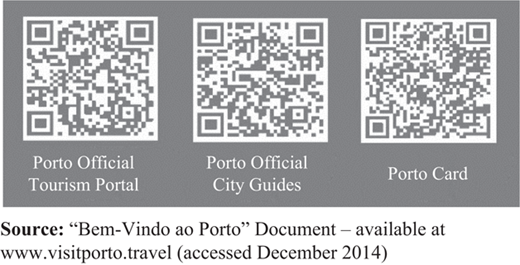
The use of QR Codes is mass-recorded in various documentation provided by the Tourism Department of the Porto City Council, and aims to provide the user, tourist or visitor with access to information about the tourist destination, providing an interface between online and offline (Figure 2).
Beacons project
The City Council of Porto, through its tourism department, is developing an innovative project of Beacons, in partnership with the company Sonae, in the Via Catarina shopping mall, which will use the database of tourism resources, giving the stores the ability to launch promotions, and other alerts for the customers to go there. It is an experimental project whose objective is long term.
Augmented and virtual reality applications
It is currently possible to observe several virtual reality applications regarding the Porto destination, according to the information provided in Table I. It is also possible to refer to the use of this technology on interactive tables available in interactive tourist stands. These tables allow for the recognition of objects and products through a code provided to the user, which when placing the device on the table recognizes the object and automatically provides additional information and also allows to offer information brochures in digital format.
Equipment with Virtual Tour
| Almeida Garrett Municipal Library | Quinta Macieirinha Romantic Museum |
| Municipal Library of Porto | Wine Museum of Porto |
| Casa do Infante | Palacete dos Viscondes de Balsemão |
| Guerra Junqueiro House Museum | Municipal Theater-Campo Alegre |
| Ortigão Sampaio House Museum | Municipal Theater- Rivoli |
| António Carneiro House Office |
Source: Available at: http://visitasvirtuais.cm-porto.pt/ci.php (accessed February 22, 2015)
Research structure
This research aims to evaluate the importance of the use of ICTs in the satisfaction and experience of the tourist in the tourist destination. To prove the objective and hypotheses formulated, a quantitative analysis was chosen. First, Porto was chosen as a smart tourism destination based on the information collected in the previous section. The reason for using a case study was based on its suitability as an ideal methodology in tourism (Gray and Campbell, 2007) and in information systems when technology is a changing dynamics and was recently implemented (Pare, 2001).
The questionnaire survey was used as the method of data collection. It was based on studies by Brakus (2001), Brown and Chalmers (2003), Clawson and Knetsch (1966), Jennings and Weiler (2006), Killion (1992), Laws (1995), Meng (2006), Schmitt (1999), Tsaur et al. (2006), Tussyadiah (2014), Vitterso et al. (2000), and Wang et al. (2012, 2014). The structure of the questionnaire allowed for the collection of the variables under study and presented in the hypotheses. The questionnaires were applied in five different places: Francisco Sá Carneiro Airport (Porto); Cais da Ribeira; Casa de Música; Intersection Avenida dos Aliados/Clérigos; Campanhã train station, which represent the areas with the highest concentration of tourists in the city. They were completed in April 2015, in two different weeks, and in each one, on two separate days: Friday and Sunday. A directed or non-probability sampling method was used, in which the selection of sample elements is based on some criterion. In this case, the area with the highest concentration of tourists in the city was chosen, and the sample represents the characteristics of the population, namely the fact that they are tourists. The probability of an element of the universe being selected for the sample is unknown. The results obtained from the sample cannot be generalized to the whole population, but it is a suitable method when it is not easily usable in a particular type of random sampling. Within the methods of directed or non-probabilistic sampling, the convenience sampling method was used, in which the sample is selected according to the availability and accessibility of the elements of the target population. For a sample of 423 elements, considering a population of over one million tourists, the maximum error is B=4.8 percent.
Data analysis and research results
In relation to the socio-demographic profile of the respondents, the data collected in Table II show that the age group with the largest representation in the sample is 45-54 years old, mostly of international origin (91 percent), highlighting Spain (25.3 percent), France (12.8 percent), and Germany (6.6 percent). The level of gross monthly income is medium/high, given that 46 percent have a value between €1,500 and €3,000 per month, and 29 percent said they earn a higher income than this. Regarding their level of education, 67 percent said they had a university or equivalent degree, which indicates a high educational level in relation to the tourist demand in the region.
Socio-demographic profile
| Socio-demographic variables | % | |
|---|---|---|
| Age (years) | Up to 24 | 8 |
| 25-34 | 17 | |
| 35-44 | 23 | |
| 45-54 | 34 | |
| 55-64 | 8 | |
| +65 | 10 | |
| Gender | Male | 51 |
| Female | 49 | |
| Gross monthly income | Less than €1,500 | 25 |
| Between €1,500 and €3,000 | 46 | |
| Between €3,001 and €5,000 | 21 | |
| More than €5000 | 8 | |
| Qualifications | High school | 7 |
| Middle course | 26 | |
| Higher education or equivalent | 67 | |
| Country of origin | Portugal | 9 |
| International | 91 |
Source: Compiled by the authors
In the analysis of the variables related to the trip (Table III), it is highlighted that the majority of visitors/tourists travel accompanied (87 percent), visit the city for the first time (74 percent), and the main reason for the visit is related to holidays (47 percent), followed by visits to family/relatives (38 percent).
Internet access at the destination is important for its choice.
Variables related to the trip
| Trip variables | % | |
|---|---|---|
| Group | Alone | 13 |
| Accompanied | 87 | |
| First visit to Porto | Yes | 74 |
| No | 26 | |
| Main reason for trip | Holidays | 47 |
| VFR | 38 | |
| Business | 14 | |
| Other | 1 |
Source: Compiled by the authors
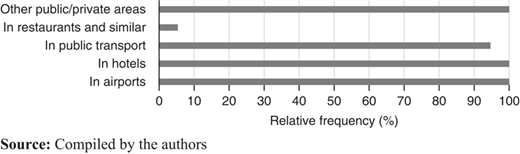
Regarding the importance of internet access/availability in Porto, 88 percent of tourists surveyed consider it important and only 12 percent do not consider it important. According to Figure 3, almost all the respondents who considered internet access/availability in the Porto destination important (374), 100 percent indicated internet availability in airports, hotels or other public/private areas, 95 percent indicated internet availability in public transport, and 5 percent indicated internet availability in restaurants and similar.
Continuing with the previous questions, 88 percent of users access the internet from mobile/computer devices. We can also conclude that 84 percent of respondents use internet applications and/or information related to their tourism experience in Porto before the visit and 88 percent use the applications and/or information available on the internet during the visit.
According to the frequency Table IV, regarding the evaluation of the impact of some applications and/or information available on the internet during the tourism experience in Porto, it is necessary to highlight the high scores obtained – very important, with a frecuency of 374, by the typologies: tourist support/tourist guides and Wi-Fi access (free, paid), followed by the items cultural agenda (museums, exhibitions, cinemas, concerts, shows, prices, ticket reservation), and weather forecast.
Evaluation of the impact of the following types of applications and/or information available on the internet during their tourism experience in Porto
| 1 (%) | 2 (%) | 3 (%) | 4 (%) | ||
|---|---|---|---|---|---|
| Tourist support/tourist guides (POI’s, maps, itineraries, circuits, etc.) | 11.6 | 88.4 | 3.65 | ||
| Wi-Fi access (free, paid) | 11.6 | 88.4 | 3.65 | ||
| Cultural agenda (museums, exhibitions, cinemas, concerts, shows, prices, ticket reservation) | 11.6 | 4.7 | 83.7 | 3.61 | |
| Weather forecast | 11.6 | 4.7 | 83.7 | 3.56 | |
| Accommodation, catering and similar (prices, availability, contacts, reservations, etc.) | 11.6 | 83.7 | 4.7 | 2.82 | |
| Transport management (air, land, schedules, check-in, prices, reservations, etc.) | 11.6 | 83.7 | 4.7 | 2.82 | |
| Car rental (companies, prices, deals, reservations, etc.) | 11.6 | 83.7 | 4.7 | 2.82 | |
| Travel agencies (programs, promotions, package tours, etc.) | 11.6 | 83.7 | 4.7 | 1.93 | |
| Language translators | 11.6 | 83.7 | 4.7 | 1.93 | |
| Webcams (locations, city points, car traffic, beaches, tourist sites) | 11.6 | 83.7 | 4.7 | 1.93 |
Note: The values shown refer to the measurement scale where 1 – not used; 2 – little importance; 3 – important; 4 – very important
Source: Compiled by the authors
On average, the importance is higher for “Tourist support/tourist guides,” “Wi-Fi access,” “cultural agenda” and “weather forecast,” followed by “accommodation, catering and similar,” “transport management,” and “car rental,” all with an average value higher than the midpoint of the measurement scale. Regarding the questions: “Is the information available on the internet about the Porto destination a decisive factor to come?” and “Is the information available on the internet about the Porto destination a decisive factor to return?” 84 percent of the tourists surveyed answered yes, while 16 percent reported that there is no influence on the visit and intention to return. This distribution of the evaluation of the applications and/or information available on the internet may indicate, for example, an increase in the level of independence both in the process of organizing the trip and in the course of the experience in the destination, which makes the Porto Management body in the area of tourism responsible, and challenges it to update interactive digital platforms and instruments, providing an integral system of information organization and destination management, establishing permanent relationships of interactivity among all the role-players in the sector in the perspective of tourism supply and demand.
There is a noticeable positive influence of the information available on the behavioral intention related to the destination, as highlighted in the studies by Jeng and Fesenmaier (2002), Bieger and Laesser (2004) or Gursoy and McCleary (2004). These studies show how the information available has a significant impact on different aspects of the decision-making process, particularly when deciding which destination to visit. Recent studies suggest that this demand in relation to a specific destination is carried out mostly during the stay and not before the visit, where the search aims mainly to identify potential destinations to visit (Xian et al., 2015) (Table V).
Relationship between “Was the information available on the internet about the Porto destination a decisive factor to come?” and “Do you think it is important to have access to the internet at the Porto destination”
| Do you think it is important to have access to the internet at the Porto destination? | |||
|---|---|---|---|
| Was the information available on the internet about the Porto destination a decisive factor to come? | No | Yes | |
| No | n | 49 | 20 |
| % of the group | 71.0 | 29.0 | |
| Yes | n | 0 | 354 |
| % of the group | 0.0 | 100.0 | |
Source: Compiled by the authors
The percentage that considers internet access/availability in the Porto destination important, and that accesses the internet from mobile devices/computers is higher (100 percent) for those who consider that the information available on the internet about the Porto destination was a decisive factor to come, being the observed differences statistically significant, according to the χ2 test (; p<0.001), based on the information provided in Tables VI and VII.
Relationship between “Was the information available on the internet about the Porto destination a decisive factor to come?” and “Do you access the internet from mobile/computer devices?”
| 14. Do you access the internet from mobile/computer devices? | |||
|---|---|---|---|
| 18. Was the information available on the internet about the Porto destination a decisive factor to come? | No | Yes | |
| No | n | 49 | 20 |
| % of group | 71.0 | 29.0 | |
| Yes | n | 0 | 354 |
| % of group | 0.0 | 100.0 | |
Source: Compiled by the authors
Relationship between “Is the information available on the internet about the Porto destination a decisive factor to return?” and “Do you think the access/availability of the internet at the Porto destination is important?”
| Do you think the access/availability of the internet at the Porto destination is important? | |||
|---|---|---|---|
| Is the information available on the internet about the Porto destination a decisive factor to return? | No | Yes | |
| No | n | 49 | 20 |
| % of group | 71.0 | 29.0 | |
| Yes | n | 0 | 354 |
| % of group | 0.0 | 100.0 | |
Source: Compiled by the authors
The percentage that also considers internet access/availability at the Porto destination to be important, and that accesses the internet from mobile devices/computers, is higher (100 percent) for those who consider that the information available on the internet about the Porto destination will be a decisive factor to return, being the differences observed statistically significant, according to the χ2 test (; p<0.001), based on Tables VII and VIII.
Relationship between “Is the information available on the internet about the Porto destination a decisive factor to return? ” and “Do you access the internet from mobile/computer devices?”
| Do you access the internet from mobile/computer devices? | |||
|---|---|---|---|
| Is the information available on the internet about the Porto destination a decisive factor to return? | No | Yes | |
| No | n | 49 | 20 |
| % of group | 71.0 | 29.0 | |
| Yes | n | 0 | 354 |
| % of group | 0.0 | 100.0 | |
Source: Compiled by the authors
First, the Pearson R correlation coefficient was used to observe the relationship between the variables collected in the global index “Impact of the applications and/or information available on the internet during the tourism experience in Porto,” the global index “Overall satisfaction regarding the destination,” all the items in “Evaluate the impact of the following types of applications and/or information available on the internet during your Porto tourism experience,” and all the items of “Evaluate your overall satisfaction regarding the destination.” Thus, it is particularly important to note the very strong correlations between those who intend to visit the destination in the next three years and the applications/information available on “Tourist support/tourist guides,” “Wi-Fi access,” between those who intend to recommend the destination and who consulted the cultural agenda (Table IX).
Pearson correlation (R): relationship between “Evaluate the impact of the following types of applications and/or information available on the internet during your tourism experience in Porto” and “Evaluate your overall satisfaction regarding the destination”
| Overall satisfaction regarding the destination | Build positive opinions regarding the destination | Recommend the destination | Encourage friends and family to visit the destination | Visit the destination in the next 3 years | Consider Porto a cultural destination in the following trips | ||
|---|---|---|---|---|---|---|---|
| Impact of applications and/or information during … | R | 0.901** | 0.763** | 0.913** | 0.913** | 0.996** | 0.867** |
| Tourist support/tourist guides | R | 0.937** | 0.820** | 0.947** | 0.947** | 1.000** | 0.910** |
| Travel agencies | R | 0.609** | 0.390** | 0.631** | 0.631** | 0.847** | 0.550** |
| Accommodation, catering and similar | R | 0.786** | 0.605** | 0.803** | 0.803** | 0.952** | 0.738** |
| Language Translators | R | 0.609** | 0.390** | 0.631** | 0.631** | 0.847** | 0.550** |
| Webcams | R | 0.609** | 0.390** | 0.631** | 0.631** | 0.847** | 0.550** |
| Transport management | R | 0.786** | 0.605** | 0.803** | 0.803** | 0.952** | 0.738** |
| Car rental | R | 0.786** | 0.605** | 0.803** | 0.803** | 0.952** | 0.738** |
| Cultural agenda | R | 0.991** | 0.925** | 0.994** | 0.994** | 0.976** | 0.978** |
| Weather forecast | R | 0.997** | 0.984** | 0.995** | 0.995** | 0.910** | 1.000** |
| Wi-Fi access | R | 0.937** | 0.820** | 0.947** | 0.947** | 1.000** | 0.910** |
Notes: n=423. **Significant at 0.01 level
Source: Compiled by the authors
Then, to test H2 and H4 we used a multiple linear regression models. These models have two or more independent variables, which will be used to estimate the values for the dependent variable (Maroco, 2011, pp. 671-689; Neter et al., 2004). In order to determine the regression parameter estimates, the least squares method is used. In addition, for the inference of each of the parameters, it is necessary to determine if the model is globally significant, through a test of significance of the coefficient of determination (F-test). This test, however, does not indicate whether all the variables are significant, or which ones are more important, so it becomes necessary to apply the t-test to determine the significance of each variable, in particular. The determination coefficient (R2) appears as a measure of the effect of the explanatory variables on the reduction of the variation of Yi, that is, on the reduction of the uncertainty associated with the prediction of Yi. In other words, r2 measures the percentage or proportion of the total variation of Yi explained by the model.
The Levene test for the homogeneity of the residual variances, in two randomly constituted groups, allows to conclude that the homogeneity of variances (Levene1.421=2.993, p=0.086) is verified. The analysis of the assumption that the residues should follow a normal distribution, studied with Kolmogorov-Smirnov with Lilliefors correction, allows to conclude that the residues do not follow a normal distribution (KS423=0.449, p<0.001). Since there is only one significant independent variable for the model, it is not justified to analyze the assumptions of the lack of self-correlation between independent variables and the absence of multicollinearity.
In this case, the dependent variable is the overall satisfaction regarding the destination, while the independent variable measures the impact of applications and/or information available on the internet during the tourism experience in Porto. The results collected in Table X show that the increase of one unit in the importance scale of “17. Impact of the applications and/or information available on the internet during the tourism experience in Porto” causes a mean increase in the measurement scale of the dependent variable “23. Overall satisfaction regarding the destination” of b=0.966 (p<0.001). The coefficient of determination indicates that 81.2 percent of the variation occurring in the dependent variable “23. Overall satisfaction regarding the destination” is explained by “17. Impact of the applications and/or information available on the internet during the tourism experience in Porto.” The F-test (F1.421=1813.0, p<0.001) of the global significance of the model is validated. Therefore, H2 is verified.
Coefficients of the variables in the model and level of significance
| Dependent variable: overall satisfaction regarding the destination | bi | s(bi) | t | p |
|---|---|---|---|---|
| (Constant) | 0.916 | 0.067 | 13.686 | 0.000** |
| 17. Impact of the applications and/or information available on the internet during the tourism experience in Porto | 0.966 | 0.023 | 42.580 | 0.000** |
Notes: bi and s(bi) – estimates of the coefficient and its standard deviation for the variable i; t – Student t statistical test; p – test value (**p<0.01)
In the case of the fourth hypothesis, the dependent variable is satisfaction level with the attributes of the destination, while the independent variable is constituted by the impact of the applications and/or information available on the internet during the tourism experience in Porto.
In Table XI, it can be seen how the increase of one unit in the importance scale of “17. Impact of the applications and/or information available on the internet during the tourism experience in Porto” causes a mean increase in the measurement scale of the dependent variable “22. Level of satisfaction regarding the attributes of the destination” of b=0.823 (p<0.001). The coefficient of determination indicates that 55.5 percent of the variation that occurs in the dependent variable “22. Level of satisfaction regarding the attributes of the destination” is explained by “17. Impact of the applications and/or information available on the internet during the tourism experience in Porto.” The F-test (F1.421=525.3, p<0.001) of the global significance of the model is validated. Therefore, H4 is verified.
Coefficients of the variables in the model and level of significance
| Dependent variable: level of satisfaction regarding the attributes of the destination | bi | s(bi) | t | p |
|---|---|---|---|---|
| (Constant) | 2.084 | 0.106 | 19.677 | 0.000** |
| 17. Impact of the applications and/or information available on the internet during the tourism experience in Porto | 0.823 | 0.036 | 22.919 | 0.000** |
Notes: bi and s(bi) – estimates of the coefficient and its standard deviation for the variable i; t – Student t statistical test; p – test value (**p<0.01)
An evaluation of the particular effects between satisfaction and the different attributes of the destination can be observed through Pearson’s correlation coefficient analysis. Thus, it was proven that in relation to the “Global Evaluation,” the strong correlation with the items “tourist support/tourist guides,” “cultural agenda”, “weather forecast,” and “Wi-Fi access” must be highlighted, which allows us to conclude that the level of satisfaction, both in relation to the tourist destination and the tourism experience, is related to the diversity of the information provided in the destination, on the one hand, and with access to information, updated in real time and provided by the managers, on the other, which should be associated with permanent interactivity with visitors/tourists (Table XII).
The use of the applications and/or information available on the internet is important during the tourism experience in Porto.
Pearson’s correlation (R): “Evaluation of the impact of the following types of applications and/or information available on the internet during your Porto tourism experience” and “ Evaluate your satisfaction level with the following destination attributes”
| Satisfaction level regarding the attributes of the destination | Climate features | Reception hospitality | Gastronomy and wines | Cultural heritage | Entertainment | Safety | Infrastructure and transport | Cost of living | Global evaluation | ||
|---|---|---|---|---|---|---|---|---|---|---|---|
| Impact of applications and/or information during … | R | 0.745** | 0.763** | 0.763** | 0.763** | 0.763** | 0.763** | 0.480** | 0.763** | 0.763** | 0.763** |
| Tourist support/tour guides | R | 0.804** | 0.820** | 0.820** | 0.820** | 0.820** | 0.820** | 0.560** | 0.820** | 0.820** | 0.820** |
| Travel agencies | R | 0.365** | 0.390** | 0.390** | 0.390** | 0.390** | 0.390** | 0.034 | 0.390** | 0.390** | 0.390** |
| Accommodation, catering and similar | R | 0.583** | 0.605** | 0.605** | 0.605** | 0.605** | 0.605** | 0.279** | 0.605** | 0.605** | 0.605** |
| Language translators | R | 0.365** | 0.390** | 0.390** | 0.390** | 0.390** | 0.390** | 0.034 | 0.390** | 0.390** | 0.390** |
| Webcams | R | 0.365** | 0.390** | 0.390** | 0.390** | 0.390** | 0.390** | 0.034 | 0.390** | 0.390** | 0.390** |
| Transportation management | R | 0.583** | 0.605** | 0.605** | 0.605** | 0.605** | 0.605** | 0.279** | 0.605** | 0.605** | 0.605** |
| Car Rental | R | 0.583** | 0.605** | 0.605** | 0.605** | 0.605** | 0.605** | 0.279** | 0.605** | 0.605** | 0.605** |
| Cultural agenda | R | 0.915** | 0.925** | 0.925** | 0.925** | 0.925** | 0.925** | 0.728** | 0.925** | 0.925** | 0.925** |
| Weather forecast | R | 0.978** | 0.984** | 0.984** | 0.984** | 0.984** | 0.984** | 0.854** | 0.984** | 0.984** | 0.984** |
| Wi-Fi access | R | 0.804** | 0.820** | 0.820** | 0.820** | 0.820** | 0.820** | 0.560** | 0.820** | 0.820** | 0.820** |
Notes: n=423. ***Significant at 0.01 levels
Source: Compiled by the authors
The importance is greater for: tourism support/tourist guides, cultural agenda, weather forecast, and Wi-Fi access, followed by accommodation, catering and similar, transport management, and car rental, all with a greater importance than the midpoint of the measurement scale, the importance being lower for travel agencies, language translators and webcams, with the importance below the midpoint of the measurement scale. The importance of the global index can also be considered to be higher than the midpoint of the measurement scale (Figure 4).
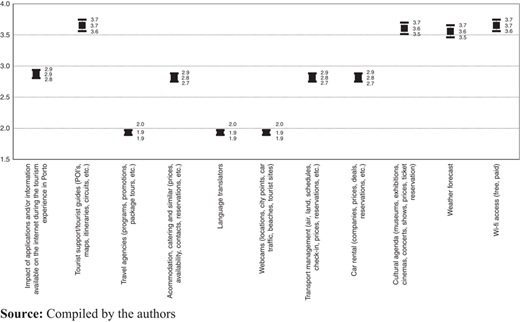
Evaluation of the impact of the types of applications and/or information available on the internet during the tourism experience in Porto
Evaluation of the impact of the types of applications and/or information available on the internet during the tourism experience in Porto
Conclusion
In an increasingly competitive tourism industry, destinations must continuously adapt, develop, and manage their offer to ensure a quality experience for their visitors. On the other hand, technology is changing the tourism experience substantially. The idea of using technology to enhance the experience is not new. Innovation lies here, in an attempt to understand its mechanisms from an empirical perspective. For this reason, the objective of this paper is to better understand the relationship between the need for information, the information tools, and the tourism experience in the destination. From a theoretical perspective, the main contribution is to deepen the knowledge of the effects of the use of technology on tourists’ behavior and experiences, in addition to the planning stages of the trip and the search for information in the context of a smart tourism destination.
In this sense, the results achieved highlight the importance of internet access in the destination, especially in places such as airports and hotels, since tourists primarily use mobile devices and computers while traveling. In studies such as those by MacKay and Vogt (2012), this relationship was not significant for the destination, although a relationship was established between internet access and the reason for the trip. In our case, the greatest influence was identified when planning the trip as a choice criterion and during the stay in the destination, as a determinant of satisfaction. In both cases, a relationship was found between internet access and the intention to return, according to the results by Jeng and Fesenmaier (2002) or Gursoy and McCleary (2004).
On the other hand, current information technologies in the destination (internet, smartphones or other mobile devices and applications) were very important for explaining the tourism experience. These results are in line with the hypotheses proposed by Buonincontri and Micera (2016), where they argue that such importance lies in the need felt by current tourists to participate in the creation of their own experience. Other authors base this importance on the potential of mobile devices and their applications when accessing information, allowing access to it anywhere and at any time (Rasinger et al., 2007). Its impact on satisfaction was lower for the tourists surveyed. This implies that regarding the destination we are not transforming all the positive aspects of the experience into satisfaction elements.
From a management perspective, the results obtained result in a set of implications that can be useful for smart destinations. The destination should have functionality and performance, in order to increase the satisfaction of the tourism experience (Goeldner and Ritchie, 2003), which involves, among other aspects, the existence of personalized online tourist services (Barta et al., 2009). Those responsible for tourism management are responsible for increasing the development of smart destinations, developing destinations that are based on innovation, technology, accessibility, and sustainability. Knowledge and the efficient use of resources should form the basis of the definition of a destination strategy based on different pillars, such as competition (comparative, competitive advantage and positioning), the business model (sustainability and orientation), the consumer (satisfaction, improvement and trends), technology (provision and distribution), and supply (innovation, differentiation, qualification, and certification).
The permanent and attentive relationship between the destination, the tourists/visitors and the agents of the sector constitutes a determining factor for the evaluation of the experience, for a greater level of satisfaction with the destination, that is, the adoption of behavioral attitudes, which favor it. The information flows resulting from the tourist activity should be used for the management of the destination in order to improve the efficiency of the offer, particularly by personalizing it for the user. In this sense, and considering the form of organization of the visitor/tourist’s trip in Porto, its evaluation regarding the use of the applications available and their crucial role in the access to information and movement in the destination, Porto has considered the analysis and development of technology integration in tourism experiences: a strategic vision for providing interactive information updated in real time in the areas of greater demand and circulation of tourists/visitors, which ensures information, but above all interaction with the offer in the destination. This evaluation leads to the results obtained in our research.
At the same time, this paper shows some limitations that must be considered. On the one hand, those related to the sampling technique used and those that condition the generalization of the results to the entire population. On the other hand, the questionnaire was applied in a single smart destination, which could lead to effects resulting from the case used in the research. It is clear that in this case, the results are correlated by the strategy followed by the destination regarding applications available and the level of implementation of the different technology solutions. Thus, the extrapolation of the results achieved in this study should take this aspect into account, previously identifying, in the case of any other destination, its performance level as a smart destination. For this reason, we consider it interesting to deepen the knowledge of the effects of technologies on the tourism experience in other smart destinations. If it had been possible to identify in general terms, the influence of each of the current technological applications or solutions of a destination on the tourism experience, the generalization of the results would be feasible. It is also interesting to understand better the mechanisms that connect the different elements of the tourism experience with satisfaction in these types of destinations. In this last case, it might be useful to modify the moment to carry out the questionnaire survey and to collect information about the trip after the tourist returns.

