


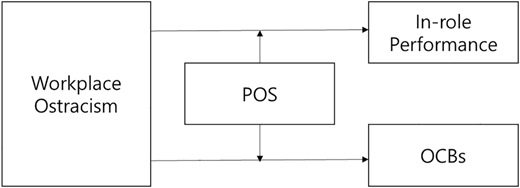
Based on the conservation of resource theory, this study developed and tested the relationship between workplace ostracism and job performance. And it assumes that the direct link between workplace ostracism and supervisor-rated in-role performance/organizational citizenship behavior is moderated by perceived organizational support.
For this, this study used a survey method and multiple regression analyses with multisource data from 256 Korean employees and their supervisors.
The results suggest the following. First, workplace ostracism was negatively associated with supervisor-rated in-role performance and organizational citizenship behaviors. Second, there was a stronger negative relationship between workplace ostracism and supervisor-rated in-role performance/organizational citizenship behaviors for employees with low as opposed to those with high levels of perceived organizational support.
This study is the first one to examine the moderating effect of perceived organizational support on the relationship between workplace ostracism and supervisor-rated in-role performance/organizational citizenship behavior.
以資源守恆論為基礎,本研究發展並測試了工作場所排斥與工作表現的關係。本研究假設感知組織支持會緩和工作場所排斥與主管評價的角色中的表現/組織公民行為之間的直接聯繫。
就此而言,本研究採用了調查方法及多元回歸分析法。多源數據取自256名韓國人僱員及其主管。
研究結果有以下的顯示:第一、工作場所排斥與主管評價的角色中的表現及組織公民行為有負相關的關係。第二、就工作場所排斥與主管評價的角色中的表現/組織公民行為的反向關連的關係而言,感知組織支持水平低的僱員,相對於水平高的僱員,呈現更強的負相關。
這是首個研究、去探討感知組識支持在工作場所排斥與主管評價的角色中的表現/組織公民行為間之關係上所起的調節作用。﹞
1. Introduction
Workplace ostracism, which is the extent to which people perceived as workers being ignored or eliminated by other employees at work, is a widespread workplace phenomenon, (Ferris et al., 2008). Workplace ostracism decreases the opportunity for social interaction, which is essential for people to meet their psychological needs. Indeed, workplace ostracism potentially affects employees' physical health (Heaphy and Dutton, 2008). It is especially true today, as teamwork has dramatically increased, suggesting the need for more social interaction and communication with colleagues (Sundstrom et al., 2000). According to a recent study, workplace ostracism is a very influential variable in explaining confined belonging and job contribution (O'Reilly and Robinson, 2009). Despite the prevalence and importance of workplace ostracism, surprisingly little research has examined the impact of this phenomenon (Ferris et al., 2008). It is, therefore, essential and timely to understand the effect of employee retirement on employee outcomes. Ostracism is an interpersonal stressor that can cause psychological difficulties (Williams, 1997, 2001). Studies have shown that the pain experienced in the workplace is closely related to undesirable outcomes such as life distress, turnover intention and poor physical health (Grandey and Cropanzano, 1999). As a result, it is crucial to study the relationship between workplace ostracism and psychological pain in the workplace.
Moreover, it is also essential to understand how to cope with ostracism because effective coping strategies can alleviate the relationship between ostracism and its negative consequences (Williams, 2007). The conservation of resources (COR) theory assumes that people are trying to consume resources and maintain and protect the remaining resources in stressful situations (Hobfoll, 1989). According to this theoretical perspective, I conceptualize workplace ostracism as a stress factor that exhausts the worker's resources (e.g. self-esteem, time, energy) and makes the resources to meet labor demand insufficient. By examining the impact on employee attitudes, I extend the previous study showing the effect of job displacement on job outcomes. Also, I suggest that perceived organizational support (POS) is a vital variable in coping with workplace betrayal. The purpose of this study is, therefore, to investigate the relationship between workplace ostracism and employee attitudes by focusing on the joint moderating effect of POS.
This study makes two significant contributions to workplace ostracism, employee attitudes and POS-related literature. First, I extend the workplace ostracism and employee attitude literature by theoretically and empirically testing the ostracism model (Williams, 1997, 2001) to link workplace ostracism and job performance in a field setting. Second, I review the joint moderating role of coping strategies, providing boundary conditions for the relationship between workplace ostracism and job performance. I present the research model of this study in Figure 1.
2. Theoretical background and hypothesis development
Williams (1997; 2001) developed the most popular model for predicting the consequences of ostracism. This model is based on the belief that ostriches can be a threat to social resources and, consequently, stressors. Recent studies have shown that social ostracism leads to a series of psychological resistance reactions, including anger (Chow et al., 2008) and negative mood (Gonsalkorale and Williams, 2007). In particular, organizational studies have shown that overtraining in the workplace is associated with high levels of anxiety, depression, job-seeking behavior and turnover intentions and low levels of satisfaction and psychological health (Ferris et al., 2008; Hitlan et al., 2006).
Interestingly, experimental studies provide evidence that the origin of ostracism does not significantly mitigate the harmful effects of ostriches. One study showed that people who were rejected by both inside and outside groups, manipulated by two groups of computer users (PC and Macintosh users), experienced a similar level of belonging loss (Williams et al., 2000). More research has revealed that rejection by contemptuous external group members is no more than being ostracized by rival out-group and in-group members (Gonsalkorale and Williams, 2007). Such distress includes job tension, emotional exhaustion and depressed mood at work. They have been linked to an outstanding job, family and health outcomes such as job satisfaction, work–family conflict (Grandey et al., 2005), organizational citizenship behavior, workplace deviance (Lee and Allen, 2002), job performance (Cropanzano et al., 2003), intention to leave (Harvey et al., 2007) and high blood pressure (Schaubroeck and Merritt, 1997).
As interpersonal stressors, ostracism threatens the social resources of goals, which are assets that can be pulled to solve problems or cope with challenging events as needed (Greenhaus and Powell, 2006). People try to preserve, protect and establish resources in light of their limited resources (Hobfoll, 1989, 2001). Therefore, they see it as a threat when they see the potential or actual loss of these valuable resources. Indeed, resource loss events are responsible for most cases of depression (Hobfoll, 1989). Ostracism presents a significant challenge to reduce the resources an individual can have. It, on the one hand, requires individuals to mobilize resources to counter foreignism, while they are less likely to recharge their resources to others and cause resources to deplete. Because resources can help an individual deal with everyday tasks, people who lack resources can be stressed and tired.
Although both males and females may engage in ostracism, females’ motivation is often retaliatory (e.g. self-defense), while male's violent behaviors tend to be control-motivated (e.g. restoration of power and dominance; Kimmel, 2002). For instance, the Philippine National Demographic and Health Survey reported that violence initiated by a married female is more common among those who have been battered by their spouse (Philippine Statistics Authority and ICF International, 2014). Despite the apparent gender symmetry in the prevalence of ostracism, females still suffer far more harmful effects. First, females as opposed to males experience more significant psychological distress and risk for posttraumatic stress disorder from partner-initiated aggression (Archer, 2000). Furthermore, gender differences in body size and physical strength make females, as opposed to males, more susceptible to severe injuries requiring sustained medical care and attention. Second, throughout the lifetime, a female is more likely to report repeated and multiple forms of abuse and suffer more severe injuries as a result (Sacket and Saunders, 1999). Thus, females have become the priority in violence prevention and control as they suffer more frequent and severe injuries than male (Saunders, 2002). Finally, females in many societies confront more career barriers and nonwork demands (e.g. glass ceiling effects and conflicting demands of multiple role obligations; Hoobler et al., 2009) than males. Therefore, the results of ostracism on female employees may be particularly damaging. For these reasons, I focus on the work-related consequences of ostracism among employed females.
I suggest that resource loss due to experience with workplace ostracism can lead to workplaces that directly affect job performance. Workplace ostracism also results in a more indirect “loss spiral,” leading to subsequent losses in other areas (Hobfoll, 2001; Ten Brummelhuis and Bakker, 2012) by depriving resources in one area. For example, workplace ostracism can lead to depletion of cognitive and physical energy as the negative perceptions and emotions of the family domain persist in the workplace. Employees must consume psychological resources to contain these negative thoughts and feelings if they do not want to undermine performance. Sadly, psychological interference with excretion in the workplace has been shown to reduce mental concentration, which is not always easy, as it can be detrimental to work productivity. I propose the following.
Workplace ostracism of female employees is negatively related to their in-role performance
Loss of resources experienced at home can reduce performance aspects other than the employee's prescribed job role. These aspects include organizational citizenship behaviors (OCBs) or voluntary and altruistic actions performed at work (Horton and Johnson, 1993). It is reasonable to assume that employees whose cognitive and emotional resources are depleted by workplace rejection are more likely to use available resources to meet their role requirements. As a result, the number of resources available to perform additional role actions can be significantly reduced. This possibility is consistent with the conservation principles of the COR theory, and individuals are motivated to preserve and reclaim lost resources fundamentally, thereby avoiding actions that could result in the loss of more resources. Also, even if women have excess resources, women can devote their lives to activities that help them deal with trauma from workplace excretion. For example, an employee who has experienced a work-out without having to spend time volunteering with an organizational committee instead of helping a coworker can decide to spend time and effort on remediation or take legal action against the partner. Sacrificing OCBs to deal with workplace ostracism-related concerns is economically rational because the failure to exhibit such behaviors is generally not punished by organizations (Podsakoff et al., 2000). I propose the following.
Workplace ostracism of female employees is negatively related to their OCBs
The COR theory predicts that people will invest or draw in other resources that they own or have access to in their environment to reduce the net loss of their resources. In an elaborate description of the COR theory, Ten Brummelhuis and Bakker (2012) suggested that in addition to their pool of resources, the environment in which people live can serve as a resource for buffering. One workspace resource that appears to buffer stressors constraints is recognized as POS (organizational support). According to the organization support theory (OST), employees must formulate support expectations based on how much an organization contributes and how well they are concerned about employee well-being (Eisenberger et al., 1986).
According to the OST, I expect POS to cushion the negative relationship between job displacement and job outcomes for several reasons. First, POS provides access to the relevant resources of the workplace, which can help abused women supplement or stockpile resources. For example, support in the form of organizational policies such as personal leave and flexible work placement can provide opportunities for women to get out of work and get out of the workplace. (Allen, 2001). Supportive work environments can also help reduce work demands that can help peers to take over the work assigned to them and preserve the remaining resources (Ray and Miller, 1994). Second, a supportive work environment signals that the employee is a valued member of the organization, which can lead to resource accumulation through its positive impact on one's sense of self-worth and its satisfaction of the fundamental human need for belongingness (Rhoades and Eisenberger, 2002). Feeling of self-esteem and belonging are both essential social and emotional resources so that events or experiences that supplement or increase them can potentially respond to resource demands coping with job exclusion. Based on this theoretical argument, I provide the following predictions.
The negative relationship between workplace ostracism of female employees and their in-role performance is moderated by their POS, such that the negative relation is stronger for low as opposed to high levels of their POS.
The negative relationship between workplace ostracism of female employees and their OCB is moderated by their POS, such that the negative relation is stronger for low as opposed to high levels of their POS.
3. Methodology
3.1 Data collection and sample
The objective of the study is to identify behavioral factors related to workplace ostracism by an empirical test. The elements of organizational behaviors can be identified by measuring female employees' perceptions in the workplace situations. I adopted an online survey method using convenience sampling for data collection as it is instrumental in collecting data from a large number of individuals in a relatively short time and at a better cost.
I conducted a survey of 500 employees who worked full time in various occupations in eight organizations, including manufacturing (n = 3), public agency (n = 2) and wholesale and retail (n = 3). I got the email addresses of the employees through the human resources management department. All participants received an email explaining the purpose of the survey, emphasizing voluntary participation, and asking for an online survey, along with an email in confidence. Participants were also given a simple questionnaire to help their direct supervisor complete the questionnaire, including questions about the participants' work behavior.
To match the employee survey with the supervisor survey, participants created a unique code identifier to display the first two letters of the mother's name, the last two letters of the father's name and the year of birth. All surveys were returned directly to the research team via email. Upon completion of the survey, the employee participant received a coffee voucher as a token to participate in the study. Of the initial pool of participants surveyed, 280 individuals returned completed surveys, yielding a response rate of 56%. Also, 248 supervisor questionnaires were returned, representing a response rate of 49.6%. After the deletion of surveys with (1) no code identifiers, (2) an excessive number of missing cases and (3) without a matched supervisor questionnaire, I was left with a final sample of 226 matched supervisor–subordinate dyads. The characteristics of respondents are reported in Table 1 (e.g. age, the level of their education, the marital status).
Sample profile
| Variables | Items | Percentages |
|---|---|---|
| Age | 20s | 24.6 |
| 30s | 27.4 | |
| 40s | 22.4 | |
| 50s | 25.6 | |
| Tenure | Less than 5 years | 53.3 |
| 6–9 years | 23.5 | |
| 10–14 years | 12.3 | |
| 15–19 years | 4.2 | |
| More than 20 years | 6.7 | |
| Level of their education | Middle school | 0.7 |
| High school | 15.8 | |
| Community college | 20.8 | |
| Undergraduate school | 52.9 | |
| Graduate school | 9.8 | |
| Position | Staff | 44.6 |
| Assistant manager | 18.2 | |
| Manager | 15.4 | |
| Senior manager | 13.3 | |
| Director | 6.3 | |
| Etc | 2.1 | |
| Marital status | Married | 54.7 |
| Single | 45.3 |
3.2 Measurement
Workplace ostracism
A ten-item scale developed by Ferris et al. (2008) was used to measure workplace ostracism. Response options ranged from 1 (“strongly disagree”) to 5 (“strongly agree”). Sample items included “Others ignored me at work,” “Others left the area when I entered,” and “My greetings have gone unanswered at work.” Cronbach's alpha for this measure was 0.92.
In-role performance
Supervisors were asked to rate the in-role performance of their employees using four items derived from Williams and Anderson (1991). Example items include, “This employee meets formal requirements of her job” and “This employee adequately completes assigned duties.” In this sample, coefficient alpha was 0.93.
Organizational citizenship behaviors
Supervisors were asked to rate the extent to which their employees engage in behaviors which are beneficial to both their organization and colleagues. I used a 20-item scale developed by Podsakoff et al. (2000). Example items include “This employee helps others who have heavy workloads” and “This employee willingly gives her time to help others who have work-related problems.” In this sample, Cronbach's alpha was 0.91.
Perceived organizational support
POS was measured using eight items from the scale developed by Eisenberger et al. (2001). Sample items from the scale include “My organization cares for my well-being” and “Help is available from my organization when I have a problem.” In this sample, Cronbach's alpha was 0.96.
4. Results
4.1 Verification of reliability and validity
The validity of variables is verified through the principal components method and factor analysis with the varimax method. The criterion for determining the number of factors is defined as a 1.0 Eigenvalue. This study applied the elements for analysis only if the factor loading was more significant than 0.5 (factor loading represents the correlation scale between a factor and other variables). The reliability of variables is judged by internal consistency, as assessed by Cronbach's alpha. This study used surveys and regarded each as one measure only if their Cronbach's alpha values were 0.7 or higher.
4.2 Relationship between variables
Table 2 summarizes the Pearson correlation test results between variables and reports the degree of multipropriety between independent variables. The minimum tolerance of 0.720 and the maximum variation coefficient of 1.388 indicate that the statistical significance of the data analysis has not been compromised by multiconnectivity.
4.3 Hypothesis test
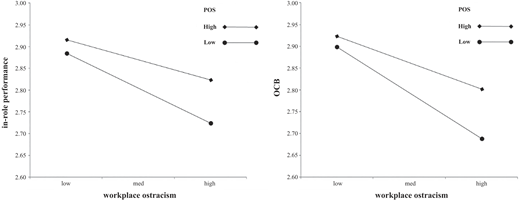
I used three-step hierarchical multiple regression analyses to test the hypotheses. In the first step, demographic variables were controlled. Workplace ostracism of female employees was entered in the second step. In the final step, the multiplicative interaction terms between workplace ostracism of female employees and their POS were introduced to test the current hypothesis about the moderating effect directly. Regarding in-role performance, results are presented in Table 3. Hierarchical regression analysis showed that workplace ostracism of female employees (β = −0.031, p < 0.01) was negatively related to their in-role performance, meaning that the more workplace ostracism female employees perceived, they were likely to show less in-role performance. Therefore, H1 was supported. Table 3 also indicates that POS of female employees significantly moderated the relationships between their workplace ostracism and in-role performance in the predicted direction (β = 0.054, p < 0.05). This result demonstrated that the negative correlation between workplace ostracism of female employees and their in-role performance was stronger for female employees with low rather than high POS (see Figure 1). Therefore, H3 was supported.
Analysis 1
| In-role performance | |||
|---|---|---|---|
| Model 1 | Model 2 | Model 3 | |
| Age | 0.012 | 0.024 | 0.019 |
| Educational level | –0.052 | –0.068 | –0.071 |
| Tenure | –0.119 | –0.120 | –0.101 |
| Workplace ostracism | –0.031∗∗ | –0.024∗∗ | |
| POS | 0.011∗∗ | ||
| Workplace ostracism *POS | 0.054∗ | ||
| Adj. R2 | 0.005 | 0.119 | 0.125 |
| F | 1.227 | 10.075∗∗ | 14.162∗∗ |
Note(s): ∗p < 0.05, ∗∗p < 0.01
Regarding their OCB, results are presented in Table 4. Hierarchical regression analysis showed that workplace ostracism of female employees (β = −0.091, p < 0.01) was negatively related to their OCB, meaning that the more workplace ostracism female employees perceived, they were likely to show less their OCB. Therefore, H2 was supported. Table 4 also indicates that POS of female employees significantly moderated the relationships between their workplace ostracism and OCB in the predicted direction (β = −0.026, p < 0.05). This result demonstrated that the negative relation between workplace ostracism of female employees and their OCB was stronger for their employees with low rather than high POS (see Figure 2). Therefore, H4 was supported.
Analysis 2
| OCB | |||
|---|---|---|---|
| Model 1 | Model 2 | Model 3 | |
| Age | 0.082 | 0.101 | 0.099 |
| Educational level | 0.017∗ | 0.028∗ | 0.022∗ |
| Tenure | 0.033 | 0.042 | 0.065 |
| Workplace ostracism | –0.091∗∗ | –0.087∗∗ | |
| POS | 0.045∗∗ | ||
| Workplace ostracism *POS | 0.026∗ | ||
| Adj. R2 | 0.006 | 0.129 | 0.145 |
| F | 1.338 | 12.881∗∗ | 16.201∗∗ |
Note(s): ∗p < 0.05, ∗∗p < 0.01
5. Conclusion
5.1 Summary of research results
Prior work has established the negative relationship between workplace ostracism and work outcomes (Grandey et al., 2005; Lee and Allen, 2002; Cropanzano et al., 2003; Harvey et al., 2007). However, this study not only focuses on the influence of workplace ostracism and both supervisor-rated in-role performance and OCB but also investigates how POS moderates the relationship between workplace ostracism and work outcomes, including in-role performance and OCB. The results of the present study are summarized as follows. First, the more employees suffer from workplace ostracism, they are less likely to show in-role performance and OCB. Second, POS decreases the influence of workplace ostracism work outcomes, including in-role performance or OCB. Employees with a higher level of POS can reduce work demands generated by workplace ostracism through access to relevant resources at work. And, employees with a higher level of POS decrease psychological demands that coping with workplace ostracism places on the employee through feeling their sense of self-worth and its satisfaction of the fundamental human need for belongingness.
5.2 Contributions and implications
The contribution of this paper is that it provides evidence that organizations, as potential resource supplements and accumulators, can mitigate the exclusive consequences of the workplace. This finding is consistent with previous empirical evidence supporting the beneficial role of support organizations in reducing the negative labor consequences of workers (Bagger and Li, 2014; Clark et al., 2015). POS has protection because it requires instrumental, emotional and assessment support to cushion work-related needs. At the same time, POS protects nonwork stressors that affect their ability to perform effectively in the workplace and employees who experience job displacement from subsequent resource loss. Indeed, Hobfoll (2001) pointed out that individuals with more resources can regenerate their lost resources. Workshops are generally regarded as safe havens for women who experience partner aggression (Wettersten et al., 2004). POS can thus reduce the impact of family-to-work conflicts when employees face multicultural stressors and can potentially contribute to important careers in job retention. Individuals utilize existing resources to create more resources (Hobfoll, 2001). The culture of working and family support positively affects employee commitment and career expectations in developed and emerging economies (Stock et al., 2015; Chang et al., 2014). In a similar vein, work is an important context in which resources can be obtained to restore an abusive and intimate relationship. Specifically, the ability to maintain employment is an important predictor of economic independence and self-reliance and predicts the end of recovery and abuse (Jewkes, 2002; Raghavan et al., 2005). Therefore, occupational productivity and job entry opportunities are heavily influenced by the experience of leaving the workplace under low POS conditions as workers' exhaustion resources are conserved and replaced rather than reproduced.
Despite the widespread prevalence of workplace ostracism in the world, we rarely know how it interferes with work and life. This study is to make a real contribution to workplace ostracism and management literature. First, POS not only reduces the impact of families on labor conflicts, when faced with multicultural stress factors but also can potentially contribute to important responses to job maintenance (Ten Brummelhuis and Bakker, 2012). The results of two independent samples further reinforce our argument that the harmful effects of workplace ostracism are no longer confined to the home context. The study also provides a theoretical foundation for understanding how certain workplace conditions, such as POS, act as contextual resources to buffer the adverse effects of workplace ostracism on work outcomes. The results support this controversy and provide a clear message about the organization's critical role in the practical management of workplace ostracism activities. I also identify POS assumptions that workplace support is most important when a critical event occurs, such as when an employee is leaving the job.
This study provides practical implications that are directly related to the performance management of vulnerable employees. One way an organization can prevent the negative consequences of rejection at work is to increase employee POS by promoting a supportive culture that delivers zero tolerance for domestic violence. POS has resulted in employees valuing the company's contributions and well-being, resulting in securing resources to provide the necessary rest for employees to overcome and cope with the experienced difficulties of exclusivity within the workplace (Allen, 2001; Eisenberger et al., 1986 Wettersten et al., 2004). Uncertain support human resource practices will be beneficial only if the organization is accompanied by a change in how they view workplace family issues such as ostracism (Kossek and Lobel, 1996). To effectively cultivate a supportive organizational culture, managers must support their work–life initiatives by enforcing policies and encouraging them to use support resources at work (Bardoel and De Cieri, 2014). For example, the pioneering work of Liz Claiborne, Inc. is a good example of how social problems such as domestic violence can be integrated into an organization's social responsibility initiative (O'Leary-Kelly et al., 2008). An organizational culture that supports recognizing exclusivity in the workplace as an important social and workplace issue helps managers to respond more quickly to the needs of affected employees.
Consequently, awareness of the workplace as a haven can increase organizational support utilization, which can be an important aspect of terminating abusive relationships between employees by providing a pathway for economic self-sufficiency and independence (Horton and Johnson, 1993; Raghavan et al., 2005). Employers can optimize the favorable location of managers and coworkers to detect risks and provide instant assistance to affected employees through daily face-to-face contact. One way an employer can create a positive and supportive culture for vulnerable employees is to allow managers and employees to educate them about how to react safely when sensitive family issues are interfering with their work, for example, access to risk, public administration, confidentiality, referral system and employee support programs. Attempting to respond to managers and colleagues without understanding the complex nature of out of work and the appropriate occupational health and safety procedures available at work is particularly important because it can harm others or themselves. For example, desirable supervisor support varies depending on the state of change of the staff, ranging from limited preferences to full acceptance of organizational support to ending violent relationships (Perrin et al., 2011). Finally, given the sensitive nature of workplace exclusivism, affected employees must be able to use the employee support program confidently. To address fears associated with stigmatization, employers must state in their policies that the use of worker family support will not jeopardize job performance evaluations. From an employee's point of view, an increase in the perception that support is available and accessible in the workplace can lead to an act of seeking help to prevent an increase in exclusive cheating in the workplace (Duffy et al., 2005). Flexible job preparation can also help to save resources, which can reduce work demands. Furthermore, workplace family support in the form of job sharing, as well as access to a safe and flexible workplace, increases psychological safety and protects employees affected by workplace accidents (Swanberg et al., 2005). However, the existence of workers' family structures and formal support (e.g. employee support policies and programs) does not necessarily guarantee the use among employees who are most in need of stigmatization (Kwesiga et al., 2007). Indeed, women are less likely to use family support initiatives in organizations that implement formal management discretionary approaches (Kelly and Kalev, 2006). It may be because women are faced with great pressure to show a high commitment to work and to reduce interfamily labor. Therefore, supportive organizational culture is appropriate for employees who experience workplace ostracism, particularly to promote psychological safety at work.
5.3 Limitations and future research directions
Based on the results of this study, this study may have some insight into the relationship between workplace ostracism and the organizational behavior of employees. However, this study should acknowledge the following limitations. First, the survey collected responses from employees working in South Korean businesses. There may be some national cultural issues in the organizational context. Second, this study was measured as a variable at the same time, but I am not sure that the relationship is consistent. Although the survey questions are arranged in reverse order of the analytical model, causal problems between variables may exist. Third, this study focuses on the workplace ostracism of female employees. Therefore, this study has the limitation of generalizing to employee outcomes regarding workplace ostracism. Future research should examine other types of impact of dark leadership, such as workplace bullying and organizational politics on employee organizational behavior.
This study was supported by Sangmyung University 2019 Research Fund.
Abstract translated by Kok Kuen TANG on behalf of EJM&BE

