Work-family conflict is an important topic which had an evolution, starting from a static definition, where work and family domains were divided, to a more dynamic and complex balance. COVID-19 has influenced society and created a significant distress among families and working activity, and this topic has been characterised by a major interest, considering some old definitions where this balance was considered problematic but not as an enriching opportunity.
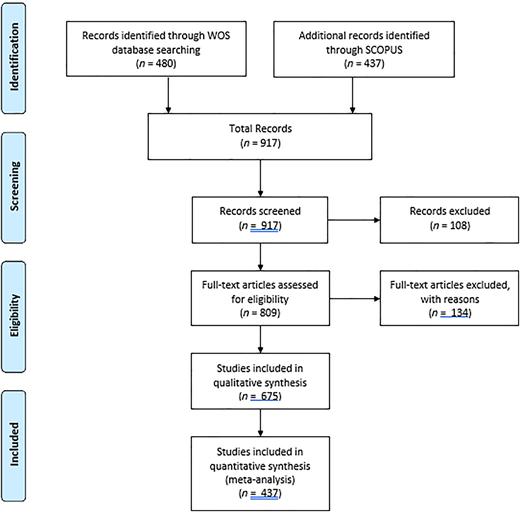
The authors used SCOPUS to find all records mentioning work-family conflict, by considering book, article and review, excluding conference paper and considering only records written in English language. After a duplicated and not pertinent record removal, the authors obtained a number of 675 records. The authors considered 437 records from SCOPUS to create a cluster map.
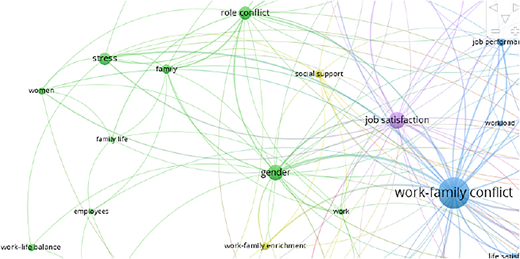
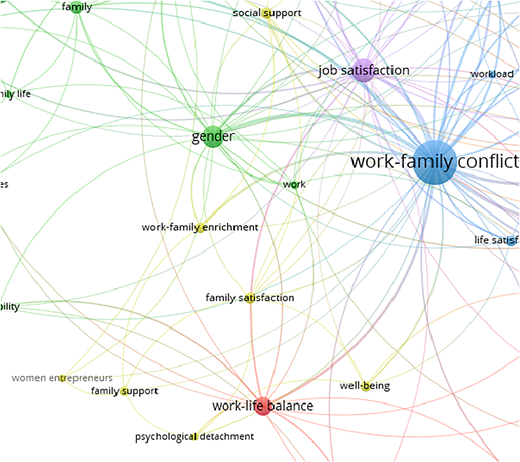
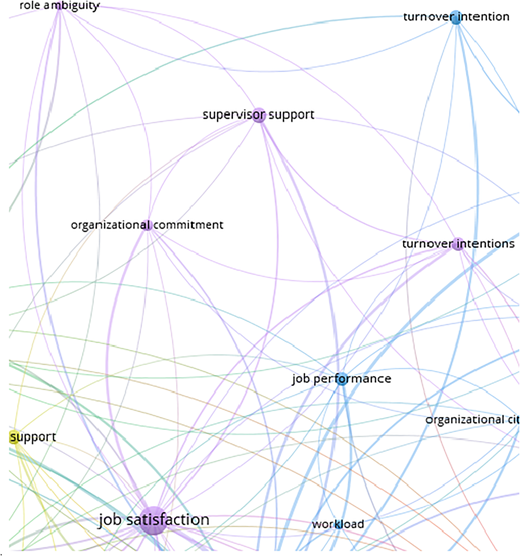
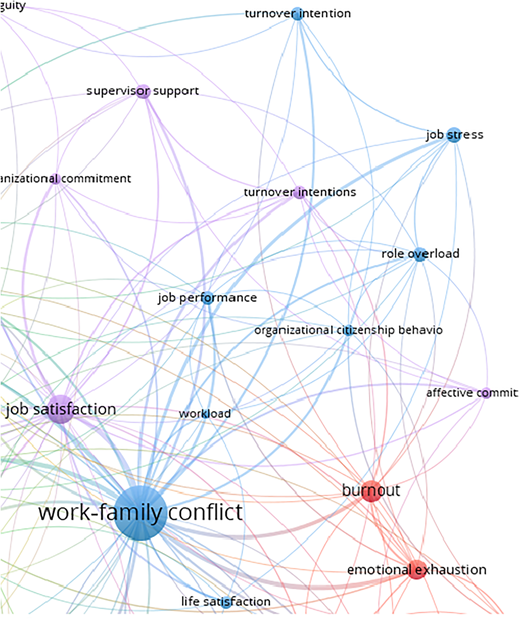
Using SCOPUS and VOSviewer the authors have clustered 5 different areas, which are regrouped in next clusters considering keywords with most co-occurrence and significancy: Work-life balance and burnout gender cluster job stress and performance social and family support job satisfaction.
Cluster map is origined only by SCOPUS database.
This work aims to find a state of art about this topic, creating hypothesis where this problem has been exacerbated by 2020 due to important society modifications created by COVID-19, where recent evolution of work-family balance has been complicated by papers which come back to consider this balance as problematic.
1. Introduction
Work-family conflict is a situation wherein, recalling the theory of motivated behaviour (Castelfranchi, 2014; Castelfranchi and Miceli, 2004), work and family needs mutually interfere with each other throughout life, sometimes creating an important, daily internal conflict, as some activities of these domains are incompatible (Burke, 1994; Arjmand et al., 2012; Andres, 2014; Weer and Greenhause, 2014). Sometimes, family-related and professional roles come into a hard conflict (Greenhaus and Beutell, 1985; Treister-Goltzman and Pereg, 2016), generating phenomena of turnover intention (Flinkman et al., 2008; Buddhapriya, 2009; Blomme et al., 2010; Carlson et al., 2011; Chen et al., 2018; Singh et al., 2018) and workaholism (Russo and Waters, 2006; Falco et al., 2012; Bakker et al., 2014; Schkoler et al., 2017; Tahir and Aziz, 2019). It is prevalent in couples who wish to grow their children (Belsky et al., 1985; Moore, 2004; Bouchard and Purier, 2011; Buehler and O' Brien, 2011; Fellows et al., 2016; Fillo et al., 2015) and where there are already children to nurture (Borelli et al., 2017) when both members of the couple are partners in an enterprise (Werbera and Danes, 2010; Xie et al., 2018) or work together (Noonan and Corcoran, 2004; Hedberg and Danes, 2012). Today, there are gender differences in the management of this conflict, with some studies describing a man's suffering (Winslow, 2005; Simbula et al., 2011) and women often having to choose between family or career (Halryngyo and Lyng, 2009), since the work-family conflict dimension depends on gender equality (Bozzon and Murgia, 2021). Studies in this area have evolved in recent years, and this topic has been cited since the end of XIX century, having an industrialisation-modified society (Kleinberg, 1989). We can define three approaches to work-family roles, following different sociological approaches born during the twentieth century (Lavassani and Movahedi, 2014):
Conflict view, born during early 1900, adopting a structural-functionalist approach, is based on a clear and static role separation between gender and functional roles in society and family.
The compensation view, introduced in the late 1970s, is based on a more fluid separation between family and work roles, wherein the individuals adopt a compensation strategy and invest more energy to resolve a lack of satisfaction
The balanced view, initiated in the late 1980s, grants a connection between work and family roles, which have to be balanced, enriching this new approach with the gender role theory, which considers the different female components in marital and family entities, for a long time considered as individuals who had to passively accept their role and not be involved in the working world. Women are involved in this approach, wherein the family and working roles have to be in contrast, not on a continuous alternation, but have to coexist and enrich each other.
We think that the three distinct approaches to this topic, which theoretically follow a chronological progression, still coexist, while also considering the influence of the cultural context in which they are threatened (Hemmert et al., 2019) and have an important influence on human resource management which is interested in pursuing employee satisfaction (Hennessy and Lent, 2008; Binde and Coad, 2013; Minnotte et al., 2015; Elrehail et al., 2020).
In the past, most family roles, especially within the middle class, were more linear than today, as a family had just one income from the male's work, while the woman had her role at home, managing the house and educating children. Since the beginning of the XIX and XX centuries, social and economic changes have modified the familiar equilibrium, which was revealed to be unsatisfactory, especially in the second half of 1900, with feminist movements which requested equal treatment and rights. Society has become more complex, less linear, sometimes disorienting (Bauman, 2000) and the first approach of conflict view cited before became insufficient; families got in trouble because some partners could not manage this change, but others also created new families and creative adaption strategies. During the last decades, some families maintained traditional roles, recalling the conflict view that we mentioned before, which did not tolerate a change in family and social structure; others created new families, where work mostly maintained fundamental importance not only on the economic side but also in placing an important border between marital and working problems, where each working partner had his or her private space, properly managed with a flexible strategy by the working organisation itself (Boiraha et al., 2020). It also worked for couples who were working together, because even in the same workplace, there was the possibility to be separated, having different functions within the organisation. The new way to treat and analyse the interaction between work and family is considering a balance and not a conflict, even if means to increase complexity (Carlson et al., 2006; Willis et al., 2008; Peters et al., 2009; Elwart and Konradt, 2011; Zhao Roy and Mattilla, 2013; Crom and Miller, 2018; Boiraha et al., 2020; Yang and Cheng, 2020). The COVID-19 pandemic which plagued China and the rest of the world in 2019 has changed life in almost all countries. Beyond the medical risk of killing many people, this pandemic – as most epidemic diseases – has created economic, political and social damage which will have negative consequences even after the end of the pandemic. Countries infected by this virus are not only in danger of human losses, but also of important limitations that most world governments have created to face this disease. If it can be a macrosocial impairment in terms of economic loss and institutional credibility, it can be a problem even in the lives of individuals and their families, increasing the work-family conflict risk (Burke, 1994; Liu et al., 2019; Osadchuck et al., 2020). While nations that have reduced their services and movement of people or continued their pre-COVID activities have paid in terms of life losses and the overload of their hospital structures and sanitarian personnel (Bergman et al., 2008; Yildrim and Aycan, 2008; Blomme et al., 2010; Takeuchi and Yamazaki, 2010; Nelson, 2012; Battistelli et al., 2013; Ruokolainen et al., 2014; Sharma et al., 2016; Dinibutun, 2020; Manzano-Garcia and Ayala Calvo, 2020), countries that have significantly restricted people's movement to just going out for essential activities have forced their citizenship to cope with important stress. Quality of life changed, and this adaptation was predominantly negative if we consider substance abuse (Taylor et al., 2021), family violence (Griffith, 2020) and psychic suffering (Fellows et al., 2016; Banerjee et al., 2021; Jokic-Begic et al., 2021; Szmulewitz et al., 2021). Most families restricted their activities and movement in 2020, administering a significant change in their work and free-time management.
This problem has been relevant in countries conducting the lockdown strategy, forcing people to suspend or convert their work activities to remote mode. This means that many people, who used to leave their houses to go to the workplace, interact with clients, colleagues and superiors and create a daily routine, have to stay at home with their partners and sometimes with their children (Battistelli et al., 2013; Beham et al., 2015; Kim and Wollensbe, 2018). Using a psychoanalytical similitude, there is a precise setting regarding the physical workplace, invested by psychological meanings, and these meanings help the worker to separate the job from the family both physically and psychologically. If the worker is forced to work in the same place where he/she works with his/her family, this separation decreases, and the conflict risk increases. This study stresses on a bio-psycho-social approach (Engel, 1977). There is no supremacy between any of these three dimensions, but it is important to understand that they have different kinds of evolution: while the biological risk related to COVID-19 will be vanquished in 1–2 years, thanks to the creation and administration of a proper vaccine, psychosocial consequences regarding individual, socioeconomic and interpersonal aspects will be elaborate with a different timing and mode. Work-family conflict, in this case, can be harmful, creating an emotive contagion between workers (Wang et al., 2020a, b) and damaging coordinators (Wilkinson et al., 2017; Dixon et al., 2020).
2. Study design, exclusion/inclusion criteria and used instruments
This study aims to determine, starting from three different approaches cited before about work-family conflict (Lavassani and Movahedi, 2014), how much literature about this topic is today-oriented. We hypothesise that globalisation has improved communication between developed and developing countries but is still present an ancient societal mode which regards also work-family relation, considered obsolete for Western developed countries standards (Chandra, 2012; Adepti et al., 2020). Additionally, we considered the influence of the COVID-19 pandemic which has strongly modified lifestyles in countries that have adopted a strict lockdown strategy, which in different cases has negatively modified people's social behaviours (Pietz et al., 2019; Prosser et al., 2020). We used 2 database systems of WOS and SCOPUS for this review, using the Boolean String: “work-family” OR “work family” OR “work” AND “family” AND “conflict” AND “role” AND “employee” OR “entrepreneur*”. We considered only articles and review articles written in English, focussing on group, individual, organisation, social psychology and other sociologic and anthropological studies. We excluded other contribution areas, such as:
Medicine
Arts and humanities
Engineering
Biochemistry
Neurology
Mathematics
Energy
Agricultural and biological sciences
Pharmaceutical
Material sciences
Physics
Immunology
Chemistry
Dentistry
Computer science
Veterinary.
We have started to use English as the only language since it is used in 90% of the publications in this area. In Figure 1 we represent our records selection procedure with PRISMA statements (Mother et al., 2009) (see Figure 2).
3. Database description
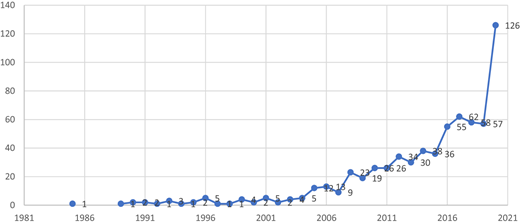
The first mention of this topic concerns work-family conflict during parenthood transition (Belsky et al., 1985). As shown in Figure 3, there has been a mild constant growth in the last 20 years in works that talk about this kind of conflict, stating that it is an important matter. However in recent decades, sometimes this growth is reduced or elevated; for example, around the world financial collapse of 2009, due to the economic/working stress among families, a significant down in the next year and then a new incrementation trend to the rearrangement which probably influenced the family lifestyle and role. It is likely that an economic crisis can also affect the family system, and family problems can interfere with job performance, but a global crisis can trigger family suffering (Repetti et al., 2002; Richter et al., 2010; Chelariu and Stump, 2011; Richter et al., 2015; Canet-Giner et al., 2020; Dong et al., 2020; Wang et al., 2020a, b). Research has also produced an assessment instrument to measure the intensity of this conflict (Kim et al., 2019). The most important increasing trend is during 2020, the first year of this pandemic, and consequently, an important modification of social interaction around the world.
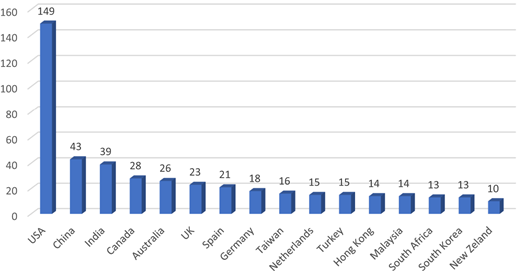
Representation of 15 most active countries publishing papers about the article's topic
Representation of 15 most active countries publishing papers about the article's topic
Considering the 13 most prolific countries around the world regarding this matter, it is unavoidable to consider the United States, officially the first country in the world to record the most COVID-positive people and COVID-related deaths. The USA is already the most prolific country in almost every area, but we underline here a significant superiority of papers about this topic, stating again how much this pandemic is socially, psychologically and economically disruptive, even more than from a simple medical point of view.
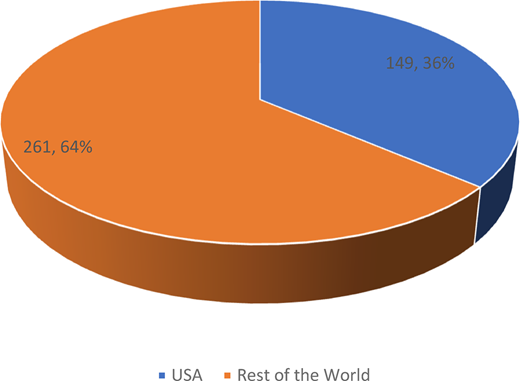
The gap between the USA publications and others is more evident when we consider the entire sum of every publishing and compare it with the record number of the others in Figure 4.
This research line is quoted in many journals in Table 1, regarding social science, human resources and organisational behaviour. The sensitivity of inner individual conflict is important because personal problems, even if related to extra-working life, risk being an excessive stress load for the worker, who could have a significant working performance deficit or decide to leave a job. That is why organisations have to consider the need to create a work routine that is not excessively demanding, avoids the efficiency obsession, or does not force workers to neglect their free time and families.
Representation of the 10 most prolific publishing journals
| No | Journals | h-index | Research Area |
|---|---|---|---|
| 34 | International Journal of Human Resource and Management | 114 | Management of technology and innovation, organisational behaviour and human resource management, strategy and management |
| 21 | Journal of Managerial Psychology | 80 | Organisational behaviour and human resource management, management sciences and operations research, social psychology |
| 19 | Personnel Review | 71 | Organisational behaviour and human resource management, applied psychology |
| 17 | Journal of Vocational Behavior | 151 | Organisational behaviour and human resource management, applied psychology, education |
| 13 | Journal of Managerial Psychology | 80 | Organisational behaviour and human resource management, management sciences and operational research, social psychology, applied psychology |
| 13 | Human Resource Management | 94 | Management of technology innovation, organisational behaviour and human resource management, strategy and management |
| 12 | Frontiers in Psychology | 110 | Psychology (miscellaneous) |
| 11 | Community Work and Family | 39 | Social sciences, sociology |
| 10 | Journal of Applied Psychology | 284 | Psychology, applied psychology |
| 10 | Career Development International | 60 | Organisational behaviour and human resource management, social sciences |
The most important researchers investigating this topic are from different countries. Most of them are Americans, but some authors are from other countries, where this issue has received attention. We think that the work-family conflict has not only psychological and organisational importance, but also cultural relevance in Western countries and is particularly sensitised in Israel and Finland, and Islamic countries such as Turkey, where there is actually a “work in progress” regarding female rights. For example, work-family conflict is an emerging matter in hospitality management, wherein hotel managers of a particular culture are used to a specific family model — for example, based on a traditional asset where women do not work (Kasper et al., 2005; Wang et al., 2010; Fackrell et al., 2013; Nasurdin et al., 2013; Lee et al., 2019; Morgan and Pritchard, 2019; Tobak and Nábrádi, 2020). Hospitality workers often treat them differently from how they behave in the family, creating a dissonance between their work and family roles (Karatepe and Uludag, 2008a, b; Karatepe, 2013; Karatepe and Kilic, 2015). Most studies are oriented to organisational and working psychology (Griggs et al., 2013; Allen et al., 2019; Hunter et al., 2019), educational psychology (Cinamon et al., 2005; Cinamon, 2009), social psychology (Mauno and Ruokolainen, 2017; Wayne et al., 2019) gender psychology (Cinamon et al., 2002; Lee et al., 2017) and hospital psychology (Rantanen et al., 2013) (see Table 2).
Table of 10 most active Authors
| No | Author | Affiliation | h-index | Prevailing Research Area |
|---|---|---|---|---|
| 8 | Karatepe O. M | Mersin University, Turkey | 44 | Social sciences; hospitality management; health professions; business, management and accounting |
| 6 | Carlson D., S | Baylor University, Waco, USA | 38 | Psychology; social sciences; econometrics and finance |
| 5 | Casper W. J | The University of Texas, Arlington, USA | 24 | Psychology; business management and accounting; arts and humanities |
| 5 | Hammer L. B | Portland State University, USA | 34 | Psychology; gender psychology; social psychology |
| 5 | Mauno S | University of Jyvaskyla, Finland | 32 | Psychology; medicine; economics, econometrics and finance |
| 5 | Kwan H K | University of Windsor, Canada | 21 | Computer science, decision science |
| 5 | Wayne J. H | Wake Forest School of Business, Winston Salem, USA | 18 | Psychology; social psychology; decision sciences |
| 5 | Kacmar K.M. | Texas State University System | 9 | Psychology; social psychology; organisation psychology |
| 4 | Allen T D | University of South Florida, Tampa, USA | 58 | Organisational psychology; business, management and accounting; decision sciences |
4. Cluster analysis
Starting from this previous database analysis, we used the VOSviewer to divide the group of articles on SCOPUS into clusters using their keywords. We stated 5, the minimum number of occurrences, extrapolating 43 items. We revealed a graphical representation that regrouped five different clusters. These clusters, with their co-occurrence, are graphically represented in Figure 5.
Cluster 1: Work-life balance and burnout (12 items, 24%)
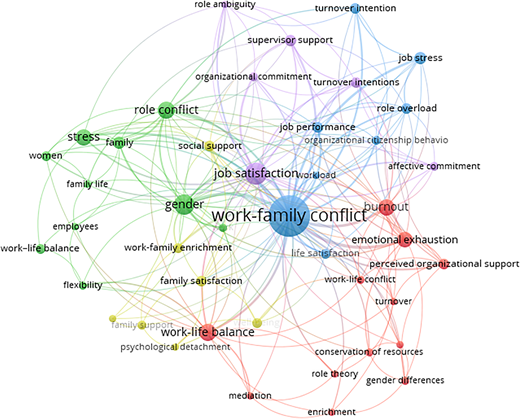
This is the third most numerous cluster, mostly related to a negative conception of suffering. In this case, we observe the coexistence of two different ways to consider work-life balance (Carlson et al., 2006; Arjmand et al., 2012; Weale et al., 2019; Akanji et al., 2020; Boiraha et al., 2020; Chen et al., 2020; Dixon et al., 2020; Haar and Brougham, 2020), following the role theory (Mcclosey, 2016; Piszczek et al., 2018). Role interaction can be defined through its positive way of mediation (Brown and Pitt-Catsouphes, 2016; Soomro et al., 2018) between the work and family domains (Boyd et al., 2016) and the negative way, which results in emotional exhaustion (Nauman et al., 2020) and burnout (Curnoyer, 1988; Westman et al., 2004; Haar, 2006; Innstrand et al., 2008; Lambert and Hogan, 2010; Dai et al., 2014; Gholitabar et al., 2020; Kao et al., 2020). The worker has to avoid this situation by finding support in others or in the organisation itself (Boyar et al., 2007; Casper et al., 2011; Liao, 2011; Baral and Sampath, 2019), saving his psychological inner resources (Babic et al., 2020) and considering other variables of vulnerability and interaction (Brewin et al., 2000; Bouchard and Purier, 2011; Baltes et al., 2011; Michel et al., 2011; Deuling and Burns, 2017; Sanchez-Vidal et al., 2020).
Cluster 2: Gender cluster (10 items, 26%).
This is the second most numerous cluster. It recalls the gender topic (Yavas et al., 2008; Mauno et al., 2012; Cloninger et al., 2015; Akanji et al., 2020; Liu and Fan, 2020) because psychological distress is usually related to women due to role conflict (Posig and Kickul, 2004; Aaltion and Huang, 2007; Edwards, 2008; Battistelli et al., 2013; Buehler and O' Brien, 2011; Ma et al., 2014). Most cultures around the world are used to excluding or inflicting stress upon women more than on men (Noor, 2003; Raskin, 2006; Wang et al., 2010; Ren and Foster, 2011; Beigi et al., 2012; Janasz et al., 2013; Huffman et al., 2014; Hassan et al., 2017; Scott, 2018), thus expecting a woman to be more bound by family roles in the management of the house and children. Women are forced to make a choice between work and family life or between working as an employee, freelancer, or entrepreneur (Winter et al., 2006; Karatepe, 2010; Deng and Gao, 2017) and organising their work-family balance (Beutell, 2010; Zhanh et al., 2012; Adisa et al., 2017), as well as trying to reach some flexibility (Hill, 2005; Offer and Schneider, 2011; Konig and Cesinger, 2015; Moen, 2017).
Cluster 3: Job stress and performance (8 items, 53%).
This is the most numerous cluster, where the work-family conflict negatively influences job performance, which is interesting for its economic consequences. The work-family interface is a topic that regards psychic individual suffering, but it is also related to cultural and psychosocial determinants, which have strong component among working organisations where a single worker is stressed (Andres, 2014; Yu et al., 2010; Chang et al., 2014; Ismail and Gali, 2017; Akanji et al., 2020; Franco and Estevens, 2020; Kazakov et al., 2020; Matthews et al., 2020). In this case, work-family conflict is related to some buffering effects, such as organisational citizenship (Gracia et al., 2006; Deery et al., 2017; Wattoo and Zhao, 2018) which increases perceived support, self-efficacy, well-being (Binde and Coad, 2013; Kim et al., 2015; Chernyak-Hai and Tzine, 2016; Deng and Gao, 2017; Wattoo and Zhao, 2018; Conte et al., 2019; Obrenovich et al., 2020; Watoo et al., 2020) and vulnerability factors such as role overload and workload (Gurbuz et al., 2013; Chan et al., 2015; Goh et al., 2015; Rubel et al., 2017). Work-family conflict can influence the organisation of the worker, increasing her/his turnover intention (Daderman and Basinka, 2016; Naibaho et al., 2019); or damaging her/his performance (Karatepe, 2013; Yustina and Valeriana, 2018; Biermeyer-Anderson and Coyle, 2019; De Clercq et al., 2020).
Cluster 4: Social and family support (seven items, 10% co-occurrence)
While the previous clusters are focused on individual and organisational dimensions, this cluster is related to the family and its interpersonal functioning. In this specific case, the family becomes a resource (Cazan et al., 2019), and not just a problematic element with role expectations, but also a buffering factor for a worker's well-being (Kinnunen et al., 2003; Deng and Gao, 2017; Xu et al., 2018), wherein the family offers support (O’Driscol et al., 2003; Goh et al., 2015; Jamaludin et al., 2018), personal enrichment and detachment (Mauno et al., 2011; Wang, 2017; Jain and Nair, 2020), reaching work-life satisfaction and enrichment (Lim et al., 2012; Lu and Kao, 2013; Dishon-Berkowitz, 2014; Kalliath et al., 2017; Nielsen et al., 2020). The gender theme wherein female entrepreneurs offer a different point of view about entrepreneurship from the perspective of sensitivity and creative thinking is mentioned again (Cloninger et al., 2015).
Cluster 5: Job satisfaction (5 items, 16% co-occurrences).
A happy worker is a positive element within an organisation. Is fundamental to preserve job satisfaction (Deng and Gao, 2017; Cazan et al., 2019; Nielsen et al., 2020) to grant positive working feedback. A worker needs to effectively invest in his or her organisation, without considering its working activity with the only goal of earning money (Chan and Fung, 2015). A proper organisation that could reduce role ambiguity and assign the right role division between workers, avoiding an excessive workload to some of them and constant supportive activity by the supervisor rational organisation reduces work-family conflict and turnover intention (Karatepe and Udulag, 2007; Culbertson et al., 2009; Ngah et al., 2010; Hammer et al., 2011; Karatepe and Azar, 2013; Proost et al., 2010; Mihelic, 2014; Chen et al., 2016; Schierman and Glavin, 2017; Zhu and Li, 2016; Raza et al., 2018; Talukder, 2019), acting positively on working stressors.
5. Conclusions
This paper begins with a consideration of the topic of work-family conflict, which has evolved during the last century and the social evolution and complexification of society. The first conception of work-family conflict stresses the word “conflict” because work and family are different domains in a linear society, which must be strictly separated and divided. The evolution of the family, passing through a series of family members, needs to create new and innovative ways to consider work and family interactions. Recent years have also included Eastern and developing countries in the research, although their cultures are still evolving in the definition of family roles. Additionally, the COVID-19 pandemic has stressed world societies beyond the biological risk, disorientating people and organisations, creating poverty, anxiety, anger, depression, as well as weakening beliefs and strong institutions we used to consider as solid. Our cluster analysis shows that most clusters, such as 1 and 3 (Figures 6 and 7), are embedded in the ancient and negative conception of work-family conflict, wherein a superior complexity among families and society brings distress due to difficulties in facilitating change. Previously, this separation between work and families was clearer, with men mostly dedicated to work and women within domestic walls. However, during recent centuries, this situation has been modified in industrialised countries, creating a new role disposition with many decades of debate and manifestations for civil and women's rights, which are still in progress. The COVID-19 pandemic has forced millions of people to reduce or change their activities, sometimes resulting in job loss or significant money and job reduction and an increased state of insecurity or job stress. This change has also been felt inside the family, with an unexpected modification in daily life and activities. The COVID-19 pandemic did not create work-family conflict, which already existed by the end of the last century, but it hit on different points of weakness in the modern system, as it overcharged some National Health Systems which were already vulnerable because of lack of financial funds, corruption, disorganisation, structural and equipment obsolescence, or personnel inadequacy. Similarly, work-family conflict was a significant matter before the 2020 pandemic and was caused by different factors, such as individual psychological difficulties, organisational problems which created excessive stress, lack of separation between work and private life, insecurity due to socioeconomic factors and a lack of serenity. Work-family conflict studies are vital to formulating prevention protocols to limit this psychological suffering and are useful for finding some diagnostic criteria to determine these warning bells as well as for creating a better working environment or allowing the worker to have a personal space to “destress” (Spencer et al., 2019) before returning to the family.
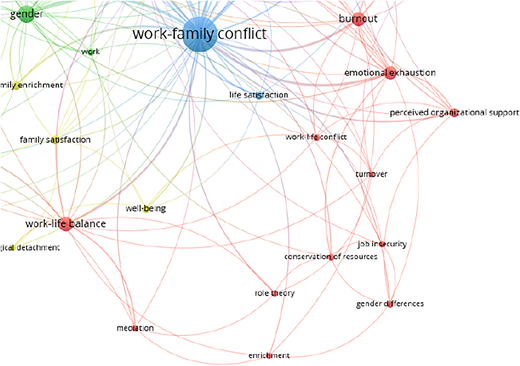
This last part is not practical with a worker forced to work remotely at home every day, but this aspect has to be managed gradually, an aspect which has not been applied in many countries that have suddenly adopted radical lockdowns and hasty reopenings. It is noteworthy that this discomfort has created another psychological wound without adopting an immediate and premature return to pre-COVID routines, demonstrating that collective trauma (Nadler and Ben-Shusham, 1989) is not sufficiently elaborated but rather removed, although this element also emerges as a more complex way to create a balance, not a conflict between work and family. Gender studies (Figure 8) are dedicated to this topic, with women as the main characters involved and valuable members of the family, being competent in working activities, but characterised by a special sensitivity to both work and family (Cardella et al., 2020), allowing the family to be a resource for support and not only a problematic and stressful element (Figure 9). The family, following more recent studies on this topic, can become an element of enrichment in this case (see Figure 10).