The purpose of this paper is to explore the effects of emerging technology (technology adoption, perceived benefits, technological challenges and ease of use) and the auditing practice of accounting professionals.
The primary method of data collection was a questionnaire directed to newly practicing chartered accountants who are partners of sole proprietorship or partnership firms in India. The data were analyzed by using partial least squares structural equation modeling (PLS-SEM).
The findings revealed that there is a positive and significant relationship between characteristics of emerging technology (technology adoption, technological challenges and ease of use) and auditing practice, while factors of the perceived benefits had a negative relationship with auditing practice.
The study model would aid technology enabled audit research by giving a platform for a new study to investigate further detailed solutions to emerging information technology determinants.
This study illustrates how tools technique perceived benefit motivates sole proprietorship practicing auditors to adopt emerging technology- enabled auditing software for auditing client's financial statements. Further, this study has added to the information technology auditing literature and might add benefits to the numerous other audit firms to adopt in emerging technology tools their audit firm.
Audit firms, generally sole proprietorship and partnership firms, should be given enough awareness about the latest audit software tools to carry out their audit tasks efficiently.
The study findings highlight benefits of emerging technology-enabled auditing practice among owners/partners of the sole proprietorship or partnership firms, which is not extensively discussed in the prior studies. Furthermore, it broadens knowledge of perceived benefit, technological challenges and ease of use in technology-enabled audit software in the auditing and accounting literature.
1. Introduction
The advances in technology have changed accounting and auditing practices. On the one hand, accounting professional services provide the preparation of income statements, the statement of financial position, equity shareholders statements, cash flow statements and other bookkeeping services. Whereas, on the other hand, the auditing profession provides services related to the audit of financial statements, taxation services and other audit services (Phang and Foong, 2010; Albring et al., 2014). Audit firms always try to use advanced audit tools to provide efficient audit services to their clients and thereby maintain a good reputation with their stakeholders (Wessels, 2005). One of the most important computer-assisted auditing tools and techniques (CAATs) is generalized audit software (GAS), which is considered to be a set of generalized software that permits auditors to cross-examine a variety of client data and test clients' accounting software (Debreceny et al., 2005; Thottoli, 2020, 2021d). Technology adoption in auditing is considered to be an essential component to assess the efficacy and efficiency of audit tasks (Pedrosa et al., 2020; Mansour, 2016). The auditing profession has recently faced various information technology (IT) challenges in conjunction with the conduct of business using advanced IT-enabled accounting transactions (Byrnes et al., 2018). Nowadays, it is virtually impractical to carry out a financial statement audit without using emerging technology tools. Such a debate may perhaps have been acceptable during the past two decades; however, it is important to know why practicing auditors use emerging technology tools from an auditing professional perspective and to ascertain how it might be possible to increase the efficacy and efficiency of external auditors' tasks (Pedrosa et al., 2015). Emerging technology tools have remained extensive in the global service environment over the past two decades, particularly with the rapid shifts in stakeholders' needs, the timely provision of services and improved service quality at a lesser cost. Auditing is considered to be a labor-intensive profession, which requires a stable emphasis on efficiency and competitiveness to increase the productivity of junior auditors during the auditing process. Accordingly, the implementation of emerging technology tools in the auditing process leads to an improvement in productivity, a better accumulation of sufficient and appropriate audit evidence, and provides a more rapid communication with stakeholders and assures the protection of confidential client data. The publication of the latest audit proposing rules places more pressure on practicing auditors to become more proficient and to be better prepared to compete in terms of the cost of audits (Abou‐El‐Sood et al., 2015). Emerging technology tools enabled auditing to improve the capability and efficiency of statutory audits. The use of electronic auditing reduces the amount of time needed to perform audit tasks and reduces the operational cost of audits. The use of emerging technology tools has enabled auditing to improve the quality of audit services, increase firms' operational profit and reduce audit risks (Okab, 2013). Auditors should thus also adopt the use of more information communication technology (ICT) tools and techniques in auditing (Ahmi et al., 2017). A limited number of studies have examined the relationship of emerging technology tools with audit practices, an example being Thottoli et al. (2019c), which examined the link between communication technology and auditing practices. The authors found that there is a relationship between four elements of communication technology and audit practice; however, this study ignores the main factors of IT. Therefore, there is currently a lack of knowledge as to how precisely emerging technology tools could influence auditors' practices.
Just as accountants and auditors need to think about artificial intelligence (AI), they also need to consider how the cloud deals with big data (Luo et al., 2018). A lack of adequate training in computerized auditing and a lack of understanding of special functions of audit software by audit assistants are considered to be the main constraints to adopting emerging technology tools for audit software in the audit process (Abou‐El‐Sood et al., 2015; Thottoli, 2021a). Computer-assisted data mining techniques are still neglected, or are only employed by a small number of practicing professionals (Pedrosa and Costa, 2014). The key challenges faced by auditors are the implementation cost of specialized audit tools and staff training (DeLone and McLean, 2003). Technological challenges have meant that their features and built-in functions have become more complicated, and internal auditors are not suggested to use such tools on account of the complexity in terms of the ease of use (Tijani, 2014). It has been seen that a lack of proficiency exists regarding the relationship between electronic auditing, both in its theoretical and practical concepts (Okab, 2013). The effectiveness of technical training has been investigated as a possible intervention for practicing auditors' use of audit software (Payne and Curtis, 2016). The key factors are ease of use, technology acceptance model (TAM), unified theory of acceptance and use of technology (UTAUT recommends that the adoption of emerging technology tools and usage is affected by effort expectancy (EE), performance expectancy (PE), facilitating conditions (FC) and social influence (SI); Venkatesh et al. (2003). Some sole proprietorship and partnership audit firms agree that the acceptance of audit software might not be cost-effective. This could be due to a lack of proper awareness of auditing software and its perceived benefit among auditors. The adoption of emerging technology tools also requires adequate practical skills and training. Ease of use and TAM may well also compel many audit firms to bring emerging technology tools to the audit firm. However, as no precise studies have been carried out that explore the specific effects of emerging technology tools factors on auditing practices, there is a lack of clarity regarding how emerging technology tools enable auditing practice. Accordingly, this research aims to examine the relationship between emerging technology tools and auditing practice, namely, technology adoption, perceived benefits, technological challenges, ease of use and auditing practice.
The rest of the paper is organized as follows: a review of literature, theoretical framework, methodology, results, conclusions and limitations.
2. Literature review
2.1 Emerging technology and auditing practice
The auditing function is an important activity in any organization, which is designed to ensure the veracity of financial statements and the need to provide a service in a controlled and supported environment (Komnenić, 2009). The current widespread use of emerging technology tools in an organization has had made a critical impact on the auditing profession. This adoption of technology will have the effect of guaranteeing that accounting data exist within a safe, regulated, monitored and supported environment. This can be considered to be a key challenge for practicing auditors. Emerging technology tools enabled environments, practicing auditors will start by applying business intelligence tools, which are considered to be a key factor in making business decisions (Ciprian-Costel, 2014). Professional auditors' IT and auditing skills are becoming increasingly important for maintaining the integrity of automated systems (Adeyemi et al., 2014). Manual auditing has transformed noticeably among auditors as a result of the latest advances in technology. Current innovative enterprise resource planning (ERP) systems are increasing the usage of online business transactions by stakeholders, as well as the usage of the cloud and the fast communication and availability of e-data for use by auditors and boards of directors (Byrnes et al., 2018). According to Costa et al. (2016), system quality has an important effect on the behavioral intention to use such systems, as well as the level of user satisfaction. Management support is also very important for deciding whether to implement ERP, or not.
Previous research findings have shown that the use of technology auditing tools for audit assignments can aid the sequencing and design of audit objectives (Kacanski, 2016). Emerging technology has thus enabled audit tools to have the potential to expedite auditors' views (Thottoli and Thomas, 2020), as such emerging technology tools produce a detailed list of junior audit tasks that free up the lead auditor to be able to focus on a special task (Abdolmohammadi and Usoff, 2001). Additionally, the literature review confirms that in general, predesigned technology (Berg, 1998) stipulates the choice of a wide variety of audit tools and techniques that can be used to support the majority of audit tasks, ranging from data mining through to data examination. Technology audit tools add value, productivity and reduce the burden for auditors, albeit they also diminish the level of auditors' responsibilities (Pedrosa and Costa, 2012).
The early literature on the adoption and utilization of emerging technology tools and CAATs found that the usage of technology tools certainly and significantly contributes to the efficiency and productivity of junior auditors' performance when auditing clients' financial statements (Janvrin et al., 2008; Banker et al., 2002; Tottoli, 2021b; Abdolmohammadi and Usoff, 2001; Elliot et al., 1985), and that they are used to support nearly all audit assignments (Pedrosa and Costa, 2012). In addition, in a separate stream of research, the effects of audit technology tools on professional judgment in terms of facilitation and decision-making skills were discovered (Bell et al., 2002).
2.2 Technology adoption
Since the majority of an organization's business involves emerging technology tools-based accounting, this obliges audit firms to adopt the usage of audit software to audit financial statements for their clients. The adoption of IT has facilitated increased performance in auditing and accounting between practicing professional auditors (Thottoli et al., 2019a). Abreu et al. (2018) examined blockchain technology and some of its variations, and they found that blockchain technology has a favorable impact on the auditing environment, and that it can help existing processes become more efficient. Internal auditors have since begun to recognize the need to use technology to carry out their auditing tasks. CAATTs, in particular, can help improve the efficiency and efficacy of auditing. The introduction of IT has been shown to result in drastic changes in the way of conducting business, where one of the most recent advances in has been cloud computing. This adoption of IT has brought about a significant change in the field of the practices of auditing and accounting firms (Soni et al., 2018). Audit firms have been obliged to use IT in their auditing, as the majority of their clients use IT in their businesses (Rosli et al., 2013). It is evident that those audit firms that use IT demonstrate better performance than those audit firms that do not use IT. Audit firms are increasingly using CAATs and audit software as an essential tool, which helps the auditor attain an increased level of audit quality and efficiency, which, in turn, improves the reliability of data analysis and the collection of evidence (Correia et al., 2019). Hence, it is hypothesized that:
Technology adoption is positively associated with auditing practice.
2.3 Perceived benefit
Based on the size of their business, most companies finalize the preparation of their financial statements at the last minute to file their financial statements with the income tax department. Auditors use audit software to overcome audit challenges. Big4 audit firms are currently using audit software for audit tasks, and therefore, the rationale behind sharing technology's perceived benefit is crucial, especially for sole proprietorship and partnership firms. The majority of audit firms are contacted to carry out their audit tasks if their auditors use IT in their professional services, and it is evident that the quality of the audit mission has increased with less audit risk. Furthermore, IT helps these firms collect information on time and quicker, and improves their understanding of the client's work and environment (Ciprian-Costel, 2014).
Audit software and the adoption of IT in auditing helps auditors to complete their audit tasks on time in an efficient manner (Mustapha and Lai, 2017). Emerging technology tools, CAAT and audit software all ensure the high quality of audit reports, and the trend is for the majority of developing countries to adopt such audit software (Oni, 2015). An audit firm can enhance the operational performance of its internal audit department (IAD) through the use of an integrated effective ERP system and proper auditing software. It has been found that investment in CAAT tools is essential, owing to its immense effectiveness in improving the performance of internal audits (Al-Hiyari et al., 2019; Tsai et al., 2015). GAS enables an internal auditor to carry out independent examinations of clients' data, which are stored on a computer without any dependence on accountants (Smidt et al., 2021). It can test the dependability of client accounting software and execute system re-performance, which in turn leads to ensuring the accumulation of audit evidence and the enhancement of the accuracy of audit tests and achieving auditing tasks more efficiently, which results in a more cost-effective audit. Likewise, CAAT tools provide auditors with the ability to save time in their auditing tasks. In several instances in the literature, the manual audit testing procedures are compared with CAATs-based techniques, where the auditor can save hours in each audit. These perceived benefits of CAAT tools were discovered by Shamsuddin et al. (2015). Hence, it is hypothesized that:
Perceived benefit is positively associated with auditing practice.
2.4 Technological challenges
The audit starts when accounting ends. The majority of audit firms' clients are capable of finalize their financial statements at the end of the year, and hence, auditors have just limited time to complete their auditing tasks. An auditor needs to be vigilant and has to ensure fairness, accuracy and the reliability of financial statements while carrying out audits within an ever-shorter period. At the same time, audit firms should consider the cost of the audit software, the availability of skilled employees and the benefit of using audit software. Cloud computing-based technology enforces certain threats, such as, for instance, inadequate protection in terms of data security and confidentiality (Chou, 2015). Internet hackers are endangering organizations, individuals and other organizations by stealing data or by triggering business operational disruption that can have a significant effect on the reliability of source data entered in the financial statements (Barta, 2018; Thottoli, 2021c). The adoption of technology includes elements such as environmental factors, the non-availability of technically experienced auditors in the job market, the size of a client's business, expectations and the unavailability of GAS in a variety of languages (Widuri et al., 2016). The perceived risks of audit software or CAATs are the FC, EE and the number of junior auditors, all of which are the main drivers for the implementation and use of CAATs (Pedrosa et al., 2020). Pedrosa and Costa (2014) emphasized the importance of the challenges of CAATs, as well as auditors' new areas of proficiency and competency. Hence, it is hypothesized that:
Technological challenges are positively associated with auditing practice.
2.5 Ease of use
The ease of use of generalized auditing software by small proprietary practicing audit firms has recently been studied by Thottoli (2022) who proposed the concept of the TAM. The TAM framework comprises four sub-components: PE, EE, SI and FC (Venkatesh et al., 2003). The two TAM components of PE and FC appear to be particularly important determinants for influencing effective GAS adoption (Mahzan and Lymer, 2014). TAM and ease of use has been examined from a software-specific perspective, including the associated factors, such as the use of software, the usefulness of the software and ease of use of software (Kim et al., 2016). The essential factors that influence internal auditors' intentions to use technology tools are PE and FC (Al-Hiyari et al., 2019). Employees' ability to use evolving technology tools reflects their technological proficiency in executing desired activities (Chopra, 2019).
Hence, it is hypothesized that:
Ease of use is positively associated with auditing practice.
3. Theoretical framework
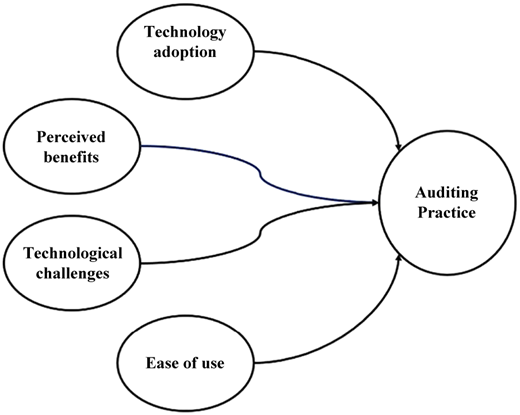
This study's framework explains the underlying structure regarding both the dependent variable (auditing practice) and the independent variables (technology adoption, perceived benefits, technological challenges and ease of use). Rationally, the theoretical framework is constructed to explain the connections between the associated variables by means of a detailed literature review survey. The research hypotheses were then developed to address the study's primary research issues. The hypotheses of this study were developed by examining the direct relationship between the emerging technology characteristics represented by technology adoption, perceived benefits, technological challenges and ease of use and auditing practice. This study has opted to concentrate on the four independent variables for certain reasons. Firstly, such variables are important emerging technology factors that influence auditing practice among small scale audit firms in Kerala, India. Secondly, the previous studies recommended technology awareness and adoption in the accounting profession (Sana'a, 2016; Venkatesh et al., 2003; Kim and Crowston, 2011). Finally, the theoretical framework outlined in Figure 1 shows the relationship between technology adoption, perceived benefits, technological challenges and ease of use within the auditing practice.
4. Methodology
4.1 Sample and data collection
In total, a survey was sent out to 350 auditors (owners/partners) of sole proprietorship and partnership firms in India in 2018. In all, only 321 respondents' answers were suitable for analysis, which represents 91.71% of the original surveys distributed. The analyzed data from the primary data collected were analyzed by using random sampling techniques and personal interviews with professional practicing chartered accountants. The majority of the surveys were returned by hand for data collection. In addition, the study also collected data by using Google Forms. Smart partial least squares (PLS), Version 3 was used for the quantitative data analysis, with bootstrapping techniques. Structural equation modeling (SEM) was used to measure the hypotheses, which is considered to be a statistical tool for analyzing structural theory in social sciences, which uses a confirmatory approach (CFA), rather than an exploratory approach (EFA) (Byrne, 2013). SEM is a general linear model (GLM) extension, which enables a researcher to test multiple regressions at the same time (Hair et al., 2006). Traditional models can be tested with SEM software, although more sophisticated correlations and models can also be used, such as CFA and time-series studies (Bollen, 1990).
4.2 Sample selection
The sample was collected from chartered accountants who are owners/partners of a sole proprietorship or a partnership firm. The reason for selecting auditors in India, where the majority of auditors are sole practices, or have just two or three partners who do not use technological tools. Therefore, there is a necessity among small-scale audit firms to be familiar with emerging technology tools to improve their auditing.
4.3 Measurements
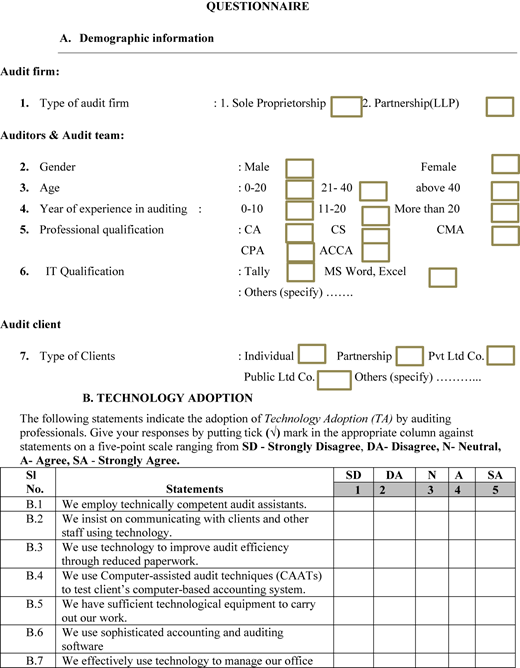
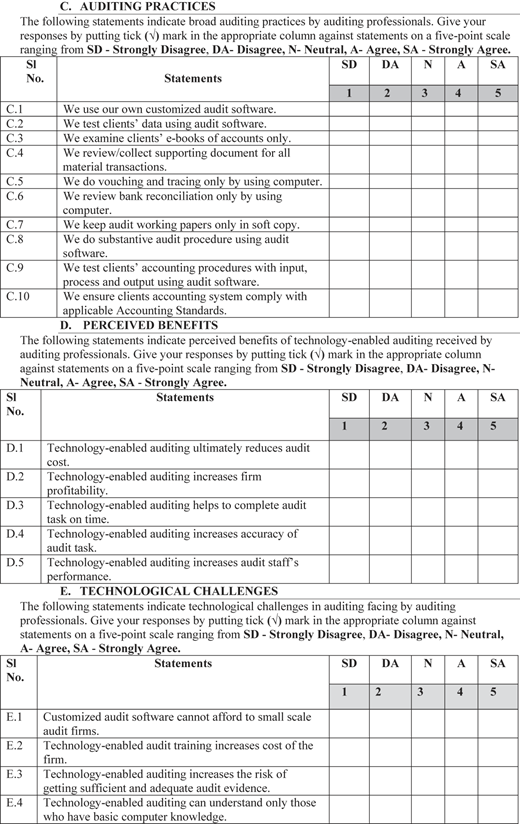
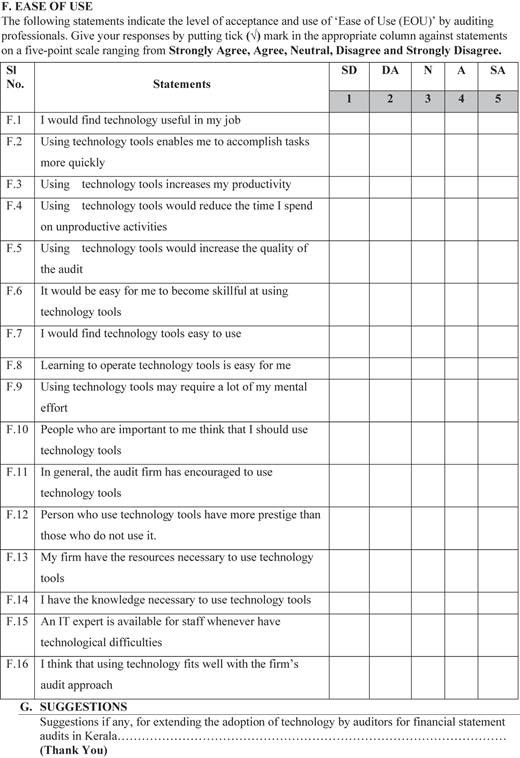
The survey is based on constructs that have been validated in prior studies ( Appendix) and that have been adapted for this study's framework. A total of seven demographic questions are included in Section A, while Section B concerns access to technology adoption. Section C provides auditing practices, Section D indicates the level of perceived benefits of technology tools in auditing by auditing professionals, Section E deals with technological challenges and Section F confronts the “ease of use” of auditing professionals. This survey questionnaire is adapted from Thottoli et al. (2019c).
4.4 Data analysis
The study analysis was carried out with small sample size. PLS-SEM provides solutions even for small samples, where models consist of several hypothetical constructs and a larger number of items in the variables (Hair et al., 2017; Willaby et al., 2015). PLS has been considered by several scholars as an evolving multivariate data-analysis technique (Wong, 2013). A five-point Likert scale was used to evaluate the questionnaire's items. The scale utilized here was from 1 to 5, with 1 being the lowest and 5 being the highest score, where 1 denotes strongly disagree, 2 denotes disagree, 3 denotes neutral, 4 denotes agree and 5 denotes strongly agree.
4.5 Reliability and validity
The reliability and validity tests confirm that the results are error-free to a certain extent, thus validating consistent measurement across a variety of instruments (Sekaran and Bougie, 2016). The result of the reliability using Cronbach alpha proved that the measures of the adopted key constructs is supported. The construct's inner dependability is deemed to be achieved when the Cronbach's alpha estimate is 0.7 or higher (Pallant, 2001). Cronbach alpha values ranging from 0.864 to 0.971 for the five constructs (auditing practice, technology adoption, perceived benefits, technological challenges and ease of use), all of which are shown under Table 1, which is considered as being an acceptable level, based on Nunally (1980) and George and Mallery (2003).
Reliability results
| Variables | Number of questions | Cronbach's alpha | Result (based on Nunally, 1980) |
|---|---|---|---|
| Auditing practice | 10 | 0.942 | Good |
| Technology adoption | 6 | 0.919 | Good |
| Perceived benefit | 5 | 0.947 | Good |
| Technological challenges | 4 | 0.734 | Good |
| Ease of use | 16 | 0.917 | Good |
Note(s): As the alpha value was more than 0.7, a subsequent analysis was performed (Nunnally, 1980; George and Mallery, 2003)
5. Results
5.1 Descriptive statistics
According to the descriptive data in Table 2, the mean average of the study's dependent variable of auditing practice is 0.042, with a standard deviation of 1.00, a minimum of −3.337 and a maximum of 2.295. The first independent variable, technology adoption, has a mean average of 0.210, with a standard deviation of 1.00, a minimum value of −4.709 and a maximum value of 1.439. The second independent variable, which is perceived benefit, has a mean average of 0.059, with a standard deviation of 1.00, a minimum value of −4.698 and a maximum value of 1.248. The third independent variable of technological challenges has a mean average of 0.134, with a standard deviation of 1.00, a minimum value of −2.140 and a maximum value of 1.735. The fourth and last independent variable, ease of use, has a mean average of 0.254, with a standard deviation of 1.000, a minimum value of −4.859 and a maximum value of 1.532. The high standard deviation of ease of use highlights the variations in the difficulties in understanding defined ease of use factors among junior and lead auditors.
Descriptive statistics
| Variables | Mean | Std. dev | Minimum | Maximum |
|---|---|---|---|---|
| Auditing practice | 0.042 | 1.000 | −3.337 | 2.295 |
| Technology adoption | 0.210 | 1.000 | −4.709 | 1.439 |
| Perceived benefits | 0.059 | 1.000 | −4.698 | 1.248 |
| Technological challenges | 0.134 | 1.000 | −2.140 | 1.735 |
| Ease of use | 0.254 | 1.000 | −4.859 | 1.532 |
The degree to which a construct is distinctive from other constructs is determined by discriminant validity (Hair et al., 2010), which is identified by the inevitability of a low correlation among the measure of concern and other measurements that do not measure the same concept or variable (Heeler and Ray, 1972). Certain criteria are utilized to analyze discriminant validity in the SEM-PLS assessment. The square root of each construct's average (AVE) should be greater than the degree of correlation between them. As a result, the square root of the AVE is compared to the correlations of the other components to adopt discriminant validity (Fornell and Larcker, 1981). Table 3 shows the discriminant validity constructs. With regards the correlation data, all emerging technology variables were positively correlated, with three of these variables being significantly correlated with auditing practice.
Discriminant validity constructs
| Auditing practice | Ease of use | Perceived benefits | Technology adoption | Technological challenges | |
|---|---|---|---|---|---|
| Auditing practice | 0.827 | ||||
| Ease of use | −0.282 | 0.796 | |||
| Perceived benefits | 0.119 | 0.029 | 0.908 | ||
| Technology adoption | 0.342 | −0.100 | 0.212 | 0.820 | |
| Technological challenges | 0.262 | 0.016 | 0.321 | −0.052 | 0.801 |
The heterotrait–monotrait (HTMT) ratio can be used to establish discriminant validity (Franke and Sarstedt, 2019; Henseler et al., 2015), where each set of reflective constructs has an HTMT value less than 0.900, as can be seen in Table 4. This indicates that discriminant validity has been proven to a satisfactory level.
HTMT ratio
| Auditing practice | Ease of use | Perceived benefits | Technology adoption | Technological challenges | |
|---|---|---|---|---|---|
| Auditing practice | |||||
| Ease of use | 0.298 | ||||
| Perceived benefits | 0.123 | 0.061 | |||
| Technology adoption | 0.358 | 0.105 | 0.238 | ||
| Technological challenges | 0.292 | 0.129 | 0.435 | 0.109 |
Cross-loading can be performed to test the discriminant validity of a model. The cross-loading results within each construct are evaluated to determine the discriminant validity, where the validity is considered to be fair and satisfactory if the item score of every construct is greater than the item score of the remaining constructs (Farrell, 2010). As seen in Table 5, each construct's item score is greater than the remaining constructs' item score, and therefore, the study's analysis substantiates that the validity of the whole constructs between the cross-loading condition is at a satisfactory level.
Cross loading results
| Auditing practice | Ease of use | Perceived benefits | Technology adoption | Technological challenges | |
|---|---|---|---|---|---|
| AP_1 | 0.767 | −0.271 | 0.037 | 0.296 | 0.194 |
| AP_2 | 0.851 | −0.243 | 0.024 | 0.284 | 0.158 |
| AP_3 | 0.834 | −0.227 | 0.069 | 0.269 | 0.169 |
| AP_4 | 0.792 | −0.207 | 0.084 | 0.308 | 0.165 |
| AP_5 | 0.859 | −0.218 | 0.159 | 0.269 | 0.248 |
| AP_6 | 0.857 | −0.212 | 0.137 | 0.311 | 0.243 |
| AP_7 | 0.843 | −0.234 | 0.129 | 0.280 | 0.270 |
| AP_8 | 0.821 | −0.231 | 0.102 | 0.265 | 0.250 |
| AP_9 | 0.811 | −0.254 | 0.134 | 0.262 | 0.236 |
| EOU_6 | −0.269 | 0.832 | 0.016 | −0.096 | −0.013 |
| EOU_7 | −0.239 | 0.862 | −0.029 | −0.084 | −0.006 |
| EOU_8 | −0.246 | 0.879 | −0.009 | −0.126 | −0.004 |
| EOU_9 | −0.267 | 0.851 | 0.002 | −0.112 | 0.040 |
| EOU_10 | −0.203 | 0.766 | 0.062 | −0.034 | −0.006 |
| EOU_11 | −0.198 | 0.756 | 0.078 | −0.005 | −0.033 |
| EOU_12 | −0.177 | 0.694 | 0.073 | −0.095 | 0.076 |
| EOU_16 | −0.163 | 0.705 | 0.031 | −0.064 | 0.076 |
| PB_1 | 0.111 | 0.052 | 0.881 | 0.223 | 0.258 |
| PB_2 | 0.065 | 0.037 | 0.907 | 0.203 | 0.276 |
| PB_3 | 0.110 | 0.046 | 0.922 | 0.187 | 0.351 |
| PB_4 | 0.106 | −0.002 | 0.922 | 0.182 | 0.291 |
| PB_5 | 0.126 | 0.007 | 0.906 | 0.173 | 0.278 |
| TA_1 | 0.303 | −0.100 | 0.031 | 0.832 | −0.029 |
| TA_2 | 0.229 | −0.022 | 0.274 | 0.840 | −0.043 |
| TA_3 | 0.201 | −0.045 | 0.268 | 0.800 | −0.088 |
| TA_4 | 0.294 | −0.112 | 0.212 | 0.807 | 0.036 |
| TA_5 | 0.290 | −0.069 | 0.175 | 0.866 | −0.057 |
| TA_6 | 0.265 | −0.089 | 0.142 | 0.830 | −0.095 |
| TA_7 | 0.334 | −0.108 | 0.166 | 0.762 | −0.043 |
| TC_2 | 0.154 | 0.118 | 0.352 | 0.052 | 0.778 |
| TC_3 | 0.271 | −0.073 | 0.107 | −0.099 | 0.854 |
| TC_4 | 0.170 | 0.056 | 0.422 | −0.037 | 0.767 |
After the measurement model evaluation had passed all of the proposed criteria, the structural model evaluation was then carried out. The investigation of the determination coefficient (R2) was the starting point for defining the structural model. In this research, the endogenous variable emerges to have an R2 value of 0.261, recommending that 27.5% of the variance in auditing practice can be described by technology adoption, technological challenges, perceived benefit and ease of use.
The relationship among constructs or latent variables hypothesized in the study model is represented by the structural model. Because prediction is the fundamental goal of PLS (Hair et al., 2010), the significance of the path estimates and the variance explained (R2) of the endogenous constructs are used to establish the level of quality of the theoretical model (Chin, 2010). As a result, it is possible to infer that this study meets this requirement in a significant manner. Table 6 shows the variance explained for endogenous construct.
5.2 Hypotheses testing
The given hypotheses were tested using the SEM-PLS bootstrapping technique. According to Lohmoller (1989), a value of path coefficient range of 0.1 has been considered to be acceptable. Initially, the results of three of the hypotheses (technology adoption, technological challenges and ease of use) were all shown to be significant, whereas one hypothesis (perceived benefit) proved to be insignificant. The summarized hypotheses results are shown in Table 7. Technology adoption, technological challenges and ease of use, all of which had a path coefficient of 0.000, have a positive relationship with auditing practice, whereas the other independent variable of perceived benefit has a negative relationship with auditing practice, with a path coefficient of −0.042 (see Figure 2).
Path coefficients
| Hypotheses | Path | Path coefficient-β | Standard error | t-value | p-value | Decision |
|---|---|---|---|---|---|---|
| H1 | TA → AUD_P | 0.341 | 0.047 | 7.223*** | 0.000 | Supported |
| H2 | PB → AUD_P | −0.042 | 0.042 | 0.988 | 0.324 | Not supported |
| H3 | TC → AUD_P | 0.297 | 0.048 | 6.166*** | 0.000 | Supported |
| H4 | EOU → AUD_P | −0.252 | 0.055 | 4.587*** | 0.000 | Supported |
Note(s): Significance levels: ***p < 0.001 (t > 3.33), **p < 0.01 (t > 2.33), *p < 0.05, (t > 1.605) (based in one-tailed test)
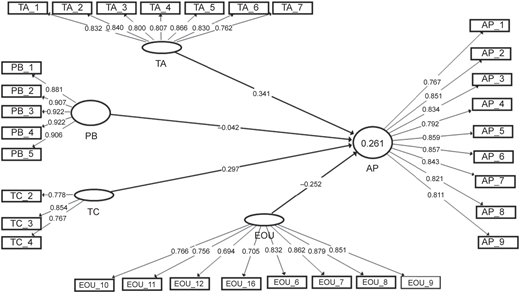
The results of the p-value and t-value are described in Table 7, which shows that technology adoption has a p < 0.001, and t = 7.223. These findings suggest that technology adoption has a significant effect on auditing practice, and it is evident that there are auditors who are ready to accept technology adoption in auditing practice, and accordingly, H1 is supported. The results of the p-value and t-value of technological challenges have p < 0.001 and t = 6.166, respectively, which indicates that technological challenge has a positive impact on auditing practice, especially as it is evident that a high level of technological challenges influences the adoption of technology tools by practicing auditors. H3 is thus also supported. The results of the p-value and t-value of ease of use have p < 0.001 and t = 4.587, respectively. This result indicates that ease of use has a positive impact on auditing practice, and it is evident that the factors of ease of use have a positive effect on audit practice. Therefore, H4 is also supported.
The p-value and t-value of perceived benefit have values of p > 0.05 and t = 0.988, respectively. This result indicates that perceived benefit has no impact on auditing practice, and that evidently, there is no lack of knowledge regarding the perceived benefit of the used of emerging technology tools for auditing practice among auditing professionals. H2 is accordingly not supported.
Overall, three findings support the claim that the majority of factors chosen for analysis had an impact on auditing practice.
6. Discussion
6.1 The impact of technology adoption among auditing practice
Previous studies have found that technology adoption is considered to be the most essential factor that impacts auditing practice (Mazza and Azzali, 2018; Baksaas and Stenheim, 2019; Wessels, 2005). Technology adoption facilitates the ability of auditors to enhance their auditing practice and also enables auditing practice to minimize probable misstatements when carrying out the auditing of items in financial statements. Additionally, scheduled auditing tasks can be carried out on time (Phang and Foong, 2010; Albring et al., 2014). Researchers originally intended to find the importance and effect of technology adoption on auditing practice (Mahzan and Lymer, 2014; Razi and Madani, 2013).
In Table 7, the path coefficient analysis reveals a significant link between the technology adoption and auditing practice (β = 0.341, p < 0.001). This is in accordance with the hypothesis proposed in this study, which indicates that technology adoption among auditors increases the level of efficiency in auditing practices. The positive relationships encountered between technology adoption and auditing practice is in accordance with the study of Mazza and Azzali (2018), who also noticed that the quality of IT controls has an impact on audits. Muda and Landau (2019) found that the technology use variable has a favorable and significant impact on the quality of auditing and accounting practices. Firstly, these positive findings can be explained by many reasons. Initially, the adoption of technology enabled in auditing practices improves the speed and accuracy of audit tasks. Secondly, scholars believe that traditional auditing might not be competent enough to be practiced in the current advanced technological environment, and therefore, practicing audit firms must transform manual auditing to technology-based auditing to improve auditing. Those firms that use technology in auditing ensure efficient, effective, speedy and timely auditing. As a result, it can be argued that the reasonable justification for obtaining this result for the first hypothesis is that auditors should be more aware of the benefits of using technology-enabled auditing software to improve their auditing efficiency.
6.2 The impact of the perceived benefit on auditing practice
The next factor examined in this research was perceived benefit. Numerous research studies have highlighted the fact that the perceived benefits of emerging technology are considered to be the most crucial factors that influence auditing practice (Razi and Madani, 2013; Abiola, 2014; Mihret and Yismaw, 2007). A well-formulated and executed audit plan is one that contains a thorough inclusion of cost and benefit emerging technology tools and cost-effective ICT training. CAATs can probably act as an associating mechanism for traditional audits with emerging technology enabled auditing, and the implementation of CAAT tools by practicing auditors has resulted in achieving many benefits. Nevertheless, the limited evidence regarding the assessment of cost-benefit analysis on investments in CAATs/GAS had led auditors to continue operating with the manual audit (Mohamed et al., 2019; Pedrosa et al., 2020). However, Table 5 shows the results of this study for the path coefficient analysis, where there was found to be a negative relationship between perceived benefit and auditing practice (β = -0.042, p > 0.05). This is not in accordance with the hypothesis suggested in this, which indicates that perceived benefit is positively associated with auditing practice.
6.3 The impact of the technological challenges on auditing practice
With regards the factor of technological challenges, the results reveal that there is a positive relationship between technological challenges and auditing practice. This finding suggests that a high level of technological challenges has a high and positive impact on auditing practice, which is in accordance with that, which was suggested in the purpose of this study (i.e. that technological challenges have a positive relationship with auditing practice) and which confirms a positive and significant direction (β = 0.297, p < 0.001). This can be perceived by the fact that a high degree of technological challenges exists among practicing auditors in the auditing practice. If there is a high level of technological challenge, then newly qualified auditors are prepared to accept these challenges in a positive way to implement advanced technology tools for audit practice. This could be the result of many reasons, such as that young, qualified auditors believe that customized audit software that is affordable for small-scale audit firms, together with technology-based audit training increases firm profitability, and that technology-enabled auditing can be understood by all those who have a basic level of computer knowledge. Widuri et al. (2019) believed that the adoption of audit software by practicing auditors is required to overcome the challenges of having to audit financial statements. Furthermore, Omoteso (2016) stated that auditors need to utilize both emerging technology tools and software to improve their quality of audit work and to able to refine their technical skills if they are to manage these new challenges. The literature defends that the audit of items in the financial systems of any organization cannot be carried out successfully without having proficiency in the transaction process via the use of computerized accounting. These results are in accordance with the objectives set out for this study.
6.4 The impact of ease of use on auditing practices
Perceived ease of use signifies “the extent to which a person believes that using an IT will enhance his or her job performance” (Betti and Sarens, 2021; Venkatesh and Bala, 2008). The findings for the fourth factor, i.e. ease of use, reveal that ease of use and auditing practice have a favorable and significant relationship. These results findings imply that the elements or factors of ease of use have a positive effect on auditing practice. These findings are in accordance with the objective of this study (i.e. that ease of use has a positive relationship with auditing practice), which confirms a significant direction (β = –0.252, p < 0.001). Auditors can use computer-assisted technologies to conduct automated audit testing across the company on a frequent, real-time basis. Damerji and Salimi (2021) found that technology readiness and perceived ease of use have a positive impact on technology adoption. In turn, Stevens (2016) found that emerging technology delivers an easy identification of the duplication of transaction data and can thus rule out the question of the reliability of the transactional data set. In addition, he states that it minimizes time spent on transforming data due to the automation process comprising pairing, extraction and formatting, and that a substantive audit includes access to all (100%) the data populations, which “can lead to superior results.” This could be attributed to the fact that there is a positive impact on the elements of ease of use among owners/partners of a sole proprietorship or partnership firms. Mansour (2016) specified that only two factors emanate from the TAM, which confirms that statutory auditor's intention to adopt CAATs, which facilitate conditions and auditors' PE. This result is in accordance with the objectives of this study. Emerging technology tools-enabled audit software can be used to ease the auditing of items in financial statements on time (Thottoli, 2021a). Researchers believe that sole proprietorship audit firms follow traditional audit practices, which can slow down the audit task, which in turn results in the non-acceptance of new client assignments. It is, therefore, important for auditors to adopt attitudes that accept the use of technology as this motivates them to adopt emerging technology tools-enabled audit software and thereby accept assignments from more clients. It is, therefore, suggested that sole proprietorship and partnership audit firms need to implement emerging technology tools-enabled audit software for auditing clients' financial statements. Ultimately, this exposes the fact that the inherent ease of use increases the adoption of emerging technology-enabled software by sole proprietorship and partnership firms, which, in turn, leads to improving the efficiency and effectiveness of auditing practice.
7. Conclusion
ICT provides a substantial change for the way of preparing and auditing financial statements. Even though the risk of material misstatements from the use of emerging technology tools-enabled transactions is high, such tools also provide new avenues for the auditing practice. The advancement of technology has shown that the traditional way of auditing is becoming more obsolete. Emerging technology tools-enabled audit software acts as a complement of added value to enable auditors to carry out audits in a more timely, efficient and effective way. Emerging technology tools-enabled auditing helps practicing auditors to accumulate sufficient and appropriate audit evidence through vouching, tracing, verification, recalculation, re-performance and electronic confirmation by third parties, and can be used to analyze procedures through the use of audit software. Accordingly, auditors must change their way of thinking to adopt emerging technology tools-enabled auditing software for auditing their clients' financial statements. The findings of this study confirm that technology adoption, technological challenges and ease of use all have a positive impact on emerging technology tools-enabled auditing practice, whereas perceived benefits have a negative relationship with emerging technology tools-enabled auditing practice.
8. Implications
The findings of this study can be used to determine a number of implications. This study highlights the value-added benefit of emerging technology tools-enabled audit software for owners or partners of sole proprietorship and partnership firms, especially in India. The adoption of audit software can increase the efficiency of carrying out audits by small audit firms. The research discussion and findings posit that a potential justification to influence the adoption of customized or GAS for internal or external auditors to make use of emerging technology-enabled audit tools. The propensity of junior auditors to adopt emerging technology, as well as their perceptions of its benefits and ease of use, provide insight into how practicing auditors can overcome technological challenges by redefining their audit firm's objectives. The findings enhance technology tools auditing practice and, in turn, add value to the literature on accounting. The study proposes public awareness of emerging technology tools-enabled audit practice, not only in form, but also in substance. Additionally, this research can assist policymakers, software providers, The Institute of Chartered Accountants of India (ICAI) – an association of audit firms, and also the government to establish thoughtful and deliberate policies that harness technology-enabled auditing practice.
9. Limitations
This research has been carried out within a limited geographical area – Kerala, India, where only auditors of a sole proprietorship or partnership firms were targeted. Hence, the results might only be relevant for the economic and governing environment of Kerala, India. It is thus necessary to carry out further research with other economic and geographical environments to provide broader findings. Future studies could also extend to large-scale audit firms in other parts of the world. Furthermore, the research could be extended to use qualitative methods. In should be added that other technological areas, such as ICT competency, ICT confidence and training in technology tools, could well impact accounting or auditing professionals' decision to adopt technology-enabled tools in the future.