


In the digital marketplace, consumers increasingly rely on opinion leaders to guide purchase decisions, yet the quality of information these influencers provide varies considerably. This study integrates opinion leadership theory with data quality research to examine how both source characteristics and information quality influence the five phases of rational consumer decision-making for high-value purchases.
Drawing on the Elaboration Likelihood Model, Uncertainty Reduction Theory, Social Proof Theory, and Information Processing Theory, we develop an integrated model hypothesizing phase-specific effects of opinion leadership and data quality. Empirical data were collected from 534 respondents via an online survey using a prototypical automotive opinion leader as stimulus. Data were analyzed using PLS-SEM with bootstrapping (5,000 subsamples).
Opinion leaders positively influence all five decision phases (need recognition, information search, evaluation of alternatives, selection and purchase, post-purchase evaluation), with effects strengthening across phases (ß = 0.373 to 0.717). Data quality influences the first four phases but not post-purchase evaluation (ß = 0.123, p = 0.205). Critically, data quality moderates opinion leadership effects only during the pre-purchase phases (DM1-3), not during purchase or post-purchase. These phase-specific patterns align with theoretical predictions about uncertainty reduction and cognitive load.
This study makes three novel contributions: (1) theoretical integration of opinion leadership and data quality within established consumer behavior frameworks, (2) phase-specific analysis revealing when each factor matters most, and (3) identification of boundary conditions where data quality ceases to moderate social influence. Results inform influencer marketing strategy, platform design for information quality, and consumer protection policies.
1. Introduction
1.1 The convergence of two digital phenomena
The digital marketplace has witnessed two parallel developments that fundamentally reshape consumer decision-making.
First, opinion leaders, individuals with substantial influence within online communities, have become central to how consumers discover, evaluate, and purchase products (Kaplan and Haenlein, 2010; Fakhreddin and Foroudi, 2021). According to the Global Web Index, 87% of consumers read product recommendations before online purchases, and 93% follow influencers on social media (Global Web Index, 2020). The influencer marketing industry, valued at $16.4 billion in 2022 (Forbes, 2022). By 2030, the global influencer marketing industry is forecasted to reach $40 billion (Doty, 2024). Opinion leaders shape consumer perceptions, attitudes, and intentions through attributes including credibility, attractiveness, expertise, and innovativeness (Fakhreddin, 2024; Chen et al., 2024; Ao et al., 2023; Casaló et al., 2020).
Second, the democratization of content creation has created a data quality crisis. With over 4.9 billion social media users worldwide generating content daily, anyone can attract followers and influence decisions regardless of expertise or information accuracy (Liu and Zhang, 2010). This has led to “information pollution”, the proliferation of misleading, inaccurate, or low-quality information in digital spaces (Wardle and Derakhshan, 2017). The European Commission (2022) identifies misinformation as a significant consumer protection concern, particularly when consumers make high-stakes decisions based on influencer content lacking accuracy, objectivity, or completeness (European Commission, 2022).
1.2 The research gap: studying source and message in isolation
Despite the simultaneous importance of opinion leaders and data quality, existing research has examined them in isolation. Opinion leadership research has focused on source characteristics such as credibility, attractiveness, expertise and their impact on consumer outcomes (Fakhreddin, 2024; Godey et al., 2016). Data quality research, grounded in the Total Data Quality Management (TDQM) framework, has examined information characteristics such as accuracy, completeness, timeliness, primarily in organizational decision-making contexts (Wang and Strong, 1996; Pipino et al., 2002; Batini et al., 2009).
Notably absent from the literature is an integrated investigation of how opinion leaders (the source) and data quality (the message) jointly influence consumer decision-making. This gap is significant because consumers do not experience these elements separately. When watching an opinion leader's video, consumers simultaneously process: (1) the source's credibility and attractiveness, and (2) the quality of information presented. The Elaboration Likelihood Model (Petty and Cacioppo, 1984) suggests persuasion occurs through both central route (information quality) and peripheral route (source credibility) processing, yet no study has examined how these dual routes operate across the entire rational decision-making process.
Furthermore, the five-phase rational decision model (Dewey, 1910; Engel et al., 1968) provides a nuanced framework for understanding phase-specific effects. Do opinion leaders and data quality exert uniform influence across need recognition, information search, evaluation of alternatives, selection and purchase, and post-purchase evaluation? Or do their roles differ depending on the cognitive demands and uncertainty levels of each phase? These questions remain unanswered.
1.3 Policy and practical drivers
Several policy issues motivate this investigation. First, consumer protection agencies worldwide are developing regulations for influencer marketing (FTC, 2023; OECD, 2021). Understanding whether data quality moderates opinion leader influence can inform disclosure requirements and content guidelines. Second, businesses investing in influencer marketing need evidence-based guidance for selecting partners who provide not only reach and credibility but also high-quality information. Third, platform designers face decisions about algorithmic ranking, should they prioritize engagement metrics or quality signals? This study's findings inform such design choices.
1.4 This study's contributions
This research addresses identified gaps by making three novel contributions:
Theoretical integration: We bridge opinion leadership theory with data quality research, grounding our model in established consumer behavior frameworks including the Elaboration Likelihood Model, Uncertainty Reduction Theory, Social Proof Theory, and Information Processing Theory.
Phase-specific analysis: Unlike previous studies treating decision-making as a unitary outcome, we examine effects across all five phases of rational decision-making, revealing when opinion leaders and data quality matter most.
Boundary condition identification: By testing moderation effects, we identify phases where data quality enhances opinion leader influence and phases where it does not, providing theoretical boundary conditions for dual-process models.
1.5 Research questions
This study addresses the following research questions:
How do opinion leaders and data quality dimensions (intrinsic, contextual, representational, accessibility) influence each phase of consumer rational decision-making (need recognition, information search, evaluation of alternatives, selection and purchase, post-purchase evaluation)?
Does data quality moderate the relationship between opinion leadership and each decision-making phase?
By exploring these questions, this research provides a deeper understanding of the interplay between social influence and information quality, contributing to marketing strategy, consumer protection, and platform design.
2. Literature review and hypotheses development
2.1 Opinion leadership
Opinion leadership refers to the extent to which an individual is regarded as a credible model whose recommendations others follow (Lazarsfeld et al., 1968). This construct originated from the two-step flow of communication theory, which proposes that opinion leaders first gather information from mass media and subsequently disseminate it through word-of-mouth (Lazarsfeld et al., 1968; Katz and Lazarsfeld, 1955).
Research confirms opinion leaders exert greater influence than mass media alone (Veirman et al., 2017). This heightened influence stems from opinion leaders' ability to shape consumers' thoughts, attitudes, and behaviors (Nunes et al., 2018). They enjoy public recognition and acceptance within their communities (Fakhreddin, 2024).
Opinion leaders are distinguished by several key attributes. They possess extensive domain knowledge and maintain large followings (Thakur et al., 2016). Specific characteristics enhancing influence include credibility, attractiveness, innovativeness, and sense of humor (Fakhreddin, 2024). They actively participate in online communities, recognized as experts in products or services, maintain distinct public identities, and receive support from other users for their discerning taste (Alves and Paula, 2014; Chan and Misra, 1990).
The terms opinion leaders, experts, and influencers are often used interchangeably, though distinctions exist. Experts possess deep knowledge but lack organic audiences, primarily marketing through word-of-mouth. Influencers have large social media followings but may lack profound subject matter expertise. Opinion leaders combine both expertise and an audience that follows their advice (Xu and Zhang, 2021).
Digital opinion leaders influence followers in three primary ways: serving as models to be emulated, advertising through word-of-mouth, and providing purchase advice (Merwe and Van Heerden, 2009). Word-of-mouth from opinion leaders generates nearly twice the long-term value of traditional promotional tools (Villanueva et al., 2008). They enhance consumer trust by mitigating social complexities and perceived risks (Gefen, 2000).
With advancing digital technology, traditional opinion leaders have evolved into digital content creators who generate income through sponsored content, affiliate marketing, and brand endorsements (Simonson, 2024). The pressure to post continuously can lead to overlooking data quality, potentially misleading followers who rely on this content for decision-making. Consumers exposed to low-quality data may suffer financially, leading to dissatisfaction and negative word-of-mouth. This study addresses this challenge by examining how data quality moderates opinion leader influence.
2.2 Consumer decision-making process
Consumers engage in decision-making to address problems encountered in daily life. Decision-making can be categorized into three types based on cognitive effort: rational, limited, and emotional (See and Lee, 2009; Mothersbaugh et al., 2020). Rational decision-making involves significant cognitive effort, where consumers compile options and evaluate attributes to identify optimal choices. Emotional decision-making relies on feelings, habits, or past experiences with minimal cognitive effort. Limited decision-making falls between these models.
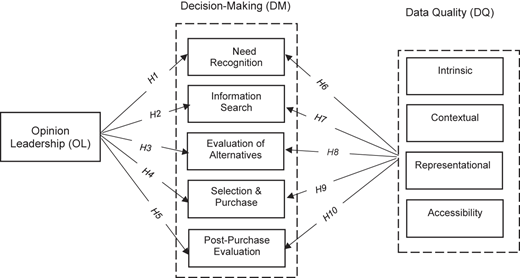
This study adopts the rational model, predominantly applied to significant purchases such as automobiles, property, and other high-value items. The rational model delineates five phases: need recognition, information search, evaluation of alternatives, selection and purchase, and post-purchase evaluation (Dewey, 1910; Engel et al., 1968; Simon, 1997; Kotler, 2000). These steps are shown in Figure 1.

2.2.1 Need recognition
The purchase decision-making process commences with the need recognition phase, wherein consumers identify a need by comparing their current state with their desired or ideal state. This need can be triggered by internal factors such as hunger, thirst, and greed, or external factors such as advertisements and salespeople. A significant discrepancy between the perceived current state and the perceived desired state leads to need recognition, which is based on the consumer's perceptual assessment rather than an objective evaluation (Mothersbaugh et al., 2020). Perception shapes how consumers view their surroundings, influencing the need recognition phase. The tendency to seek variety can also drive need recognition, which typically increases when purchase frequency is low (Comegys et al., 2006). Opinion leaders, perceived as experts and trustworthy in their field, can influence consumer product and brand adoption. To initiate momentum and impact consumer behavior, companies often employ several opinion leaders with specific objectives to promote their brands (Amblard and Deffuant, 2004). Opinion leaders provide product information and advice for purchase decisions to other consumers through frequent word of mouth, thereby affecting the perception, attitude, and behavior of other consumers (Villanueva et al., 2008). Consumer needs can be either active (those that the consumer is aware of) or inactive (those that the consumer is unaware of). Opinion leaders play a crucial role in making consumers aware of these needs, particularly inactive ones. Therefore:
Opinion leaders positively impact the need recognition phase by increasing consumer awareness of both active and inactive needs.
2.2.2 Information search
The subsequent step in the purchase decision process is the information search, wherein consumers utilize various channels to gather information about products or services that can fulfill their needs. This phase equips consumers with evaluative criteria, alternative solutions, and the alignment between these alternatives and the evaluative criteria (Mothersbaugh et al., 2020). The information search can be internal or external. Initially, consumers rely on their long-term memory to find suitable solutions based on past experiences. If the internal search is insufficient, consumers turn to external sources such as websites, opinion leaders, and blogs (Punj and Brookes, 2001). Consumers receive information in passive and active modes. In the passive mode, they pay attention to conversations and advertisements around them, whereas in the active mode, they deliberately seek detailed information about various vendors, brands, and models. Information sources can be categorized into three main types: personal sources (e.g. family and friends), commercial sources (e.g. mass media, advertising, and salespeople), and experimental sources (e.g. examining the product in person) (Moorthy et al., 1997). The search process aims to reduce uncertainty about a product and its potential alternatives (Posavac et al., 2002; Erdem and Swait, 2004; Paulssen and Bagozzi, 2005; Comegys et al., 2006). In this phase, consumers research products or services by collecting information from opinion leaders (Zhao et al., 2018). Consumers seek information from opinion leaders to mitigate risks in the purchase process, as opinion leaders are considered credible sources of information (Ding and Qiu, 2019). Opinion leaders can significantly impact the information search phase by providing timely and accurate information, aiding consumers in assessing the specifics and overall value of products and services (Song et al., 2017). Therefore:
Opinion leaders positively impact the information search phase by increasing the amount of accurate information available to consumers and expediting decision-making.
2.2.3 Evaluation of alternatives
In the evaluation of alternatives phase, consumers establish criteria for the items in their choice set to shortlist them for the final purchase. These criteria represent the minimum acceptable levels that an item must meet to be included in the final choice set. From the consumer's perspective, evaluative criteria are based on the benefits they can receive from the brand rather than solely its technical features. These criteria can be tangible, such as cost, product dimensions, and performance measures, or intangible, such as style, taste, prestige, or brand image (Bloch, 1995). By the end of the evaluation phase, consumers have ranked all items in their choice set. Recommendations play a crucial role in helping consumers reduce the amount of information they need to process and shortlist the alternatives that can meet their needs (Kumar and Benbasat, 2006). A significant source of recommendations is opinion leaders (Shi and Wojnicki, 2014). Consumers seek recommendations to mitigate the physical, financial, and social risks associated with decision-making. Opinion leaders fulfill this role by experimenting with and evaluating various alternatives (Leal et al., 2014; Cho et al., 2012). Therefore:
Opinion leaders positively impact the evaluation of alternatives phase by enhancing consumers' ability to rank and compare different options effectively.
2.2.4 Selection and purchase
In the selection and purchase phase, consumers choose and buy their preferred item. Choice uncertainty is a key driver of information search for decision-making (Raiffa, 1968; Schlaifer, 1959). Consumers generally follow one or a combination of affective, attitude-based, and attribute-based approaches to select their intended brand and product. Consumers with high levels of choice uncertainty are more likely to consult others, such as peers and experts (Urbany et al., 1989; Huang et al., 2017). Two factors might impact consumer decisions in this phase. First, the attitudes of others, such as best friends or community pressure, can alter a consumer's preference despite their initial intention to buy a different item. Second, unexpected situations, such as sudden price changes, can also influence decisions. Opinion leaders strongly impact the decision-making process of purchasers for choosing a product or service, as well as their behaviors and attitudes (Godey et al., 2016). They can persuade ordinary agents to adopt their thoughts even if there is a slight difference between their own opinions and those of ordinary agents (Amblard and Deffuant, 2004). Consumer attitude acts as a precursor to judgment, decision, and behavior (Petty et al., 1995). Opinion leaders influence consumers' attitudes toward a brand, shaping their brand preferences and resulting in purchase decisions (Godey et al., 2016). Additionally, the endorsement of an opinion leader can lessen the risk of purchasing goods online (Tobon and García-Madariaga, 2021). Therefore:
Opinion leaders positively impact the selection and purchase phase by recommending appropriate items that fulfill consumer needs.
2.2.5 Post-purchase evaluation
The final phase in the purchase decision process is the post-purchase evaluation, which occurs after the purchase. This step involves usage, evaluation, and satisfaction, potentially leading to repurchase, positive word of mouth, and loyalty, or dissatisfaction, resulting in brand-switching, severing ties with the vendor, and negative word of mouth. Immediately after the purchase and before usage, consumers may experience doubt or anxiety known as post-purchase dissonance. This dissonance is caused by factors such as the difficulty of choosing among alternatives, the importance of the decision, the consumer's tendency to experience anxiety, and the irrevocability of the decision (Mothersbaugh et al., 2020; Sweeney et al., 2000). Dissonance generally occurs when consumers are highly involved with purchases through rational decision-making and is less common with emotional and limited decision-making (Luce, 1998). Opinion leaders can positively impact consumers' trust and loyalty through their reputation, innovativeness, expertise, communication skills, and credibility (Ho, 2021; Divita, 2015; Zhao et al., 2018; Huffaker, 2010). Although opinion leaders cannot directly influence factors such as the importance of the decision, the consumer's tendency to experience anxiety, and the irrevocability of the decision, they can mitigate consumer dissonance by reassuring consumers of their choice. Therefore:
Opinion leaders positively impact the post-purchase phase by reducing post-purchase dissonance.
2.3 Data quality
Data quality is crucial in decision-making as it serves as the foundational material upon which decisions are based; low-quality data can lead to erroneous decisions (Wang et al., 2023). In the past literature, the terms data and information have often been used interchangeably. Data refers to raw facts collected on a subject, such as product attributes like price and type, whereas information refers to processed data, such as identifying the best-selling product over a certain period. The field of data quality is theoretically defined within the Total Data Quality Management (TDQM) framework, which aims to deliver high-quality data for decision-making (Wang, 1998). In the context of information systems, data quality is evaluated based on the system's ability to convey semantic meaning and communicate knowledge (Xu et al., 2013).
In this research, the source of information is an opinion leader who provides data on vendors, brands, products, and services. The data quality framework was first defined by Wang and Strong (1996), who identified key data quality dimensions for data consumers. According to Wang and Strong (1996), four dimensions—intrinsic, contextual, representational, and accessibility—along with their respective subdimensions, define data quality. Intrinsic data quality refers to the inherent quality of data without considering its practical context. Contextual data quality assesses the quality of data within a specific context. Representational data quality includes the understandability and conciseness of the data. The accessibility dimension refers to the availability of data to authorized users. Table 1 depicts the main dimensions of data quality and their respective subdimensions (Wang and Strong, 1996).
Data quality dimensions
| Intrinsic | Contextual | Representational | Accessibility |
|---|---|---|---|
| Accuracy(DQ1) | Relevancy(DQ5) | Interpretability(DQ10) | Accessibility(DQ14) |
| Believability(DQ2) | Value-added(DQ6) | Understandability(DQ11) | |
| Objectivity(DQ3) | Timeliness(DQ7) | Representational consistency(DQ12) | Security(DQ15) |
| Reputation(DQ4) | Completeness(DQ8) | Concise Representation (DQ13) | |
| Appropriate amount of data(DQ9) |
Quality is considered a precondition for excellence in organizational processes (Smith and Offodile, 2008). Thus, data, as the raw material for decision-making at both organizational and individual levels, needs to be of high quality to produce fruitful results. To measure data quality, both the subjective perception of data users and the objective measurements of quality dimensions can be considered. If data users assess the quality of data as poor, it will influence their behavior accordingly (Pipino et al., 2002). User perception of quality can be measured using quantitative approaches such as survey questionnaires.
The following paragraphs define the data quality dimensions mentioned in Table 1. Accuracy measures the correctness of the data, ensuring that database values match real-world values (Batini et al., 2009). Believability is the degree to which information is perceived as true and credible. Objectivity refers to the fairness, impartiality, and lack of bias in the information. Reputation indicates how highly information is valued based on its source and content. Relevancy is the extent to which the data is applicable to the task at hand. Value-added measures the benefit provided by the data. Timeliness assesses how up-to-date the data is, considering the time elapsed between a real-world change and the subsequent update. Completeness evaluates whether the data is sufficient in terms of depth and breadth, with an appropriate amount of data fulfilling the needs. The representational data category includes interpretability, ease of understanding, representational consistency, and concise representation. Interpretability is the extent to which data is appropriate in terms of languages, symbols, units, and definitions. Understandability measures how unambiguous, transparent, and simple the data is to comprehend. Representational consistency ensures that relevant data is displayed in a uniform format. Concise representation refers to the degree to which information is condensed without being overwhelming. In the accessibility category, accessibility refers to the ease with which authorized users can retrieve data, while security ensures that information access is adequately restricted (Pipino et al., 2002; Wang and Strong, 1996). Danniswara et al. (2017) confirmed that information quality and brand preference are relevant dimensions in consumers' purchase intentions and decisions. The Elaboration Likelihood Model (ELM) suggests that informational influence can occur at any stage of the decision-making process (Petty and Cacioppo, 1984). Users often assess the quality of arguments based on their perceptions of the information source. High-quality arguments are considered useful, leading to information acceptance and attitude change, which consequently influences purchase intention (Bhattacherjee and Sanford, 2006; Nunes et al., 2018). For a message to be persuasive, it must exhibit argument quality, source credibility, source attractiveness, and source perception (Teng et al., 2014). Argument quality is validated in terms of completeness, accuracy, timeliness, relevance, and strength (Cheung and Thadani, 2012). Exposure to persuasive messages can alter attitudes, influencing the intention to purchase recommended products or services (Hsu et al., 2013). When purchasing expensive items such as cars, consumers often consult various sources, including market experts, to make informed decisions. High-quality data from online influencers can significantly aid potential buyers throughout the decision-making process. Therefore, the acceptance of information, which depends on its quality, directly affects consumers' purchase intentions. Since consumers need quality data to make correct decisions, data quality dimensions significantly impact the decision process. Given the persuasive role of opinion leaders in purchase intention and decision, the quality of the information they provide is crucial. Therefore, we hypothesize:
The perceived quality of data provided by opinion leaders positively impacts need recognition.
The perceived quality of data provided by opinion leaders positively impacts information search.
The perceived quality of data provided by opinion leaders positively impacts evaluation of alternatives.
The perceived quality of data provided by opinion leaders positively impacts selection and purchase.
The perceived quality of data provided by opinion leaders positively impacts post-purchase evaluation.
2.4 Theoretical framework: integrating opinion leadership and data quality
This study draws upon multiple complementary theoretical perspectives to explain how opinion leaders and data quality jointly influence consumer decision-making. Rather than presenting a purely descriptive model, we ground our hypotheses in established consumer behavior theories that specify the mechanisms through which source characteristics and information quality operate.
2.4.1 Elaboration likelihood model (ELM)
The Elaboration Likelihood Model (Petty and Cacioppo, 1984; 1986) provides the foundational framework for understanding dual routes to persuasion. ELM posits that individuals process persuasive information through two distinct routes:
Central route: When motivation and ability to process information are high, individuals carefully scrutinize message arguments. In this route, information quality (accuracy, completeness, relevance) determines persuasion outcomes.
Peripheral route: When motivation or ability is low, individuals rely on heuristic cues such as source attractiveness, expertise, or credibility. In this route, source characteristics (opinion leadership attributes) drive persuasion.
In the context of high-involvement purchases like automobiles, consumers are typically motivated to process information carefully, suggesting central route processing should dominate. However, the complexity of automotive decisions may exceed many consumers' expertise, creating conditions where peripheral cues become important (Chaiken, 1980).
Application to this study: ELM predicts that opinion leaders influence consumers primarily through peripheral route mechanisms (source credibility, attractiveness, expertise), while data quality influences consumers through central route mechanisms (argument quality). The relative importance of each route may vary across decision phases depending on consumers' motivation and ability at each stage.
2.4.2 Uncertainty reduction theory (URT)
Uncertainty Reduction Theory (Berger and Calabrese, 1975) has been extensively applied to consumer behavior (Urbany et al., 1989). URT posits that individuals are motivated to reduce uncertainty in decision-making situations, particularly when decisions involve significant consequences.
In consumer contexts, uncertainty manifests in multiple forms (Murray, 1991):
Knowledge uncertainty: Lack of information about product attributes
Choice uncertainty: Difficulty comparing alternatives
Outcome uncertainty: Inability to predict post-purchase satisfaction
Application to this study: The five-phase decision-making model can be reconceptualized as a progressive uncertainty reduction process:
Need recognition (DM1): Uncertainty about current-desired state discrepancy
Information search (DM2): Active uncertainty reduction through information acquisition
Evaluation of alternatives (DM3): Uncertainty reduction through comparison
Selection and purchase (DM4): Residual uncertainty despite information
Post-purchase evaluation (DM5): Uncertainty about decision correctness (dissonance)
Opinion leaders reduce uncertainty by providing expert guidance (Gefen, 2000), while high-quality data reduces uncertainty by providing accurate, complete, and timely information (Wang and Strong, 1996). This theoretical lens explains why both constructs matter and predicts that their relative importance may diminish once uncertainty is resolved.
2.4.3 Social proof theory
Social Proof Theory (Cialdini, 1984, 2009) asserts that individuals look to others' behavior to determine appropriate action in ambiguous situations. This heuristic, “if others are doing it, it must be correct”, operates strongly when individuals lack expertise or face complex decisions.
Application to this study: Opinion leaders serve as social proof agents. When consumers observe an opinion leader endorsing a product, they interpret this as evidence that the product is appropriate. Data quality interacts with social proof by providing the substantive evidence that validates or undermines the opinion leader's recommendations. High-quality data strengthens social proof by demonstrating that recommendations are evidence-based; low-quality data weakens social proof by revealing that recommendations lack foundation.
2.4.4 Information processing theory
Information Processing Theory (Bettman et al., 1998) conceptualizes consumers as cognitive misers who seek to minimize mental effort while making satisfactory decisions. Consumers develop heuristics and decision strategies to cope with information overload.
Application to this study: The five decision phases impose different cognitive demands:
Need recognition (DM1): Low cognitive load; pattern recognition
Information search (DM2): High cognitive load; active processing
Evaluation of alternatives (DM3): Highest cognitive load; comparative judgment
Selection and purchase (DM4): Moderate cognitive load; implementation
Post-purchase evaluation (DM5): Low cognitive load; satisfaction assessment
Opinion leaders reduce cognitive load by providing pre-processed information and recommendations (Kumar and Benbasat, 2006). Data quality affects the efficiency and accuracy of cognitive processing—high-quality information is easier to process and yields more accurate judgments. This explains why DQ moderation effects appear in high-load phases (DM2, DM3) but disappear in lower-load phases (DM4, DM5).
2.4.5 Integrated theoretical model
Table 2 summarizes the theoretical predictions and their alignment with this study's findings.
Theoretical foundations summary
| Theory | Key mechanism | Predictions for this study | Alignment with findings |
|---|---|---|---|
| Elaboration Likelihood Model | Central vs. peripheral processing | Both OL (peripheral) and DQ (central) influence DM; effects vary by phase | Supported: Both constructs significant; patterns differ by phase |
| Uncertainty Reduction Theory | Uncertainty motivates information seeking | Strongest effects in high-uncertainty phases (DM1-3) | Supported: Effects strongest in early phases |
| Social Proof Theory | Others' behavior guides decisions | OL influence strengthened by DQ (social proof validation) | Partially supported: Moderation in DM1-3 only |
| Information Processing Theory | Cognitive load affects processing | DQ moderation strongest in high-load phases (DM2, DM3) | Supported: Moderation only in high-load phases |
3. Research method
The proposed research model is illustrated in Figure 2. This project adopts a quantitative approach to assess consumers' perceptions of data quality (DQ) and opinion leadership (OL), and their impact on purchase decision-making (DM). The primary objective is to elucidate the relationships between the research constructs. Initially, the relationship between OL and DQ with the five phases of DM will be investigated. Subsequently, the moderating impact of DQ on the relationship between OL and the five phases of DM will be explored.
3.1 Data collection
The proposed research model was tested through an online survey designed to capture participants' perceptions regarding the impact of opinion leadership (OL) and data quality (DQ) dimensions on various phases of the decision-making (DM) process. Data collection was conducted in two phases. In the first phase, 241 samples were collected from various groups: (1) online participants invited via LinkedIn, (2) students, staff, and faculty at an American university who were asked to participate through the Communication Center website, (3) students at the College of Business who participated via the research pool and received one credit hour, and (4) students enrolled in business courses at the College of Business. In the second phase, 336 samples from diverse demographic groups worldwide were collected through crowdsourcing on Prolific. A total of 43 incomplete samples were removed from the dataset, leaving 534 samples for analysis. These samples were checked for missing data, outliers, and invalid values to ensure the reliability of the data analysis results. All participants voluntarily completed the online survey on Qualtrics.
The survey instrument, provided in Appendix A, was adapted from previous research projects in this area, with some questions newly designed. Items for OL were adapted from Casaló et al. (2009), Gentina et al. (2014), and Thakur et al. (2016). Items for DM were based on the five-phase rational decision model (Dewey, 1910; Engel et al., 1968; Simon, 1997; Kotler, 2000), and items for DQ were adapted from Wang and Strong (1996). The instrument utilized a seven-point Likert scale format (“strongly agree = 1” through “strongly disagree = 7”), assessing respondents' agreement with questions on OL, DQ, and DM.
Three groups of questions were asked for DQ, DM, and OL as research constructs. For the OL category, respondents were asked to watch at least two videos from a list of hand-picked videos by a famous YouTuber, Scotty Kilmer, a mechanic with over 50 years of experience and more than six million subscribers. He publishes daily videos on various car-related topics, including technical details, purchasing advice, and reviews of different makes and models. Respondents were asked six questions (OL1-6) about their perception of Scotty to determine whether they accepted him as an opinion leader.
To assess the impact of opinion leadership on the five phases of rational decision-making, respondents were asked five questions (DM1-5) regarding the influence of the YouTuber's information on their decision-making. These questions collectively constitute the DM construct. For data quality, participants were asked fifteen questions (DQ1-15) about the impact of Scotty's data quality dimensions on their decision-making phases. To control variables such as make, model, and year in consumer decision-making, respondents were encouraged to watch two preselected videos on the YouTuber's channel, where he recommends cars from Toyota based on criteria such as budget, durability, maintenance, and depreciation.
The survey was approved by the International Review Board (IRB) under contract 2005863–1.
3.1.1 Stimulus selection justification
The selection of a single opinion leader (Scotty Kilmer) as the stimulus was a deliberate methodological choice with both strengths and limitations. Following established guidelines for experimental survey design (Highhouse and Gillespie, 2009; Aguinis and Bradley, 2014), we prioritized internal validity over external validity at the stimulus level for several reasons:
Stimulus consistency: Using multiple influencers would introduce confounding variance related to differences in communication style, presentation format, content selection, and parasocial relationship development. This would make it impossible to isolate effects of opinion leadership and data quality from influencer-specific characteristics.
Manipulation control: A single stimulus allows precise control over information respondents receive. All participants watched the same videos, ensuring variations in data quality perceptions reflect individual evaluation differences rather than objective content differences.
Theoretical sampling: Scotty Kilmer exhibits prototypical opinion leader characteristics as defined in literature:
Domain expertise: 50+ years mechanical experience
Reach: 6+ million subscribers
Content frequency: Daily uploads
Engagement: High comment activity
Trustworthiness: Established reputation in automotive communities
Independence: Not directly employed by automotive manufacturers
Following Calder et al.'s (1982) distinction between effects application and theory application research:
Effects application seeks to generalize findings to specific populations, contexts, and stimuli. Our single-stimulus design would be inappropriate for effects application.
Theory application seeks to test theoretical relationships hypothesized to generalize across contexts. Our design is appropriate for theory application because we test generalizable mechanisms (ELM dual routes, uncertainty reduction, social proof) rather than stimulus-specific effects.
3.2 Data analysis
Among 534 respondents, 296 were male, 234 were female, and 4 preferred not to disclose their gender. In terms of age, 308 respondents were in the 18–24 age group, 142 participants were in the 25–34 age group, 57 participants were in the 35–44 age group, 18 participants were in the 45–54 age group, 7 participants in the 55–64 age group, and 2 participants in the 65+ age group. Regarding employment, 301 were students, 15 were faculty, 143 were staff, 2 were retired, 39 were self-employed, and 34 were unemployed. In terms of education level, 2 had less than a high-school degree, 95 were high-school graduates, 198 had some college education with no degree, 48 participants had associate degrees, 140 participants had bachelor's degrees, 41 participants had master's degrees, 6 had doctoral degrees, and 4 participants had professional degrees (JD, MD).
The data analysis was carried out using SmartPLS (Ringle et al., 2024). The proposed hypotheses were tested using PLS-SEM (Partial Least Squares Structural Equation Modeling). Structural Equation Modeling (SEM) is utilized to simultaneously identify multiple statistical relationships through visualization and model validation. As an extension of multiple regression and factor analysis, SEM explores relationships between multiple constructs, each represented by various measures (Dash and Paul, 2021; Sarstedt et al., 2017). It uses a confirmatory approach to hypothesis testing by examining dependence relationships among research constructs (Hooper et al., 2008).
There are two main variations of SEM: Covariance-Based SEM (CB-SEM) and Partial Least Squares SEM (PLS-SEM). PLS-SEM, which is based on variance models, has proven to be more effective for theory development (Hair et al., 2017), making it suitable for this study. In this research, PLS-SEM is applied to investigate the relationships between research constructs. PLS-SEM uses Confirmatory Factor Analysis (CFA) on the variables that define each construct. The primary objective of PLS-SEM is to maximize the explained variance (R2) of the endogenous latent variables in the PLS path model. Key metrics for evaluating the measurement model include reliability, convergent validity, and discriminant validity. For the structural model, important metrics include R2 (explained variance), f2 (effect size), Q2 (predictive relevance), and the size and statistical significance of the structural path coefficients (Hair et al., 2017).
3.2.1 Measurement model validation
In the initial step of data analysis, we examine the proposed research model using PLS-SEM. To evaluate the model, we first assess the measurement models to ensure the reliability and validity of the variables constituting the constructs. This is followed by an evaluation of the structural models to analyze the relationships between these constructs. As shown in Figure 3, all loadings of the research main constructs including opinion leadership and data quality are above 0.8, indicating high convergent validity of the construct factors. To assess the reliability of the measures, indicator reliability, composite reliability (CR), Cronbach's Alpha, rho_A, and rho_C were used. All outer loadings for constructs are above 0.7, indicating the reliability of all indicators. All reported values for CR and Cronbach's Alpha are above 0.8, establishing reliability for all reflective constructs.
For OL, Cronbach's alpha (0.954) for internal consistency reliability and composite reliability (0.957) indicate that the measurement model is both valid and reliable. For DQ, Cronbach's alpha (0.988) for internal consistency reliability and composite reliability (0.989) demonstrates high validity and reliability of the DQ construct. Furthermore, all variables within the research constructs have an Average Variance Extracted (AVE) above 0.8, demonstrating high convergent validity (Shi and Maydeu-Olivares, 2019).
For discriminant validity, all square roots of AVEs are above 0.7 and greater than the loadings on other constructs, verifying discriminant validity. Additionally, the discriminant validity reported by the Heterotrait-Monotrait ratio (HTMT) is less than the acceptable threshold of 0.9, confirming discriminant validity (Hair et al., 2017). Therefore, we conclude that OL and DM1-5 are distinct and unique constructs. The HTMT via 5,000 bootstrapping subsamples was used to assess discriminant validity. All HTMT values are below 0.90, indicating discriminant validity between all constructs.
Furthermore, to check for common method bias, we conducted a Common Method Factor analysis. The tolerance values (VIF) for the predictor construct (OL1-6) and the latent variable (DM1-5) range between 1 and 1.674, which falls within the acceptable range of 0.20–5 (Hair et al., 2017), confirming that there is no collinearity between the predictor construct variables and the latent variables. Next, we assess collinearity for the DM1-5 and DQ1-15 constructs using VIF values, which range from 1 to 2.18, well within the acceptable range of 0.20–5 (Hair et al., 2017). This confirms the absence of collinearity among the predictor and latent variables.
3.2.2 Hypothesis results – structural model evaluation
The next step involves evaluating the path coefficients and the significance of the effects. We use the PLS complete bootstrapping procedure with 5,000 subsamples to test the statistical significance of the structural paths (hypotheses). The results, as shown in Figure 3, indicate that the effect of OL on the five phases of DM is significant.
Results indicate that OL positively impacts:
DM1 (Need Recognition): β = 0.373, R2 = 0.866, p < 0.001
DM2 (Information Search): β = 0.450, R2 = 0.850, p < 0.001
DM3 (Evaluation of Alternatives): β = 0.391, R2 = 0.835, p < 0.001
DM4 (Selection and Purchase): β = 0.552, R2 = 0.811, p < 0.001
DM5 (Post-Purchase Evaluation): β = 0.717, R2 = 0.698, p < 0.001
The significance of all factors calculated using bootstrap analysis is less than 0.001, confirming the importance of the variables and the model. The result of the first part indicates that hypotheses H1 through H5 are supported.
Furthermore, the impact of Data Quality (DQ) on the five phases of Decision-Making is shown in Figure 3. Results show that DQ positively impacts:
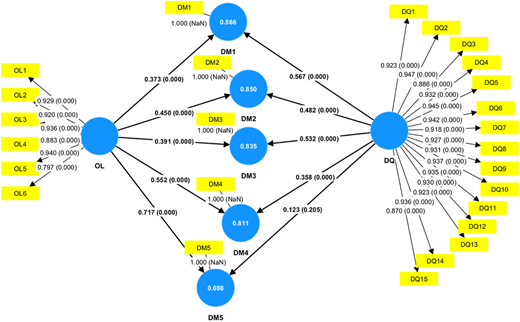
DM1: β = 0.567, R2 = 0.866, p < 0.001
DM2: β = 0.482, R2 = 0.850, p < 0.001
DM3: β = 0.532, R2 = 0.835, p < 0.001
DM4: β = 0.358, R2 = 0.811, p < 0.001
DM5: β = 0.123, R2 = 0.698, p = 0.205
Therefore, H6 through H9 are supported. H10 is not supported due to the insignificance of the test (p > 0.05).
In the last step, we study whether DQ moderates the impact of OL on the five phases of DM. As indicated in Figure 4, DQ moderates the influence of OL on DM1 through DM3 (i.e. need recognition, information search, and evaluation of alternatives). The results indicate that DQ moderates the impact of OL on:
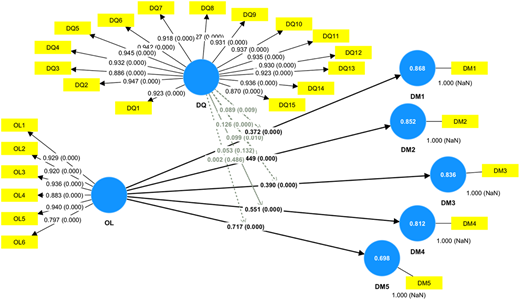
DM1: β = 0.089, p < 0.01
DM2: β = 0.126, p < 0.001
DM3: β = 0.099, p < 0.01
However, due to the insignificance of the tests (p > 0.05), DQ does not moderate:
DM4: β = 0.053, p = 0.132
DM5: β = 0.002, p = 0.486
Table 3 summarizes the result of hypotheses testing.
Hypotheses results
| Hypothesis | Path coef | p-value | Sig. |
|---|---|---|---|
| H1: opinion leaders (OL) → consumer decision making (DM1) need recognition | 0.373 | 0.000 | YES |
| H2: opinion leaders (OL) → consumer decision making (DM2) information search | 0.450 | 0.000 | YES |
| H3: opinion leaders (OL) → consumer decision making (DM3) evaluation of alternatives | 0.391 | 0.000 | YES |
| H4: opinion leaders (OL) → consumer decision making (DM4) selection and purchase | 0.552 | 0.000 | YES |
| H5: opinion leaders (OL) → consumer decision making (DM5) post-purchase evaluation | 0.717 | 0.000 | YES |
| H6: data quality (DQ) → consumer decision making (DM1) need recognition | 0.567 | 0.000 | YES |
| H7: data quality (DQ) → consumer decision making (DM2) information search | 0.482 | 0.000 | YES |
| H8: data quality (DQ) → consumer decision making (DM3) evaluation of alternatives | 0.532 | 0.000 | YES |
| H9: data quality (DQ) → consumer decision making (DM4) selection and purchase | 0.538 | 0.00 | YES |
| H10: data quality (DQ) → consumer decision making (DM5) post-purchase evaluation | 0.123 | 0.205 | NO |
| DQ moderating effect on OL → DM1 (strengthening) | 0.089 | 0.009 | YES |
| DQ moderating effect on OL → DM2 (strengthening) | 0.126 | 0.000 | YES |
| DQ moderating effect on OL → DM3 (strengthening) | 0.099 | 0.010 | YES |
| DQ moderating effect on OL → DM4 (strengthening) | 0.053 | 0.132 | NO |
| DQ moderating effect on OL → DM5 (strengthening) | 0.002 | 0.486 | NO |
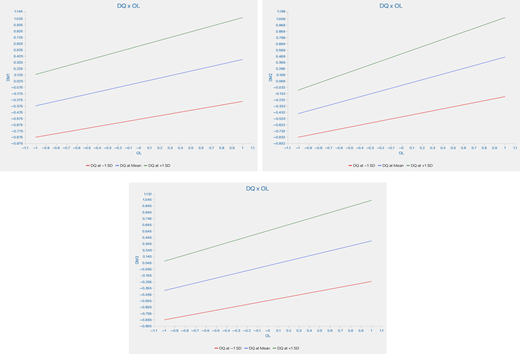
The results indicate that not only does the information provided by opinion leaders impact the first three phases of rational decision-making, but the quality of the data they provide also moderates their influence on consumer decision-making. The first three stages of decision-making—need recognition, information search, and evaluation of alternatives—are heavily reliant on the information provided by opinion leaders. The slope analysis results (Figure 5) show that the moderating effect of data quality strengthens the relationship between opinion leaders and the first three stages of decision-making. This means that if opinion leaders provide higher quality data, they can have a stronger effect on consumer decision-making. The non-significant effects of data quality on the last two stages of decision-making are theoretically meaningful and will be discussed in the next section.
4. Discussion
4.1 Discussion of findings
This study explored the significance of opinion leaders (OL) and the quality of the data they provide (DQ) on consumer decision-making (DM). The findings reveal that opinion leaders significantly influence all phases of consumer decision-making, with effects strengthening across phases (β increasing from 0.373 for need recognition to 0.717 for post-purchase evaluation). This pattern suggests that opinion leaders' influence becomes more pronounced as consumers progress through the decision journey, potentially because accumulated trust and perceived expertise have greater impact on later phases where uncertainty about decision correctness is highest.
Data quality impacts the first four phases of rational decision-making but not post-purchase evaluation. The strongest effects were observed in need recognition (β = 0.567) and evaluation of alternatives (β = 0.532), indicating that high-quality information is most critical when consumers are building awareness of needs and comparing options. The non-significant effect on post-purchase evaluation (β = 0.123, p = 0.205) aligns with theoretical expectations that experiential factors dominate after purchase. Data quality also moderates the influence of opinion leaders on the first three phases (need recognition, information search, evaluation of alternatives) but not during the purchase and post-purchase phases. This phase-specific moderation pattern is one of the study's most important findings, revealing that the synergy between source credibility and information quality operates primarily during pre-purchase deliberation. Once consumers accept an individual as an opinion leader, they rely heavily on them for decision-making. Opinion leaders facilitate consumer decision-making by introducing new information that helps consumers recognize their needs, whether they are aware of them or not. Consumers perceive opinion leaders as reliable sources of information, consistent with findings by Ding and Qiu (2019) and Zhao et al. (2018). Opinion leaders assist consumers in selecting items by listing and recommending those that fulfill their needs (Ding and Qiu, 2019; Zhao et al., 2018). When making significant purchases, such as property or cars, consumers risk substantial capital. Accurate decisions result in comfort and financial gain, while poor decisions can lead to discomfort and financial loss. To mitigate these risks, consumers turn to opinion leaders to compensate for their lack of technical and financial expertise. Opinion leaders bridge this gap by offering valuable insights.
4.1.1 Main effects interpretation
The significant positive effects of opinion leadership across all five phases (H1-H5 supported) confirm that opinion leaders serve as critical information intermediaries throughout the consumer decision journey. The increasing coefficient values from DM1 (β = 0.373) to DM5 (β = 0.717) suggest that opinion leaders' influence compounds over time—consumers who rely on an opinion leader for initial need recognition are likely to continue relying on that same source through post-purchase evaluation. This finding extends prior research that focused primarily on pre-purchase phases (Fakhreddin, 2024; Godey et al., 2016). The significant effects of data quality on the first four phases (H6-H9 supported) confirm that information characteristics matter in consumer decision-making. The pattern of effects—strongest in need recognition and evaluation of alternatives—aligns with Information Processing Theory predictions that high-quality information is most valuable when consumers are building knowledge structures (DM1) and making comparative judgments (DM3). The weaker effect on selection and purchase (DM4: β = 0.358) suggests that by the time consumers reach the purchase phase, other factors such as price, availability, and situational constraints may begin to override information quality considerations.
4.1.2 Moderation effects interpretation
The finding that data quality moderates opinion leader influence only in the first three phases (DM1-3) provides important boundary conditions for dual-process theories. This pattern supports the theoretical framework developed in Section 2.4:
ELM prediction: During early phases, consumers are motivated to process both central (DQ) and peripheral (OL) cues, creating interaction effects. By later phases, processing motivation declines.
URT prediction: Uncertainty is highest in early phases, making consumers receptive to both source credibility and information quality. As uncertainty resolves, the marginal value of both decreases.
Information Processing Theory prediction: Cognitive load is highest in DM2 and DM3, creating conditions where the combination of source credibility and information quality provides the greatest benefit.
The slope analysis (Figure 5) confirms that higher data quality strengthens the relationship between opinion leaders and consumer decision-making in the first three phases. This means that opinion leaders who provide higher quality data can exert stronger influence during pre-purchase deliberation—a finding with important practical implications for influencer selection and content strategy.
4.1.3 Explaining non-significant findings
The non-significant effects, data quality on post-purchase evaluation (H10) and moderation effects for DM4 and DM5, are theoretically meaningful rather than mere failures to reject the null. We offer theoretical explanations grounded in consumer behavior research.
Post-purchase evaluation (DM5) differs fundamentally from earlier phases in temporal orientation and information sources. Drawing on Expectation-Confirmation Theory (Oliver, 1980, 1997), we identify three reasons why pre-purchase information quality becomes irrelevant after purchase:
Shift from Anticipatory to Experiential Information: During pre-purchase phases, consumers process anticipatory information—data about what the product will do. Post-purchase, consumers rely on experiential information—data about what the product actually does (Hoch and Deighton, 1989). Experiential information (product performance, usability, reliability) supersedes even highest-quality anticipatory information because it reflects reality rather than predictions.
Cognitive Dissonance Processes: Post-purchase evaluation is heavily influenced by cognitive dissonance reduction (Festinger, 1957). Consumers who made significant purchases are motivated to view their decision positively, regardless of pre-purchase information quality. They may selectively attend to information supporting their choice or dismiss information suggesting poor decisions. These dissonance-reduction mechanisms operate independently of pre-purchase data quality (Sweeney et al., 2000).
Experience Dominates Description: Research on the “experience effect” (Hoch and Ha, 1986) demonstrates that direct product experience overwhelms even detailed verbal descriptions. A consumer who has driven a car for one month has information that is more vivid, personally relevant, and diagnostic of actual satisfaction than any expert opinion. Thus, by the post-purchase phase, the marginal contribution of pre-purchase data quality to satisfaction is negligible.
The finding that data quality moderates opinion leader influence only in DM1-3 (need recognition, information search, evaluation of alternatives) but not in DM4-5 (selection/purchase, post-purchase) can be explained through multiple theoretical lenses:
ELM-Based Explanation: Processing Motivation Declines: According to ELM (Petty and Cacioppo, 1984), individuals engage in central route processing only when motivated and able. During early phases, consumers are highly motivated because they are building knowledge from scratch (high uncertainty) and have not yet formed preferences (high openness to influence). By purchase phase, consumers have typically formed preferences and reduced uncertainty. Processing motivation declines, making them less likely to scrutinize either source credibility (OL) or argument quality (DQ).
Uncertainty Reduction Theory: Uncertainty Minimized: Uncertainty Reduction Theory suggests information seeking continues until uncertainty reaches acceptable levels. By DM4, consumers have typically reduced uncertainty enough to make a decision. Once uncertainty is minimized, additional information adds little value.
Dual-Process Saturation: Research on dual-process models suggests when both central and peripheral cues are processed extensively during early phases, consumers reach a “saturation point” (Meyers-Levy and Malaviya, 1999). By DM4, they have integrated both source and message information into preference structures. The purchase decision becomes implementation of formed preferences rather than new information processing.
Situational Factors Dominate: Purchase decisions (DM4) are often influenced by situational factors that override both source credibility and information quality (Belk, 1975): price changes at point of sale, availability constraints, time pressure, promotional offers, and social influence from others present at purchase. These situational factors explain why the OL-DQ interaction observed in deliberative phases fails to predict purchase behavior.
These non-significant findings have important theoretical implications:
Boundary Conditions for Dual-Process Models: Our results suggest ELM's dual routes operate primarily during pre-decision deliberation but not during decision implementation or post-decision evaluation. This temporal boundary condition extends ELM theory by specifying when central and peripheral routes matter.
Phase-Specific Uncertainty Dynamics: Findings support phase-specific conceptualization of uncertainty. Uncertainty is highest and most consequential in early phases, driving reliance on both source credibility and information quality. As uncertainty resolves, marginal value of both decreases.
Primacy of Experience: The absence of DQ effects on post-purchase evaluation underscores the primacy of direct experience over second-hand information, challenging assumptions that high-quality pre-purchase information can substitute for post-purchase experience.
4.2 Theoretical contributions
This study makes several novel theoretical contributions to the field of consumer decision-making.
First, it provides theoretical integration of opinion leadership and data quality within established consumer behavior frameworks. By grounding our model in ELM, Uncertainty Reduction Theory, Social Proof Theory, and Information Processing Theory, we offer a comprehensive explanation of how source characteristics and information quality jointly influence consumers. This integration addresses the gap identified in Section 1.2 and responds to calls for more nuanced understanding of dual-process persuasion in digital contexts.
Second, the study provides phase-specific insights into consumer decision-making by differentiating between pre-purchase, purchase, and post-purchase phases. This granular approach reveals that opinion leaders and data quality do not exert uniform influence across the decision journey. Instead, their roles shift as consumers progress from uncertainty reduction (early phases) to implementation (purchase) to validation (post-purchase). Such phase-specific analysis is relatively rare in past research, which often treats decision-making as a homogeneous process.
Third, the study identifies boundary conditions for the interaction between source credibility and information quality. The finding that data quality moderates opinion leader influence only in the first three phases reveals that the synergy between central and peripheral routes operates primarily during pre-decision deliberation. This temporal boundary condition extends dual-process theories by specifying when source and message characteristics combine synergistically versus when they operate independently.
Fourth, the non-significant finding for H10 (DQ → DM5) contributes to theory by demonstrating the limits of information quality. While high-quality information is valuable for pre-purchase decisions, it cannot substitute for direct product experience in determining post-purchase satisfaction. This finding challenges assumptions in both academic research and marketing practice about the power of information to shape all phases of consumer experience.
4.3 Practical implications
This research offers actionable insights for multiple stakeholders in the digital marketplace.
4.3.1 For marketing managers and brand strategists.
Phase-Specific Influencer Selection: Opinion leaders influence all five phases, but data quality matters most in early phases. Therefore:
For brand awareness and need creation (DM1): Partner with influencers who excel at engagement and reach
For consideration and evaluation (DM2-3): Prioritize influencers demonstrating high data quality—accuracy, completeness, balanced comparisons
For conversion (DM4): Focus on influencers with strong credibility and trust signals, as purchase decisions rely more on source credibility than information quality
For post-purchase reinforcement (DM5): Select influencers who can provide ongoing engagement and community building
Data Quality Audits: Implement systematic data quality audits for influencer content before publication. Using Wang and Strong's (1996) framework, audit checklists should assess:
Intrinsic quality: Is information accurate, believable, and objective?
Contextual quality: Is it relevant, timely, and complete for the target audience?
Representational quality: Is it interpretable, understandable, and consistently formatted?
Accessibility quality: Can consumers easily access and retrieve the information?
Content Co-Creation Guidelines: Instead of leaving content entirely to influencers, co-create content that ensures data quality while maintaining authentic voice. Provide influencers with verified data sheets, product specifications, and comparison matrices while allowing them to present this information in their unique style.
4.3.2 For platform designers and algorithm developers.
Quality signals in ranking algorithms: Current social media algorithms primarily optimize for engagement (likes, comments, shares). Our findings suggest this may inadvertently promote low-quality content that generates emotional reactions but lacks informational value. Platforms should incorporate data quality signals into ranking algorithms:
Accuracy verification by domain experts
Completeness of information relative to topic standards
Timeliness indicators (how recently information was updated)
Source credibility metrics
Consumer-facing quality indicators: Develop visible indicators of data quality, similar to verification badges but specifically for information accuracy. For example, a “high-quality information” badge could appear on content that meets established quality thresholds, helping consumers make quick quality assessments.
4.3.3 For policymakers and consumer protection agencies.
Informed consent for influencer marketing: Regulators should require clearer disclosures not just about commercial relationships but also about information quality standards. Consumers should know whether influencers have verified their claims or are sharing unsubstantiated opinions.
Quality standards for sponsored content: As influencer marketing matures, industry associations should develop voluntary quality standards for sponsored content, particularly in high-involvement categories like automotive, financial services, and healthcare where poor decisions have significant consequences.
Consumer education initiatives: Public awareness campaigns should educate consumers about evaluating information quality from digital sources using the four dimensions identified in this research.
4.3.4 For consumers.
Quality Assessment Heuristics: Apply simple heuristics to evaluate influencer information quality:
Accuracy: Does the influencer cite verifiable sources?
Objectivity: Are both pros and cons presented?
Timeliness: Is information current or outdated?
Completeness: Does it cover all relevant aspects or just selected features?
Strategic Use of Influencers: Recognize that influencers serve different purposes at different decision phases. Use engaging influencers for inspiration and need recognition, but seek specialized, high-quality sources for detailed evaluation and comparison.
5. Limitations and future research
5.1 Sample composition and generalizability
The sample comprised predominantly younger respondents (308 of 534, or 57.7%, aged 18–24; 84.3% aged 34 or younger). This demographic skew has important implications for interpreting and generalizing the findings.
Automobile purchasing patterns differ significantly across age cohorts (Ratchford et al., 2007; Punj and Brookes, 2002):
Younger consumers (18–34): Often first-time buyers; more likely to rely on digital sources; typically have lower budgets; may prioritize style, technology, fuel efficiency
Middle-aged consumers (35–54): Experienced buyers; replacement purchases; family considerations; higher budgets; may prioritize safety, reliability, space
Older consumers (55+): Experienced buyers; may prioritize comfort, ease of use, brand loyalty
The overrepresentation of younger consumers means our findings may capture decision processes characteristic of first-time or inexperienced buyers rather than the full spectrum of automotive consumers. Inexperienced buyers may rely more heavily on opinion leaders (due to lack of personal knowledge) and may be more sensitive to data quality (due to inability to evaluate claims independently).
It has implications for generalizability:
Opinion leader effects: The strong OL effects observed (β = 0.373 to 0.717) may be inflated compared to older, more experienced consumers who have established brand preferences and knowledge structures.
Data quality effects: Younger consumers, being digital natives, may have higher expectations for data quality dimensions (accessibility, representational quality) than older cohorts who may prioritize different aspects.
Moderation effects: The significant moderation in early phases may be particularly pronounced for inexperienced buyers who lack internal reference points and thus depend more heavily on both source credibility and information quality.
We conducted post-hoc analyses to assess whether age influenced the results. Due to small subsample sizes in older age groups (45–54: n = 18; 55–64: n = 7; 65+: n = 2), multi-group analysis was not statistically feasible. However, the consistency of our findings with theoretical predictions (ELM, URT) suggests the core mechanisms may generalize, even if effect sizes vary across populations.
5.2 Stimulus specificity and external validity
As noted in Section 3.1.1, employing a single opinion leader enhances internal validity but limits external validity:
Influencer characteristics: Scotty Kilmer represents an older, highly experienced domain expert with utilitarian communication style. Findings may not generalize to younger, lifestyle-focused influencers (e.g. fashion or beauty influencers) who emphasize aesthetic and experiential aspects differently.
Platform effects: YouTube, as a long-form video platform, enables detailed information presentation. Findings may not generalize to platforms with character limits (Twitter/X), visual focus (Instagram), or short-form video (TikTok, Reels) where information presentation constraints differ.
Product category: The automotive context represents high-involvement, utilitarian, high-cost products. Findings may not generalize to low-involvement, hedonic, or low-cost products where decision processes differ fundamentally (Zaichkowsky, 1985).
Content characteristics: The specific videos selected focused on Toyota recommendations. Findings may not generalize to content about other brands, particularly those with different quality perceptions or brand images.
5.3 Future research agenda
Building on this study's findings and limitations, we propose a comprehensive future research agenda.
5.3.1 Cross-cultural comparative studies
Consumer decision-making processes are shaped by cultural dimensions (Hofstede, 2001; De Mooij and Hofstede, 2011). As shown in Table 4, future research should examine whether our findings replicate across cultural contexts.
Future research
| Cultural dimension | Predicted effect | Research question |
|---|---|---|
| Individualism/Collectivism | Collectivist cultures may rely more on opinion leaders as social proof | Does OL influence vary by cultural orientation? |
| Uncertainty Avoidance | High uncertainty avoidance cultures may value DQ more | Does DQ effect size increase in high uncertainty avoidance cultures? |
| Power Distance | High power distance cultures may defer more to expert opinion leaders | Does OL expertise matter more in high power distance cultures? |
| Long-term Orientation | Long-term oriented cultures may emphasize post-purchase evaluation more | Does DM5 importance vary by temporal orientation? |
5.3.2 Cross-product category studies
This study examined automobiles as a prototypical high-involvement, rational decision product. Future research should test the model across product categories varying on key dimensions. Table 5 shows these product categories.
Cross-product category study
| Product category | Characteristics | Predicted differences |
|---|---|---|
| Financial services | High involvement, intangible, credence qualities | DQ may matter more due to inability to verify claims experientially |
| Fashion/apparel | Moderate involvement, hedonic, symbolic | OL may matter more (social identity); DQ may matter less |
| Consumer electronics | High involvement, rapidly evolving | Timeliness (DQ dimension) may be critical |
| Groceries/household | Low involvement, frequent purchase | Limited decision-making may replace rational model |
| Healthcare/wellness | High involvement, personal risk | Both OL and DQ may have amplified effects |
5.3.3 Multi-influencer and multi-platform studies
To address external validity concerns, future research should:
Influencer type comparison: Compare mega-influencers (celebrity status), macro-influencers (professional content creators), micro-influencers (niche experts), and nano-influencers (peer-level credibility).
Platform comparison: Compare YouTube (long-form video), Instagram (visual + short-form), TikTok (ultra-short video), Twitter/X (text), LinkedIn (professional).
Content format comparison: Compare review videos, comparison guides, unboxings, testimonials, and educational content.
5.3.4 Longitudinal and experimental designs
Our cross-sectional survey captures perceptions at a single point. Future research should employ:
Longitudinal designs: Track consumers through actual purchase journeys to observe how OL and DQ influence unfold over time.
Experimental manipulations: Systematically vary data quality dimensions (e.g. high vs. low accuracy, complete vs. incomplete information) to establish causality.
Field experiments: Partner with brands to test influencer campaigns with varying data quality standards, measuring actual purchase outcomes.
5.3.5 Mediation and mechanism studies
While this study establishes direct and moderation effects, the underlying mechanisms require further investigation:
Trust as mediator: Does OL influence operate through trust? Does DQ influence operate through perceived diagnosticity?
Cognitive load as mediator: Does DQ reduce cognitive load, enabling more efficient processing?
Uncertainty reduction as mediator: Does the combination of OL and DQ reduce perceived uncertainty more than either alone?
5.3.6 Negative effects and boundary conditions
This study focused on positive effects. Future research should examine:
Opinion leader misconduct: When opinion leaders provide low-quality data or engage in unethical behavior, what are the effects on consumers and brands?
Skepticism and resistance: Under what conditions do consumers resist opinion leader influence?
Information overload: Is there an optimal level of data quality, beyond which consumers experience overload and decision paralysis?
The supplementary material for this article can be found online.

