


This study develops a conceptual framework to explain the dynamic and socially embedded nature of digital transformation within organizations. It examines how technological affordances, social interactions, and structural contexts jointly shape organizational adaptation and performance outcomes.
The framework integrates structuration theory, Adaptive Structuration Theory (AST) and its individual-level extension (ASTI), along with organizational structure and institutional theory, to conceptualize digital transformation as an iterative process in which human agency, organizational routines, and institutional pressures interact with emerging digital technologies. Central to the model is the appropriation of structures, operationalized through consensus and faithfulness of appropriation.
The framework generates propositions linking technology, task, and individual characteristics to appropriation processes and demonstrates how organizational structures and institutional pressures influence performance outcomes. It emphasizes that new organizational forms emerge through socially enacted and institutionally moderated interactions with digital technologies, enabling adaptation in volatile environments.
By reframing digital transformation as a socially constructed and institutionally embedded phenomenon, this study provides a multi-level theoretical lens and establishes a foundation for future empirical research on the interplay between digital technologies, organizational structures, and institutional dynamics.
1. Introduction
Digital transformation has become a central theme in both academic and practitioner literature, fundamentally reshaping organizational strategies, processes, and value-creation models. Although research on digital transformation has expanded, much of it remains focused on technological adoption, digital capabilities, and business model innovation, with limited conceptual and empirical work examining how organizations are socially and structurally transformed during this process (Warner and Wäger, 2019; Verhoef et al., 2021; Plekhanov et al., 2023; Shahzad et al., 2025). Digital transformation encompasses not only digitization (conversion of analog data into digital form) and digitalization (process modifications) but also the embedding of digital technologies across the entire organization to generate disruptive changes in business models, customer value delivery, and organizational structures (Vial, 2019).
Placing digital technologies at the core of organizational strategy therefore requires more than the adoption of new tools; it demands the realignment of routines, processes, and cultural practices, as well as broader structural adjustments (Li et al., 2017). Prior research emphasizes that firms must redesign value-creation mechanisms and overcome organizational inertia and resistance to realize the full benefits of digital transformation (Vial, 2019; Reis and Melão, 2023; Jafari-Sadeghi et al., 2023). While existing frameworks (e.g. Vial, 2019; Warner and Wäger, 2019; Verhoef et al., 2021; Plekhanov et al., 2023) conceptualize digital transformation primarily as a capability-driven or technology-enabled process, these perspectives largely offer macro-level guidance. They describe how organizational structures evolve as individuals and groups interact with new technologies, yet they provide limited explanation of the social mechanisms through which technology appropriation reshapes rules, routines, and coordination arrangements within organizations.
Giddens’ structuration theory (1984) offers a valuable lens for addressing this limitation by emphasizing the duality of structure; how structures shape human actions while being continuously reproduced through them. Within organizations, actors enact routinized practices guided by rules and resources, which in turn generate and modify social structures (Laud et al., 2015; Akaka and Vargo, 2014). Building on this foundation, Orlikowski’s (1992) structurational model of technology highlights that technologies are both shaped by human action and enabling of human practices, revealing a causal relationship between technology and organizational structure. DeSanctis and Poole’s (1994) adaptive structuration theory (AST) further specifies how technology structures and social interactions co-evolve as organizations interpret and appropriate technological innovations. These theories underscore a critical gap in existing digital transformation frameworks. Organizational restructuring does not result solely from the adoption of digital technologies; rather, it emerges through the ongoing, practice-based appropriation and reproduction of technological structures.
Despite these insights, two theoretical gaps remain. First, prior integrative frameworks of digital transformation (e.g. Vial, 2019; Verhoef et al., 2021) synthesize technological and strategic dimensions but do not explicitly model the micro-level social mechanisms through which technology appropriation produces enduring changes in formal organizational structures. Second, although AST explains how technologies are appropriated in group contexts, it does not systematically theorize how such appropriation accumulates into enterprise-level structural reconfiguration or how institutional environments condition its performance consequences.
To address these gaps, this study develops a multi-level conceptual framework that links technology, task, and individual inputs to appropriation processes, structural reconfiguration, institutional pressures, and performance outcomes. In this framework, structural reconfiguration is conceptualized as a mediating mechanism connecting appropriation processes to organizational performance, while coercive, normative, and mimetic pressures function as moderating conditions shaping the relationship between structural change and performance. By integrating structuration theory, AST, organizational structure research, and institutional theory, the framework explains how micro-level technology appropriation processes scale into enterprise-level structural transformation within institutionally embedded environments.
Methodologically, this study adopts a theory-building approach grounded in problem-driven theoretical integration. Rather than conducting a purely procedural systematic review, the study responds to a critical conceptual gap in digital transformation research: the lack of a multi-level explanation connecting micro-level appropriation processes with organizational structural adaptation and institutional pressures. Accordingly, a structured and iterative review of foundational and contemporary scholarship was conducted across four domains: structuration theory (Giddens, 1984), AST and its individual-level extension (ASTI) (e.g. DeSanctis and Poole, 1994; Schmitz et al., 2016), organizational structure research, and institutional theory (e.g. DiMaggio and Powell, 1983; Scott, 1995). Sources were selected based on three criteria: (1) theoretical relevance to the focal constructs under investigation, including appropriation, structural reconfiguration, and institutional moderation; (2) citation influence and prominence within the information systems and organizational studies literature; and (3) explanatory contribution to understanding technology–structure interactions and institutional dynamics. Sources were excluded if they addressed technology adoption without examining the social mechanisms of structuration, or if they focused primarily on empirical measurement without contributing to the conceptual development of the study’s core constructs.
Building on this premise, the framework links appropriation processes to structural reconfiguration under institutional moderation, generating emergent organizational forms in volatile digital environments. It also provides conceptually grounded guidance for managers seeking to align digital initiatives with organizational structures and institutional contexts to enhance adaptability and performance. The remainder of this paper proceeds as follows. Section 2 reviews the literature on digital transformation. Section 3 presents the theoretical foundations of structuration theory, AST, organizational structure, and institutional theory. Section 4 develops the conceptual model and propositions linking appropriation processes, structural reconfiguration, institutional pressures, and performance outcomes. Section 5 discusses theoretical and managerial implications and outlines directions for future research.
2. Digital transformation
Digital transformation refers to profound organizational change driven by the adoption, integration, and enactment of digital technologies. It encompasses three interconnected processes: digitization, the conversion of analog data into digital form; digitalization, the redesign of processes enabled by digital tools; and the broader organizational transformation that arises when digital technologies become embedded across functions, reshaping business models, structures, and cultural orientations (Vial, 2019; Verhoef et al., 2021; Plekhanov et al., 2023). As such, digital transformation extends well beyond implementing new technologies; it constitutes a comprehensive reconfiguration of how organizations operate, compete, and create value in increasingly volatile and data-intensive environments (Hanelt et al., 2021; Maiolini et al., 2025).
Existing scholarship provides important insights into the technological and strategic foundations of digital transformation. Studies highlight enabling technologies such as artificial intelligence, blockchain, cloud computing, and big data analytics as catalysts for new forms of value creation and competitive differentiation (Sousa-Zomer et al., 2020; Skare et al., 2023; Zhong and Ren, 2023). However, the literature remains fragmented; some perspectives emphasize business model innovation (Verhoef et al., 2021), others prioritize dynamic capabilities and strategic agility (Warner and Wäger, 2019), and still others focus on cultural or structural adaptation (Li et al., 2017; Reis and Melão, 2023). This fragmentation motivates an integrative lens that connects technological, organizational, and social dimensions of transformation.
More importantly, although scholars acknowledge that digital transformation affects organizational structures and routines, most frameworks privilege technology- or capability-centric explanations. They often describe how digital tools enhance efficiency or enable strategic renewal without examining the social processes through which organizational members interpret, appropriate, and institutionalize these technologies (Akaka and Vargo, 2014; Vial, 2019). As a result, we know relatively little about how digital technologies become embedded in everyday practices, how they reconfigure coordination and control mechanisms, or why similar technologies produce different structural outcomes across organizations. Furthermore, the institutional context; namely the coercive, normative, and mimetic pressures that shape organizational responses to digital change, remains underexplored, despite its central role in enabling, constraining, or legitimizing structural adaptation (DiMaggio and Powell, 1983; Ng and Sia, 2023).
While several theoretical perspectives have been applied to digital transformation research, such as the resource-based view (RBV) and dynamic capabilities, these approaches primarily emphasize how organizations develop and deploy valuable resources and capabilities to achieve competitive advantage. Yet they offer limited insight into the social processes through which digital technologies become embedded in everyday organizational practices. Similarly, perspectives such as service-dominant logic (SDL) emphasize value co-creation and institutional arrangements but do not explicitly explain how technology appropriation reshapes internal organizational structures.
Affordance theory (Markus and Silver, 2008) extends the analysis by conceptualizing technology in terms of the action possibilities it enables for specific users in specific contexts. However, affordance perspectives focus on how individuals perceive and actualize discrete technological features rather than explaining how repeated enactments accumulate into lasting changes in formalization, centralization, and organizational coordination. Sociomateriality (Orlikowski, 2007) goes further by treating organizational life as constituted through the entanglement of social and material elements, resisting any separation between technology and the social.
While this perspective usefully foregrounds the relational and performative character of technology use, its flat ontology makes it difficult to theorize directional causal mechanisms between appropriation and structural outcomes, a distinction central to the present framework. Structuration theory and its extensions, particularly AST, preserve the analytical distinction between technological inputs and organizational structures while explaining how recursive enactment links the two, enabling a more tractable account of how micro-level appropriation processes scale into enterprise-level structural transformation.
3. Theoretical background
3.1 Structuration theory
Structuration theory, developed by Giddens (1984), explains the reciprocal relationship between human agency and social structures through the principle of the duality of structure. Structures, comprising rules and resources, both shape human action and are reproduced or transformed through that action over time (Jones and Karsten, 2008; Akaka and Vargo, 2014). Within organizations, actors draw upon structural modalities of signification (interpretive schemes), legitimation (norms), and domination (power and resources) to guide their practices. Through these practices, they continually enact, reinforce, or modify organizational routines (Laud et al., 2015).
Structuration theory has become foundational in information systems (IS) research because it explains how technologies and organizations co-evolve. Barley’s (1986) seminal study shows that new technologies can disrupt established social orders, altering patterns of coordination, authority, and expertise. Building on this insight, Orlikowski (1992) introduces the structurational model of technology, which extends Giddens by articulating the duality of technology, the notion that technologies are both shaped by human action and enabling of future action. From this perspective, digital technologies do not create value solely through their material features; instead, value emerges through the organizational practices, business models, and structures that actors enact around these technologies (Vargo et al., 2015; Vial, 2019).
In IS research, “technology” includes software, hardware, data representations, and the symbolic meanings and routines associated with their use (Akaka and Vargo, 2014). Consequently, technology adoption reflects a mutually constitutive relationship, IT systems shape organizational structures, but these structures also shape how technologies are interpreted and used (Jones and Karsten, 2008). Thus, organizational change associated with digital transformation cannot be understood solely through technical or managerial capabilities; it requires attention to the social processes through which structures and technologies influence one another.
A major extension of structuration theory is AST, developed by DeSanctis and Poole (1994). AST examines how organizational members appropriate the structural features embedded in advanced information technologies during implementation and use. Rather than assuming deterministic effects of technology, AST emphasizes that performance outcomes depend on how faithfully or inventively users adapt and enact technological structures (Kang et al., 2012). AST has been applied to contexts such as group decision systems, enterprise platforms, social media, malleable IT, and IT outsourcing (Schmitz et al., 2016; Deng et al., 2021; Shao and Li, 2022). AST therefore provides an important basis for understanding digital transformation as a process of social interpretation, adaptation, and structuration.
Actor-network theory (ANT) offers an alternative socio-technical perspective by treating both human and non-human entities, such as machines, algorithms, and technical artifacts, as actors that shape outcomes (Brooks et al., 2008; Greenhalgh and Stones, 2010). While ANT illuminates nonlinear change and the agency of technological artifacts, it has been critiqued for its flat ontology and the assumption of symmetry between humans and non-humans. Jones and Karsten (2008) argue that many of ANT’s insights regarding relational dynamics are already embedded within Giddens’ structuration theory, which offers a more theoretically coherent foundation for understanding the interaction between technology and organizational structures.
3.2 Adaptive structuration theory (AST) and AST for individuals (ASTI)
AST conceptualizes technology use as an Input-Process-Output (IPO) system in which IT-enabled interactions shape and are shaped by social structures. As illustrated in Figure 1, AST identifies three categories of inputs that influence how technology-supported work unfolds (DeSanctis and Poole, 1994; Sun et al., 2020; Shao and Li, 2022; Schmitz et al., 2016):
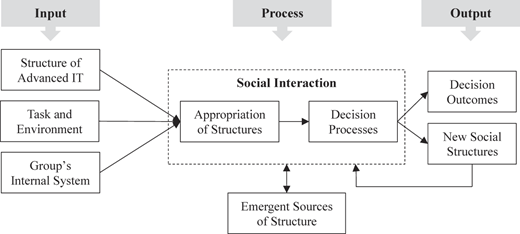
Summary of AST constructs. Adapted from DeSanctis and Poole (1994), Schmitz et al. (2016)
Technological structures, including system features and the underlying “spirit” or intent of the technology;
Task and environmental structures, such as workflow requirements, interdependencies, and contextual constraints; and
Group internal structures, including norms, culture, and collective capabilities.
These inputs jointly shape how technology is interpreted and adapted to organizational needs.
At the process stage, AST emphasizes appropriation, the way in which users engage with, interpret, and modify technological structures to fit their social and organizational contexts (DeSanctis and Poole, 1994; Ko et al., 2021). Appropriation unfolds along two key dimensions (Sun et al., 2020; Deng et al., 2021):
Consensus of Appropriation (COA): the degree to which actors (e.g. IT and business units) align on how technology should be used;
Faithfulness of Appropriation (FOA): the extent to which technology is enacted in ways consistent with its intended features and spirit.
Although often subtle and difficult to observe directly, appropriation can be inferred from improved decision-making processes, increased idea generation, reduced relational conflict, and stronger task focus.
In the output stage, appropriation results in performance outcomes such as higher-quality decisions, more accurate solutions, and greater commitment to implementation. Over time, these interactions give rise to new social structures, reflecting ongoing structuration as technology and organizational contexts evolve together.
Building on AST, Schmitz et al. (2016) develop Adaptive Structuration Theory for Individuals (ASTI) to apply the same IPO logic at the micro level. ASTI identifies three individual-level inputs: technology characteristics, task characteristics, and personal attributes (e.g. knowledge, experience, cognitive style), that shape how individuals adapt their behaviors in technology-mediated work. The process stage focuses on structuration episodes, in which individuals modify both technologies and tasks through two forms of adaptation: (1) technology adaptation, involving changes in how features are used or repurposed; and (2) task adaptation, involving adjustments in how work is conducted (Goodhue and Thompson, 1995; Schmitz et al., 2016). These adaptations interact dynamically to transform inputs into performance outputs, including enhanced efficiency, productivity, or revenue generation.
AST and ASTI provide complementary perspectives for examining how technology use unfolds across levels of analysis. AST explains how collective appropriation shapes group routines, coordination structures, and organizational outcomes, whereas ASTI focuses on the individual behaviors and cognitive processes that feed into these collective dynamics. This multi-level view is essential for understanding digital transformation, where technological change triggers cascading adaptations, from individual learning and task redesign to group-level coordination adjustments and organization-wide structural shifts. Importantly, these processes occur within broader institutional environments that influence which adaptations become stabilized or legitimized over time, linking AST/ASTI directly to the framework developed in this study.
3.3 Organizational structure
Organizational structure refers to the formal system of roles, rules, relationships, and responsibilities that coordinates work and enables organizations to achieve collective objectives (Dalton et al., 1980). Structure specifies how tasks are divided, how authority is distributed, and how communication and coordination occur across hierarchical levels. Classic organizational theory conceptualizes structures along a continuum from mechanistic to organic forms (Burns and Stalker, 1968). Mechanistic structures are characterized by high centralization, extensive formalization, rigid procedures, and multiple hierarchical layers, resulting in stability and control. In contrast, organic structures exhibit decentralization, flexible coordination, informal communication, and distributed decision authority, features that promote adaptability in dynamic and uncertain environments (Nowotny et al., 2022). Most organizations combine elements of both forms, adjusting structural arrangements as they respond to strategic needs and environmental pressures.
Scholars have proposed several dimensions to analyze organizational structure. Hage (1965) identifies variables such as complexity, centralization, and formalization, which map closely onto the mechanistic-organic typology and distinguish bureaucratic from professional organizational forms (Erol and Ordu, 2018). Dalton et al. (1980) consolidate these variables into three overarching structural dimensions: specialization/complexity, formalization/standardization, and centralization, each capturing the degree to which member behavior is prescribed, regulated, or constrained. Tolbert and Hall (2009) similarly emphasize centralization, formalization, and complexity as the core components of formal structure. Empirical studies continue to apply these dimensions across diverse contexts. For example, in supply chain management, Nowotny et al. (2022) highlight centralization, formalization, horizontal integration, and vertical differentiation, while Richter et al. (2019) examine how centralization, standardization, and specialization influence firm performance.
Across this body of research, centralization and formalization consistently emerge as the most critical structural dimensions affecting decision-making, coordination, and organizational outcomes (Auh and Menguc, 2007; Eva et al., 2021). Formalization represents the extent to which rules, policies, and procedures are codified and enforced. While it supports consistency, clarity, and operational control, excessive formalization can constrain creativity, impede learning, and hinder innovation (Tagod et al., 2021). Centralization, defined as the concentration of decision authority at higher hierarchical levels, may enhance control and streamline decision processes but often reduces responsiveness, as senior leaders may lack local expertise or real-time customer insights (Auh and Menguc, 2007; Walheiser et al., 2021).
Recent research demonstrates that organizational structure directly shapes how digital technologies are interpreted, integrated, and enacted. Highly centralized or formalized structures inhibit experimentation with new digital tools, whereas more organic arrangements facilitate flexible adaptation and cross-functional collaboration, conditions essential for successful digital transformation. As organizations embed digital technologies into their processes, the balance between formalization and decentralization often shifts, generating new hybrid forms that blend stability with flexibility. Understanding these structural dynamics is therefore central to explaining how digital transformation unfolds, and it provides a foundation for the conceptual model developed in the next section.
3.4 Institutional theory
Institutions are enduring social structures that provide organizations with a framework for reducing uncertainty and establishing stable patterns of interaction. They consist of formal rules, laws, regulations, written policies, and contracts, as well as informal constraints such as norms, cultural values, and unwritten customs (Meyer and Rowan, 1977; Loosemore et al., 2021). Together, these mechanisms guide organizational behavior through both explicit and implicit channels (Sahin and Mert, 2023; Struckell et al., 2022; Balzano et al., 2025; Jafari et al., 2025). Institutional theory explains how these structures influence organizations within similar environments, often leading them to adopt comparable forms and practices. It has thus become a dominant macro-level perspective for examining organization-environment relationships (Ng and Sia, 2023).
A core concept in institutional theory is legitimacy, the perception that an organization’s actions are appropriate and desirable within a socially constructed framework of norms, values, and beliefs (Struckell et al., 2022). To obtain legitimacy, organizations frequently engage in institutional isomorphism, a process by which they become more similar to other organizations facing comparable conditions (DiMaggio and Powell, 1983; Scott, 1995; Ng and Sia, 2023; Posadas et al., 2023). In this regard, Scott (1995) identifies three pillars of institutions that shape legitimacy:
Regulative pillar: conformity to laws, regulations, and formally sanctioned rules.
Normative pillar: alignment with social values and moral expectations.
Cognitive pillar: shared beliefs and cultural frameworks that shape perceptions and behavior.
Building on these pillars, DiMaggio and Powell (1983) delineate three corresponding mechanisms of institutional isomorphism: coercive, normative, and mimetic pressures. Coercive pressures arise from external mandates such as government regulations, industry standards, or stakeholder demands (Do et al., 2022; Struckell et al., 2022). Normative pressures stem from professional standards and moral obligations, encouraging organizational members to conform to expectations of their professional community (Struckell et al., 2022; Castro-Lopez et al., 2023). Mimetic pressures occur when organizations emulate peers or industry leaders to reduce uncertainty and enhance legitimacy, particularly in ambiguous or volatile environments (DiMaggio and Powell, 1983; Do et al., 2022; Struckell et al., 2022).
These institutional forces collectively shape organizational structures and practices, fostering homogeneity among firms. While this homogeneity may reduce competitive differentiation, institutional theorists argue that it can also enhance legitimacy, reduce uncertainty, and improve organizational performance by aligning organizations with widely accepted norms and expectations (Struckell et al., 2022). This perspective also highlights the moderating role of institutional pressures in shaping how structural adaptations during digital transformation affect performance outcomes (Tagod et al., 2021; Lin et al., 2021), the focus of the conceptual framework developed in the next section.
3.5 Theoretical positioning: structuration and AST for digital transformation
Digital transformation research draws on multiple theoretical traditions. Resource-based and dynamic capability perspectives conceptualize transformation as capability development and strategic renewal, treating digital technologies primarily as strategic resources that enable competitive advantage. Institutional theory explains why organizations pursue digital innovation under coercive, normative, and mimetic pressures, while socio-technical and affordance perspectives emphasize the interaction between technological features and human agency. However, these perspectives provide limited insight into how technology use recursively reshapes formal organizational structures over time.
Structuration theory and AST provide a complementary lens by conceptualizing structures as both the medium and the outcome of social action. By foregrounding appropriation processes, AST explains how recurring patterns of technology enactment progressively reconfigure organizational arrangements. This recursive orientation makes structuration-based approaches particularly well suited for theorizing digital transformation as an ongoing process of structural adaptation rather than a discrete strategic initiative.
Building on this theoretical foundation, the present study develops a multi-level conceptual framework with three primary objectives. First, it reconceptualizes digital transformation as a process of recursive structural reconfiguration. Second, it formalizes technology appropriation, operationalized through consensus and faithfulness, as a mediating mechanism linking digital technology use to structural and performance outcomes. Third, it incorporates institutional pressures as moderating conditions that shape the relationship between structural reconfiguration and organizational performance. By integrating micro-level appropriation dynamics, organizational structural change, and macro-level institutional influences, the framework offers a cross-level explanation of digital transformation processes.
Although the theoretical perspectives informing this study are individually well established within the information systems and organization studies literature, the principal contribution of the present research lies in their systematic integration into a unified cross-level model. Existing frameworks either theorize appropriation without clearly specifying its structural consequences, as in AST, or examine institutional pressures without grounding them in micro-level enactment processes. The proposed framework advances beyond simple theoretical integration by explicitly conceptualizing appropriation as a mediating mechanism and institutional pressures as moderating conditions, relationships that have not previously been jointly theorized in digital transformation research. Accordingly, the study contributes not merely a synthesis of existing perspectives, but a more structurally integrated and explanatorily robust account of digital transformation.
4. Conceptual framework and propositions
4.1 Theoretical framework
Digital transformation, the integration of digital technologies into all facets of organizational activity, has emerged as a critical strategic challenge for contemporary firms. Prior research has examined digital transformation from multiple perspectives, including business model innovation, dynamic capabilities, structural change, and the role of information and communication technologies (ICT) across business, societal, cultural, and technological domains (Vial, 2019; Van Veldhoven and Vanthienen, 2022; Reis and Melão, 2023). Among these perspectives, considerable scholarly attention has focused on the interplay between digital technologies and business models, emphasizing how new technologies reshape value creation and competitive dynamics (Reis and Melão, 2023; Plekhanov et al., 2023). However, the social and structural processes through which digital technologies are appropriated and embedded into organizational life remain comparatively underexplored.
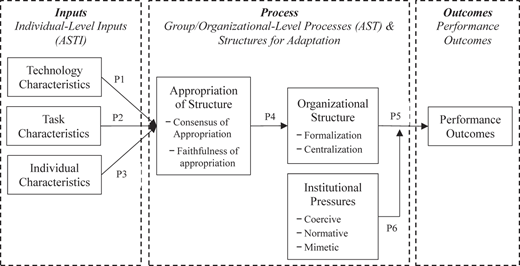
To address this gap, the proposed conceptual framework, depicted in Figure 2, integrates insights from AST/ASTI, organizational structure and institutional theory. This integrative perspective conceptualizes digital transformation as a multi-level, process shaped by individual inputs, group-level appropriation dynamics, organizational structures, and institutional pressures. Broadly, the framework comprises three interconnected components: (1) inputs, (2) structural adaptation processes, and (3) performance outcomes.
4.1.1 Inputs: individual-level Inputs (ASTI)
Following Schmitz et al. (2016), the framework identifies three categories of input factors; i.e. technology characteristics, individual characteristics, and task characteristics, that influence how digital technologies are appropriated within organizations. These inputs shape how individuals engage with technology and initiate adaptation behaviors within organizational settings.
4.1.2 Process: social interaction and structural adaptation
4.1.2.1 Group/Organizational-level processes (AST)
Consistent with DeSanctis and Poole (1994), the framework positions appropriation of technological structures as the central social process linking technologies to organizational outcomes. Appropriation captures how users interpret, modify, or reinforce the structures embedded in digital technologies. It is operationalized through two dimensions: COA and FOA. These appropriation processes determine whether digital technologies are used in compliance-oriented or more innovative, adaptive ways.
4.1.2.2 Structures for adaptation: organizational and institutional contexts
The framework integrates organizational structure and institutional pressures as key contextual factors shaping adaptation. Organizational structure is conceptualized through the dimensions of formalization and centralization (Dalton et al., 1980), which affect flexibility, coordination, and decision-making in response to technological change. Institutional pressures are drawn from DiMaggio and Powell’s (1983) typology: coercive, normative, and mimetic forces, which influence the legitimacy, diffusion, and sustainability of structural adaptations across organizations.
The shift from Group/Organizational-Level Processes to Structures for Adaptation reflects a movement from micro-level social interactions to the broader organizational and institutional contexts that shape them. While AST focuses on how users interpret, appropriate, and modify technological structures to influence organizational outcomes, these processes do not occur in isolation. Organizational structures set the boundaries within which appropriation occurs, influencing flexibility, coordination, and decision-making. Simultaneously, institutional pressures moderate which structural adaptations are considered legitimate or sustainable. In this way, the framework links the enactment of technology at the group or organizational level to the contextual forces that shape how these enactments translate into enduring structural changes.
4.1.3 Outcomes: performance outcomes
The ultimate outcomes of digital transformation are captured through organizational performance, including effectiveness, efficiency, innovation capability, and adaptability. These outcomes emerge from interactions among technologies, individuals, tasks, and evolving organizational and institutional structures. Over time, these dynamics produce new structural configurations that either facilitate or constrain continued digital transformation.
In this framework, digital technologies function as catalysts for organization-wide change, driving shifts in structural configurations, cultural logics, social interactions, and competitive dynamics (Skare et al., 2023; Li, 2022; Guerra et al., 2023). By integrating multi-level structuration dynamics (AST and ASTI) with organizational and institutional contexts, the framework conceptualizes digital transformation as a socially enacted, and institutionally embedded process rather than a purely technological shift. It highlights how technology-task-individual inputs interact with organizational structures and institutional pressures to yield meaningful performance outcomes.
4.2 Propositions
While AST provides foundational insights into how patterns of technology appropriation influence organizational structures, prior research has largely focused on localized technology use and its immediate structural consequences. The present framework extends AST in three important ways. First, it conceptualizes structural reconfiguration as a mediating mechanism linking appropriation processes to organizational performance. Second, it introduces institutional pressures as moderating conditions that shape the strength of the relationship between structural reconfiguration and performance outcomes. Third, it situates appropriation processes within enterprise-wide digital transformation initiatives, thereby extending AST beyond discrete episodes of technology use toward sustained organizational-level structural adaptation. Building on these theoretical extensions, the framework is translated into a set of propositions that articulate the key relationships among technology characteristics, appropriation dynamics, structural reconfiguration, institutional pressures, and organizational performance.
AST and its ASTI identify three primary sources of structuration, technology, tasks, and individuals, that convey social structures within organizations. Technology characteristics encompass technical features, functional affordances, and symbolic meanings embedded in digital systems. Task characteristics refer to structural properties arising from work processes, interdependence, and environmental contingencies. Individual characteristics capture personal traits, digital competence, learning capacity, and prior experience, functioning analogously to elements of group memory (Schmitz et al., 2016; Shao and Li, 2022). These inputs jointly shape how technological structures are interpreted and enacted during social interaction.
Within AST, appropriation constitutes the central mechanism through which individuals and groups reproduce or transform the structures embedded in technology, thereby shaping organizational outcomes (DeSanctis and Poole, 1994; Chin et al., 1997). In line with prior research, appropriation is operationalized along two dimensions: COA and FOA (Chin et al., 1997; Deng et al., 2021; Wang et al., 2023). Drawing on AST and ASTI, the following propositions specify how technology, task, and individual characteristics influence appropriation processes within digital transformation contexts:
The degree of consensus and faithfulness in technology appropriation increases when digital technologies exhibit high interpretive transparency and structural flexibility.
The positive effect of digital technologies on appropriation consensus is stronger when tasks are characterized by high interdependence and uncertainty.
Individual digital competence and change orientation positively influence the faithfulness of technology appropriation.
Digital transformation is widely characterized as a long-term process in which digital technologies become integral to strategy and operations, prompting organizational reconfiguration and generating both positive and negative outcomes (Li et al., 2017; Vial, 2019). Within AST, technology is conceived as a social structure that interacts with routines and practices; through interactive enactments, this interaction produces new patterns of organizing that gradually become institutionalized (DeSanctis and Poole, 1994; Kang et al., 2012; Laud et al., 2015). Appropriation thus serves as the critical link between technological inputs and emergent organizational forms. Based on this reasoning, we propose the following relationship:
Higher levels of appropriation consensus and faithfulness increase the likelihood of sustained structural reconfiguration within organizations.
Extending this logic, the framework emphasizes the role of social structures in adaptation, encompassing both organizational structure and institutional pressures. Organizational structure, particularly the dimensions of formalization and centralization, shapes coordination, decision-making authority, and information flows, and serves as a key determinant of organizational behavior and performance (Dalton et al., 1980; Auh and Menguc, 2007; Richter et al., 2019). Although empirical evidence regarding the structure-performance relationship remains mixed (Dalton et al., 1980), these dimensions continue to play a prominent role in contemporary studies of organizational effectiveness, innovation, and adaptability.
Within the context of digital transformation, formalization and centralization are among the most consequential structural attributes influencing coordination, decision-making, and organizational flexibility (Eva et al., 2021; Nowotny et al., 2022). Accordingly, this study conceptualizes adapted organizational structures as key mediating mechanisms through which appropriation processes translate into performance outcomes. This perspective aligns with Verhoef et al. (2021), who argue that digital transformation necessitates structural reconfiguration, and that these structural arrangements have a direct impact on organizational performance. Based on this reasoning, we propose the following relationship:
Structural reconfiguration resulting from digital transformation positively influences organizational performance.
Institutional theory emphasizes how coercive, normative, and mimetic pressures influence organizational responses to external expectations by promoting legitimacy and reducing uncertainty. Coercive pressures stem from regulations and compliance requirements, normative pressures arise from professional norms and shared values, and mimetic pressures emerge when organizations imitate others under conditions of uncertainty. Empirical evidence on the performance effects of institutional pressures is mixed: some studies report direct effects (Castro-Lopez et al., 2023; Ng and Sia, 2023), while others highlight moderating effects, particularly when structural adaptation and risk management processes are involved (Tagod et al., 2021; Lin et al., 2021). For instance, Tagod et al. (2021) demonstrate that coercive pressures strengthen the relationship between organizational structure and risk management practices.
Building on this evidence, the framework posits that institutional pressures influence the extent to which adapted organizational structures translate into performance outcomes. Accordingly, we propose the following:
Institutional pressures moderate the relationship between structural reconfiguration and organizational performance, strengthening it when digital transformation enhances organizational legitimacy but weakening it when compliance requirements constrain structural flexibility.
4.3 Discussion
This study conceptualizes digital transformation as a recursive, socially constructed, and institutionally embedded process, rather than a linear technological upgrade. By integrating AST/ASTI, organizational structure research, and institutional theory, the framework explains how digital technologies, human agency, and institutional environments interact to generate sustained structural adaptation and differentiated performance outcomes.
The framework advances digital transformation research in three principal ways. First, it positions technology characteristics, task conditions, and individual capabilities as foundational antecedents shaping patterns of technology appropriation. Rather than assuming that digital technologies automatically generate organizational change, the model emphasizes consensus and faithfulness of appropriation as socially negotiated processes that determine whether technological features become embedded in organizational routines. Digital transformation therefore depends not simply on technological adoption, but on interpretive alignment and the quality of enactment. Importantly, these relationships are subject to contextual boundary conditions. The influence of appropriation consensus is expected to be strongest when tasks are highly interdependent, because disagreement regarding technology use directly impairs coordination across units. In contrast, in routine and low-interdependence tasks, partial consensus may still support adequate performance, thereby weakening the proposed effect. Similarly, the positive influence of faithfulness of appropriation on structural reconfiguration may be moderated by organizational inertia. In highly formalized environments, even faithful enactment may be insufficient to destabilize entrenched routines, slowing structural change despite high-quality appropriation.
Second, the study conceptualizes appropriation as the central generative mechanism linking technology use to enterprise-level structural reconfiguration. Through recursive enactment, repeated interactions stabilize emerging digital routines and gradually reshape organizational dimensions such as formalization, centralization, and coordination. By explicating this cumulative process, the framework extends prior AST research beyond localized technology use to explain how micro-level interactions scale into sustained organizational transformation. Structural change is therefore conceptualized as emergent, path-dependent, and continuously reproduced through practice. The proposed causal mechanism operates through recursive feedback dynamics. High-consensus appropriation reduces interpretive divergence across organizational units, thereby lowering coordination costs and enabling decision rights to be redistributed more efficiently, which may gradually loosen centralized structures. Likewise, faithful appropriation reinforces the intended logic of digital systems, reducing reliance on informal workarounds and selectively decreasing redundant forms of formalization over time. This accumulation process also suggests a potential trade-off: organizations that accelerate structural change through rapid, top-down appropriation mandates may achieve short-term efficiency gains while simultaneously undermining the social negotiation processes necessary for the legitimacy and durability of newly enacted arrangements.
Third, the framework introduces institutional pressures as boundary conditions shaping whether structural reconfiguration translates into improved performance. By incorporating coercive, normative, and mimetic forces, the model connects micro-level structuration processes with broader legitimacy environments. Digital transformation outcomes therefore depend not only on internal structural coherence but also on the extent to which newly enacted arrangements align with institutional expectations. This integration helps explain why structurally similar digital initiatives may produce different performance outcomes across organizational fields.
Collectively, these contributions shift the analytical focus of digital transformation research from technological artifacts or strategic capabilities toward the recursive production and institutionalization of organizational structures. Performance outcomes are therefore framed as contingent upon the stability, coherence, and legitimacy of newly enacted digital arrangements, rather than on technological sophistication alone.
The applicability of the framework is subject to several contextual conditions. It is most relevant in settings where digital technologies substantially alter coordination patterns, decision rights, or information flows. Incremental IT upgrades that leave structural arrangements largely unchanged are unlikely to activate the recursive dynamics described here. The model also assumes moderate to high levels of organizational complexity. In highly centralized environments, appropriation processes may be constrained by hierarchical control, limiting bottom-up structural emergence. Conversely, in loosely structured organizations, structural adaptation may remain informal and fail to consolidate into measurable performance outcomes. Institutional moderation is expected to be strongest in highly regulated or normatively structured fields, such as healthcare, financial services, and public administration, where legitimacy pressures are particularly salient. Finally, the framework is intended to explain enterprise-level digital transformation initiatives rather than isolated team-level technology implementations, as the propositions assume organization-wide structural consequences and performance implications.
5. Conclusion and implications
Digital transformation has become a defining phenomenon in contemporary business and management, reshaping how organizations operate, compete, and create value. As digital technologies permeate core processes, business models, and organizational structures, they alter routines, decision rights, and coordination mechanisms. Understanding these dynamics is therefore essential for organizations seeking to navigate increasingly volatile environments and leverage digital technologies for sustained advantage.
This study contributes to the growing literature by proposing a conceptual framework that reframes digital transformation as a socially enacted and institutionally embedded process. By integrating structuration theory, AST/ASTI, organizational structure research, and institutional theory, the framework explains how technology appropriation, social interaction, and external legitimacy pressures co-evolve to produce structural reconfiguration and performance consequences. The accompanying propositions translate this integrative logic into theoretically grounded and empirically testable relationships, providing a foundation for future multi-level research on digital transformation.
5.1 Theoretical contributions
This study advances structuration-based and digital transformation research in three substantive ways. First, the study reconceptualizes digital transformation as a process of recursive structural adaptation rather than a discrete technological implementation or capability-building initiative. While prior research often frames transformation through strategic resources or dynamic capabilities, this framework grounds transformation in structuration processes. By shifting analytical attention from technological artifacts to the ongoing production and reproduction of organizational structures, the study positions digital transformation as fundamentally structural, practice-based, and emergent.
Second, the study advances AST by explicitly modeling appropriation as a mediating mechanism linking digital technology use to organizational structural reconfiguration and performance outcomes. Prior AST research has primarily examined appropriation at the group level and emphasized immediate interactional consequences. This framework extends that tradition by theorizing how consensus and faithfulness of appropriation accumulate through recursive enactment to reshape formalization, centralization, and coordination mechanisms at the enterprise level. In doing so, it connects micro-level enactment processes to macro-level structural change and measurable performance implications.
Third, the framework incorporates institutional pressures, coercive, normative, and mimetic, as moderators of the structural reconfiguration-performance relationship. By integrating structuration logic with institutional theory, the study situates recursive structural dynamics within broader legitimacy environments. This multi-level integration clarifies the boundary conditions under which structural adaptation enhances performance, demonstrating that transformation success depends not only on internal coherence but also on alignment with external institutional expectations.
Collectively, these contributions provide a cross-level explanation of digital transformation that connects individual enactment, collective appropriation, structural reconfiguration, and field-level institutional forces. By moving beyond technology-centric and linear accounts, the study expands the theoretical scope of digital transformation research and establishes a foundation for empirical investigation of multi-level structuration processes in digitally transforming organizations.
5.2 Practical implications
Although conceptual in nature, this study offers several theoretically grounded implications for managers leading digital transformation initiatives. First, digital transformation should not be understood merely as a technological upgrade. Structural change emerges through appropriation processes, particularly through the development of shared interpretations (consensus) and the faithful enactment of technological features. Managers should therefore foster cross-functional communication, clarify expectations regarding technology use, and invest in digital capability development to support the stabilization of emerging organizational routines. For example, when implementing enterprise-wide AI analytics platforms in financial services, organizations must ensure that departments share a common understanding of how data-driven insights should inform decision-making processes. Without such interpretive alignment, technology use may become fragmented and inconsistent across organizational units, thereby limiting the effectiveness of transformation efforts.
Second, technological adoption must be accompanied by complementary structural adaptation. Organizations may need to redesign decision rights, coordination mechanisms, and levels of formalization to fully realize the value generated by emerging digital routines. For instance, a manufacturing firm implementing IoT-enabled predictive maintenance systems may need to decentralize certain operational decisions so that frontline employees can respond effectively to real-time data and system alerts. In the absence of corresponding structural redesign, the potential performance benefits of digital technologies may remain constrained or unrealized.
Third, managers must pay close attention to the institutional environments within which digital transformation unfolds. In highly regulated sectors such as healthcare and financial services, compliance requirements, professional norms, and regulatory expectations strongly influence the legitimacy of structural change initiatives. Institutional pressures may facilitate transformation by legitimizing digital innovation, but they may also constrain organizational flexibility through strict regulatory mandates and normative expectations. Consequently, effective digital transformation requires organizations to balance innovation initiatives with regulatory compliance and the maintenance of external legitimacy.
Taken together, these implications suggest that successful digital transformation depends on the holistic management of technological implementation, social interaction, structural redesign, and institutional alignment rather than treating these elements independently. Although future empirical research is needed to validate these propositions, the proposed framework provides managers with a structured perspective for understanding and navigating the complexities of organizational transformation in the digital era.
5.3 Limitations and directions for future research
Despite its contributions, this study has several limitations that open important avenues for future research. First, digital transformation remains conceptually heterogeneous across the literature. Some perspectives emphasize technological change, whereas others foreground business model innovation, cultural transformation, or strategic renewal. Although the present study conceptualizes digital transformation primarily as a process of recursive structural adaptation, future research should examine how this structural perspective interacts with alternative theoretical approaches to clarify complementarities and identify relevant boundary conditions. In particular, research streams on digital work and practice theory, which examine how digital technologies reshape coordination, control, and everyday work practices, may provide complementary insights into the micro-foundations of transformation and enrich the appropriation processes theorized in this framework (e.g. Orlikowski and Scott, 2008; Feldman and Orlikowski, 2011).
Second, the proposed framework is conceptual and has not yet been empirically validated. Future studies should operationalize key constructs, especially consensus and faithfulness of appropriation, and empirically test the proposed relationships among appropriation processes, structural reconfiguration, institutional pressures, and organizational performance. Third, the framework may be more applicable to medium- and large-sized organizations operating in regulated or professionalized industries than to informal start-up environments or loosely coupled platform ecosystems. Comparative studies across industries and organizational contexts could help clarify the boundary conditions of the model.
Finally, because structuration processes are recursive and evolve over time, longitudinal and process-oriented research designs would be particularly valuable for examining how appropriation patterns and structural changes develop throughout digital transformation initiatives. Such research could further refine and extend structuration-based explanations of digital transformation.

