The purpose of this paper is to construct a digital collection and database of traditional clothing that is convenient for the digital dissemination and application of traditional clothing and provide resources for research on clothing fashion, traditional clothing techniques, clothing culture, history and clothing teaching.
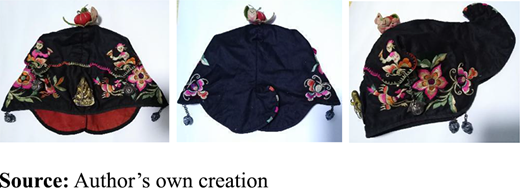
A real object analysis method was used in this paper, based on 15 core elements of the internationally common DC metadata standard, and with consideration to the characteristics of clothing products and clothing industry application specifications, the core elements of DC are expanded to facilitate the detailed record of the characteristic information of clothing, especially the implicit clothing culture. A code symbol compilation method was developed to give each piece of clothing a unique number, facilitating identification, classification and recording. At last, a metadata construction scheme for traditional clothing was developed. A traditional embroidered children's hat and Mamianqunt serve as examples to demonstrate the metadata elements.
The clothing meta-database provides a main body of traditional clothing while also paying attention to the collection of cultural elements. It is composed of five layers of classified data, source data, characteristic data, connotation data and management data, as well as 28 data elements, providing ease of sharing and interoperation.
This paper expands the subset of fashion metadata by describing traditional clothing metadata, especially the excavation of clothing cultural elements, and developing code compilation methods so that each clothing product can obtain a unique identification number, thereby building a traditional clothing metadata construction scheme consisting of five data layers and containing 28 data elements. This scheme records the information about each layer of traditional clothing in detail and provides shared data for discipline research and industry applications.
Introduction
Traditional clothing is an important part of traditional culture, the product of human social practice and the mark of a specific historical period. It carries the historical and cultural information and original memory of human beings and embodies vivid historical traces. Wang et al. (2022) extracted feature information from traditional clothing through the method of mean filtering, effectively combining clothing identification with clothing culture learning and uncovering new methods for the inheritance of national culture. Traditional clothing embodies the specific period of political system, social conditions and economic form. Its color, shape and pattern are a condensed form of artistic connotation, rich ancient spirit and national belief. Chen et al. (2022) organized and refined the patterns, colors and structural characteristics of traditional clothing, combining the representative elements of traditional clothing with a fractal algorithm so that traditional clothing could better reflect fashion art and national cultural characteristics.
Traditional clothing is a special material for anthropological, ethnological, folklore and historical research, and it has the same important position as graphic and text records, vocal music transmission, architecture and seal cutting. Therefore, the importance of protecting and promoting traditional clothing is attached to the accumulation of thousands of years of human clothing civilization and plays a strong role in the foundation of national development. A unique phenomenon in Bangladeshi cultural heritage is the tendency to wear traditional costumes at festivals (Minhus and Huie, 2021). A unique phenomenon of Korean cultural heritage tourism is its inclusion of traditional clothing (Lee and Lee, 2019). Chang (2019) considered this to be meaningful in addressing the current Korean traditional costume content on YouTube, part of the ongoing Korean wave based on traditional culture. Valentino (2017) considered historical clothing to be an important resource for scholars in fields ranging from fashion design to sociology. Traditional clothing research also plays an important role in the development of the fashion industry, such as through cultural referencing and cultural amalgamation (Audita et al., 2023).
However, most traditional clothes are natural fiber products, such as cotton, silk, hemp, wool and kudzu. These natural fibers are affected by time, temperature, humidity, light and other factors that contribute to oxidation and decomposition, making them difficult to retain. Goodrum and Martin (2005) describe the historic costume collection as being extremely fragile and vulnerable to overhandling, resulting in much of the costume collection being packed away in storage boxes. There is a basic need to bring the historic costume collection out of the closet so that it can be accessed by a variety of users. Creating a searchable database of digitized images and supporting documentation for each piece offers a means by which to make the collection accessible to students, scholars, designers and other interested individuals around the world.
For the above reasons, it is very important and urgent to create a digital collection of the style, color, pattern, craft and physical-cultural connotation of traditional clothing. After its collection, electronic data can be retained for a long time and can be used to reflect the specific original state of history. This paper explores a metadata construction scheme conducive to the digital collection of traditional clothing.
Literature review
Metadata is information describing the properties of data. It is an electronic directory used to support functions such as indicating storage location, providing historical data, resource finding and file recording. There is no essential difference in the concept and function between the card or book catalogs and the machine-readable cataloging in the library automation system (Guo et al., 2004). The compilation of metadata must clearly describe and collect the content or features of the data so as to achieve the purpose of assisting in data retrieval.
Application of international metadata standards
As an important data infrastructure, the metadata standard has been widely valued in the United States, the United Kingdom, Australia, China, Germany and many other countries. The United States is the driving pioneer of the open government data movement and has been ranked high in open data (Open Data Barometer, 2022). The US Open Government Data Platform divides data sets into two types, original and geospatial, and uses different metadata criteria to describe each type (Si and Zhao, 2018). The original dataset was described using the Project Open Data Metadata Schema V1.1(;POD v1.1), while the geospatial dataset was described using two geospatial metadata criteria – ISO 19115–2 and the Content Standard Digital Geospatial Metadata. The National Science Foundation and the European Commission's Open Research Data Pilot Program both require funded projects to submit the metadata standards used in their research data (Gomez et al., 2016).
In June 2009, the UK launched its open data. The country plans on designing the government data website Data.gov.uk using related data standards and methods (Sheridan and Tennison, 2016) and then adjusting the details according to actual needs. Britain’s collection, which has a large number of geographic information resources using geospatial metadata standards (GEMINI), establishes a perfect geographic information system and geographical positioning infrastructure while simultaneously offering a variety of types of data, such as typical education, culture, science and technology, transportation, public security, statistics, medical care, health, finance and environment (Zhao et al., 2016). The Australian open government data platform Data.gov.au uses the Australian Government Locator Service (AGLS) metadata standard, the Australian and New Zealand Land Information Council (ANZLIC) geospatial metadata standard, and the World Wide Web Consortium (W3C) organized by the Data Catalog Vocabulary (Huang and Li, 2017). At the same time, state government websites must use the AGLS description data resources based on the Dublin Core Metadata Elements Set (DC) to ensure the continuity, consistency and retrievability of national websites (AGLS Metadata Standard, 2022).
The State Administration of Cultural Heritage of China has formulated the Code for the Registration of Cultural Relics in their Collection (WW/T 0017-2013) (The State Administration of Cultural Heritage, 2022). The Beijing Municipal Bureau of Quality and Technical Supervision of China has formulated the digital record Metadata Specification of Cultural Relics and Artworks (DB11/T1219-2015) (Beijing Municipal Bureau of Quality and Technical Supervision, 2022). This record contains 12 categories, including identification, name and classification, and the sub-elements of different levels are set up to describe the art metadata in detail. Germany implemented the G8 Open Data Charter under the National Action Plan in November 2014, ensuring that metadata is standardized to ensure quality and interoperability while the national data platform GovData is built (Zhai et al., 2022). In June 2021, Germany passed the Second Open Data Act, which established the legal status of GovData as a national unified metadata platform (Hinweis zum Datenschutz, 2022).
Currently, there are more than 20 kinds of metadata standards that have been applied or tested internationally (Feng et al., 2001). Among the existing applied metadata standards, five are widely used (Zhou and Zhao, 2018). These five metadata criteria are described, respectively, as follows:
VRA Core (Visual Resources Association Core Categories for Visual Resources) Launched by the American Visual Resources Association, it is suitable for the visual resource description of three-dimensional entities such as architecture, folk culture and prehistoric artifacts (Yu, 2008).
CDWA (Categories for the Description of Works of Art): Funded by the Paul Getty Trust and developed by the Art Information Working Group, it is suitable for describing artworks and digital image resources.
FGDC (Federal Geographic Data Committee): Developed by the US Federal Geographic Data Commission, it coordinates the development, use, sharing and advocacy of federal geographic data.
DC (Dublin Core Metadata Elements Set): Developed by the American Computer Networking Library Center, it is applicable to the network resource description.
GILS (Government Information Locator Service): Created by the United States government, it is a utilization system that provides the public with means to retrieve, locate and obtain public federal information resources.
Application of metadata standards in the field of clothing digitalization
In the field of clothing digital resources, there is no unified standard for metadata organization. Among the above five metadata standards, the application scope of VRA, CDWA and DC is easily adaptable to the digital resources of traditional clothing. CDWA was developed in 1990 as the earliest metadata standard applied in the art field. After several updates, it now contains about 540 elements (Getty Vocabulary Program, 2019). Some clothing picture collection organizations also use CDWA or VRA metadata for simple descriptions. The digital collection database of the University of Washington Library in the United States is a DC based on the description standard. The description items include title, creator, publication, distribution, source, annotation, theme, historical period, identifier, association, collection information, digital information, digital collection place and resource type (Li and Li, 2008).
The library of Beijing Institute of Fashion Technology takes DC, CDWA and VRA metadata as standard references and constructs the metadata information containing with 23 basic elements of clothing pictures, including picture type, title, creator, classification, theme, source, etc. Li (2014) has improved these methods (Li and Li, 2008), increasing the original 23 elements to 29 and dividing them into three parts: 14 core elements, seven special core elements of clothing pictures and eight individual elements. Some of the elements have expanded several element modifiers and added coding system modifiers. Liang et al. (2021) constructed the metadata of the traditional national costumes of Guangxi, China, from the two information types of management function and cultural content; it drew on the hierarchical classification structure and subcategory definition form of CDWA standard, designing 15 categories with 37 subcategories.
Wu (2017) conducts external metadata construction of Xinjiang ethnic costume pattern motifs, introduces the metadata design of cultural calculation and conducts research based on cultural genes, cultural quantification and cultural visual analysis. Wu (2021) collects the information of Chinese She costume patterns from the four aspects of basic information, explicit information, invisible information and digital information and constructs an element set composed of 21 data elements such as name, collection place, provider, producer, age, size, position and use occasion. Su (2016) builds a set of elements for the ethnic minority costumes of Guangxi Province, China. This set primarily contains pictures and is composed of 30 elements supplemented by video, audio, vector files and articles. Based on different basic functions of metadata, Weng and Li (2019) integrates art into description metadata, management metadata and associated metadata, which is then further divided into basic information, specific description, collection management information, record information, object record information, circulation record information, digital image information, auxiliary data information and eight metadata modules. Thus, the tree-level data structure is built to provide a possible path for the interoperability of art metadata.
China's national standard “National Central Product Classification – Product Category Core Metadata – Part 13: Clothing” (GB/T 37600.13-2018) (China Institute of Standardization et al., 2018) stipulates the unified modeling language description and dictionary description of the core metadata of clothing in product information management. However, this standard applies only to the description, coding, database building, inquiry and release of information about clothing products used today and is not applicable to the traditional clothing that can be used as collectibles. For example, the washing and care methods, functional information, taking information, safety information and other information formulated in this standard are not suitable for traditional clothing. Because traditional clothing has lost its original wearing function, the main value of traditional clothing today lies in its design reference, craft reference and historical and cultural research.
The above metadata research is not a comprehensive and complete description of the characteristics of traditional clothing, especially its cultural connotation and artistic value. As a result, the metadata scheme constructed in this project should not only fully describe the classification information, source information, management information and physical characteristics information of traditional clothing but also thoroughly describe the historical and cultural connotation information thereof.
The Dublin Core Metadata Elements Set metadata application
Dublin Core Metadata Element Set (DC) is the most widely used and influential metadata standard in the world. It is highly versatile and outlines the basics of metadata standards used across various fields (Jia et al., 2018). DC has a simple structure, containing only 15 elements: title, creator, subject, description, publisher, contributor, date, type, format, source, language, relation, identifier, coverage and right, and it supports the description of resources in any content. It has semantic interoperability between resources of different disciplines, which is conducive to interdisciplinary and cross-domain retrieval. DC also has flexible extensibility, allowing the user to add and delete elements and other additional structures as needed (Jia et al., 2018). At present, DC metadata has been gradually applied to the library-related businesses along with the construction of digital libraries, and it is guiding the development direction of metadata description (Du, 2020).
Therefore, the construction of the traditional clothing metadata in this paper also subscribes to the 15 core elements of DC to the greatest possible extent. At the same time, considering the attributes of clothing product resources and the importance of traditional culture, the corresponding metadata elements are expanded.
Methodology: traditional clothing metadata construction method
Principles of traditional clothing metadata construction
Metadata is the basis of traditional clothing digital resource database construction. In the specific design of clothing metadata scheme, the setting of metadata should take into account applicability and universality and also consider the implicit cultural connotation and artistic value of traditional clothing. Therefore, it is necessary to add special considerations to the metadata.
First of all, concise, clear and accurate descriptions of the attributes of traditional clothing are important. Traditional clothing resources have diverse carriers and huge amounts of information, which should be concentrated into a database with simple and accurate descriptions. At the same time, the original and authentic information about clothing should be retained so as to facilitate the use of traditional clothing or carry out research on clothing culture.
Secondly, the positioning should be clear. There is no physical clothing object when digital resources are used, so the data positioning should be clear to promote the discovery and retrieval of information objects in the network environment.
Thirdly, to facilitate the search, the important information in the information object should be extracted and organized, endowed with standard meaning, so as to make the search results more accurate and facilitate users in finding the resources they really need.
Finally, when considering the specific attributes and localization standards of traditional clothing, we should fully respect the existing international general standards and form a mapping relationship with the element setting, so as to facilitate sharing and interoperation with other data resources (Shen et al., 2010).
Traditional clothing metadata were collected in layers
This paper takes nearly 2,000 pieces of Chinese traditional clothing objects dating back to the Qing Dynasty as the main objects of database construction. At the same time, non-physical pictures and videos collected through books and the Internet serve as the main objects. Based on the above metadata construction principle, the 15 core elements of DC are fully considered, and these 15 core elements are extended. At the same time, the traditional clothing database is constructed by means of layered collection and element record. The hierarchical scheme and the set of elements are shown in Table 1.
As shown in the table, the connotation data is a relatively abstract concept, being a cognitive feeling of a certain thing. There are many forms of connotation, and they do not belong to the objective physical attribute but rather to feeling – subjective, ideological or psychological. For example, children like to wear a given kind of clothes, a given color makes the wearer more energetic, a given jewelry technology is exquisite, etc.
The technology level refers to the quality of the clothing technology, such as whether the sewing process is fine, whether the color collocation is beautiful, whether the material application is reasonable, whether the structure is scientific and so on.
Compilation of clothing categories
Apparel is classified and saved according to the categories and subcategories. Clothing categories and code characters are compiled as shown in Table 2.
Code character description
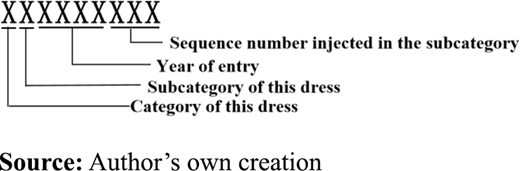
To facilitate classified storage, data record, enquiry and extraction, this project provides a unique identity code for each item, The specific scheme involves setting the code character into a nine-digit number format: XXXXXXXXX. The first code represents the category of clothing, such as clothing. The second code represents the subcategory of clothing, such as skirt. The third to sixth codes represent the year of the description, such as 2023. The seventh to ninth codes are the serial numbers of these subcategory items recorded in the database, namely the number of clothing items in this given subcategory. The code character is compiled as shown in Figure 1.
Results: metadata construction scheme of traditional clothing
Description scheme of the metadata elements of traditional clothing
Following the principles of metadata construction, data stratification method, apparel category compilation method and clothing code compilation method, this project constructs the traditional clothing metadata description scheme. The recording instructions, necessity and multiple values of each element of the traditional clothing metadata are listed in Table 3 so as to facilitate the data collectors’ ability to accurately and properly put the information into the database.
Case of metadata record of traditional clothing (child hat)
Case of metadata record of traditional clothing (Mamianqun)
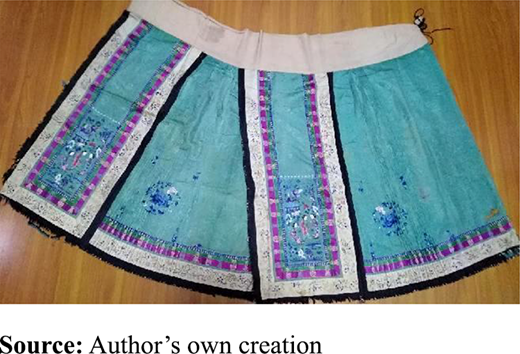
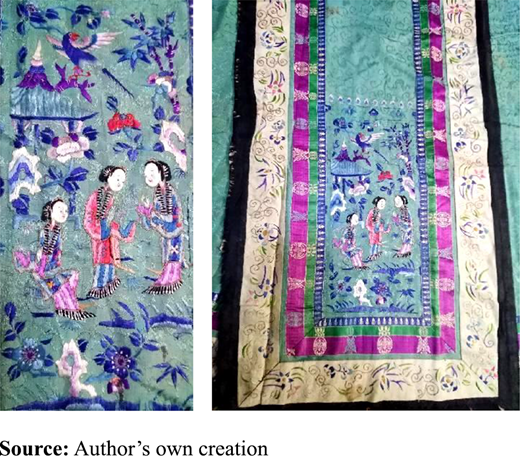
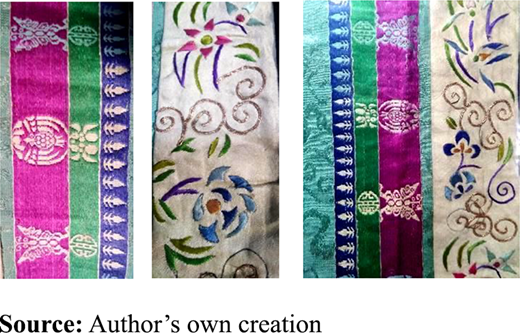
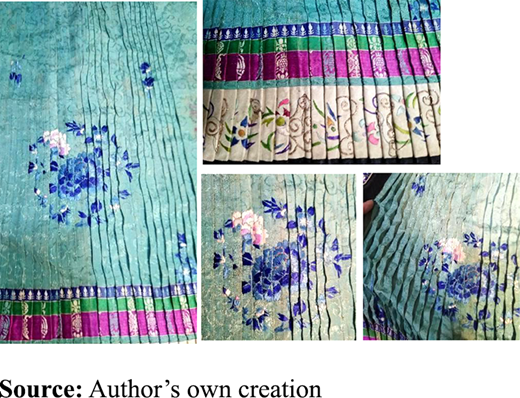
Mamianqun was the most typical style for Chinese women during the Ming and Qing Dynasties, and its shape can be traced back to the Song Dynasty in China (Qi, 2015). The two doors in the front and back of the Mam are beautifully decorated, and the patterns involve happiness of dragon and phoenix, the portrait of ladies, phoenix playing on the peony, birds paying homage to the phoenix, Kirin send son and so on. The side of Mamianqun is trimmed or edged with a simpler pattern. The waist of Mamianqun is made of white or other simple cotton, fixed with rope or knot. Mamianqun has experienced a series of changes, developing during the simple modeling function of the Song Dynasty and adapting to the fresh and elegant style of the Ming Dynasty, the luxury of the Qing Dynasty, the beauty and simplicity of the Republic of China and finally the modern fashion innovation, but its structure of “horse face” (mamian) has always existed (Cao and Wang, 2016). Plate 4 is one of the representative models of Chinese Mamianqun. Take the metadata of Mamianqun as an example, as shown in Table 5.
Discussion
Mapping formed with Visual Resources Association, Categories for the Description of Works of Art and Dublin Core Metadata Elements Set
To realize data interoperability and data sharing, the traditional clothing metadata elements of this paper are mapped with the 15 core elements of the DC metadata standard in Table 1 alongside the VRA and CDWA metadata elements listed (Zhou and Zhao, 2018; Li and Li, 2008). The mapping relationships are shown in Table 6.
According to the mapping relationship in Table 6, we can see that the traditional clothing metadata elements constructed in this paper can basically form and map with DC core metadata, and the mapping relationship with VRA and CDWA is also relatively close, which can allow for sharing and interoperability between general metadata standards.
Application of the metadata scheme for traditional clothing
This paper fully considers that the traditional clothing metadata scheme should be concise, be clear, have clear positioning, facilitate information search and facilitate resource sharing principles, in addition to building classified data, source data, characteristic data, connotation data and management data using, the five layers and development of 28 elements of traditional clothing metadata construction scheme. As seen with the children’s hat and face skirt and their accompanying metadata element descriptions, each piece of traditional clothing can be permanently preserved through a digital metadata solution so as to realize the traditional clothing metadata scheme construction theory and traditional clothing digital preservation practice. According to this metadata scheme, the data of each collected traditional clothing can be recorded to form a digital resource database of traditional clothing, providing information resources for application and research in various fields. Among the 28 metadata elements, the characteristic data such as shape, color, pattern and craft can provide inspirational material for the innovative design of modern costumes, encouraging an integration of tradition and modernity where it concerns designing costume commodities with a historical and cultural atmosphere. The source data of the nation, generation year and production area, as well as the connotation data of the use occasion and cultural implication, can provide evidence for the research of clothing culture, regional culture, national culture, historical culture and so much more. The data on process form, level and quality can provide references for the process technology development of modern products. These 28 metadata elements of traditional clothing can also provide teaching materials for clothing and history-related majors.
Conclusion
In the era of digital economic construction, metadata is an important data description mechanism to realize data discovery, indexing, preservation, management, sharing and reuse (Wang et al., 2021). The construction of a metadata resource database for traditional clothing can promote the permanent preservation of traditional clothing through information storage. After the digital information resource database is reached, it provides users with the convenience of using resources in different regions, taking the promotion and dissemination of traditional clothing out of the limitations of time and space. The traditional clothing metadata resource database also provides researchers with a large and efficient information knowledge base; information calling and sharing are convenient, which is further conducive to sharing and interoperability.
At present, the application of a metadata standard still has problems with information dispersion and low use efficiency, both of which need to be further improved (Sun and Zhai, 2021). There is a need to adopt certain technical means and collect different sources, different formats and different characteristics of heterogeneous metadata mapping and association. Heterogeneous metadata from different sources, formats and characteristics are collected for mapping, association and integration to improve the normalization, standardization and interoperability of metadata (Yao, 2021). The construction of metadata in this paper is an attempt to build the basis of the research work on traditional clothing collation, and it is in the preliminary stage. With the continuous deepening of sorting and research and the continuous promotion of sharing and common resources, the database of this paper will be further improved to provide a more scientific and applicable traditional clothing data database.
The author gratefully acknowledges the financial support provided by the Sanming University's National Fund Cultivation Program under fund numbers PYS2106, as well as the Fujian Province Social Science Foundation Project under project number FJ2022X009. These two projects provided financial support and a research platform for this paper from study design to submission.