


Higher education institutions provide a vital role in providing education towards solving sustainability issues. Hence, the adoption of development agendas, such as the United Nations Sustainable Development Goals (SDGs) through the SDG Accord, into curriculum. As a signatory of the sector SDG Accord, Coventry University Group has the responsibility of providing an enabling environment to promote the achievement of the Goals. This article introduces a model for embedding the goals into curriculum; with creative teaching practice and enriching student experience at the centre to the approach taken. The approach considers three dimensions: Staff Development, the Goals within Teaching, and Students' Activities.
Introduction and aim
The Sustainable Development Goals (SDGs) or 2030 Agenda for Sustainable Development, without any doubt, is one of the most crucial and humanitarian resolutions of the United Nations after the Millennium Development Goals (MDGs) (United Nations, 2015a). The 2030 Agenda is broader and introduces tertiary education into the development agenda. This differs from the MDGs where the focus was on universal primary attainment (Owens, 2017). Higher education has a multifaceted role in establishing a sustainability culture in societies, as well as training and producing graduates who are equipped with knowledge and skills that will enable them to tackle world challenges using sustainable approaches (Leal Filho et al., 2019; Tanaka & Tabucanon, 2014; United Nations, 2019). As such, Coventry University (CU) is making great strides towards the development of socially responsible graduates by incorporating sustainability in all its teaching, activities and operations. It is well known as one of the leading modern universities in the UK. The University is a signatory of United Nations Principles of Responsible Management Education (PRME), the first cohort of universities to join the Responsible Futures programme of the National Union of Students (NUS), and a member of the Environmental Association of Universities and Colleges (EAUC). In 2018, CU signed the SDG Accord, the higher education sector’s response to the SDGs, to show the commitment of the University group to sustainable education and social responsibility.
This paper aims to demonstrate CU's commitment to the SDGs, through a review of the University's most recent activities. Much of the activities discussed in this paper were presented at the EAUC annual conference held in Manchester, UK, from 19th – 20th June, 2019. It is our intention that this paper will help those who wish to promote sustainability in their own institutions.
Sustainable development
The concept of sustainable development is not new, and it has been defined in many ways (Mensah & Casadevall, 2019). One key definition is provided by Word Commission on Environment and Development, popularly known as the Brundtland (1987) definition. Here, sustainable development is defined as “development that meets the needs of the present without compromising the ability of future generations to meet their own needs”. Over the years, the United Nations Organisations has come up with several development initiatives to mobilise educational resources, reduce poverty and inequality, improve healthcare, prevent diseases and enhance the standard of living, all over the world. Some of these initiatives include, Education for Sustainable Development (ESD), since 1992; MDGs, from 2000 to 2015; PRME, founded in 2007; and more recently, the SDGs, adopted in 2015.
Sustainability initiatives: the Coventry way
CU Group is member of several sustainability networks, allowing us to support and develop regional, national and international knowledge and practice relating to sustainability. For example, in 2011, the University signed the United Nations PRME initiative, which has six principles to equip business school students with sustainability skills. Under the PRME initiative, the University is required to adhere to the Sharing Information on Progress (SIP) criteria, every two years. This is expected to showcase the University's commitment to development of individuals with global skills. The University is also among the first cohort of universities to join the Responsible Futures programme of the NUS in 2014 and, it is accredited for the programme. Every three years, a Responsible Futures' audit on Social Responsibility and Sustainability (SRS) initiatives of the University, is carried out by students, supported by the NUS, and presented to staff. In 2015, the University achieved the NUS Responsible Futures kitemark for progress in embedding sustainability within the curriculum. This followed a one-year project by a partnership group consisting of Coventry University Student Union (CUSU), academic leads and sustainability representatives, to review and progress ESD within the University. Key achievements of the partnership group are the inclusion of 'Community and Responsibility' as a pillar of the Education Strategy, and adding ESD to the Job Descriptions post of the Associate Dean (Student Experience) in all Faculties. CU students also participate in the annual Responsible Futures’ Skills Survey. In the 2019/2020 survey, 69% of our students indicated that they want to learn more about sustainability.
The University is an active member of the EAUC, attending and presenting in its annual conferences. The 2019 EAUC regional meeting was held in CU, in collaboration with other regional universities and Sustainability West Midlands. Both Sustainability West Midlands and the EAUC have mailing lists which are open to staff and students with information about events and training resources. In 2018, Coventry University signed the SDG Accord, further demonstrating its commitment to sustainable development.
In 2019, Curriculum 2025 was established with the purpose of developing and implementing a new curriculum framework targeted at developing the skills and attributes to enable students to be ‘world-ready’. The framework focuses on eights key themes, one of which is Sustainability and Social Responsibility. Progress within the 2019/2020 academic year has included the review of our course evaluation forms (Course Quality Enhancement and Monitoring forms) to baseline current adoption of sustainability teaching and learning in the curriculum. To support our focus on ESD, staff and students have taken part in workshops, internal conferences, and we have engaged 976 student course representatives through the ‘Student Rep’ conference.
Sustainable Development Goals and the SDG Accord
On September 25th, 2015, 193 countries gathered at the United Nations' General Assembly in New York and adopted the 2030 Agenda for Sustainable Development, made up of 17 Global Goals, popularly known as the SDGs. This Agenda is a plan of action for People, Prosperity, Planet, Partnership and Peace (United Nations, 2015a). The SDGs are presented in Table 1.
The Sustainable Development Goals (SDGs).
In recognition of the vital role Higher Education Institutions play towards a sustainable world, the SDG Accord was launched in September 2017. This is a Universities and Colleges commitment towards achieving the SDGs, which has two main aims:
“First it is to inspire, celebrate and advance the critical role that education has in delivering the Sustainable Development Goals (SDGs) and the value it brings to governments, business and wider society”.
“Secondly, the Accord is a commitment learning institutions are making to one another to do more to deliver the goals, to annually report on each signatory's progress, and to do so in ways which share the learning with each other both nationally and internationally”.
The SDG Accord has four types of signatories: Institution, Individual, Supporting Organisations and Students' Organisation. However, only institutions are required to follow the five principles of the Accord, outlined below:
“Align all major efforts with the Sustainable Development Goals, targets and indicators, including through their education, research, leadership, operational and engagement activities;
Aim to involve members from all key stakeholder groups in this endeavour, including students, academics, professional staff, local communities and other external stakeholders;
Collaborate across cities, regions, countries and continents with other signatory institutions as part of a collective international response;
Using their own unique ways, inform, share their learning and account to both local and global communities their progress toward the Sustainable Development Goals;
Annually report to the UN High Level Political Forum”.
Following the University's commitment to the SDG Accord, the Coventry University Education for Sustainable Development Working Group (CUESD) was created in 2018. The working group is made up of diverse and multidisciplinary staff who are driven by passion for sustainability. A working group like this, which is made up of like minds, plays an important role in encouraging discussions, debates and sharing of knowledge.
An enabling environment: Coventry University’s sustainability activities 2018-2020
We have conducted a review and synthesis of our sustainability activities between 2018 to 2020 and have summarised them under three dimensions: Staff Development, the Goals within Teaching, and Students' Activities. It is important to note that activities from Coventry University’s Research Centres are not incorporated within this article, and the authors have considered all other information available to them at the time of writing, following the presentation made by the authors at EAUC’s 2019 conference. Future studies can consider a more formal approach of collating best practices based on University’s set out sustainability targets. Information used in this paper was derived from internal sources such as conferences, training & workshops, feedback forms, newsletters, course/programme specification documents, and information publicly available on University sustainability web page.
Staff Development
In 2018, the CUESD working group was created, and staff across faculties were invited to join, to share best practices, generate new thinking, and take initiatives in bringing the goals into classroom levels. Impressive strides have been made since the emergence of the working group. For instance, between 2018 to 2020, the CUESD working group ran 17 staff development workshops and webinars on awareness and implementation of the goals across CU campuses (Coventry University Coventry Campus, London Campus, Scarborough Campus, Coventry University College (CUC)). We also ran bespoke staff development workshops for faculties and schools. The workshops are designed at two levels:
Awareness
Embedding the Goals into the Curriculum
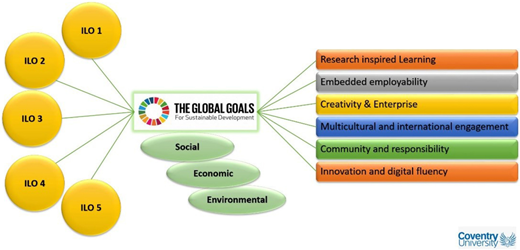
At the first level, we introduce colleagues to the 17 SDGs and their targets. We also provide them with the history of the MDGs and the significant progress made towards those goals (United Nations, 2015b). Our next step was to assist our academic staff in embedding the goals into their modules/courses. To do that, we considered the six pillars of the Coventry University Education Strategy, and the economic, social and environmental dimensions of sustainability (United Nations, 2015a). From this, we designed the 4-Step Model, a simple and straightforward model:
Step 1 – A light-touch approach towards the goals.
Having 17 SDGs, 169 targets, and over 230 indicators make educators hesitate to go through them and embed them into their learning design for students. Therefore, we start by asking staff to think about the learning objectives/outcomes of their module/course. Educators are then required to read the name of the goals and decide which one of them relates to their module/course. This light touch step reduces the 17 goals to two or three, in many cases.
Step 2 – The targets and indicators of the chosen goals.
In this step, we ask educators to read the targets of the goals that they picked in the previous step. That means they now need to go through about 30 targets (instead of 169 targets) and, decide which of them are most related to their module/course learning outcomes. After identifying those specific targets, they are ready for the third step, which is the design of the classroom activities.
Step 3 – Designing classroom activities.
So far, educators have some specific targets of the SDG(s) for which they need to design some classroom activities for their students. When creating activities, we encourage them to consider the three dimensions of sustainability; social, economic and environmental. By taking those three dimensions into consideration, educators can design activities, with intended learning outcomes, linked to SDG(s) related to their disciplines. This means that the goals are now brought into the classroom. Then, educators are ready to map their innovation against the six pillars of Coventry University Education Strategy.
Step 4 – The six pillars of the Coventry University Education Strategy
At this stage, educators need to map their classroom activities against the six pillars of education strategy. These pillars are designed to provide a transformative and authentic learning environment for students (Gearing, 2015), and they are;
Research inspired teaching
Embedded employability
Creativity and enterprise
Multicultural and international engagement
Community and responsibility
Innovation and digital fluency
Mapping the classroom activities against the pillars of education strategy completes the 4-step model of embedding the goals into curriculum, as shown in Figure 1. The model brings authenticity into the curriculum by equipping students with high standard subject knowledge, skills and proficiencies needed to engage and tackle real-world problems. Authentic education also motivates students to engage with the classroom activities and assessment tasks (Sotiriadou et al., 2019; Villarroel et al., 2018).
Sustainable Development Goals in Teaching
The CUESD working group developed a simple means of auditing existing modules. A spreadsheet (Bello, 2020) was designed to collect data on modules, such as level of study, number of students on the module, and the SDG(s) aligned to students’ learning. During the CUESD's audit, we found that our students have provided services to the growth of our city. For example, the Practical Legal Skills and Advanced Practical Legal Skills of Coventry Law School have Clinical Education Programmes that allow students to voluntarily work in the community. Law students volunteer with Coventry Law Centre on several issues, including social security appeals, covering Goals 3, 4, 8 and 16. Under the Business Enterprise module, students help small business owners with marketing, data and learning (Goals 1, 3, 4, 8, 9).
A teaching excellence case study from the Faculty of Engineering, Environment and Computing, provided a practical awareness of sustainability in the school of Energy Construction and Environment. One example is where students collect coffee grounds from campus cafes and take them to the soil mechanics lab where they mix the coffee grounds with soil to produce flower pots and benches. This activity is designed to meet several SDGs linked to three pillars of our education strategies; community and responsibility, embedded employability, and research inspired teaching. In addition, The Centre for Global Engagement have recruited over 450 students in its ‘Be the Change’ programme, to look at global cities through the lens of the SDGs to understand challenges and progress with the goals (see Extended data for links to case studies).
Furthermore, a formal University review was carried out by Curriculum 2025, for each faculty, to capture information on modules that integrate the SDGs. It was found out that there is evidence of the SDGs in modules though many modules were not designed with the SDGs in mind. This is not surprising given that the 17 SDGs were recently introduced into formal teaching curriculum through the establishment of Curriculum 2025 in 2019. However, the review process has provided staff with an opportunity for curriculum revisions (Nhamo & Mjimba, 2020; Tandon, 2017), to incorporate the SDGs.
Student Centred Activities
Enterprise and innovation, and corporate social responsibility are the main pillars of CU’s Corporate Strategy. Through these pillars, the University encourages the development of entrepreneurial skills and contribution to business development in the community, and encourages activism and social responsibility. For instance, Coventry University Social Enterprise (CUSE) supported a range of innovative new enterprises linked with the SDGs, through their Launch Programme. For example, the Try it Fund provides students with funding to try out their business ideas. Another programme supporting CU’s Corporate Strategy is the Fab Lab Project, which is a community hub helping to challenge societal issues by supporting skills development through working with particular groups who would most benefit. Annual Green Week brings together students, external organisations and staff in promoting sustainable practices. During the 2020 Green Week, an 'Investment Fund' workshop invited students to join the University's investment fund managers from a range of commercial organisations to ask about the sustainability of our investments and engage students in supporting the University in reviewing its Ethical Investment Policy.
In October 2019, CUSU, collaborated with World Wide Fund for Nature (WWF) and Sodexo on campus, to encourage healthy lifestyle through what we eat. For example, samples of plant-based foods were on display with educational materials on the impact of what we eat on our environment, in the main students' Hub. In February 2020, CU held a multi-disciplinary 24-hour SDGs Hackathon. This activity brought stakeholder groups (student, staff, industry experts) together, to work with other institutions from across the globe to problem solve sustainability-based challenges. The hackathon initiated discussions on new University partnership, academic exchange and joint research. CUSU also collaborated with the University of Worcester to undertake the Responsible Futures' audit online, in April 2020. With auditors being able to join the audit team from the UK and internationally. It is impressive to witness the commitment of students towards SRS in this era of the COVID-19 pandemic.
Conclusion and recommendation
This paper sets out to discuss the approach taken by Coventry University in embedding the SDGs into curriculum. We looked at SDGs from the perspectives of staff development, teaching and students’ activities. Within teaching, C25’s formal review of courses has identified coverage of sustainability within programmes and found that there is scope for this to be embedded further, and an enhanced way of capturing and measuring this activity would be beneficial to monitor progress. SDGs coverage within curriculum are expected to change on a large scale for the 2020/2021 academic year, firstly because course reviews have now taken place and new module/course specification documents are drafted with more focus on sustainability; second, the 2019/2020 Responsible Futures’ Skills Survey showed that about 69% of CU students want to learn more about sustainability and; third, the COVID-19 pandemic calls for a rethink on the type of global skills our future graduates need, to tackle global challenges.
Therefore, we recommend that educators embed the SDGs into their curriculum as it brings about authenticity, and helps students develop problem-solving skills needed for real life challenges. Feedback from colleagues suggests that the 4-step Model is a straightforward approach of embedding the goals into the curriculum, and therefore, we recommend using it. We also recommend that educators design formative activities, and support student-led extra curricular events on sustainability issues. This will help them develop soft skills like evaluative judgement, critical thinking, self-regulation, communication skills and teamwork.
Data availability
Underlying data
All data underlying the results are available as part of the article and no additional source data are required.
Extended data
- Curriculum 2025 Case Studies on Sustainability and Social Responsibility: http://curriculum.coventry.domains/sdgs/case-studies/
- The Faculty of Engineering, Environment and Computing Case Study information: https://acdev.orgdev.coventry.domains/application/files/3715/9088/2606/Shervin_Motamedi_case_study.pdf; https://vimeo.com/344790649/cd764c8d14
- Public Health and Community Studies CU College Case Study information: https://acdev.orgdev.coventry.domains/download_file/492/846
Figshare: SDGs Module Audit Spreadsheet, https://doi.org/10.6084/m9.figshare.12869633.v2 (Bello, 2020).
Data are available under the terms of the Creative Commons Attribution 4.0 International license (CC-BY 4.0).
Publisher’s note
This article was originally published on the Emerald Open Research platform hosted by F1000, under the ℈Quality Education for All and EAUC collection℉ gateway.
The original DOI of the article was 10.35241/emeraldopenres.13866.1
Author roles
Bello J: Conceptualization, Investigation, Project Administration, Writing - Original Draft Preparation, Writing - Review & Editing; Fletcher S: Conceptualization, Investigation, Validation; Ammari-Allahyari M: Writing - Original Draft Preparation
Funding statement
The author(s) declared that no grants were involved in supporting this work.
Competing interests
No competing interests were disclosed.
References
Reviewer response for version 1
Olurotimi Kemiki, Department of Estate Management and Valuation, Federal University of Technology, Minna, Nigeria
Competing interests: No competing interests were disclosed.
This review was published on 22 September 2020.
This is an open access peer review report distributed under the terms of the Creative Commons Attribution Licence, which permits unrestricted use, distribution, and reproduction in any medium, provided the original work is properly cited.
Recommendation: approve
This paper discusses the approach taken by Coventry University in embedding the SDGs into the curriculum. The University designed the simple 4-Step Model for educators. The paper identified the success of the model in the university and concludes by recommending that educators embed the SDGs into their curriculum.
However, there is need for the authors to discuss the limitation(s) of the model and its suitability for Post graduate studies.
- Is the work clearly and accurately presented and does it cite the current literature?
Yes
- If applicable, is the statistical analysis and its interpretation appropriate?
Not applicable
- Are all the source data underlying the results available to ensure full reproducibility?
No source data required
- Is the case presented with sufficient detail to be useful for other practitioners?
Yes
- Are the conclusions drawn adequately supported by the results?
Yes
- Is the background of the case’s history and progression described in sufficient detail?
Yes
Environmental Management, Sustainability and Real Estate
I confirm that I have read this submission and believe that I have an appropriate level of expertise to confirm that it is of an acceptable scientific standard.
Reviewer response for version 1
Renuka Thakore, School of Engineering, University of Central Lancashire, Preston, United Kingdom; Research, Innovations and Partnerships, University College of Estate Management, Reading, United Kingdom
Competing interests: No competing interests were disclosed.
This review was published on 15 September 2020.
This is an open access peer review report distributed under the terms of the Creative Commons Attribution Licence, which permits unrestricted use, distribution, and reproduction in any medium, provided the original work is properly cited.
Recommendation: approve
The figure 1 has ILO abbreviation for which full form is not provided. My assumption is that ILO full form is'intended learning outcomes', this needs to be made clear.
The figure 1. Road map of the 4-step Model needs more theoretical interpretation to explicitly show its important role in delivering SDGs and its contribution to ESD
How the ILO activites feed into the six pillars of the Coverntry University Education Strategy needs to discussed for the reader to understand how it contributes to ESD.
- Is the work clearly and accurately presented and does it cite the current literature?
Yes
- If applicable, is the statistical analysis and its interpretation appropriate?
Not applicable
- Are all the source data underlying the results available to ensure full reproducibility?
No source data required
- Is the case presented with sufficient detail to be useful for other practitioners?
Yes
- Are the conclusions drawn adequately supported by the results?
Yes
- Is the background of the case’s history and progression described in sufficient detail?
Yes
Education and Sustainability
I confirm that I have read this submission and believe that I have an appropriate level of expertise to confirm that it is of an acceptable scientific standard.

