Recent literature highlights ambiguity regarding diversity management (DM) interventions and their impacts. This paper supports the idea that to avoid this ambiguity, a better contextualised and conscious DM approach is required, one that relies on a clear and solid connection between the meanings of difference, the DM interventions and the overall HR practices.
Fifty HR professionals were involved. Based on the phenomenography recommendations, in-depth semi-structured interviews were developed and analysed.
Results show multiple nuances and meanings associated with diversity and DM, indicating the need for complex and contextualized approaches to ensure the sustainability and effectiveness of DM. The analysis also reveals a tendency to work “by categories” and in response to problematic or urgent situations; this implies that DM is often not integrated into business and HR strategies. Results show that efforts must increasingly focus on identifying an organic approach, defined as an organisational mandate for the legitimacy of DM actions, i.e. intervention at individual, group and systemic levels; involving both internal and external stakeholders; and focusing on measurement and monitoring.
The paper aims to show how DM risks leading to contradictory results if not contextualised and in dialogue with organisational realities. This research supports the advancement of a more profound understanding of DM without assuming diversity to be objectifiable a priori, analysing diversity and DM, and how these relate to the overall HRM approach.
Introduction
A consistent stream of diversity management (DM) literature focuses on implementing “effective” activities to maximise the positive impacts of diversity in the organisation (O'Leary and Sandberg, 2017; Yadav and Lenka, 2020). Thus, a managerial perspective is assumed to conceptualise diversity as definable and measurable at the mainstream level through predetermined objective categorisations. However, the most recent literature has revealed some ambiguity related to DM interventions and their impacts (Brøgger and Andersen, 2024; Kulik, 2014; O'Leary and Sandberg, 2017). When it comes to the outcomes, the literature shows that the evidence of the intervention’s effectiveness may not be entirely clear regarding enhancing organisational diversity, improving its management and providing both social and economic benefits (Benschop et al., 2015; Corvino et al., 2022; Dobbin and Kalev, 2016; Dover et al., 2020; Kuntz and Pandaram, 2022; Nadiv and Kuna, 2020; Nkomo and Hoobler, 2014; Wall-Andrews et al., 2022; Wang et al., 2023). Workforce diversity can deliver economic benefits and promote a sense of belonging and well-being, but only when effectively managed (Kulik, 2014).
To understand how organisations could approach DM, we agree with a growing body of more critically oriented literature suggesting that diversity and its management are not something objectifiable a priori; if anything, it is preliminarily necessary to understand the significance attributed to DM initiative (Brøgger and Andersen, 2024; Holgate et al., 2012; Koellen, 2021; O'Leary and Sandberg, 2017; Olsen and Martins, 2012; Triana et al., 2021; Wall-Andrews et al., 2022). In his 2014 contribution, speaking in terms of “diversity management system,” Kulik effectively highlighted the importance of focusing on the connection between the meanings attributed to diversity, the motivations underlying the decision to manage it, the translation into organisational practices and their perception by the organisational population. More specifically, Kulik (2014) shows how diversity paradigms (deferring to an organisation’s normative beliefs and expectations about employee diversity and its role in the organisation) drive organisational diversity policies. This level in the structure of the diversity system refers to the organisation’s goals for DM. The organisation’s diversity paradigm and diversity policies are then translated into the choice of diversity programs, i.e. the organisation’s formal DM activities. Finally, diversity practices reflect the organisation’s DM programs as experienced by the organisational population, regardless of their consistency with the organisation’s intention. Indeed, a crucial element to keep in mind is that employees will interpret DM initiatives (regardless of their specific purpose) as signals of organisational identity and culture (Gazzaroli and Gozzoli, 2021; Gazzaroli et al., 2019; Gozzoli, 2016a, b; O'Leary and Sandberg, 2017; Wall-Andrews et al., 2022; Wang et al., 2023). Consequently, we believe a contextualised and conscious approach is indispensable for an effective approach to DM. By contextualised and conscious approach, we intend for the organisation to look and reflect on itself in terms of meanings related to diversity (as its representation will connote all DM processes); the motivations the organisation identifies to activate DM processes and towards which organisational goal to guarantee coherence and connection between the meanings related with diversity, the DM initiatives and the overall HRM approach. Therefore, the assumption of a contextualised and conscious approach requires organisations not only to focus on the meanings associated with diversity and its management but also to connect them to the life stage they are going through concerning the issue of diversity, such as it is a fallback dictated by internal or market crises, it is a choice to respond to regulatory needs, it is a decision to develop innovation and enhance internal resources. In this study, we support the idea that to approach diversity effectively, DM should be contextualised, and conscious meaning DM practices should be based on a clear and solid connection between the meanings of difference, the DM actions and the whole HRM practices. For this exploratory study, we decided to focus on HR figures because the function of this role is intrinsically linked to the transmission and translation of organisational culture assumptions into HRM actions and processes (Kulik, 2014; O'Leary and Sandberg, 2017; Shore et al., 2011; Testa et al., 2024; Zaccone and Pedrini, 2024).
The meaning(s) related to diversity and DM
When discussing diversity and DM, an essential first step is to identify what constitutes difference within the organisation and under what terms it is perceived. One of Ely and Thomas’s most cited contributions is on how organisations (Thomas and Ely, 1996) and work groups (Ely and Thomas, 2001) understand diversity and its role in the work context. The authors identify three perspectives on diversity: (1) a discrimination and equity perspective, focusing on eliminating discrimination against minorities’ members; (2) an access and legitimacy perspective, focusing on access diverse markets by matching workforce and customer demographics; and (3) an inclusion and learning perspective, focusing on differences in the workforce as an opportunity to reconfigure the core tasks in the organization. Over time, the definition of diversity has gone from a “narrow” view, linked to socio-demographic dimensions, to a broader view, in which the dimensions that characterise it are multiple and overlapping (Podsiadlowski et al., 2012). As Martín-Alcázar et al. (2012) suggest, human capital diversity in organisations can be defined as the outcome of the interaction between the different characteristics of all the employees, ranging from unchangeable and visible factors (such as gender, age and ethnicity); to invisible and partially changeable factors (such as cultural background and professional training); to work-related-assets diversity (such as knowledge, skills and abilities, values and cognitive style). Therefore, as DM in organisations should be intended as a set of practices aimed at understanding each person’s potential and interaction between superficial and deep diversity dimensions to build a work environment fostering development and integration to produce positive outcomes and generate value (Yang and Konrad, 2011), it is possible to identify a progressive complexification within the DM practices. Precisely, we can identify four eras of DM development (Offerman and Basford, 2014; Page, 2017; Shore et al., 2018; Yadav and Lenka, 2022). The first one, the Affirmative Action era, was mainly focused on signalling and repairing the faults of historical exclusion towards women and minorities in employment, education and culture. This first era can be seen as the precursor: minorities and women had been allowed access to broader job opportunities; however, they continued to be excluded from the upper levels of the hierarchy and the spheres of influence in organisations. This led to the focus of the second era (1990–2000), where the focus was on providing training programs mainly aimed at promoting awareness in the dominant class and helping the excluded categories to blend in and develop the appropriate skills to be efficient. The third era (2000–2010) shifted the focus from the paradigm of integrating differences to its strategic management, trying to highlight its competitive advantage. Finally, the last era (2010–2020) saw the majority of efforts focused on systematising theoretical framework models that would allow for a broadening of the factors considered when managing diversity. In summary, the concept of DM historically replaced the idea of equal opportunity, a.k.a. affirmative action. Indeed, with increasing diverse complexity came the need to move beyond the idea that it could be sufficient to allow equal organisational access to members of marginalised groups. The mere presence and juxtaposition of diversity in human resources risks precluding any benefit and improvement (Offerman and Basford, 2014; Winters, 2014). Thus, the foundation of DM is the valorisation, development and “use” of human capital diversity to achieve business growth and improve the organisation’s quality of life.
Moreover, it is necessary to keep in mind, as well pointed out in the critical literature, that the concept of diversity itself is relationally constructed and derived from the specific organisational history and culture, endowed with significance and (re)produced within organisations through context-specific processes that contribute to the reiteration of those meanings (Gazzaroli and Gozzoli, 2021; Gazzaroli et al., 2019; Gozzoli, 2016a, b; Köllen, 2020; O'Leary and Sandberg, 2017; Wall-Andrews et al., 2022; Wang et al., 2023). In this regard, at the state of the art, it is worth mentioning that DM initiatives can still unintentionally be traced back to the sole categories of power, privilege, domination, disadvantage and deprivation, consequently leading to counterproductive interpretations such as biased assumptions about the competence of members of disadvantaged groups, the belief that the organisation discriminates against and excludes members of majority groups (Dover et al., 2020; Nkomo and Hoobler, 2014). Based on what has been discussed, it seems clear that approaching diversity and DM – because of their various and contextualised meanings – solicits several (and sometimes unexpected or conflicting) expectations and reactions. Accordingly, providing organisational equal access opportunities is only the premise; for DM to be generative, it is not trivial to point out that understanding the assumptions underlying diversity within the human capital and DM’s proposals is necessary, because those same meanings will imbue the experiences and affect the potential of DM (Lorbiecki and Jack, 2000; Mease and Collins, 2018; Page, 2017). From our point of view, therefore, diversity within organisations is the expression of the specific composition of human capital present in the organisation at a given time, that is, both in terms of individuals and of the overall system. Because of that, we believe it is important to emphasise how assuming that difference requires a contextual and conscious approach implies starting from the exploration of the meanings that each context and the organisational actors who “live it” daily attribute to difference to avoid the risk of taking “for granted” that DM practices are an expression of an authentic attribution of value to difference.
Implementing DM initiatives within the human resources processes
DM initiatives are supposed to ensure an environment in which people perceive themselves to be recognised, can feel safe both physically and psychologically, can be part of a group in which they feel recognised and respected in their specificity, and can feel part of processes not only in terms of execution (Shore et al., 2018). HRM research suggests that organisations are more successful when they use a strategic “configuration” of multiple integrated activities to address a specific topic; therefore, we can assume that simultaneous implementation of multiple DM activities allows to convey a signal more than any single meaningful activity about the value the organisation places on diversity (Brøgger and Andersen, 2024; Kulik, 2014; Nadiv and Kuna, 2020; Testa et al., 2024). This implies that when we talk about DM, we should be referring to multifaceted processes that cannot be made to adhere to rational-adaptive assumptions; DM actions should be assumed as closely intertwined with “regular” HR processes (Brøgger and Andersen, 2024; Nadiv and Kuna, 2020). It has often been pointed out that mainstream management literature has almost exclusively applied social psychological approaches that do not allow for sufficient evidence of the role of organisational contexts in shaping the meaning of diversity (Brøgger and Andersen, 2024; O'Leary and Sandberg, 2017). Therefore, the challenge for HR as the connecting function between top management and the organizational population then becomes ensuring that DM initiatives are anchored within broader organisational strategies and avoiding DM being reduced to an exercise in conformity or style rather than as an integral part of the corporate vision (Das, 2022; Kundi and Aboramadan, 2022; Morfaki and Morfaki, 2022).
However, the recent scoping review conducted by Testa et al. (2024) shows that previous studies investigating the intertwining of DM and HR practices often found fragmentation and ambiguity in terms of consistent evidence of how the interaction between the two is managed in organisations. Thus, the literature on this topic tends to focus on a global approach or specific HR-related practices. In the case of universalistic approaches, what emerges as the focus is identifying best practices that can be applied to all organisations, regardless of their specific characteristics, needs and critical issues, therefore not fully recognising DM multidimensionality and its implications for the overall HR practices. Regarding specific HR-related practices (such as recruitment and selection, training, compensation and performance evaluation), the focus usually does not imply the embedding between people management actions and DM bypassing the possibility of recognising diversity as part of the organisational strategy. Thus, we can say that the indication pointed out throughout the years in literature (Kulik, 2014; O'Leary and Sandberg, 2017; Triana et al., 2021) for more research focusing on HR professionals to understand what organisations are doing about diversity has not yet been fully met: there is indeed a need to understand what organisations are doing about diversity and why they are doing it. Thus, when implementing DM initiatives, it is necessary to consider this inherent complexity to work towards the alignment with HRM and strategic and organisational initiatives and avoid or limit contradictions and paradoxes. In this regard, in their work, Nadiv and Kuna (2020) propose an interesting overview of the possible paradoxes that can be encountered during DM implementation: the paradox between necessary change required by DM and the desire for stability that may result in organisational actors' opposition to implementing DM actions; the paradox of bureaucratic control and the certain degree of adaptability and flexibility required when implementing DM that may fuel a counter-demand for more bureaucratisation; the paradox of long-term business gains and short-term losses. On the part of the organisation’s managers, ignoring, underestimating or not legitimising the co-presence of these opposing forces would thus constitute an obstacle in implementing DM initiatives. Therefore, in pursuing the implementation of DM initiatives and embedding them into the HRM, it is functional to support organisational actors in recognising and accepting the inevitability of some degree of uncertainty, resistance and conflict that can be generated and consequently be prepared to foreshadow and configure any short-term losses as part of the process related to such fatigue and resistance (Brøgger and Andersen, 2024; Nadiv and Kuna, 2020).
Aim of the study
As shown in the previous sections, DM policies are distinguished by a contingent nature specific to the organisation in which they are designed and implemented (Gazzaroli and Gozzoli, 2021; Gazzaroli et al., 2019; Gozzoli, 2016a, b; Köllen, 2020; Kulik, 2014; O'Leary and Sandberg, 2017; Wall-Andrews et al., 2022; Wang et al., 2023). Organisational meaning related to diversity may vary, and its management could be fruitful only when diversity is recognised as an intrinsic value. Moreover, to effectively influence and transform key organisational components (such as practices, organisational structures and organisational processes), DM practices must be intertwined with the overall HRM policies (Benschop et al., 2015; Holck, 2016). More specifically, we support the idea of an approach based on a clear and solid connection between the meanings of difference, the DM actions and the whole HRM practices to guarantee more effective DM practices.
In this regard, a further premise related to the country where this study took place is required. DM in Italy began to gain substantial attention during the 2000s and is still relatively underdeveloped and perceived as “marginal”; thus, most Italian organisations tend to approach DM diversity from a compliance or marketing standpoint rather than fully recognising it as an organisational priority (Ravazzani, 2016; Ravazzani et al., 2021). Unlike the original business models of DM policies, the economic-business fabric in Italy is mainly composed of small and medium-sized enterprises (SMEs), which affects their ability to implement such policies. The Italian territory consists of 78.9% micro enterprises, 18.5% small enterprises, 2.2% medium-sized enterprises and the remaining 0.4% large enterprises (Istat, 2023 [1]). Moreover, Italy has a relatively homogenous population compared to other countries and remains a clear imbalance and exposure to critical issues in terms of employment, job placement, and pay for young people, women and foreigners (Istat, 2024 [2]). The old-age index in 2023 reached 193.1 (elderly for every hundred young people) and the employed workforce appears to be aging faster than the population: compared to 2004, the share of 15–34 year olds among the employed has decreased more than in the population (−11.5 points compared to −6.3 points) and the opposite has occurred among those over 50 (+16.6 versus +5.3 points for 50–64 year olds and +1.6 versus +4.7 points for 65–89-year-olds). The age issue for the Italian context is not just a matter of percentages but refers to the co-presence of different perspectives regarding opportunities for growth and enhancement of skills and know-how. As far as gender is concerned, Italy’s considerable lag in managing gender diversity is well known, especially concerning pay equity and the possibility of occupying leadership positions: in the Global Gender Gap compiled by the World Economic Forum in 2023, Italy slips to 79th place out of 146 countries, losing a good 13 positions compared to the previous year. In the labour market, differences between Italians and foreigners also remain: in 2023, the employment rate (20–64 years) of foreigners (65.1%) grows less intensely than that of Italian peers and is still lower than that of natives (66.4%). Finally, as highlighted by research conducted by Istat and UNAR in 2020–2021, 26% of employed or formerly employed LGBT + people reported that their sexual orientation had been a disadvantage or cause of aggression during their working life. Because of this national socio-cultural context, DM in Italy still focuses only on certain diversity categories: organisations tend to focus heavily on gender and age policies driven by societal pressures and national legislation (Ravazzani et al., 2021). To this end, the present work, through a qualitative approach, aims to provide evidence that DM to be effective, should rely on a contextualised and conscious approach. Therefore, we explored
Representation and meanings of diversity in the organisations, assuming (based on the literature) to find various (and potentially contradictory) connotations related to diversity.
Types, levels of intervention and purpose of the DM, to understand how diversity is declined and managed in terms of practices in factual terms and in terms of coherence.
HRM processes and DM, to understand if and how DM and HRM are intertwined, and how DM policies are perceived as core activities of the whole HRM.
Materials and methods
Sample and procedure
Potential participants were contacted through a letter of invitation describing the research proposal and aims, the procedure and the topics of the interview. The letter of invitation was shared via email through the network of MIDA S.p.A., a consulting firm that has been active on the topic for years and was interested in exploring the state of the art of DM in Italy. The invitation letter also made explicit that the choice to participate in the research was voluntary and would not entail any future constraint. Interested professionals could signal their intention to participate by contacting the research’s contact person and agreeing on an interview slot. The final sample (see Table 1) turns out to be composed of 50 HR professionals with different titles and functions in the HR domain and with different professional backgrounds to give voice to and understand as many nuances, meanings and experiences related to DM as possible. Most participants have a role seniority of more than 15 years and hold positions of HR Director (n. 35); CSR/Sustainability Manager (n.6); DE&I Manager (n.9). The sectors in which the organisations operate are distributed as follows: service industry 53%, production industry 34% and not-for-profit 13%. We decided to include different organisational types in the sample because, in the Italian context, in terms of DM, there are no significant differences related to the field in which the organization operates (Ravazzani, 2016; Ravazzani et al., 2021).
Consistent with our aim, it was deemed appropriate to refer to the assumptions of the phenomenographic approach. Phenomenography is based on the study of individual conceptions – assumed as the different ways in which an individual interprets and understands a particular phenomenon – to build a better comprehension of how individuals understand and the possible relationships between individuals’ different conceptions of a given aspect of reality (Marton, 1981; Sandberg, 2005; Trigwell, 2000). More specifically, to capture possible variations in the understanding of the issues of interest, it was decided to select participants with as diverse characteristics as possible, pay special attention to the variability and relationships among the possible conceptions of participants during both data collection and analysis (Marton, 1981).
Measure
A semi-structured in-depth interview (Table 2) was developed in line with the phenomenographic recommendations to conceive DM as the result of professionals’ comprehension of their practice based on the organisational representations of diversity and its management. The areas of interest and questions were thus formulated in order to (1) capture the different ways in which a particular phenomenon is perceived by a group of individuals (conceptions); (2) analytically identify aspects of variance among the different conceptions (structural factors); and (3) order the conceptions hierarchically, according to an inclusive process and on the basis of the structural factors of variance identified (Marton, 1981; Sandberg, 2005; Trigwell, 2000).
Data analysis
We applied the Interpretative Phenomenological Analysis (IPA) method, following the instructions of Smith et al. (2021). IPA aim to explore in depth how people make sense of their personal experiences, focusing on understanding the subjective meaning an individual attaches to an experience within its context. Therefore, it appeared to be the most suitable choice, given the exploratory nature of the research and the focus on HR figures as the roles expected to transmit and translate the OCD. Following the IPA approach’s instructions, the analysis method consisted of the following steps: detailed reading, exploratory annotation, emergence of themes, connections between themes and the development of an interpretive narrative. The interviews were audio-recorded upon informed consent and then transcribed verbatim. The transcripts were read repeatedly to identify early differences and similarities in ways of understanding the phenomenon under study. During this first phase, we applied a hierarchical categorisation system that combined top-down and bottom-up logic (Hsieh and Shannon, 2005). These logics were combined because the three macro areas of the rationale derived from the literature analysis (top-down logic) needed to be deconstructed and reconstructed, considering the comparison with all research participants (bottom-up logic). Specifically, for top-down logic, we drew on the three macro-categories of the rationale, applying direct content analysis (codes are defined before and possibly during data analysis). To identify the micro-categories, according to bottom-up logic, conventional content analysis was applied (categories and category names arise from the data). After these two steps, an interpretive process was initiated to understand the meanings of the macro- and micro-categories (see the previous section about phenomenography). Next, the similarities and differences were made explicit to progressively define the structural aspects that differentiate the various conceptions from each other and, consequently, to proceed in the interpretation of their peculiarities. Once the structural and referential elements that distinguish the various conceptions had been clarified, their finalisation and hierarchical ordering proceeded. Each participant was attributed the emerging dominant conception. This attribution was made by coding the transcripts related to each participant from the list of conceptions defined in the previous step. The analyses involved three researchers, one considered “primary” in that he was more directly involved and responsible for analysing the data and two others “secondary” in that they were primarily involved in reflective comparisons of the progressive results. The primary researcher analysed the data by developing protocols in which each concept or category was linked to the empirical material from which it was drawn. The other researchers read and commented on the first researcher’s development by indicating doubts and supporting the explication and clarification of the categories and interpretations. The coders belonged to the same research group.
Findings
The results below will be presented and organised according to the rationale’s reworking based on what emerged in terms of conception variability and relationships among conceptions during data collection and analysis. During the cross-sectional comparison of the data, no significant divergences or differences emerged in relation to the organisations to which the participants belonged or the role they played, so it was decided to present the data in aggregate form. Bearing in mind what has been highlighted with respect to the Italian context (Ravazzani, 2016; Ravazzani et al., 2021) in terms of the characteristics of the working population and the predominance of SMEs that have only recently begun to approach the issue of diversity and its management. This first evidence is not surprising, and considering that the Italian context still seems to lack sufficient maturity and sedimentation on the topic of DM, it does not contradict our assumption of the need for a contextualised and conscious approach.
Representation and meanings of diversity in the organisations
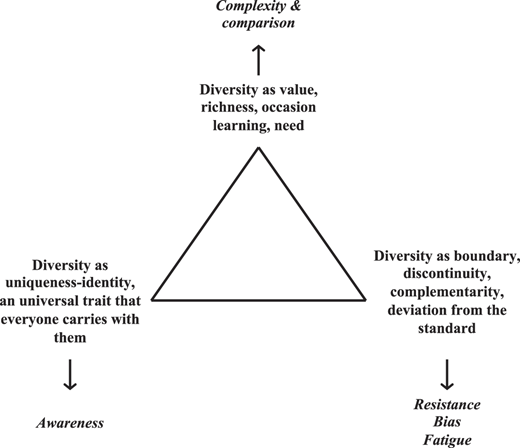
Based on the interviews, diversity in Italian organisations (Figure 1) can be represented with three different meanings (which may or may not be co-present). We named the first meaning “complexity and confrontation”, which refers to organisational representations of diversity as a source of value, richness, opportunity for learning, an organisational necessity («Our CEO has worked for American companies so anyway there is this – this idea that diversity is a value, that is, working with people coming from other parts of the world enriches you if you put yourself out there a little bit».; «We believe that diversity is a strong asset for our employees, we strongly support its expression»). The second category of meanings was called “awareness of self and others” and refers to organisational representations of diversity as a universal trait that everyone carries, the unique identity that every employee brings into the organisation («We like the concept of variety more because diversity stigmatises far too in the sense of distancing ourselves and lead us to increase our prejudices»; «I had many experiences in different organisation and I have to say that diversity is something always present, it’s just about willing to let it have space»). The third category of meanings was named “resistance-bias-fatigue” and refers to diversity as a boundary between employees, a possible cause of discontinuity and deviation from the standard and what is expected («We are a predominantly national company so the theme of multiculturalism is not such an obvious or such a strong theme. I must say, then, in my experience, the most pronounced difference is age; this can represent a huge theme of disparity»; «Usually I must fight with my CEO because he usually focuses only on gender. This is a good thing I’m saying it isn’t but there also other diversity that should receive attention but they’re not trendy enough … you know what I mean?»).
In terms of meanings and representations of diversity is also prominent the close correlation emerging from the interviews between diversity and inclusion. In some cases, the difference is seen as a prerequisite for inclusion: an awareness of diversity (seeing it and knowing it) is necessary for inclusion, understood as grounding actions to allow people to be themselves («DM is … is the first step to get to inclusion because first you have to recognise the difference then work primarily on communication in daily management»; «Our final goal is having an inclusive organisation»; «In my vision DM is the premise to reach inclusion and equity for everybody»). In other cases, however, inclusion is seen as a prerequisite for legitimising difference: the starting point is the non-discriminatory, caring and merit-based management of people to allow the next step of drawing value from the differences that people bring and express («Ethically and legally companies must take into consideration and apply the principle of non-discrimination. Having done that, we then figure out how to best value diversity», «I think that we’re still far away from being able to allow diversity beign recognised as legit itself. That’s the goal»). This kind of relationship is worth keeping in mind not just because it is strongly intertwined with the context in which organisations operate but also because it may affect the way diversity is perceived as an asset or an obligation and, therefore managed («There is some inherent difference in who we are and how we are, because … we deal with a business that comes very much into people’s lives»)
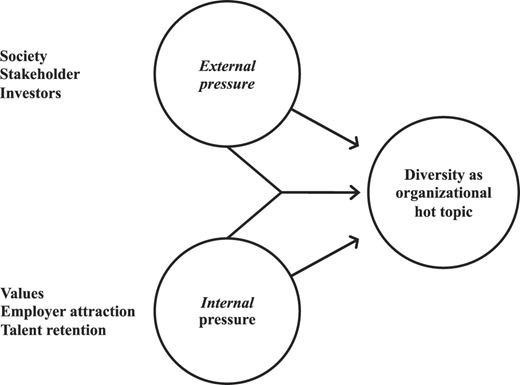
While exploring organizational meanings and representations of diversity in connection with organizational history, differentiation emerged regarding motivations and drivers by which an organization decides to approach diversity. These drivers and motivations move along a continuum, which sees some organisations incentivised by external pressures, others by internal pressures, and others by both (Figure 2).
The prominence given to internal and external pressures depends on the representations that organisations refer to diversity. At one pole, diversity is intended as a tool and, consequently, approached to promote a positive image (internally and externally), as a claim for marketing reasons, or as a cultural legacy. On the other pole, diversity is recognised as an intrinsic worth organisational factor («From a marketing point of view now you have to expose yourself in some way at least, no? So externally, some companies are doing it [DM], while there is no internal correspondence. Instead, many companies are doing it very seriously, in my opinion, though thanks to the sensitivity of yes … of … of people internally who become passionate about this issue and make it a corporate issue.»; «My AD is finally allowing me to develop a DE&I division because there’s a lot of requests from our investors. It’s not the best, but at least I’m allowed to work on some diversity policies».). However, when attempting to delve into the connection of these drivers with organisational history, participants’ answers have remained at the level of contingent diversity pressures and disconnected from a more complex link at the overall organizational history and the historical moment the organisation is experiencing regardless of the specific issue of diversity. This disconnection seems to be attributable to the explanation that diversity and its management are still understood -even when identified as an intrinsic organizational value-as “separate” from the overall HRM and organizational processes («Diversity and DM by us are understood as a separate issue.»; «I would not know compared to the past if there were DM initiatives, but I don’t think so … we just started to deal with it.»; «Often DM are just spot actions, on the need.»; «Sometimes I feel like DM is just a patch to keep it quiet»).
Types, levels of intervention, and purpose of the DM
Exploration of the actions and policies implemented by the organisations revealed two main perspectives of DM intervention target. On the one hand, we detected DM cross-cutting interventions targeting the entire corporate population, which address diversity in terms of the unique identity and experiences of each employee («If you want to realise proper DM, you cannot take one issue at a time!»; «Diversity is a whole, we can’t dissect people into categories and labels!»; «I worke din many big organisations and I have to say that the most effective DM policies are the one who take into account everyone»). On the other hand, we found DM category-oriented interventions targeting specific social groups, based on the assumption that diversity implies the need to fulfil ethical and regulatory obligations for protection and the creation of the conditions for access and growth in the professional world («Well, the differences are distinguished in nature, so you have to deal with them in their specificity»; «We believe that DM has the duty to protect the minorities; otherwise diversity could be perceived as a disadvantage»; «DM should be primary focused on those who needs the most»). It is worth mentioning that within the 50 organisations that participated in the research, most of them (n.32) adopted this second perspective to define DM interventions and targeted individual categories. Among the diversity categories mentioned by participants —gender, generations, culture, disability, LGBTQ+— gender followed by generations occupy a central place and constitute the two main focuses of interest toward which the most significant efforts are currently directed. However, it was found that, compared to the past, companies have less difficulty relating to a broader range of diversities («We’re trying to»; «I see the changes. They’re happening slowly, but they’re happening and that what keeps me going and keep up!»).
Based on the combination of target and purpose we identified three main levels that DM interventions intercept (Table 3). More specifically, given the focus on specific and singular targets, we identified the individual one as the level of interest for DM category-oriented interventions. On the other hand, as far as DM cross-cutting interventions are concerned, we have identified the group and system level as those of interest precisely because these types of interventions take a perspective on difference as an issue that affects all employees as individuals in relation to each other.
It is worth noting that one critical issue has emerged across all DM implementations, namely, evaluation. A general absence of an evaluation culture is recognized, affecting not only the monitoring projects through the definition of objectives and measurable, communicable and transparent KPIs but also to give evidence of the impact and value of DM actions («We need to systematise, that is, we have done many things but we do not have an organic and structured and detailed vision with clear objectives yet and that makes us scatter resources and limits the ability to capitalise on what is being done.»; «I think this [evaluation] is critical when dealing with DM because already we have to make … a higher effort to make it clear that DM is also crucial; I think one of the ways to make it obvious even to those who believe less is to give KPIs, so really treat diversity like any other business asset.»).
HRM processes and DM
The first evidence to point out is that many of the participants found a general lack of a common thread between DM and HRM practices, implying a lack of systematic planning that would enable an organic approach for coherent and effective DM grounding into the overall HRM vision and strategy («If I work in a more cross-cutting way without putting the flag “I am doing DM” but I am “doing managerial actions” … diversity and DM will become part of a way to be in the company.»; «Companies really must make an effort in rethinking their processes of recruiting, of developing people, of training, of creating that competence of recognising and valuing diversity, which you then see expressed in the fact that diversity simply exists in the company, as it simply exists in the world no?»; «Someone might think that being a DE&I manger is the best scenario, in my opinion it’s not. Because it’s always like we are something else, something apart from the rest of the HRM»).
One of the first issue that emerged from data analysis to guarantee a proper connection between DM and HRM, concerns the requirement of a punctual analysis of the actual organisational structure in terms of verticalisation, hierarchies, and processes that define relational and work dynamics («It first needs commitment from top management to ensure consistency of vision and approaches … because it is the only way to generate change truly.»; «We have a remarkable sensitivity from top management; otherwise, we could not have completed half of the initiatives.»; «The new AD is my biggest ally, because it’s about the endorsement»). Strongly related to the previous evidence, it was repeatedly pointed out that creating alliances with apex roles is necessary to build and sediment aligned organisational culture and processes that cascade to contaminate the corporate population.
Finally – although there was a cross-sectional awareness that DM is a time-consuming process, activating fear/resistance – it is worth noting what emerged concerning conflict when dealing with DM. Based on participants' responses, the positionings toward conflict are generally of fear and denial («No conflict is a word that does not belong to us»; «I don’t like using the word “conflict”, because it implies that there’s something wrong in terms of relationship and this doesn’t sound God.»). In the first case, the tendency is indeed to represent conflict as a threat, something to be avoided with the consequence of feeding and reinforcing homogeneous views and losing spaces for innovation and confrontation («We have a culture that tends to avoid conflict. In my opinion, this is one of the biggest limitations of this corporate culture, and we do not really have tools for managing conflict.»; «The corporate approach is to stifle conflict because the focus is on productivity.»). In the second case, the inclination is not to legitimise conflict, as it is perceived as not very generative, preferring to speak only in terms of confrontation and collaboration, with the risk of inducing excessive rationalisation and losing the emotional dimension («We prefer to always talk about getting along.»; «It is a company where conflict comes up very little … relationships are always at least on the surface very serene, fair.»; «We always try to promote a collaborative environment»; «In general terms, I would say that there’s a good climate, with no conflictual issues»).
We believe this last emphasis is important because the implementation of DM practices requires the need to build a culture that supports the development of working spaces and processes for legitimate expression of conflictual dynamics and possible paradoxes related to it («It should be understood that conflict does not mean ending up talking down to each other, but recognising that people may have different views, experiences, approaches, and that to get a true cooperation or new ideas we need to confront each other.»). Indeed, this step is critical not only to ensure greater protection and awareness with respect to the challenges posed by DM but also to ensure that its representation at the organizational level identifies it as a threat to organizational processes but as an integral part of HR practices.
Discussion
Assuming diversity within organisations as the expression of the specific composition of human capital present in the organisation at a given time, that is, both in terms of individuals and the overall system, to develop an effective DM, a contextualised and conscious approach to diversity and DM is necessary. More precisely, we assumed that a contextualised and conscious approach to diversity is based on a clear and solid connection between the meanings of difference, DM actions, and the entire HR practice, is an indispensable premise.
In our study we decided to focus on HR figures since most research work focuses on employees as a source of information on DM or on top management as decision-makers, often neglecting other valuable and critical sources, namely, HR professionals who manage DM programs (Kulik, 2014; O'Leary and Sandberg, 2017; Shore et al., 2011; Testa et al., 2024; Zaccone and Pedrini, 2024).
The first matter of interest concerns representations of diversity and DM. Thus, diversity presents itself as a factor intrinsically linked to the complexity of reality that requires expertise to be recognised and legitimised to avoid the risk of a tout court idealisation or stigmatisation. Indeed, the representation and meaning(s) attributed to diversity significantly determine DM strategies and actions (Benschop et al., 2015; Dover et al., 2020; Holgate et al., 2012; Köllen, 2020; Nadiv and Kuna, 2020; Nkomo and Hoobler, 2014). As seen from the results of the analyses, the first point of interest concerns the meaning(s) attributed to diversity and DM in the Italian organisational context. Based on our results, representations of diversity and DM in organisations can be synthesised as an element of rupture and unpredictability. In line with the literature’s latest evidence (Brøgger and Andersen, 2024; Holgate et al., 2012; Koellen, 2021; O'Leary and Sandberg, 2017; Olsen and Martins, 2012; Triana et al., 2021; Wall-Andrews et al., 2022) diversity is recognised as an organisational asset able to generates value only when is perceived as part of the reality and therefore requires to be ethically and strategically legitimatised. Added to this are the associations found between diversity and inclusion. These two constructs are conceptualised in a sort of cause-and-effect relationship, in which diversity is the premise of inclusion or vice versa. In either case, the following possible risks must be considered. Starting with a difference as the focus of work carries the risk of developing a latent narrative related to a dimension of the weakness of the minorities and an amplification of the distance between the dominant and minority parties. This power imbalance perception can reinforce resistance to change. Starting with inclusion as the focus of work carries the risk of an idealising narrative that needs to legitimise the expression of the dimensions of fatigue, resistance, and contradiction and may depower listening systems related to individual needs and uniqueness. What can be inferred, therefore, is the need to keep the various meanings and perspectives in constant dialogue because as pointed out by the DM critical literature, diversity construct is relationally constructed and derived from the specific organisational history and culture (Gazzaroli and Gozzoli, 2021; Gazzaroli et al., 2019; Gozzoli, 2016a, b; Köllen, 2020; O'Leary and Sandberg, 2017; Wall-Andrews et al., 2022; Wang et al., 2023). In this regard, a relevant observation concerns the issue of diversity categorisation tendency. While the interviews reveal a precise identification and mapping of the types of diversities that must be thematised, in most cases, only specific categories are the subject of “dedicated” actions. This confirms the necessity already highlighted by Ravazzani (2016) and Ravazzani et al. (2021) for a more complex vision on diversity in Italian organisations. Thus, because of the meaning attributed to diversity and, therefore, the level at which the intervention is placed, a first question in DM processes in Italian organisations concerns the type of approach with which such proposals are to be connoted: macro/micro category/target grouping or tailor-made approach focused on the specificity of the human capital of the organisation? In the first case, the process usually focuses on responding to the need to protect specific categories/social groups, creating the conditions for access and growth in the professional world, and fulfilling regulatory requirements. A possible risk is a generalisation that flatten and exacerbates distances. In the second case, the process is focused on “abstracting from categorisation” to value the uniqueness in terms of identity, functional/professional skills, and learning acquired through life experiences. Possible risks are fragmentation and little cohesiveness. The question then arises about whether and how it is possible to hold these two takes together with a systems perspective. Another question that arises is to understand how such management actions take place. It is clear from the interviews the potential and urgency recognised to activate DM initiatives. However, very often there is still a scarcity of a more organic and systemic vision that would allow, not only greater cohesion between the activities proposed and the needs of the organisational population but also a strategic direction aligned with the management of human capital “tout court”. A further step in relaunch is whether (and how) it is possible to prefigure a progressive “abstraction from categorisations” into a coherent and sustainable planning that avoids the risk of generalisations, exacerbation of distances or fragmentation. The interventions, in fact, in most cases are targeted actions dictated by urgencies or problematic issues originating from external or internal “pressures. DM initiatives often still struggle to contaminate” the organisation as a whole and are hard to monitor in substantive terms. This evidence also relates to the difficulty on the part of HR roles to connect divergence and DM with the history and life stage that the organization is experiencing, confirming how the tendency in organizations in Italy is still to flatten everything on a vision that does not contextualise DM as part of the whole System.
These findings are particularly relevant if one takes into consideration the most recent evidence in the literature that points out how, very often, DM initiatives (precisely because they are tied exclusively to specific labels and focused only on certain minorities) tend to accentuate even more the tendency toward categorisation and lead to secondary effects of resentment and vindication on the part of those who do not fall as targets in such proposals. What is being evoked is the assumption of a wide-ranging perspective, which touches on different aspects at both the individual and relational levels (Nadiv and Kuna, 2020; Nkomo and Hoobler, 2014). The relevance of understanding the “whys” behind the choice to work on diversity and DM appears to align with our assumption of the need for a contextualised and conscious approach to DM to guarantee consistent results through time. Thus, to speak of diversity in organisations means paying attention to and bringing into dialogue the specificities and uniqueness that distinguish and define each professional, the relationship between the parts of the system (i.e. between individuals, between individual and group, between groups). The common thread then becomes working to develop DM processes consistent not only with each other but also (and especially) with the entire human resource management framework. In these terms, diversity can be a crucial and intrinsic aspect of human capital management, enabling it to promote creativity and innovation processes and strengthen professionals' sense of well-being and belonging to their organisation (Kuntz and Pandaram, 2022; Shore et al., 2018).
Results suggest that there can be three levels DM actions may address depending on the perspective assumed about diversity and its management: the individual, the group, and the system. It means thinking DM with a progressive focus that can provide and secure different outcomes: responding to the need for protection by creating the conditions for access and growth in the professional world; promoting awareness-raising actions; development for the organisational populations; supporting relationship and sense of belonging; and activating management aimed at valorizing the human capital. However –despite this heterogeneous landscape in terms of commitment and implementation of strategies, and actions to actual impact on the organisation’s day-to-day life– our results suggest that the actions implemented still fall mainly under the first level, while to achieve global and permanent results, it is necessary to act on all three levels. This evidence further supports our assumption that DM should rely on a contextualised and conscious approach based on a clear and solid connection between the meanings of diversity, DM actions, and the whole HR practices.
At this point, it is necessary to mention an unavoidable precondition for a contextualised and conscious approach to DM: a close alliance and synergy within top management on the meaning related to diversity and DM. It is at the leadership level that strategies and policies are determined, and key decisions are made in the light of what has been defined as the organisational vision. Only when the organisational apex defines diversity as an asset to promote innovation and wellbeing DM is truly and effectively recognised as intertwined with the overall HRM (Wall-Andrews et al., 2022). This recommendation is also particularly relevant to managing the paradoxes that might arise when dealing with DM (Nadiv and Kuna, 2020). Indeed, as pointed out in the introduction, even when DM is recognised as an organisational asset, its implementation could activate a series of contradictions between the need for change, the need for flexibility, and the long-term benefits versus the need for stability, control, and optimisation of efforts and potential short-term losses. Thus, when diversity and DM are supported and identified as part of the organisational culture, it is possible for potential conflicts to find a space and be reframed, generatively, as a process that can stimulate the sharing of different points of view, bringing into a dialogue of heterogeneous outlooks. The counterpart is the need (at all organisational levels) to develop skills in reading and managing the emotional dimensions, fatigue, and resistance.
Conclusion
The starting point of the present study is a view of diversity as a transversely present dimension around which there is a need to build a conscious and contextualised approach to it. Since we acknowledge the need to develop a reflective gaze that brings theory and practice into dialogue, our study’s focus of interest was directed toward the DM meaning(s) and how DM is integrated into more general HRM practices and organisational processes. In mainstream terms, DM is understood as a set of proposals aimed at promoting access and non-discrimination of historically underrepresented groups while also providing positive outcomes in terms of productivity and well-being (Dover et al., 2020; Yadav and Lenka, 2022). However, a growing body of literature shows how in most cases DM tends to rely on the assumption that diversity is objectifiable and manageable through a set of formalized activities that usually do not allow for an effective and efficient DM approach (Benschop et al., 2015; Dobbin and Kalev, 2016; Dover et al., 2020; Koellen, 2021; Gotsis and Kortezi, 2015; Nadiv and Kuna, 2020; Nkomo and Hoobler, 2014; O'Leary and Sandberg, 2017; Olsen and Martins, 2012; Triana et al., 2021; Wall-Andrews et al., 2022; Wang et al., 2023). Indeed, even before DM outcomes, it is necessary to consider the processes associated with DM, which cannot be exhausted in a “one shot” treatment but, on the contrary, implies a cyclical and continuous dynamic over time. To develop an informed and effective long-term approach to diversity, it is necessary to have a contextualised and conscious approach based on a clear and solid connection between the meanings of difference, the DM actions, and the whole HR practices. Accordingly, this paper aimed to analyse: 1. organisational representations of diversity and its management; 2. how those understandings and meanings translate into coherent DM; 3. making DM part of organisational HR processes. What has been found confirms it is necessary to prefigure a critical reading of the context to allow a contextualised planning capable of defining the actual perimeter of action based on the company’s history and the actual human capital needs and resources. The interpretation of diversity is not unique, and it depends on the “maps” that have been built over time. There is often a lack of planning with an organic systematic approach. Important initiatives are implemented but as something “parallel” and not fully integrated with the organisation’s business and overall HR strategies. Initiatives must be consistent with the specific organisational aims. The most effective way to safeguard DM proposals is by choosing priorities, identifying clear and shared KPIs, and only then identifying the most coherent actions. On the contrary, organisations often seem to choose first the actions and then the related measures, risking losing sight of the overall vision. DM has cost regarding time consumption and quantity/quality of resources applied to put actions in place. And the outcome is not always proportional. Hence, creating a network between business and DM functions could provide consistent process support.
The evidence that has emerged from this paper has some important implications for diversity research and literature. First, it suggests that to advance our understanding of what constitutes managers' DM practice, it is not sufficient to focus exclusively on what activities are involved in management. Instead, this study suggests a shift in the lens of inquiry: from a focus on activities as such, to an actual understanding of the organisational assumptions underlying diversity and the decision to implement DM initiatives as determinants of the entire organization’s understanding and perception of such actions. Second, future studies should explore the connection between DM and HRM practices. Indeed, as our results show, this integration allows for consistent DM initiatives and may enable the organisation to take a more systematic and comprehensive approach to DM. Most research has focused on the effects of a particular activity or initiative and the perceived effectiveness of DM. In contrast, DM requires researchers to take as a starting point the meanings to ensure the effectiveness and relevance of DM initiatives, it is preliminarily necessary to understand why and how organisations decide to work on diversity and to define a design consistent with the strengths and weaknesses of that starting point.
The most relevant highlights for practitioners can be clustered into three macro areas (Table 4).
Limitations and future research
Considering the measure used in this research (although the interviews were very rich with all the participants), it only captures verbal and individual elements. In future studies on this topic, it would be interesting to combine different methodologies and integrate perspectives from different roles, both managerial and executive, to better capture elements at different levels. In this sense, ethnographic observations could provide an interesting integration. Observations will enable the discovery of where and when, in daily practice, the dimensions of fatigue and resources are applied when dealing with DM. Additionally, graphic symbolic tools can provide relevant insights into psychic dimensions that are less conscious and can play a significant role. Lastly, given the exploratory nature of this early work, future research should also investigate the implications when diversity and DM are strongly linked to organisational history and permeate cross-cutting human resource management and business strategies.