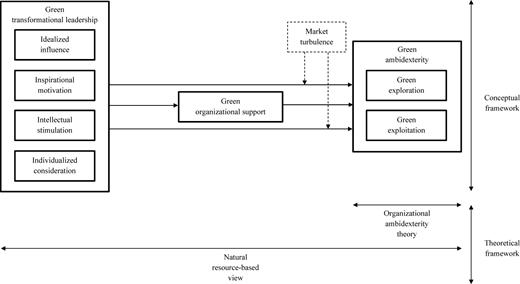
Drawing on the natural resource-based view and organizational ambidexterity theory, this study aims to examine whether green transformational leadership (idealized influence, inspirational motivation, intellectual stimulation, individualized consideration) fosters employees' green ambidexterity (exploration, exploitation) through green organizational support, with market turbulence as a boundary condition.
Survey data were gathered from 383 employees employed in green-certified ready-made garment factories in Bangladesh. Partial least squares structural equation modeling (PLS-SEM) was used to assess measurement and structural models.
Green transformational leadership promotes employees' green ambidexterity under conditions where it translates into green organizational support, which, in turn, predicts both green exploration and green exploitation and fully or partially mediates the effects of its four dimensions on those outcomes. Market turbulence further strengthens this support-based pathway for green exploitation, whereas no equivalent effect emerges for green exploration.
Current work on green transformational leadership often treats leadership and ambidexterity as unidimensional constructs. This study shows that the dimensions of green transformational leadership do not exert uniform employee-level effects (what). Green organizational support functions as the main conversion mechanism through which green transformational leadership becomes green ambidexterity (why). Market turbulence sharpens that process mainly on the exploitative side (when). Evidence from the Bangladeshi ready-made garment industry extends green human resource management research into a labor-intensive setting that faces acute environmental pressure as well as strong export dependence.
1. Introduction
Environmental transition has become a strategic necessity in the ready-made garment industry. Bangladesh offers a particularly sharp setting for that challenge, given that the sector remains central to national manufacturing while continuing to face criticism for chemical pollution, greenhouse-gas emissions, and water use (Alam et al., 2023; Rahman et al., 2025). Pressure from international buyers, regulators, and environmental groups has pushed many firms to adopt greener production practices. Even then, adoption remains uneven. A small but visible group of factories has secured green certification, whereas many firms still struggle with constrained resources, limited technological capability, and weak internal environmental routines (BGMEA, 2025; Iqbal and Su, 2025; Rahman et al., 2025).
Such an imbalance creates a managerial problem that extends well beyond symbolic sustainability claims. Factories in this sector must preserve productivity, delivery reliability, and cost discipline while cutting environmental harm. A purely exploratory approach that only experiments with new green practices is unlikely to survive in a production system shaped by tight buyer deadlines and cost pressure, similarly, a purely exploitative approach that only refines current routines is also unlikely to achieve long-run environmental adaptation. Green ambidexterity addresses that tension through the joint pursuit of green exploration, which involves experimentation with new environmental ideas, methods, and practices, and green exploitation, which involves refinement and reliable use of existing environmental practices (Úbeda-García et al., 2022; Zhao et al., 2021). Notably, both capabilities rely heavily on employees in labor-intensive settings, such as ready-made garments, where day-to-day implementation rests on managerial and supervisory judgment.
Leadership should, in principle, play a decisive role in that process. While transformational leaders frame strategic direction, shape norms, and motivate discretionary effort, green transformational leadership extends that logic to environmental objectives by encouraging leaders to articulate an environmental vision, challenge entrenched routines, and support employees' green development (Kusi et al., 2021; Lathabhavan and Kaur, 2023). Current evidence, however, leaves three important gaps. First, prior studies often model green transformational leadership as a single construct, which masks the possibility that its dimensions may not affect employee outcomes in the same way. Second, ambidexterity research has largely treated exploration and exploitation as organizational outcomes, with limited attention to how employees balance those two activities in practice, especially in developing-country manufacturing settings (Dranev et al., 2020; Úbeda-García et al., 2022). Third, the mechanism through which transformational leadership shapes ambidexterity remains underdeveloped. Notably, leadership message that celebrates sustainability may carry little force unless employees also perceive organizational support for green action. External volatility may complicate that further, given that market turbulence can alter the value of green investment and the urgency of operational adaptation (Le and Do, 2024; Qiu et al., 2020).
Green organizational support addresses the missing mechanism, given that employees are more likely to invest effort in environmental action when they perceive that the organization values, recognizes, and resources such action (Aboramadan and Karatepe, 2021; Akram et al., 2024), whereas a leadership agenda that stresses environmental values yet fails to produce support structures is unlikely to change behavior on the factory floor. Market turbulence, in turn, serves as a plausible boundary condition, since turbulent markets intensify uncertainty around demand, price, and competition. Under such conditions, organizational support for green action may become more valuable, although that value may differ across exploration and exploitation.
This study develops and tests a model that links four dimensions of green transformational leadership, namely idealized influence, inspirational motivation, intellectual stimulation, and individualized consideration, to employees' green ambidexterity, reflected in green exploration and green exploitation, with green organizational support serving as a mediator and market turbulence serving as a moderator, underpinned deliberately by the natural resource-based view and organizational ambidexterity theory. In line with the IMPACT criteria for theory selection (Hollebeek et al., 2025), the two theories offer a strong match with the study's focal concepts and relationships, as the natural resource-based view is well suited to explain why environmental capabilities and support structures can become strategically valuable (Hart, 1995; Hart and Dowell, 2011), whereas organizational ambidexterity theory is well suited to explain how employees navigate the tension between green exploration and green exploitation (March, 1991). Read jointly, the two theories allow the study to explain why leadership and organizational support become consequential for environmental capability and how that capability is enacted through employees' balancing of refinement and experimentation under conditions of market turbulence. This joint theoretical lens is also parsimonious, conceptually rigorous, practically relevant, and empirically testable through the proposed main, mediating, and moderating relationships.
Three contributions emerge from this study. First, the study unpacks green transformational leadership into its constituent dimensions, which allows a more precise account of how leadership shapes employee-level green ambidexterity. Novelty arises here through theoretical refinement (Lim, 2026), given that the analysis shows the dimensions do not operate as a uniform set of effects. Second, the study positions green organizational support as the mechanism that translates leadership behavior into environmental action, which theoretically extends the natural resource-based view and organizational ambidexterity theory to the employee level and adds theoretical breadth to current green human resource management (HRM) research (Lim, 2026). Third, the study identifies market turbulence as a boundary condition, which clarifies when green organizational support becomes especially consequential. Interestingness arises in two ways: one is counterintuitive (Lim, 2026), given that not all dimensions of green transformational leadership exert direct positive effects on both green exploration and green exploitation, while the other is noteworthy (Lim, 2026), given that market turbulence sharpens the support-to-exploitation link but not the support-to-exploration link. These three contributions, therefore, challenge three prevailing assumptions in the literature, namely, that green transformational leadership operates as a uniform construct on employee outcomes (what), that leadership rhetoric in itself is sufficient to drive employee green action (why), and that external volatility uniformly amplifies green capability (when). The study, accordingly, does more than apply established theories to a new setting, since it extends the explanatory reach of the natural resource-based view and organizational ambidexterity theory to the employee level, and offers a more granular account of what drives green ambidexterity, why that process occurs, and when it becomes stronger in a labor-intensive industry under environmental pressure.
2. Literature review
2.1 Theoretical grounding
Two theoretical lenses guide the study (Figure 1). The natural resource-based view argues that environmental capabilities can become sources of advantage when firms build difficult-to-imitate routines around pollution prevention, product stewardship, and sustainable development (Hart, 1995; Hart and Dowell, 2011) and, thus, read through that lens, green transformational leadership and green organizational support represent strategic resources that shape how employees approach environmental work. Organizational ambidexterity theory adds a complementary insight, where performance improves when organizations balance exploration with exploitation rather than privileging one at the expense of the other (March, 1991) and, thus, when applied to environmental management, that balance requires employees to refine existing green routines while also searching for new green solutions. In turn, the joint reading of these two theories reveals a clear explanatory logic in which leadership provides direction and signals environmental priority, organizational support turns that direction into actionable conditions such as training, recognition, and resource access, employees enact green ambidexterity through green exploration and green exploitation, and market turbulence may alter the strength of this process by changing the urgency attached to environmental efficiency and experimentation.
2.2 Green transformational leadership and green ambidexterity
Green transformational leadership refers to leader behavior that motivates followers to pursue environmental goals that exceed narrow compliance requirements and comprises four commonly identified dimensions, namely idealized influence, inspirational motivation, intellectual stimulation, and individualized consideration, which capture the leader's environmental credibility and role-modeling, the articulation of an attractive green vision, the invitation to question current practices and generate fresh solutions, and tailored coaching and personal support for employee development, respectively (Bass, 2000; Hadi, 2026; Kusi et al., 2021).
Green ambidexterity rests on two distinct but related employee capabilities, namely green exploration, which involves the search for novel environmental ideas, methods, and practices, and green exploitation, which involves the refinement and reliable use of existing environmental practices (Úbeda-García et al., 2022; Zhao et al., 2021). Green transformational leadership should, in principle, foster both green exploration and green exploitation through four dimensions, namely idealized influence, which legitimizes environmental priorities through role-modeling, inspirational motivation, which mobilizes discretionary effort through vision, intellectual stimulation, which widens the pool of environmental ideas through cognitive challenge, and individualized consideration, which helps employees apply environmental practices more skillfully through tailored support (Bass, 2000; Hadi, 2026; Kusi et al., 2021).
Prior work on ambidexterity supports that general expectation. Transformational leadership has been linked with organizational ambidexterity in general (Chang, 2016; Nemanich and Vera, 2009; Rao-Nicholson et al., 2016) and exploration and exploitation innovation in particular (Zuraik and Kelly, 2018) in non-green settings. Green leadership studies also show that environmentally focused leadership can stimulate green creativity (Hameed et al., 2022) and pro-environmental behavior (Farrukh et al., 2022). Recent work further suggests that leaders with a clear environmental orientation help organizations balance innovation with operational discipline in sustainability-related tasks (Martínez-Falcó et al., 2024; Sakina and Dou, 2025).
Building on this literature, a reasonable theoretical extrapolation is that the dimensions of green transformational leadership should not influence green exploration and green exploitation in identical ways, even though positive relationships remain plausible across all four dimensions. More specifically, green exploration is likely to benefit from inspirational motivation and intellectual stimulation, given that these dimensions should encourage employees to question routine assumptions, search for cleaner methods, and propose alternative solutions, whereas idealized influence may strengthen that process by legitimizing green experimentation and individualized consideration may help employees persist when exploratory efforts create uncertainty. Green exploitation, in contrast, is likely to depend more heavily on disciplined implementation, process refinement, and steady attention to detail, with idealized influence reinforcing compliance with green standards and individualized consideration helping employees master and improve existing green routines. A multidimensional test is, accordingly, necessary, since the four dimensions need not generate identical psychological responses, even though each captures a form of leader behavior that can plausibly support employees' green ambidexterity and, in turn, supports the expectation of positive relationships across all four dimensions. Hence:
Green transformational leadership, through its dimensions of (a) idealized influence, (b) inspirational motivation, (c) intellectual stimulation, and (d) individualized consideration, has positive relationships with green exploration.
Green transformational leadership, through its dimensions of (a) idealized influence, (b) inspirational motivation, (c) intellectual stimulation, and (d) individualized consideration, has positive relationships with green exploitation.
2.3 Green transformational leadership and green organizational support
Early literature on organizational support argues that employees form beliefs about the extent to which the organization values their contribution and cares about their welfare (Eisenberger et al., 1986). Extending this logic to the environmental context, employees often infer those beliefs through leader behavior, given that supervisors and managers act as the most visible agents of the organization, such that a green leader who consistently signals environmental commitment may shape employees' views of whether the organization genuinely supports green action.
Green organizational support refers to employees' perception that environmental initiatives are encouraged, recognized, and resourced by the organization, as reflected in mechanisms such as trainings, recognition systems, and resource allocation around green initiatives (Aboramadan and Karatepe, 2021; Akram et al., 2024), from which it is reasonable to expect that green transformational leadership could strengthen those perceptions, given that idealized influence could make environmental commitments appear credible rather than ceremonial, inspirational motivation could frame green goals as organizational priorities rather than temporary slogans, intellectual stimulation could suggest that the organization welcomes green ideas, and individualized consideration could signal a willingness to invest in employee development for environmental purposes.
Empirical work lends support to this theoretical logic. Leadership behavior shapes perceived organizational support in general management settings (Suifan et al., 2018) while green leadership studies further suggest that leaders who prioritize environmental issues often strengthen employees' perceptions that environmental action is both supported and expected within the organization (Ansari and Khan, 2024; Hameed et al., 2022; Mukhtar et al., 2025). Such signals may be especially important in labor-intensive production settings, where employees often look for visible proof that environmental expectations are backed by genuine organizational commitment. Hence:
Green transformational leadership, through its dimensions of (a) idealized influence, (b) inspirational motivation, (c) intellectual stimulation, and (d) individualized consideration, has positive relationships with green organizational support.
2.4 Green organizational support and green ambidexterity
Green organizational support should enhance green ambidexterity through two interrelated routes, given that, first, such support could reduce the perceived risk attached to green action and, in turn, make employees more willing to test new environmental ideas when they believe the organization values and will resource such effort and, second, strengthen employees' ability to refine and apply existing green practices when environmental work is backed by trainings, recognitions, and resources.
Such expectations are consistent with the natural resource-based view, which suggests that environmental advantage rests not on symbolic commitment alone but on the development of organizational capabilities supported by appropriate resources and routines (Hart, 1995; Hart and Dowell, 2011). Read alongside organizational ambidexterity theory, which implies that exploration and exploitation depend on arrangements that allow experimentation without sacrificing operational reliability (March, 1991), green organizational support can be understood as the enabling condition that makes both forms of environmental action more likely. In this sense, support structures such as training, recognition, and resource allocation may help employees refine current green practices while also creating the safety, legitimacy, and room needed to pursue new green initiatives.
Empirical evidence points in that direction. For instance, perceived organizational support has been linked with employee environmental behavior, green citizenship behavior, and green work outcomes (Aboramadan and Karatepe, 2021; Akram et al., 2024; Rubel et al., 2025). Similarly, supportive climates also strengthen employees' willingness to participate in environmental initiatives and sustain behavioral change over time (Bodhi et al., 2025). Hence:
Green organizational support has positive relationships with (a) green exploration and (b) green exploitation.
2.5 Mediating role of green organizational support
A direct effect of green transformational leadership on green ambidexterity remains plausible, yet a purely direct model appears incomplete, since employees do not convert leadership messages into environmental action in isolation but through organizational contexts that either validate or weaken those messages. Green organizational support can, in this sense, be understood as the missing link, insofar as leaders who champion environmental priorities are more likely to foster employees' perception that the organization itself supports green action, which, in turn, should encourage both exploratory and exploitative green behavior.
At a more granular level, green organizational support is theorized to convert leadership signals into employee green action through three interlinked cognitive routes. First, support cues could activate reciprocity norms, given that employees who perceive organizational investment in environmental work tend to feel obligated to reciprocate through discretionary green effort (Eisenberger et al., 1986). Second, support cues could reduce the perceived risk attached to green action, since visible resources, recognition, and procedural fairness signal that experimentation and refinement will not be penalized (Edmondson, 1999). Third, support cues could raise the perceived legitimacy of green work, which converts a leader's environmental message from personal preference into a sanctioned organizational priority (Suchman, 1995). Absent such cues, leadership signals may remain symbolic rather than behavioral.
The mediating logic is consistent with prior green HRM work, which suggests that green leadership, green HRM practices, and supportive environmental climates often shape employee outcomes through perceived support, motivation, and contextual reinforcement rather than through direct exhortation alone (Hameed et al., 2022; Kusi et al., 2021). Ambidexterity research similarly suggests that exploratory and exploitative behavior depends on enabling conditions rather than on leader intent alone (Cancela et al., 2023; Peters and Buijs, 2022). A mediation model is, in turn, better aligned with the way green transformational leadership is likely to operate in labor-intensive production settings. Hence:
Green organizational support mediates the relationships between the dimensions of green transformational leadership, namely (a) idealized influence, (b) inspirational motivation, (c) intellectual stimulation, and (d) individualized consideration, and green exploration.
Green organizational support mediates the relationships between the dimensions of green transformational leadership, namely (a) idealized influence, (b) inspirational motivation, (c) intellectual stimulation, and (d) individualized consideration, and green exploitation.
2.6 Moderating role of market turbulence
Market turbulence captures the volatility of customer preferences, competition, and demand uncertainty (Le and Do, 2024; Qiu et al., 2020). Such turbulence can alter the value of green organizational support. Under relatively stable conditions, green organizational support may remain beneficial without becoming decisive, whereas under more turbulent conditions the same support may assume greater importance as firms face stronger pressure to adapt quickly, preserve efficiency, and maintain legitimacy under uncertainty. A contingent effect is, accordingly, plausible.
Two expectations follow from this logic. On one hand, market turbulence could strengthen green exploration, given that uncertainty may intensify the need for new environmental solutions, adaptive learning, and experimentation. On the other hand, market turbulence could also strengthen green exploitation, given that firms operating under pressure often place greater emphasis on reliable process improvement, tighter cost discipline, and the effective use of existing routines. Existing studies suggest that dynamic environments heighten the value of organizational capabilities (Larbi-Siaw et al., 2022; Qiu et al., 2020), although they do not clarify whether that heightened value should apply equally to exploration and exploitation. This study, therefore, expects that higher market turbulence will strengthen the positive relationship between green organizational support and both dimensions of green ambidexterity.
Market turbulence moderates the relationship between green organizational support with (a) green exploration and (b) green exploitation, such that the relationships are stronger under high market turbulence.
3. Methodology
3.1 Instrumentation
All items were adapted from established scales given the importance of operational consistency (Lim et al., 2026). Green transformational leadership was measured through four dimensions (idealized influence, inspirational motivation, intellectual stimulation, individualized consideration) using 11 items adapted from Bass and Avolio (1995) and later applications in green leadership research (Gao et al., 2020). Green exploration and green exploitation were measured with eight items adapted from Chen et al. (2014) and Sheng and Chien (2016) and later used in green ambidexterity research (Úbeda-García et al., 2022). Green organizational support was measured with four items derived from Eisenberger et al. (1986) and subsequent green HRM research (Aboramadan and Karatepe, 2021). Market turbulence was measured with five items adapted from Peters et al. (2019) and Senbeto and Hon (2020).
3.2 Sampling
The empirical setting comprises green-certified ready-made garment factories in Bangladesh, which suits the research question for two reasons. First, the sector faces sustained environmental scrutiny under conditions of intense cost and delivery pressure. Second, green-certified factories provide an appropriate context for observing variation in employee perceptions of green leadership, green organizational support, and green ambidexterity. According to the Bangladesh Garment Manufacturers and Exporters Association, 258 LEED-certified green factories were operating in Bangladesh at the time of data collection (BGMEA, 2025).
A survey design was adopted, given that the study sought to test a multi-construct model across a relatively large employee sample. Snowball sampling was used to reach managerial employees in those factories. A probability design was not feasible, given that no public roster of eligible managerial employees was available across participating firms. Initial access was secured through senior managers, who subsequently circulated the questionnaire to eligible respondents in their networks. While snowball sampling enabled access to an otherwise hard-to-reach managerial population, it is acknowledged that the approach carries the risk of network homophily, which was partially mitigated by drawing initial seeds from multiple factories and functional areas to broaden network reach beyond a single firm or social cluster (Lim, 2025).
The questionnaire contained two sections: section one measured the focal constructs on a five-point Likert scale from 1 (strongly disagree) to 5 (strongly agree) while section two captured demographics. Before full deployment, a pretest with 10 academic experts ensured content validity while a pilot test with 50 respondents ensured face validity (Lim, 2024).
Ethical safeguards were built into the procedure. Each respondent received a short explanation of the study's purpose, the voluntary nature of participation, and the right to withdraw at any stage. Responses were anonymous. Only aggregated data were analyzed. After permission was secured from the participating factories, questionnaires were distributed to managerial employees located mainly in Dhaka and Narayanganj, where the concentration of green garment factories is highest (Amin et al., 2025). A total of 430 questionnaires were returned. Forty-seven were incomplete and were removed, leaving 383 usable responses.
The final sample reflects the managerial structure of the sector. Most respondents were male (88%), married (79.6%), and held a master's degree (69%). Functional representation spanned HR (22%), operations (17%), marketing (15%), finance (15%), production (13%), accessories management (11%), and merchandising (6%).
3.3 Analysis
The analyses were conducted using SmartPLS to estimate the measurement and structural models, with partial least squares structural equation modeling (PLS-SEM) selected as the estimation approach given the study's prediction-oriented design, the inclusion of multiple mediation paths and a moderation effect, and the suitability of PLS-SEM for handling complex models with several reflective constructs and indirect paths (Hair et al., 2019).
Common method bias (CMB) was addressed procedurally and statistically (Podsakoff et al., 2012). Procedurally, the questionnaire separated construct blocks to reduce proximity effects. Statistically, Harman's single-factor test showed that the first unrotated factor explained 46% of the variance, which falls below the 50% threshold and suggests that CMB is unlikely to dominate the results. Even then, it is recognized that procedural and statistical remedies offer only partial assurance against CMB, since both rely on a single source, which means that the findings should be interpreted with that constraint in view and multi-source designs are explicitly recommended in the limitations section as a stronger basis for triangulation.
4. Results
4.1 Measurement model
The measurement model met the recommended thresholds for reliability and validity, with Cronbach's alpha and composite reliability values above 0.70 for all constructs (Lim, 2025), convergent validity supported by retained item loadings above 0.70 and average variance extracted above 0.50 (Lim, 2025), and discriminant validity was generally supported through square roots of average variance extracted that exceeded inter-construct correlations (Hair et al., 2019). Tables 1 and 2 report the full results.
4.2 Structural model
The structural model showed acceptable explanatory and predictive power, with R2 values of 0.615 for green exploration and 0.494 for green exploitation indicating moderate explanatory power, variance inflation factors below 3 indicating that collinearity was not a concern, Q2 values of 0.529 and 0.383 for green exploration and green exploitation supporting acceptable predictive relevance, and a standardized root mean square residual of 0.066 indicating satisfactory model fit relative to the 0.08 guideline (Hair et al., 2019; Henseler et al., 2016).
Table 3 reports on the structural model statistics. Among the direct paths from green transformational leadership to green ambidexterity, only inspirational motivation positively predicted green exploration (β = 0.348, p < 0.01) and only individualized consideration positively predicted green exploitation (β = 0.188, p < 0.05). The remaining direct paths from idealized influence, intellectual stimulation, and individualized consideration to green exploration were not significant. The remaining direct paths from idealized influence, inspirational motivation, and intellectual stimulation to green exploitation were also not significant.
All four dimensions of green transformational leadership significantly predicted green organizational support. The strongest effect came from individualized consideration (β = 0.476, p < 0.01), followed by idealized influence (β = 0.274, p < 0.01), inspirational motivation (β = 0.202, p < 0.01), and intellectual stimulation (β = 0.090, p < 0.05). Green organizational support, in turn, positively predicted both green exploration (β = 0.410, p < 0.01) and green exploitation (β = 0.604, p < 0.01).
The mediation results were uniformly supportive, given that green organizational support significantly mediated the relationships between each green transformational leadership dimension and each green ambidexterity dimension. These results suggest that leadership becomes environmentally consequential largely through employee perceptions of green organizational support.
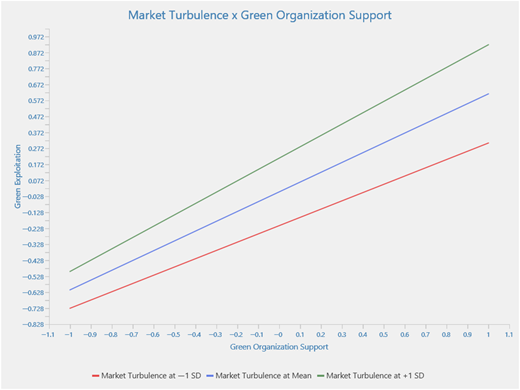
The moderation results were mixed. Market turbulence strengthened the relationship between green organizational support and green exploitation (β = 0.096, p < 0.05). No significant moderation effect emerged on the relationship between green organizational support and green exploration (β = −0.014, p > 0.05). Figure 2 illustrates the significant interaction. Under high market turbulence, the positive slope linking green organizational support with green exploitation becomes steeper.
5. Discussion and implications
5.1 Discussion
The results show that green transformational leadership does not operate as a uniform lever of employee green ambidexterity. Only inspirational motivation directly predicts green exploration, whereas only individualized consideration directly predicts green exploitation. Those findings complicate the dominant expectation that all dimensions of transformational leadership should stimulate environmental outcomes in similar ways. Vision appears especially relevant for exploratory green behavior, which aligns with work linking inspirational leadership to green creativity (Li et al., 2020) and pro-environmental behavior (Farrukh et al., 2022). Tailored support appears especially relevant for exploitative green behavior, which aligns with work showing that individualized leader attention helps employees refine and implement current green routines more effectively (Afsharbakeshlo et al., 2024; Zhong et al., 2025).
Non-significant direct effects deserve equal attention, since the absence of direct significance does not imply that idealized influence and intellectual stimulation lack value, but instead suggests that their influence may be more conditional in this setting. In highly structured production environments such as ready-made garments, ethical role-modeling and cognitive challenge may not, on their own, be enough to alter employee behavior, as employees may admire a leader's environmental stance and still withhold green action when they do not perceive formal support, room, or permission to experiment. The same logic helps explain why individualized consideration predicts green exploitation yet not green exploration, given that personal coaching can improve the disciplined use of existing routines, whereas exploratory green activity also requires room for experimentation, tolerance of failure, and organizational signals that novel ideas will be supported.
Green organizational support emerges as the decisive mechanism in the model. All four dimensions of green transformational leadership significantly predict green organizational support, which, in turn, predicts both green exploration and green exploitation. The indirect effects remain significant across all dimensions. This pattern supports organizational support theory and green HRM research, both of which suggest that employees respond less to leadership rhetoric in isolation and more to the organizational conditions that leadership helps create (Aboramadan and Karatepe, 2021; Akram et al., 2024; Hameed et al., 2022). This implies that leadership does not automatically generate employee green ambidexterity, but becomes effective only when employees interpret leader behavior as evidence that the organization will resource, recognize, and protect green effort.
Market turbulence sharpens that conclusion. Green organizational support becomes more strongly associated with green exploitation under high turbulence, whereas no equivalent strengthening appears for green exploration. Contingency research offers one explanation. Under volatile market conditions, factories often privilege reliable efficiency gains, process control, and waste reduction (Le and Do, 2024; Qiu et al., 2020), which makes exploitative environmental routines especially valuable. Exploration remains desirable, yet its benefits are more distant and its risks more visible, thus, support alone may not overcome those constraints when market volatility is high.
5.2 Key theoretical implications
First and foremost, the study challenges the routine treatment of green transformational leadership as a unidimensional construct, given that a single composite score can obscure meaningful variation across its dimensions. More specifically, inspirational motivation and individualized consideration exhibit distinct direct effects, whereas idealized influence and intellectual stimulation operate mainly through green organizational support, which implies that research collapsing these dimensions into one index risks overstating the uniformity of leadership effects.
Next, the study extends the natural resource-based view and organizational ambidexterity theory by locating their joint operation at the employee level. This challenges the implicit assumption that strategic environmental resources translate directly into employee behavior. Green transformational leadership represents a strategic behavioral resource, yet that resource does not translate directly into green ambidexterity in most cases. Green organizational support acts as the conversion mechanism through which leadership intent becomes environmental capability. This implies that environmental resources gain value only when employees perceive organizational conditions that allow those resources to be used.
Last but not least, the study refines contingency arguments in green HRM and ambidexterity research. Market turbulence does not amplify all green outcomes equally as its effect concentrates on green exploitation, which suggests that external volatility may make support-backed efficiency more actionable than support-backed experimentation. Future theorizing on green ambidexterity should, accordingly, distinguish more carefully between the antecedents of green exploration and green exploitation rather than assuming parallel dynamics.
5.3 Key managerial, policy, and societal implications
Managers in the ready-made garment industry should take a clear lesson from these findings. Symbolic green leadership is not enough, since environmental speeches, role-modeling, and exhortation are unlikely to change employee behavior unless they are matched by strong green organizational support. Management teams should, accordingly, connect green leadership with tangible support systems such as environmental training, accessible green suggestion schemes, recognition for environmental improvements, visible resource allocation, and fair procedures around green targets.
Green transformational leadership dimensions also vary across purposes, with inspirational motivation appearing more useful when firms seek novel environmental ideas and higher green exploration, whereas individualized consideration appears more useful when firms seek tighter execution, more reliable process discipline, and higher green exploitation. Leadership development should thus reflect that distinction, given that a generic green leadership program may be less effective than one that trains supervisors to use specific leader behaviors for specific green outcomes.
Policy implications are equally important. Professional bodies and public agencies often reward visible certification, yet the findings suggest that certification alone does not guarantee employee green ambidexterity, which implies that support infrastructures deserve greater policy attention. Training grants, cleaner production advisory services, and incentives that strengthen green support systems inside factories may produce stronger behavioral change than badge-oriented approaches while buyers can reinforce that shift by rewarding factories that demonstrate employee-level support mechanisms rather than certification status alone.
Societal implications extend beyond the factory gate, since stronger green organizational support can help reduce pollution-intensive routines in a sector that affects local water systems, air quality, and community health. A workforce that experiences green training and organizational recognition may also carry stronger environmental awareness into households and communities, which implies that environmental transition in labor-intensive industries is not only a question of operational efficiency but also one of industrial legitimacy and environmental justice. Such effects are especially salient given that pollution from labor-intensive manufacturing often concentrates in lower-income communities near factory clusters (Bick et al., 2018), which makes employee-level green action a matter not only of business performance but also of distributive fairness.
6. Conclusion
6.1 Concluding remarks
This study examined whether green transformational leadership promotes employees' green ambidexterity in Bangladesh's ready-made garment industry, with green organizational support serving as a mediator and market turbulence as a moderator. Drawing on the natural resource-based view and organizational ambidexterity theory, and using survey data from 383 managerial employees analyzed through PLS-SEM, the findings show that the four dimensions of green transformational leadership do not operate as a uniform lever, that their effects on green ambidexterity travel primarily through green organizational support, and that market turbulence sharpens the support-to-exploitation link without strengthening the support-to-exploration link. In sum, green transformational leadership becomes environmentally consequential when it is reinforced by employees' perceptions of green organizational support, and that conversion intensifies on the exploitative side under turbulent market conditions.
6.2 Limitations and future directions
Several limitations frame this study and, in turn, open avenues for future research.
First and foremost, the cross-sectional design constrains causal inference, which suggests that multi-wave studies would be useful for examining whether green organizational support develops over time as a result of leadership behavior and whether green exploration later contributes to green exploitation.
Besides that, all focal measures were self-reported and drawn from a single source, which introduces well-known risks of CMB, social desirability, and self-enhancement. Although Harman's single-factor test does not indicate a dominant common-method problem, such tests offer only a weak diagnostic and cannot rule out method-level inflation altogether, which means that multi-source designs combining employee self-reports with supervisor evaluations and archival sustainability indicators would offer a stronger basis for triangulation.
In addition, the use of snowball sampling, although suited to a hard-to-reach managerial population, restricts representativeness and carries the risk of network homophily, since respondents are more likely to share characteristics with the initial seeds. Future research could pursue stratified or census-style designs once accessible rosters of managerial respondents in green-certified factories become available.
Furthermore, the study focuses on one industry in one country. While the ready-made garment sector offers a theoretically valuable setting, service industries and technology-intensive sectors may display different ambidexterity dynamics, which implies that comparative work across industries and countries is needed to clarify where these findings generalize and where they remain context-bound.
Moreover, the study centers on green transformational leadership. Future research could compare this leadership style with green servant leadership, responsible leadership, or inclusive leadership to determine whether the support-based pathway identified here is specific to green transformational leadership or reflects a broader green leadership process.
Last but not least, another avenue for future research arises from the non-significant direct effects, as future studies should examine whether job autonomy, psychological safety, production pressure, or environmental training intensity help explain why some leadership dimensions do not translate directly into green exploration or green exploitation.