Agro-food processing SMEs operate in disruption-prone environments where regulatory compliance is often portrayed as a cost rather than a resilience resource. However, there is limited evidence on whether and how perceived government regulations are linked to supply chain resilience in developing economies. This study examines whether government regulations are associated with supply chain resilience directly and indirectly through firms' network embeddedness within supply chain relationships.
The study uses a cross-sectional survey of 249 agro-food processing SMEs in Uganda drawn from formally registered urban-based firms selected districts in the Greater Kampala Metropolitan Area (GKMA). Data are analyzed using partial least squares structural equation modeling to test direct and indirect associations among the study variables.
The results indicate that stronger regulatory frameworks are associated with higher levels of network embeddedness. Higher network embeddedness is also associated with stronger reported supply chain resilience. Mediation analysis shows that network embeddedness accounts for part of the association between government regulations and supply chain resilience, suggesting an indirect statistical pathway rather than a demonstrated causal process. The findings therefore suggest that regulations are more strongly associated with resilience when they are accompanied by inter-firm trust, timely information exchange, and coordinated action across supply chain partners.
This study is limited by its cross-sectional design, which cannot capture how regulations, network embeddedness, and resilience evolve over time or directly examine CAS dynamics such as adaptation and feedback. Its focus on registered, urban-based agro-food SMEs in selected Ugandan districts also limits external validity, especially for informal and rural firms. In addition, the study does not account for institutional heterogeneity across locations and agencies, and other possible explanatory mechanisms were not examined. Future research should use longitudinal, mixed-method, and more inclusive designs to address these limitations.
The findings offer context-specific implications for policymakers, SME managers, and development actors seeking to strengthen resilience in agro-food supply chains. Policymakers may need to complement compliance enforcement with collaborative arrangements that recognize the role of inter-firm networks. SME managers should invest in trusted relationships, communication, and joint problem solving with key partners. Development agencies may support shared platforms, peer learning and value-chain partnerships that strengthen coordination. However, these implications should be interpreted cautiously, as the study focused on registered, urban-based agro-food SMEs in selected Ugandan districts where enforcement capacity is uneven.
Drawing on complex adaptive systems theory as an interpretive and sensitizing lens, this study highlights a relational view of regulation by showing that government regulations are associated with SC resilience through network embeddedness. Rather than treating regulation and inter-firm networks as independent drivers, the findings suggest that the association between regulation and resilience is stronger when regulatory conditions are reflected in supply chain relationships marked by shared understanding and coordination. The study contributes evidence from registered, urban based agro-food processing SMEs in selected Ugandan districts, showing how regulatory conditions and inter-firm relationships are linked to reported resilience.
1. Introduction
Ensuring the continuity of food supply has become a central concern for policymakers, businesses, and scholars as food systems face persistent disruptions arising from economic volatility, climate change, public health crises, and geopolitical shocks. Within this uncertain environment, supply chain (SC) resilience has emerged as a critical capability that enables food SCs to withstand disturbances, respond to changing conditions, and sustain essential functions over time. Government regulations form an integral part of this landscape by shaping the institutional conditions under which these SCs operate. Rather than merely constraining firm behavior, regulatory frameworks establish shared social, environmental, and economic rules that structure how firms anticipate risks, coordinate responses, and maintain operations under disruptions (Eruaga, 2024; Wu and Tham, 2023). When designed and enforced effectively, regulations provide a common reference point that reduces ambiguity, aligns expectations among actors, and facilitates more coordinated responses during periods of instability (Sendawula et al., 2024). Social regulations promote fair labor practices and worker protection, strengthening trust within firms and across communities and enabling cooperation under stress (Yu et al., 2022). Environmental regulations safeguard natural resources and encourage sustainable production, supporting long-term viability and legitimacy in competitive markets (Kazancoglu et al., 2021). Economic regulations governing taxation, competition, and market access further enhance predictability, allowing firms, particularly SMEs, to plan, invest, and remain competitive despite uncertainty (Jeong et al., 2021). While some firms rely heavily on internal capabilities to manage disruptions, many increasingly depend on regulatory systems not only for compliance but also as external enablers of coordination and information exchange that underpin SC resilience.
The relevance of regulatory environments is especially pronounced for agro-food processing small and medium enterprises (SMEs) (Ajer et al., 2023). These enterprises contribute to food security by adding value to agricultural products, generating employment, and ensuring a steady supply of safe and nutritious food, thereby supporting both livelihoods and national economic development (Tukamuhabwa, 2023). At the same time, agro-food processing SMEs operate under severe constraints, including exposure to climate variability, price fluctuations, limited access to finance, infrastructure deficits, and institutional weaknesses (Kyagante et al., 2024; Tumuramye et al., 2026). In such contexts, government regulations serve a stabilizing function by providing standards and enforcement mechanisms that reduce uncertainty and encourage orderly market participation. Compliance with regulatory requirements often pushes SMEs to engage more closely with SC partners, industry associations, and regulatory agencies, strengthening their integration within broader supply networks (Stahn et al., 2017). In Uganda, policy instruments such as the Micro, Small and Medium Enterprises Policy (2015), the Third National Development Plan (2021–2025), and the National Industrial Policy (2020), alongside institutions such as the Uganda National Bureau of Standards and the Uganda Revenue Authority, shape the operational environment for agro-food SMEs. However, these regulatory conditions are not experienced uniformly across firms, as enforcement intensity, monitoring capacity, and compliance demands often vary across agencies, locations, and enterprise contexts. This uneven regulatory reality helps explain why the relationship between government regulations and supply chain resilience remains contested in the existing literature.
Despite the apparent importance of regulation and inter-firm relationships, the existing literature offers mixed and sometimes contradictory evidence on how government regulations influence SC resilience. Several studies report that regulations strengthen enterprise resilience, stimulate innovation, and support environmentally responsible practices (Wu and Tham, 2023; Baah et al., 2024; Rakhmawati et al., 2020). In contrast, other research suggests that regulations may suppress innovation or fail to improve firm performance when they are poorly aligned with local realities, weakly enforced, or perceived as overly restrictive by SMEs (Jeong et al., 2021; Zulu-Chisanga et al., 2021; Worku, 2016). Further ambiguity arises from the way regulations are often conceptualized in empirical studies. Many scholars treat regulatory frameworks as contextual moderators or indirect enablers rather than as active drivers of resilience outcomes (Yu et al., 2022; Chatterjee and Chaudhuri, 2022; Dubey et al., 2023). Even where regulation is acknowledged as influential, the analytical focus tends to center on sustainability or environmental performance, with limited attention to SC resilience (Alkahtani et al., 2020; Kazancoglu et al., 2021; Rakhmawati et al., 2020). Moreover, social, environmental, and economic regulations are frequently examined in isolation, overlooking their combined and interactive effects on firm behavior and network formation. A closely related study proposes networks as a way to address institutional voids in Uganda's agricultural sector. However, its focus is on informal actors and value chain upgrading, rather than on resilience outcomes among agro-food SMEs (Stahn et al., 2017). Similarly, recent Ugandan evidence indicates that regulatory compliance mechanisms can support sustainability outcomes among SMEs, yet these studies do not explain how regulations help build network embeddedness or supply chain resilience (Kabbera et al., 2026; Sendawula et al., 2024). The current literature therefore remains underdeveloped in three respects. First, it does not sufficiently explain how perceived regulatory conditions are linked to resilience in agro-food SMEs. Second, it gives limited attention to the possibility that such associations may operate indirectly through inter-firm network relationships. Third, it rarely addresses these questions in a Ugandan context characterized by informality, uneven enforcement, and institutional heterogeneity.
This study responds to these gaps by adopting Complex Adaptive Systems (CAS) theory as its primary interpretive lens for examining the relationships among government regulations, network embeddedness, and SC resilience. Prior research has predominantly drawn on the Resource-Based View, Social Network Theory, Dynamic Capabilities Theory, and Stakeholder Theory to explain regulatory effects on firm performance and resilience. While these perspectives have generated important insights, they tend to treat regulations, networks, and resilience as separate elements, which limits understanding of how resilience is associated with their interaction. By contrast, CAS theory views SCs as interconnected systems shaped by interactions among institutional rules, organizational actors, and relational structures. In this study, however, CAS is used as a sensitizing and interpretive framework rather than as a basis for testing dynamic system processes. Given the cross-sectional design, the theory is applied to explain patterns of association among the study variables rather than to directly observe adaptation, feedback, or co-evolution over time. Guided by this perspective, the study addresses the following research questions:
RQ1. What is the relationship between government regulations and SC resilience?
RQ2. How does network embeddedness mediate the relationship between government regulations and SC resilience?
The remainder of the paper is organized as follows. The next section develops the theoretical framework grounded in CAS theory interpretive framework. This is followed by a review of relevant literature on government regulations, network embeddedness, and SC resilience, highlighting key conceptual relationships and unresolved issues. The methodology section outlines the research design, sampling procedures, data collection, and analytical approach. The results are then presented and interpreted in relation to existing theory and empirical evidence. The paper concludes by discussing the theoretical, managerial, and policy implications of the findings, as well as limitations and directions for future research.
2. Theoretical background. Complex adaptive systems (CAS) theory
CAS theory offers a powerful lens for understanding how SCs function as interconnected systems in which outcomes emerge from continuous interaction rather than from isolated decisions or linear cause–effect relationships. Originating from the natural and social sciences, the theory explains how diverse agents respond, and reorganize in response to uncertainty through repeated interactions shaped by shared rules and constraints (Holland, 1995; Holling, 2001). When applied to agro-food SCs, CAS theory captures the reality that resilience does not reside within individual firms alone but is better understood in relation to collective responses involving producers, processors, regulators, and communities operating within a volatile institutional and ecological context (Tukamuhabwa et al., 2015; Adobor, 2020). From this perspective, government regulations are not treated as static external pressures or mere compliance requirements but as institutional rules that structure interaction, reduce ambiguity, and shape how firms respond within changing conditions. Social, environmental, and economic regulations shape expectations about acceptable practices and influence how firms coordinate, interpret and respond to disruptions, thereby functioning as institutional conditions that may stabilize behavior while also allowing variation in firm responses. Network embeddedness represents the relational mechanism through which these rules are enacted and transformed into collective action, encompassing the structural connections that facilitate repeated exchange, the shared understandings that align interpretations of regulatory requirements, and the trust that sustains cooperation under stress (Stahn et al., 2017). Within a CAS perspective, the interaction between regulations and embedded networks is useful for interpreting how coordination, shared understanding, and joint problem solving may be associated with resilience as a system-level pattern rather than a purely firm-level attribute.
Although CAS theory is useful for explaining adaptation, emergence, and interdependence in SCs, it also has limitations that should be acknowledged. In SC and operations research, CAS is often applied as a broad interpretive perspective, and scholars have noted that its core processes, such as feedback, nonlinearity, and emergence, are not always easy to test directly in cross-sectional designs (Nair and Reed-Tsochas, 2019; Pathak et al., 2007). CAS can also give limited attention to power differences and coercive pressures (Preiser et al., 2018), which is important in agro food systems where regulators, large buyers, and SMEs do not interact on equal terms. In addition, in contexts shaped by institutional voids and informality, compliance may be uneven, strategic, or symbolic, so regulatory effects cannot be assumed to translate automatically into coordination and resilience (Saha et al., 2022; Stahn et al., 2017). Even with these limitations, CAS theory remains appropriate in this study when used alongside the concept of embeddedness, because embeddedness helps explain how complex interactions become concrete relationships, shared meanings, and coordination practices that are necessary for resilience in SCs. Given the cross-sectional design of this study, these dynamic processes are not directly observed over time; CAS theory is therefore used as an interpretive framework to explain the associations identified among regulation, embeddedness, and resilience rather than as a fully tested dynamic model. From this perspective, the study does not claim to demonstrate adaptation or learning processes empirically. Instead, it uses CAS to interpret why regulatory conditions, relational embeddedness, and reported resilience may be statistically connected in this setting.
3. Literature review and hypothesis development
3.1 Supply chain (SC) resilience
SC resilience has evolved from a narrow recovery-focused concept into a more comprehensive understanding of how supply systems function under persistent stress. Early research, influenced by engineering, defined resilience as SC's capacity to return to its original state after a disruption, emphasizing efficiency and rapid recovery (Holling, 2001). While useful, this view limited resilience to a reactive process focused solely on restoring previous conditions. Recent insights from the organizational and social sciences have broadened the concept to encompass persistence during crises, adjustment to new circumstances, and structural adjustments aimed at reducing future risks (Ivanov, 2023; Wieland et al., 2023). This shift in definition is fundamental to agro-food systems, where shocks don't only result from combined social and environmental patterns, but also produce long-term effects that cannot be remedied by simply restoring past operations. For SMEs in developing economies, the stakes are even higher because their SCs operate amid volatile markets, political instability, weak infrastructure, and unpredictable weather (Tukamuhabwa, 2023). Their limited financial buffers increase vulnerability, making resilience dependent not only on internal adjustments but also on strategies that actively prepare for repeated shocks. This study, therefore, adopts a systems-oriented view of SC resilience, treating persistence and structural changes as interconnected dimensions that may be supported by collective action. This approach is preferred because it views resilience not just as surviving immediate disruptions but also as maintaining continuity, reorganizing practices, and ensuring the stability of food systems. This understanding provides the foundation for the present study, which examines the factors associated with stronger supply chain resilience among agro-food processing SMEs.
3.2 Government regulations
Government regulations shape the institutional environment within which SCs coordinate, compete, and respond to disruption (Eruaga, 2024). In agro-food systems, they cover areas such as food safety, labor standards, environmental protection, and market governance (Ajer et al., 2023; Chi, 2024). When properly designed and effectively enforced, such regulations can stabilize markets, enhance compliance with quality standards, and build trust among SC actors (Baah et al., 2024). Specifically, social regulations protect workers and promote community welfare around the organization (Alkahtani et al., 2020), environmental regulations encourage responsible use of natural resources (Wu and Tham, 2023), and economic regulations provide predictability in taxation, trade, and competition (Jeong et al., 2021). In this way, regulations can provide an important foundation for more stable and responsible supply chain operations. However, their contribution is not always straightforward because weak enforcement, high compliance costs, and policies that are poorly aligned with business realities often limit their effectiveness, suppress innovation, and weaken firm's capacity to respond (Chatterjee and Chaudhuri, 2022; Zulu-Chisanga et al., 2021). In many African contexts, enforcement intensity differs across locations and sub-sectors, while compliance often ranges from full adherence to selective or symbolic compliance, especially where monitoring capacity is limited. This reflects a wider governance challenge in which regulatory institutions operate with fragmented mandates, limited capacity, and uneven credibility (Hansen-addy and Parrilli, 2025). Under such conditions, firms may not experience regulation as a stable and predictable rule system, but rather as a negotiated constraint that encourages partial compliance, delayed compliance, or strategic avoidance depending on prevailing pressures and opportunities (Nieuwenhuizen, 2019; Worku, 2016).
In Uganda, government has introduced several frameworks to address these challenges, including the MSME Policy of 2015, the National Investment Policy of 2018, the National Environment Act, and the Industrial Policy of 2020, all of which are aligned with the Third National Development Plan and aim to promote competitiveness, agro-industrialization, and environmental stewardship. However, despite these policy interventions, agro-food processing SMEs continue to demonstrate weak SC resilience, as unsustainable practices contribute to ongoing environmental degradation in a sector that generates more than 70% of national output (Ajer et al., 2023). This suggests that the core problem lies not in the absence of policy, but in the gap between policy design and implementation, as Uganda's regulatory architecture appears strong on paper but uneven in practice (Kabbera et al., 2026). This reflects institutional voids characterized by weak implementation, limited monitoring capacity, and low enforcement (Saha et al., 2022; Stahn et al., 2017). As a result, SMEs often respond to regulatory requirements in ways that fit their day-to-day operations and resource constraints rather than through full and uniform compliance (Sendawula et al., 2024).
The literature, therefore presents mixed evidence on the role of regulations, suggesting that their relationship with SC resilience may not be direct or uniform. Rather, the varied findings point to an intervening mechanism that shapes how firms experience and respond to regulatory demands. In this study, network embeddedness is positioned as that mechanism. Regulations that strengthen ties among SC actors, promote shared understanding, and reinforce trust-based coordination are more likely to be associated with resilience, whereas regulations that impose compliance costs without generating such relational benefits are likely to show weaker associations. Testing this mediating role therefore, shifts the literature from asking whether regulations matter to examining how they are associated with SC resilience and under what relational conditions that association appears stronger in agro-food processing SMEs.
3.3 Network embeddedness
Network embeddedness reflects the depth and quality of a firm's integration within the web of relationships linking suppliers, customers, regulators, and support institutions, explaining why some firms can mobilize resources and coordinated action during disruption while others cannot (Dogbe et al., 2020). Beyond access to tangible resources, embeddedness captures whether relationships enable timely information exchange, shared understanding, and trust-based cooperation under uncertainty (Li and Fei, 2023; Wise et al., 2020). The literature commonly distinguishes three interrelated dimensions. Structural embeddedness refers to the pattern and strength of ties that determine access to partners and information channels (Song et al., 2020). Cognitive embeddedness captures shared norms and interpretations that reduce misunderstanding and speed alignment when conditions change (Capioto et al., 2019). Relational embeddedness develops through repeated interactions that build trust, reciprocity, and commitment, which are essential for joint problem-solving during crises (Wang et al., 2020; Zhou et al., 2022). For agro food processing SMEs, these dimensions support regulatory compliance, strengthen bargaining power, and enable collective responses to supply disruptions, and may contribute to improved preparedness over time (Feng et al., 2024). This role is particularly important in contexts where institutional capacity is uneven, as networks often complement formal regulation by transmitting expectations, reinforcing accountability, and sustaining continuity (Sendawula et al., 2024). Ugandan evidence from the informal agricultural economy shows that small business networks can help address institutional voids by pooling resources and information, improving access to buyers and finance, and using informal rules to reduce opportunism and stabilize exchange (Stahn et al., 2017).
Despite this relevance, the role of network embeddedness in resilience has not been sufficiently examined, as most studies emphasize innovation and firm performance (Tian et al., 2021; Wise et al., 2020), or focus narrowly on single dimensions, with relational ties attracting more attention than structural or cognitive aspects (Feng et al., 2024; Frankowska and Cheba, 2021; Wang et al., 2020; Zhou et al., 2022). While these studies establish that embeddedness matters for firm outcomes, they leave unanswered whether and how the combined effect of structural, cognitive, and relational embeddedness enables firms to withstand and adapt to disruptions. This study addresses that gap by treating embeddedness as a multidimensional construct that mediates the regulation-resilience relationship.
3.4 Theoretical model and hypothesis development
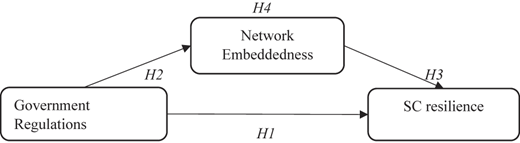
The proposed model conceptualizes SC resilience as a function of both regulatory influence and relational integration within agro food processing SMEs. It posits that government regulations shape SC resilience directly and indirectly by strengthening firms' network embeddedness. Network embeddedness is thus positioned as the key mechanism through which regulatory frameworks may be translated into resilient SC outcomes. Consistent with the cross-sectional design, these relationships are examined as hypothesized associations rather than as empirically verified temporal or causal processes. Figure 1 illustrates the hypothesized relationships underpinning the model.
3.5 Government regulations and supply chain resilience
Government regulations shape the institutional conditions under which SCs anticipate risk, coordinate responses, and sustain operations in the face of disruption (Chatterjee and Chaudhuri, 2022). In agro food systems, social regulations governing hygiene, food safety, labor standards, and community health reduce operational failures, protect consumer confidence, and secure market access during periods of stress (Wu and Tham, 2023; Yu et al., 2022). Economic regulations, including licensing, taxation, and pricing frameworks, further contribute to resilience by improving predictability, limiting financial volatility, and enabling firms to mobilize resources for recovery and reinvestment following shocks (Jeong et al., 2021). Environmental regulations complement these mechanisms by promoting responsible resource use, waste management, and cleaner production practices, thereby lowering ecological risks and safeguarding the natural systems on which agro food SCs depend (Zhang et al., 2020; Zheng et al., 2021). Regulations can therefore act as an important governance force that promotes order, continuity, and responsible adjustments in SCs.
At the same time, the resilience effects of regulations are not always consistent. Recent institutional research on SMEs shows that, particularly in emerging economies, the effects of regulations depend heavily on implementation capacity, because gaps in monitoring and enforcement often shape actual firm behavior more than formal rules on paper (Saha et al., 2022). Studies in African SME contexts similarly show that licensing and tax administration can improve performance under supportive conditions, yet the same requirements can become burdensome where enforcement is uneven or compliance processes are costly (Edmore, 2017; Worku, 2016). Evidence from Uganda also shows that regulatory compliance in manufacturing SMEs is shaped by how firms interpret and operationalize requirements within their day-to-day constraints (Sendawula et al., 2024). This suggests that regulation is often experienced through practical compliance routines rather than through policy intent alone. In addition, frequent regulatory changes and overlapping mandates across agencies may create uncertainty and discourage long-term investment in resilience capabilities (Nieuwenhuizen, 2019). From a CAS perspective, regulations are not simply external controls, but institutional rules that can shape how agro-food processing SMEs coordinate, respond, and reorganize their practices in response to disruption.
However, the evidence on these dynamics remains divided. Some scholars argue that regulations harmonize practices and stimulate collaboration and innovation across chain actors (Baah et al., 2024; Wu and Tham, 2023), while others caution that when poorly designed or enforced, they impose heavy compliance burdens that reduce flexibility, stifle innovation and reduce performance (Zulu-Chisanga et al., 2021). A key weakness in this literature is that it often assumes that firms face and absorb regulations in similar ways, yet smaller firms usually carry a heavier administrative burden than larger ones (Buthelezi, 2023). This is especially important in African SME contexts, where overregulation, red tape, and administrative complexity can raise operating costs, consume managerial time, and increase failure risks, particularly for smaller and younger firms (Nieuwenhuizen, 2019; Worku, 2016). Another shortcoming of the existing literature is that regulations are often examined as background, moderating or mediating factor rather than as a direct governance force shaping resilience outcomes (Alkahtani et al., 2020; Chatterjee and Chaudhuri, 2022; Dubey et al., 2023), and the food processing sector has received little attention in this context. This creates uncertainty about whether social, economic, and environmental regulations directly strengthen resilience in fragile agro-food SME supply chains.
What these contrasting findings suggest is that the effect of regulations on SC resilience may not be uniform. Rather, it likely depends on how firms experience and respond to regulatory demands within their operating environment. In Uganda, where implementation capacity varies across districts and agencies, the same rule may support resilience in some firms but constrain others, while network access may help firms convert regulatory requirements into workable routines (Sendawula et al., 2024; Stahn et al., 2017). This makes it important to first establish whether government regulations are associated with SC resilience in agro-food processing SMEs. It is against this backdrop that the present study examines how social, economic, and environmental regulations relate to the resilience outcomes in agro-food processing SME SCs, leading to the following hypothesis:
Government regulations have a positive association with SC resilience in agro-food processing SMEs.
3.6 Government regulations and network embeddedness
Regulations extend their influence beyond individual firms by shaping how SC actors interact, coordinate, and embed themselves within networks. The CAS perspective views agro-food processing SCs as dynamic systems made up of interconnected actors whose survival depends on continuous coordination, adjustment and interaction (Jagustović et al., 2019). Within such systems, regulations provide boundaries that guide behavior, reduce uncertainty, and shape the patterns of interaction that emerge across the network. Social regulations can encourage routine coordination between suppliers, processors, and distributors, ensuring alignment of practices across the chain and fostering trust that is difficult to achieve without common standards (Eruaga, 2024). Economic regulations can draw SMEs into more formalized networks where engagement with state agencies, industry associations, and communities enhances access to training, finance, and procurement opportunities, thereby implanting them more deeply in institutional and market structures (Zulu-Chisanga et al., 2021). Environmental regulations may strengthen interconnections by compelling firms to cooperate on collective initiatives such as waste management, renewable energy adoption, and sustainability projects, which cultivate shared responsibility and mutual accountability (Wu and Tham, 2023). In this sense, regulations can shape not only firm behavior, but also the structural, cognitive, and relational conditions that support network embeddedness.
At the same time, this influence is unlikely to be automatic or uniform. The extent to which regulations strengthen network embeddedness depends on how consistently rules are enforced and how firms perceive the credibility and predictability of regulatory institutions (Stahn et al., 2017). Where enforcement is fair and consistent, regulations can support stronger ties, clearer expectations, and greater confidence among supply chain actors. However, where enforcement is weak, uneven, or perceived as arbitrary, firms may become cautious, limit collaboration, or avoid expanding network ties in order to reduce administrative exposure and compliance risk. From a CAS perspective, this means that regulations matter not only as institutional signals that stabilize expectations, but also as institutional influences whose effects depend on how they shape structural linkages, shared interpretations, and relational trust across supply networks (Dubey et al., 2023; Orr and Donovan, 2018). Thus, regulation can either strengthen or weaken embeddedness depending on how it is experienced and enacted within the supply chain environment.
Despite this relevance, the relational role of regulation remains underdeveloped in existing literature. Most studies focus on firm-level outcomes such as green innovation (Yu et al., 2022), resource acquisition (Zulu-Chisanga et al., 2021), digitalization (Dubey et al., 2023; Wu and Tham, 2023), logistics innovation (Baah et al., 2024), or green SC management (Rakhmawati et al., 2020). While these studies are useful, they pay limited attention to the social processes through which regulations shape network relationships across actors. Even studies that come close to this issue fall short: for example, Alkahtani et al. (2020) Examined network structures in relation to government support, but did not investigate how regulations shape the networks themselves, while Zulu-Chisanga et al. (2021) linked government support to collaboration but overlooked embeddedness as the mechanism through which trust, reciprocity, and shared norms translate regulatory support into performance outcomes. Similarly, although prior work highlights networks among small business owners as a practical response to institutional voids (Stahn et al., 2017), it does not explain how specific regulatory pressures, including social, economic, and environmental regulations, help build such networks. This leaves an important gap, especially in fragile agro-food SCs where network relationships often compensate for weak formal institutions. It is this gap that the present study addresses by examining whether government regulations can foster network embeddedness in agro-food processing SME SCs, leading to the following hypothesis:
Government regulations have a positive association with network embeddedness in agro-food processing SME SCs.
3.7 Network embeddedness and supply chain resilience
Network embeddedness offers a relational explanation of why some firms are able to withstand disruptions while others struggle despite having comparable internal resources. Rooted in a CAS perspective, embeddedness recognizes that SCs function as socially organized systems in which resilience emerges from patterned interaction rather than from isolated firm level actions (Dogbe et al., 2020). For agro food processing SMEs, embeddedness strengthens resilience by anchoring firms within networks that facilitate timely information exchange, collective sense making, and coordinated responses when shocks occur (Li and Fei, 2023). Structural embeddedness provides access to diverse partners and communication channels, enabling firms to mobilize inputs, market intelligence, and logistical support during disruption (Capioto et al., 2019; Song et al., 2020). Cognitive embeddedness aligns interpretations, norms, and expectations across actors, reducing coordination costs and enabling rapid adjustment under uncertainty (Wise et al., 2020). Relational embeddedness develops through repeated interaction and mutual commitment, generating trust and reciprocity that sustain cooperation and limit opportunistic behavior when pressure intensifies (Zhou et al., 2022). When these dimensions operate together, embedded networks may support persistence by ensuring continuity through trusted ties, adjustments by enabling shared understanding and flexible reconfiguration of practices, and and longer-term strengthening of SC arrangements. This role is particularly salient in contexts where formal institutions are weak or uneven, as embedded networks often substitute for formal governance by reducing uncertainty, reinforcing accountability, and producing locally grounded solutions.
Despite its relevance, prior research has not thoroughly examined this relationship. Many studies focus on broader forms of embeddedness, such as business ecosystem embeddedness (Riquelme-Medina et al., 2023), embeddedness of threats and opportunities (Tukamuhabwa et al., 2017), and social ecological embeddedness. This makes it difficult to isolate the distinct contribution of network embeddedness to resilience outcomes in SCs. The ones that address network embeddedness link it to innovation performance (Dogbe et al., 2020; Tian et al., 2021; Wise et al., 2020), leaving it unclear whether the same relational mechanisms that stimulate innovation also sustain continuity under disruption. Moreover, the three dimensions are often studied separately, with relational ties attracting the most attention (Wang et al., 2020; Zhou et al., 2022), structural aspects considered in isolation (Song et al., 2020), and cognitive embeddedness largely overlooked. As a result of these gaps, existing studies do not clearly explain how the combined operation of structural, cognitive, and relational embeddedness strengthens SC resilience, particularly in fragile SME contexts. This study addresses these gaps by showing that, together, the structural, cognitive, and relational dimensions of embeddedness are associated with agro-food SMEs' ability to respond to disruption and sustain operations under pressure. This positions network embeddedness as a key explanatory pathway through which SC resilience can be understood in fragile SME contexts. From this perspective, the following hypothesis is proposed:
Network embeddedness is positively associated with SC resilience in agro-food processing SMEs.
3.8 Mediation of network embeddedness
Government regulations aim to stabilize SCs, but their impact on resilience is not automatic because written rules must first be implemented. This process explains the mixed results reported in existing studies, where regulations sometimes strengthen coordination and performance, yet in other cases impose compliance burdens that reduce flexibility. The translation from rules to practice is influenced by interactions among SC actors, rather than by isolated firm-level adjustments (Jagustović et al., 2019). Regulatory requirements set by government authorities necessitate collaboration among suppliers, processors, and regulators; thus, the effectiveness of these requirements depends on the quality of interfirm relationships. Network embeddedness provides this mediating pathway by establishing structural linkages, shared cognitive frames, and trust-based relations that enable firms to coordinate and collectively internalize regulations. When firms are embedded in such networks, regulatory demands are no longer perceived as individual burdens but as shared responsibilities that can be managed jointly (Wise et al., 2020). This collective orientation may support resilience by supporting persistence through continuity of operations, adjustment through flexible responses to changing conditions, and gradual improvement in practices (Alkahtani et al., 2020). In developing institutional contexts, embedded networks function as informal governance systems that make regulatory frameworks practical. Without embeddedness, regulations risk remaining abstract directives with limited impact on SC resilience outcomes.
However, despite this key role, the mediating function of network embeddedness in the relationship between government regulations and SC resilience has received limited attention as most research has focused narrowly on direct effects of regulation. This suggests that government regulations may be associated with supply chain resilience not on their own, but through the embedded networks that help firms translate regulatory demands into coordinated and workable responses. The literature therefore points to network embeddedness as a plausible mechanism through which government regulations can strengthen resilience in agro-food processing SMEs. From this reasoning, the following hypothesis is proposed:
Network embeddedness mediates the relationship between government regulations and SC resilience in agro-food processing SMEs.
4. Methodology
4.1 Population, sample, data collection and analysis
This study adopted a positivist research orientation and employed a cross-sectional survey design to examine the relationships between government regulations, network embeddedness, and SC resilience among agro food processing SMEs. The study focused on formally registered, urban-based SMEs operating in Kampala, Wakiso, Mukono, and Jinja districts, which constitute Uganda's principal agro industrial clusters characterized by dense supply networks and active regulatory engagement (UBOS, 2020). A total of 249 firms participated in the survey, with the firm serving as the unit of analysis in all estimations. To ensure informed and contextually grounded responses, managers from management, procurement, production, and marketing functions were purposively selected because of their direct involvement in regulatory compliance and supply chain decision making. Data were collected using structured questionnaires administered through a combination of face-to-face visits and online distribution over a four-week period, supported by follow-up calls and emails to enhance response quality. All sampled firms returned usable responses, yielding a 100% firm-level response rate. At the respondent level, the study obtained 919 individual responses, with at least three managers per firm. Although four respondents were initially targeted per firm, some firms returned three completed questionnaires, which still provided multiple informed responses per firm and reduced the risk of single-informant bias.
Because the constructs were conceptualized at the firm level, individual manager responses were aggregated to the firm level before hypothesis testing and structural model estimation. Specifically, valid manager responses within each firm were averaged to generate one firm-level score for each construct. Before aggregation, within-firm inter-rater agreement and reliability were assessed using rwg, ICC1, and ICC2. rwg values were computed using a uniform null distribution for the 5-point scale and averaged across items for each construct, following James et al. (1984). ICC1 and ICC2 were estimated from one-way random-effects models using construct scores. rwg was used to assess the extent of within-firm agreement, while ICC1 and ICC2 were used to determine whether responses showed sufficient between-firm variance and whether the resulting firm-level means were reliable for aggregation. All rwg values exceeded the recommended threshold of 0.70, ICC1 values were above 0.05, and ICC2 values exceeded 0.70, thereby confirming adequate within-firm agreement and reliability of the firm-level means. These results supported aggregation to the firm level, after which the aggregated construct scores were used in all subsequent analyses.
After aggregation, internal consistency and construct validity were assessed at the firm level before structural model estimation using PLSSEM. PLS-SEM was selected instead of covariance-based SEM because the study focused on explaining and predicting network embeddedness and SC resilience rather than reproducing a covariance matrix to assess model fit. It was also suitable because government regulation was modeled formatively and the structural model included several direct and indirect relationships. PLS-SEM is appropriate for prediction-oriented studies, formative measurement and complex structural models (Hair et al., 2019, 2022; Shmueli et al., 2019). The analysis was conducted at the firm level because government regulation, network embeddedness and SC resilience were treated as organizational constructs rather than individual-level perceptions.Ethical considerations were strictly observed through voluntary participation, informed consent, and assurances of confidentiality and anonymity. The sample largely comprised small enterprises operating in key subsectors such as grain processing, animal feeds, dairy, and meat processing, providing an appropriate and representative context for analyzing regulation-driven resilience dynamics in Uganda's agro food sector in the selected urban districts. The details are in Table 1 below.
4.2 Measurement of study variables
Constructs were measured using items adapted from the literature, with adjustments made to reflect the Ugandan agro-food processing context. Government regulations were conceptualized as social, economic, and environmental Regulations (Edmore, 2017; Jeong et al., 2021), and were operationalized as managers' perceptions of the clarity, consistency, and enforcement of regulatory requirements affecting their firms. This perception-based operationalization is important because regulatory conditions in Uganda are not necessarily experienced uniformly across firms, sectors, or locations. Network embeddedness was composed of structural, cognitive, and relational dimensions (Dogbe et al., 2020; Li and Fei, 2023; Wise et al., 2020). The dependent variable was measured through persistence, adaptation, and transformation, with items adapted from recent research in SC management (Ivanov, 2023; Wieland et al., 2023). All items were measured on a five-point Likert scale ranging from strongly disagree (1) to strongly agree (5), which was chosen for its clarity, ease of use, and ability to capture degrees of perception among managerial respondents. Before full deployment, the instrument was reviewed by subject-matter experts and pre-tested with a small group of managers to ensure contextual clarity and content validity within the Ugandan agro-food sector.
4.3 Common method bias
Both procedural and statistical safeguards were applied to minimize the risk of common method bias in the study. At the design stage, questionnaire items were carefully structured and grouped by construct, with clear introductory statements used to reduce response patterning and inattentive answering. Respondents were also assured of anonymity and confidentiality, which helped to lower evaluation apprehension and reduce the likelihood of socially desirable responses. To assess potential bias empirically, Harman's single-factor test was conducted, and the results showed that the largest unrotated factor explained only 27.6% of the total variance, suggesting that no single factor accounted for the majority of covariance among the measures (Podsakoff et al., 2003). In addition, a full collinearity assessment was performed by examining variance inflation factor values for all latent constructs. The VIF values ranged between 1.0 and 2.0, remaining well below the conservative threshold of 3.3 recommended for detecting common method bias (Kock, 2015).These procedural and statistical checks provide confidence that common method bias is unlikely to threaten the validity of the findings.
4.4 Non-linearity
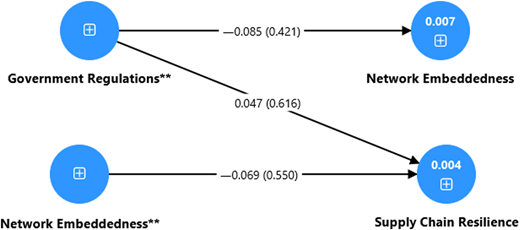
To examine whether the relationships among the study variables exhibit non-linear effects, quadratic terms were introduced into the structural model and assessed alongside the linear paths. This procedure allows for the detection of potential curvilinear patterns, such as diminishing returns or threshold effects, that may not be captured by linear specifications. The results, illustrated in Figure 2, provide no empirical support for non-linear relationships among the constructs. Specifically, the squared effect of government regulations on network embeddedness is negative and statistically insignificant (β = −0.085, p = 0.421), indicating that variations in regulatory intensity do not produce statistically detectable curvilinear changes in the degree to which agro-food processing SMEs are embedded within their supply networks. Similarly, the squared path from government regulations to supply chain resilience is positive but not significant (β = 0.047, p = 0.616), suggesting that increases or decreases in regulatory pressure do not lead to accelerating or diminishing resilience outcomes. The squared effect of network embeddedness on supply chain resilience is also negative and statistically insignificant (β = −0.069, p = 0.550), providing no evidence that resilience improves or deteriorates at an increasing or decreasing rate as embeddedness deepens. Taken together, these findings indicate that the relationships among government regulations, network embeddedness, and supply chain resilience are adequately captured by linear effects, and that introducing non-linear specifications does not improve explanatory power within the present dataset. The absence of significant quadratic terms suggests that the observed associations follow a predominantly linear pattern across the sampled firms, there by justifying the use of a linear structural model in subsequent analyses.
4.5 Endogeneity
Endogeneity was assessed using the Gaussian Copula approach to determine whether the estimated relationships were biased by reverse causality, omitted variables, or unobserved confounding effects. Four alternative model specifications were estimated to ensure robustness. In the first model, network embeddedness was treated as the potentially endogenous construct, and the associated Gaussian Copula term was positive but not statistically significant (GC = 0.212, p = 0.386), indicating no statistical evidence of endogeneity. Although the direct path between government regulations and network embeddedness was statistically significant in this model, endogeneity is determined solely by the significance of the copula term rather than by structural path coefficients. In the second model, government regulations were specified as endogenous, and the Gaussian Copula term for government regulations was negative and non significant (GC = −0.134, p = 0.534), providing no evidence of endogenous bias. The third model simultaneously assessed government regulations and network embeddedness as potentially endogenous, and again neither copula term reached statistical significance (GC(GR) = −0.138, p = 0.754; GC(NEE) = 0.505, p = 0.401). The fourth model extended the analysis by additionally testing the potential endogeneity of the relational path between government regulations and network embeddedness, and the corresponding copula term was also non significant (GC (GR → NEE) = −0.304, p = 0.524). The results suggest that the estimated structural relationships are unlikely to be materially biased by endogeneity within the limits of the cross-sectional design, as shown in Table 2.
4.6 Measurement validation
The measurement model was assessed using widely accepted threshold criteria to ensure reliability and validity. Indicator reliability was first examined, with most loadings exceeding the recommended minimum of 0.70, and all remaining loadings above the acceptable lower bound of 0.60 for established constructs, indicating adequate contribution of each item to its respective construct (Hair et al., 2020; Sarstedt et al., 2020). Internal consistency was confirmed through composite reliability values, all of which exceed the threshold of 0.70, demonstrating stable and consistent measurement across constructs (Hair et al., 2020). Convergent validity was established as the average variance extracted for each construct surpassed the 0.50 benchmark, indicating that more than half of the variance in the indicators is captured by the latent constructs (Fornell and Larcker, 1981). Discriminant validity was evaluated using both the Fornell–Larcker criterion and the heterotrait–monotrait ratio, with the square roots of average variance extracted exceeding inter-construct correlations and all HTMT values remaining below the conservative cut-off of 0.90, which supports the empirical distinctiveness of the constructs (Henseler et al., 2015; Henseler and Schuberth, 2020). As shown in Table 3, the results met established methodological thresholds and provided an appropriate foundation for structural model estimation.
4.7 Assessment of formative higher-order constructs
The model contained reflective lower-order constructs and formative higher-order constructs. The formative higher-order constructs were therefore assessed for collinearity and the significance and relevance of their outer weights, following Hair et al. (2022). All VIF values were below the conservative threshold of 3.0, indicating that collinearity among the dimensions was not a concern. All outer weights were positive and statistically significant at p < 0.001, and their 95% bias-corrected and accelerated confidence intervals excluded zero. The magnitude of the weights also showed the relative contribution of each dimension to its higher-order construct, with the complete results presented in Table 4.
4.8 Measurement model assessment
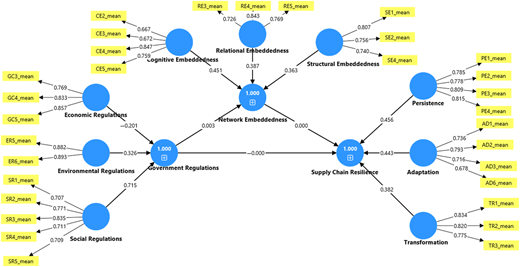
Figure 3 displays the final measurement model following confirmation of reliability and validity. All indicators load on their respective constructs with values meeting accepted thresholds, with loadings generally above 0.708 and none falling below minimum acceptable levels, indicating adequate indicator reliability (Hair et al., 2020).
5. Analysis and results
5.1 Correlation results
The correlation results reveal statistically significant associations among the study variables. Government regulations show a positive relationship with network embeddedness (r = 0.673, p < 0.001), indicating that firms operating under more structured regulatory conditions tend to report higher levels of embeddedness within their supply networks.A positive association is also observed between government regulations and supply chain resilience (r = 0.649, p < 0.001), reflecting a tendency for firms in regulated environments to report higher capacity to maintain, adjust, and reorganize operations during periods of disruption. The strongest correlation occurs between network embeddedness and supply chain resilience (r = 0.691, p < 0.001), highlighting the relevance of stable inter firm relationships, shared expectations, and trust in supporting resilience outcomes. Overall, the pattern of correlations suggests that regulatory frameworks, network relationships, and resilience outcomes are closely related within agro food processing SMEs. These results are summarized in Table 5 below.
5.2 Direct hypothesis testing
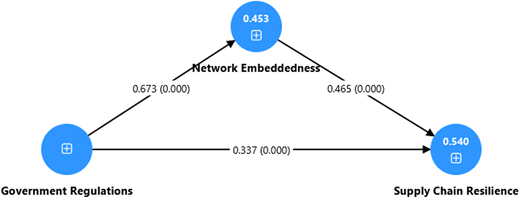
The structural results indicate that government regulations and network embeddedness are significantly associated with supply chain resilience among agro-food processing SMEs. Government regulations show a strong and significant effect on network embeddedness (β = 0.673, p < 0.001), suggesting that regulatory frameworks are linked to how firms organize and sustain relationships within their supply networks, including coordination, shared expectations, and repeated interaction. Regulations also exert a direct positive influence on supply chain resilience (β = 0.337, p < 0.001), indicating that regulatory requirements are associated with firms' reported capacity for continuity and preparedness through standardized procedures, planning discipline, and heightened risk awareness. Network embeddedness further demonstrates a strong positive effect on supply chain resilience (β = 0.465, p < 0.001), highlighting the role of trust-based relationships, information exchange, and coordinated action in supporting firms' ability to cope with and respond to disruptions. Given the cross-sectional design, these findings are interpreted as statistically significant associations rather than as evidence of causal effects.
5.3 Indirect hypothesis /mediation testing
The mediation analysis reveals a significant indirect effect through network embeddedness (β = 0.313, p < 0.001). The continued significance of both the direct path from government regulations to SC resilience and the indirect pathway through network embeddedness is consistent with partial statistical mediation. However, because the study is cross-sectional, this indirect effect should not be interpreted as evidence of a causal process or temporal sequence. Instead, the results indicate that government regulations are associated with SC resilience both directly and indirectly through their association with network embeddedness. While regulatory frameworks are directly linked to to operational stability, their broader relevance may be more evident where firms internalize regulatory requirements within networks characterized by trust, shared understanding, and sustained interaction. In this sense, network embeddedness maybe understood as a relational condition through which formal rules can be linked to coordinated responses, collective learning, and flexible behaviort, reinforcing the view that resilience is associated with the interaction between institutional guidance and relational structures rather than from compliance alone as seen in Table 6 below.
5.4 Assessment of predictive performance
PLS-Predict was used to assess the model's out-of-sample predictive performance. The model explained 45.3% of the variance in Network Embeddedness and 54.0% of the variance in SC Resilience. The Q2_predict values were positive for Network Embeddedness (0.448) and SC Resilience (0.414), indicating that the model had predictive relevance for both endogenous constructs (Shmueli et al., 2019). Network Embeddedness recorded an RMSE of 0.751 and an MAE of 0.603, while SC Resilience recorded an RMSE of 0.773 and an MAE of 0.610. RMSE places greater weight on larger prediction errors, whereas MAE shows the average absolute prediction error. These results show that the model generated out-of-sample predictions for both endogenous constructs. Table 6 presents the predictive and structural model results, while Figure 4 illustrates the path coefficients, significance levels, and explained variance.
6. Discussion
The findings support H1, which states that government regulations are positively associated with SC resilience in agro-food processing SMEs. In this study, Social, economic, and environmental regulations appear to reduce uncertainty and encourage more disciplined routines that support persistence and the capacity to cope with disruption, which are core features of resilience from a CAS perspective. These results are consistent with Wu and Tham (2023), who showed that environmental regulations foster cultures of environmental consciousness that strengthen resilience, and Baah et al. (2024), who found that subsidies and regulatory measures can stimulate innovation and support firms' continuity under pressure. However, other studies disagree or report weaker effects, arguing that regulatory burdens and uneven enforcement can limit flexibility and dampen resilience investments, especially for smaller firms (Zulu-Chisanga et al., 2021; Jeong et al., 2021; Nieuwenhuizen, 2019; Worku, 2016). The present findings help explain this mixed evidence by suggesting that, in Uganda, regulatory influence depends less on formal rules alone and more on how regulation is implemented in practice, including enforcement credibility and the administrative feasibility of compliance (Sendawula et al., 2024; Kabbera et al., 2026). CAS theory helps interpret these divergences by showing that resilience outcomes may be associated with how actors interpret and respond to rules within specific institutional contexts. However, these findings should be read as associational patterns rather than as demonstrated dynamic or causal processes. In rigid systems where compliance costs are burdensome, regulations may suppress innovation and flexibility. In contrast, in resource-constrained settings, the same rules can paradoxically stimulate resilience by transforming uncertainty into structured routines that enable firms to anticipate risks, coordinate responses, and sustain operations.
The results also supported H2, which suggests that government regulations have a positive association with network embeddedness in agro-food processing SMEs. This is an important contribution, as the direct link between regulations and network embeddedness has not been systematically examined in the existing literature; most studies only imply it by showing how institutional pressures encourage cooperation among firms (Dubey et al., 2023; Jeong et al., 2021; Wu and Tham, 2023). It also aligns with evidence that networks among small business owners bridge institutional voids by pooling compliance information, sharing trusted service providers, and coordinating responses to standards and inspections (Stahn et al., 2017). This suggests that in Uganda's agro-food sector, regulatory demands cannot be met by SMEs in isolation, compelling firms to build stronger relational ties, share knowledge, and coordinate strategies, thereby strengthening their structural, relational, and cognitive embeddedness. At the same time, this relationship may depend on the credibility and uniformity of enforcement, particularly in environments where institutional capacity varies across regions. Although prior studies such as Statsenko et al. (2024) and Tukamuhabwa et al. (2015) underline the role of interdependencies in resilience; they do not identify regulations as a direct driver of embeddedness. This study advances that debate by showing that, particularly in weak institutional settings, regulations may act as catalysts for cooperation, encouraging firms to embed more deeply in their networks. Even so, the present evidence shows a statistical association rather than directly observed network-building processes. In such contexts, networks become informal institutions help firms interpret and apply regulatory expectations through trust, reciprocity, and peer monitoring.
Similarly, the findings support H3, suggesting that embeddedness in networks is positively associated with SC resilience in agro-food SMEs. This is because agro food processing networks operate as CAS, where firms interact repeatedly by exchanging resources, knowledge, and strategies that are associated with stronger resilience (Touboulic et al., 2018). Structural embeddedness links firms to other network players, ensuring access to partnerships and resources during disruption; cognitive embeddedness fosters shared norms and interpretations that enable coordinated responses under uncertainty; and relational embeddedness builds trust, reciprocity, and informal safety nets that reduce opportunism and sustain cooperation. These dimensions form the social infrastructure through which resilience is achieved. This finding is consistent with Dogbe et al. (2020), Tian et al. (2021) and Wise et al. (2020) who showed that embeddedness enhances innovation and organizational adjustments necessary for resilience in SMEs. Nevertheless, some studies note that excessive embeddedness may also create rigidity or over-dependence under certain conditions, suggesting that network effects are not universally beneficial (Simon et al., 2013). However, much of the literature has treated these dimensions in isolation, often emphasizing relational ties while overlooking how structural and cognitive aspects reinforce resilience when integrated. These findings confirm that it is the strength and quality of networks, rather than isolated efforts, that are associated with resilience over time.
Lastly, H4 on mediation is supported, indicating that network embeddedness acts as a channel through which government regulations can be translated into SC resilience outcomes for agro-food SMEs. This suggests that regulations are likely to become more effective when reinforced by interfirm relationships that promote collaboration and joint problem-solving. While earlier studies often treated the link between regulations and resilience as direct (Dubey et al., 2023; Wu and Tham, 2023), the present results reveal that networks are the missing link that explains why regulatory interventions succeed in some contexts but fail in others, a gap that has remained unresolved in the literature. CAS theory clarifies this mediation by showing that networks operate as relational spaces where rules are collectively interpreted and applied, creating conditions for coordination, shared understanding, and workable responses (Jagustović et al., 2019). For example, food safety or environmental certification may be prohibitive for a single SME but becomes feasible when firms share knowledge, coordinate inspections, and pool logistics. In this way, regulation shifts from a rigid directive to a practical resource that is associated with incremental changes necessary for building resilience in SCs.
6.1 Conclusion
This study examined how government regulations and network embeddedness are associated with the resilience of agro-food processing SMEs in Uganda, focusing specifically on registered SMEs operating within selected urban agro-industrial districts. The results indicate that regulations are positively associated with SC resilience both directly and indirectly through embedded networks. These networks turn rules into shared practices of trust, cooperation, and knowledge sharing. From a CAS perspective, resilience can be interpreted as being associated with the interaction between formal rules and networks that support adjustment and change to survive disruptions. However, these dynamics are inferred from firms' reported capacities and relationships rather than directly observed over time. In environments where formal institutions are weak, resilience relies less on rules alone and more on the relational ecosystems that make those rules effective. The findings therefore suggest that, within similar registered urban SME contexts, effective regulation may need to go beyond setting standards and also support the conditions that strengthen collaboration among SMEs, because such networks are associated with stronger capacity to withstand and respond to disruptions. These conclusions should not be generalized uncritically to all Ugandan SMEs or to developing economies more broadly.
6.2 Theoretical contributions
This study makes a substantive theoretical contribution by drawing on CAS theory to explain how government regulations and network embeddedness are associated with SC resilience in food processing. Rather than treating regulations as external constraints and networks as parallel social structures, the findings suggest that resilience can be understood as being associated with their interaction within a single interconnected system. Regulations provide system-wide orientation by setting shared rules that reduce uncertainty and stabilize expectations, while network embeddedness enables these rules to be interpreted, applied and reinforced through everyday interactions. This study therefore contributes to CAS-informed SC research by showing how CAS can be used as an interpretive framework for understanding observed associations among institutional rules, relational structures, and reported resilience in a cross-sectional design, rather than by empirically demonstrating adaptation, feedback, or emergence over time. By empirically establishing network embeddedness as a central pathway through which regulatory signals are linked to resilience outcomes, the study extends existing work that has typically examined institutions and networks separately. Instead, it proposes an integrated view in which resilience is produced through the interplay between policy design and relational practice. This contribution is particularly important where institutional capacity is uneven and resilience depends less on rule enforcement alone and more on how rules are socially embedded within networks of trust, reciprocity, and shared learning. In doing so, the study grounds CAS theory in the lived realities of agro-food SMEs and provides a more complex explanation of how resilience reported and interpreted under persistent uncertainty and resource constraints.
6.3 Practical contributions
The findings offer context-specific insights for policymakers, SME managers, and development actors seeking to strengthen resilience in agro-food supply chains. For policymakers, the results suggest that regulations should be designed not only to enforce compliance but also to recognize the networks through which resilience is supported. This points to the potential value of moving beyond isolated, firm-level enforcement towards more relational and collaborative compliance arrangements. Agencies such as the Uganda National Bureau of Standards may, where feasible, consider certification and inspection approaches that recognize verified SME associations, cluster-based audits, shared training, and joint improvement plans. Such arrangements may help lower compliance costs, reduce duplication, and strengthen the ties that support coordinated responses to disruption. For SME managers, the findings show that resilience depends not only on internal capabilities but also on deliberate investment in trusted relationships with suppliers, buyers, regulators, and peer firms through regular communication, joint problem solving, and information sharing. For development agencies, the implication is to move beyond stand-alone enterprise support and consider shared traceability platforms, peer learning systems, and value-chain partnerships that reinforce coordination and mutual accountability. However, these implications should be interpreted cautiously and within the scope of the sampled firms. The study did not directly examine regulatory capacity, enforcement coherence, or the feasibility of sector-wide implementation. Accordingly, the implications are best understood as context-sensitive suggestions for registered, urban-based agro-food SMEs in similar settings, rather than as system-wide prescriptions for the entire Ugandan agro-food sector or for developing economies more broadly. In a context such as Uganda, where enforcement capacity is uneven, the practical usefulness of network-based compliance mechanisms is also likely to vary across districts, agencies, and value chains.
6.4 Study limitations and further research directions
Although this study makes important contributions, some limitations suggest directions for future research. First, the cross-sectional design restricts understanding of how regulations and network embeddedness change over time; longitudinal studies would show how repeated disruptions influence firm responses and network development. Such longitudinal designs would also be better suited to examining the dynamic processes associated with CAS theory, including adaptation, feedback, and system reconfiguration, which the present study could not directly observe. A further limitation relates to sampling bias and external validity. The study was restricted to formally registered, urban-based agro-food processing SMEs located in selected districts, which means the sample may not fully represent the wider population of agro-food SMEs in Uganda, particularly informal enterprises and firms operating in rural or less regulated settings. Because registered and urban-based firms are more likely to have stronger regulatory exposure, better access to support institutions, and more structured supply chain relationships, the observed associations may differ from those that would be found among less formalized enterprises. Consequently, the external validity of the findings should be interpreted with caution, and generalization beyond similar registered agro-food processing SMEs in comparable urban contexts remains limited. Future research should therefore include informal, rural, and less institutionally connected SMEs to test whether the reported relationships hold across a broader range of operating environments.
Relatedly, the study did not explicitly account for institutional heterogeneity, as regulatory implementation and enforcement may vary across districts, agencies, and value-chain segments, shaping firms' experiences differently even under the same national framework. Future studies could model such institutional differences, for example, by comparing locations, enforcement intensity, or sector-specific oversight arrangements. The assessment of Government Regulations was also limited by the absence of a separate global item in the questionnaire, which prevented redundancy analysis. Although collinearity and the significance and relevance of the outer weights were assessed, future studies should include a global measure to permit an independent test of convergent validity. Third, while network embeddedness was confirmed as a key mediating factor, other mechanisms, such as digitalization, leadership styles, and cultural norms, may also explain how regulations affect SC resilience. Finally, qualitative methods such as case studies or ethnography could supplement quantitative data by exploring the lived practices, narratives, and learning processes through which SC resilience emerges in practice. Mixed-methods and longitudinal research would be especially valuable for unpacking the regulatory processes, institutional constraints, and relational dynamics that a cross-sectional survey cannot fully capture.