In a fast evolving labour market, higher education graduates need to develop employability competences. Key in becoming employable is the ability to reflect on learning experiences, both within a curriculum as well as extra-curricular and work placements. This paper wants to conceptualise how an online learning platform might entail a reflective practice that systematically supports students in reflecting on their learning experiences.
When studying online learning platforms for developing students' employability competences, it became clear that the effectiveness of the platform depends on how the platform guides students' reflective practice. In turn, the authors studied which features (tools, services and resources) of the online learning platform are guiding the reflective practice.
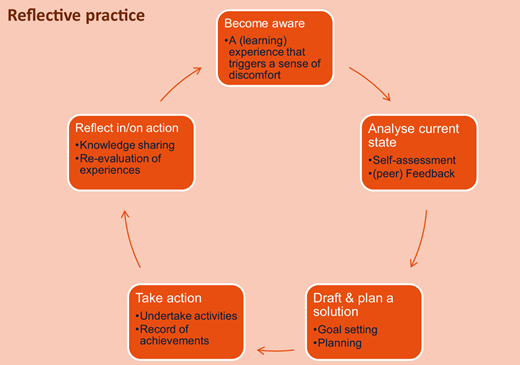
This resulted in the introduction of an online learning platform, containing a comprehensive set of online learning tools and services, which supports students' reflective practice and, in turn, their employability competences. The online platform facilitates both feedback from curricular and work-related learning experiences and can be used as a start by students for showcasing their employability competences. The reflective practice consists of a recurrent, systematic process of reflection, containing various phases: become aware, analyse current state, draft and plan a solution, take action and, finally, reflect in and on action.
Future research revolves around studying the features of online learning platforms and their role in fostering students' reflection and employability competences.
The conceptual model provides concrete indicators on how to implement online learning platforms for supporting students' reflection and employability competences.
This is the first article that analyses an online learning platform that guides students' reflective practice and fosters their employability competences. The authors provide concrete suggestions on how to model the online platform, building further on reflective practice theory.
1. Introduction
The knowledge society, increasing uncertain labour market perspectives, the rapid changing impact of IT on society, high-performance workplaces, industry specific demands and accreditation standards, globalisation and economical changes contribute to the changing role of higher education in the 21st century (Humburg and Velden, 2013; Oraison et al., 2019). Institutions for higher education and their students as well as employers agree on the importance of developing students' employability competences next to academic knowledge and skills (Aarts and Künn, 2019; Branine, 2008; Tomlinson, 2008; Tomlinson, 2012; Tymon, 2013). Although employability is a complex, multidimensional construct, key is the ability to obtain and maintain employment throughout someone's career (Bridgstock, 2009; Fugate et al., 2004; Harvey, 2001; Hillage and Pollard, 1998). Acknowledging employability as a complex, multidimensional construct, Römgens et al. (2019) introduced a competence-based definition of employability, including six dimensions derived from both higher education and workplace learning. These dimensions of employability include the mastery of discipline-specific knowledge, transferable generic skills, emotional regulation, career development skills, self-management skills and self-efficacy. These dimensions underline a positive relationship with employers' perceptions of graduate employability (Chhinzer and Russo, 2018; Bridgstock, 2009).
Literature argues that employability as a learning outcome results in the first place from active learning experiences within curricular courses, in combination with parallel personal development through work-related experience and extra-curricular activities (Pool and Sewell, 2007; Rae and Matlay, 2007). Across all these learning experiences, the students' capacity to reflect on experiences and their own development seems to be fundamental to develop employability competences (Moon, 2004; Pool and Sewell, 2007; Yorke, 2006). Reflective practice in the context of employability can be defined as a systematic, recurrent process of internally examining and exploring a sense of inner discomfort regarding employability competences, followed by a cascade of undertaking reflective activities. To these activities belong: goal setting, planning and performing and subsequent evaluating new experiences (Atkins and Murphy, 1993; Boud et al., 1985; Boyd and Fales, 1983; Dewey, 1933; Finlay, 2008; Fook, 2006; Mann et al., 2007; Moon, 1999; Peltier et al., 2005; Rogers, 2001; Schön, 1983). Although evidence for educational strategies based on reflective practices that enhance employability is scarce (Mann et al., 2007), some studies report on relationships between reflection and learning and competence development (Baruah et al., 2017). Under appropriate conditions and contextual factors, the reflective practice helps students to enhance their competency development (Mann et al., 2007; Rogers, 2001; Yip, 2006).
Reflective practices in higher education take form in logs, such as reflective learning journals and diaries, story-telling activities, portfolios and work-related learning activities such as internships and placements (Baruah et al., 2017; Moon, 2004; Roberts, 2009). Furthermore, the use of online tools, such as chats, blogs and online discussion forums supporting reflective learning activities, has become increasingly more prevalent (Burhan-Horasanlı and Ortaçtepe, 2016; Kori et al., 2014). Since the 1990s, there has been considerable growth in the adoption of technology within higher education to support the development of skills (Humburg and Velden, 2013) and provide students with many opportunities for reflection (Lin et al., 1999). Online learning tools and services hold the promise to be flexible and personalised, offer a wide variety of learning activities and are able to create a bridge between curricular and extracurricular activities, both organised by the university, such as central career services, as outside the university, in the form of hobbies or voluntary work (Harvey, 2005). In higher education, there is a wide variety of online learning platforms (OLPs) (an integrated set of online tools, services and resources) in use, which has grown in interest since the beginning of the COVID-19 pandemic. However, so far little to no attention has been paid to which (and how) online functionalities can be used to foster employability competences. Therefore, this article presents a conceptual model of an OLP supporting a reflective practice that fosters students' reflection as core employability competence.
In next sections, we will describe the various elements within the conceptual model. First, the concept of competence-based employability is defined, followed by a discussion on the theory on reflective practices in higher education. Next, we describe online tools, services and resources that support reflective practices. Finally, we present a use case and the conceptual model of an OLP that supports a reflective practice for enhancing employability competences.
2. A conceptual model of students' reflective practice for employability
2.1 Competence-based employability and reflection
The concept employability has been studied and defined by many researchers in various academic disciplines, such as Human Resource Development, Psychology and Management. Yet, there seems to be no consensus across disciplines on a definition for employability (Álvarez-González, 2017; Römgens et al., 2019; Williams et al., 2016). Following the various perspectives, Römgens and colleagues (2019) introduced a multi-dimensional, competence-based definition of employability. This definition was derived from core references within several disciplines in two streams of research on higher education (Bridgstock, 2009; Hinchliffe and Jolly, 2011; Pool and Sewell, 2007; Yorke and Knight, 2006) and workplace learning (Akkermans et al., 2013; Defillippi and Arthur, 1994; Fugate et al., 2004; Forrier et al., 2009; Peeters et al., 2019). Their definition encompasses competences which were recognised by both streams of research: (1) disciplinary knowledge and generic, transferable skills; (2) social skills; (3) lifelong learning skills and being able to adapt to changing situations and environments; and (4) meta-cognitive skills for reflecting. Two competences were discussed in only one of the two streams of research: emotional regulation (higher education) and well-being regarding the work–life balance (workplace learning). This multi-dimensional, competence-based definition of employability reflects also the importance of various factors that employers consider when assessing the employability of graduates students (Chhinzer and Russo, 2018).
Meta-cognitive skills, such as reflection, are considered fundamental for exploiting other employability competences (Clarke, 2018; Moon, 2004; Pool and Sewell, 2007). Moon (2004) also argues for the importance of reflection for students' employability as it is related to different kinds of learning situations after graduation, such as experiential learning, problem-solving or the management of feelings and emotions, and helps graduates to gain and maintain the awareness of their skills and attributes they have learned in higher education. Rogers (2001) defines reflection as “a cognitive and affective process that requires active engagement from the individual, is triggered by an unusual or perplexing situation or experience, involves examining one's responses, beliefs, and premises in light of the situation at hand, and results in integration of the new understanding into one's experience”.
2.2 Reflective practice
Several theoretical frameworks for reflection and reflective practices have been developed and used across a variety of educational settings within higher education (Rogers, 2001). Nevertheless, it is difficult to pinpoint one definition and model that applies to a reflective practice in higher education that fosters students' awareness on employability (Fook, 2006). Based on previous research, we frame a reflective practice that fosters employability competences as a recurrent process of internally examining and exploring a sense of inner discomfort regarding employability competences, followed by a cascade of undertaking activities. These activities entail goal setting, planning and performing and subsequent evaluating new experiences (Atkins and Murphy, 1993; Boud et al., 1985; Boyd and Fales, 1983; Dewey, 1933; Finlay, 2008; Fook, 2006; Mann et al., 2007; Moon, 1999; Peltier et al., 2005; Rogers, 2001; Schön, 1983). This process of reflection and action leads to a new viewpoint on employability competences as perceived by the student. The reflective practice can be seen as a form of active, experience-based learning. Five groups of reflective activities fit into this practice: become aware, analyse current state, draft and plan a solution, take action and, finally, reflect in and on action. Although each group can be characterised by typical supporting learning activities, the stages of the reflective practice can flow into each other without explicit predefined borders. Figure 1 displays the reflective practice that fosters employability competences.
In next sections, we will elaborate on the elements of this reflective practice and examples of learning activities that fit within this reflective practice.
2.2.1 Become aware
A sense of an inner challenge, mostly triggered by a previous experience of surprise or positive of negative feelings about a learning situation, enables students to identify a discrepancy between their current and desired level of employability competences (Atkins and Murphy, 1993; Boud et al., 1985; Boyd and Fales, 1983; Dewey, 1933; Peltier et al., 2005; Rogers, 2001; Schön, 1983). Regarding employability, examples of this inner discomfort are uncertainties students experience with regard to their fit for the labour market, the feeling that they are insufficient equipped with self-management skills and career building skills or difficulties in expressing their competences to potential employers (Bridgstock, 2009). Examples of experiences that trigger this feeling are the undertaking of personality tests, peer stories, being coached in the development of competences or activities that connect students with potential employers, encompassing both workplace-based activities (placements, practicums and internships) and virtual or campus-based activities (client projects, industry panels, consultancies, start-up/incubators, virtual placements and mentoring programmes) (Jackson and Bridgstock, 2021).
2.2.2 Analyse current state
The awareness of the inner feelings leads to the need for a critical and constructive analysis of the problem (Boyd and Fales, 1983) which consists of identifying existing knowledge, collecting additional information and challenging internal and external assumptions (Atkins and Murphy, 1993; Peltier et al., 2005; Rogers, 2001). For this kind of self-reflection, students want to map out their current strengths and weaknesses, whereas this activity also prompts them to reflect and engage in further information seeking or modification activities (Griffiths et al., 2018). Examples of learning activities that support students in this kind of self-reflection are self-assessment and peer-feedback. Self-assessment fosters reflection on one's own learning processes and results and evaluation in terms of judgements on one's own learning. Next to self-assessment offers peer assessment an arrangement for learners to help each other to plan their learning and develop metacognitive, personal and professional skills (Topping, 2009). In addition, feedback from professional mentors or coaches can be valuable because of their knowledge of the labour market and the external perspective taken (Nuis and Beausaert, 2021).
2.2.3 Draft and plan a solution
Students draft and plan a solution and decide to act in terms of how to improve their employability competences (Rogers, 2001). Goal setting and personal development planning (PDP) are typical learning activities that support this stage of the reflective practice. Goal setting and subsequent self-reflection on the performance and learning outcomes have a positive impact on motivation and encourages self-awareness (Jackson, 2015). Goal setting is most effective when students define realistic and measurable goals and show reflective practices such as self-reflection and peer assessment (Jackson, 2015; Travers et al., 2015). PDP is an instructional feature that helps students to articulate personal goals and to reflect on and evaluate the progress towards achievement of these goals (Moon, 2004; Pool and Sewell, 2007). PDP helps students to improve their general skills for study and career management (Harvey, 2005; Monks et al., 2006).
2.2.4 Take action
According to Dewey (1933) and Schön (1983), experimentation helps to test the hypotheses that have been formulated during the goal setting stage. Experimentation takes form by undertaking activities that yield experiences for the re-evaluation of the original problem regarding employability. Students might not only undertake activities that meet academic knowledge and skills requirements, they might also consider activities that make them discuss and reflect on the alignment between graduate attributes and industry-specific employability criteria and accreditation standards (Oraison et al., 2019).
Learning experiences that foster the reflective practice not only derive from courses within the academic curriculum, but also from co-curricular and extracurricular activities. Students value extracurricular activities for employability and for developing personal and professional skills such as confidence, character, social skills, planning and organisation (Clark et al., 2015; Thompson et al., 2013). Experiences in extracurricular activities are claimed to enhance (employers' perceptions of) graduate employability by combining experiential learning, course work and sometimes community service (Cole et al., 2007; Kinash et al., 2016; Stuart et al., 2011; Tomlinson, 2008). Typical learning activities that fit with this stage of the reflective practice are workshops on competency development, coaching, internships, work placement, voluntary work, sports or involvement in student societies.
A portfolio enables students to collect and maintain evidence of achievement of the undertaken activities and the outcomes as defined in their personal goals regarding the development of employability competences. In higher education, portfolios are broadly used to keep track of learning activities and development over time. In addition, portfolios have been reported to promote reflective practice, employability and professional certification (Farrell, 2020).
2.2.5 Reflect in and on action
According to Schön's description of reflection in action (1983), students examine experiences and responses as they happen, whereas reflection on action involves reviewing, describing, analysing and evaluating past practices, resulting into new insights that enhance future practice. Mezirow (1981) affirmed that examination and reflection are crucial in generating new perspectives. Through re-evaluation, students develop a new perspective to the initial situation of inner discomfort regarding their employability. Reflection in action typically happens when a student has to resolve an in-the-moment issue and tries a new practice in order to see if a new solution overcomes the current challenge (Schön, 1983).
Reflection on experiences can be fostered by the use of a portfolio or by knowledge sharing. Students value the use of portfolios as part of the process of PDP for increasing self-awareness by reflection (Çimer, 2011; Monks et al., 2006) or articulating and displaying to future employers their capabilities in different skills (Farrell, 2020; Jackson, 2015). As Rodgers (2002) points out, sharing reflections is beneficial to the learning experience as it helps a student to see the importance of an experience and to see it in a new light since fellow students might provide different perspectives. Knowledge sharing defined as “the exchange of knowledge, ideas and experiences in order to promote reflection” (Chin Wei, 2012) can take many forms in education, ranging from more formally oriented activities such as staff-supported (online) discussions or academic peer learning programmes, to more informal activities, such as student-run study groups or social media groups and coffee meetings (Gamlath and Wilson, 2017).
2.3 Online learning platform to enhance a reflective practice
Hill (2012) defined an OLP as “a framework of tools, online services and resources that work seamlessly together to deliver a learning experience by unifying educational theory and practice, technology and content”. The use of tools, online services and resources does not need to be restricted to only formal institutional applications. Social media such as blogs and wikis can also be part of an OLP that fosters reflection (Dabbagh and Kitsantas, 2012). Many higher education institutions (HEIs) experiment with online tools, services and resources to enhance learning including reflection (Ebner et al., 2019; Reese, 2015). The use of technology in education varies from virtual courses to blended learning formats wherein online learning functions as a supplement to face-to-face interactions. Online learning provides students with synchronous and asynchronous learning opportunities in both an individual and a collaborative way (Francis and Shannon, 2013; Reese, 2015). In the next sections, we will elaborate on the functionalities of an OLP that can support the stages and underlying learning activities of the reflective practice.
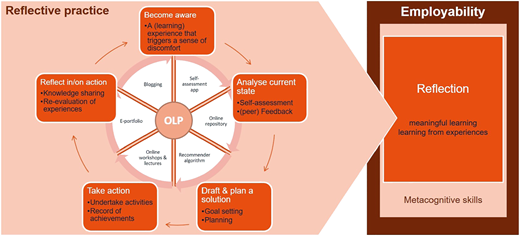
2.3.1 Functionalities within OLP that support the reflective practice
2.3.1.1 Become aware
Comparable with learning management systems that provide an overview of students' grades and other curricular achievements, an online overview that makes acquired competences within curricular courses explicit to a student can serve as a digital prompt for raising awareness about employability competences. Also conducting online personality tests might function as a trigger to become aware of the inner discomfort regarding employability competences.
2.3.1.2 Analyse current state
In an OLP, which supports the reflective practice, students might start to analyse their employability competences by undertaking an online self-assessment and eventually ask for peer feedback. An online self-assessment test supports students in their self-reflection and gaining a better understanding of both the academic knowledge and skills and their competences (Martínez-Villagrasa et al., 2020).
2.3.1.3 Draft and plan a solution
Based on the results of a self-assessment, students set goals and plan activities regarding the development of employability competences. Instructors might encourage students to use social media such as blogs and wikis for creating typical goal setting and planning related learning activities such as online bookmarks, media resources, personal journals and calendars (Dabbagh and Kitsantas, 2012). A desirable functionality for the support of goal setting is an algorithm-based recommender system. A recommender system can advise on goals or activities based on information about the individual learner and the available learning activities and historical information about similar learners and activities (Drachsler et al., 2008). These requirements require another functionality in terms of a repository with a comprehensive overview of all kinds of activities, within or next to the curriculum, organised by HEI's affiliated departments (such as Career Services), and vacancies for placements, internships or other work-related learning opportunities. Such a repository dispatches these activities (linked to the underlying goals and their usage data) to both the recommender system and a website or portal that is easily accessible for students. A repository acts as a broker between various source systems (such as student administration systems and teaching and learning environments) and the recommender system. The repository should facilitate the storage and flexible access of the content, objects and metadata about the activities and opportunities that are offered to students (Kleinberger et al., 2001).
2.3.1.4 Take action
In the next stage, students undertake different activities that foster the development of employability competences. Recording of the activities undertaken is needed in order to allow the students to reflect in and on their actions. A commonly used functionality for this kind of environments is the e-portfolio. Some studies report benefits from the use of an e-portfolio for building on self-awareness through reflection and improving competences (Dahllof et al., 2004; Graves and Epstein, 2011; Simatele, 2015), although writing authentic reflections without a proper supportive structure might be underestimated (Brammer, 2011). As Driessen (2017) poses, without mentoring, portfolios might be merely seen as bureaucratic hurdles in competency-based education programmes.
2.3.1.5 Reflect in and on action
Students use e-logs for reflection in action or reflective journals for reflection on action (Cord et al., 2010). The use of journal writing and formative feedback enhances the quality of reflection (Bruno and Dell'Aversana, 2017). In addition, an e-portfolio can be used as a formative assessment tool, allowing reflection in relation to learning goals and the planning of professional development, as a learning tool or as a tool to scaffold complex tasks such as collaboration or creating employment portfolios (Roberts et al., 2016; Harrington and Luo, 2016; Jwaifell, 2013; Meth et al., 2020). The online platform should also facilitate the sharing of reflections on activities published on the platform. Knowledge sharing encourages discourse, collaboration and reflection (Charband and Jafari Navimipour, 2016). Knowledge sharing in the case of an OLP in our study might involve the reviewing of activities by students through the sharing of experiences after conducting these activities. This form of knowledge sharing promotes reflection (Dabbagh and Kitsantas, 2012).
2.3.2 Use case description
As a first step towards the implementation of an OLP that supports the reflective practice, the use case description in Table 1 can serve as input for creating a prototype. The use case entails a description of the goal, the actors, the pre- and post-conditions and the flow of events that correspond to the stages of the reflective practice. In this use case, we describe different pathways for the reflective practice, formulated as typical steps or extensions, since the reflective practice is not a linear process of consecutive activities that every student needs to conduct in the same order. For each step, we provide two ends of online tools, services or resources: one for the short term that entails a more feasible implementation and one for the long term that requires a more complex architecture. In addition, we give some examples of online tools, services or resources that have been applied at an HEI and that could be part of an OLP that fosters a reflective practice.
3. Discussion
In this article, we addressed the need for developing employability competences, from both the perspective of HEIs and students. We argued that the students' capacity to reflect on experiences and their own development seems to be fundamental to develop employability competences. Despite numerous studies on reflection, a common definition of a reflective practice for employability as a key competence for employability is still lacking. In addition, different types of online tools and services are acclaimed to have positive effects on learning and reflection, but a comprehensive set of tools that ends up in an OLP to support reflection is yet to be crystallised.
This article presents a conceptual model (Figure 2) for an OLP that supports a reflective practice for the development of reflection as key competence of employability via a competence-based approach (Yorke, 2006; Pool and Sewell, 2007; Bridgstock, 2009; Hinchliffe and Jolly, 2011; Römgens et al., 2019). The OLP enables a personalised approach to help students to develop a strategy for the development of employability competences by providing a comprehensive set of opportunities for participation in and reflection on both curricular and extra-curricular activities.
Although knowledge in the area of technology design principles for effective support of reflection and learning is accumulating, the explicit evaluation of their benefits in longitudinal and authentic settings remains scarce (Rodriguez Triana et al., 2017). Our conceptual model about an OLP for reflective practice and employability competences shows various avenues for future research. In sum, research challenges concern the design principles and effectivity of an online platform that fosters reflection and employability and the determinants and outcomes of a reflective practice. We discuss these areas of research in the following sections.
3.1 Design principles and effectivity of an online learning platform
The online platform should facilitate an authentic learning environment, supporting students in the development of their employability competences, including reflection. Herrington (2006) defined design principles for such a learning environment, such as an authentic context that reflects the way knowledge will be used in real life, and reflection. The design principles that apply to the online platform supporting a reflective practice and the development of employability competences call upon elaboration. The functionalities that need to be part of such an OLP can be object of study. Qualitative research through focus groups with IT and educational experts might help to answer these questions.
3.2 Determinants and outcomes of a reflective practice
Future research should unravel the role of the different factors and conditions that promote or inhibit the stages of the reflective practice. These conditions include adequate support, time, resources, connection to peers, tools and appropriate student-centred opportunities on both institutional and course level (Rogers, 2001; Finlay, 2008). Also, a structured process of mentoring or coaching is assumed to be supportive to reflection (Jackson, 2015; Rogers, 2001) and to knowledge sharing (Jakovljevic et al., 2013; Johnson, 2001).
The conceptual model presented in this article suggests also empirical studies on the effectiveness of the reflective practice for the development of students' employability competences. Although a lot of literature on employability provides arguments that institutions must change to better prepare students for the workplace, it is not yet clear what kind of (online) learning experiences are most effective for the development of employability competences (Peet, 2016). E-portfolios are acclaimed to encourage both reflective and active learning (Simatele, 2015) as well as showcasing reflective practices via an OLP to provide potential employers insights in graduates' employability skills (Meth et al., 2020; Peet, 2016). However, empirical evidence on how both purposes, learning and showcasing to potential employers, can be combined, is limited. For example, having an academic coach providing feedback on the learning process, while an external coach assesses students' final showcase e-portfolios might be a good way to combine both purposes (Nuis and Beausaert, 2021).
However, extensive empirical evidence on the generalisability of the reflective practice stages and accompanying (online) instructional features is not available yet. Longitudinal, quantitative studies based on validated questionnaires measuring reflective practice (Priddis and Rogers, 2018), levels of reflection (Kember et al., 2000) and technology acceptance models (Ahmed and Ward, 2016) are assumed to reveal relations between the use of OLPs as a reflective practices and employability competences.
4. Conclusion
The need to develop employability competences next to academic knowledge is generally recognised. Employability as a learning outcome results from the cumulative learning experience within curricular courses, in combination with parallel personal development through work-related experience and extra-curricular activities. Key in becoming employable is the ability for reflection on and evaluation of learning experiences in the past.
Technological change and especially the predominance of ICT have impact on both the skills higher education graduates need to develop as on higher education itself. Online tools and services can support the development of skills and provide students with resources for reflection. Although a lot of attention is paid to online learning within the curriculum, activities and tools that foster reflective practices for curricular, extra-curricular learning and work-place-based learning are less studied.
Given these challenges, we constructed a conceptual model for the development of reflection as the key competence of employability. The conceptual model brings together various theoretical frameworks, which have not been linked before. By bringing these frameworks together, we aim at introducing online learning for supporting a reflective practice, leading to the development of students' employability competences. The model provides concrete levellers on how to implement OLPs for supporting reflection and more largely, employability competences.