Faced with the rapid transformation of the accounting profession by artificial intelligence (AI), this study proposes an in-depth bibliometric analysis to map the evolution and structure of this field of research.
Based on a corpus of 447 scientific articles extracted from the Web of Science database and published between 1989 and 2023, our analysis combines performance indicators and scientific mapping techniques, in particular networks of keywords’ co-occurrence. The objective is to identify the dynamics of publications, to identify the central themes and to chart future research trajectories.
The results reveal an exponential acceleration of publications over the last decade, marking a conceptual shift from traditional expert systems to advanced technologies such as machine learning and deep learning. The thematic analysis highlights major research areas, particularly the application of AI to fraud detection, the improvement of the reliability of financial information and the transformation of audit practices, which are emerging as driving themes of research. The study also identifies emerging themes such as the prediction of business failures and process automation. In conclusion, this article provides a roadmap for researchers and practitioners. He emphasizes the importance of developing explainable AI (XAI), meeting ethical challenges and strengthening collaboration between academia and industry to ensure a responsible and value-creating integration of AI in accounting.
Identification of the dynamics of publications to detect the central themes and to outline future research trajectories in the field of the of AI on the accounting profession.
This study underscored the increasing interest in leveraging AI and blockchain to transform accounting practices. Building on these foundational studies, this paper aims to provide a comprehensive analysis of AI's impact on the accounting profession.
1. Introduction
Recent studies have shown artificial intelligence (AI's) [1] rapid transformation of accounting, and recent literature strongly emphasizes its potential for task automation and capability enhancement. A notable example is Omoteso (2012), who explored the relationship between expert systems and neural network automation. More recent research, including studies by Khan, Adi, and Hussain (2021) and Munoko, Brown-Liburd, and Vasarhelyi (2020), has highlighted the advantages of incorporating AI into auditing practices. Fog computing-based AI significantly boosts efficiency, according to Khan et al. (2021), achieving a 92% productivity gain and a 95% accuracy improvement over traditional human auditor methods. Meanwhile, Munoko et al. (2020) highlighted the broader benefits of adopting AI, including improvements in temporal efficiency, faster and more accurate data analysis and better customer service. Together, these studies highlight the transformative potential of AI technologies for improving audit practices and overall organizational performance.
Kokina and Blanchette (2019) highlighted the advantages of using robotic process automation (RPA) to automate structured, repetitive, rule-based processes that rely on digital inputs. This automation can lead to cost savings, improved process documentation, lower error rates, more accurate performance tracking and higher-quality reporting. RPA helps organizations streamline workflows and reduce manual tasks, allowing employees to focus on more strategic activities that require human judgment and decision-making. Automating these routine and time-consuming tasks can significantly enhance operational efficiency and productivity. However, successful digital transformation requires effective change management to ensure that employees receive the mentoring and support required during the transition.
Many researchers have explored the integration of AI into the accounting profession and examined various aspects of its application. Hilal, Gadsden and Yawney (2022) highlighted several models for anomaly detection in financial fraud, noting a shift toward the adoption of more advanced supervised and unsupervised learning techniques. Garanina, Ranta, and Dumay (2022) investigated the impact of blockchain on auditing and accounting, focusing on trends in record-keeping and managing the transactions and digital audit trails. Ranta, Ylinen, and Järvenpää (2022) emphasized the role of machine learning (ML) in management accounting, particularly in improving cost management, budgeting and decision support. Secinaro, Dal Mas, Brescia, and Calandra (2021) conducted a bibliometric analysis of the integration of blockchain and AI technologies in accounting and auditing and identified four key topics related to blockchain-based accounting systems and their AI-driven mechanisms. This study underscores the increasing interest in leveraging AI and blockchain to transform accounting practices.
Recent research has unanimously confirmed the remarkable expansion of this field of study, with a particularly marked acceleration over the last decade (Wei, Zhang, Wei, & Tsaur, 2025). This growth reflects the academic community's growing interest in technological applications in accounting, reflecting the profound transformations that the profession is currently experiencing. Longitudinal analyses reveal a significant conceptual evolution: while the first research focused mainly on expert systems and traditional computer applications, contemporary work embraces more sophisticated technologies such as ML, generative AI and automatic natural language processing (NLP) (Aziki, Ilahiane, & Fadili, 2025).
The examination of the dominant themes highlighted several priority research axes. The automation of accounting processes is a central topic, encompassing the digitization of entries, automatic reconciliation of accounts and optimization of workflows (Elnakeeb & Elawadly, 2025). AI-assisted auditing also represents a major area of investigation, with applications in risk analysis, intelligent sampling and continuous evaluation of internal controls. Fraud detection, which was historically complex and time-consuming, now benefits from sophisticated algorithmic approaches capable of identifying suspicious patterns in large datasets (Wei et al., 2025). Simultaneously, the automated production of financial reports and predictive models for accounting forecasts constitutes a promising area of development, gradually transforming traditional reporting practices.
This transformation is part of the broader context of the digital revolution, where the concepts of big data, advanced analytics and digital transformation are redefining the contours of the accounting profession (Elnakeeb & Elawadly, 2025). Some studies explore specialized niches, examining, for example, the impact of AI on the quality of accounting estimates and the reduction of cognitive biases (Rus, Török, Bogdan, & Gherai, 2024) or its role in the emergence of environmental accounting and sustainability reporting (Tavares & Vale, 2024). These researchers testify to the diversification and progressive specialization of the field.
Beyond technical aspects, bibliometric analyses highlight the profound implications of AI on the evolution of the accounting profession. Studies converge to identify a fundamental transformation of the required skills: while automation takes over repetitive and standardized tasks, professionals are called upon to develop analytical, strategic and decision-making skills at a higher level (Mohammad et al., 2020; Chávez-Díaz, Aquiño-Perales, De-Velazco-Borda, Villagómez-Chinchay, & Flores-Sotelo, 2024). This professional change raises important issues in terms of training, adaptation and repositioning of the actors in the sector.
The analysis of research networks reveals a contrasting scientific geography, with a predominance of American institutions in the production of knowledge (Elmi et al., 2025), while showing the emergence of fruitful international collaborations and new poles of excellence (Rus et al., 2024). Most of these studies are based on one or a few specific databases (such as Scopus). Although this database may not include all relevant publications, it potentially limits the completeness of the analysis (Chávez-Díaz et al., 2024). To enrich these bibliometric analyses, this study attempts to analyze the conceptual structure of this relationship by providing concept maps based on the thematic map identified from the Web of Science documents that have not yet been exploited by previous studies. The rapid evolution of digital technologies has generated abundant academic production in accounting. Although seminal bibliometric studies, such as those of Secinaro et al. (2021) and Garanina et al. (2022), have rigorously documented the impact of blockchain, this study differs from the previous studies by a fundamental conceptual leap, namely, the passage from the analysis of trusted infrastructure to that of automation of cognition. Whereas previous reviews focused on so-called “deterministic technologies” such as blockchain, which secures the immutability of registers, or Robotic Process Automation (RPA), which automates repetitive tasks based on strict rules (Kokina & Blanchette, 2019), AI imposes a probabilistic and heuristic paradigm (Marrone & Hazelton, 2019). This change in nature justifies an autonomous review. Indeed, AI does not just store or transfer data; it simulates complex cognitive processes such as reasoning, learning and judgment, which are traditionally reserved for human expertise. In addition, our methodological approach, which combines performance analysis and scientific mapping, differs from that of Garanina et al. (2022), who used topic modeling (Latent Dirichlet Allocation), and that of Secinaro et al. (2021), which is characterized by particularly thorough open qualitative coding. Thus, our work is not redundant but a complementary and necessary contribution, offering a unique and exhaustive mapping of the impact of another major transformative technology on the accounting profession.
Building on these foundational studies, this study aims to provide a comprehensive analysis of AI's impact on the accounting profession by addressing the following key research questions.
In what ways have publication trends and research themes related to the use of AI in accounting shifted over the last ten years? This question aims to understand how research in this field has evolved and shifted its focus over time.
Which AI techniques are being used, and in which accounting contexts do they generate the most interest? This question attempts to clarify the current extent of AI usability in today's professional accounting practices.
What other potential issues or areas for further investigation have previous studies identified? This question aims to uncover unexplored niches and provide insights into traditional review processes for identifying gaps for further research in accounting and AI.
Compared to previous bibliometric studies on AI in accounting, this study makes three distinct and complementary contributions. First, it proposes an exhaustive and updated mapping of scientific production covering the period 1989–2023 from the Web of Science database, a source still little exploited by comparable studies, which mainly favor Scopus (Chávez-Díaz et al., 2024; Aziki et al., 2025). Secondly, unlike previous reviews that have documented the impact of “deterministic” technologies such as blockchain or RPA (Secinaro et al., 2021; Garanina et al., 2022), our study makes a fundamental conceptual shift by focusing the analysis on the “probabilistic and heuristic” paradigm of AI (Marrone & Hazelton, 2019), a technology that does not just store or transmit data, but which simulates complex cognitive processes such as reasoning, learning and judgment. Third, our methodological approach, which combines performance analysis and thematic scientific mapping, results in an original conceptual model that theorizes the paradigmatic transition from traditional accounting to AI-enhanced accounting, articulated around five structural ruptures documented in the literature.
2. Literature review
The academic literature on AI in accounting does not constitute a homogeneous and linear corpus. It is crossed by fundamental questions that structure debates between researchers and delimit the still uncertain boundaries of the field. Three major areas of debate emerge from the analysis of scientific production. The first focuses on the respective places of algorithmic automation and human professional judgment in the accounting profession. The second question is the inevitable trade-off between the predictive power of complex models and their intelligibility by practitioners and regulators. The third examines the conditions under which the efficiency gains promised by AI can be achieved without compromising the fairness, responsibility, and governance of accounting systems. These three axes of debate are not watertight; they articulate and reinforce each other, forming the conceptual framework from which our bibliometric cartography, presented in Section 4, makes sense.
2.1 Automation versus professional judgment
The first line of fracture that crosses the literature opposes two visions of AI in accounting: that of a substitute tool that automates and replaces the professional and that of an augmentation tool that extends its judgment capabilities. On the one hand, studies demonstrate the superior efficiency of algorithms in precise and repetitive tasks: the detection of fraud by neural networks surpasses classical statistical methods (Kirkos, Spathis, & Manolopoulos, 2007; Ngai, Hu, Wong, Chen, & Sun, 2011), the automation of accounting entries reduces errors and costs (Chen et al., 2023; Colombo & Beuren, 2023) and predictive models of financial distress compete with human expertise (Chen & Du, 2009). On the other hand, Sutton, Arnold, and Holt (2018) warn about the risk of dequalification and ask the fundamental question: how far can we automate without depleting the quality of professional judgment? Munoko et al. (2020) complete this questioning by showing that the efficiency gains of AI in auditing are accompanied by systemic ethical risks – algorithmic biases, decision opacity, diffuse responsibility – which cannot be absorbed by the technical nature of the tools alone.
2.2 Predictive accuracy vs explainability
A second, more recent and deeper axis of debate opposes the predictive performance of complex models to their intelligibility. The founding work on deep neural networks demonstrates remarkable levels of accuracy in predicting bankruptcies (Cho, Vasarhelyi, Sun, & Zhang, 2020; Kanapickienė, Kanapickas, & Nečiūnas, 2023) and detecting accounting anomalies (Ashtiani & Raahemi, 2022). However, this algorithmic “black box” comes into direct contradicts the professional justification requirements specific to auditing and legal accounting. As Lehner, Ittonen, Silvola, Ström, and Wührleitner (2022) point out, an audit decision based on an inexplicable algorithm raises serious normative questions regarding responsibility and ethics. It is in this gap that research on explainable AI (XAI) fits in Fukas, Rebstadt, Menzel, and Thomas (2022) and Müller, Schreyer, Sattarov, and Borth (2022) have shown how SHAP methods make it possible to make fraud detection processes understandable for auditors, paving the way for an AI that is both efficient and justifiable.
2.3 Efficiency gains vs ethical and governance risks
The third axis of debate concerns the governance of the profession's digital transformation. If the opportunities are documented, increased productivity, improved quality of financial reports, real-time detection of anomalies (Zhao & Wang, 2024; Appelbaum, Kogan, & Vasarhelyi, 2017) and the associated risks are just as salient. The threat of job displacement (Carlsson-Wall, Goretzki, Hofstedt, Kraus, & Nilsson, 2022; Zhang, Zhu, Dai, Wu, & Chen, 2023) and the need to reconfigure professional skills (Damerji & Salimi, 2021; Manita, Elommal, Baudier, & Hikkerova, 2020) constitute training issues that are still insufficiently addressed. Moreover, the bibliometric analysis by Chávez-Díaz et al. (2024) reveals a worrying geographical concentration of publications in English-speaking countries, potentially limiting the scope of the recommendations to specific institutional contexts. These unresolved tensions justify a rigorous and updated mapping of the field, which this bibliometric study offers.
3. Methodology
This study undertook a comprehensive bibliometric analysis to investigate the existing literature on AI and the accounting profession. The Web of Science database was chosen for its extensive coverage, high-quality data and advanced search capabilities, ensuring access to a wide array of peer-reviewed publications while guaranteeing the relevance and academic rigor of the analyzed materials. Web of Science has several distinctive advantages over other bibliographic databases. First, WoS offers exceptionally wide disciplinary coverage because of its three complementary indexes: the Science Citation Index (SCI), the Arts and Humanities Citation Index (AHCI) and the Social Sciences Citation Index (SSCI). Its main advantage lies in its sophisticated impact analysis system, which considers the citations issued by all indexed publications (AlRyalat, Malkawi, & Momani, 2019).
This study followed a multi-step approach. First, a performance evaluation was conducted to trace the historical development of literature, highlighting key journals, influential authors and significant publications in the field. Next, science mapping techniques were employed to visualize the conceptual framework, revealing major themes, research clusters and connections between different research areas. This combination of quantitative analysis and visual representation offers a thorough and insightful exploration of the evolving role of AI in the accounting profession.
In the following section, we describe the search strategy used to systematically retrieve relevant publications from the Web of Science database (de Bruyn, Ben Said, Meyer, & Soliman, 2023). It details the specific search query, including the keywords, operators and filters used to ensure a comprehensive and accurate literature selection. Clearly articulating this search strategy promotes transparency and replicability, enabling others to understand and build on this study.
The search query was designed to identify scholarly research articles in the Web of Science database that examined the impact and applications of AI technologies in various aspects of the accounting profession.
The query was organized around three main components as presented in Table 1.
The last step of the query narrowed the search to specific Web of Science subject categories, including business, finance, economics and management, to maintain relevance and exclude papers from non-business areas. This query, conducted on October 20, 2023, yielded 454 documents. After the data cleaning process, 447 articles were selected. This sorting involved the withdrawal of three articles without an abstract and four without cited references. We chose to exclude documents without abstracts because they are essential for the robustness of the thematic analysis and scientific mapping (science mapping). The bibliometric tools used (such as Bibliometrix and the R package) also rely on abstracts to generate thematic maps if in some cases the keywords do not generate a relevant thematic map. Although our research strategy was designed to maximize thematic coverage, several inherent limitations must be recognized. First, the exclusive use of the Web of Science database, if it guarantees the rigor and academic quality of the sources (AlRyalat et al., 2019), can lead to the underrepresentation of important contributions published in journals indexed on other bases (Scopus, Openalex) or in adjacent disciplines such as applied computer science and information systems. Significant works on ML in finance published in journals classified in “Computer Science” or “Engineering” and not in “Business, Finance or Economics” have thus been excluded by the filter of WoS categories, introducing a disciplinary representation bias. Second, publications for practitioners were deliberately excluded from our corpus. This decision, motivated by the concern for methodological homogeneity and reproducibility, has the disadvantage of not capturing some of the applied research and innovations that are still present in peer-reviewed journals, especially in the field of generative AI and real-time audit tools. Third, the exclusion of documents without abstracts or cited references, justified by the requirements of the bibliometric tools used (Bibliometrix, VOSviewer), represents a marginal loss of seven documents (1.5% of the initial corpus), whose impact on the aggregate indicators is negligible. These limitations do not invalidate the conclusions of the study but call for caution in generalizing the results to the entire world's scientific production on AI in accounting.
4. Bibliometric analysis
This study uses a robust methodology with specialized bibliometric analysis tools to comprehensively and insightfully examine the literature. The primary analysis was performed using the Bibliometrix package within R statistical software (version 4.4.2). This powerful package, along with the interactive features of RStudio and the web-based Biblioshiny interface (Aria & Cuccurullo, 2017), facilitated an in-depth data analysis, visualization and interpretation.
4.1 Performance analysis
Bibliometric tools were employed to explore the evolution of the research landscape in AI for accounting. First, the study focused on analyzing publication trends over time through metrics such as annual output and cumulative growth, providing a clear overview of expanding research activities. Second, a citation analysis was conducted to identify the works that had the most significant influence on the field, as determined by their frequency of citations. An index was employed to assess author's impact, highlighting those who made lasting contributions. Additionally, the impact of various journals was compared to evaluating the relative influence of different publishing outlets. Together, these bibliometric tools offer valuable insights into the development of this field and its future direction.
4.1.1 Data description
This section describes the key bibliometric features of the analyzed literature, including publication trends, author patterns and citation impact.
Table 2 presents the key findings of this bibliometric analysis of papers published between 1989 and 2023. The results indicate that 242 sources, including journals and books, contributed to 447 documents. The average annual growth rate of document production is 13.71%. The average age of these documents was 5.76 years, with each document receiving an average of 14.06 citations. The selected database contained 18,928 references. Regarding content, there were 691 additional keywords and 1,315 keywords provided by the authors. Among the 1,183 contributors, 75 authors published documents as sole authors (i.e. without co-authors). In total, 79 documents were published by these authors alone. This means that some of these 75 authors have written more than one document alone; indeed, the four additional documents come from authors who have each written at least two solo publications, while 1,108 published collaboratively. On average, each article had 2.83 co-authors, reflecting a 22.82% rate of international collaboration, highlighting the global nature of scientific partnerships in this field.
4.1.2 Publication evolution
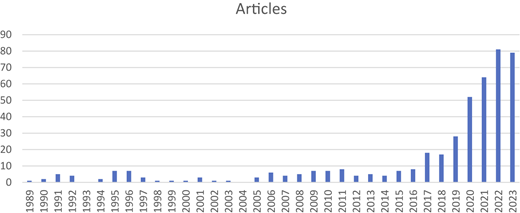
This section highlights the temporal evolution of scientific production on AI and the accounting profession, which is crucial for understanding the progressive maturation of this interdisciplinary field of research and identifying the key periods of emergence of this theme. Figure 1 illustrates the publication trends in accounting and AI over 34 years, from 1989 to 2022. The graph reveals two distinct phases of research output. The first phase, spanning 1989 to approximately 2010, showed a relatively stable publication rate with a gradual upward trend.
The evolution of the number of published articles, as shown in Figure 1, depicts a radical transformation in the research landscape, which has accelerated dramatically over the last decade. Initially, from 1989 until the mid-2010s, scientific production was modest and fluctuating, reflecting the emergence of pioneering but niche disciplines such as “expert systems.” The first inflection appears around 2016, where a more sustained growth testifies to the rise of data analysis techniques, such as “Data Mining”. However, the real explosion occurred in 2019, with exponential growth peaking in the most recent years. This unprecedented surge directly coincides with the rise of AI and ML, which have established themselves as the central themes and primary engines of research, eclipsing previous approaches and redefining the field's priorities.
4.1.3 Most impactful sources
This section presents an analysis of the influence and impact of the main scientific journals in the field of AI applied to accounting, which is of extreme importance to identify academic reference sources and understand the prioritization of scientific contributions in this emerging research field. Table 3 presents the bibliometric indicators for eight prominent journals in the fields of AI and accounting, each with an h-index of 5 or higher. The choice of the index threshold for the most impactful authors or the most relevant sources makes it possible to select those with the most significant impact on the intersection between AI and accounting. The analysis of the data shows that below these thresholds, the number of sources and authors increases exponentially, making the visualization and interpretation of the results illegible and less discriminative. By setting these thresholds, we isolate the “major influencers” of the field, thus offering a natural boundary between sources with a strong influence and those whose impact is more diffuse or emerging.
Table 3 lists the h-index values for each journal, along with their total citations (TC), number of publications (NP) and publication year (PY). This overview highlights the influence and research output of these journals in the relevant subject areas. The h-index (Hirsch, 2005), g-index (Egghe, 2006) and m-index (Bornmann, Mutz, & Daniel, 2008) are valuable bibliometric indicators for assessing the contributions of scholarly works by journals and individual authors. While the h-index reflects both the quantity and quality of citations, indicating researchers' productivity, the g-index emphasizes the most cited works. Meanwhile, the m-index adjusts for the stage of a researcher's career, allowing a fair comparison among scholars at different points in their professional journeys.
The choice of the h-index threshold ≥5 makes it possible to clearly distinguish the eight truly exceptional journals from the other journals published in the AI and accounting themes, thus creating a natural and objective boundary between the sources with major impact and those with more moderate influence.
The analysis of the eight sources whose h-index is greater than or equal to 5 reveals a coherent editorial structure around three complementary poles. The first pole, embodied by Expert Systems with Applications (h-index 22, 51 articles since 1991), concentrates on the empirical applications of AI to critical financial problems, particularly the detection of fraud by data mining (Kirkos et al., 2007), and establishes itself as the essential reference of the field by its volume and age. The second cluster brings together journals at the interface between accounting information systems and digital transformation: the Journal of Emerging Technologies in Accounting (h-index 11) and the International Journal of Accounting Information Systems (h-index 10) illustrate how literature has gradually integrated continuous auditing, blockchain and generative AI. A third, more specialized pole, brings together journals such as Intelligent Systems in Accounting Finance & Management and the Managerial Auditing Journal, which respectively deepen the automatic processing of natural language and the tools for practical risk detection. This tripartition reflects the growing maturity of the field: from an experimental phase dominated by expert systems, the field has evolved toward the institutionalization of research in accounting AI in dedicated journals.
4.1.4 The most impactful authors
The identification of the most impactful authors in the field of AI applied to the accounting profession is of extreme importance to map the major scientific contributions and recognize the academic reference figures who have shaped the evolution of this interdisciplinary field of research. Table 4 showcases the five most influential authors in AI and accounting, ranked according to their h-index, total citations (TC) and number of publications (NP). These metrics provide important insights into the research impact and productivity of these prominent scholars, highlighting their significant contributions to the field.
The profiles of the most influential authors reveal an intellectual architecture in three generations. The first generation, led by Vasarhelyi Miklos A. (h-index 5, 356 citations), laid the conceptual foundations for automated auditing in the 2010s, defining the theoretical contours of the field (Issa, Sun, & Vasarhelyi, 2016). A second generation of authors, such as Sun Ting and Hussainey Khaled, have operationalized these theories by empirically demonstrating the superiority of ML over traditional statistical methods in accounting estimates (Ding et al., 2020) and by anchoring technological auditing in global crisis contexts (Albitar, Gerged, Kikhia, & Hussainey, 2021). Finally, an emerging third wave, represented by the Sattarov-Borth-Schreyer trio, explores the current boundaries of the field with synthetic data generation models (Sattarov, Schreyer, & Borth, 2023), answering the fundamental dilemma between the usefulness of data for training algorithms and the confidentiality of financial information. This generational evolution confirms the trajectory identified in our conceptual model, from an observation paradigm to a risk anticipation and management paradigm.
4.2 The conceptual structure
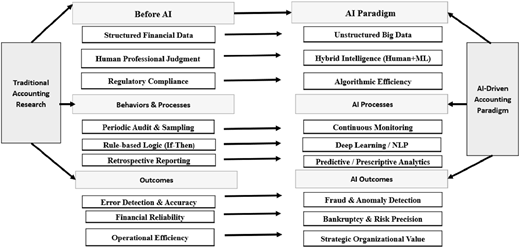
The performance analysis conducted in Section 4.1 (identification of the driving forces, founding authors, and thematic clusters) does not constitute an end in itself; it provides the empirical materials from which the conceptual model presented in Figure 7 is built. Thus, the dominance of ML and neural networks in the motor themes (Section 4.2.3) reflects the methodological transition from determinism to adaptive intelligence, which is modeled in the third break of the model. Likewise, the emergence of the “Big Data” theme in a specialized niche (Section 4.2.3) corresponds to the first rupture of the model (transition from structured to unstructured data). This deliberate distinction between the empirical results and the theoretical model is maintained throughout the following sections.
4.2.1 Topic trends
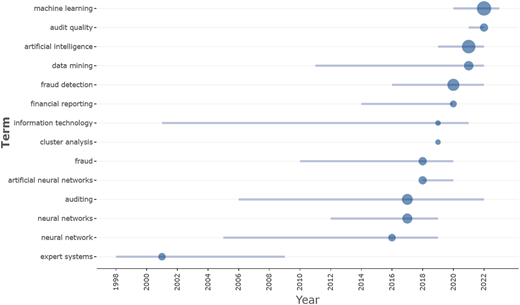
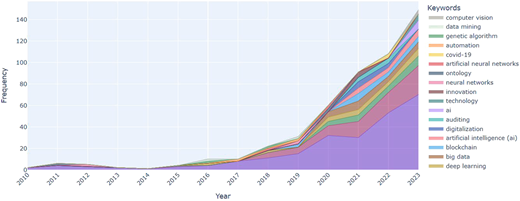
The analysis of the temporal evolution of keywords establishes a fundamental element of bibliometric study, enabling the mapping of intellectual dynamics and the emergence of concepts in the field of AI applied to accounting. This quantitative approach to scientific production offers a unique perspective on the transformation of research paradigms over time, as illustrated in Figure 2.
Examining the development of specific AI-related accounting topics reveals how various fields are emerging and expanding. Key issues addressed include ML, deep learning, combating financial fraud, accounting practices and forecasting. There has also been a notable increase in the practical application of AI, particularly with the adoption of techniques like text and data mining. From 1998 to 2023, these areas have progressed as accounting practices have integrated modern technology. The evolution of these topics over time highlights advancements in technologies that are becoming more effective like AI solutions and extending their applicability within the accounting sector.
4.2.2 Co-citation network
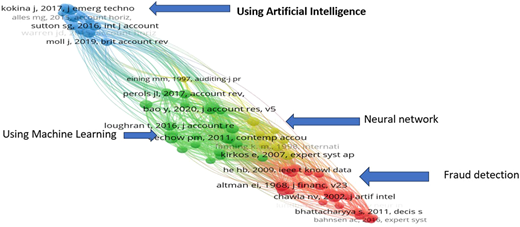
The analysis of the co-occurrence networks of references, facilitated by specialized bibliometric tools such as VOSviewer, provides a clear picture of the thematic evolution and identifies emerging trends. This bibliometric method reveals how the fundamental concepts have evolved from the first expert systems (2000) to more sophisticated technologies such as ML and fraud detection (2020–2022).
The co-citation network illustrated in Figure 3 examines the citation relationships among various authors and their papers, focusing on specific areas of interest such as AI, neural networks, ML, fraud detection and auditing. The connections between these references demonstrate the interconnectedness of research in these fields, highlighting how one study influences another within the realm of accounting and AI.
4.2.3 Thematic map
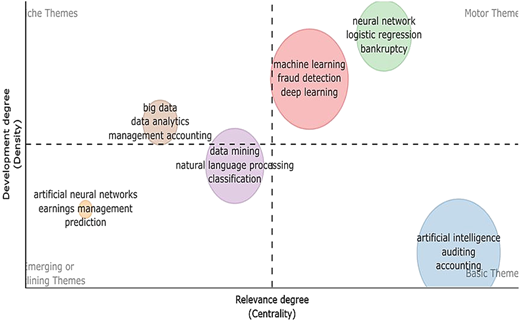
Thematic mapping uses keyword co-occurrence networks to depict the structure of research activities (Callon, Courtial, & Laville, 1991). The x-axis represents the importance of themes within the literature (centrality), while the y-axis indicates the development level of these themes (density). As a result, the thematic map is divided into four quadrants. In the upper right quadrant, we find “Motor Themes,” which are well-established and widely prevalent, exhibiting both high centrality and high density. “Basic Themes” occupy the lower right quadrant; these areas may currently hold low importance but are gradually developing, characterized by high centrality and low density. The upper left quadrant contains “Niche Themes,” which represent specialized and clearly defined areas of study with limited connections, resulting in low centrality but high density. Lastly, the lower left quadrant depicts “Emerging or Marginal Themes,” which are in the early stages of development or situated on the fringes of research activities – areas with both low centrality and low density that show growth potential. This mapping provides a comprehensive overview of the research domain, highlighting established themes alongside foundational, core and newly emerging topics, as depicted in Figure 4.
4.2.3.1 Basic themes cluster: artificial intelligence
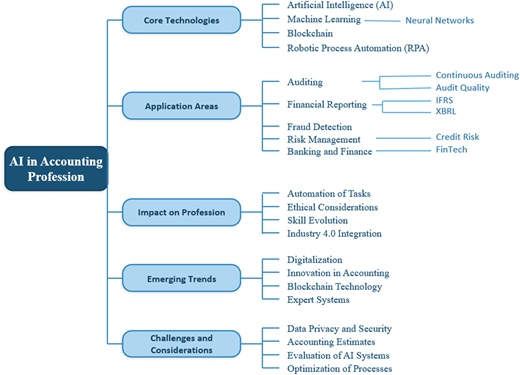
This cluster demonstrates that AI is more than just a tool in accounting; it represents a transformative movement within the field. It impacts various aspects of work, including basic tasks, and needs the development of new skills for accountants while presenting both challenges and opportunities. Furthermore, it suggests that the integration of AI in accounting is interconnected with other trends, such as blockchain technology, and aligns with broader movements toward digitalization and Industry 4.0, as illustrated in Figure 5.
Integration of AI in accounting is rapidly transforming auditing and financial reporting practices. In the realm of auditing, AI-driven automation enhances tasks related to data analysis and risk assessment, as noted by Kokina and Davenport (2017) and Hardy and Laslett (2015). While these technologies streamline processes, they also raise ethical concerns and potential biases within AI systems. AI's influence on financial reporting is evident from the work of Türegün (2019) and Ding et al. (2020), which highlights how ML and blockchain technologies improve the accuracy of ledger information. However, the emerging challenges outlined by Munoko et al. (2020) underscore the need for effective principles and practices when implementing AI in auditing. Ye and Johnson (1995) further emphasize the importance of interpretability and explainability to foster trust among users.
4.2.3.2 Motor themes cluster: machine learning
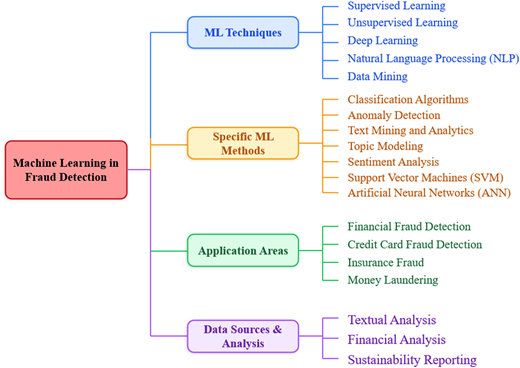
This cluster highlights the challenges associated with applying ML in fraud detection, exploring various ML approaches tailored to different types of fraud and the data-related obstacles that come with them. It also indicates that increasingly sophisticated methods are being developed, underscoring the ongoing progress in this field, as shown in Figure 6.
The integration of ML in accounting has profoundly transformed auditing and financial control practices. Its ability to recognize recurring patterns in large data sets makes it a particularly effective tool against financial fraud, as demonstrated by the work of Ngai et al. (2011) and Kirkos et al. (2007), whose algorithms, decision trees, neural networks and Bayesian networks surpass traditional statistical methods. This effectiveness extends to credit risk assessment and insurance fraud detection. Sinha and Zhao (2008) value the integration of business knowledge in data mining classifiers, Viaene, Derrig, Baesens and Dedene (2002) demonstrate the contribution of Bayesian networks in the analysis of automobile claims, while Aslam, Hunjra, Ftiti, Louhichi and Shams (2022) mobilize deep learning and text mining techniques based on Latent Dirichlet Allocation (LDA) to refine their detection. Beyond numerical data, ML also invests in narrative sources. Brown et al., 2020 exploit Bayesian thematic modeling to detect manipulations in 10-K reports, and Chen (2016) identifies linguistic markers of fraud in financial documents, thus signaling the transition from observational accounting to predictive accounting, integrating structured and unstructured data.
4.2.3.3 Motor themes cluster: neural network
The “neural networks” cluster constitutes a mature and central research stream, dedicated to the application of AI for the prediction of financial risks and the detection of accounting anomalies. The founding idea that unites these works is that neural networks, thanks to their ability to model complex nonlinear relationships, surpass traditional statistical models in the anticipation of critical events. This field is largely dominated by the prediction of financial distress and bankruptcies, as illustrated by the reference article by Chen and Du (2009), which established a reference methodology. This approach has been validated and extended in various contexts, notably by McKee (2003), who compared the performance of these models to that of the auditors, and by Jiang and Jones (2018), who adapted these techniques to the Chinese market, demonstrating their relevance on a global scale. Beyond the simple prediction of bankruptcy, the versatility of this approach is manifested in its application to other forms of risk. Hájek (2011) thus used neural networks to model the credit rating of municipalities, proving their effectiveness in the public sector, while Ragothaman and Lavin (2008) on restatements of results and Abdou, Ellelly, Elamer, Hussainey and Yazdifar (2021) on results management show that neural networks are able to identify subtle configurations associated with financial manipulations. This cluster also highlights the ability of neural networks to integrate various sources of information. Boritz, Kennedy and Albuquerque (1995) illustrate this trend by demonstrating that the combination of accounting information and market data significantly improves the accuracy of predictions, an adaptability confirmed by the recent work of Bernardi et al. (2021), which simulated the impact of the COVID-19 crisis on the financial health of companies.
4.2.3.4 Emerging themes cluster
AI is transforming accounting and finance, enabling the integration of advanced technologies that go beyond traditional financial analysis and forecasting. AI has proven particularly valuable in improving decision-making, especially in predicting irregularities such as financial distress and bankruptcy, as well as refining investment strategies. However, addressing biases and limitations in AI models is crucial, requiring careful design, validation and interpretation. Chen and Du (2009) highlight the role of artificial neural networks (ANN) and data mining in enhancing financial distress prediction models, showing that AI can outperform traditional metrics in this area.
McKee (2003) employs rough set models to predict bankruptcy and analyze auditors' signaling rates, highlighting the potential of rough sets in identifying struggling companies. Hájek (2011) demonstrates the use of neural networks to predict credit ratings for US municipalities with high accuracy. Berg (2007) shows that generalized additive models (GAMs) outperform older methods in predicting bankruptcy, while Bose and Pal (2006) argue that neural networks excel in forecasting the outcomes of dot-com firms. Recent research by Berg further confirms that GAMs offer better bankruptcy prediction compared to traditional techniques. However, Bose and Pal emphasize the superiority of neural networks in predicting earnings for dot-com companies. AI systems have also enhanced valuation models and other investment decision-making processes. Stehel, Horák and Vochozka (2019) applied Kohonen networks to forecast agricultural output, while Vochozka and Machová (2017) used ANN to evaluate key value drivers in construction companies. Peat and Jones (2012) demonstrate that neural network models are effective in predicting a company's likelihood of insolvency. Similarly, Biscontri (2012) discusses the use of radial basis function cells for earnings forecasts, alongside the application of neural networks in financial forecasting.
4.2.3.5 Niche theme: big data
The emergence of big data has profoundly transformed the accounting and auditing professions, by introducing data analysis tools (Data Analytics) and ML (Machine Learning) at the heart of processes. This research cluster highlights the way in which these technologies are exploited to improve the quality and efficiency of missions. Current studies are actively exploring the application of predictive analytics for tasks as varied as the detection of fraudulent financial reports Aboud and Robinson (2022) or the prediction of auditor changes (Hunt, Hunt, Richardson, & Rosser, 2022). Specific techniques such as the mining process are also integrated to optimize financial statement audits (Werner, Wiese, & Maas, 2021). Beyond practical applications, the research is interested in the theoretical frameworks that govern the adoption of these innovations, based for example on the Gartner maturity curve (O'Leary, 2009) or by analyzing the obstacles and drivers to the adoption of advanced data analytics in auditing (Krieger, Drews, & Velte, 2021). The global impact of this technological convergence on the accounting profession is also a central topic (Ibrahim, Elamer, & Ezat, 2021), especially with regard to the influence of these new analyses on auditors' decisions (Brazel, Ehimwenma, & Koreff, 2022).
4.2.4 Conceptual model of the transformation of accounting research by artificial intelligence (1989–2023)
Figure 7 illustrates the fundamental transition taking place within accounting research and practice, opposing the historical traditional approach (“Before AI”) to the new paradigm driven by AI (“AI-Driven Accounting Paradigm”). This structural mutation is analyzed through three interdependent dimensions, namely the antecedents, the processes and the results. This conceptual model is of a mixed nature: it is both explanatory, in that it organizes and theorizes the breaks documented empirically in the literature, and normative, in that it draws the trajectories that accounting research and practice should take to integrate AI in a responsible and value-creating way. This model is anchored in three complementary theoretical frameworks from accounting and audit literature. First, the decision usefulness theory, developed by Beaver (1968) and Demski (1976), postulates that accounting information has value only insofar as it helps decision-makers to form expectations and reduce their uncertainty. The breaks 1 and 4 of the model, transition from structured data to unstructured data and from retrospection to strategic anticipation – are directly in line with this logic: AI amplifies the decision-making utility of accounting information by making it prospective and multidimensional. Secondly, the insurance theory, as formalized by Wallace (2004) and revisited in the digital context by Power and Power (1999), states that the value of the audit lies in its ability to reduce the information risk for stakeholders. The break 2 of the model, illustrated by the transition from periodic audit to continuous audit, operationalizes this theory in the context of AI. By allowing real-time monitoring of all financial transactions (Hardy & Laslett, 2015), AI maximizes the reduction of the informational risk targeted by insurance theory. Moreover, work on professional judgment in auditing (Samiolo, Spence, & Toh, 2024; Lehner et al., 2022) highlights the constitutive tension between human expertise and algorithmic decision support. The third break in the model, from logical determinism to deep learning, questions precisely the way in which adaptive algorithms can support, complement or, in some cases, supplement the professional judgment of the auditor. The conceptual model does not consider this tension as resolved: it poses it as the central issue of the next decade of research in accounting AI.
4.2.4.1 The transition from structured data to unstructured data via AI
The evolution of accounting research, as illustrated by the literature from 1990 to 2024, highlights a major transition in accounting evidence. Traditionally, the discipline was based exclusively on structured data (balance sheets, income statements, financial ratios), often analyzed retrospectively to verify compliance (Vasarhelyi & Halper, 1991). The introduction of AI has transformed this paradigm by allowing the exploitation of unstructured data (Big Data). This link, identified as the “Data Source” in our model, is broken down into three key points.
From numbers to text (NLP): Modern research uses NLP to analyze annual reports and executive speeches. Unlike numbers alone, textual analysis makes it possible to detect feelings or concealments that structured data do not reveal (Goel & Uzuner, 2016; Fisher, Garnsey, & Hughes, 2016).
The integration of big data: The audit is no longer limited to the sampling of internal transactions. AI models now integrate massive external data (social networks, economic news) to offer a 360° view of corporate risks (Appelbaum et al., 2017; Appelbaum et al., 2017).
Predictive accuracy: By combining structured and unstructured data, deep learning algorithms manage to predict bankruptcies and frauds with much greater accuracy than conventional statistical methods. We thus move from an “observation” accounting to a “predictive” accounting (Cho et al., 2020; Kanapickienė et al., 2023).
4.2.4.2 From periodic audit to continuous audit
The second major connection identified in the literature concerns the temporality of the control. Traditionally, the audit is perceived as a “snapshot” (snapshot) taken at fixed intervals, usually once a year or quarterly. This classic paradigm is based on manual sampling, which limits the detection capacity to errors present in the data selected a posteriori.
The emergence of AI and expert systems has enabled the transition to continuous auditing (CA). This transition from periodical to continuous, documented as early as the 90s by the pioneering work of Vasarhelyi and Halper (1991), radically transforms the function of the auditor.
Real-time monitoring: Unlike the traditional audit which takes place months after closing, AI allows 24/24 and 7/7 monitoring of financial flows. The algorithms analyze 100% of the transaction population instead of a simple sample (Hardy & Laslett, 2015).
Immediate identification of anomalies: Switching continuously allows the detection of “outliers” (outliers) at the very moment when they occur. This significantly reduces the detection time of frauds, which, in a traditional system, could remain invisible until the next annual audit mission.
Proactivity vs reactivity: As Issa et al. (2016) and Munoko et al. (2020) point out, AI is moving the cursor from simple historical verification to proactive risk management, where the auditor can intervene before a minor error becomes a major financial crisis.
4.2.4.3 From deterministic logic to deep learning (Deep Learning)
The methodological transition identified in the literature marks the transition from a “rigid” intelligence to an “adaptive” intelligence. Historically, decision support systems in accounting and auditing were based on expert systems based on rules (logic “If-Then”). These methods, although transparent, had two major flaws: they were unable to process complex nonlinear relationships and were easily circumvented by fraudsters knowing the thresholds for triggering alerts.
The evolution toward neural networks and deep learning is transforming this approach.
Complex pattern recognition: Contrary to human-defined rules, neural networks learn directly from data. They excel in “pattern recognition” (pattern recognition), identifying subtle correlations between thousands of variables that a human auditor could not link (Koskivaara, 2000).
Sophisticated fraud detection: Recent literature shows that intelligent methods are particularly effective in detecting financial statement fraud. Where a classic rule fails because fraud is “made up” to appear normal, ML models detect deep structural anomalies (Perols, 2011).
Adaptability: As highlighted by the work of Hilal et al. (2022) and Schreyer, Sattarov, Gierbl, Reimer, and Borth (2021) present in your bibliography, these models do not just apply instructions; they refine as they process new data, making internal control systems much more resilient to new accounting manipulation techniques.
4.2.4.4 From historical retrospection to strategic anticipation
This connection illustrates one of the most profound paradigm shifts: the transition from an “observation” accounting to a “predictive” accounting. Traditionally, accounting and auditing are retrospective. Their role is to report and certify what has already happened (the past), often acting as a form of financial autopsy of concluded transactions. The integration of AI moves the cursor to the future thanks to predictive analytics.
Anticipating defaults: Recent literature, particularly the work of Ding et al. (2020), demonstrates that AI is no longer content with checking past creditworthiness, but uses hybrid data (financial and non-financial) to predict bankruptcies with unprecedented precision long before they occur.
Real-time risk modeling: Motie and Raahemi (2024), in their systematic review of 33 studies, show that graphical neural networks (GNNs) surpass traditional methods by detecting complex fraudulent configurations in financial transactions that conventional rules cannot identify. These models learn from historical data to project future risk trajectories, allowing early intervention before anomalies become major crises.
Evolution of the professional role: This change radically transforms the function of the accountant and the auditor. They are no longer simple “historians” of figures but become “strategic advisers”. Their added value no longer lies in validating the past, but in providing forward-looking insights to secure the sustainability of the organization.
4.2.4.5 From accounting accuracy to the fight against financial cyber-crime
This connection highlights a shift in the fundamental priorities of the profession. Historically, traditional accounting and statutory auditing were mainly aimed at accuracy and reducing unintentional errors. The objective was to ensure that the financial statements were free from material misstatements due to negligence or improper application of standards. The integration of AI moves this objective toward the active tracking of malicious intentionality.
Faced with the sophistication of financial crime: As transactions become digital and complex, fraud becomes more subtle. As Hilal et al. (2022) point out, AI is now perceived as the only bulwark capable of keeping pace with high-tech financial crimes that standard human controls can no longer intercept.
The power of data mining: The work of Schreyer et al. (2021) shows that intelligent methods do not only look for discrepancies in numbers, but behavioral patterns. By analyzing millions of data, the AI detects structural anomalies that betray a deliberate manipulation of financial statements.
Deception detection: Recent literature even explores the ability of AI to analyze language (NLP) to detect deception in annual reports. The objective is no longer just to check if the accounts are “fair”, but to determine if management is trying to hide an unfavorable economic reality (Fisher et al., 2016).
4.2.5 Future research directions
To detect the different AI tools most used in literature generated with the PyBibX software In Python Library (Pereira, Basilio, & Santos, 2025), the evolution of the 15 most used keywords in literature and to see what other tools to analyze in future research axes for the analysis of the impact of AI on the profession of the accountant, as presented in Figure 8.
Advancements in AI within the accounting field should address several key areas to improve AI integration into accounting processes. First, it is crucial to recognize the importance of real-world applications by allocating resources to design and test AI models using data from accounting professionals and firms (Omoteso, Patel, & Scott, 2010). Second, after conducting in-depth research, it is essential to develop specific accounting methods for interpretable AI (XAI), ensuring that the decision-making process is transparent and understandable for AI systems. This approach will help build trust among practitioners and stakeholders.
Thirdly, the use of explainable AI (XAI) techniques should be deepened to improve the transparency of the models. Studies such as those by Fukas et al. (2022) and Müller et al. (2022) have shown how methods such as Shapley Additive Explanations (SHAP) can be used for critical applications such as fraud detection and the explanation of accounting anomalies. Fourth, Schreyer, Sattarov and Borth (2022) stressed the need to explore federated learning and other privacy preservation techniques to allow audit models to be trained on sensitive customer data without compromising confidentiality. Fifth, a new axis consists in designing and evaluating AI-enhanced conversational robots (“bots”) to automate and optimize the audit investigation process, a research avenue considered viable and promising but still little explored, as indicated by (Raschke, Saiewitz, Kachroo & Lennard, 2018). Finally, establishing clear evaluation criteria and standards for AI applications in accounting tasks is necessary, as it will guide the selection of tools and best practices within the industry. Moreover, addressing ethical concerns is a shared responsibility that must be tackled collectively. Establishing standardized measures of accountability could enhance the responsibility of decision-makers involved in developing AI tools, underscoring the need for a more refined approach to fostering responsible AI practices (Mökander & Floridi, 2021). In conclusion, combining AI advancements with emerging technologies such as blockchain, cloud services and NLP presents promising opportunities to significantly improve and transform the accounting profession (Akinbowale, Mashigo, & Zerihun, 2023).
Beyond updating the data, our thematic mapping highlights major structural ruptures completely absent from the work of Secinaro et al. (2021) and Garanina et al. (2022). On the one hand, we identify the critical emergence of explainable AI (XAI – Explainable Artificial Intelligence) (Müller et al., 2022). While previous studies on the blockchain dealt with data transparency, the XAI introduces the issue of logic transparency. In a field where professional judgment is governed by strict auditing standards, the XAI fills a fundamental practical gap: it allows the auditor to justify the conclusions generated by the algorithm, transforming the AI from a “black box” into an auditable proof. On the other hand, our analysis integrates the disruptive impact of generative models (Zhao & Wang, 2024). If the reviews of 2021 stopped at the automation of transactional tasks, our results demonstrate that we have entered the era of automation of strategic cognition. AI is no longer limited to detecting errors; it is now capable of synthesizing non-financial information and producing forward-looking advice. By mobilizing the notion of “mental revolution” suggested by Marrone and Hazelton (2019), this manuscript demonstrates that the shift in literature is not only temporal, but epistemological. We are moving from a vision of the accountant as a “register manager” (even digital) to that of a strategic architect and supervisor of cognitive ecosystems. Our study thus fills a crucial theoretical void by modeling how the convergence between human judgment and explicable algorithmic analysis redefines the very nature of the accounting mission in the era of advanced AI.
5. Conclusion
This bibliometric study underscores the significant impact of AI on accounting, especially in areas like fraud detection and financial reporting. For responsible integration, it is crucial to address existing research gaps and enhance transparency through explainable AI. Collaboration between academia and industry can yield tailored AI solutions that deliver tangible benefits in practical applications. Firstly, from the year 2019, we see an explosion exponential growth of the research linked AI and ML with accounting that peaked in the most recent years. Secondly, AI techniques such: ML, data mining, cluster analysis, ANN and expert systems are being used in today's professional accounting practices. Thirdly, we uncover unexplored niche's themes: big data, data analytics and management accounting which represent specialized and clearly defined areas of study with limited connections; as well as emerging or marginal themes: data mining, NLP, ANN and earning management prediction which show gaps for further research in accounting and AI.
In this regard and since the accounting profession has undergone a profound transformation and the skills required of accounting professionals have changed due to AI tools, accounting educators must modify the curriculum of accounting studies by integrating these tools for all the accountant's tasks and especially for the decision-making assistance.
Studies converge to identify a fundamental transformation of the required skills: while automation takes over repetitive and standardized tasks, professionals are called upon to develop analytical, strategic and decision-making skills at a higher level (Mohammad et al., 2020; Chávez-Díaz et al., 2024). This professional change raises important issues in terms of training, adaptation and repositioning of the actors in the sector.
Furthermore, creating ethical guidelines and strategies to mitigate bias is essential for fair AI implementation in accounting. Standardizing evaluation metrics, exploring the potential of emerging technologies and advancing explainable AI methods can boost both accountability and innovation. By seizing these opportunities and encouraging collaboration, the accounting profession can harness AI to increase efficiency and deliver greater value to stakeholders.
Note
Throughout this manuscript, the term “Artificial Intelligence (AI)” is used as a generic term designating all the computational techniques that simulate human cognitive abilities. “Machine Learning (ML)” refers to the subset of AI in which systems learn from data without being explicitly programmed for each task. “Deep Learning (DL)” constitutes a subset of ML based on deep neural network architectures capable of modeling nonlinear relationships of high complexity.