This study explores the effect of bank-to-CBDC disintermediation on bank earnings management and the implications for earnings quality after the issuance of a central bank digital currency (CBDC).
The study used the conceptual discourse analysis method to explore the effect of bank-to-CBDC disintermediation on bank earnings management and the implications for earnings quality after CBDC issuance.
The CBDC information reported by banks is considered decision-useful and value-relevant only if investors and investor analysts find value in using CBDC in their own economic activities. Bank managers can mitigate the adverse effect of bank-to-CBDC disintermediation on bank earnings by using accounting numbers, such as loan loss provisions (LLPs) and bank deposit rates, to manage their earnings. Accrual-based earnings management is achieved using LLPs. Real earnings management is achieved using the bank deposit rate. The consequence of earnings management is a reduction in earnings quality and financial reporting quality.
It extends the literature by showing that adverse digital currency financial flows can encourage banks to manage earnings.
It is recommended that bank supervisors should increase their scrutiny of bank LLPs estimates and limit bank managers' ability to alter the bank deposit rate in response to adverse bank-to-CBDC disintermediation.
The present study examines how CBDC adoption influences banks to undertake real earnings management using changes in bank deposit rates. This context has not been explored in the earnings management and CBDC literature.
1. Introduction
This study explores the effect of central bank digital currency (CBDC) adoption on banks' earnings management and the implications for earnings quality. The world is presently witnessing the rapid digital transformation of money (Laven, 2014). This can be seen in the rapid rise of private digital currencies, such as cryptocurrency and stablecoin, which are controlled by private actors and corporate firms. Central banks have a legal mandate to issue legal tender currency, and they do not want to be left behind in the on-going digital transformation of money. Central banks want to transform the nature of central bank money to keep-up with the on-going digital transformation of money (Auer, Cornelli, & Frost, 2023). They want to issue a digital fiat currency that is relevant for the modern digital economy. This digital fiat currency is known as a CBDC.
ACBDC is the digital equivalent of physical currency notes (Engert & Fung, 2017). It is the digital equivalent of fiat money. It is issued by a central bank, and its supply is controlled by the issuing central bank (Lee, Yan, & Wang, 2021). Once issued, it becomes a digital legal tender, which can be used as a means of exchange and in the settlement of debt. CBDC takes two forms: retail CBDC, which is used by individuals and wholesale CBDC, which is used by corporations (Hamdy, 2023; Papapaschalis, 2021).
Accounting and banking scholars are interested in CBDC because bank earnings quality and financial reporting quality are likely to be affected by bank managers' response to bank-to-CBDC disintermediation. Bank managers may have incentives to alter financial reporting to mitigate any adverse impact of bank-to-CBDC disintermediation on their banking business. The existing literature has studied the relationship between private digital currencies, crypto assets and financial reporting in accounting (Hubbard, 2023; Luo & Yu, 2024). However, there is no widespread consensus on how digital assets influence accounting choices and financial reporting. There is also no discussion on the role of CBDC in influencing the accounting choices of bank managers.
Given the importance of the banking sector to national economies, it is important to understand the effect of bank-to-CBDC disintermediation on banks' financial reporting practices, especially earnings management and the implications for bank earnings quality. The importance of this study is further reinforced by the fact that banks are highly regulated, and the impact of bank-to-CBDC disintermediation on banks is likely to be closely monitored by regulators who want banks to remain stable after CBDC issuance and widespread CBDC adoption. Accounting standard setters may watch out for distortions in financial reporting due to bank-to-CBDC disintermediation. Regulators and accounting standard setters would find this study useful in understanding how CBDC affects bank earnings quality.
This study contributes to the existing literature in several ways. The major contribution of this study to the literature is that it extends previous works that examine the use of LLPs for earnings management (e.g. Ozili, 2023). The present study extends this literature by examining how CBDC adoption might influence banks to undertake real earnings management using changes in bank deposit rates. Two, the study contributes to the literature by examining how CBDC might affect banks' earnings quality. It is argued that bank-to-CBDC disintermediation could reduce banks' access to cheap deposit funding, which can adversely affect bank lending and bank earnings. Banks can mitigate this effect by manipulating accounting numbers to protect their earnings from being affected by adverse bank-to-CBDC disintermediation. Three, this study extends prior research on the relationship between private digital currencies and accounting choices (e.g. Barth, 2022; Luo & Yu, 2024; Hubbard, 2023). This study identifies several choices that bank managers can make in response to the disruptive effect of bank-to-CBDC disintermediation on banking business. Four, the study contributes to the literature that examines the determinants of bank earnings quality (e.g. Roychowdhury, 2006; Dechow, Ge, & Schrand, 2010). Examining how bank-to-CBDC disintermediation affects bank earnings quality provides a good paradigm to understand the impact of CBDC on bank accounting practices and bank earnings quality.
Regarding methodology, the method used to develop this conceptual study is the conceptual discourse analysis method (CDAM) which involves reviewing the CBDC literature and the earnings management literature to identify contexts encouraging accrual and real earnings management, identify the principles, theories, patterns or assumptions used to establish causation and using these insights to develop a coherent linkage between the bank managers' actions and bank earnings management in a CBDC environment. The CDAM is used as the basis for selecting the literature used to support the proposed relationships.
The rest of the study is structured as follows. Section 2 presents some theoretical perspectives on the link between CBDC, bank managerial discretion and earnings management, as well as the literature review. Section 3 provides a conceptual framework on how CBDC is used by bank customers in the banking sector. Section 4 presents the accounting for CBDC. This section offers insights into the accounting standard for CBDC as well as the value relevance of CBDC. Section 5 discusses the link between bank managerial discretion and bank-to-CBDC disintermediation. It also explores real-versus-accrual earnings management in response to bank-to-CBDC disintermediation. It further explores some accounting numbers used to engage in earnings management. Section 6 presents the implications for earnings quality and financial reporting quality. The conclusion of the study is presented in section 7.
2. Theory and literature review
2.1 Theory
The discussion in the article is anchored on two theories: the network theory and the positive accounting theory. The network theory states that the potency of a blockchain innovation (e.g. CBDC or cryptocurrencies) increases through a network effect as more users adopt the blockchain innovation or as more users join the blockchain network (Liu, Tsyvinski, & Wu, 2022). Network theory proposes the idea that the value of a blockchain innovation increases when more users use the blockchain innovation (Rochet & Tirole, 2003; Armstrong, 2006). This proposition is supported by Cong, Li, Tang, and Yang (2021) and Sockin and Xiong (2020), who emphasize that the value of private digital currencies depends on user adoption and the network effect. The implication of the network theory for CBDC is that a CBDC must be adopted for it to gain any value, and the success and valuation of CBDC are strongly linked to its current and future user base.
On the other hand, positive accounting theory attempts to explain the reason why managers influence the size of reported earnings. Positive accounting theory states that the accounting information generated by a firm depends on the choice of accounting methods used to generate that information, which in turn depends on the explicit compensation contracts given to firm managers to achieve a good positive performance (Watts & Zimmerman, 1978). The theory argues that the explicit contracts given to firm managers motivate them to use specific accounting methods/techniques to manage reported earnings to meet financial reporting objectives that depend on the reported earnings number (Watts & Zimmerman, 1986). The implication is that the accounting information generated by management in financial reporting reflects several factors that were taken into consideration when generating financial reports, such as how resources are allocated, management compensation, regulatory requirements, debt covenant restrictions, financing decisions, investment decisions and other considerations (White, Sondhi, & Fried, 2003). This implies that the reported earnings in the financial report of firms reflect both accounting and non-accounting decisions of managers. The implication of positive accounting theory for this study is that firm managers can use specific accounting techniques and choices to mitigate the adverse impact of bank-to-CBDC disintermediation on bank reported earnings.
2.2 Relevant literature
Foundational studies, such as those by Dechow et al. (2010), synthesize over two decades of research to define earnings quality. They define earnings quality as a context-dependent concept that reflects the ability of earnings to accurately represent a firm's fundamental performance. Their review categorizes earnings quality proxies into properties of earnings, investor responsiveness and external indicators, while outlining how determinants like firm characteristics influence firm outcomes such as the cost of capital. Roychowdhury (2006) examines the extent to which firm managers engage in earnings management by manipulating real activities. The author finds that managers manipulate real activities to avoid reporting annual losses. Managers manipulate real activities by offering price discounts to temporarily increase sales, undertaking overproduction to report lower cost of goods sold and deliberately reducing discretionary expenditures to improve reported margins, which reduces earnings quality.
The banking literature suggests that loan loss provisions (LLPs) may be used to manage earnings. This is documented in studies such as Kanagaretnam et al. (2004) investigate whether bank managers use their discretion in estimating LLPs to reduce earnings variability. They find that bank managers use their discretion to influence LLPs to reduce earnings volatility, and bank managers' decisions to reduce earnings variability are related to the need for external financing. Haq, Ongena, Pu, and Tan (2024) investigate the impact of dividend policy on earnings quality and opportunistic earnings management in 45 individual banks across 45 developed and developing countries between 1996 and 2019. They find that high dividend payouts reduce earnings management and mitigate agency problems, and the effect is persistent in well-capitalised and non-listed banks.
Other studies explore the accounting for digital currencies. Digital currencies, in this context, include the universe of cryptocurrencies, blockchain, stablecoins, crypto assets and CBDC. Barth (2022) emphasizes that there is a need to broaden accounting reports to accommodate digital assets, digital currencies and other new innovations. Yu, Lin, and Tang (2018) examine the potential role of blockchain technology in financial accounting. They argue that, in the short term, firms could use public blockchain as a platform to voluntarily disclose information, while, in the long run, firms could use blockchain technology to reduce earnings management and manipulation to increase accounting information quality. In a different study, Luo and Yu (2024) show that US firms recognize digital currencies, particularly cryptocurrencies, using different accounting standards such as IFRS and GAAP, and some firms recognize cryptocurrencies as long-term intangibles, while other firms recognize cryptocurrencies as liquid, short-term assets. In contrast, Hubbard (2023) argues that the most appropriate financial accounting treatment for cryptocurrencies is to recognise cryptocurrencies as an intangible asset so that they can be valued accurately at a fair value price.
Alsalmi, Ullah, and Rafique (2023) investigate some issues surrounding the classification of digital currencies, particularly central bank digital currencies (CBDCs) and privately issued cryptocurrencies such as Bitcoin. They show that current accounting standards do not precisely cover the accounting treatment of digital currencies, and there is a need for an accounting standard to provide guidance on the identification, classification, measurement and presentation of digital currencies. Brandon, Holt, Jones, Long, and Stanley (2024) show that accounting standard setters, such as the Financial Accounting Standards Board (FASB), have recently released financial reporting guidelines for cryptocurrencies, which aim to offer guidance on the reporting of digital currencies. However, scholars such as Tan and Low (2017) insist that there should be no accounting treatment for digital currencies because digital currencies, such as Bitcoin, are not intended to become a financial reporting currency, but they are meant to only complement fiat money.
Another strand of CBDC literature examines the effect of CBDC on financial stability. Brunnermeier et al. (2019) argue that digital currencies can cause an upheaval of the international monetary system, while CBDC ensures that public money remains a relevant unit of account in the era of the digitalisation of money. Whited, Wu, and Xiao (2022) attempt to quantify the impact of a CBDC on the banking system. They show that a one-dollar introduction of CBDC replaces bank deposits by around 80 cents on the margin, while bank lending falls by one-fourth of the drop in deposits because banks partially replace lost deposits with wholesale funding. This substitution raises banks' interest-rate risk exposure and lowers their resilience to negative equity shocks, thereby increasing bank fragility.
3. CBDC in banking
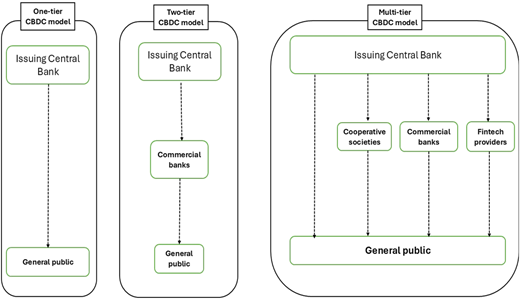
When a central bank issues a retail CBDC, the retail CBDC is distributed to end users in three ways using either a one-tier CBDC model, a two-tier CBDC model or a multi-tier CBDC model, as shown in Figure 1. In a one-tier (direct) CBDC model, the central bank delivers the CBDC directly to the user. The central bank performs all the tasks involved, from issuing and distributing the CBDC to the account-based or token-based CBDC wallet of the user (Athanassiou, 2020; Miernicki, 2023). This model is common with wholesale CBDC, where the central bank issues CBDC directly to firms such as financial institutions and non-financial institutions (Athanassiou, 2020).
In a two-tier CBDC model, the central bank delivers the CBDC directly to an intermediary such as a financial institution, which then distributes the CBDC to the end user. Under this model, the central bank only issues and redeems the CBDC, but the central bank is not involved in the distribution of the CBDC to end users. This model is common with retail CBDC, where the central bank issues the CBDC and delivers it into a specially created CBDC account of the intermediary, which is usually a bank (Wenker, 2022). The bank then opens a CBDC account for CBDC users and credits the user's CBDC wallet with the amount of CBDC requested (Hayashi & Toh, 2022; Wenker, 2022). The third model is the multi-tier CBDC model where the central bank issues and redeems CBDC, but distribution and payment services would be delegated to many private sector agents who can deliver the CBDC to end users.
The choice of which CBDC model to adopt in a country depends on each country's unique circumstances, such as the size of the financial sector, people's willingness to adopt and use CBDC, financial integrity standards, anti-money laundering standards, efficiency of the digital payment system and the supervisory capacity of regulators. The two-tier CBDC distribution model is the most widely adopted CBDC distribution model in countries that have already issued a CBDC, such as Nigeria, the Bahamas and Jamaica.
Once a CBDC deposit is in the wallet of the user, the user can undertake only three activities, which are to (1) make a CBDC payment to another party, (2) receive CBDC inflow from someone or (3) the user exchanges CBDC for cash or bank deposit. When a person makes CBDC payments to another CBDC user, the transaction has no adverse effect on banks. Likewise, when a person receives CBDC inflow from another CBDC user, the transaction has no adverse effect on banks. However, if a bank customer chooses to convert some or all of their bank deposit to CBDC deposits, such a transaction would lead to movement in funds from the commercial banking system to the central banking system, leading to a reduction in deposit funding in the commercial banking system.
4. Accounting for CBDC
This section presents the accounting for CBDC. It offers insights into the accounting standard for CBDC as well as insights into the value relevance of CBDC.
4.1 The accounting standard for CBDC
At the time of writing [1] there is no standardized accounting framework that generates measurements for the valuation of CBDC. The absence of such an accounting framework poses a challenge for investors who want to determine the intrinsic value of CBDC in financial statements. However, if CBDCs are delivered on a private or public (permission or permissionless) blockchain, it can provide rich information that may be used to determine the value of CBDC because blockchain can make CBDC information easily available, timely and understandable to regulators and verifiable by investors since information about the underlying economic activities is available privately and continuously on the blockchain (Wang, Ma, & Ren, 2022). These properties of blockchain data resonate with the Financial Accounting Standards Board (FASB)'s financial reporting conceptual framework, which emphasizes that financial information should be accessible, useful, relevant and faithfully represent what it purports to represent. Also, the usefulness of financial information can be improved if it is comparable, verifiable, timely and understandable (Schipper & Vincent, 2003). Since there is no generally accepted accounting principles (GAAP) or International Financial Reporting Standards (IFRS) for the accounting of CBDC, banks and non-financial firms have the freedom to make judgments and determine the accounting treatment that is relevant for CBDC. However, it is expected that banks may apply the same accounting treatment for currency notes to CBDC since CBDC is also a currency in digital form. This means that CBDC may be recognized under current assets in the balance sheet of banks.
4.2 Value relevance of CBDC
The value of a CBDC increases when there is widespread use of CBDC by the population, including firms. The widespread use of CBDC can lead to significant bank-to-CBDC disintermediation in the balance sheet of banks (Ozili, 2022). As more individuals and firms use CBDCs, investors and investor analysts may also use CBDCs. The utility or value that investors and investor analysts might gain from using CBDC lies in what they can use CBDC to do, such as for payments, settlement of debt, purchase equity stocks or for investment purposes (Chuen & Teo, 2021). If investors and investor analysts derive value from using CBDC in their own economic activities, they may react positively to positive CBDC information released by banks in their financial reports. In other words, if investors or investor analysts react to banks' release of information about CBDC, then it means that the disclosed CBDC information is value-relevant to investors and investor analysts. This implies that the value relevance of CBDC is determined by (1) the perceived utility of CBDC to investors and investor analysts, and (2) the type of CBDC information released by banks in their financial reports. Other factors that may be taken into account when determining the value relevance of CBDC information include the size of banks' CBDC holdings and the volume of CBDC transactions in banks.
5. Bank-to-CBDC disintermediation and earnings management
This section discusses the relationship between bank-to-CBDC disintermediation and bank managerial discretion. It also explores real-versus-accrual earnings management in response to bank-to-CBDC disintermediation. It further explores some accounting numbers used to engage in earnings management.
5.1 Bank-to-CBDC disintermediation and bank managerial discretion
In a two-tier CBDC model, CBDC activity in the bank balance sheet arises from two main sources. The first source of CBDC activity is when bank customers make payments using CBDC or when they receive income or inflows in the form of CBDC. The second source of CBDC activity is when bank customers convert their bank deposit to a CBDC deposit and when they convert their CBDC deposit to bank deposits (Ozili, 2023). Bank managers have stronger incentives to respond to the second source of CBDC activity than the first source of CBDC activity. This is because monetary policy decisions, such as increasing the remuneration on interest-bearing CBDC, can lead to “bank-to-CBDC disintermediation” – a term used to describe the migration of bank deposits to CBDC deposits (Whited et al., 2022). If central banks increase the interest rate on interest-bearing CBDC, bank depositors may want to benefit from the favourable interest rate on CBDC deposits. Therefore, bank depositors may have incentives to transfer some bank deposits to the central bank in the form of CBDC deposits into their token-based or account-based CBDC wallet (Ozili, 2023). Significant migration of bank deposits to CBDC deposits is worrisome to bank managers, especially when there are no regulatory price and quantity limits on bank-to-CBDC deposit migration. Bank managers may be concerned that the migration of bank deposits to CBDC deposits can decrease the size of cheap deposit funding available to banks, and it may expose banks to funding and liquidity risks, which can adversely affect bank earnings (Bindseil, 2019). Bank managers may be motivated to make certain accounting choices to protect bank earnings from the adverse impact of the migration of bank deposits to CBDC deposits.
5.2 Bank-to-CBDC disintermediation and accrual-based versus real-based earnings management
In the previous section, it was argued that the migration of bank deposits to CBDC deposits might decrease the size of cheap deposit funding available to banks (Whited et al., 2022). It may lead banks to seek external financing, which is costly, and the high cost of funding can deplete bank earnings (Bindseil, 2019). Bank managers can mitigate this by managing their earnings using either accrual-based earnings management strategies or real-based earnings management strategies. Regarding accrual-based earnings management, bank managers have incentives to understate or decrease the size of specific accrual numbers, such as LLPs, in order to boost earnings (Mnif & Slimi, 2024). The decrease in LLP estimate may increase bank interest margin and increase bank overall earnings. This is a strategy to offset the adverse effect of high funding cost on banks' reported earnings due to bank-to-CBDC disintermediation (Ozili, 2023). Regarding real-based earnings management, banks can also mitigate the depletion of bank earnings by using real strategies such as raising the interest rate on bank deposits. Bank managers have incentives to increase the interest rate on bank deposits to encourage bank depositors to keep their deposits with banks instead of moving them to CBDC deposits. This is a real earnings management strategy because raising interest rates on bank deposits is a reward to bank depositors and an expense to banks, and it is disguised as normal bank operations, thereby making it difficult for auditors to detect.
5.2.1 Accrual earnings management using loan loss provision in a CBDC environment
LLP is a major accrual that banks set aside to cover expected loan losses in their loan portfolio (Mahieux, Sapra, & Zhang, 2023). LLP estimates are commonly used to signal expected loan loss or credit risk. However, research shows that LLPs can also be used for other purposes, such as earnings management, capital management and bank signalling (Le, Nguyen, & Tran, 2021; Kanagaretnam et al., 2004).
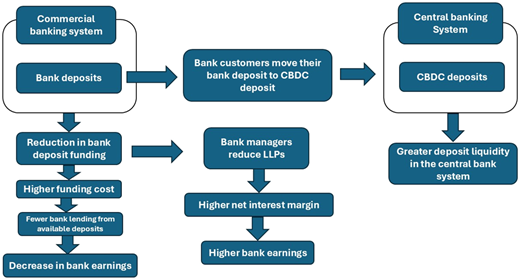
In the context of CBDC, bank managers can use LLPs for earnings management purposes in a CBDC environment, regardless of whether the CBDC is interest-bearing or non-interest-bearing. To illustrate this, assume that a central bank has issued a CBDC, and the CBDC is widely used by the population, including investors and investor analysts. When this happens, the central bank can introduce economic policies that increase the demand for CBDC among the population. Such policy action can motivate a large number of people to migrate a part of their bank deposit to a CBDC deposit. However, such policy action is not favourable to banks because banks want to retain cheap deposit funding, and the loss of customer deposit liquidity can adversely affect banks' ability to lend from available deposits, which can impair bank earnings.
In response to this, bank managers may have incentives to mitigate the effect of such policies on bank earnings by manipulating LLPs estimate (see Figure 2). Manipulating LLP estimate is a strategy used by bank managers to increase earnings or smooth earnings, depending on the earnings outcomes that bank managers want to achieve. However, accounting standards, such as IFRS 9 Current Expected Credit Losses (CECL), can constrain managerial discretion over LLPs by forcing earlier loss recognition and requiring auditable and data-driven forecasting of LLP estimates to avoid manipulation (Mahieux et al., 2023; Hansen, Charifzadeh, & Herberger, 2024). This can fully or partially constrain bank managers from manipulating LLPs for accrual earnings management purposes. Other factors, such as audit quality, competitive pressures and strict bank regulation, can also constrain bank managers from manipulating LLPs for accrual earnings management purposes (Alzoubi, 2016; Kao, Wu, & Yang, 2009; Healy, Serafeim, Srinivasan, & Yu, 2014).
Notwithstanding, banks that are not strictly required to comply with IFRS 9 CECL and are experiencing significant bank-to-CBDC deposit migration may have incentives to realistically understate LLPs, by reporting fewer-than-usual LLPs in their bank income statement to increase bank interest margin and increase bank earnings as a way to counter the depressive effect of bank-to-CBDC deposit migration on bank earnings. Therefore, understating LLPs is a potent accrual earnings management strategy that bank managers can rely on in a CBDC environment because it allows them to increase earnings when bank-to-CBDC deposit migration increases the funding cost of banks and decreases bank earnings.
Finally, the hypothesis which can be developed from this is that accrual earnings management has occurred if large bank-to-CBDC disintermediation leads to a significant decrease in discretionary LLPs estimate.
A significant increase in bank-to-CBDC disintermediation and a significant decrease in discretionary loan loss provisions may indicate accrual earnings management, which can impair earnings quality.
The hypothesis can be stated in a functional form as:
Accrual earnings management = f(change in bank-to-CBDC disintermediation, the change in size of discretionary LLPs).
The functional model above can be estimated using regression models to determine the CBDC-induced determinants of accrual earnings management, with accrual earnings management being the dependent variable, while the frequency and value of bank-to-CBDC disintermediation and change in discretionary LLPs are the independent variables, supported with other control variables.
5.2.2 Real earnings management using bank deposit interest rate in a CBDC environment
Roychowdhury (2006) and Cohen and Zarowin (2010) explore real earnings management and show that firm managers engage in real earnings management by engaging in practices that disguise as normal business operations, but which are aimed at manipulating reported earnings to meet short-term earnings targets. Examples of these practices include offering sales discounts to temporarily inflate sales, reducing discretionary expenditures to increase short term profit, and overproduction to spread fixed costs and lower the reported cost of goods sold to increase profit (Roychowdhury, 2006). They also show that this behaviour may be pronounced during intense competition or during major corporate events such as seasoned equity offerings (Cohen & Zarowin, 2010). They further show that the consequence of real earnings management is that it forces businesses to make sub-optimal business decisions that could lead to severe business decline in the future (Cohen & Zarowin, 2010).
Consistent with the works of Roychowdhury (2006) and Cohen and Zarowin (2010), I argue that banks can engage in real earnings management by constantly adjusting their deposit rates [2] in a way that disguises as normal banking operations but which is aimed at manipulating banks' reported earnings to meet short term earnings targets, and this behaviour is likely to be pronounced in an environment where there is widespread CBDC adoption.
At this juncture, it is important to clarify that there are two types of changes in bank deposit rates. The first type is the change in deposit rate that occurs due to ordinary competitive responses, such as when banks raise their deposit rates to avoid losing customers to their competitors or when banks decrease their deposit rates after competitors decrease their deposit rates. The second type occurs when bank managers periodically alter deposit rates to reduce total interest expense to boost net interest margin and report better profits. This type of change in deposit rate is more aligned to real earnings management because it disguises as normal banking operations.
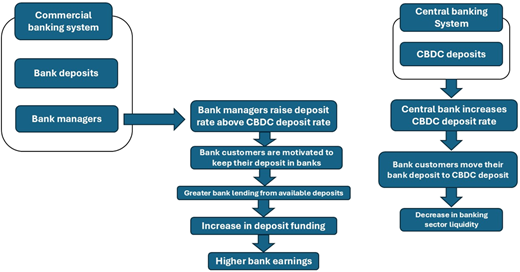
To illustrate how bank deposit interest rate is used to engage in real earnings management in a CBDC environment, assume that a central bank has issued an interest-bearing CBDC and the CBDC is widely used by the population, including investors and investor analysts. When this happens, the central bank can make a monetary policy decision to increase the interest rate on CBDC deposits to reduce excess liquidity in the commercial banking sector. Such a monetary policy decision by the central bank may lead to bank-to-CBDC deposit migration as bank customers may have incentives to move their bank deposits to CBDC deposits to enjoy the resulting high interest rate on CBDC deposits (Lukonga, 2023). But this decision is not favourable to banks because banks want cheap deposit liquidity, and the loss of customer deposit liquidity can increase banks' funding cost and adversely affect bank earnings.
Bank managers may have incentives to counter such monetary policy decisions by raising the bank deposit interest rate to retain customer deposits (see Figure 3). Bank managers can use their discretion to increase the bank deposit rate to discourage bank customers from moving their bank deposits to CBDC deposits (Whited et al., 2022). Bank managers can also raise the bank deposit rate to match or exceed the interest rate on CBDC deposits, as this is the only way to convince bank customers to keep their deposit with banks instead of migrating to CBDC deposit (Ozili, 2023). Bank managers may continue to increase the bank deposit rate anytime the central bank increases the interest rate on CBDC deposits.
Raising the bank deposit rate may decrease bank earnings due to rising interest expense, but the decrease in bank earnings from raising the bank deposit rate would be less severe than the decrease in bank earnings that would result from significant bank-to-CBDC deposit migration. Bank managers can also decrease the bank deposit rate anytime the central bank decreases the interest rate on CBDC deposits, but bank managers can ensure that the bank deposit rate is always equal to the CBDC deposit rate or higher than the CBDC deposit rate for such a strategy to be meaningful and impactful on bank earnings.
Frequently changing the bank deposit interest rate is a potent earnings management strategy for bank managers because it helps bank managers to manage their earnings by retaining customer deposits, preserving the low-cost deposit funding they receive from customer deposits, increasing their ability to lend from available deposits and improving their earnings. Hence, the bank deposit interest rate is a real-based tool for bank earnings management in a CBDC environment because the frequent changing of bank deposit interest rates by banks can be disguised as a real bank activity when, in reality, it is a real earnings management strategy.
Finally, the hypothesis which can be developed from this is that real earnings management has occurred if a change in CBDC deposit rate leads to a corresponding or disproportionate change in bank deposit rate to mitigate bank-to-CBDC disintermediation, retain customer deposits and preserve bank earnings.
A significant change in CBDC deposit rate followed by a corresponding or disproportionate change in bank deposit rate to mitigate bank-to-CBDC disintermediation can imply real earnings management, which can impair earnings quality.
The hypothesis can be stated in a functional form as:
Real earnings management = f(change in CBDC deposit rate, change in bank deposit rate, size of bank-to-CBDC disintermediation).
The functional model above can be estimated using regression models to determine the CBDC-induced determinants of real earnings management, with real earnings management being the dependent variable while the change in CBDC deposit rate, change in bank deposit rate and frequency and value of bank-to-CBDC disintermediation are the independent variables, supported with other control variables.
6. Implications for earnings quality and financial reporting quality
Earnings quality is commonly defined as the extent to which reported earnings faithfully represent what it purports to represent (Schipper & Vincent, 2003). Accounting standard setters are interested in earnings quality because it is an indirect indicator of the quality of financial reporting (Schipper & Vincent, 2003; Dechow et al., 2010). Accounting standard setters want firms to report high-quality earnings so that firms' earnings disclosure can be decision-useful and value-relevant to those who rely on the reported earnings numbers for investment decision-making and for contracting purposes (Schipper & Vincent, 2003). With regard to CBDC, earnings quality can decrease if bank managers understate LLPs to increase reported earnings in response to unfavourable bank-to-CBDC disintermediation that adversely affects bank earnings. Earnings quality can also decrease if bank managers frequently increase the bank deposit rate to influence the size of reported earnings in response to high CBDC deposit rates that trigger adverse bank-to-CBDC disintermediation that adversely affects bank earnings.
Low earnings quality is a problem because it can induce unintended wealth transfers, it can lead to excessive compensation to bank managers (Schipper & Vincent, 2003; Dechow et al., 2010), which can lead to bank insolvency (Schipper & Vincent, 2003; Dechow et al., 2010). It can also mislead investors into continuing to allocate capital to a bank that overstates its earnings, thereby increasing the risk of bank insolvency and bank failure. Low earnings quality also reduces economic growth through capital misallocation and the diversion of crucial scarce resources to shady projects that yield imaginary expected payoffs (Schipper & Vincent, 2003).
To increase earnings quality, accounting standard setters and bank regulators should put in place mechanisms that prevent bank managers from using LLPs or the bank deposit rate to engage in accrual-based or real earnings management. Bank supervisors should increase their scrutiny of bank LLPs estimates and prevent banks from altering the bank deposit rate each time the central bank changes the interest rate on CBDC deposits. Accounting standard setters also have a duty to issue standards that improve the decision-usefulness of accounting numbers in bank financial reports. They should introduce standards that make it difficult for bank managers to alter accounting numbers, such as LLPs, for the purpose of earnings management. This may help to limit the persistence of earnings management and increase the quality of reported earnings.
Furthermore, in the absence of accounting standards, existing constraints, such as regulatory capital requirements, risk management policies and market competition, have the potential to limit the extent of bank earnings management using LLP and deposit interest rate manipulation. High regulatory capital requirements can discourage bank earnings management because the imposition of higher capital requirements is likely to compel banks to abandon accounting gimmicks and resort to capital markets to raise real capital funding to meet the minimum capital requirements, thereby discouraging activities linked to accrual-based or real earnings management (Ahmed, Takeda, & Thomas, 1999). Risk management policies also influence bank earnings management by constraining manipulative behaviour often associated with earnings management (Nugrahanti, 2016). Effective risk management policies can introduce better controls and transparency, which can reduce bank managers' incentive to use accounting numbers to manage earnings or to smooth income (Nugrahanti, 2016). Market competition can also affect the incentives for earnings management (Tizaoui, Dabbou, & Galleli, 2025). Rather than constrain earnings management, market competition can provide an additional motivation for bank managers to engage in earnings management. Competition can lead bank managers to overstate bank earnings in order to protect their jobs in a competitive industry (Tizaoui et al., 2025). In summary, the presence of higher regulatory capital requirements and effective risk management policies, combined with mandatory compliance with accounting standards, can act as strong constraining factors that discourage bank earnings management.
7. Conclusion
This study explored the effect of bank-to-CBDC disintermediation on bank earnings management and the implications for bank earnings quality. Although there is no official guidance on the financial reporting of CBDC from accounting standard setters, banks are expected to apply the accounting principle of faithful representation when reporting CBDC in financial reports. The study showed that widespread adoption of CBDC and the introduction of policies that encourage people to hold large quantities of CBDC can adversely affect bank funding cost, limit banks' ability to lend to borrowers from available deposits and impair bank earnings. This can provide incentives for bank managers to use accrual-based or real accounting numbers to manage reported earnings to offset any adverse effect of bank-to-CBDC disintermediation on bank earnings. The consequence of such action is a decrease in bank earnings quality, which has implications for the decision-usefulness and value relevance of the information contained in bank financial reports. Accounting standard setters do not want a decrease in bank financial reporting quality in a CBDC environment, and it is in their best interest to mitigate it.
The policy implication of CBDC-induced earnings management is that it can erode investor confidence in banks if investors make poor investment choices based on misrepresented bank financial reports after CBDC issuance. It can lead to losses for investors, which can result in lawsuits, protracted legal issues, loss of bank reputation, financial distress or bankruptcy of banks when earnings manipulation is exposed, which can threaten financial stability. To mitigate this, policymakers should take proactive measures to improve earnings quality by introducing regulations aimed at mitigating CBDC-induced accrual-based and real earnings management.
Therefore, it is recommended that accounting standard setters should introduce standards that make it difficult for bank managers to alter accounting numbers for the purpose of earnings management. Bank supervisors should scrutinize bank LLPs estimates and monitor how banks' discretionary LLPs estimate change in response to adverse bank-to-CBDC disintermediation. If an abnormal change in discretionary LLP is detected, regulators can resolve this by stipulating a regulatory upper and lower band within which LLPs estimate should fall at all times and require banks to provide a strong justification if they have a reason why their LLPs estimate should lie outside the regulatory band. Bank supervisors should also scrutinize the bank deposit rate and limit bank managers' ability to alter the bank deposit rate too frequently in response to changes in the CBDC deposit rate that may trigger adverse bank-to-CBDC disintermediation. One way to do this is to require banks to seek regulatory approval before changing their deposit interest rate after CBDC issuance. This can enable the central bank to detect early whether banks intend to change their bank deposit rate because of potential bank-to-CBDC disintermediation arising from changes in the CBDC deposit rate.
Future research can use regression analysis to examine the effect of bank-to-CBDC disintermediation on bank income smoothing, and the moderating role of audit quality, institutional quality and bank corporate governance in mitigating bank earnings management in a CBDC environment. Future research can also use event study methodologies to explore whether CBDC issuance affects banks' corporate sustainability. Future research can also use questionnaires and surveys to solicit responses to gain insight into how Fintech and cryptocurrency providers might react to the use of CBDC in the banking sector. Future research can also examine the differential effects of CBDC design (that is, interest-bearing vs non-interest-bearing, one-tier vs two-tier distribution) on the magnitude of disintermediation incentives.
Notes
9th June, 2026.
Generally, in banking, a bank deposit interest rate is the interest rate that banks pay to deposit account holders. It is the interest payable on customer deposits held by banks. It is the money earned by individuals and corporations for allowing banks to use their deposit funds. It is calculated as interest rate times the customer deposit amount.