


The primary objective of this study was to aggregate and synthesize existing research findings in the realm of educational financing considering the adoption of educational technology (EdTech).
The study involves the application of the Preferred Reporting Items for Systematic Reviews and Meta-Analysis Model, considering the journal articles from the last 10 years (2013 through 2023) obtained from the EBSCO and Emerald Insight databases to perform a systematic literature review.
EdTech has given institutions new sources of income. The demand for online courses, credentials and other digital learning tools is rising, opening up new revenue potential for schools. Take-now-pay-post-placement is a new business model for the upskilling sector that enables learners to enroll in pertinent upskilling courses and pay back once they are placed (at a higher salary).
The development of technology has significantly lowered the overall educational cost, democratized access to education and empowered people to take charge of their education regardless of their location or socioeconomic status. With technology acting as a potent instrument to facilitate learning and close access barriers to education, this trend is expected to continue.
1. Introduction
The technology used in educational contexts to improve teaching, learning and the overall educational experience is referred to as educational technology or “EdTech” (Stefaniak and Carey, 2019). It includes a broad range of electronic resources, software programs, hardware gadgets and Internet platforms created expressly for educational purposes focused on improving educational results (Hasan Al-kumaim et al., 2021), promoting personalized learning, increasing student engagement and offering students of various demographic profiles access to high-quality education (El-Sabagh, 2021). The world of education has undergone a paradigm shift (Singh et al., 2020) recently; with improvements in affordability and accessibility because of expanding usage of the Internet (Crick, 2021) and smartphone technologies, students even in the most remote areas of the world may now access instructional resources (Oliveira et al., 2021). Additionally, there has been an increase in household spending on education, underscoring the value that society places on this crucial industry (Williamson et al., 2021).
The cost of education has greatly decreased as a result of technological advancements (Alexander et al., 2019), which have also democratized access to education and given everyone more control over their education status (Cukurova et al., 2019). This pattern is anticipated to continue as technology will play a crucial role in promoting education and bridging access gaps (Joshi et al., 2020). EdTech has the potential to reduce the costs associated with conventional education methods of physical infrastructure (Rughoobur-Seetah and Hosanoo, 2021) and steeping towards leveraging online platforms, digital resources and virtual classrooms (Peng and Dutta, 2022). It has considerably increased educational access, especially in underserved communities and developing countries (Pollio and Cirolia, 2022). These technologies make it possible to adapt educational materials and teaching strategies to the unique needs of each student, resulting in more effective and efficient learning (Macgilchrist et al., 2019).
The previous contributions have often emphasized on the application of various advanced technologies in the educational sector with minimal focus on the educational financing through EdTech solutions (Komljenovic, 2021). Hence, the researchers focus on exploring the research gap towards the acceptance of EdTech tools, scope for digital infrastructure (Houlden and Veletsianos, 2023) and the adoption of cutting-edge instructional approaches (Johns, 2022) can all be aided by this infusion of funds, which will ultimately have an effect on how much is spent on education. Thus, the present study attempts to answer the below questions through a comprehensive systematic literature review (SLR).
What are the key dimensions that influence adopting EdTech among higher educational institutions (HEIs)?
Which major cluster themes apply to HEIs using EdTech?
Does financing have an impact on how EdTech is adopted?
Many EdTech platforms' courses and programs (Wargo et al., 2020) are focused on teaching students how to build in-demand skills like coding, data analysis and digital marketing. Government agencies, charity groups and venture capitalists have all made large investments in EdTech due to its growth. These investments have hastened the creation and development of EdTech companies and initiatives, providing new funding possibilities for educational institutions and students. HEIs have experienced a substantial impact from technology, which has revolutionized several aspects of instruction, learning, research and administration (Veletsianos et al., 2024). It has increased educational access by removing constraints associated with distance. The utilization of multimedia materials, online simulations, virtual labs and educational apps helps students comprehend challenging concepts and build practical skills (Osei-Bryson et al., 2022). Learning management systems (LMSs) and online collaboration technologies enable the seamless delivery of content, communication and collaboration between students and instructors (Williamson et al., 2020).
Intelligent tutoring systems and adaptive learning software use algorithms and data analysis to tailor training (Flavián et al., 2022), identify areas for development and provide students with targeted feedback (Williamson and Komljenovic, 2022). In HEIs, administrative procedures have been reduced by technology, increasing effectiveness and productivity. Student information systems automate the processes of enrollment and grading (Williamson, 2021a). Online learning platforms and video conferencing tools promote (Baig and Yadegaridehkordi, 2023) collaborative learning and build compelling virtual learning environments through synchronous and asynchronous interactions between students and instructors. Interactive and interesting learning opportunities are made possible by EdTech tools and platforms (Fouad, 2021) facilitated through digital transformation and open educational resources (OER). Additionally, EdTech enables organizations to provide massive open online courses and other online materials for no charge or at a discounted price, democratizing education for a larger audience (Abibo et al., 2022) using tools for learning analytics and data analytics provide details about students' engagement, performance and learning patterns (Pangrazio et al., 2022). Educational financing refers to the various mechanisms and processes involved in funding and financing education, from early childhood education to higher education.
2. Materials and methods
The current qualitative study examines the critical factors that influence the uptake and application of educational technology (EdTech) in educational financing. The research follows the Preferred Reporting Items for Systematic Reviews and Meta-Analysis (PRISMA) Model (Xiao and Watson, 2019) structured on four stages, namely, identification, screening, eligibility and inclusion. The model increases transparency and raises the standard of reporting. The PRISMA statement offers a standardized checklist of things that should be included in a systematic review report. It includes a flow diagram and a 27-item checklist that describe the various steps of a systematic review, from the selection of pertinent research to the inclusion and analysis of data (Kaur et al., 2023).
The SLR was defined based on the mathematically formulated PRISMA model adapted from Jahangir et al. (2023), which was used to obtain the eligible articles included for the final review. The formula is illustrated below to arrive at the total number of full-text articles to be included in the SLR.
where each component of the formula is indicated as below.
: Indicates the total number of studies shortlisted and included for SLR;
- Number of studies recorded after the Identification process;
- Number of studies recorded after removing duplicated ones from along with conditions (Screening Level 1);
- Number of studies recorded after removing studies from considering the title and abstract along with conditions (Screening Level 2) and
- Number of studies recorded as eligible after removing studies from based on specified conditions.
2.1 Boolean search strategy
The popular academic databases often considered in SLR and bibliometric analysis comprise of EBSCO Host, Emerald Insight, Web of Science (WoS) and Scopus (Jevanesan et al., 2021). The primary methodology examined in the current review mechanism involved conducting a comprehensive search from EBSCO Host (Galleli et al., 2020) and Emerald Insight (Alvino et al., 2021), utilizing Boolean operators, as described by Ayatollahi and Zeraatkar (2020). The search was conducted using the following keywords: “EdTech” OR “educational technology” AND “higher educational institutions” AND “cost” OR “finance,” with a focus on the relevance of the search.
EBSCO frequently offers full-text article access directly, or at the very least, and links to the articles' online locations that can expedite the document retrieval process in SLR, covering a broad range of subjects of interdisciplinary and multidisciplinary. It has excellent features like text-to-speech that lets the reader listen to the research articles aloud and free access to the articles for academicians with a user-friendly interface. Emerald Insight is a comprehensive collection of peer-reviewed business and management journals facilitating in integration of the objective of the study, thereby supporting the claim that high-quality articles can be found in EBSCO Host and Emerald Insight apart from other databases.
EBSCO Host can be accessed with registered login credentials of the affiliated institution and Emerald Insight offers complimentary token access for the users as an alternative to institutional subscription, unlike WoS or Scopus databases. EBSCO Host and Emerald Insight don’t mandatorily need the institution subscribing the access to the database to access the articles.
2.2 Inclusion and exclusion criteria
The SLR was grounded to examine the factors influencing the adoption or application of EdTech in educational financing among the HEIs. The timeframe of the research is between January 2013 and June 2023, where peer-reviewed academic journal articles including conference proceedings available in full text were considered. The articles containing the keywords finance, technology and education were published only in English and indexed in databases (EBSCO Host and Emerald Insight). The articles published before 2013, publications in the form of book chapters, case studies, working papers and short reviews, were excluded at the filtration level.
A variety of reputable worldwide publishers, including Springer Nature, Taylor & Francis, Wiley, Emerald, Elsevier and Sage, have their publications available on EBSCO Host. On the other hand, Emerald Publishing House is the exclusive publisher of the articles in Emerald Insight. Data from popular databases like Scopus, WoS, Springer and others were not specifically extracted for systematic review due to access restrictions.
Table 1 describes the inclusion and exclusion criteria (Mengist et al., 2020) treated as filtration operations employed in the study.
Inclusion-exclusion criteria
| Inclusion criteria | Exclusion criteria |
|---|---|
| 1. Timeline of study: Research articles published between Jan 2013 and June 2023 | 1. Articles published prior to 2013 |
| 2. Peer-reviewed academic journal articles available in full text | 2. Research in the form of books, case studies, short reviews |
| 3. Articles with key keywords finance, technology and education were considered | 3. Working papers were not considered |
| 4. Other popular databases | |
| 4. Articles published only in English | |
| 5. Articles from the Emerald Insight and EBSCO Host databases |
Source(s): Authors’ compilation
India’s journey towards EdTech began in 2004 with the introduction of smart classrooms and satellite-based learning techniques. E-learning first became popular in 2008 when organizations like Extra Marks and Khan Academy started providing online education. However, the Ministry of Education introduced information and communication technology (ICT) to the Indian educational system at the school level in 2004. After 2010, ICT became more popular since it helped students develop their ICT skills. Customers of all ages are now served by the EdTech industry, which has grown rapidly over the last ten years (Aaradhi and Chakraborty, 2024). Consequently, the study’s timeframe from January 2013 to June 2023 is crucial. The articles were in their early stages and had little effect on the education sector before the study period.
For instance, if a particular shortlisted full-text article emphasizes “engaging transformed fundamentals to design global hybrid higher education” but doesn’t explicitly describe the reference to a financial ecosystem in EdTech among the HEIs, that particular article was excluded from further study.
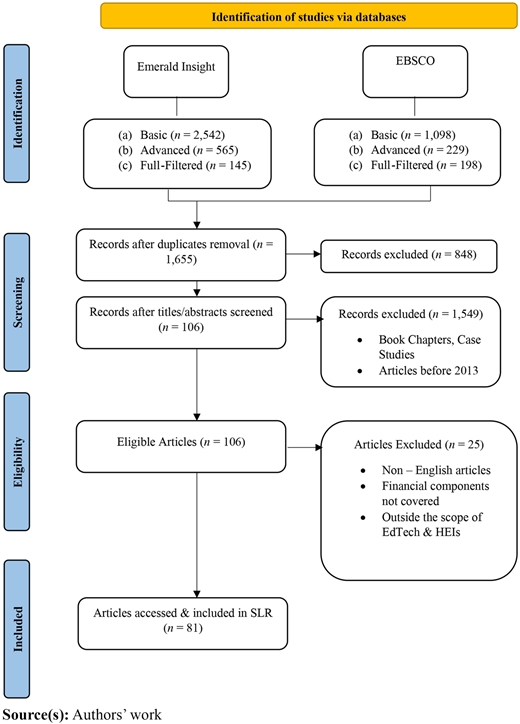
The PRISMA model is a widely recognized guideline for conducting SLRs. It consists of several stages that researchers should follow to ensure a comprehensive and transparent review process (Abelha et al., 2020). The present research has deployed a scientific model, as depicted in Figure 1.
PRISMA model of systematic literature review
PRISMA model of systematic literature review
2.3 Identification stage
The identification stage is the first and crucial for systematically identifying relevant studies that will be further evaluated and synthesized in the subsequent stages of the PRISMA model, such as screening, data extraction and data synthesis. It ensures transparency and replicability by clearly documenting the search strategy and selection process, allowing others to assess the rigor of the review. There was a scientific method deployed in search criteria during the process of identification stage involving (a) basic search, (b) advanced search and (c) full-filtered search describing the search strategy.
The mathematical formula applied in the identification phase is illustrated:
The researchers have considered two databases (EBSCO and Emerald Insight) at the identification stage to perform a basic search , advanced search and full-filtered search , respectively. The “” is the total number of studies included in the identification process across all the chosen individual databases. The basic search based on the search strategy from the EBSCO resulted in 1,098 articles and Emerald Insight resulted in 2,542 articles. The advanced search involved the time frame, type of document, publisher and PDF selection criteria, resulting in 229 articles from EBSCO and 565 articles from Emerald Insight. Lastly, the full-filtered search associated with the Boolean operators' search strategy resulted in 198 from EBCSO and 145 from Emerald Insight articles, respectively.
The basic research from both databases resulted in 3,640 articles, advanced search from both databases resulted in 794 articles and full-filtered search from both databases resulted in 343 articles.
2.4 Screening stage
The process of screening studies is an integral part of conducting an SLR within the PRISMA framework. The researchers evaluated the titles and abstracts of the studies to determine their potential relevance to the research question and inclusion criteria. This led to the removal of 848 articles using Mendeley Reference Manager due to their inclusion in both databases. The parameters considered during the elimination process were based on author names, year of publication, title, journal name, publisher, volume and issue number. The record of studies that were processed further in the screening resulted in 1,655 articles.
During the further process, there were 1,549 articles excluded from the study, which belonged to the category of books, case studies, book chapters, working papers and articles published before 2013. After critically reviewing the title, abstract and keywords of the articles, 106 articles were retained for the next stage.
2.5 Eligibility and inclusion stage
A systematic and transparent approach was followed during the eligibility and inclusion stage to ensure that studies meeting the predetermined criteria are included while minimizing the risk of bias or undue influence on the final results of the systematic review. In this stage of review, 25 full-text articles published in non-English languages, falling outside the scope of EdTech, and articles without the financial components were removed. Therefore, 81 full-text articles were zeroed on to be included in the SLR for a rigorous study to investigate the factors influencing the adoption or application of EdTech in educational finance among HEIs.
3. Results
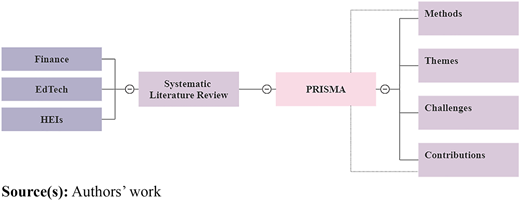
In this section of the study, the schematic representations of the deep analysis of 81 articles about the “EdTech financial ecosystem” are presented. These findings are visually depicted in Figure 2.
Schematic representation of findings
Schematic representation of findings
The key search words on the broader domain comprising of “EdTech,” “HEIs” and “finance” facilitated in laying the fundamental base for the SLR by adopting the PRISMA model, leading to gathering the findings from the shortlisted articles in the form of research methods, themes, challenges and unique contributions during the study.
The PRISMA model in SLR resulted in significant dimensions, as described in Figure 3, after a rigorous process from the eligible 81 full-text articles listed as below:
Learning ecosystem – HEIs use of EdTech has encouraged evolution of the learning ecosystem to enhance teaching and learning, increase accessibility and provide students with flexible learning options. They typically employ LMS as the central location for managing online courses and educational resources (Dabbagh and Castaneda, 2020).
Technological innovations - HEIs are at the cutting edge of innovation in a field that is dynamic and undergoing rapid change because they are constantly experimenting with and utilizing new technology to enhance teaching and learning procedures (Chugh et al., 2023).
Investment - The biggest challenge is raising the funds for the infrastructure required for online or hybrid learning. Additionally, funding will be needed for software updating, employee training and development (Bharathi et al., 2021).
Quality - Inadequate financing and investments in universities and colleges impair the quality of education and educational resources. Higher engagement and better learning results from a user interface and user experience. Engaging faculty and students in the development and evaluation of EdTech tools allows for feedback for continual improvement (Momani, 2023).
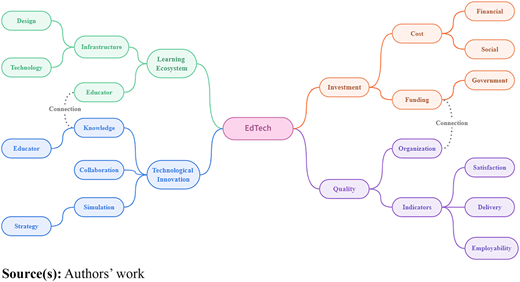
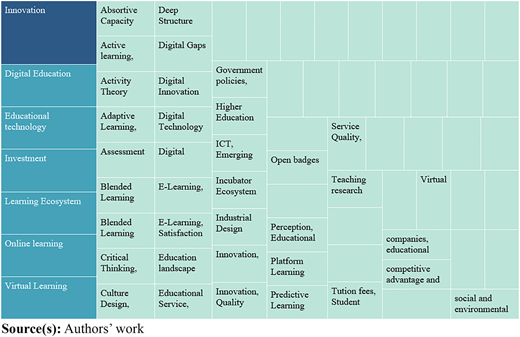
Figure 4 describes the generated themes comprising innovation, EdTech, digital education, investment, online learning, virtual learning and learning ecosystem. The allocation of financial resources is increasingly directed towards the development and advancement of educational technologies (Williamson, 2022). The integration of EdTech has brought about advancements in the classroom, allowing for a blended learning environment (Asia’s Fintech et al., 2022). This has resulted in enhanced communication and improved teaching and learning experiences for students. The utilization of emerging technologies and digital services enables the creation of innovative educational experiences, fosters opportunities for growth and improvement, enhances operational efficiencies and optimizes the effectiveness of learning and teaching activities (Dospinescu et al., 2019).
Themes of EdTech financial ecosystem
Themes of EdTech financial ecosystem
The allocation of resources towards the implementation of EdTech aims at enhancing the efficiency and effectiveness of the learning process on a huge investment (Williamson, 2021b). The prospective trajectory of education is underpinned by the utilization of quantitative financial valuation methodologies, which enable the anticipation of monetary gains derived from the allocation of funds toward EdTech (Williamson and Komljenovic, 2023). The integration of EdTech, especially automation, is poised to have a significant impact on the educational domain, facilitating educators in providing tailored and efficient learning experiences. The implementation of technology has the potential to revolutionize the administration and consumption of education, ultimately democratizing and increasing its accessibility on a worldwide level, provided it is executed well (Yiu et al., 2023).
4. Discussion and conclusion
It is imperative for HEIs to thoroughly assess the efficacy and consequences of new technologies before their implementation. The dearth of implementation of EdTech among the HEIs aspects that exert an influence on the implementation process encompasses a scientific investigation, environment, acceptability, adoption rate, appropriateness, feasibility, cost and sustainability (Psomas, 2021). The current research was aimed at examining the fundamental factors that exert a substantial influence on the acceptance and integration of EdTech within the domain of educational funding. It specifically focused on anticipating future article publishing in this area.
It can also be inferred that the majority of the previous contributions to the literature have applied the conceptual method, SLR, survey method and mixed methods in their research methodologies, which are summarized in Table 2.
Summary of the eligible full-text articles
| SL. No | Authors and year | Findings | Themes | Methods |
|---|---|---|---|---|
| 1 | Stough and Lee (2021) | The combination of textual analysis and literature review provided insights and helped to develop emergent themes which were used to develop the Technology-Driven Design Process Model | Industrial design | Grounded theory |
| 2 | Fox-Turnbull and Stables (2022) | It is critical for those studying technology education to understand that technologists do not always appreciate nor anticipate the transformative nature of their work | Technological evolution | Experiential learning |
| 3 | Buckley et al. (2022) | A strong emphasis has been placed on quantitative research within the open science movement | Transparency | Interview method |
| 4 | McLain (2022) | Project-based learning is considered to be a (or even the) deep structure, believed to be the 'best' way to impart disciplinary know-how of the subject’s signature pedagogy | Deep structure | Signature pedagogy |
| 5 | Xu et al. (2023) | Eight dimensions and 25 measurement items of assessing NoT were derived from the PoT, historical, sociological and educational literature | Assessment | Grounded theory |
| 6 | Lee and Park (2023) | It provided the effectiveness of the integrative programs in technology education | Integrated programs | Survey method |
| 7 | Citrohn and Svensson (2022) | Swedish technology teachers would benefit from developing their knowledge about the design process, where models are used as representations for decision making | Knowledge | Systematic literature review |
| 8 | Branch (2020) | Digital transformation becomes an institutional way of life learned, shared and transmitted both by directive bodies, at both academic and administrative levels of the university | Digital transformation | Conceptual |
| 9 | Ifenthaler and Yau (2020) | Learning analytics approaches utilize effective techniques in supporting study success and students at risk of dropping out | Learning analytics | Systematic literature review |
| 10 | Czerniewicz et al. (2023) | Interviews with educators in three broad disciplinary areas to explore their views, practices, and experiences regarding the use of online materials reflected to be more effective | Activity theory | Interview Method |
| 11 | Okoye et al. (2023) | Digital technologies have become an inevitable and indispensable part of education and learning | Digital technology | Mixed methods |
| 12 | Sharma et al. (2022) | The educational implications of AI in emerging economies by examining the challenges therewith and provides recommendations for AI’s adoption | Investment | AI-driven systems |
| 13 | Smith (2020) | Importance of digital education post COVID-19 with critical concerns and hopes | Digital education | Conceptual |
| 14 | Graham et al. (2023) | Encourages online doctoral programs and researchers to take an ecological approach | Online learning | Experiential study |
| 15 | Castro (2019) | Educational technology capabilities (ETC) provide complementary insights to identify the best approach when aligning learning goals in technology-based implementations | Blended learning | Systematic literature review |
| 16 | Giannakos et al. (2022) | E-learning tools and traditional learning practices making it accessible to anyone wanting to implement a flipped classroom experience in his/her course | E-learning | Conceptual |
| 17 | Caiazza et al. (2021) | Explores a systems perspective of the Covid-19 pandemic using the absorptive capacity construct | Absorptive capacity | Explorative study |
| 18 | Clausen (2022) | Iterative process to develop a comprehensive micro-credentialing system aligned with the ISTE standards for educators | Educator | Conceptual |
| 19 | Guan et al. (2020) | Framework for expanding our field’s epistemology for in-program and emerging educational technologists to build their capability to lead organizations that learn in a Knowledge Age | Innovation | Critical analysis |
| 20 | Greenhow et al. (2022) | New ways of motivating learners and scaffolding the learning process | Open badges | Comprehensive approach |
| 21 | Li (2020) | Re-designing what investment instruments look like for EdTech incubators can realign incentives for more and better EdTech solutions | Incubator ecosystem | Conceptual |
| 22 | Bond et al. (2020) | Impact of educational technology research and the many innovative learning environments | Educational technology | Conceptual |
| 23 | Alonderiene and Majauskaite (2016) | Higher education leaders are uniquely positioned to move beyond the emergency adoption of online learning | Leadership | Mixed methods |
| 24 | Campbell et al. (2023) | Increase the use of educational technology among faculty, staff, and students | Innovation | Mixed methods |
| 25 | Lomellini and Lowenthal (2022) | The components of a vibrant and dynamic professional web presence, such as creating a personal website, engaging in social networking, contributing and sharing resources/artifacts, and attending to search engine optimization (SEO) | Strategy | Conceptual |
| 26 | Mirata et al. (2020) | Educational technology must embrace new technology, renew the concept of educational development, shape the new pattern of educational ecology | Adaptive learning | ASSURE model |
| 27 | Rabin et al. (2020) | Innovation management perspective to critically examine the use and misuse of the business model concept in the context of digital innovation in the higher education sector | Digital innovation | Conceptual |
| 28 | Li et al. (2023) | The study found that the structure of abilities of innovation and entrepreneurship instructors at Chinese higher education institutions is unbalanced, and they lack specialized knowledge and skills | Entrepreneurship | Survey method |
| 29 | Collet et al. (2023) | Minimizing costs; Managing costs and maximizing returns; and no financial concerns; which prove to be socially stratified | Investment | Latent class analysis |
| 30 | Sewagegn and Diale (2021) | Limited time given for one course; it was difficult to implement active learning between students and educators | Block teaching | Thematic analysis |
| 31 | Ecton and Dziesinski (2022) | A clearer pattern of punctuated equilibrium for institutional factors that would be expected to impact institutional friction | HEI finance | Punctuated equilibrium theory |
| 32 | Barney et al. (2021) | Private institutions in the US have become financially dependent on international students' tuition and have clear implications for the financial futures | Organization | Resource dependence theory |
| 33 | Thomas et al. (2020) | EdTech companies are dynamically active in forming and shaping symbiotic EdTech/university relationships | Online learning | Semi-structured interviews |
| 34 | Mapp (2022) | Flipped learning and its theoretical bases are explained before detailing its application in an introductory social work research method | Teaching research | Systematic literature review |
| 35 | Halter (2020) | Technology can provide opportunities for regional collaboration and cooperation that could benefit the Pacific | Collaboration | Conceptual |
| 36 | Al-Omairi et al. (2021) | It brings new understanding to the field of instructional technology, with an emphasis on users' behavioral intentions regarding e-learning tools | E-learning | Fuzzy decision-making |
| 37 | Tetteh et al. (2021) | Radical change has taken place across universities globally and internationally in response to the accretion of demands from diverse stakeholders | Quality assurance | Survey method |
| 38 | Sousa-Vieira et al. (2021) | Attributing responsibility for social change to abstract notions of education, market and technology, a new shared vision | Employability | Qualitative method |
| 39 | Callimaci and Fortin (2022) | Technological complexity can also be considered an opportunity cost as it negatively impacts perceived usefulness | Educational technology | Theory of reasoned action |
| 40 | Czerkawski and Berti (2021) | Instructional design framework along with a set of strategies that could be used to foster learner engagement in online learning | Learning technology | Conceptual |
| 41 | Boer and Asino (2022) | Models in designing for cross-cultural education ecosystems and programs intended to support learning needs | Cultural design | Conceptual |
| 42 | Bozkurt et al. (2022) | Institutional resilience and how careful systemic planning that strategically integrates online planning is key to the success of online programs essential for institutions’ future resilience | Learning ecosystem | Conceptual |
| 43 | Mclinden et al. (2022) | Bronfenbrenner’s ecological systems theory is drawn upon as a lens through which to examine proximal and distal influences on part-time students and their study experiences | Educational landscape | Conceptual |
| 44 | Macgilchrist (2021) | Experimental institutions and public funding shape a more ecological and equitable world | Technology | N/A |
| 45 | Jones et al. (2021) | The current marketisation of higher education, the reduction in public finances and continuing economic uncertainty led to contradictory and conflicting pressures | Educational resource | N/A |
| 46 | Kim et al. (2023) | Community, engagement, pedagogy, equity, and design-based research, through which scholarly communities are creating knowledge that influences research and practice in online learning contexts | Online learning | Systematic literature review |
| 47 | Wheelahan and Moodie (2022) | Evolving relationship between learning and late capitalism, and the digitalization of education policy and governance | Platform learning | Critical analysis |
| 48 | Costa et al. (2020) | Early researchers found virtual learning environments (VLEs) as tools for communication, leading to social constructivist learning | Virtual learning | Conceptual analysis |
| 49 | Gallagher and Lamb (2023) | Portray digital education as an external and universal force capable of radical transformation | Digital education | Conceptual analysis |
| 50 | Alam and Mohanty (2022) | Complementary practices function as processes of ‘assetization’, aimed at turning educational services and resources into digital assets with calculable future value for EdTech investors | Educational service | Conceptual analysis |
| 51 | Khamis et al. (2021) | Systems and processes developed across the university in the effort to ensure educational continuity is the key driver of positive change | Collaboration | Kotter's 8-step change model |
| 52 | Menon and Suresh (2022) | The study revealed government initiatives and institutional commitment as other enablers that can promote technology agility in higher education | Government policies | Total interpretive structural modelling and Matrice d'Impacts Croisés Multiplication Appliquée á un Classement (MICMAC) analysis |
| 53 | Joshi et al. (2020) | Investing in institutional-supported technologies is a costly venture for HEIs, Government financial support will reduce the burden | Environmental setting | Interpretative phenomenological analysis |
| 54 | Pike et al. (2023) | The use of online assessment has a positive impact on students' academic performance which involves cost to the HEIs | Assessment | Task-technology fit theory |
| 55 | Kosiba et al. (2022) | Common characteristics and challenges identified across both traditional higher education involves Cost | Agile schemes | Experiential study |
| 56 | Mirrlees and Alvi (2019) | ChatGPT can be effectively integrated into education to automate routine tasks and enhance the learning experience for students | Efficiency | Systematic literature review |
| 57 | Arango-Uribe et al. (2023) | Online classes and courses reduces cost by 62.99% than that of offline courses | Sustainability | Structural equation modelling |
| 58 | Wong and Li (2020) | Reputation, Eligibility, Affordability and Teaching are key constructs that are perceived as important by students in their search behavior | Funding support | Exploratory factor analysis |
| 59 | Rana et al. (2020) | Research-oriented faculty members need more time to carry out their research work, and their cost is higher than those who are less involved in research work | Financial and social costs | Semi-structured interviews |
| 60 | Gašević et al. (2019) | Interest in learning analytics, the vast majority of institutions are yet to exploit the full use of learner and organizational data to address institutional and educational challenges | Learning analytics | Narrative review analysis |
| 61 | Games and Rendi (2019) | A proof-of-concept test to explore the application of the corporate sector insights for strategic innovation in higher education teaching and learning | Innovation | Systematic literature review |
| 62 | Abdul Aziz et al. (2019) | The personal readiness of respondents towards Education 4.0 is very high; yet concern was raised about the financial and managerial readiness of institutions | Perception | Mixed methods |
| 63 | Sung et al. (2019) | There are emerging requirements for developing the education and retraining sector for existing and potential finance participator | FinTech | Mixed methods |
| 64 | Maritz (2019) | Anecdotal evidence of job vacancies and developments in the entrepreneurship discipline enhanced through programs | Venture finance | Contextual review of SLR |
| 65 | de Araujo Carneiro (2019) | University mode aiming at its transformation into entrepreneurial, through integrative practices between teaching, research | Innovation | Exploratory method |
| 66 | Ion et al. (2019) | Appropriate incentives and financial resources to the ecosystem enhances Industry 4.0 adoption | Policymaking | Semi-structured interviews |
| 67 | Kansheba (2020) | The entrepreneur needs to be exposed to opportunities mainly market access and resources (labor, technology and finance) | Micro finance | SLR and content analysis |
| 68 | Ahmad et al. (2020) | Technology implementation can create its own set of challenges and issues specific to each institution | Simulation technology | Survey approach |
| 69 | Camilleri (2021) | HEIs can use different performance indicators and metrics to evaluate their service quality in terms of their resources | Service quality | Systematic literature review |
| 70 | Kyriakopoulos et al. (2020) | Students achieve better cognitive learning outcomes of sustainability when multi-methodological experiential and active learning education is used | Environmental accounting | Exploratory factor analysis |
| 71 | O’Brien et al. (2019) | HEI community engagement through entrepreneurial education is a novel way of adding value without financial sustainability a program will not survive | Infrastructure | Conceptual model |
| 72 | Cordova et al. (2021) | Economic vulnerability explains the earliest interest in implementing cost and budget restrictions | Virtual internationalization | N/A |
| 73 | Mello Silva and Vargas (2022) | Innovativeness and positive Quality Assurance (QA) outcomes are directly linked to how these processes are managed in universities | Innovation | Systematic literature review |
| 74 | Visvizi and Daniela (2019) | Artificial intelligence and cognitive computing, augmented, virtual and mixed reality, Internet of Things, blockchain, bear the promise to effectively assisting HEI administrators in navigating their institutions | Emerging technology | Systematic literature review |
| 75 | Makarova et al. (2019) | The digital gaps among educators and students hinder the implementation of the seamless learning framework in HEIs | Digitalization | Systematic literature review |
| 76 | Chase and Murtha (2019) | There is a significant variation in ways students respond to the predictions at various emotional levels while using technology | Predictive learning analytics | Content analysis |
| 77 | Chowdhury et al. (2018) | Any innovative educational reform will be successful only when it is fully accepted and adopted by all the key stakeholders | Blended learning | Exploratory study |
| 78 | Williamson (2016) | Reporting and compliance; analysis and visualization; security and risk mitigation; and predictive analytics are the major areas of Big Data in education | Data complexity | Semi-structured interviews |
| 79 | Kimmelmann and Lang (2019) | The study reveals the nature of adoption that may inform the development of institutional eLearning diffusion structures | Virtual learning | Systematic literature review |
| 80 | Rodriguez-Segura (2022) | Focuses on the analysis of five policy statements about micro-credentials among HEIs | Education policy | Systematic literature review |
| 81 | Jiang et al. (2019) | Examine extant empirical research involving educational technology during COVID-19 to understand how the pandemic has influenced educational technology research | Effectiveness | Systematic literature review |
Source(s): Authors’ compilation
4.1 Implications
Financing for future receivables can help EdTech (subscription model) produce multi-year upfront income. EdTech has long-term benefits for academic institutions, teachers and students. It can improve students' employability by equipping them with useful skills and lowering the financial burden associated with prolonged periods of unemployment or underemployment. Individualized learning may make the need for remedial classes or other instructional support less pressing, which could save money for educational institutions. Students can pursue higher education no matter where they live thanks to online learning resources and distance learning courses (Blignaut et al., 2022).
4.2 Limitations and future scope of research
The findings of this study indicate that academic journals (Psomas and Antony, 2019) published in the selected databases tend to exhibit greater consistency when it comes to the presence of detailed abstracts that effectively outline the study’s purpose, research methodology, findings and implications. The aspiring researchers could explore some applied EdTech tools and resources (An and Oliver, 2021) comprised of LMSs, online collaboration tools, digital content, OER, adaptive learning software, gamification and simulations, mobile learning, data analytics and learning analytics.
4.3 Conclusion
EdTech has the potential to transform traditional teaching strategies, broaden educational access and satisfy a variety of learning needs. It can promote collaboration and communication, improve individualized learning, provide engaging and dynamic learning possibilities and provide prompt feedback. However, effective integration requires careful planning, effective implementation strategies and ongoing evaluation to ensure its impact on teaching and learning outcomes.

