The purpose of this systematic review is to explore the implementation, adoption and challenges of Internet of Things (IoT) in academic libraries.
Following the application of inclusion and exclusion criteria from the Preferred Reporting Items for Systematic Reviews and Meta-Analyses (PRISMA) method, 26 records were selected as the main findings to analyse. The 26 records were also loaded into Python 3.9.7. through Latent Dirichlet Allocation (LDA), an unsupervised statistical topic modelling technique for high-level interpretation of textual data to strengthen and justify the findings.
A coherence score was calculated to determine the optimal number of topics for the LDA model. Using this score, the analysis revealed two distinct topics, reflecting the main themes discussed in the 26 selected records from the application of PRISMA. Academic libraries and library researchers in the Global South are focused on policy, implementation and adaptability of IoT, while in the Global North, the focus is on smart library buildings, innovations and collaboration for effective IoT integration. Global North cannot be associated with under-resourced environments and infrastructures in the adoption and implementation of IoT that exist in the Global South.
Library professional bodies must develop frameworks, guidelines and standards to improve infrastructure, implementation, adoption and integration of IoT technology.
The current study is novel as it explores the acceleration of IoT in academic libraries. The novelty is illustrated in the use of the PRISMA method and LDA to provide insightful glimpses into IoT in academic libraries.
1. Introduction
Rapid growth in the Internet of Things (IoT) and the networked world is positively transforming academic libraries. Mncube (2023) agrees that academic libraries are relying on IoT to access and adopt educational materials. IoT employs networked and Internet-connected sensors embedded in technologies that connect and share data (Lavanya et al., 2025). IoT aims to enable technological devices to interact and communicate with each other through the creation of a more cohesive, interconnected and automated environment. Globally, in the evolving spheres of the Fourth Industrial Revolution (4IR), academic libraries are seizing opportunities to utilise the IoT for service delivery (Ivaldi et al., 2022). Academic libraries identify with IoT as an enabler for the creation, storage, appropriation, processing and dissemination of information and resources (Khan et al., 2022). IoT becomes smarter in nanoseconds as it adopts emerging and innovative technologies to improve and enhance service delivery, relying on technological advancements to create interconnected library spaces (Igbinovia and Okuonghae, 2021).
IoT technologies are dominating many domains, organisations and educational sectors, including higher education institutions (Mircea et al., 2021). Often, higher education institutions opt for a business enterprise model, in which subsidiaries, such as libraries, tend to be cloud-based, allowing for interoperable functions and services. IoT benefits libraries by saving staff time, enhancing patron service, and utilising patron profiling to make tailored recommendations by collecting real-time data (Maina, 2023). Radio Frequency Identification (RFID) can be IoT-adapted with library resources to create a smart monitoring system that directs patrons to the availability and location of library books (Liu, 2024). System integration in IoT can involve sensors to monitor environmental conditions within the library, and IoT-based security systems can include smart cameras and sensors to oversee the library premises (De Sarkar, 2022). This aligns with the current trend of libraries and institutions gradually moving to digital platforms for operations and services. It encourages traditional libraries to transition to digital libraries, where information sources are accessed efficiently and effectively, enabled by IoT.
IoT technologies, such as mobile devices, are widely used by digital natives in academic and research information organisations (Bi et al., 2022). New trends in collection management, library usage, content management, information literacy, tracking issued and overdue books, sending reminders, sharing information resources, and handling reference queries can be automated through IoT applications (Bagavathi, 2023b). IoT promotes smart shelves and asset tracking systems, which have been recognised as valuable tools for inventory management, enabling real-time tracking of materials and improved resource allocation within academic libraries (Ferdousmou et al., 2024). Furthermore, IoT technologies also assist libraries in optimising collection organisation, preventing loss, and streamlining retrieval and return processes (Munavalli, 2024).
However, IoT integration in higher education, particularly in library contexts, is still in its infancy, and there remain benefits and challenges (Spaho et al., 2025; Hashim et al., 2025). Privacy and security, data management, interoperability, and the need for staff training and support are challenges highlighted in the literature (Ram et al., 2023). This includes cost of implementation issues, technical complexity, integration with existing systems, user acceptance and adoption, and ensuring reliable connectivity (Mishra, 2023). Overcoming IoT implementation challenges in academic libraries requires careful planning, policy development and collaboration among library professionals, IT experts and stakeholders (Oyedokun, 2024; Roy and Habib, 2024; Hamad et al., 2024). Furthermore, aside from these challenges, little is known about how IoT deployment impacts service delivery, resource management and user experiences in academic libraries (Asim et al., 2022a). Therefore, this study seeks to answer the following research questions:
Is the Internet of Things being implemented in academic libraries to enhance service delivery, resource management, and user experience?
Are there challenges associated with adopting Internet of Things technologies in academic libraries?
2. Literature review
2.1 Internet of Things and service delivery
IoT technologies enhance academic libraries by enabling the monitoring and control of various resources, optimising energy consumption, and creating a comfortable environment for users (Zhou, 2024). IoT devices can be analysed to gain valuable insights, enabling predictive maintenance and customised service delivery. IoT-oriented academic libraries can automate and accurately perform most labour-intensive activities, thereby improving system efficiency (Khan et al., 2022; Zhou, 2024). IoT is also driving a shift towards remote access in academic libraries, as users need to be more technologically inclined and prefer to access information remotely. With the advent of IoT, especially in the Global North, academic libraries are embracing and integrating innovative technologies to provide quality services and unlimited access to electronic information for users (Adigun et al., 2024).
In the current digital era, libraries provide intelligent information services utilising technological innovations such as RFID, mobile and wireless access, remote assistance, the semantic web, AI, IoT, image and voice recognition, and augmented reality (AR) to deliver services (Kumar, 2023). Consequently, the adoption of new technology and digital trends requires library staff and patrons to be digitally competent (Hamad et al., 2024). Therefore, librarians, not limited to an academic environment, need digital competencies skills in computing, web-based platforms, mobile devices, digital content management, the ability to work with art application databases, and searching skills with integrity (Dube et al., 2024; Hussain et al., 2025). These are the fundamental digital skills that librarians and students can acquire at universities and through practice. In addition, IoT-enabled libraries can provide dynamic services and enhanced user experiences creating a more interactive and user-centric environment (Agboke and Oladokun, 2024).
2.2 Internet of Things for resource management
In libraries, IoT systems are optimised for resource storage and management to facilitate seamless information access and service to users. IoT plays a role in knowledge management processes, productivity, organisation, sharing and utilisation, leading to improved and enhanced services in academic libraries (Khalifa et al., 2024). Technological advances and increasing usage influence academic libraries in the current 4IR era. IoT applications play a key role in supporting resource management activities in information institutions and library management (Lu and An, 2025). Swaminathan (2024) note that IoT has also become a prevalent feature in libraries, utilised for various purposes such as content creation and management, delivery and access tools, and long-term preservation. Over time, IoT has come to rely on AI for informed collection management decisions, identifying trends and predicting demand for specific materials, facilitating round-the-clock access to resources, and enhancing space utilisation by digitising materials for easier retrieval (Omame and Alex-Nmecha, 2021). These systems are integrated with Library Management Systems to enable users to request and return books independently, using RFID or barcode technology.
IoT technologies and devices are transforming resource management services in academic libraries by enhancing service quality and boosting operational efficiency (Khan et al., 2022). Nowadays, library resources are stored and digitally preserved for online accessibility to users in academic libraries. Globally, academic libraries are striving for efficiency in resource management and are playing a crucial role in bridging the digital divide, offering free access to technology and resources, regardless of socioeconomic status, promoting equitable information access (Adigun et al., 2024). Digitalisation projects and the transition to intelligent management systems through cloud platforms are key to resource management and optimisation (Lu and An, 2025). Thus, academic libraries are becoming dependent on innovative technologies like IoT for technological advancements and management of resources in the digital age (Rahmanova, 2025; Sharma and Khan, 2024; Swaminathan, 2024).
2.3 Internet of Things user experience
In the 4IR era, IoT technologies are contributing to understanding human interactions with digital applications, products, services or environments by considering aspects such as the temporality of experience, user emotions and beliefs, user expectations, and the context of interaction (Ntoa, 2025). Based on user experience (UX), IoT has transformed academic library management by examining how smart gadgets, sensors and information analytics can be utilised to advance asset management, user interactions and speed of library operations (Mane et al., 2024). This results in dynamic changes within the library context regarding service provision. Libraries are placing significant emphasis on enhancing UX to provide engaging and seamless interactions. Through improved UX, supported by sophisticated algorithms, users can expect to receive personalised recommendations that match their interests and preferences (Vashishth et al., 2024). IoT is also influenced by the adoption of 5G technology, bringing transformative changes to academic library services and providing new opportunities to increase efficiency and enhance UX (Lu and An, 2025).
Worldwide, academic libraries are being influenced by the 4IR and are adopting IoT technologies to transform the traditional library experience (Jain and Behera, 2023). 4IR and IoT have resulted in the visibility of open educational resources (OER) in academic libraries, which has led to a growing emphasis on scholarly information and educational resources supporting research and teaching. In African higher education libraries, there is a need to articulate and realign an IoT-driven business enterprise system for implementing OER within an IoT-driven educational context Mncube (2023). Apart from OERs, AI and IoT technologies are increasingly integrated into society. Therefore, in an individual’s daily life, the nexus between digital literacy skills, IoT and AI are essential for enhancing their experience. Libraries can provide the impetus through training programmes, workshops and resources to help users develop digital skills such as coding, data analysis and information literacy skills essential for users to succeed in the 4IR digital economy (Moonasar, 2025). Juxtaposed, IoT scalability poses a challenge for IoT adoption in libraries, especially in developing economies (Igbinovia, 2021). According to Kandil and Benaboud (2024), IoT scalability refers to a device’s ability to adapt to environmental changes and meet evolving needs in the future. IoT has immense potential to perform multiple tasks across different networks; however, it struggles with adaptability. Hence, this seems to be a problem for organisations such as libraries, which acquire new devices or technologies for user services (Asim et al., 2022b). Therefore, Farabegoli et al. (2024), asserts that adding a new technology and device to existing IoT infrastructures can impact performance and lead to system reconfigurations.
3. Method
Critically analysing scientific contributions in a literature review strengthens research arguments on a phenomenon (Wright and Michailova, 2023). This assists in addressing challenges or identifying the progressive nature of a phenomenon. Therefore, to investigate the current implementation and challenges associated with IoT in academic libraries, the authors reviewed existing literature. Within this context, the authors decided to use Preferred Reporting Items for Systematic Reviews and Meta-Analyses (PRISMA) to underpin the appraisal process. PRISMA is a sequential method used when synthesising and interrogating literature on a specific topic (Sarkis-Onofre et al., 2021). This method removes the blurriness surrounding a phenomenon through synthesis, transparency and evidence from literature. More importantly, PRISMA methods present the current state of knowledge of a topic and inform future research and practice (Chlomoudis et al., 2022).
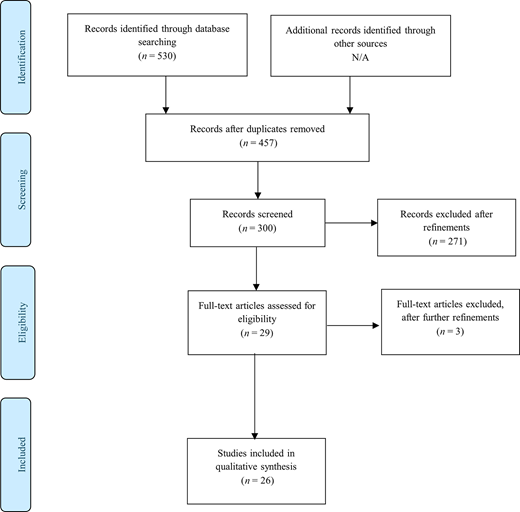
The steps in the PRISMA method are labelled as Identification, Screening, Eligibility and Included – Figure 2. PRISMA method is interlinked, much like a pivot, when examining records, thereby guiding the process with accuracy and reliability (Agrawal et al., 2024). Nevertheless, when using the PRISMA method, there is an associated risk of bias due to researchers having multiple realities and selecting records according to subjective perceptions of a phenomenon (Innocenti et al., 2022). To reduce the risk of bias, records were individually screened using a citation management tool (EndNote). A shareable library was created using EndNote and made available to the authors using Microsoft OneDrive. The authors downloaded the EndNote Library onto their desktop and individually interrogated the records during the Screening, Eligibility and Included stages of the study – Figure 2. After each stage, the authors reconvened with their screened records to discuss which to include or exclude, reducing bias and ensuring validity. Records decreased to align with the research objectives as the authors progressed through the stages of PRISMA.
3.1 Search strategy
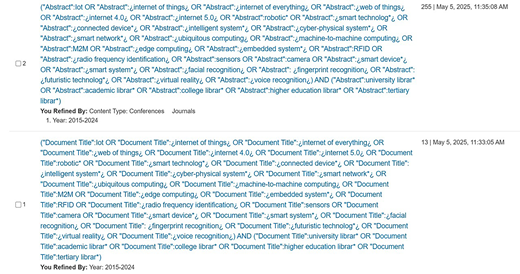
Accuracy and currency are essential when synthesising records using PRISMA criteria (Page et al., 2021). However, before records can be screened, a search strategy must be developed that pinpoints relevant records from databases. The same search keywords developed in the search strategy must be applied in all databases to ensure unbiased searching and transparency. This ensured that records retrieved present a clear picture of the discourse in the literature about a phenomenon. In Figure 1, the authors present a sample of the search history from the Institute for Electrical and Electronics Engineers (IEEE) database. The authors also present keywords in concepts one and two when searching the databases, as shown in Table 1. The search history from the IEEE database includes the keywords from the search strategy developed in Table 1. It also illustrates the date, month and time the search was conducted in the IEEE database on the topic. This study explored the use of IoT in academic libraries, employing a combination of primary and secondary research methods. Concept 1 in Table 1 represents the primary term of IoT, which is interchangeable and associated with other terms. Some of the terms are “connected device”, “intelligent system” and “machine-to-machine computing”. Concept 2 in Table 1 shows the term “higher education libraries”, which is secondary to IoT. Higher education libraries are used as a truncation or wildcard operator with variations such as “university librar*” and “academic librar*” to broaden the search and results.
3.2 Inclusion and exclusion criteria
The IoT has been trending over the past decade as digital-enabled technologies have developed globally (Shaikh et al., 2022). Taking this into consideration, the authors decided to examine the literature from 2014 onwards to gain insight into implementation patterns and challenges of IoT in academic libraries. In systematic reviews, authors can set boundaries and limit publications to a specific timeframe depending on the trajectory of a topic. Page et al. (2021) agree that one can demarcate specific timelines and content to be included or excluded depending on PRISMA and how a topic has evolved in literature. Book reviews, editorials, blogs, book chapters, commentaries, website reviews and trade journals were excluded before the identification stage of PRISMA. Records selected for Identification, Screening and Eligibility consisted only of full-text articles and conference papers. Furthermore, records in languages other than the English dialect were excluded from the study.
3.3 Selected databases and Preferred Reporting Items for Systematic Reviews and Meta-Analyses method
Table 1 presents an iterative search strategy that was developed and used across web of science, scopus and IEEE databases. These databases were relevant and appropriate for searching on the topic. The selected databases were explored using a combination of associated terms and search strings with the “AND” and “OR” boolean operators. Results from the databases were downloaded into EndNote, and then PRISMA criteria were applied to the records. In the first stage of the PRISMA methods, a combined total of 530 records were identified from the databases – Figure 2.
In the Identification stage, the filter option on EndNote was used to remove 73 duplicate records. Then, 457 records were scanned to ascertain alignment with the research questions, resulting in 157 being removed. Thereafter, the two stages of Screening followed, wherein the title/abstract and full text were reviewed. When the titles and abstracts were reviewed, 258 records were removed in Screening One – Figure 2. The full text of the remaining 59 records was screened in Screening Two, and 13 records were removed. In total, 271 records were removed when Screening titles, abstracts and full texts. During the Eligibility stage, 29 records were screened to determine their appropriateness to the research questions. An additional 3 records were excluded after refinement, resulting in 26 records Included in the study – Figure 2.
3.4 Latent dirichlet allocation
The authors still believed that although PRISMA methods reduced bias and increased validity, inclusion, exclusion and appraisal were based on perceived interpretations. With this in mind, the authors decided that the final Included records, as shown in Figure 2, needed interrogation with no human intervention. To do this, an unsupervised machine learning algorithm, Latent Dirichlet Allocation (LDA), cross-examined textual data from Figure 2. Chauhan and Shah (2021) posit that LDA is a natural language processing algorithm commonly used to model topics using Python’s online interactive tools. The LDA places objectivity into a study by identifying clusters/groups of words and phrases that frequently appear in the corpus textual data of records such as PRISMA with no human influence. The reason for running the LDA was not to demonstrate the validity and reliability of the data set or to ascertain whether bias was indeed reduced. The authors aimed to determine whether the textual corpus in the LDA and findings from the PRISMA method, as shown in Figure 2, correlated or if there was an error in judgement in the subjective perceptions of IoTs in academic libraries.
4. Results and findings
In Table 2, the final Included data set is presented on IoTs in academic libraries. Seventeen records explicitly address RQ2 concerning challenges of IoTs in academic libraries, worldwide (SI1, SI2, SI3, SI4, SI5, SI7, SI8, SI12, SI13, SI14, SI15, SI18, SI20, SI23, SI24, SI25, SI26). In records S1, SI3, SI4, S15, S17, SI8, S12, S14, SI23, SI24, SI25, the word “challenges” is used when referring to the “implementation”, “adoption” or “integration” of IoTs in academic libraries – RQ1. Interestingly, when these records in Table 2 are compared to Figure 3, a relationship is evident between Asia, Africa and the Middle East regarding the implementation, adoption, integration and challenges of IoTs in academic libraries. Therefore, we infer from Table 2 that developing countries (India, Pakistan, Iran, Nigeria, Ghana, South Africa and Bangladesh) are grappling with implementing, adopting and integrating IoTs in academic libraries.
4.1 Publications and Internet of Things in academic libraries
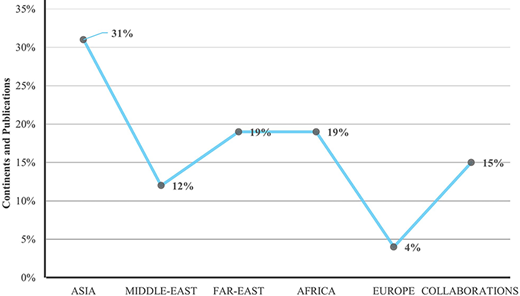
To determine whether the inference in Table 2 is justified, a deeper understanding of the records is unpacked in Figure 3. Asia, with 31%, comprising Bangladesh, Pakistan and India, presents the most publications on IoTs and academic libraries (SI3, S14, SI5, SI9, SI13, SI16, SI24, SI26). In the studies from Bangladesh, Pakistan and India, the main themes that emerged were challenges in adopting and implementing IoTs. Furthermore, the lack of staff training in technological skills and competencies is hindering the integration of IoTs in Asian academic libraries. As a solution, Saha and Roknuzzaman (2024) suggested policy guidelines for implementing IoTs in academic libraries. Pakistan also collaborated with China and Canada (SI15) in exploring the willingness to adopt IoT technologies in academic libraries. The findings underscore the use of technological innovations in supporting and adopting IoTs in Pakistan, Canada and China. Similarly, Saudi Arabia and Pakistan also collaborated (S125) on exploring the topic. The main findings indicated a lack of technical infrastructure, security and privacy concerns in the implementation of IoTs. Furthermore, a lack of technological skills and the unavailability of policy and strategic planning are impeding the successful adoption of IoT applications in university libraries. In the Middle East, studies from the United Arab Emirates (SI1) and Iran (SI12, SI23) reveal that IoTs have the potential to enhance service delivery in academic libraries. However, there is a challenge since academic libraries lack the technical knowledge infrastructure to implement IoTs. One of the main concerns emanating from these studies is the training needs for staff regarding IoTs. In Africa (SI2, SI7, SI21, SI22), similar patterns exist as in Asia, with IoTs and concerns surrounding implementation, skills, competencies and limited budgets. Thus, the inference from Table 2 correlates with the findings in Figure 3. Consequently, India, Pakistan, Iran, Nigeria, Ghana, South Africa and Bangladesh are grappling with challenges in the adoption, implementation and integration of IoTs. We also found that this was not the case in China (SI6). While concerns exist around staff training, privacy and security, the integration of IoTs was not identified as a challenge. In the Far East, records (SI8, SI10, SI11, SI14, SI17) show concern when implementing IoT technologies, such as biometrics. Still, these are technical issues that are resolved during the implementation stages of new technologies. Countries in the Far East seem to have navigated the policy and adoption stages and are busy implementing IoTs in academic libraries. Besides Italy (SI19), there is limited literature pointing to the challenges of IoT in developed countries. Even in the Italian study, the conversation was focusing on experimenting with multisensory platforms that have the potential to enhance the preservation of books and paper documents in library storage. It seems that the Global North has moved beyond the implementation of IoT in academic libraries, while the Global South faces barriers to adoption, implementation and integration of IoT in academic libraries.
4.2 Research design and Internet of Things in academic libraries
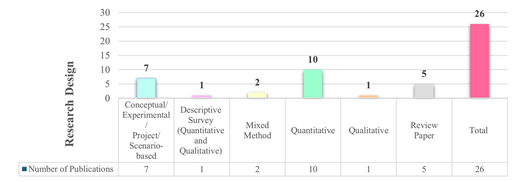
Figure 4 further illustrates the disparity between the Global North and South in terms of challenges and the implementation of IoTs in academic libraries. China, Indonesia and Taiwan are the only countries in the Global South (Far East) that display technological prowess in IoT and academic libraries. In studies (SI8, SI10, SI11, S117, S119) and SI20, the debate is on the conceptualisation and delivery of new IoT technologies for academic libraries to enhance services, systems and user experiences. While in studies (SI1, SI2, SI3, SI4, SI5, SI7, SI9, SI12, SI13, SI16, SI18, SI21, SI22, SI23, SI24, SI25, SI26), also emanating from the Global South, the discussions are focused on determining how to address the challenges of implementing IoTs. These studies (SI1, SI3, SI5, SI7, SI9, SI12, SI13, SI16, SI18, SI21, SI22, SI23, SI24, SI25, SI26) explored IoTs using approaches such as reviews, quantitative, and only two studies (SI2 and SI4) adopted mixed-method designs. This constitutes approximately 65% of records that emerged from the Global South using reviews and quantitative methods to address implementation issues and challenges in IoT and academic libraries. In Figure 4, the project-based paper from India (SI9), is quantified with the conceptual, experimental and scenario-based papers. However, the focus in SI9 was on a proposed solution to surveillance and smart accessibility systems with no implementation mechanisms. This pattern is the current norm in the Global South compared to the North, except for the Far East. It is also noteworthy that dialogues in China are slowly moving towards feedback from academic librarians to support the implementation strategies of IoT in academic libraries through qualitative studies – Figure 3. However, there is a need for more qualitative and mixed-method studies as the debate on IoT implementation and challenges gains momentum in the global discourse.
4.3 Latent Dirichlet Allocation and Internet of Things in academic libraries
A coherence score was calculated to determine the optimal number of topics for the LDA model. Using this score, the analysis revealed two distinct topics, reflecting the main themes discussed in the 26 selected articles.
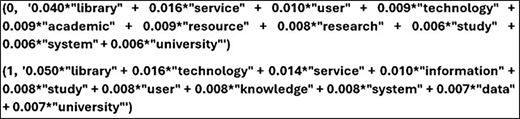
Figure 5 presents the most common keywords and their associated weights within each topic, highlighting the main themes that emerged from the LDA modelling. These keywords and their corresponding weights were automatically generated by the LDA algorithm implemented in Python and examined using an interactive visualisation tool in Python. The LDA algorithm assigns weights to key terms within each topic based on how frequently they appear across the collection of textual data. The themes for each topic were derived by examining the words with the highest weights and most frequent occurrences linked to that topic. Topic 0 focuses on the service role of academic libraries and how IoT tools could be used to improve the student and user experience. The occurrence of keywords like “library”, “service”, “user”, “technology” and “academic” suggests that IoT is often discussed as a tool to make academic libraries more interactive and useful for teaching and research support. This aligns with the review findings that IoT has clear benefits for better access to resources and improved library services. At the same time, the absence of the term “IoT” in the topic modelling also reflects the slow adoption of IoT, as many libraries face challenges with resources, infrastructure and institutional support.
Topic 1 highlights the technical side of IoT adoption, with words such as “technology”, “information”, “system”, “data” and “university”. This points to a focus on the systems and information structures needed for IoT to work in academic libraries. The results link with the challenges found in the literature around data management, costs, interoperability and lack of expertise. These barriers explain why IoT adoption in academic libraries remains slow, particularly in contexts where the digital divide limits access to advanced technologies, such as in developing countries.
Table 3 demonstrates the assignment of themes to each topic based on the dominant keywords. Topic 0 is characterised as “IoT for Service Delivery and User Support in Academic Libraries” because the prevalence of words such as “library”, “service”, “user” and “resource” points clearly to how IoT is positioned around service enhancement and academic support. Topic 1 is defined as “Technological and Infrastructural Aspects of IoT in Academic Libraries” since the frequent appearance of terms like “technology”, “information”, “system” and “data” indicates that this theme is shaped by the underlying systems and structures required for IoT integration.
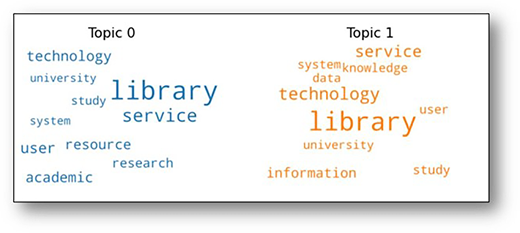
Figure 6 presents a word cloud that visually represents the dominant terms identified within each topic using the LDA topic modelling technique. The word cloud provides an immediate visual impression of the most frequent and strongly weighted words from the reviewed literature. Each word’s size corresponds to its weighting within the topic, showing its relative importance. Larger words such as “library”, “service”, “user”, “technology” and “academic” in Topic 0 reflect the central focus on the provision of library services and resources in higher education, particularly how IoT technologies are being integrated into academic libraries to improve the user and student experience. This theme aligns with the systematic review findings, which highlight that while IoT holds strong potential to enhance library services and improve the user experience, adoption has been slow due to barriers such as limited resources, infrastructural constraints and the digital divide.
In contrast, Topic 1 highlights the technical perspective of IoT adoption, with dominant words such as “technology”, “information”, “system”, “data” and “university”. This points to a focus on the technical systems and information structures required for IoT to function effectively in academic libraries. The results align with challenges reported in the literature, including issues of data privacy, high costs, interoperability and limited technical expertise. These challenges explain why IoT adoption in academic libraries remains slow, particularly in contexts where the digital divide restricts access to advanced technologies, such as in developing countries.
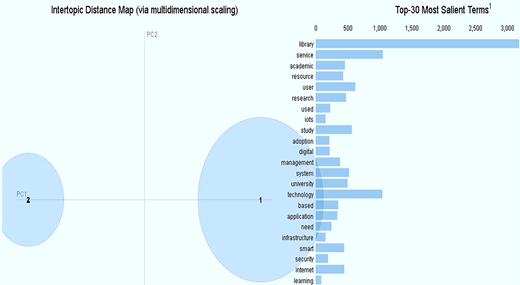
Figure 7 presents the top 30 salient terms emerging from the LDA analysis, reflecting how IoT in academic libraries is framed within the literature. Prominent terms such as “library”, “service”, “academic”, “resource”, “user” and “research” underscore the institutional role of academic libraries in supporting academic communities, such as students and researchers, and managing information resources. At the same time, the occurrence of terms like “system”, “infrastructure”, “technology”, “digital”, “security” and “internet” points to the technical foundations required for IoT adoption, particularly in relation to system management, smart applications and secure digital environments.
However, the terms “iots”, “infrastructure”, “management” and “adoption” bring forth the challenges in IoT implementation and academic libraries. “Infrastructure” and “technology” highlight the costs and resource demands of adopting digital systems capable of supporting IoT, whilst “management” points to gaps in governance frameworks, policy, security, interoperability and regulation of data privacy. The recurring emphasis on “adoption” reflects the fact that while IoT holds transformative potential, its uptake in academic libraries remains slow, especially in developing contexts where the digital divide further restricts access to advanced infrastructure and expertise. In addition, Figure 7 illustrates the distribution of the two identified topics across the 26 identified articles, alongside the top 30 prevalent terms emerging from these selected papers. In this diagram, Topic 0 is labelled as “1” and Topic 1 as “2”. The size of each circle reflects the topic’s dominance across the data set, with larger circles indicating stronger prominence.
5. Discussions
The study explored the implementation, adoption and challenges of IoT in academic libraries from a global perspective. Findings affirm that academic libraries recognise IoT as an enabler for library services. However, there are noticeable differences in IoT adoption and academic libraries between the Global North and South. In the Global South, academic library practitioners and researchers lament delays in the implementation and adoption of IoTs due to challenges. Numerous studies in the Global South reveal issues related to policy guidelines, IoT infrastructure, integration, adoption, adaptability, awareness, stagnant digital transformation, skills development, training and a lack of funding, hindering the adoption of IoTs in academic libraries (Amoah and Minishi-Majanja, 2023; Asim and Arif, 2023; Asim et al., 2022b; Bagavathi, 2023a; Eiriemiokhale and Olutola, 2023; Harati et al., 2021; Kaushik, 2019; Khan et al., 2022; Kumar, 2023; Masenya, 2024; Ocholla and Ocholla, 2020; Oyedokun, 2024; Razavi et al., 2021; Saha and Roknuzzaman, 2024; Shahzad et al., 2024). These challenges in the Global South infer that IoT is a disruptive innovation that has positively challenged traditional methods and the levels of digital transformation in academic libraries. Eiriemiokhale and Olutola (2023)concur that issues such as power outages, the need for training tech-inclined users, budget cuts, and the high costs of IoT installation hinder progress in the Global South. These issues are linked to the reality that academic libraries in the Global South still lack adequate infrastructure and resources. With all these challenges, 4IR is beginning to shape the discourses in the Global South, showing signs of acceleration; however, emerging technologies associated with IoTs show minimal growth (Ocholla and Ocholla, 2020; Saha and Roknuzzaman, 2024).
In Africa, the adoption of IoT for information accessibility and resource management in academic libraries remains limited, primarily due to challenges in infrastructure, training, organisational barriers, user acceptance and staff training (Maina, 2023). Furthermore, there is a lack of frameworks focusing on sustainability, implementation and adoption strategies for IoT in African academic libraries (Boateng et al., 2025). From this, one can presume that IoT is relatively new and, therefore, there are complexities in adoption, implementation and integration (Igbinovia and Okuonghae, 2021). It seems that scarcity of policies, guidelines, frameworks and resources in Africa and the larger Global South acts as a barrier to the integration, implementation and adoption of IoT (Oyedokun, 2024; Ocholla and Ocholla, 2020; Agboke and Oladokun, 2024; Boateng et al., 2025). This highlights the need for international library organisations, such as the International Federation of Library Associations and the United Nations Educational, Scientific and Cultural Organization, to prioritise assisting with solutions for integrating IoT into the Global South.
In this study, findings in the Global North differ from those in the Global South. Academic libraries and library researchers in the Global South are focused on policy, implementation and adaptability of IoT (Saha and Roknuzzaman, 2024; Asim et al., 2022b; Shahzad et al., 2024; Sinha and Singh Brar, 2024; Amoah and Minishi-Majanja, 2023). Juxtapose, in the Global North, the lens is on smart library buildings, innovations and collaboration for effective IoT integration into service delivery (Cheung et al., 2023; Khan et al., 2022; Monti et al., 2019). The authors, therefore, infer that the Global North cannot be associated with under-resourced environments and infrastructures in the adoption and implementation of IoT that may exist in the Global South. In North America, IoT and AI-related technologies are already integrated into the daily operations of academic libraries. Thus, the literature and findings confirm that American, Canadian and Italian academic libraries are using products that incorporate IoT technologies to support the academic agenda in higher education (Cheung et al., 2023; Khan et al., 2022; Monti et al., 2019). Furthermore, IoT is currently associated with emerging technologies or challenges in the Global South. Conversely, IoT and emerging technologies are being fluidly integrated into academic libraries in the Global North (Cheung et al., 2023). Library users can access and utilise a shared pool of interconnected computing resources, including storage, servers and software applications, via the internet (Ibrahim et al., 2025). Furthermore, IoT technologies in the Global North enable cloud-based solutions, allowing for efficient management and storage of digital materials, including research papers, e-books and multimedia content (Sivankalai, 2021). In addition, although academic libraries in the Global South and North confirm the importance of scalability and interoperability of IoT, the challenges faced are of a different nature. Still, there is also a common challenge faced in both the South and North related to skills development and training of library staff in relation to IoT. Unsurprisingly, countries in the Far East that belong to the Global South are the only exception, as there is less concern surrounding IoT policy, implementation, infrastructure, adaptability and scalability. In countries such as China, Taiwan and Indonesia, the challenges are like those in the Global North, with technical complexities during the implementation of IoT technology at the forefront.
The study presents differing views from the Global South and North related to policy development, financial implications and infrastructure. Differing views exist in the IoT discourses concerning the Global South and North debate. Yet, similarities are prevalent in some instances with issues concerning IoT adoption, implementation, training and skills development, although with diverging challenges. This study further highlights that in the Global North, academic libraries are concerned with the sustainability of innovation and collaboration in IoT, with a lesser focus on policy, financial implications and infrastructure. Boateng et al. (2025) concur with the findings from the Global North and also agree that IoT adoption in academic libraries in the Global South is hindered due to inadequate strategic direction and financial constraints.
Within the context of leading publications, Global South is leading in publications aligning with the research questions of this study on challenges, implementation and adoption of IoTs (Figure 3). Asia makes a notable contribution of 31% to IoT in academic libraries, followed by Africa and the Far East with 19%, the Middle East with 12%, Europe with 4% and Collaborations with 15%. The collaborations mainly exist between China and America, with Canada, Mauritius, Tunisia and Pakistan also networking to publish on IoT in academic libraries. Findings in the collaborations also establish the disparities in challenges related to the implementation and the adoption of IoT in the Global South and North. Furthermore, when the synthesis of the records using PRISMA methods is correlated with the corpus data from the LDA, the authors were able to understand why the Global South dominates the academic discourse compared to the North. The Global South, excluding the Far East, is currently facing challenges with policy formulation, implementation, adoption, scalability, interoperability, integration, infrastructure, cost implications and skills development of IoTs. While Global North also has challenges, the focus is on technical complexities, staff training and development. Therefore, the discourses emanating from the Global South are dominating the extant literature as the focus is on finding solutions to technocentric challenges with limited financial muscle and strategic direction on IoT in academic libraries.
6. Conclusion and recommendations
This study aimed to examine the presence of IoT in academic libraries from a global perspective. The findings showed significant differences regarding the study phenomenon. Common findings related to the challenges of policy formulation, integration, adoption and implementation of IoT in the Global South. These issues are often connected to a lack of resources and inadequate infrastructure. In contrast, in the Global North, resources and infrastructure are available; however, their concerns focus on ongoing innovations and collaboration between academic libraries and IoT experts. To support these findings, the study effectively employed PRISMA and LDA. Ultimately, the study recommends the following improvements for IoT, especially in the Global South:
In the emerging IoT era, global library organisational bodies need to develop frameworks, guidelines and standards that will help academic libraries in the Global South to improve the implementation, adoption and integration of IoT in their library spaces.
To challenge researchers, governments, libraries and cooperatives to quickly develop potential solutions for investing in relevant infrastructure, enabling better IoT adoption in the Global South, especially within academic libraries.
This study explored global perspectives on IoT in academic libraries. It encourages researchers interested in this phenomenon to investigate further issues of IoT through empirical single case studies, focusing on specific academic libraries. In addition, there is an opportunity for librarians from various academic institutions to collaborate and examine a similar topic from different viewpoints.
Whilst the study offers valuable insights, it is essential to acknowledge certain limitations inherent to systematic reviews, including this one. Although the authors limited subjectivity by screening the records individually, ultimately, researchers are human, and bias can emerge from our multiple realities and perceptions. The authors increased the validity and reliability of the data by cross-checking the data set selected from the PRISMA method using the LDA. Despite this, the findings were limited only to data from the IEEE, Scopus and Web of Science databases. Future studies should widen the scope using a wider range of databases. Furthermore, a more exhaustive approach can be considered when conducting systematic reviews and bibliometrics on the topic by using mixed-method designs to explore the extant data from literature.