This paper highlights a crucial public safety issue due to falling objects from tall residential buildings in Singapore. A systematic façade inspection regime and a system of evaluation of severity for the detection and assessment of potential falling objects from tall buildings are presented.
The research uses qualitative case study approach with 450 tall residential buildings sampled for the study. The common materials, elements, components with high risk of falling objects, the nature and type of the falling, the critical factors affecting the falling, the respective level of severity, and the effectiveness of various diagnostic techniques and protocols, are summarised.
Façade for tall residential buildings in Singapore comprises mainly cementitious materials cast in situ or precast, with fixtures and architectural features, all of which have potential of falling. The common anomalies arising from each material and fixture/features are identified, the causes evaluated and their implications to future design, construction and maintenance analysed.
This study provides original and significant information to a crucial public safety issue, setting design and construction criteria that will serve as a benchmark for new and existing facades, applicable to all cities dominated by tall buildings. The paper presents original figures, checklists and guides as a basis for readers' consideration to use according to their respective unique conditions.
Introduction
In the year 2018, the percentage of public residential building in Singapore exceeding the age of 20 and 30 years were 74 and 56%, respectively (Figures 1 and 2). It is not surprising that more and more incidents of falling objects from height have occurred. The city has reported more than 90 incidents in the past three years where parts of facades fell off (Plate 1). Not only have these cases appeared on media headlines, they have gone all the way into the parliament as a serious public safety issue.
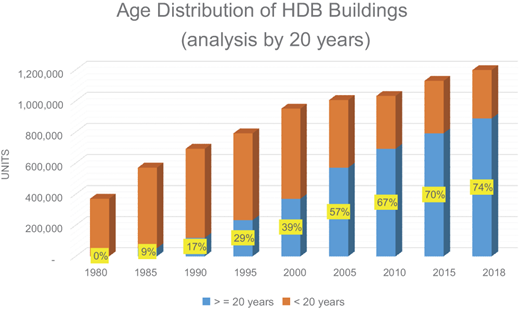
Percentage of public residential building in Singapore exceeding the age of 20 years
Percentage of public residential building in Singapore exceeding the age of 20 years
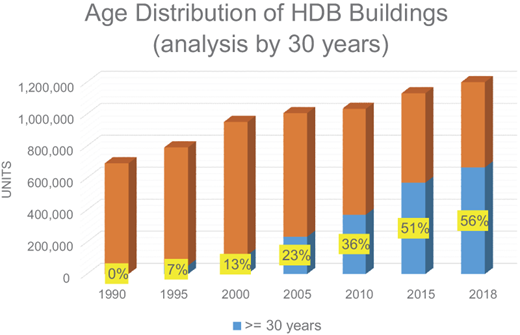
Percentage of public residential building in Singapore exceeding the age of 30 years
Percentage of public residential building in Singapore exceeding the age of 30 years
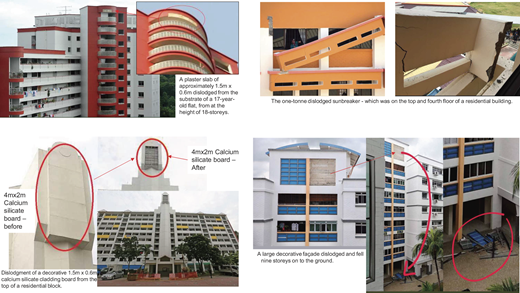
Examples of recent cases of falling objects from height of public residential buildings in Singapore
Examples of recent cases of falling objects from height of public residential buildings in Singapore
A new legislation on periodic façade inspection (PFI) was passed in Singapore on 6 March 2020, subjecting facades of older tall buildings for a mandatory inspection every seven years by a qualified person for potential falling objects. This new inspection regime is applicable to all buildings taller than 13 m and older than 20 years.
This paper discusses a study designed to evaluate the causes of common falling cases and the roles of relevant professionals in preventing or mitigating such occurrences on the outset of the planning/design stage. A systematic façade inspection regime and a system of evaluation of severity, for the detection and assessment of potential falling objects from tall buildings are presented.
Methodology
The state-of-the-art of regional and global counterparts in terms of standards and best practices for façade inspection and maintainability to prevent falling objects from tall buildings were reviewed. Relevant global standards relating to maintainability factors (e.g. SS, BS, ISO, EN, AS and ASTM) were incorporated in the databank as the foundation phase for the creation of a viable and evidenced based appraisal system.
Case and field study of commonly occurring problems that may lead to falling objects from 450 tall residential buildings were conducted with consideration of factors shown in Table 1.
Factors considered for case and field studies
| Façade components | Factors considered |
|---|---|
| Structural |
|
| Architectural |
|
| Services |
|
Face-to-face interviews and workshops with the respective professionals involved in the design, construction and operation of the buildings were conducted for detailed investigation on each problem for their (1) problem types; (2) extent of problem; (3) failure mechanism; (4) good practices in design/construction/FM and (5) environmental issues.
Results and discussions
Periodic façade inspection
Legislations worldwide similar in principles to that of Singapore's PFI include:
US (ASTM, 2019a, b) –
1990 – Chicago – Maintenance of Exterior Walls and Enclosures (>80 ft, different intervals)
1998 – New York–Periodic Inspection of Exterior Walls and Appurtenances of Buildings (>6 storeys, every 5 years)
Other states include: Columbus, Pittsburgh, Boston, Cincinnati, Cleveland, Detroit, Milwaukee, Philadelphia, St Louis, San Francisco
Canada – Quebec – Bill 122 (≥5 storeys, every 5 years)
HK – 2012 - Mandatory Building Inspection Scheme (age>30, every 10 years) (HK Government Building Department, 2017)
Singapore – 2020 – Building Control Act (≥13 m, age>20 years, every 7 years)
Singapore's PFI requires a 2-stage investigation:
Stage 1 - Visual inspection of the entire façade area
Visual inspection of the condition of the entire (100%) building façade elements from ground level or other available vantage points and openings; Use of drone mounted with optical cameras and/or infra-red/laser detectors.
Detect dilapidation and displacement of façade elements
Stage 2 - Close-up hands-on inspection of each elevation
Minimum of 10% close-up “hands-on inspection” to be carried out for each building face (elevation)
Inspection may include tapping, localised removal of façade elements or panels for inspections and material testing to ascertain the deterioration level and/or integrity of the façade elements, if required;
Determination of whether such defects, deterioration are of any concern; and
Recommendation of remedial measures to be carried out.
For building with wide spread defects observed, the Competent Person may recommend a full facade investigation of localised areas or the whole building for BCA's consideration and approval prior to the fall.
Types of façade
A building facade essentially falls into one of the following four types:
Mass wall
Masonry
Reinforced concrete
Barrier wall
PC panel, GRP, GRC etc
Metal cladding
Exterior insulation and finish system (EIFS)
Rainscreen (cavity) wall
Brick cavity
Rainscreen cladding
Curtain wall
Stick system
Unitised system
with their characteristics summarised in Figure 3.
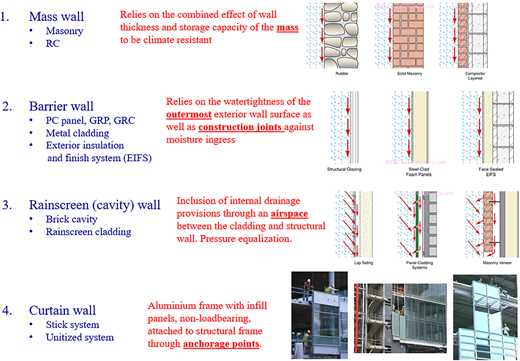
Four major types of building façade
Four major types of building façade
As most residential buildings in Singapore fall under Type 1 and Type 2, this paper focuses on mass and barrier walls.
Potential falling objects
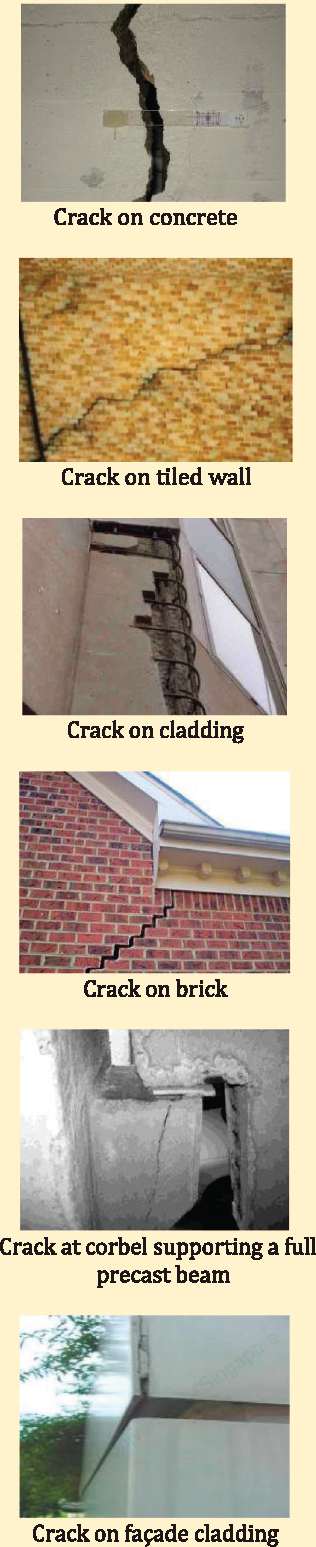
Common anomalies of different “materials” and “features” which would lead to falling objects are summarised in Figures 4 and 5 (Chew, 2016, Chew et al., 2018).
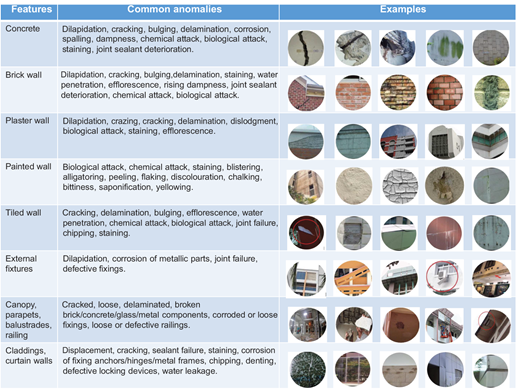
Common anomalies from different façade materials
Common anomalies from different façade materials
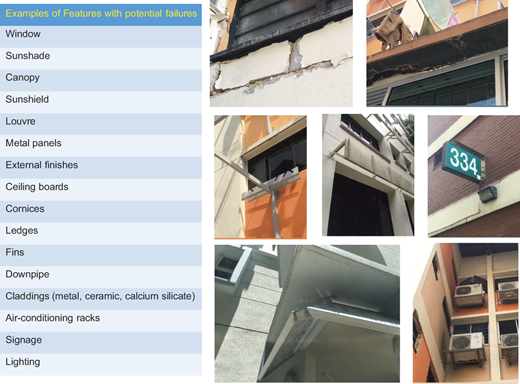
Common anomalies from different façade features
Common anomalies from different façade features
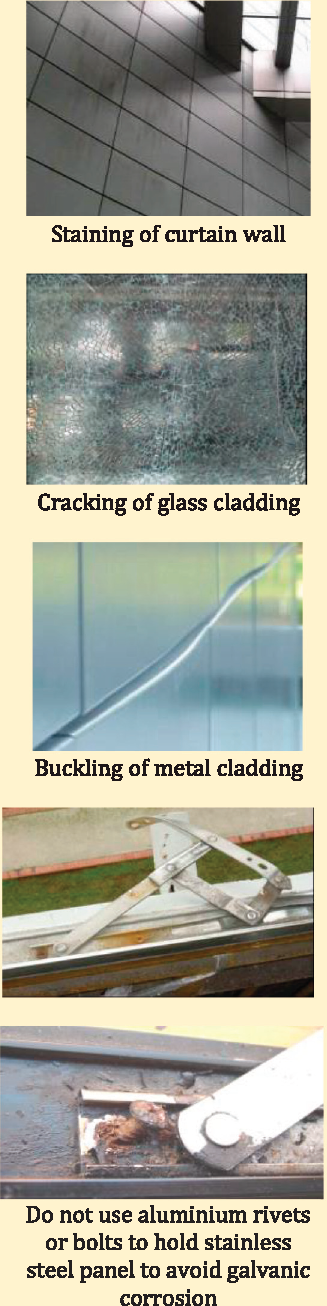
One other potentially high fatal falling object is falling windows. Figure 6 shows the statistics of window falling off from tall buildings in Singapore. Investigations show that about 80% of the fallen windows were casement windows. The majority of them had fallen due to corrosion of the aluminium rivets holding the friction stays, as well as improper design; installation; maintenance; and wear and tear of the friction stays.
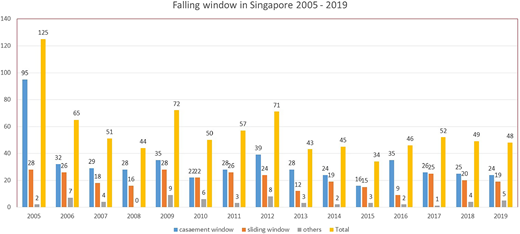
Statistics of falling window from tall buildings in Singapore
Statistics of falling window from tall buildings in Singapore
Façade inspection
Table 2 shows an example of inspection checklist for both Stage 1 and Stage 2.
Stage 1 - visual inspection of the entire façade area
This is the stage to assess the general condition of the building under inspection. Visual aids such as binoculars, cameras with powerful zoom, drones mounted with optical cameras and/or infra-red/laser detectors (Chew et al., 1997, Chew, 1998) are some of the methods used (Plate 2). Areas with dilapidation and displacement of façade elements are identified, together with areas with potential falling objects (latent defects), for detailed investigation in Stage 2.
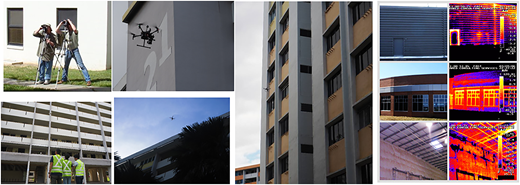
Stage 1 - visual investigation for 100% of the façade surface area
Stage 1 - visual investigation for 100% of the façade surface area
Stage 2 - close-up hands-on inspection of each elevation
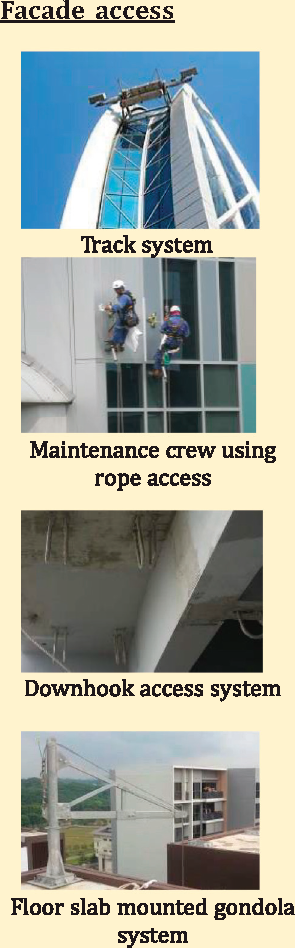
This is the stage to conduct close-up hands-on inspection of at least 10% of each elevation, as identified from Stage 1. This stage requires the deployment of façade access systems. A variety of instrumentation from tapping to non-destructive and destructive tests may be utilised to examine the extent and severity of the anomalies (Chew, 1992, 1999a, b, c, 2000a, b, c, Chew et al., 2001). Recommendations for remedial measures are made based on risk evaluation of the results (Table 3). For building with wide spread defects observed, a full facade investigation of Stage 2 may be recommended.
A recommended benchmark for risk index
| Risk index | Description | Definition |
|---|---|---|
| High risk | Intolerable | Blow whistle. Activate emergency SOP. Provide immediately temporary public safety features, e.g. netting, cordon etc. |
| Medium risk | Undesirable | Latent defects imminent. Inform all relevant parties. Recommend remedial actions |
| Low risk | Tolerable | Documentation for future maintenance and inspection to ensure the risk is kept to minimum |
Summary of results
Tables 4–6 summarise:
Lessons learnt from past and present mistakes, showing the causations of the anomaly, who is responsible for what and how to prevent the occurrence of the anomaly and
Recommendations for new buildings in the future, to consider issues related to design, construction and maintenance at the outset of the planning stage, to prevent the occurrence of falling objects from facades, with relevant international standards specified.
Façade – structural
| Problem | Design | Construction | Maintenance |
|---|---|---|---|
Cracks
| Tall slender concrete structures should be designed with due consideration of the effects of lateral deflection, and be within acceptable vibration limits in accordance with BS EN 1992-1-1, SS EN 1992-1-2, CP 65-1 or equivalent. Any deflection/deformation of the concrete structure due to vertical loading should be compatible to the degree of movement acceptable by other elements (i.e. the finishes, services, partition, glazing, and cladding) in accordance with BS EN 1992-1-1 or equivalent. Limit States Method should be considered for design and verification for durability of facade structures. Refer to modelling of deterioration process in accordance with ISO 13823 or equivalent. The causes, effects, and methods of prevention and repair for cracks (e.g. longitudinal cracks, transverse cracks, cracks above prestressing strands, web crack at or near the prestressing strands, corner crack, and miscellaneous cracks) in precast concrete wall panels should be considered and applied in accordance with BS EN 13369, CP 81 or equivalent. Limit the design crack width with reference to CP 65-2 or equivalent. Laboratory mechanical tests should be carried out to measure deformations on horizontal joints between load-bearing walls and concrete floors in accordance with ISO 7845 or equivalent. | Use two-stage joints for precast façade construction to ensure higher water-tightness performance, since doing so avoids seepage through hairline cracks — as is the case with one-stage joints in accordance with SS EN 1992-1-2 or equivalent. Seal off horizontal joints for load bearing walls with non-shrink grout. Minimise cracks in rendered brick walls by using appropriate mix ratio, thickness and number of coats. Provide bonding bars at interfaces between different material in order to minimise cracks (e.g where brick wall abuts concrete). Alternatively, the bonding bars can be cast together with the concrete member (Perkin, 2002). At the completion of the construction stage, minor repair work or fixing adjustments may be acceptable. Enhance the durability of vulnerable parts of construction; ensure that surfaces exposed to water are freely drained; provide adequate cover to steel; use protective coatings for either steel or the concrete, or both in accordance with BS EN 1992-1-1, SS EN 1992-1-1, SS EN 1992-1-2, SS CP 65-1 or equivalent Make accessible components of which predicted service life is less than the design life of the structure for inspection, and replace them in accordance with ISO 13823 or equivalent | For decisions on surface repair, consider the ease of access for future work, relative cost of hiring and erecting scaffolding, and the probable frequency of maintenance in accordance with BS 8221-2, SS 509-2 or equivalent. Record and retain documentation of all executed works on façades, including photographs and non-destructive survey techniques, to provide background information prior to further assessment or work. Cary out semi-annual inspections of stone-wall elements and inspect all elevations. Keep accurate and cumulative records of inspection findings in accordance with ASTM C1496-18, BS 8298-1 or equivalent Regular cleaning is critical for the long-term durability and appearance of natural stone facades. Perform periodic joint repairs, (i.e. sealant replacement, tuck pointing, and cleaning) in accordance with ASTM C1496-18, BS 8298-1 or equivalent Perform repairs and restoration works in accordance with ASTM C1722-18, BS 8221-2 or equivalent For cases of cracked or broken stones, carry out the following: a) Seek assistance for stone replacement; b) Tuck point or caulk crack with sealant if fragments are stable and secure; c) Monitor closely for additional cracking or movement Monitor joints for continued movement in accordance with ASTM C1496-18, BS 8298-1 or equivalent |
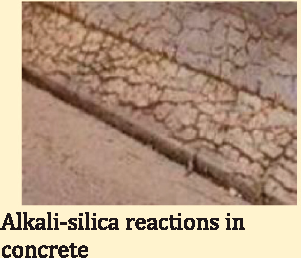
Alkali-Silica reaction (ASR)
| Carefully analyse all cementitious material and aggregates during material selection and sourcing. Specify the use of non-reactive aggregates. Recommend low alkali cement, and take steps to prevent alkaline solutions from coming into contact with and penetrating the concrete (BCA, 2004). | Use information from field performance history to determine the susceptibility of ASR. Perform testing for ASR in cementitious materials and aggregate in mortar bars in accordance with ASTM C1567-13/ASTM C1293-20 or equivalent. | Where there is potential for ASR, be on the lookout for typical visual symptoms such as: unusual expansion of concrete, evidenced by longitudinal cracks; map cracking (random cracking pattern); closed joints; spalled surfaces; displacement of adjacent structural components; pop-outs; |
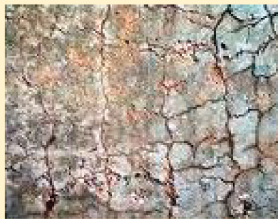
| Test aggregate supply to determine potential reactivity in accordance with ASTM C227-10, ASTM C1260-14, ASTM 295/C295M-19, BS EN 932-5, BS 812-123 or equivalent. | If historical experience or test results show a potential concern, provide additional supplementary cementitious materials (SCMs) to inhibit ASR in accordance with ASTM C618-19, ASTM C989/C989M-18a or equivalent. | efflorescence (surface deposits); or discolouration (dark or blotchy areas). Identify ASR using a petrographic microscope in accordance with ASTM C856/C856M-20, electron microscopy, or an ASR detect kit (coloured dye field test kit). |
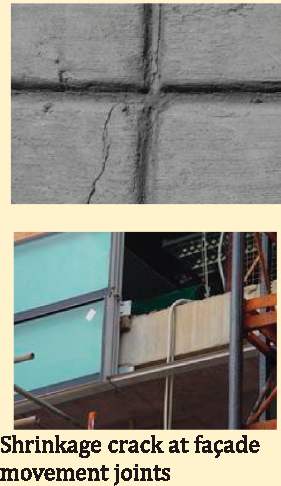
Movement joints
| Use suitable joints to accommodate movement in accordance with BS EN 13830, CP 96 for sealant classification and selection criteria. For joint design in precast concrete refer to BS 6093, BS EN 14992, CP 81 or equivalent Specify two-stage joint for joints of external façade and walls to ensure durable waterproofing in accordance with BS 6213, SS 637 or equivalent. | Adopt the requirements in forming movement joints in accordance with BS EN 1992-1-1, BS 6093, CP 65-1 or equivalent. Joint should prevent movement, spread of flame, transmission of airborne sound between dwellings and be weather-tight (if external) in accordance with BS EN 13369, CP 81or equivalent. Use overlapping to ensure water-tightness even under vertical movements. | A visual inspection of the façade is key in identifying defects in movement joints. Inspections for general defects and moisture ingress can be carried out either quarterly or during façade cleaning exercises. Recommend housekeeping of joints by cleaning on a routine basis to remove any dirt or debris that may inhibit their movement. Carry out repair at movement joints through proper re-application of sealants. |
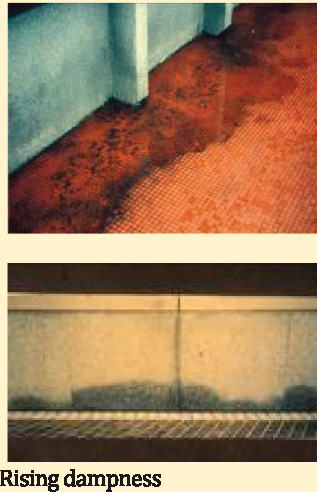
Rising dampness
| Implement proper waterproofing design detailing for reinforced concrete structures. To avoid rising dampness, use suitable DPM/DPC for the site ground conditions in accordance with SS637 or equivalent Concrete façade design needs to take into consideration a sound understanding of the exposure conditions on site in accordance with BS EN 1992-1-1 or equivalent Specify a dense concrete with minimum water to cement ratio to reduce permeability as permeability is closely related to concrete durability. | Provide adequate damp-proof course/membrane at a height of at least 150 mm above the surrounding finished floor level, to prevent upward movement of moisture through capillary action or rainwater bouncing off the ground. Provide adequate surface drainage and adequate coating, and/or hydrophobic materials, and/or chemical injection as moisture barrier in accordance with BS 8215, BS6576 or equivalent. | Identify tell-tale signs of moisture entry/rising dampness (e.g. wetness, staining, darkening due to trapped moisture, discolouration and/or efflorescence deposits). Diagnose rising dampness through surface-breaking flaws with a liquid penetration test. To remedy rising damp, expose lower surfaces of façade and allow drying; then damp-proof and provide additional drainage in accordance with ASTM C1496-18, BS 8298-1 or equivalent. |
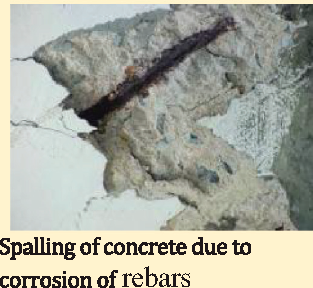
Corrosion of RC
| Adopt the general reinforced concrete requirements in accordance with ISO 15673 or equivalent Adopt the general rules for designing concrete and steel composite structures in accordance with BS EN 1994-1-1, SS EN 1994-1 or equivalent | Ensure reinforcements are surrounded with adequate thickness of good quality, well-compacted, homogeneous concrete, free from honeycombing or other defects. Perform material selection with the aim to reduce chloride content in concrete in mind, so as to reduce corrosion risk of embedded metal. | Carry out appropriate maintenance of the fenestration product and its interfaces with the wall system to ensure long-term delivery of the desired water penetration resistance. Maintain records of building use, maintenance and performance problems, as well as responses to those problems in accordance with ASTM E241-09 or equivalent. |
Façade – Architectural
| Problem | Design | Construction | Maintenance |
|---|---|---|---|
Material selection & handling
| Design curtain walls to withstand live loads resulting from regular maintenance activities in accordance with BS EN 13830, CP 96 or equivalent. Recommend materials for curtain wall elements in accordance with BS EN 13830, CP 96 or equivalent Classify clay and calcium silicate brickwork and select the appropriate maintenance method in accordance with BS 8221-1, SS 509-1 or equivalent. For fa çade hardware and other components such as mullions, panels, fascia, column covers, windows, doors, trim, roofing, gutters, and flashing, use a material that is corrosion-resistant. If different metallic materials are intended, such material should be compatible for both contact and run-off to avid galvanic corrosion and the like in accordance with ISO 15686-1 or equivalent. For supporting components for architectural features such as curtain walls, cladding, sun breakers signboards, friction stay for casement windows etc., use stainless steel or non-corrosive materials. Do not use any form of adhesive for dry-fixed stone cladding and external wall tiles. Recommend use of locally green certified wall products such as glass, sealant, blocks and wall panels (SGBC, online). | Strict supervision is recommended to achieve quality for surface evenness, finishing, and alignment without noticeable staining or cracking. Refer to relevant façade material standards as per CONQUAS (BCA, 2017). Precast walling components should be transported, handled and stored so as to avoid damages. Handle material as per guidelines set out in SS CP 81, BS EN 13369 or equivalent. Components of structural timberwork should be fabricated, stored and handled on site in accordance with BS EN 1995-1-1, CP 7 or equivalent. Designers and Builders should prepare and hand over an Operation and Maintenance Manual to the owner/building manager during commissioning in accordance with ASTM E2266-11 or equivalent | Adhesion of structural/weather seal sealants should be inspected and tested. Movement failures, moisture, condensation, and the condition of the organic coatings on metal surfaces should be checked in accordance with ASTM C1401-14 or equivalent. All buildings with wall cladding should be inspected every 6 to 12 months for deterioration of aluminium framing. Condition of coating, hardware, glass, sealants and weather seals should be checked on in accordance with CP 96, BS EN 13830 or equivalent. Proper maintenance should be carried out on structural timberwork components to maintain effectivity during the intended lifespan in accordance with BS EN 1995-1-1, CP 7 or equivalent. |
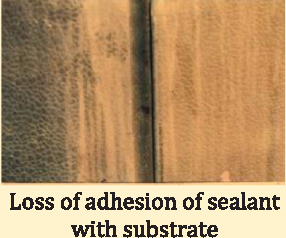
Sealant deterioration
| Select sealant joint type and mode of application in accordance with BS 6213, CP 96; including requirements for quality management programme. Adopt the guidelines on the selection of construction sealants in accordance with BS 8221-2, SS 509 or equivalent. For grading of sealant (i.e. pourable or non-sag), refer to | Apply sealants in accordance with recommended guidelines in BS 8000-0, BS 6093, CP 96 or equivalent Perform dynamic peel test and dynamic tensile test on structural sealants in accordance with ISO 28278-2 or equivalent. Carry out non-destructive and destructive inspection | Adopt ASTM C1193-16 or equivalent to identify areas with remedial sealant repair or maintenance work, as multi-story structures require a periodic façade inspection at an interval of about 5 years. Replace failed sealants immediately in accordance with ASTM C1401-14, BS EN 13022-1 or equivalent. |
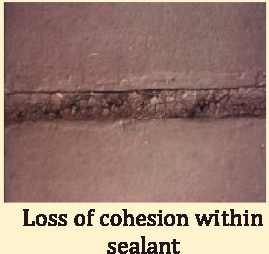
| ASTM C920-18, ASTM C639-15 or equivalent. Make provisions for access for regular sealant inspection and avoid placing design features/services across joints that impede access for maintenance (Perkin, 2002). | procedures of weatherproofing sealant joints in accordance with ASTM C1521-19, BS EN 15651-1 or equivalent. Use two-cloth method to properly clean and prime. Check the sealant for adhesion and compatibility with adjacent surfaces (Chew, 2002/2003). | Test suspected failure of waterproofing using ASTM C1521, BS EN 15651-1 or equivalent. Use ASTM C1487-19 or equivalent for remedial work for glazing sealant. |
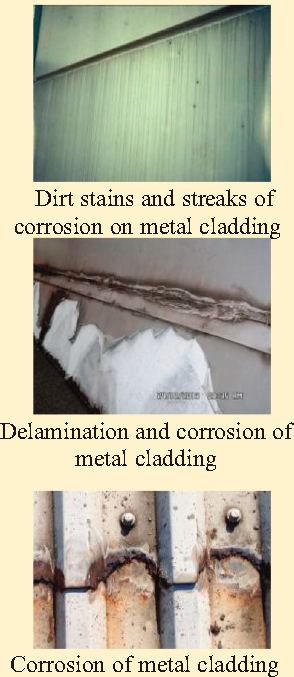
Corrosion of metal cladding
| Material selection for metal cladding should be based on aesthetics, cost, availability, formability and corrosion resistance in accordance with BS 5427, and structural performance and fire safety. Evaluation of corrosion resistance of the metal should be based on product warranty, environmental effects (external, internal, industrial, and acid rain), and maintenance (unwashed areas). Aluminium infill panels should be based on BS EN 485-1 or equivalent. Mild steel infill panels should be adopted in accordance with BS EN 10346 or equivalent. | Ensure the use of manufacturer’s fasteners/ brackets/stiffeners and all fixings and accessories to prevent sacrificial corrosion, as well as transmit all imposed loads and stresses of the cladding. Avoid scratching and damage of protective coating/film during site handling and installation. Alert designer/supplier if cladding is exposed to high concentrations of sulphur and chloride containing gases. Refer to lightning protection in accordance with SS 555-1 to 4. Remove drill swarf and other visible contaminants from the cladding surface to avoid corrosion (Chew et al, 2005). | Inspections should be carried out to look out for signs of deterioration in aluminium framing in accordance with BS EN 13830, CP 96 or equivalent. Routine cleaning should be carried out to remove surface contaminants from metals in order to ensure maximum corrosion resistance of the metal. The cleaning process chosen should be selected based on type of contaminant, the recommended degree of cleanliness, and cost in accordance with ASTM A380/A380M-17, BS EN 1993-1-4, BS EN ISO 12944-8 or equivalent Special care should be taken in order not to damage the cladding surface during cleaning/maintenance (Chew et al, 2006/2008/2011). |
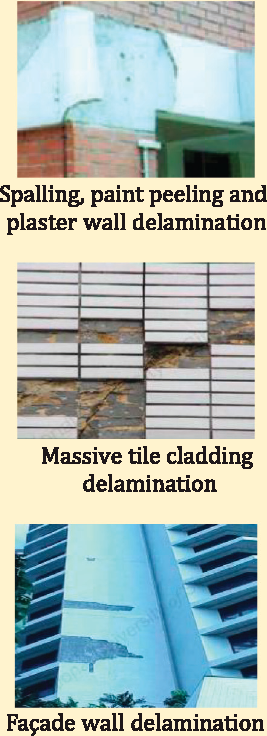
Delamination of façade
| Recommend surface treatment and protection in accordance with SS 509-2, BS 8221-2 or equivalent. Ensure proper detailing of window, door, and abutment points where water seepage can occur and cause delamination. Design movement joints as recommended on the structural concrete in accordance with BS 6093 or equivalent. | Sufficiently remove curing agent (used for early stripping of formwork) to ensure proper adhesion on the substrate. Ensure proper substrate preparation (cleaning) prior to application of plaster/tile finishing. Perform quality workmanship on façade through the correct handling and angle of application to prevent delamination and debonding in accordance with BS 8000-0 or equivalent. Adopt the performance requirements for curtain walling, including safety in accordance with BS EN 12179, ASTM E2270-14 or equivalent. | Repair of spalled surfaces should be done by cutting loose and flaking material to the base and replacing with new bricks or blocks, or made with layers of mortar. Consolidate weathered masonry (to stabilise the degradation) in accordance with SS 509-2, BS 8221-2 or equivalent. Maintenance and repair of renders should be carried out in reference to BS EN 13914-1, ASTM C926-20 or equivalent. Attend to cracks on façade surface promptly to control moisture ingress in order to avoid delamination. Re-tile debonded tiles or over-clad existing façade to remedy delamination (Perkin, 2002). |
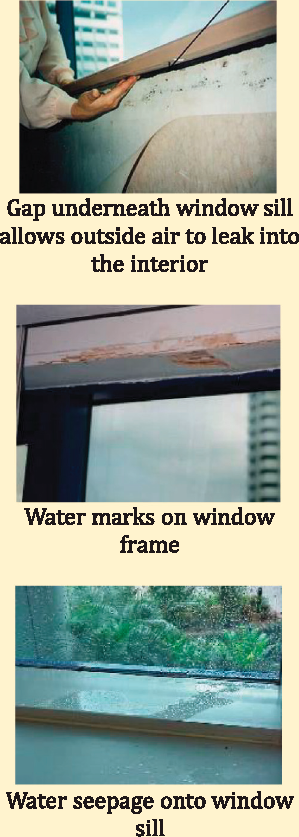
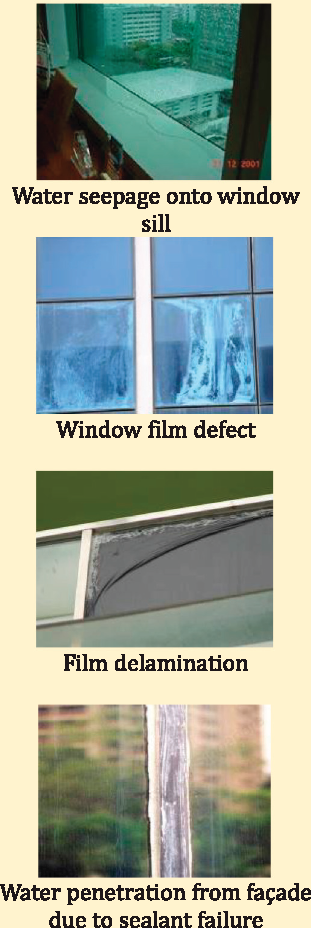
Weather-tightness
| Specify and ensure joint sealant performance are of suitable form to withstand air penetration during assembly, transportation, installation and operation of the curtain wall system in accordance with BS EN 12152, BS EN 13830, CP 96 or equivalent. Adopt the recommendations for water-tightness of external walls in accordance with SS 637 or equivalent. Refer to the provisions for water-tightness of precast concrete slab and wall panels in accordance with BS EN 13369, CP 81 or equivalent. Adopt the preventive measures for water leakage and weatherproof joints in accordance with BS EN 12154, BS EN 13830, CP 96 or equivalent. | Measure air permeability of joints between precast concrete external wall components with reference to ISO 6589, BS EN 12153, CP 96, SS 212, SS 268 or equivalent. Test weather resistance of the external façade against acceptable performance criteria. Detect water leakage through façade by simulating rainwater penetrations under pressure using a water-tightness test. Maintain water-tightness with respect to rainwater which will otherwise give rise to moisture stains on internal face, or cause damage to the façade or other building elements in accordance with ISO 7361 or equivalent. Maintain water-tightness of joints between two prefabricated ordinary concrete external wall components in accordance with ISO 7729 or equivalent. | Maintain or replace integral seals in window units within the duration of the service life in accordance with ASTM E2266-11 or equivalent. Check condition of windows and caulk seals annually in accordance with ASTM E241-09 or equivalent. Maintain repair records to identify a pattern of leakage; and to identify if repairs may be causing or contributing to current leakage. Use of maintenance records to diagnose buildings with chronic leakage problems (e.g. areas that have been subjected to several attempts at remediation). Suspected water leakage in glazing systems should be evaluated using the relevant parts of ASTM E2128-17. NDT methods can be used (e.g. thermography, fiberscope, elastic recovery meter). |
Window/fenestration
| Adopt the guidelines for calculations of thermal performance of windows, doors and shading devices in accordance with ISO 15099, BS EN ISO 12631 or equivalent. For the recommended thermal performance of a curtain wall (overall U value in accordance with standards), refer to BS EN ISO 12631, BS EN 13830, CP 96 or equivalent. | Keep an attic stock on-site for future uncertainties, especially important for reflective or low-emissivity coated glass as replacement stock may result in colour or reflectivity matching problem in accordance with ASTM C1401-14 or equivalent. Test method for weather-tightness (air leakage and water tightness) of aluminium alloy windows in accordance with BS 4873, SS 212 or equivalent. For cleaning of fenestration products, adopt the manufacturer’s installation instructions. Maintenance requirements should be passed on during commissioning stages. | Carry out regular maintenance of the fenestration product and its interfaces with the wall system to ensure water penetration resistance in accordance with ASTM E241-09 or equivalent. Clean glazing system’s exterior surface to control accumulation of environmental pollutants, as well as to avoid staining and disfiguration of glass. Periodic maintenance should be carried out as recommended for window gasket seals and operating hardware in accordance with ASTM C1401-14 or equivalent. Use cleaning solvents in strict accordance with solvent manufacturer’s instructions and applicable codes, safety regulations, and environmental regulations. MEK (Methyl ethyl ketone) and similar solvents may damage organic sealants, gaskets, and finishes used on fenestration products in accordance with ASTM E2112-19C, BS 8213-4 or equivalent |
Staining
| Specify material and application methods for water repellency of porous masonry in accordance with BS 8221-2, SS 509-2 or equivalent. Throw off water from the façade altogether through an outward projecting sill or overhanging eaves (which incorporate a throat or drip lines on its underside) or provide blocking features such as copings/flashings. Use efficient scupper drains/downpipes to channel water down and away from the façade. To provide drip grooves along the underside of projecting features. Specify paint system which is permeable to avoid any paint defects which may cause staining. Render the detailing for open joints as opposed to butt joints to avoid sealant staining. To use non-bleed sealants so as to prevent staining from silicone oil. Recommend joint designs which are able to retain runoff within joints and expansion joints designated to provide vertical runoff carrying dirt down along the façade surface (BCA, 2004). Specify façade self-cleaning applications (e.g. TiO 2, superhydrophobic paint products, etc.) with due consideration given to site orientation, sunshades and protruding features. | Paint façade surfaces evenly with no patchiness. The finished texture should be uniform in Colour (Chew et al, 2004). Ensure proper rendering to control surface granularity and local faults as it influences colour uniformity of the external façade in accordance with ISO 7361 or equivalent. Correct sealant applications to ensure consistent and continuous quality. Avoid misaligned panels of cladding in accordance with BS 8000-0 or equivalent. Refer to the planning of painting programme, including inspection regime (initial and routine inspections) for buildings in accordance with BS 6150, SS 542 or equivalent Use self-cleaning coatings on newly built substrates for increased success in its performance. All construction/repair works on a façade surface should be done prior to application of a water repellent in accordance with BS 8221-2, SS 509-2 or equivalent For serviceability of exterior façade surfaces, adopt ASTM E1667-95a or equivalent It is important as it dictates the building’s individual and corporate identity. | Consider availability of adequate water supply, drainage provisions and electrical power supply to choose façade cleaning method. Records of cleaning operations (including; photographs before and after cleaning, and drawings of nature of deposits, thickness and patterns) should be kept for buildings of significance in accordance with BS 8221-1, SS 509-1 or equivalent. Maintain façade in a state as near as possible to its new condition. Ease of façade maintenance can be expressed by frequency of necessary maintenance operations; labour and supplies necessary for each maintenance operation; and notice of possible ways of removing stains, graffiti, etc. in accordance with ISO 7361 or equivalent Detect/determine staining of porous substrates by joint sealants in accordance with ISO/NP 16938-1 or equivalent Adopt the recommendations for treatments for controlling organic growth in accordance with BS 8221-2, SS509-2 or equivalent Repair painted surfaces damaged by wear and tear; wash down; remove defective paint film; apply sealer/primer (if necessary); and repaint in accordance with BS 6150, SS 542 or equivalent. |
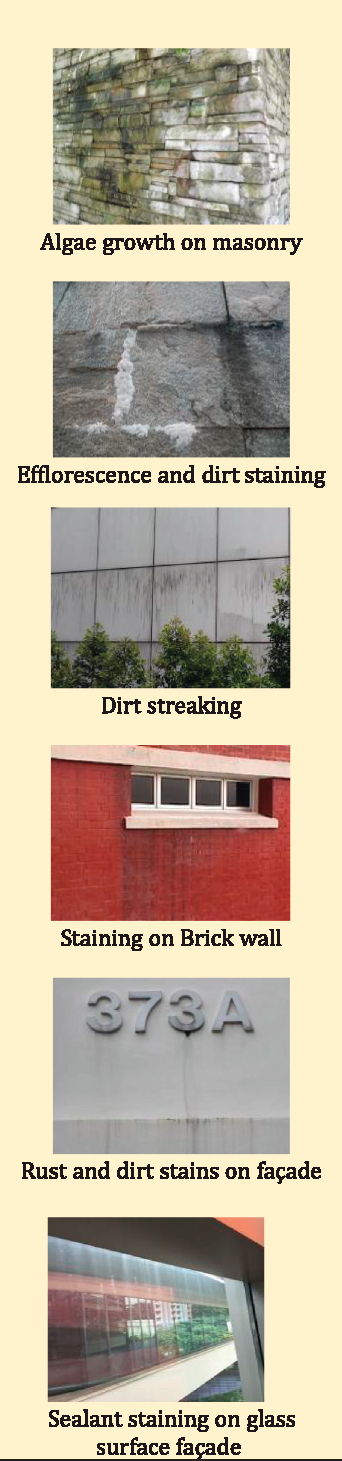
Table 4 shows the concerns for design, construction and maintenance on the outset of the planning/design stage, for structural components, e.g. column, beams, slabs, walls and other load bearing and non-loading components.
Table 5 shows the concerns for design, construction and maintenance on the outset of the planning/design stage, for architectural components, e.g. finishes, furnishings and other elements that contribute to the aesthetic value and liveability.
Table 6 shows the concerns for design, construction and maintenance on the outset of the planning/design stage, for service components which include vertical and horizontal circulation systems, electro-mechanical and sanitary connections.
Conclusions
Falling objects from tall building façades including materials, components and features/fixtures are life threatening public safety issue that have been reported globally. It is imperative that all façades must be designed, constructed and maintained adequately with public safety in mind, preventing falling objects from height. The new legislation Singapore recently implemented on PFI is discussed and guides and checklists are recommended. In addition to existing buildings, the paper sets quality benchmarks for future new buildings, spearheading the integration of designers, constructors and facility managers on the outset of the planning/design stage, by providing easy to read tables summarising (1) knowledge learnt from past mistakes and (2) quality benchmarks. Based on predictive/preventive approach, the tables serve to define acceptable standards in design, construction and operation practices to prevent falling objects from facades.Appendix
Normative references/standards referred to for facade
| ASTM C33/C33M-16e1 | Painting of buildings. Code of practice |
| ASME A120.1 | Code of practice for cleaning and surface repair of buildings. Metals (cleaning only) |
| ASTM A380/A380M-17 | Workmanship on construction sites. Introduction and general principles |
| ASTM C1193–16 | Calculating domestic water consumption in non-domestic buildings. Code of practice |
| ASTM C1260–14 | Code of practice for the sampling and monitoring of hot and cold water services in buildings |
| ASTM C1293–20 | Code of practice for the selection of water reuse systems |
| ASTM C1401–14 | Specification for masonry units. Clay masonry units |
| ASTM C1487–19 | Products and systems for the protection and repair of concrete structures. Definitions, requirements, quality control and evaluation of conformity. Concrete injection |
| ASTM C1496–18 | Eurocode 2: Design of concrete structures. General rules and rules for buildings |
| ASTM C1521–19 | Eurocode 2. Design of concrete structures. Liquid retaining and containing structures |
| ASTM C1567–13 | Adhesives for ceramic tiles. Requirements, assessment and verification of constancy of performance, classification and marking |
| ASTM C1722–18 | Gravity drainage systems inside buildings. Sanitary pipework, layout and calculation |
| ASTM C227–10 | Workmanship on building sites. Cementitious levelling screeds and wearing screeds. Code of practice |
| ASTM C295/C295M-19 | Workmanship on building sites. Internal and external wall and floor tiling. Ceramic and agglomerated stone tiles, natural stone and terrazzo tiles and slabs and mosaics. Code of practice |
| ASTM C618–19 | Screeds, bases and in situ floorings. Concrete bases and cementitious levelling screeds to receive floorings. Code of practice |
| ASTM C639–15 | Screeds, bases and in situ floorings. Concrete wearing surfaces. Code of practice |
| ASTM C856/C856M-20 | Guide to facilities maintenance management |
| ASTM C920–18 | Code of practice for design and installation of damp-proof courses in masonry construction |
| ASTM C926–20 | Code of practice for cleaning and surface repair of buildings. Cleaning of natural stone, brick, terracotta and concrete |
| ASTM C989/C989M-18a | Code of practice for cleaning and surface repair of buildings. Surface repair of natural stones, brick and terracotta |
| ASTM E1667–95a | Paints and varnishes. Corrosion protection of steel structures by protective paint systems. Types of surface and surface preparation |
| ASTM E2112–19c | Non-destructive testing. Infrared thermographic testing. General principles |
| ASTM E2128–17 | Code of practice for ceramic wall and floor tiling |
| ASTM E2266–11 | Ceramic tiles – Part 1: Sampling and basis for acceptance |
| ASTM E2270–14 | Ceramic tiles – Grouts and adhesives – Part 1: Terms, definitions and specifications for adhesives |
| ASTM E241–09(2014)e1 | Guidelines for simplified seismic assessment and rehabilitation of concrete buildings |
| ASTM E2513–07 | Ceramic tiles – Definitions, classification, characteristics and marking |
| ASTM E2841–19 | Ceramic tiles – Grouts and adhesives – Part 5: Requirements, test methods, evaluation of conformity, classification and designation of liquid-applied waterproofing membranes for use beneath ceramic tiling bonded with adhesives |
| ASTM E903–12 | Paints and varnishes. Examination and preparation of test samples |
| BS 1139–2.2 | Code of practice for cleaning and surface repair of buildings – Part 1 : Cleaning of natural stone, brick, terracotta, concrete and rendered finishes |
| BS 1881–210 | Code of practice for cleaning and surface repair of buildings – Surface repair of natural stones, brick, terracotta and rendered finishes |
| BS 4873 | Code of practice for painting of buildings |
| BS 5427 | Code of practice for waterproofing of reinforced concrete buildings |
| BS 5974 | Admixtures for concrete, mortar and grout – Part 2 : Definitions, requirements – Concrete admixtures – Definitions, requirements, conformity, marking and labelling |
| BS 6037–1 | Eurocode 2: Design of concrete structures, Part 1–1 General rules and rules for buildings |
| BS 6093 | Code of practice for design of joints and jointing in building construction |
| BS 6150 | Painting of buildings. Code of practice |
| BS 6213 | Selection of construction sealants. Guide |
| BS 6398 | Specification for bitumen damp-proof courses for masonry |
| BS 6576 | Code of practice for diagnosis of rising damp in walls of buildings and installation of chemical damp-proof courses |
| BS 8000–0 | Workmanship on construction sites. Introduction and general principles |
| BS 8004 | Code of practice for foundations |
| BS 8102 | Code of practice for protection of below ground structures against water from the ground |
| BS 812–123 | Bases for the design of structures – Deformations of buildings at the serviceability limit states |
| BS 8204–1 | Screeds, bases and in situ floorings. Concrete bases and cementitious levelling screeds to receive floorings. Code of practice |
| BS 8204–2 | Screeds, bases and in situ floorings. Concrete wearing surfaces. Code of practice |
| BS 8210 | Guide to facilities maintenance management |
| BS 8213–4 | Windows and doors. Code of practice for the survey and installation of windows and external doorsets |
| BS 8215 | Code of practice for design and installation of damp-proof courses in masonry construction |
| BS 8221–1 | Code of practice for cleaning and surface repair of buildings. Cleaning of natural stone, brick, terracotta and concrete |
| BS 8221–2 | Code of practice for cleaning and surface repair of buildings. Surface repair of natural stones, brick and terracotta |
| BS 8298–1 | Code of practice for the design and installation of natural stone cladding and lining. General |
| BS EN 1004 | Mobile access and working towers made of prefabricated elements. Materials, dimensions, design loads, safety and performance requirements |
| BS EN 10088–2 | Stainless steels. Technical delivery conditions for sheet/plate and strip of corrosion resisting steels for general purposes |
| BS EN 10346 | Continuously hot-dip coated steel flat products for cold forming. Technical delivery conditions |
| BS EN 12152 | Curtain walling. Air permeability. Performance requirements and classification |
| BS EN 12153 | Curtain walling. Air permeability. Test method |
| BS EN 12154 | Curtain walling. Watertightness. Performance requirements and classification |
| BS EN 12179 | Curtain walling. Resistance to wind load. Test method |
| BS EN 12810–2 | Facade scaffolds made of prefabricated components. Particular methods of structural design |
| BS EN 12811–1 | Temporary works equipment. Scaffolds. Performance requirements and general design |
| BS EN 12845 | Fixed firefighting systems. Automatic sprinkler systems. Design, installation and maintenance |
| BS EN 13022–1 | Glass in building. Structural sealant glazing. Glass products for structural sealant glazing systems for supported and unsupported monolithic and multiple glazing |
| BS EN 13139 | Aggregates for mortar |
| BS EN 13369 | Common rules for precast concrete products |
| BS EN 13561 | External blinds and awnings. Performance requirements including safety |
| BS EN 13830 | Curtain walling. Product standard |
| BS EN 13914–1 | Design, preparation and application of external rendering and internal plastering. External rendering |
| BS EN 14630 | Products and systems for the protection and repair of concrete structures. Test methods. Determination of carbonation depth in hardened concrete by the phenolphthalein method |
| BS EN 14992 | Precast concrete products. Wall elements |
| BS EN 1504–2 | Products and systems for the protection and repair of concrete structures. Definitions, requirements, quality control and evaluation of conformity. Surface protection systems for concrete |
| BS EN 1504–3 | Products and systems for the protection and repair of concrete structures. Definitions, requirements, quality control and evaluation of conformity. Structural and non-structural repair |
| BS EN 1504–5 | Products and systems for the protection and repair of concrete structures. Definitions, requirements, quality control and evaluation of conformity. Concrete injection |
| BS EN 1504–9 | Products and systems for the protection and repair of concrete structures. Definitions, requirements, quality control and evaluation of conformity. General principles for use of products and systems |
| BS EN 15651–1 | Sealants for non-structural use in joints in buildings and pedestrian walkways. Sealants for facade elements |
| BS EN 15651–3 | Sealants for non-structural use in joints in buildings and pedestrian walkways. Sealants for sanitary joints |
| BS EN 1932 | External blinds and shutters. Resistance to wind loads. Method of testing and performance criteria |
| BS EN 1992-1-1 | Eurocode 2: Design of concrete structures. General rules and rules for buildings |
| BS EN 1992-1-2 | Eurocode 2. Design of concrete structures. General rules. Structural fire design |
| BS EN 1992–3 | Eurocode 2. Design of concrete structures. Liquid retaining and containing structures |
| BS EN 1993-1-4 | Eurocode 3. Design of steel structures. General rules. Supplementary rules for stainless steels |
| BS EN 1994-1-1 | Eurocode 4. Design of composite steel and concrete structures. General rules and rules for buildings |
| BS EN 1995-1-1 | Eurocode 5: Design of timber structures. General. Common rules and rules for buildings |
| BS EN 39 | Loose steel tubes for tube and coupler scaffolds. Technical delivery conditions |
| BS EN 485–1 | Aluminium and aluminium alloys. Sheet, strip and plate. Technical conditions for inspection and delivery |
| BS EN 74–1 | Couplers, spigot pins and baseplates for use in falsework and scaffolds. Couplers for tubes. Requirements and test procedures |
| BS EN 752 | Drain and sewer systems outside buildings. Sewer system management |
| BS EN ISO 11600 | Building construction. Jointing products. Classification and requirements for sealants |
| BS EN ISO 12631 | Thermal performance of curtain walling. Calculation of thermal transmittance |
| BS EN ISO 12944–8 | Paints and varnishes. Corrosion protection of steel structures by protective paint systems. Development of specifications for new work and maintenance |
| CP 14 | Code of practice for scaffolds |
| CP 4 | Code of practice for foundations |
| CP 52 | Code of practice for automatic fire sprinkler system |
| CP 65–1 | Code of practice for structural use of concrete – Design and construction |
| CP 65–2 | Code of practice for structural use of concrete – Special circumstances |
| CP 7 | Code of practice for structural use of timber |
| CP 81 | Code of practice for precast concrete slab and wall panels |
| CP 96 | Code of practice for curtain walls |
| EN 1997 | Geotechnical design |
| ISO 11600 | Building construction – joint-sealing products–Classification and requirements of sealants |
| ISO 13823 | General principles on the design of structures for durability |
| ISO 15099 | Thermal performance of windows, doors and shading devices – Detailed calculations |
| ISO 16938–1 | Buildings and civil engineering works – Determination of the staining of porous substrates by sealants used in joints – Part 1: Test with compression |
| ISO 28278–2 | Glass in building – Glass products for structural sealant glazing – Part 2: Assembly rules |
| ISO 28841 | Guidelines for simplified seismic assessment and rehabilitation of concrete buildings |
| ISO 6589 | Joints in building – Laboratory method of test for air permeability of joints |
| ISO 7361 | Performance standards in building – Presentation of performance levels of facades made of same-source components |
| ISO 7729 | Typical vertical joints between two prefabricated ordinary concrete external wall components – Properties, characteristics and classification criteria |
| ISO 7845 | Horizontal joints between load-bearing walls and concrete floors – Laboratory mechanical tests – Effect of vertical loading and of moments transmitted by the floors |
| SS 150 | Specification for emulsion paint for decorative purposes |
| SS 212 | Specification for aluminium alloy windows |
| SS 509–1 | Code of practice for cleaning and surface repair of buildings – Part 1 : Cleaning of natural stone, brick, terracotta, concrete and rendered finishes |
| SS 509–2 | Code of practice for cleaning and surface repair of buildings – Surface repair of natural stones, brick, terracotta and rendered finishes |
| SS 542 | Code of practice for painting of buildings |
| SS 555–1 | Protection against lightning – Part 1: General principles |
| SS 555–2 | Protection against lightning – Part 2: Risk management |
| SS 555–3 | Protection against lightning – Part 3: Physical damage to structures and life hazard |
| SS 555–4 | Protection against lightning – Part 4: Electrical and electronic systems within structures |
| SS 598 | Code of practice for suspended scaffolds |
| SS 599 | Guide for wayfinding signage in public areas |
| SS 637 (formerly CP 82) | Code of practice for waterproofing of reinforced concrete buildings |
| SS EN 12620 | Specification for aggregates for concrete |
| SS EN 1992-1-1 | Eurocode 2: Design of concrete structures, Part 1–1 General rules and rules for buildings |
| SS EN 1992-1-2 | Eurocode 2: Design of concrete structures, Part 1–2 General rules – Structural fire design |
| SS EN 1994-1-2 | Eurocode 4 – Design of composite steel and concrete structures – General rules – Structural fire design |
Façade – Services
| Problem | Design | Construction | Maintenance |
|---|---|---|---|
Facade access
| Ease of access, relative cost of hiring and erecting scaffolding and the probable frequency of maintenance should be considered when making decisions on façade work in accordance with BS 8221-2, SS 509-2 or equivalent. The façade access system should be designed for the intended load, provide easy and safe access to all façade areas, have maximum coverage, and not disrupt tenant activities during operations (BCA, 2004). | Implement comprehensive safety plan for working on façade, which shall include a fall prevention plan, permit-to-work system and fall control measures (including fall prevention systems and personal fall arrest systems)(BCA, 2017). For safety design, construction, operation and maintenance of scaffolding, working platforms and gondolas, adopt BS 6150, SS 542 or equivalent. It is presupposed that workplace safety and health aspects are in compliance with applicable statutory and regulatory requirements. Use scaffoldings and associated components with reference to BS EN 1004, BS EN 39, BS EN 74-1, BS 1139-2.2, BSEN 12810-2, BSEN 12811-1, CP 14 or equivalent. If permanently installed suspended access equipment should be used, refer to BS 6037-1, BS 5974, SS 598 or equivalent. | The least hazardous product and system should be selected for the façade cleaning operation. All risks should be identified, assessed and managed in accordance with BS 8221-1, SS 509-1 or equivalent. The safe use of permanently installed building maintenance units for façade maintenance should be done in accordance with ASME A120.1 or equivalent. Cleaning robots can be used to overcome the dangerous and time consuming nature of cleaning work (BCA, 2017). Façade access systems should be maintained in strict compliance with the relevant codes and standards in accordance with SS 598, BS 6037-1 or equivalent. |
Fixtures and fittings
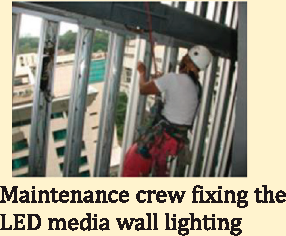
| Adopt accessibility requirements, to allow maintenance personnel to reach fixtures and fittings on the façade. | For serviceability of façade LED lightings, all components’ life spans should be indicated, including their point of failure (e.g. faulty façade LED lighting). | Defective downpipes, gutters, flashing, lead coverings, and jointing should be repaired quickly, and obsolete cables and fixings should be removed in accordance with BS 8221-2, SS 509-2 or equivalent. |