With the acceleration of climate change, economic development is becoming progressively limited by resource and environmental constraints. A green and low-carbon transition can be greatly facilitated by increasing green total factor productivity (GTFP) of enterprises. This paper aims to establish the mechanism between digital–real integration (DRI) and GTFP and provide empirical findings that can inform the development of green development policies.
Relying on panel data covering Chinese industrial enterprises, the authors assess the effect of DRI on GTFP and further explore the mechanisms of mediation by means of fixed-effects estimation and mediation analysis. To guarantee the validity of the study’s findings, the authors take into account endogeneity and conduct a series of robustness tests.
The results present the evidence that DRI has a significant positive impact on GTFP. According to the results of the mediation, DRI supports the growth of GTFP, in large part due to the fact that it spurs green innovation practices, accelerates digital transformation and relieves financing pressures. Results from the heterogeneity analysis indicate that the positive effect is stronger for state-owned enterprises, firms operating in pollution-intensive and heavy-industry sectors and firms situated in eastern China. The moderating analysis indicates that environmental regulation, when more stringent, reinforces the beneficial effect of DRI on GTFP; by contrast, stronger R&D intensity and green finance reduce the strength of this effect.
This research methodologically explains the use of DRI to improve GTFP and provides empirical data to shape policies regarding climate change mitigation, green industrial development and carbon reduction.
1. Introduction
Climate change has emerged as one of the most important and urgent issues in recent decades, creating instability in the natural ecosystems and threatening the long-term sustainable development of human societies (Xie et al., 2023; Tiwari et al., 2025). China, with the world’s most complete industrial system, is therefore central to domestic decarbonization and also serves as a pivotal natural laboratory for the green transformation of global industry (Liu et al., 2025). In this regard, the study of industrial green development in China not only contributes to resolving the domestic low-carbon transition issues but also offers strategic solutions to other developing countries under the same pressure (Chen et al., 2025). Against this backdrop, it has become an urgent priority to identify replicable and innovative pathways for China’s low-carbon development (Chen et al., 2024). Green total factor productivity (GTFP) serves as a critical indicator of green development by incorporating environmental costs like pollution into the total factor productivity framework (Yang et al., 2024a). Therefore, improving GTFP of industrial enterprises is crucial for achieving China’s reduction emission targets and provides empirical evidence for the global community to mitigate climate change and promote sustainable industrial growth (Xie and Huang, 2025).
Digital–real integration (DRI) refers to the process of integrating digital technologies, including big data, cloud computing, artificial intelligence and block-chain, into the real economy to generate value (Xu et al., 2025). DRI is more than the simple overlay of technology onto traditional industries; it represents a co-evolutionary process that unfolds through sustained and dynamic interactions. On the one hand, the digital economy enriches the real economy by expanding its scope and potential for development; on the other hand, the real economy provides abundant data resources to offer crucial support for the development of the digital economy (Pang et al., 2025). Therefore, compared with the digital economy in isolation, DRI can unlock digital-technology value more effectively because it delivers synergies beyond the simple addition of individual contributions. Although prior studies have examined the effects of digital transformation (Shen et al., 2023), digital technologies (Teruel et al., 2026) and the digital economy (Tian et al., 2024; Wang and Wang, 2025) on green and sustainable development, the influence of DRI on enterprises’ GTFP remains under-explored. To address this gap, this study explores three critical questions:
Does DRI play a significant role in supporting the GTFP of enterprises?
What are the mediating channels of this effect?
What are the boundary conditions that influence the association between DRI and GTFP?
By answering these questions, the proposed study will enhance the current body of literature and offer a set of empirical results to guide policy and practice toward the realization of the objectives of green development in China. The study also provides significant policy implications to assist other developing countries in overcoming climate constraints and pursuing carbon reduction goals in the face of such pressures.
The contributions of this paper are as follows. First, taking DRI as the starting anchor, we develop a theoretical framework that accounts for how DRI may enhance GTFP. The framework expands the coverage of DRI and offers a new lens for leveraging DRI to accelerate GTFP progress. We then build and estimate a path model that decomposes DRI’s impact on GTFP into three principal mechanisms: the green innovation effect, the digital transformation effect and the financing-constraint alleviation effect. This method can not only disclose the role of DRI in improving corporate GTFP, but also explain the connection between digitization and green productivity. Finally, we identify the boundary conditions that govern the extent to which DRI is effective. Other than heterogeneity studies depending on ownership structure, industry characteristics and regional location, we also study the moderating functions of environmental regulation, R&D intensity and green finance. These results support the design of targeted environmental policies and provide useful guidance for firms seeking to realize green development objectives.
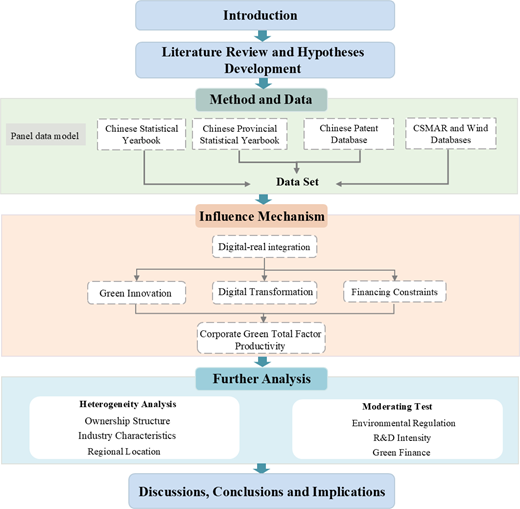
The rest of this study is arranged as follows. Section 2 provides a literature review and formulates our theoretical framework and hypotheses. Section 3 provides the data sources, variables and econometric models. Section 4 presents and interprets the empirical results. In Section 5, the findings are discussed. Section 6 summarizes the main conclusions, articulates policy recommendations and sets out an agenda for future research. Figure 1 shows the overall structure of this paper.
2. Literature review and hypotheses development
A new wave of digital revolution is fundamentally changing the landscape in which economic development unfolds (Ghobakhloo, 2020). The digital economy is a central channel to this change as it enhances the efficiency of resource allocation and reinforces value creation, thus driving the traditional industrial industries toward upgrading (Deng et al., 2022). With the increased integration of digital and real economies, innovative business models, business processes and development mechanisms will probably become a key to the green development of the corporate sector and carbon emissions reduction (Zhong et al., 2025). This section presents a theoretical framework and develops research hypotheses to account for the role of DRI in enhancing corporate GTFP.
2.1 Direct impact of digital–real integration on green total factor productivity
As technological revolution and industrial change intensify, the digital economy and the green economy are showing an increasingly close convergence (Yang et al., 2024b). DRI brings artificial intelligence, big data, cloud computing and other fundamental digital technologies into traditional industrial value chains. This process changes the paradigms of the traditional models of production, alters the distribution of resources and enhances value generation (Zhong et al., 2025), which eventually becomes a major driver of corporate carbon reduction and sustainable growth.
DRI has three primary impacts on corporate GTFP. First, DRI advances technological upgrading together with artificial intelligence adoption, thus improving the efficiency of factor and information flows and promoting better resource pooling and integration (Wang et al., 2025). This allows firms to optimize resource allocation and reduce waste, thereby enhancing corporate GTFP. Second, DRI enables a more precise allocation of resources to green production stages and supports the continuous development and adoption of green products (Liu et al., 2024a). By integrating data as a production factor, DRI also helps generate new information and knowledge (Sun et al., 2024a), thereby improving how efficiently traditional production factors are used and promoting a steady increase in GTFP. Third, DRI promotes the development of technologies such as the Internet of Things and artificial intelligence. These technologies facilitate the industrial shift toward smart manufacturing, mitigating negative environmental impacts (He, 2026). DRI advances the implementation of green supply chain management, enabling firms to track and control their supply chains more efficiently. Real-time digital monitoring of resource consumption and emissions improves eco-efficiency (Liu et al., 2025) and thus provides a solid foundation for GTFP growth. Based on the above analysis, the following hypothesis is proposed as follows:
Digital–real integration positively affects corporate green total factor productivity.
2.2 Indirect impact of digital–real integration on green total factor productivity
Green innovation refers to the development of environmentally friendly technologies, products, processes and management methods (Zhao et al., 2022). Prior research indicates that green innovation promotes economic value creation (Wu et al., 2025) and reduces environmental pollution and resource waste (Chen and Xing, 2025). Consequently, advancing green innovation serves as a critical mechanism for improving GTFP and achieving green development goals (Jiakui et al., 2023).
Due to the large investment requirements and uncertainty associated with green innovation (Behera et al., 2025), firms often face dual pressures from insufficient incentives and capability constraints. DRI can offer a new pathway to overcome these barriers through intelligent upgrading and resource coordination. On the one hand, as a foundation for DRI, the digital economy helps break down information silos and accelerates the sharing and diffusion of knowledge (Qiao et al., 2024). It can also expand firms’ knowledge bases and improve green innovation efficiency (Liao et al., 2024). On the other hand, DRI enables firms to efficiently pool, integrate and allocate key inputs needed for green innovation (Sun et al., 2024a). Further, it can promote the restructuring of innovation processes and the developmental acceleration of core technologies, thereby improving innovation efficiency and outcomes (Cheng and Zhou, 2025). Based on this analysis, the following hypothesis is proposed:
Green innovation mediates the positive relationship between digital–real integration and corporate green total factor productivity.
Digital transformation is a systemic shift in which firms embed advanced digital technologies into their operations to replace inefficient traditional practices (Steiber et al., 2021), demonstrating potential to enhance operational efficiency and foster firm growth (Ullah et al., 2025). This drives intelligent upgrades across production processes, products and management systems (Qian and Chen, 2024) and helps firms improve total factor productivity (Qian et al., 2025). As a result, speeding up corporate digital transformation is essential to enhancing GTFP and promoting the achievement of green development and carbon reduction goals.
For digital transformation to succeed, firms must be able to govern digital resources and apply advanced technologies, and DRI provides crucial support on both fronts. On the one hand, deeper integration of the digital economy with the real economy is continuously improving modern information network infrastructure (Sun et al., 2024a). In such a context, firms can co-build an open digital ecosystem with supply chain partners, improve their ability to orchestration and manage digital resources and create a strong foundation for digital transformation (Li et al., 2022). On the other hand, DRI performs a technological-engine role. The application of next-generation digital technologies, including artificial intelligence and big data, contributes to faster digital upgrading across functional domains such as manufacturing, management and services (Tortorella et al., 2021). This application can significantly improve the efficiency of transformation processes and support deeper digital transformation. Based on this analysis, the following hypothesis is proposed:
Digital transformation mediates the positive relationship between digital–real integration and corporate green total factor productivity.
Financing constraints arise when information asymmetry and agency costs increase financing costs and raise barriers to securing funds. Under such conditions, the stricter the financing terms, the more difficult it is for firms to obtain external financing (Li et al., 2023). As for industrial firms, the green transition from “Polluting capital” to “Clean capital” is a long-term process that relies heavily on stable, patient investment (Zhu and Zhu, 2025). Accordingly, effectively alleviating financing constraints is crucial for enhancing corporate GTFP and achieving carbon reduction and green development goals.
A firm’s ability to obtain external financing depends largely on the scope and quality of its information disclosure (Mertzanis et al., 2024). DRI helps enhance information transparency and reduce information asymmetry (Sun et al., 2024b), alleviating firms’ financing constraints through several channels. First, by enhancing data sharing between enterprises and financial institutions, DRI reduces uncertainty about a firm’s creditworthiness, thereby increasing its access to capital (Sun et al., 2024a). Second, as digital technologies become deeply embedded in firms’ operations and financial service processes, firms can access a wider range of financial resources at lower transaction costs and with higher efficiency (Nguyen et al., 2020). Moreover, the rapid development of the digital economy has motivated continuous innovation and diversification of digital finance models, further broadening firms’ financing channels (Sreenu, 2025) and reducing financing constraints. Based on this analysis, the following hypothesis is proposed:
The alleviation of financing constraints mediates the positive relationship between digital–real integration and corporate green total factor productivity.
3. Research design
China is the world’s largest manufacturing nation and contributes nearly 30% of global industrial output (Wu et al., 2022). Therefore, to ensure data availability and consistent statistical standards, this study uses Chinese industrial enterprises as the research sample.
3.1 Data and sample
This study uses panel data of Chinese industrial enterprises from 2012 to 2022. To ensure sample quality and reduce the impact of outliers, the data were processed as follows. First, we exclude firms with financial anomalies. Then, we drop observations with substantial missing values in key variables. Finally, we winsorize all continuous variables at the 1st and 99th percentiles. The final data set contains 15,565 firm-year observations representing 2,572 listed companies. The analysis is based mainly on data collected from the China Statistical Yearbook, Provincial Statistical Yearbooks, the China National Intellectual Property Administration and the CSMAR and Wind databases.
3.2 Variables
The key variables considered in this paper are defined below:
Dependent variable: GTFP. In line with Chen (2024) and Liu et al. (2024b), corporate GTFP is measured through a super-efficiency slacks-based measure (SBM) model incorporating undesirable outputs and the Malmquist-Luenberger (ML) index. Specifically, we define capital, labor and energy as inputs, while operating revenue and pollution-related environmental externalities are specified as desirable and undesirable output, respectively (see Table 1). This specification allows a production possibility set to be defined for each decision-making unit. The SBM model is then applied to assess the relative position of each observation with respect to the production frontier, thereby measuring static efficiency under environmental constraints. Building on this, the ML index is computed to capture inter-temporal dynamics in productivity, and the index is chain-linked over time to transform the resulting growth rates into annual GTFP levels.
Independent variable: DRI. To systematically quantify DRI, this study adopts the coupling coordination degree model proposed by Chang and Wang (2023). We measure DRI in two steps. First, we calculate development indices for the digital economy and the real economy separately using the entropy method (see Table 2). Second, a comprehensive DRI indicator is constructed from these indices using the coupling coordination model. The relevant model formulas are presented below:
In equation (1), denotes the degree of integration between the digital economy and the real economy in period t, and and represent their development levels, respectively. However, when both subsystems exhibit relatively low development levels in certain regions, equation (1) may generate a spurious result that overstates the degree of integration. To address this limitation, a coupling coordination degree model is further constructed, defined as follows:
In equation (2), denotes the degree of integration between the digital and real economies in period t, and denotes their overall development level. Parameters α and β denote the weights of the digital and real economies, respectively, and are both set to 0.5. The DRI index ranges from 0 to 1, with higher values indicating a greater degree of integration.
Control variables: To account for potential influences of other factors on the robustness of the empirical results, the following control variables are included: Firm Size (Size), measured as the natural logarithm of the number of employees. Firm Age (Age), measured as the natural logarithm of one plus the firm’s age. Return on Assets (ROA) is calculated as net profit divided by average total assets. Tobin’s Q is the ratio of market value to total assets. Cash Flow (Cash) is the net operating cash flow divided by the total assets. Revenue Growth (Growth) is the rate of revenue growth. Provincial per capita GDP is used as a proxy of Regional Economic Development (PGDP). Government Intervention (GOVIN) is calculated as the natural logarithm of the ratio of regional fiscal expenditures to regional GDP.
3.3 Models
To test H1 and investigate the impact of DRI on corporate GTFP, we build a fixed-effects model based on the methodology of Hao et al. (2023) and Su et al. (2023). The baseline model is specified as follows:
In equation (3), is corporate GTFP. represents the provincial-level measure of DRI. denotes the vector of control variables. To lessen the risk of omitted-variable bias, we incorporate regional fixed effects and industry fixed effects in the model and defines as the error term.
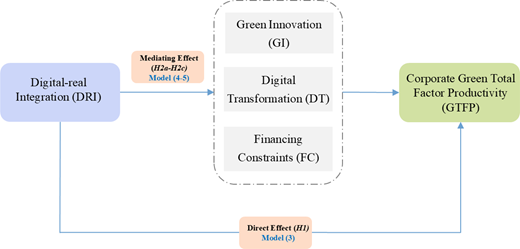
To further clarify how DRI impacts GTFP and to test H2a–H2c, we develop the mediation model specifications as follows:
In equations (4) and (5), stands for the mediators, covering green innovation, digital transformation and financing constraints. Figure 2 provides a schematic view of the empirical framework.
4. Empirical results
The empirical analysis is presented in this section. We present descriptive statistics, estimate baseline regressions, perform endogeneity tests, conduct robustness checks, carry out mechanism analyses and complete further examinations. Collectively, these studies offer complete and plausible evidence regarding firm behavior.
4.1 Descriptive statistics
Table 3 shows the descriptive statistics of the key variables. The mean of GTFP is 1.030, with a maximum of 1.172 and a minimum of 0.853. The evidence points to wide dispersion among industries, suggesting ample scope for improvement. The mean of DRI is 0.510, and the standard deviation is 0.192. The results indicate a considerable disparity in the level of integration among provinces. The remaining variables exhibit reasonable statistical properties. In addition, every variance inflation factor (VIF) falls well below 10, the conventional cutoff, suggesting that multi-collinearity is unlikely to affect the results.
4.2 Baseline regressions
In Table 4, we report baseline fixed-effects regression results examining the association between DRI and GTFP. Column (1), which controls for industry and provincial fixed effects, shows that the coefficient on DRI is 1.144 and statistically significant at the 1% level. Column (2) further incorporates the control variables, yielding a coefficient of 0.620 for DRI, which remains significant at the 1% level. These results indicate a significantly positive association between DRI and GTFP, suggesting that DRI is not merely an auxiliary element in the production process but an important driving force for enhancing firms’ green efficiency and advancing industrial green transformation. Therefore, H1 is supported.
4.3 Endogeneity analysis
To address potential reverse causality and omitted variable bias, we use two-stage least squares (2SLS) and the system generalized method of moments (system GMM).
Following Zhao et al. (2025), we construct an instrumental variable (IV) by interacting provincial fixed-line telephone penetration in 1984 with the national number of Internet users in the previous year. Table 5 reports the 2SLS estimation results. Column (1) shows that the coefficient on the IV in the first stage is 7.482e-08, significant at the 1% level, indicating that DRI can effectively promote firms’ GTFP. Column (2) shows that the coefficient on DRI in the second stage is 1.150, significant at the 1% level. Moreover, the Kleibergen-Paap rk LM statistic and the Kleibergen-Paap rk Wald F statistic respectively pass the under-identification and weak instrument tests, indicating that the chosen instrument is valid for DRI. These findings are consistent with our baseline results and provide robust support for H1.
Second, following Wintoki et al. (2012), we apply the system GMM estimator to account for potential dynamic panel bias. The corresponding results are presented in Table 5. Column (3) shows that the AR (2) p -value is insignificant, confirming that the regression residuals are not serially correlated. Meanwhile, the p -value of the Hansen test is insignificant, suggesting that the likelihood of an endogeneity problem is minimal. After controlling for the dynamic effects, the coefficient on DRI is 0.009, significant at the 1% level, which indicates that DRI can effectively enhance firms’ GTFP and reinforces the robustness of our results.
4.4 Robustness test
To ensure the robustness of the empirical findings, we conduct a series of robustness checks. First, we exclude major exogenous shocks by re-estimating the model after excluding the 2020–2022 COVID-19 pandemic period; the results in Column (1) of Table 6 confirm that DRI’s positive effect remains significant (β = 0.538, p < 0.01). Second, we use lagged DRI (one- and two-period lags) to capture delayed impacts (Columns (2)–(3)). In both cases, the effect remains significant (β = 0.591, p < 0.01; β = 0.506, p < 0.01). Third, we use alternative DRI measurements by assigning four weight combinations: (α = 0.3, β = 0.7), (α = 0.7, β = 0.3), (α = 0.4, β = 0.6) and (α = 0.6, β = 0.4) and then recalculating the DRI index according to Columns (4)–(7). Regression results show that the positive effect persists across all specifications (β = 0.678, p < 0.01; β = 0.535, p < 0.01; β = 0.658, p < 0.01; β = 0.583, p < 0.01). The results remain in line with the baseline findings in terms of both sign and statistical significance, suggesting that DRI can effectively enhance GTFP and thereby lending further support to the reliability of our conclusions.
4.5 Mechanism test
The preceding theoretical analysis suggests that DRI can improve corporate GTFP through the mediating roles of green innovation (GI), digital transformation (DT) and financing constraints (FC), with Table 7 reporting the corresponding results.
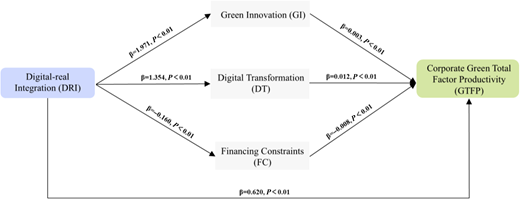
First, Columns (1)–(2) examine the mediating role of GI. Following Cheng et al. (2025) and Bai et al. (2023), we use the “IPC Green Inventory” published by the World Intellectual Property Organization (WIPO) and measure GI as the natural logarithm of one plus the firm’s annual count of green patent applications. The results in column (1) show that DRI has a significant positive effect on GI (β = 1.971, p < 0.01), suggesting that DRI enhances firms’ GI effectively. The significant positive effect of GI on GTFP (β = 0.002, p < 0.01) in column (2) confirms that GI can improve GTFP. These results indicate that DRI promotes improvements in GTFP by enhancing firms’ GI, implying that GI plays a significant mediating role in the relationship between DRI and GTFP. Therefore, H2a is supported.
Second, Columns (3)–(4) examine the mediating role of DT. Following Fan et al. (2024), we use text analysis to extract keywords related to artificial intelligence, blockchain, cloud computing and big data from listed corporate annual reports and measure DT as the natural logarithm of one plus the total frequency of these keywords. Column (3) shows that DRI has a significant positive effect on DT (β = 1.354, p < 0.01), suggesting that DRI effectively promotes firms’ DT. Column (4) shows that DT has a significant positive effect on GTFP (β = 0.008, p < 0.01), suggesting that DT improves GTFP. These results indicate that DRI promotes improvements in GTFP by fostering firms’ DT, implying that DT plays a significant mediating role in the relationship between DRI and GTFP. Therefore, H2b is supported.
Finally, Columns (5)–(6) examine the mediating role of FC. Following Li et al. (2025), we proxy the degree of FC using the FC index; larger values point to more severe constraints. Column (5) indicates that DRI has a strong negative influence on FC (β = −0.160, p < 0.01), and column (6) indicates that FC has a strong negative influence on GTFP (β = −0.004, p < 0.05). These findings indicate that DRI enhances GTFP by mitigating the FC of firms, suggesting that FC can be an important mediating factor between DRI and GTFP. Consequently, H2c is justified. Figure 3 summarizes the test results.
4.6 Further analysis
To investigate possible boundary conditions, we analyze heterogeneity across firms with different ownership structures, across industries with different characteristics and across regions. We also test moderating effects to investigate the effects of environmental regulation, R&D intensity and green finance on the relationship between DRI and GTFP. The findings are summarized in Tables 8 and 9.
Table 8 summarizes the heterogeneity analysis results. Columns (1)–(2) compare state-owned (SOEs) and non-state-owned enterprises (non-SOEs). The findings indicate that DRI enhances GTFP in both samples, and the effect is significant among SOEs (β = 0.708). Such a trend can be an indication of comparative advantages of SOEs in the acquisition of resources, market coverage and policy support, which allows them to better convert digital dividends into gains in GTFP.
The estimates in Columns (3)–(6) are used to examine heterogeneity across industry characteristics. We initially classified firms into heavily polluting (HPs) and non-heavily polluting (non-HPs) industries. Columns (3)–(4) show that DRI has a strong impact on improving GTFP in the two groups, but more pronounced among HPs (β = 0.702). We categorize firms into heavy and light industries. Columns (5)–(6) indicate that DRI has a significant positive effect on GTFP in both groups, with a stronger effect on heavy-industry firms (β = 0.691). A plausible explanation is that firms in polluting and heavy industries operate under tighter environmental regulation, which increases their motivation to use DRI to advance green transformation, thereby significantly raising GTFP.
Columns (7)–(9) explore regional heterogeneity in Eastern, Central and Western regions. Columns (7)– (9) indicate that the three regions have considerable improvements in GTFP related to DRI. The effect is uneven across regions and declines from East (β = 0.560) to Central (β = 0.356) and then to West (β = 0.233). The evidence aligns with the East’s advantages in digital infrastructure and technology diffusion, while the Central and Western regions tend to incur higher digital adoption costs and show a stronger dependence on resource-oriented industries.
Table 9 reports the moderation test results. Columns (1) and (2) examine the moderating role of environmental regulation (ER). Following Jiang et al. (2025), we measure ER as the ratio of industrial pollution control investment to the secondary industry value-added. Column (2) shows a positive DRI × ER interaction coefficient (β = 0.491, p < 0.01). The evidence indicates that ER positively moderates the effect of DRI and GTFP. These findings support the Porter Hypothesis by showing that well-calibrated policy pressure can lead firms to exploit DRI more effectively for process optimization and green improvement.
Columns (3)–(4) test the moderating role of R&D intensity (R&D). Referring to Chen et al. (2022), we calculate R&D as the ratio of a firm’s R&D expenditure to operating revenue. Column (4) reports a significantly negative interaction coefficient for DRI × R&D (β = −0.002, p < 0.01), suggesting that R&D exerts a negative moderating effect on the DRI–GTFP linkage. This pattern lends support to a resource crowding-out explanation. Because intensive R&D investment draws on scarce resources, firms face greater difficulty in assigning resources to digital–green integration, which in turn weakens the overall effectiveness of DRI.
Columns (5)–(6) evaluate green finance (GF) as a moderator. Following Wu et al. (2024), we construct a GF evaluation system covering green credit, green investment, green insurance, green bonds, green support, green funds and green equity, and then derive a provincial GF index. Column (6) shows that the interaction coefficient for DRI × GF is negative (β = −0.982, p < 0.01). The findings show that GF negatively moderates the impact of DRI and GTFP. A plausible explanation is that improved green financial conditions may lessen firms’ incentives to invest in long-cycle digital–green integration, leading them to rely more on end-of-pipe pollution control for quick compliance and thus weakening the marginal contribution of DRI to GTFP.
5. Discussions
This section systematically presents the empirical findings on the direct effects, indirect effects and further analyses of DRI. By approaching the issue from multiple dimensions, the study offers practical insights and convincing empirical support for industrial firms striving to realize green transition and carbon-reduction goals.
5.1 Discussion on the direct effects
This study offers a systematic account of how DRI promotes corporate GTFP in China and delivers both a theoretical framework and practical guidance for firms seeking green transition and carbon reduction. Previous research confirms that digital transformation (Shen et al., 2023) and the digital economy (Lin et al., 2024) can improve operational efficiency and environmental performance, but this body of work is mainly concerned with partial applications or end-of-pipe interventions and gives limited consideration to the overall mechanisms by which DRI promotes GTFP. This study fills this gap by revealing the way in which DRI enhances green development capacity under China’s dual-carbon agenda. Through optimizing factor allocation and improving the efficiency of resource utilization (Wang et al., 2025), DRI reinforces firms’ endogenous motivation to adopt green production practices. At the same time, firms can use digital monitoring and process control systems to track resource consumption and pollutant emissions in real time (Liu et al., 2025), thereby supporting higher GTFP. These findings echo the argument of Ghobakhloo (2020), who notes that the deep integration of digital technologies into manufacturing is central to the exploitation of green opportunities.
5.2 Discussion on the indirect effects
The mechanism results suggest that DRI enhances GTFP through three principal channels: green innovation, digital transformation and the easing of financing constraints. This pathway of green innovation shows that DRI supports firms in the efficient integration and allocation of the key inputs necessary for green innovation (Sun et al., 2024a). It also promotes core-technology R&D and improves innovation efficiency (Cheng and Zhou, 2025), increasing green innovation output and driving growth in GTFP. The digital transformation pathway indicates that the deep application of next-generation digital technologies accelerates digital upgrading across multiple functions (Tortorella et al., 2021) and drives firms’ digital transformation. Through process optimization and more granular management, this transformation enhances resource utilization efficiency and environmental performance, ultimately contributing to higher GTFP. The financing constraint pathway further indicates that DRI strengthens data sharing between firms and financial institutions, mitigating information asymmetry and improving firms’ access to finance. Also, the development of the digital economy has fostered new models of digital finance and further broadened firms’ financing channels (Sreenu, 2025), providing sustained financial support for GTFP growth. These results are consistent with Javeed et al. (2024) ’s research on the functionalities of digital finance.
5.3 Discussion on the heterogeneity and moderation analyses
Heterogeneity and moderation analyses further show that the positive effect of DRI on GTFP is subject to several boundary conditions. The impact is significantly stronger for SOEs, pollution-intensive and heavy industrial firms and enterprises located in the eastern region. The pattern indicates that SOEs benefit more, likely because ample resources and stronger policy support help them more effectively convert DRI into GTFP gains. Pollution-intensive and heavy industrial firms that are under tighter environmental regulations possess higher incentives to use DRI to meet their environmental requirements and green upgrading. Companies in eastern China have better digital infrastructure and developed market mechanisms that would enable successful integration. Simultaneously, these results also reflect a possible negative aspect that DRI might increase the digital divide. Technological and financial impediments to DRI implementation are usually more pronounced among businesses in areas with limited resources or with low digital development. This increases the likelihood that they will lag in the green transition and end up capturing fewer benefits from DRI.
Moderation analysis demonstrates that external regulations, internal resources and financial supply are the three factors that influence the intensity of the influence of DRI on GTFP. The relationship becomes stronger under tighter environmental regulation, which fits the Porter Hypothesis: rising regulatory pressure drives firms to leverage digital technologies for more precise pollution control and energy savings, thereby boosting the green productivity effects of DRI. Conversely, an increased level of R&D intensity and the advanced green finance undermine the positive relationship. Heavy R&D spending seems to constrain effective DRI by absorbing scarce resources, whereas better-developed green finance may promote end-of-pipe solutions with rapid returns instead of deeper DRI with longer-term productivity payoffs. Overall, the results map out the boundary conditions of DRI’s influence. Policy efforts should both stimulate DRI and remain attentive to unintended consequences such as resource misallocation, so as to avoid an unbalanced integration of the digital and real economies.
6. Conclusions, practical implications and limitations
In this section, the main findings of the study are summarized, policy implications are drawn and limitations and future research directions are discussed. These insights are meant to assist green development and carbon-reduction efforts under the climate change backdrop.
6.1 Conclusions
With climate change intensifying, the transition to green and low-carbon development is becoming a more urgent task. China’s role as the world’s manufacturing center, together with its complete industrial system, implies that accelerating industrial green transition is important for fulfilling domestic dual-carbon goals and for offering practical lessons to other developing countries facing similar challenges. In this paper, DRI is recognized as one of the major motivators of industrial restructuring and enhancement of GTFP. We analyze the impact of DRI on corporate GTFP and the mechanisms involved by using panel data from Chinese industrial firms. The principal findings are as follows. First, DRI has a strong positive effect on GTFP, indicating that the further integration of the digital and real economies promotes long-term industrial growth in GTFP. Second, we find that DRI affects GTFP through a combination of green innovation, digital transformation and reduced financing constraints. All these pathways promote resource distribution, increase the efficiency of production and enhance environmental management. Third, the effect of DRI is context-dependent. Heterogeneity tests document stronger effects in three groups: SOEs, firms in pollution-intensive and heavy industries and firms in eastern China. Moderation analysis further shows that environmental regulation amplifies the relationship, whereas R&D intensity and green finance tend to weaken it.
6.2 Practical implications
This study elucidates the mechanism by which DRI enhances GTFP in industrial enterprises and proposes significant policy implications. These policy insights not only guide China in leveraging DRI to boost corporate green efficiency for climate change mitigation and carbon reduction targets, but also offer policy frameworks and implementation pathways for other developing nations facing similar pressures for industrial green transformation.
First, it is fundamental to consolidating DRI’s foundation for enhancing GTFP by building a carbon-oriented digital ecosystem. Governments should accelerate the deployment of new digital infrastructure, e.g. block-chain, big data, 5G, while upgrading traditional infrastructure. Targeted support for R&D in core enabling technologies like cloud computing and artificial intelligence is essential to overcome critical technological bottlenecks. These measures will enhance digital infrastructure and enable technology capabilities, foster DRI development and further improve green efficiency and emissions reduction performance.
Second, a multi-tiered policy support framework should be strengthened to enhance the transmission mechanism of DRI boosting green efficiency. Targeted subsidies for digital-green integration can incentive enterprises to develop and commercialize green patents using digital technologies. Moreover, technological and talent limitations can be mitigated by the creation of demonstration projects and common digital service platforms, which will enhance the internal transformation momentum in enterprises. A more standardized digital disclosure mechanism would improve transparency, making it easier for capital to flow to activities that deliver higher efficiency with lower emissions. Overall, this policy mix can facilitate the process of DRI to enhance GTFP, which will further stimulate decarbonization and green development.
Third, various governance approaches are required to be adopted to make DRI effective in carbon reduction and green development. From a micro-level policy angle, SOEs should act as exemplars by piloting and scaling digital–green synergistic pathways that can be replicated across firms. For firms in pollution-intensive and heavy industries, stricter emission standards together with external pressures should strengthen the incentive to leverage DRI for green upgrading. From a regional standpoint, eastern regions should broaden and deepen DRI to strengthen scale effects and exploit economies of scale. Central and western regions should prioritize improving infrastructure while developing tailored digital solutions to help narrow the digital divide. The approach to differentiated governance facilitates governments to adopt a “tiered, targeted” strategy that is able to accommodate differences in enterprise types, industry structures and local digital bases across countries. This increases policy accuracy, averts the expansion of digital divides and eventually increases the efficiency of the green transition.
Fourth, the policy coordination and resource allocation environments should be enhanced to ensure that DRI sustainably improves GTFP. Closer policy coupling between environmental regulation and digital industrial policy can turn regulatory pressure into an effective catalyst for green upgrading. At the same time, guiding enterprises to balance R&D with targeted investment in DRI can help reduce the crowding-out effect. Moreover, green credit evaluation standards should shift away from emissions-only compliance and increasingly stress the depth of DRI implementation and the quality of production restructuring. By guiding finance toward foundational technological upgrades, the complementary between green finance and sustainable development investments can be strengthened. Together, the measures mitigate potential risks and reinforce the long-term impact of sustainable development investments in driving emissions reduction and green growth.
6.3 Limitations and future research directives
Despite the fact that this research contributes to the deeper comprehension of the effect of DRI on the GTFP of firms and provides both theoretical and policy implications to consider, there are various limitations that should be discussed further. First, the analysis mainly concentrates on China and has not yet included cross-country heterogeneity. Future studies could assemble cross-national panel data to compare the role of DRI across different development phases and institutional arrangements, helping to derive conclusions with wider applicability. Second, though we have considered heterogeneity and boundary conditions, many other factors affecting green development trajectories have not yet been considered. More variables like digital finance, the stages of the corporate life cycle and the use of renewable energy should be included in a more detailed framework in future research. Third, there is still scope to refine how the core variables are measured. GTFP is estimated using the SBM-ML method; nevertheless, because of data constraints, non-desired outputs are limited to a narrow set of representative pollutants (e.g. SO2), which could result in an underestimation of overall environmental impacts. Likewise, our coupling-coordination-based DRI measure primarily captures the general compatibility between the digital and physical economies, instead of the extent of deep technological integration. Future studies could take advantage of microdata at the firm level, using machine learning to derive more detailed disaster risk improvement metrics and expand environmental indicators in a more comprehensive, multidimensional manner. These refinements would enhance construct validity and mitigate potential measurement biases.