This paper aims to explore whether and how urban climate adaptation policy affects corporate green mergers and acquisitions (GMAs).
Using a difference-in-differences model, this paper identifies the causal effects of urban climate adaptation policy on GMAs.
Results reveal that urban climate adaptation policy would promote corporate GMAs. Specifically, after the urban climate adaptation policy implementation, corporate in pilot cities stimulated GMA activities by an average of 4.8% compared to those in non-pilot cities. This effect is more prominent for state-owned enterprises and corporate in high energy-intensive industries. Furthermore, the study findings show that improvement of institutional investors and an increase in analyst coverage are two channels.
This study advances a synergistic governance framework that integrates climate adaptation with environmental sustainability, offering actionable pathways for policymakers.
1. Introduction
To realize China’s dual-carbon goals – carbon peaking and carbon neutrality – the Chinese government has promulgated and implemented a comprehensive suite of strategies to drive a green transformation (Du et al., 2021; Zhao et al., 2025). Given enterprises’ status as the primary micro-level actors, the pathways by which they undergo this transition are of critical importance. Among the various environmental initiatives undertaken by enterprises, green mergers and acquisitions (GMAs) – defined as M&A activities aimed at acquiring core technologies (e.g. energy-saving and emission-reduction), green physical assets and access to markets for environmentally friendly products – play an irreplaceable and pivotal role (Yang and Chi, 2023; He et al., 2025). This is because, compared to the gradual process of internal R&D, GMAs enable corporate to rapidly acquire strategic green resources, facilitating a fundamental restructuring of business operations and a green transformation of their core competencies. Therefore, it is significant for understanding the dynamics of this transition by examining what drives corporate GMAs activity. While existing literature has extensively explored economic motivations such as financial incentives and market pressure (Hu et al., 2023; Liu et al., 2023; Wang et al., 2025; Yang et al., 2023), how urban climate adaptation policies, as a crucial form of non-economic institutional pressure, reshape corporate strategic decisions on GMAs and its underlying mechanism remain underexplored. Existing literature has primarily focused on mitigation-oriented policies, such as carbon emission trading schemes, which incentivize green transformation through cost-push mechanisms (e.g. increasing the cost of carbon). However, urban climate adaptation policies represent a distinct governance paradigm. Unlike mitigation, which targets the cause of climate change, adaptation targets the consequences by enhancing regional resilience to physical risks. This shifts the corporate logic for GMAs from mere regulatory compliance to strategic risk hedging and long-term asset protection. Building on the quasi-natural experiment created by 2017 Climate Adaptation Pilot Cities (CAPC) policy in China, this study investigates whether and how urban climate adaptation policy affects corporate GMA activities to fill this gap.
Theoretically, urban climate adaptation policy promotes corporate GMAs by reshaping the information and capital environment through two distinct mechanisms. First, under signaling theory (Connelly et al., 2011), policy-driven risk disclosures serve as a “resilience signal” of a corporation’s long-term viability (Flammer, 2021). This mitigates adverse selection and attracts sustainability-focused institutional investors who provide the stable capital and oversight needed to execute large-scale strategic acquisitions. Second, consistent with information intermediary theory (Healy and Palepu, 2001), the policy acts as an “information catalyst” that enables financial analysts to better “unpack” the complexities of green initiatives. By increasing analyst coverage and reducing information processing costs (Ramnath et al., 2008), these intermediaries lower financing barriers and execution risks, empowering corporations to proactively pursue GMAs as a tool for sustainable transformation.
China offers a compelling context for investigating the causal impacts of urban climate adaptation policy on corporate GMAs for two reasons. First, as a global economy simultaneously confronting climate risks and green transformation pressures (Fang, 2024), China empirically validates the “climate shock–policy response–GMAs” transmission mechanism, offering replicable transformation pathways for climate-vulnerable regions such as India and Southeast Asia. Second, China adopts the centralized hierarchical governance framework to implement urban climate adaptation policy (Teng and Wang, 2021), which enforces stringent policy compliance and effectively mitigates local self-selection biases. Therefore, the exogeneity of CAPC policy shock establishes an ideal quasi-experimental research design to uncover underlying links between urban climate adaptation policy and corporate GMAs.
Our article has several findings. First, urban climate adaptation policy promotes corporate GMAs. Specifically, after policy implementation, corporates in pilot cities stimulated their corporate GMAs by an average of 4.8% compared to those in non-pilot cities. Second, this effect is more prominent for state-owned enterprises (SOEs) and corporates in high energy-intensive industries. Furthermore, our findings show that improvement of institutional investors and an increase in analyst coverage are two channels.
This article makes three contributions. First, our paper enriches the literature on climate adaptation by shifting the focus to corporate strategic responses, specifically addressing the intersection of policy uncertainty and information environments. Previous research has investigated how urban climate adaptation policy affects agricultural production (Kahn, 2016; Kahsay and Hansen, 2016), infant health (Da Mata et al., 2023), locational decisions (Fankhauser, 2017) and urban green productivity (Wen et al., 2024). However, its impact on corporate pro-environment behaviors remains underexplored. Additionally, while existing literature has focused on the economic effects of climate policies – such as corporate performance under US re-entry into the Paris Agreement (Ramzan and Ali, 2025), employment effects of EU energy taxes (Commins et al., 2011) and the disclosure effects of climate mandates (Dat et al., 2025) – it often centers on mitigation-oriented tools that drive behavior through compliance costs. In contrast, our paper highlights the unique role of adaptation-focused governance in mitigating policy uncertainty and reshaping financial market responses. By examining how adaptation signals influence institutional investors and analyst coverage, we bridge the gap between climate governance and market-based information mechanisms. We fill this research gap by studying whether and how urban climate adaptation policy influences corporate GMAs in a major developing economy – China – where climate risks are comparatively severe.
Second, we extend the literature on GMAs by positioning adaptation policy within the broader landscape of policy instruments. Comparative studies show that mitigation- and governance-oriented tools – such as carbon emissions trading schemes (Zou and Ma, 2024), ESG regulations (Li et al., 2025) and green finance (Yi et al., 2024) – shape GMAs mainly through compliance costs, financing channels and investor pressure (e.g. Hu et al., 2023; Liu et al., 2023; Wang et al., 2025; Yang et al., 2023). Crucially, our study delineates the distinct logic through which adaptation-oriented governance shapes corporate behavior compared to these mitigation policies. While mitigation tools primarily drive GMAs by internalizing environmental externalities and imposing compliance costs, adaptation-oriented governance focuses on long-term resilience. Rather than merely penalizing emissions, adaptation policies signal corporate capacity to maintain business continuity under physical climate shocks. This shifts the strategic motivation for GMAs from “compliance-driven cost-minimization” to “resilience-driven value-creation”. Consequently, this study demonstrates how urban climate adaptation policy drives GMAs, advancing the M&A literature through a climate adaptation lens.
Finally, leveraging a difference-in-differences (DID) design with an event study model, we causally identify the impact of urban climate adaptation policies on corporate GMAs and document heterogeneous effects. The design has clear data requirements, prefecture-year-level adaptation actions, and comparable pre-policy trends – so it can be readily applied and replicated in other countries implementing similar climate policies. Accordingly, our evidence provides actionable guidance for governments across diverse institutional settings: craft adaptation policies, tailor sector-specific incentives and financing tools, and mobilize corporates toward pro-environmental investment.
2. Background and hypothesis
2.1 Background
Climate change and global warming have emerged as critical global priorities, with cities increasingly confronting intensified climate risks and complex disasters that strain urban infrastructure and safety systems. Consistent with the IPCC’s framing, climate governance rests on twin pillars – mitigation and adaptation – embedded in climate-resilient development; under the UNFCCC, National Adaptation Plans and the Global Goal on Adaptation provide a multilevel framework to mainstream adaptation into planning and track collective progress. While mitigation policies focus on “transition risks” related to carbon pricing, the CAPC policy specifically addresses physical risks by integrating climate resilience into urban planning. This provides a unique institutional environment where corporates are encouraged to proactively adjust their resource portfolios to withstand environmental shocks. As a country highly exposed to climate risks, China saw climate-change-intensified natural disasters affect 95.444 million people in 2023, causing direct economic losses of 345.45bn yuan [1]. To tackle climate change, China introduced the 2017 CAPC policy, covering 28 cities, which aims to boost urban climate adaptation, enhance monitoring and emergency management and integrate climate adaptation into urban planning. Its outcomes involve advancing urban greening and ecological services, as well as encouraging cities to undertake health adaptation initiatives [2].
2.2 Hypothesis
According to signaling theory (Connelly et al., 2011), in a market characterized by high information asymmetry, external observers look for credible signals to distinguish high-quality firms from others. Urban climate adaptation policy serves as a distinctive resilience signal that conveys a corporate’s long-term viability under climatic shocks. Unlike mitigation-oriented policies that primarily signal environmental liabilities or compliance costs, adaptation policies – such as mandatory climate risk disclosures and green infrastructure standards – highlight a corporate’s capacity to safeguard its assets and maintain business continuity (Flammer, 2021). This credible signal effectively mitigates the adverse selection problem (Ross, 1977), allowing sustainability-focused institutional investors to identify corporates with genuine transformation potential rather than those merely “greenwashing”. By attracting these investors, who provide stable capital and professional oversight, the policy reduces the financial constraints and agency risks associated with large-scale strategic investments, thereby driving corporate green M&As.
Furthermore, information intermediary theory (Healy and Palepu, 2001) suggests that the market’s evaluation of corporate strategic decisions depends on the quality of the information environment and the role of third-party intermediaries. GMAs are inherently complex and often suffer from high valuation uncertainty because of their long-term nature and information opacity. Urban climate adaptation policies act as an “information catalyst” by increasing the information supply regarding regional climate risks and corporate adaptive measures. Financial analysts, serving as professional information intermediaries, use this standardized data to “unpack” the complexities of corporate green initiatives. Increased analyst coverage reduces information processing costs for the market and alleviates information asymmetry between the corporate and potential financiers (Ramnath et al., 2008). By improving the transparency of green transition pathways, these intermediaries help the market recognize the strategic value of corporate adaptation, thereby lowering the financing barriers and execution risks for corporations to proactively pursue GMAs as a tool for sustainable transformation.
Hence, our article proposes the following hypothesis (shown in Figure 1):
The urban climate adaptation policy promotes corporate GMAs through a signaling mechanism that attracts institutional investors and an information intermediary mechanism that enhances analyst coverage.
3. Sample and model
3.1 Sample
Our sample includes Chinese A-share-listed corporates during 2011–2022. Data are sourced from the CSMAR database (corporate financial data) and the China City Statistical Yearbook (prefecture characteristics data). Following Hu et al. (2023), we clean the sample based on the following rationales to ensure the representativeness and statistical validity of our findings: financial and insurance industries are excluded because of their unique capital structures and regulatory environments, which differ significantly from the industrial and commercial sectors primarily targeted by climate policies; insolvent corporates (ST or corporate with negative equity) are removed because financial distress severely distorts corporate investment behavior; these corporates may prioritize short-term survival or debt restructuring over long-term strategic GMAs, potentially skewing our results; corporates with only one observation are excluded because the corporate fixed-effects model requires multiple observations over time to identify within-corporate variation; and samples with missing variables are removed to maintain statistical consistency [3]. Finally, our article obtains 27,998 observations.
3.2 Model specification
3.2.1 Introduction to the difference in differences model.
The DID model is a quasi-experimental research design widely used in econometrics to estimate causal effects (Guceri and Liu, 2019; Braghieri et al., 2022). The DID estimator identifies the causal effect by comparing the temporal change in outcomes for the treatment group against that of the control group. This double-differencing method eliminates biases from time-invariant heterogeneity between groups and common time trends, thereby isolating the average treatment effect on the treated (ATT) and yielding a credible causal estimate.
The DID approach is well-suited to our context, leveraging China’s 2017 CAPC policy across 28 cities as a quasi-natural experiment. As this national policy was exogenous to individual corporate GMAs decisions, it mitigates endogeneity concerns. The DID design uses this exogenous shock by comparing the evolution of corporate GMAs between pilot (treatment) and non-pilot (control) cities, thereby providing a robust estimate of the policy’s net effect.
3.2.2 Identification strategy.
Referring to Hu et al. (2023), our paper adopts a DID model to explore whether urban climate adaptation policy affects corporate GMAs:
GMA is the dependent variable, measuring corporate GMAs. TREAT × POST measures urban climate adaptation policy. F is a prefecture control variable, and X is a corporate control variable. Additionally, and represent year- and corporate-fixed effects, respectively. To address the serial correlation of residuals arising from heterogeneous urban climate adaptation policy across cities and years, we adopt the approach of Brandt et al. (2017) and Luo et al. (2025) by clustering standard errors of coefficients at the city-year level. In our robustness checks, we re-estimate our models with standard errors clustered separately at the city and corporate levels.
3.3 Variable measurement
3.3.1 Corporate green mergers and acquisitions.
The initial sample of M&A announcements was manually collected from the annual reports and temporary announcements disclosed by publicly listed companies on designated platforms, such as the official websites of stock exchanges. To identify corporate GMAs, we adopted the methodology outlined by Shi and Huang (2024). Specifically, we used Python to perform a text analysis on the collected announcements. Using a predefined dictionary of keywords indicative of environmental objectives – including but not limited to “energy-saving technologies,” “emission-reduction technologies,” and “green development” – we programmatically scanned the documents. An M&As event was classified as a GMAs if its announcement contained one or more of these predefined keywords. Subsequently, to measure a corporate engagement in GMAs at the annual level, we constructed the corporate annual GMAs intensity by calculating the natural logarithm of its yearly count of GMA activities plus one. It is undeniable that keyword-based identification of GMAs can introduce biases – such as false positives (environmental rhetoric/ESG boilerplate), false negatives (absence of seed terms or rare synonyms), contextual ambiguity and homonym interference, underdisclosure and double-counting from repeated announcements. Accordingly, we conduct sample-based human audits and de-duplicate multiple announcements to improve classification accuracy. Moreover, in robustness checks, we measure the corporate GMAs with alternatives – a binary indicator, count-data models (negative binomial regressions [NBR]) and the inverse hyperbolic sine (IHS) transformation – and the results remain consistent.
3.3.2 Urban climate adaptation policy (TREAT × POST).
As discussed in Section 2.1, to cope with the impacts of extreme weather, China implemented the CAPC policy in 2017. The pilot areas include 28 cities. Then, we construct the independent variable TREAT × POST. TREAT equals one for corporates in 28 pilot cities; POST equals one for post-2017 years.
3.3.3 Control variables.
To address potential endogeneity from omitted variables bias, our paper follows previous literature related to the factors influencing corporate GMAs (Hu et al., 2023; Liu et al., 2025) and control for both external environmental constraints and corporate-level capabilities and incentives. At the prefecture level, we include economic development (LnGDP) and financial development (FINANCE). At the corporate level, we control for size (SIZE), leverage (LEV), property rights (SOE), rate of return (ROA) and corporate age (AGE). Therefore, including these controls helps isolate the net impact of CAPC policy on corporate GMA activities.
3.4 Descriptive statistics
Table 1 presents summary statistics for key variables. The GMA variable shows a mean of 0.272 with a standard deviation of 0.529, reflecting significant heterogeneity in GMA activities across A-share listed corporates during the sample period.
4. Results
4.1 Basic results
Based on Model (1), our article explores whether urban climate adaptation policy affects corporate GMAs. Column (1) of Table 2 reports the results with no control variables. From Columns (2)–(4), we sequentially include the prefecture-level control variables, corporate-level control variables and corporate- and year-fixed effects based on Column (1). Both results reveal that the coefficients on TREAT × POST are significantly positive, which indicates that implementation of urban climate adaptation policy would promote corporate GMAs. Specifically, after implementation of urban climate adaptation policy, corporates in pilot cities will, on average, stimulate GMA activities by 4.8% (=exp(0.047) − 1) compared to corporates in non-pilot cities. The 4.8% effect is moderate at the corporate level, yet economically meaningful in the aggregate. GMAs are low-frequency decisions with sizable fixed costs (search, due diligence, integration), so even a single-digit percentage change implies a non-trivial shift in investment thresholds. This finding is consistent with real-world strategic shifts, such as Anhui Conch Cement headquartered in pilot city Wuhu. In 2021, the corporate invested hundreds of millions of yuan in green asset acquisitions to decarbonize its production. This case exemplifies how our 4.8% statistical average reflects tangible, high-value strategic behavior in pilot cities, particularly for SOEs in energy-intensive industries.
To place our findings in a broader perspective, the observed impact is consistent with the “policy nudge” effects prevalent in global climate governance. Research across diverse jurisdictions, such as the European Union and China, confirms that climate-related regulatory shocks and mitigation-oriented policies induce significant shifts in corporate innovation and environmental investment. Our study demonstrates that urban adaptation policy, functioning through resilience signaling, achieves a strategic redirection effect of a similar magnitude to these global instruments. This highlights that adaptation governance serves as a critical driver for corporate resource reconfiguration worldwide. Our findings further resonate with global experiences in nations such as the USA and Vietnam, where climate policy shocks act as catalysts for corporate-level strategic change. Ultimately, this comparison illustrates that adaptation policies in developing regions can match the efficacy of market-based tools in developed economies in driving sustainable transformation.
4.2 Identification conditions
4.2.1 Parallel trend assumption test.
The validity of our DID identification strategy hinges on the parallel trend assumption, which requires that in the absence of the 2017 CAPC policy, corporate GMA activities in both pilot and non-pilot cities would have followed a similar evolutionary trajectory. If systematic differences in GMA trends existed between the treatment and control groups prior to the policy intervention, our baseline estimates would be biased. To rigorously validate this assumption, we use an event study framework to examine the dynamic treatment effects. This approach allows us to estimate the differences in GMAs between pilot and non-pilot cities for each year relative to the policy shock. Specifically, we construct a series of dummy variables to identify the pre-treatment and post-treatment periods, setting the year prior to the policy (2016) as the baseline year. The specific econometric model is formulated as follows:
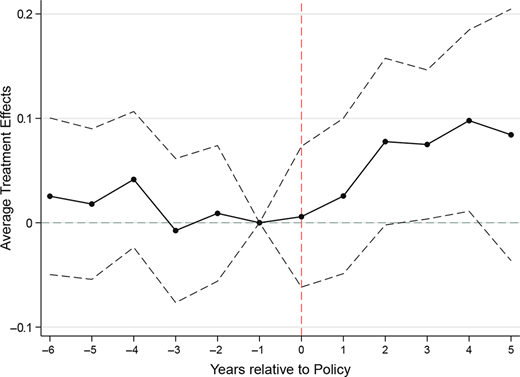
where D(j) equals one when year t is year j + 2017, otherwise zero. Therefore, the coefficients on TREAT × D(j), , capture the effects of urban climate adaptation policy on corporate GMAs in year j relative to policy. The other variables in Model (2) are the same as the variables in Model (1). Figure 2 clearly shows that the coefficients (solid line) from to are statistically insignificant, and their 95% confidence intervals (dashed lines) include zero, indicating that there is no significant pre-policy climate adaptation effect on corporate GMAs. Hence, Model (2) satisfies the parallel trend assumption. Additionally, coefficients are significantly positive and increase continuously, indicating that the urban climate adaptation policy has persistent enhancement effects on corporate GMAs.
4.2.2 Spillover effect.
The DID model assumes that there are no spillover effects, meaning that the net effect of city c’s climate adaptation policy on GMAs is not influenced by the climate policies of neighboring cities. Therefore, this paper refers to Xu et al. (2025) and adopts the following model to test whether policy spillover effects exist, thereby ensuring the reliability of the DID model’s estimation results:
where TREAT_N denotes city c’s neighboring city c′’s treatment status. Specifically, we identify the treatment status of geographically adjacent neighboring cities (TREAT_NCITY) and cities in the same province (TREAT_NPRO). Therefore, TREAT_NCITY × POST represents the spillover effect of neighbor cities, and TREAT_NPRO × POST indicates the spillover effect of cities in the same province. The empirical results are shown in Table 3. Both coefficients on TREAT_NCITY × POST and TREAT_NPRO × POST are insignificant, indicating that there are no spillover effects of climate policies. Thus, the basic assumption of Model (1) is also satisfied.
4.3 Channels discussion
Although the previous section established that urban climate adaptation policy promotes corporate GMAs, the underlying mechanisms require further empirical verification. Based on the theoretical framework developed in Section 2.2, we use a mediation effect model to examine two specific channels: the signaling mechanism (via institutional investors) and the information intermediary mechanism (via analyst coverage). The specific model is as follows:
Here, M represents the mediation variable, defined as institutional ownership (INS_OWN) and analyst coverage (Ln(ANA + 1)). If both and are statistically significant, a mediation effect is confirmed. The results are presented in Table 4. First, we test the signaling mechanism. Following Ying et al. (2015), we measure institutional investors (INS_OWN) by the proportion of institutional ownership. Columns (1) and (2) show that the coefficients on TREAT × POST and INS_OWN are both significant and positive. These results validate our signaling theory argument: the CAPC policy acts as a “resilience signal,” reducing adverse selection and attracting long-term institutional capital. These investors, in turn, provide the necessary financial and monitoring support to facilitate corporate GMAs.
Second, we test the information intermediary mechanism. Following Cang et al. (2014), we measure analyst coverage as Ln(1 + number of analysts). Columns (3) and (4) reveal significant and positive coefficients for TREAT × POST and Ln(ANA + 1). This aligns with information intermediary theory, suggesting that the CAPC policy serves as an “information catalyst.” By increasing the information supply regarding climate risks, the policy attracts financial analysts who reduce information processing costs and valuation uncertainty for the market. This improved information environment alleviates the information asymmetry that often hinders complex GMAs.
Overall, these findings demonstrate that urban climate adaptation policy promotes corporate GMAs by triggering a signaling effect that attracts institutional investors and an information intermediary effect that enhances analyst coverage.
4.4 Heterogeneous effects
4.4.1 Corporate property rights: state-owned enterprises and non-state-owned enterprises.
According to the different types of corporate property rights, our article divides corporates into two groups: SOEs and non-state-owned enterprises (NSOEs). We further examined the heterogeneous effects of urban climate adaptation policy on corporate GMAs between SOEs and NSOEs by Model (1). The results are shown in Table 5. The coefficients on TREAT × POST are only significantly positive in SOEs, indicating that urban climate adaptation policy more strongly promotes GMAs for SOEs than non-SOEs. This result aligns with our expectations. SOEs’ policy-backed resources facilitate strategic GMAs requiring long-term commitments, as Wang et al. (2023) suggest. Additionally, SOEs bear greater responsibilities in fulfilling social responsibilities, especially in promoting green transformation and sustainable development. By contrast, NSOEs face stronger short-term performance pressure and tighter bankruptcy constraints, which lowers their willingness to undertake strategic M&As with delayed payoffs.
4.4.2 Energy-intensive industry: high energy-intensive industry and low energy-intensive industry.
Referring to Du et al. (2018), our article divides the iron and steel industry, non-ferrous metals industry, non-metallic mineral products industry, petroleum refining and coking industry, chemical industry, and power industry into high energy-intensive industries and other industries as low energy-intensive industries. Based on Model (1), we further examined heterogeneous effects of urban climate adaptation policy on corporate GMAs between high- and low-energy-intensive industries. Results are shown in Table 6. The coefficient on TREAT × POST is significantly positive (0.059, t = 3.042) for high energy-intensive industry but statistically insignificant (−0.020, t = −0.203) for low energy-intensive industry, indicating that GMA enhancement effects of urban climate adaptation policy are more pronounced in high energy-intensive industry compared to those in low energy-intensive industry. This discrepancy may be attributed to the fact that corporates in high-energy industries consume a large amount of energy and produce high carbon emissions during the production process. Climate policies often set strict standards for energy use and carbon emissions, such as carbon taxes and energy consumption limits. Climate policies raise costs for energy-intensive corporates, squeezing profits and compelling investments in energy-saving, emission-cutting and technological upgrades for compliance. Otherwise, they may face risks of production restrictions or even shutdowns (Cang et al., 2014). Therefore, corporates in high-energy industries are more sensitive to climate policies (Zhong et al., 2025). Hence, impacts of urban climate adaptation policy on GMAs in high-energy industries are more pronounced. In contrast, for low-energy-intensive corporates, compliance pressure and expected cost savings from green acquisitions are comparatively modest, so the incentive to pursue GMAs is weaker. These corporates can often meet climate requirements through incremental process improvements or minor investments rather than undertaking large, strategic acquisitions, making the policy effect statistically insignificant.
4.5 Robust checks
4.5.1 Alternative measures for corporate green mergers and acquisitions.
In this section, we refer to Lu (2021) and measure the corporate GMAs by a dummy variable (GMA_2) that equals 1 when a corporate has GMAs activities and 0 otherwise. In Column (1) of Table 7, the coefficient of the TREAT × POST is still significantly positive, indicating the conclusion still holds. Additionally, as suggested by Cohn et al. (2022), estimating linear regressions of the natural logarithm of 1 plus count-based outcome (yearly count of GMAs activities, Count_GMA) variable produces estimates that can have the wrong sign in expectation. Therefore, our paper adopts count data models – NBR – as robustness checks, with Count_GMA as our dependent variable. Column (2) shows the conclusion still holds. Additionally, we also apply the IHS transformation to the yearly count of GMA activities (GMA_3) – which accommodates zeros and approximates the log for larger values (Bellemare and Wichman, 2020) – and re-estimate the baseline specification. The results [Column (3)] remain positive and statistically significant, reinforcing the robustness of our findings.
4.5.2 Placebo test.
Our estimator in mode (1) may also be confounded by unobservable factors. Therefore, this section refers to Wei et al. (2024) and conducts two placebo tests to resolve this concern: a placebo for virtual policy year and a placebo for virtual pilot corporates. First, we conduct a virtual year placebo to examine whether the enhancement effects of corporate GMAs are caused by the policy year rather than by other year-related factors such as the macroeconomic environment or industry development trends. Specifically, we conduct placebo tests by creating dummy variables POST2013 (years ≥ 2013) and POST2015 (years ≥ 2015) for hypothetical policy start years. At the same time, we construct two dummy policy variables, PLACEBO2013 (intersection term of TREAT and POST2013) and PLACEBO2015 (intersection term of TREAT and POST2015), respectively. Additionally, to avoid the interference of the real urban climate adaptation policy in 2017, we refer to Lu (2021) and restrict our sample to before the policy year (2017). The results are shown in Columns (3)–(4). Both coefficients on PLACEBO2013 and PLACEBO2015 are insignificant. Therefore, results further indicate that GMA enhancement is from urban climate adaptation policy, rather than other unobservable factors in different years.
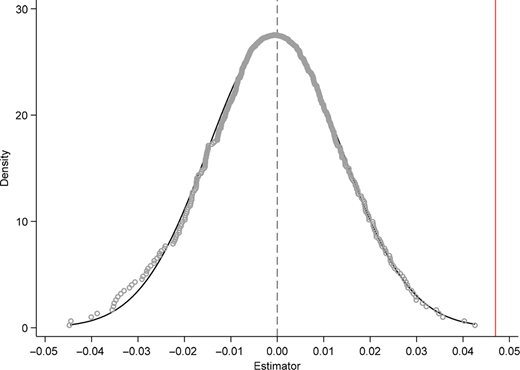
Further, this paper will conduct a placebo for virtually treated groups. In this paper, we randomly assigned corporates as the treated group and constructed a virtual TREATPlacebo. We then re-estimate coefficients on TREATPlacebo×POST. We conduct placebo tests by simulating 500 random policy years. As shown in Figure 3, the kernel density plot reveals that the 500 placebo coefficients cluster in the right tail and are statistically distinct from zero, confirming the 2017 policy’s unique causal effect on GMAs.
4.5.3 Excluding the impacts of the city’s geographic characteristics.
A city’s geographic characteristics (e.g. location advantages, natural resource endowment, transportation connectivity) shape production environments and regional policy orientations (Zhou et al., 2024), thereby driving corporate GMA activities. Following Zhu and Xu (2022), we interact city geographic traits (altitude, slope and coastal distance) with year dummies. Column (5) shows TREAT × POST remains significantly positive ( = 0.043, t = 2.347).
4.5.4 Controlling for contemporaneous policy.
To isolate the focal policy effect, we systematically control for contemporaneous policy enacted during the study period. Results are shown in Table 8.
Industry policies. China has implemented many fiscal policies, such as the fixed asset depreciation policy in 2014, the resource tax reform in 2013 and so on. These fiscal policies are roughly industry-based as the pilot unit. Therefore, referring to Zhang et al. (2022), our article includes the industry–year-fixed effects. The result is shown in Column (1).
2016 Central environmental protection inspection (CEPI). The Ministry of Ecology and Environment conducted five rounds of CEPI actions across 31 provinces during 2016–2017, followed by two 2018 “lookback” batches in 20 provinces, significantly enhancing local environmental governance accountability (Wang et al., 2023). Referring to Lin and Sun (2023), our article generates variable CEPI to capture the variations from the implementation of CEPI and include it in Model (1). The result is shown in Column (2).
2017 Green financial reform and innovation pilot zones (GFRIPZ) policy.Yi et al. (2024) find that green finance policy would reshape corporate pro-environmental M&As. Referring to Yan et al. (2022), our article constructs GFRIPZ, then controls it. The result is shown in Column (3).
2013 Clean air action (CAA). The clean air action, by strengthening environmental regulation, significantly increases the probability of GMAs among polluting corporates (Han et al., 2022). Referring to Lin and Zhu (2020), our article constructs CAA, then controls it. The result is shown in Column (4).
In summary, empirical findings robustly confirm that urban climate adaptation policy maintains a statistically significant positive effect on corporate GMAs.
4.5.5 Mitigating selection bias in pilot corporates.
Section 2 has discussed that the distribution of climate adaptation policy pilot cities is relatively random across 18 provinces in China, which to some extent ensures the similarity between pilot and non-pilot corporates in the DID model. Following Wei et al. (2024), our article re-selects non-pilot corporates that are similar to pilot corporates to mitigate the sample self-selection problem. Results are shown in Table 9.
First, we refer to Xu et al. (2025) and select non-pilot cities neighboring the pilot cities (excluding non-pilot cities that are not adjacent to the pilot cities) to ensure that pilot corporates and non-pilot corporates have similar geographical conditions and economic situations. The result in Column (1) shows that the coefficient on TREAT × POST is still significant. Additionally, we also select non-pilot cities in the province with the pilot cities (excluding provinces without pilot cities) to ensure that pilot corporates and non-pilot corporates have similar political systems and policy environments. Column (2) shows that the coefficient on TREAT × POST is still significant.
Second, to address selection bias from non-random city selection, we apply propensity score matching (PSM) following Hu et al. (2023). Using a logit model, we match groups based on corporate-level (SIZE, LEV, ROA, AGE, SOE) and prefecture-level (LnGDP, FINANCE) covariates. Three techniques – nearest neighbor, kernel and radius matching – ensure “common support” and group balance. Table 9 (Columns 3–5) confirms that TREAT × POST remains significantly positive. While PSM effectively balances observables, it cannot account for unobserved time-varying factors or sample loss outside the common support, which may affect generalizability. Nonetheless, the consistent results across matching methods and the inclusion of fixed effects in our main model reinforce the robustness of our causal identification.
4.6 Further discussion
In this section, we further examine the commercial and economic impacts of urban climate adaptation policy, focusing on corporate-level performance, market competitiveness and employment. Specifically, we estimate effects on return on assets (ROA), revenue growth and the natural logarithm of corporate employment. The results in Table 10 indicate that climate-adaptation policies do not affect ROA and have no statistically significant impact on the number of employees but do significantly increase corporate revenue growth. The potential reason for this is twofold. First, the policy amplifies corporate capacity for top-line expansion through a “green signaling” effect, while profitability is still absorbing integration costs and green investments – consistent with a “scale-first, efficiency-later” characteristic pattern of GMAs. Second, revenues are boosted via a “green technology” channel that avoids the rigid labor demand associated with traditional capacity expansion; as a result, GMAs raise market share without materially changing corporate total employment.
5. Conclusions and policy implications
5.1 Conclusions
This article examines the links between urban climate adaptation policy from the Chinese 2017 CAPC policy and corporate GMAs based on A-share listed corporates covering 2011–2022. Results reveal that urban climate adaptation policy would promote corporate GMAs. Specifically, after the urban climate adaptation policy implementation, corporates in pilot cities stimulated GMA activities by an average of 4.8% compared to those in non-pilot cities. This effect is more prominent for SOEs, corporates in high energy-intensive industries and corporates located in cities with high climate risk perception. Furthermore, our findings show that improvement of institutional investors and an increase in analyst coverage are two channels.
5.2 Policy implications
First, in light of the 4.8% increase in GMAs stimulated by the policy, we recommend expanding climate-resilient city pilots. Strengthening local adaptation governance can effectively “crowd in” green investment and transform external climate pressures into internal corporate transformation drivers. Second, grounded in the identified signaling and information intermediary mechanisms, governments should mandate standardized climate risk disclosures. Enhancing information transparency will attract institutional “patient capital” and enable analysts to better evaluate complex green initiatives, thereby reducing valuation uncertainty in the capital market. Third, reflecting the weaker response of NSOEs, policy focus should shift toward “information empowerment.” Establishing regional green technology platforms and sector roadmaps can lower information costs and investment risks for private enterprises, helping them better recognize and execute strategic GMA opportunities. Finally, given the observed synergy between ESG performance and policy effectiveness, we suggest linking adaptation metrics to green financial incentives. Integrating adaptation performance into green credit and bond evaluation frameworks will create market-driven rewards and lower financing barriers for sustainable corporate acquisitions.
5.3 Limitations and future research directions
Our paper also has several limitations. First, because of data constraints, our analysis focuses on the incidence and count of GMAs, as we were unable to systematically identify the monetary value of these transactions. Future research should prioritize investigating how urban climate adaptation policy influences the deal value of GMAs once such data become more readily available. Second, this study uses theoretical hypotheses to elucidate the influence of urban climate adaptation policy on GMAs. While this establishes a valuable conceptual framework, the approach lacks a degree of formal theoretical underpinnings. To strengthen the theoretical foundation, future work should aim to construct a mathematical model to formalize the proposed relationships and mechanisms between urban climate adaptation policy and GMAs. Finally, this study focuses on a single policy’s effect on GMAs, yet corporates respond to a complex regulatory landscape. Future work should, therefore, integrate other policies (e.g. carbon markets, subsidies) to determine whether they work in concert with urban climate policies to create synergistic effects on GMAs.
Notes
Ministry of Ecology and Environment of the People’s Republic of China, “2023 China Climate Change Monitoring and Evaluation Bulletin”, January 20, 2024, Link to memLink to the cited website of mem.
National Development and Reform Commission of the People’s Republic of China, “Notice on Carrying Out Pilot Work for Climate-Adaptive City Construction”, Link to ndrcLink to the cited website of ndrc.
In STATA 17, the reghdfe command automatically excludes firm samples with only one year of observations to improve the accuracy of model estimation (Correia, 2015).