As the largest carbon reservoir on Earth, the ocean plays a vital role in addressing climate change. Market mechanisms can enhance the effectiveness of ocean carbon sinks and leverage the ocean’s potential in climate governance. To ensure a stable and effective transition of marine carbon sinks from ecological resources into ecological capital within a market framework, robust policy and legislative support is essential. This paper aims at illustrating China’s practice in enhancing ocean carbon sinks through market mechanisms from the perspective of policy, especially how to establish such market mechanisms with the guidance of policy, while proposing suggestions for future optimization and summarizing inspirations from China’s practices.
This paper uses normative, empirical and comparative analysis methods to evaluate the effectiveness of policies China has formulated for establishing market mechanisms of ocean carbon sinks. It conducts a comprehensive review of national and local normative documents, matching them with Chinese empirical examples and pilot projects and then concludes achievements and challenges of China’s policy, together with inspirations from China’s practice.
China has initially established a multilevel regulatory system guided by its dual carbon goals, encompassing accounting methods and standards of ocean carbon sink, ocean carbon sink trading mechanisms and protection and restoration of marine carbon ecosystems. These policies have contributed to the diversification of products and value realization mechanisms of ocean carbon sinks. However, several challenges remain, including ambiguous property rights over ocean carbon sinks, inconsistent accounting standards, unsound trading norms and the lack of market-oriented pricing mechanism. To enhance regulatory effectiveness, China should further advance the top-level design of ocean carbon sink management, improve the monitoring, reporting and verification (MRV) system and integrate ocean carbon sinks into the China Certified Voluntary Emission Reduction (CCER) trading system to refine pricing mechanisms.
This paper provides the first systematic review of China’s both national and local policies related to market mechanisms of ocean carbon sinks. These policies can be classified into three main areas: accounting methods and standards of ocean carbon sink, trading of ocean carbon sink and protection and restoration of marine carbon ecosystems. It also identifies key characteristics of China’s approach, particularly the coordination between central and local governments under the dual carbon goals, which provides inspiration for global application of market mechanisms to enhance ocean carbon sinks.
1. Introduction
Ocean carbon sink refers to the mechanism by which the ocean absorbs and stores greenhouse gases through abiotic inorganic cycling of carbon and the cycling of carbon due to biological activity (Heinze et al., 2015). As the largest carbon reservoir in the Earth, additional with diverse ecosystem services and functions, the ocean plays an irreplaceable role in addressing global climate change (Gruber et al., 2019; Daba and Dejene, 2018; Sutton-Grier and Moore, 2016; Poloczanska et al., 2018).
Existing research proves that market mechanisms can actively enhance ocean carbon sinks by realizing its economic value (Sunny et al., 2023). It should be noted that such market mechanisms do not act independently but rather play a precise role and need to be part of a suite of measures, surrounded by other complementary policies and measures (Blyth et al., 2009; Larson et al., 2008). Establishing market mechanism for ocean carbon sinks requires not only environmental science and technology and economics as theoretical support, but also policy to provide realistic guarantee which is characterized by a notable element of artificial cultivation, particularly within the framework of a socialist market economy, as exemplified by China (Jabbour et al., 2021; Lo, 2013).
Since the release of the Blue Carbon: Assessment Report on the Carbon Sink of Healthy Oceans by the UNEP, as response China has been continuously advancing its ocean carbon sink plan (Nellemann et al., 2009). Recently, China has attached particular importance to enhancing ocean carbon sinks through market mechanism, aiming to achieve both their ecological and economic benefits. In this process, policy plays an important role in promoting and guiding the construction and operation of such market mechanisms in China, which existing research has barely covered. Currently, only a few literature deals with China’s marine carbon sink trading polices which is limited to the single market mechanism of “trading,” without depicting the overall path for China to enhance ocean carbon sink through market mechanisms from the perspective of policy analysis (Wang et al., 2024).
To fill the gap, this study attempts to first systematically sort out China’s policies regarding ocean carbon sinks from the perspective of market mechanism, evaluate their effectiveness in enhancing ocean carbon sinks through market mechanisms, then finally put forward corresponding suggestions for optimization. Specifically speaking, Section 2 provides a literature review clarifying the reason of applying market mechanisms in enhancing ocean carbon sinks and relevant international practices, Section 3 introduces the materials and methodology of this study, Section 4 provides findings of China’s policy in enhancing ocean carbon sinks through market mechanisms, meanwhile discussing challenges of existing policies, whereas Sections 5 proposes conclusion and recommendations of this study.
2. Literature review
Existing research on applying market mechanisms to enhance ocean carbon sink has focused on the following aspects:
2.1 The function of carbon sink market and its rationale
Ocean carbon sink market is a mechanism that uses the carbon sink capacity of marine ecosystems to achieve carbon reduction. Its function is to quantify the carbon sink of ocean ecosystem, convert it into tradable carbon credits and incentivize private sectors to protect and restore marine ecosystems. Compared with carbon emission quotas, market mechanisms, serving as effective tools for resource allocation, offer distinct advantages in ocean carbon sink enhancement. (1) For providers of carbon sinks, market mechanisms can increase their income, improve their lives, thus providing monetary incentives to increase carbon sink (Lockie, 2013). Research shows market is beneficial for expanding the capacity of carbon sinks (Lin et al., 2024). (2) For greenhouse gas emitters, market mechanisms give them flexibility to choose the most cost-effective method to comply with emission limits (Janet and Jason, 2020). (3) For the society as a whole, market mechanisms provide an effective tool for climate finance, stimulate green technological innovation and industrial investment, finally helping reduce the overall social costs of carbon mitigation (Gao et al., 2019; Marcu, 2014).
2.2 Global developments of ocean carbon sink markets and relevant research in China
In 2014, the Conservation International (CI), the International Union for Conservation of Nature (IUCN) and the Intergovernmental Oceanographic Commission of UNESCO (IOC-UNESCO) jointly developed the “Coastal Blue Carbon: Methods for Assessing Carbon Stocks and Emissions Factors in Mangroves, Tidal Salt Marshes, and Seagrass Meadows,” providing support for evaluating and measuring blue carbon storage and flux around the world (Howard et al., 2014). Ocean carbon sink trading is a market-oriented exchange of ecological products, sequestrating carbon with greenhouse gas emission rights through carbon credit for ecological compensation. It serves a basis for the implementation of market-oriented governance of marine carbon sink (Zhao et al., 2021).
The significant role of ocean carbon sinks in addressing climate change has become a universal consensus in the international community, and several countries have explored ocean carbon trading mechanisms. For example, in 2011, the USA has launched “Bringing Wetlands to the Market-Expanding Blue Carbon Implementation” program in its New England region, aiming to achieve broader wetland management, restoration and protection goals through carbon offset credit monetization (Waquoit Bay National Estuarine Research Reserve, 2013; Office for Coastal Management, 2025).
Regarding this new carbon reduction mechanism, Chinese scholars have conducted research on ocean carbon sinks around its right object and legal attributes, its trading mode and its economic value accounting, exploring how to establish market mechanisms for ocean carbon sinks in China (Li, 2020; Zhao et al., 2021; Liu et al., 2019).
Existing research has demonstrated that market mechanisms possess positive ecological, economic and social functions in enhancing ocean carbon sink, and what kind of market mechanisms have been applied in realizing the value of ocean carbon sinks. but it does not systematically explain how to enhance ocean carbon sinks through market mechanisms, especially how such market mechanisms are established. This is precisely the issue that this study aims to explore, taking recent Chinese practices as a sample to illustrate how the ocean carbon sink market mechanism is established, with a particular focus on how policies influence its establishment and operation.
3. Methods and materials
3.1 Study area
This study covers 11 provincial coastal regions in mainland China, including eight provinces (from north to south: Liaoning, Hebei, Shandong, Jiangsu, Zhejiang, Fujian, Guangdong and Hainan), one autonomous region (Guangxi) and two municipalities directly under the central government (Tianjin and Shanghai). These 11 provincial coastal regions are rich in marine resources, with diverse fishing grounds, oil and gas reserves and ports, supporting their vigorous development of fisheries, shipping and energy industries, becoming the core engine of China’s marine economy. For example, Liaoning and Tianjin rely on their advantages in heavy industry and ports to deeply cultivate the manufacturing of marine equipment; Hebei and Shandong are strengthening their marine fisheries and port related industries; Jiangsu and Shanghai take lead in marine technology and premium shipping; Zhejiang and Fujian lead innovation in marine engineering equipment and offshore fisheries with private economy; Guangdong, Guangxi and Hainan focus on emerging marine industries, laying out offshore wind power, deep-sea aquaculture and coastal tourism (China’s Ministry of Natural Resources, 2025).
The choice of this area is based on its geographical location and socio-economical relevance to the ocean. On one hand, these regions have a total coastline of 20,400 kilometers and are rich in ocean carbon sink resources (Chinese Economic Data, 2024). On the other hand, these regions are relatively economically developed with a gross domestic product (GDP) of 64,070.5bn yuan in 2024, accounting for 47.5% of the national GDP, of which the total marine economy is 1.031548tn yuan (National Bureau of Statistics of China, 2024) (see Table 1).
3.2 Materials sources
This study investigates the role of policy in enhancing ocean carbon sinks through market mechanisms. The materials search was conducted systematically using Laws and Regulations Database-Chinalawinfo, China National Knowledge Infrastructure (CNKI), Information service platform for standardization of China’s natural resources, China’s National public service platform for standards information, Chinese Court website and Ministry of Natural Resources of the People’s Republic of China Online sources. Materials were searched and identified using keywords such as climate change, carbon peaking, ocean carbon sinks/blue carbon, ocean carbon sink value, ocean carbon sink economy, ocean carbon trading and market mechanism.
By conducting the abovementioned materials search, this paper reviews and divides China’s policies regarding enhancing ocean carbon sinks through market mechanisms into two levels: national and local, based on the different legislative subjects. On this basis, according to legislative purpose and normative content, this study further divides (1) policies at the national level into 3 aspects (see Table 2): a. top design of ocean carbon sinks-dual carbon goals; b. ocean carbon sink standards; c. protection and restoration of ocean carbon sink; (2) policies at the local level are also divided into 3 aspects (see Table 3): a. dual carbon goals; b. ocean carbon sink standards; c. trading of ocean carbon sink.
3.3 Analytical methods
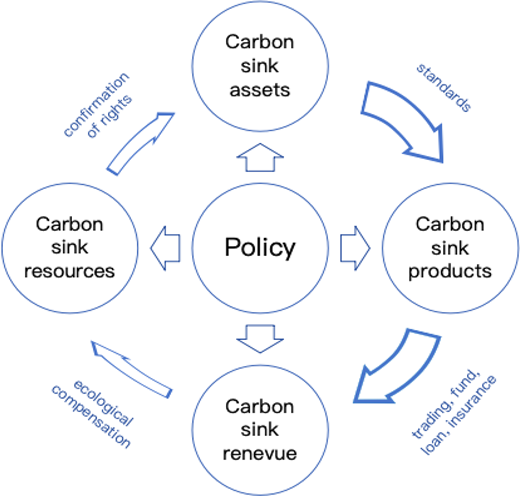
This study applies empirical analysis method to evaluate the effectiveness of China’s policies. The enhancing effect of market mechanisms on ocean carbon sinks lies in realizing and increasing the value of ocean carbon sinks through market capital operation, providing abundant funds for coastal ecosystems protection, thereby fully leveraging the ocean’s carbon sink capacity (Ullman et al., 2013). The effective operation of market mechanism requires the transition of ocean carbon sinks from ecological resources to ecological capital. Based on the theory of ecological capital, this process can be divided into four stages, namely, (1) the stage of assetization which conducts confirmation of property rights, (2) the stage of productization which relies on eco-technological innovation and application, (3) the stage of marketization which requires stable pricing mechanisms and profit expectations and (4) the stage of revenues distribution (namely the operation of ocean carbon sink capital) which requires establishing ecological compensation mechanism (Costanza et al., 1997; Birch and Muniesa, 2020; Libecap, 2009; Chen et al., 2024; Farley, 2008; Jiang et al., 2019).
In addition, this study adopts comparative analysis method to compare and analyze policies at both the national and local levels. Considering ocean carbon sinks are one of the important countermeasures for China to achieve its dual carbon goals, this study compares and analyzes the correspondence and relevance of national and local policies from 3 aspects: (1) decomposition (2) monitoring and evaluation and (3) implementation assessment of dual carbon goals. From the perspective of the relationship between central and local governments, it finally summarizes what inspiration China’s practice can provide on how to enhance ocean carbon sinks through market mechanisms, especially how to establish such a set of market mechanisms.
4. Findings and discussions
This study aims to explore how does China enhance ocean carbon sinks through market mechanisms from the perspective of policy. For this purpose, a necessary step is to evaluate the effectiveness of relevant policies in enhancing ocean carbon sinks through market mechanisms. Just as a coin has two sides, this study conducts a dialectical evaluation on the abovementioned issue from both positive and negative aspects. Specifically, Section 4.1 introduces the achievements of China’s policies with a particular focus on the interaction between policy and market mechanisms, meanwhile providing inspirations based on summarizing the process of policymaking between China’s central and local governments. Whereas Section 4.2 conducts a reflective analysis of China’s policies, summarizing deficiencies of the existing policies, for which Section 5.2 proposes recommendations for further policy improvement.
Overall, based on the four stages proposed by the ecological capital theory, the relevant practices in China can be summarized as follows: (1) during the stage of assetization of ocean carbon sinks, three counties in China have formulated specialized management measures for ocean carbon sinks, stipulating the ownership of ocean carbon sinks should be determined based on the information recorded in the registration system. However, the registration procedures are currently regional and inconsistent. (2) During the stage of productization of ocean carbon sinks, China has developed over ten accounting methods/methodologies for carbon sinks in different marine ecosystems. Various types of ocean carbon sink products have been developed, covering ecosystems such as mangroves, kelp, bivalves, seagrass beds, wetlands. (3) During the stage of marketization of ocean carbon sinks, Chins has applied 4 mechanisms to realizing the value of ocean carbon sinks, including trading, fund, loan and insurance of ocean carbon sinks. (4) During the distribution of revenues from ocean carbon sinks, there is currently no document specifying this mechanism in China. However, there are a few voluntary practices. For example, in the trading of mussel carbon sink in Dachen Island, the 100,500 RMB obtained from the transaction is partially retained in Dachen Common Prosperity Fund for marine ecological protection, and partially given back to mussel farmers.
4.1 Findings
As can be seen from the above, China has preliminarily established a multi-level regulatory system under dual-carbon goals which covers measuring and accounting standards, trading and restoration of ocean carbon sinks. This paper finds that under central-local collaboration, China’s introduction of these policies has realized the market value of ocean carbon sinks and promoted the development of ocean carbon sinks at certain stages of market operation.
4.1.1 China’s policies effectively enhancing ocean carbon sinks at the stage of production and marketization.
Through empirical analysis, this study finds that supported and guided by relevant policies, China’s market mechanisms of ocean carbon sinks currently operate smoothly in the second and third stages (hence the corresponding arrows in Figure 1 are thicker and wider), namely practices regarding “standards” and “trading, fund, loan and insurance” (see Figure 1).
Regarding the second stage, China has developed diverse products of ocean carbon sinks under the stimulus of policies. The investigation of ocean carbon sink products is an important perspective for observing whether policies have enhanced ocean carbon sinks at the stage of production of ocean carbon sinks (the second stage of the Loop). The productization of ocean carbon sinks requires corresponding standards to measure and account ocean carbon sink a project generates, which is the main operational basis for the productization process and the operational norms for the optimal allocation of carbon resources through the trading of carbon sinks. Many regions in China have developed local ocean carbon sink methodologies for typical marine ecosystems within the region. And based on this, China has developed diverse ocean carbon sink products covering a wide range of ocean carbon sink ecosystems such as mangrove forests, kelp, bivalve shellfish, seagrass beds and wetlands. For example, (1) Mangrove carbon sink product. As the province with the largest area of mangrove forests in China, Guangdong currently has a mangrove forest area of 11400 hectares with enormous carbon sink potential. In April 2023, Department of Ecology and Environment of Guangdong Province released “Guangdong Mangrove Carbon Inclusive Methodology", providing technical support for realizing the value of mangrove ecological products (Department of Ecology and Environment of Guangdong Province, 2023) . (2) Kelp carbon sink product. Lianjiang City in Fujian Province is known as the “hometown of kelp in China,” with a cultivation area of over 110,000 acres and huge carbon sink potential. In response, Fujian Province has formulated the “Technical Regulations for Carbon Sink Assessment of Cultivated Kelp” and actively developed kelp carbon sink products (Department of Ocean and Fisheries of Fujian Province, 2025; Zhang and Chen, 2023). (3) Seagrass bed carbon sink product. As an important blue carbon ecosystem, seagrass beds can efficiently absorb carbon dioxide and store it in seabed sediments for a long time, with carbon burial efficiency far exceeding that of forests (Ministry of Ecology and Environment of the People’s Republic of China, 2025). Shandong province, as the main seagrass area in northern China, has a rich seagrass bed ecosystem dominated by zostera marina, scattered in cities such as Weihai, Qingdao and Dongying. Regarding this, Shandong Province completes its first seagrass bed carbon sink transaction in June 2024 and has launched its Methodology of Carbon Sink in Seagrass Beds in 2025 (Department of Ecology and Environment of Shandong Province, 2025).
Regarding the third stage, China has developed diverse mechanisms to realize the value of ocean carbon sinks under the stimulus of policies. Mechanisms to realize the value of ocean carbon sinks refer to the conversion mechanism to turn ocean carbon sinks from products to revenue. The investigation of such mechanism is an important perspective for observing whether policies have enhanced ocean carbon sinks at the stage of marketization of ocean carbon sinks (the third stage of the Loop). Materials analysis show China’s local regions have explored diversified market mechanisms to realize the value of ocean carbon sinks in the process of implementing ocean carbon sinks policies, including trading, fund, loan and insurance of ocean carbon sinks (see Table 4).
Specifically, (1) trading refers to the purchase of certified ocean carbon sink products from suppliers through trading platforms to neutralize their own carbon emissions. Up till now, 9 out of the 11 coastal regions investigated by this study have carried out ocean carbon sink trading, with 82% participating rate. It is estimated that China has completed 262,500 tons of verified carbon reductions through trading of ocean carbon sinks since 2021, with a volume of trade over 20 million RMB (Liu, 2025). (2) Fund is a financing method that gathers money from numerous investors to provide long-term and stable financial support and guarantee for ocean carbon sinks projects. With corporate funds and funds raised by society as the main sources, China has established a specialized fund to support ocean sinks enhancement projects (Xiamen Marine Development Bureau, 2024). (3) Loans are a form of debt financing. Due to the long construction period and high investment risk of ocean carbon sink projects, banks in Qingdao, Shandong, Yancheng, Jiangsu and Shantou, Guangdong have explored using the forward income of carbon reduction generated from ocean carbon sink projects as collateral to issue loans (Wang and Li, 2021; State-owned Assets Supervision and Administration Commission of YanCheng Municipal Government, 2024). (4) Insurance is an important financial tool for risk transfer and allocation in the process of realizing the value of ocean carbon sink products. Several regions in China have developed green insurance products for ocean carbon sink projects (Chen et al., 2023; Yao, 2024).
Overall, with the support of relevant policies, China is realizing the value of ocean carbon sinks through diverse market mechanisms, providing a new pivot for the development of the blue economy.
4.1.2 Inspirations for enhancing ocean carbon sinks through market mechanisms from China’s practice: central-local collaboration.
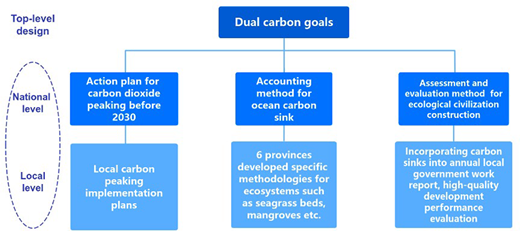
China has conducted meaningful explorations in accounting, trading and management of ocean carbon sinks, especially in the central-local collaboration in formulating policy to establish market mechanisms of ocean carbon sinks (see Figure 2), which provide reference and inspiration for countries (Li and Xing, 2024).
On the one hand, this process exhibits characteristics of centrally driven, namely the central government conducts top-down goal design and guidance. At the national level, since China proposed the dual carbon goals in 2020, the central government have incorporated it into the overall layout of economic and social development of the country. Specifically, the central government is responsible for formulating macroeconomic policy guidelines on dual-carbon issues, and then outsourcing policy objectives and standards to provincial governments which then refine policies and then decompose and outsource them to municipal governments. Each level of government follows this process until the grassroots government is responsible for specific implementation. By gradually outsourcing, then the national goal of dual carbon is responded to and implemented by governments at local levels.
In this process, the dual-carbon goals are achieved through a hierarchical system of bureaucracy, pushed down via administrative pressure to ensure the local governments’ enforcement and implementation of the central government’s goal. Generally speaking, the conduction of such administrative pressure mainly relies on three steps:
decomposition of the goal;
monitoring and evaluation of the goal; and
assessment of the goal.
Specifically, regarding ocean carbon sinks, China’s central government:
has stipulated ocean carbon sinks as an important task in mitigating climate change and realizing the dual-carbon goal in the Opinions on the Complete and Accurate Implementation of the New Development Concept to Do a Good Job of Carbon Peak and Carbon Neutrality and the Action Program for Carbon Peak by 2030 (completing the decomposition of the dual-carbon goal).
Central government has also issued standards and technical specifications for measuring and accounting ocean carbon sinks, such as the Method for Accounting ocean carbon sinks, Technical Procedures for the Investigation and Assessment of Carbon Stocks in Mangrove Ecosystems, to realize the monitoring and assessment of dual-carbon goals.
Central government has successfully established an assessment and evaluation system for the dual-carbon goals. In 2016, the General Office of the State Council first issued Assessment and Evaluation Method of Ecological Civilization Construction. Furthermore, then the Ministry of Environmental Protection also jointly formulated Indicator System for Green Development and Indicator System for Ecological Civilization Construction Assessment with other departments, significantly increasing the weight of environmental indicators when assessing political performance of leading cadres. In this context, as enhancing ocean carbon sink is an important part of China’s “Ten Actions for Carbon Peak” and a sub goal of environmental protection, it can be reflected as an important indicator in the performance appraisal of leading cadres (Li, 2025).
On the other hand, local governments have actively responded to the dual-carbon goals proposed by the central government, making decomposition and implementation of goals according to local conditions. Specifically:
All of the 11 coastal regions investigated in this study have included ocean carbon sinks in their local carbon peaking plans, regarding enhancing ocean carbon sinks one of the important tasks in implementing carbon peaking (to decompose the dual-carbon goals).
On the basis of the industry standards formulated by the Ministry of Natural Resources, localities have developed ocean carbon sink accounting methodologies with local characteristics in accordance with local conditions and in combination with typical local ocean carbon sink resources (to implement the monitoring and evaluation of dual-carbon goals).
Fujian, Shandong and Hainan have reported on the development of ocean carbon sinks as an important part of their “dual-carbon” efforts in the annual work reports of local governments (Zhao, 2025; Zhou, 2023; Feng, 2023). In addition, some provinces have also explored incorporating ocean carbon sink as indicator into the performance appraisal systems of cities or leaders (to improve the assessment system of dual-carbon goals) (Zhou and Ji, 2022).
In short, goal governance is an effective way to coordinate the contradictions between national unity and local diversity. China’s experience in using market mechanisms to enhance ocean carbon sinks can be summarized in one sentence: central and local cooperation under dual carbon goals. The implementation of dual-carbon goal not only provides opportunity for developing ocean carbon sinks, but also drives and guides local governments to conduct innovative explorations in enhancing ocean carbon sinks through market mechanisms. This model not only realizes national coordination and promotion, but also helps to stimulate local vitality.
4.2 Discussions
Although China’s policies have effectively enhanced ocean carbon sinks at the second and third stages (namely production and marketization), existing policies still have deficiencies which affect the full realization of their normative effect, hindering the operation of market mechanism at the first and fourth stage (namely assetization and distribution of revenues).
4.2.1 Unclear confirmation of property rights of ocean carbon sinks.
Clear property rights are the prerequisite for realizing the closed-loop capitalization of ocean carbon sinks (Saenz and Lewer, 2005). Legally, the sea area that serves as the foundation for ocean carbon sinks is vested in state ownership, and the state holds the sovereign right to govern and administer marine resources. For a long time, the state’s management of marine resources has mainly focused on spatial, biological and mineral resources and the management of ocean carbon sinks is still being explored. Although to meet the increasing demand for sea use, the law has divorced the ownership and use right of the sea area, allowing civil entities to obtain the use right of specific sea areas through administrative licenses, the production and operation activities allowed by the use right of the sea area at present mainly include marine aquaculture, ship-breaking, tourism and recreation, the salt industry, mining, public welfare undertakings, construction projects, etc. and have not yet been involved in the development and trading of ocean carbon sinks.
Existing legislations such as the Environmental Protection Law, the Law on the Management of Sea Area Usage and the Property Rights Section of the Civil Code does not provide for the attribution, division and transfer of the ownership, usage rights, income entitlements of ocean carbon sinks, which has led to the existence of systemic barriers to the establishment of property rights for ocean carbon sink resources. In the case of difficult to clarify the property rights, the economic disputes between the transaction subjects are easy to arise, which to a certain extent brings uncertainty to ocean carbon sinks transactions, and is not conducive to the construction and promotion of the market mechanism of ocean carbon sinks. More importantly, unclear confirmation of property rights will also make it difficult to identify the recipients of ecological compensation, thereby hindering the flow of revenues back to the providers of carbon sinks.
4.2.2 Incomplete market regimes for ocean carbon sinks.
The current development of China’s ocean carbon sink market mechanism faces three primary challenges that hinder its effectiveness and scalability:
Inconsistent accounting standards
While China has established its own ocean carbon sink accounting methodology such as Accounting Method for Marine Carbon Sink, significant discrepancies persist between theoretical standards and practical implementation. Current trading practices reveal that only the Zhanjiang mangrove project adheres to methodological norms, whereas other transactions rely on nonstandardized approaches. Most calculations focus solely on carbon removal quantities while neglecting critical factors like baseline scenarios, carbon leakage and the role of biological carbon pumps.
This practice of inconsistent accounting standards undermines the scientific validity of carbon accounting which is a prerequisite for realizing the economic value of ocean carbon sink resources through market mechanisms (Gifford, 2020). Furthermore, China’s monitoring of ocean carbon sink remain underdeveloped, with no dedicated system for tracking blue carbon resources, leaving the sector dependent on preliminary mapping and investigation data rather than robust, ongoing assessment mechanisms.
Non-standardized trading processes
The market is plagued by irregular trading procedures at multiple levels. Firstly, the registration phase of ocean carbon sink project is frequently omitted, as evidenced by existing transaction records. This skipping creates systemic issues including poorly defined project boundaries, inaccurate baseline scenario establishment, and compromised monitoring feasibility. Such deficiencies are particularly problematic for assessing carbon leakage and ecosystem impacts, potentially distorting the principle of additionality that underpins carbon trading. Secondly, the predominance of offline transactions conducted outside of official platforms demonstrates the market’s immaturity. While platforms like Xiamen Property Rights Trading Center have emerged, their exclusion from China’s Certified Voluntary Emission Reduction (CCER) system prevents integration with the national carbon market. This marginalization is reflected in buyer motivations, which currently emphasize social reputation over genuine carbon offsetting objectives.
Deficient verification mechanisms
Currently, there are only five authorized third-party verifiers for carbon sink projects (Certification and Accreditation Administration of the PRC, 2024). In practice, only the Zhanjiang mangrove project underwent proper auditing by a CCER-qualified institution (China Quality Certification Center). Other transactions have relied on unaccredited scientific research institutions for evaluation, creating legal vulnerabilities in verification processes.
It can be observed that there is a lack of robust verification mechanisms in the marketization process of ocean carbon sink. This irregularity in credentialing undermines the credibility of ocean carbon sink quantification and raises questions about the market’s integrity.
The abovementioned systemic deficiencies collectively constrain the development of a reliable, scalable ocean carbon sink market in China, which requires further policy interventions to to ensure that ocean carbon sink trading conforms to international best practices and aligns with China’s broader climate governance framework.
4.2.3 Non market-driven pricing of ocean carbon sinks.
The trading price of ocean carbon sinks ranges from 485 yuan/ton to 8 yuan/ton in practice. This large fluctuation of price derives from that the existing transactions are not truly market-oriented, which are jointly caused by the following factors. (1) Under the existing filing, quantification, and verification mechanisms, it is difficult to ensure the additionality of carbon sink enhancement in ocean carbon projects. (2) Meanwhile, currently ocean carbon sink has not yet been incorporated into national carbon emission trading market. (3) There is also a significant difference in the demand for ocean carbon sink trading between the supplier and buyer. Specifically, the demand elasticity of the supply side is relatively small, while that of the purchase side is relatively large, which determines that the bargaining power of the purchaser is significantly stronger than that of the supplier, rendering the trading of ocean carbon sink a “buyer’s market”.
In addition, existing ocean carbon sink projects are mostly developed and traded under the guidance and participation of the government who plays an important role through the trading process (sometimes even becoming the supplier of the project). This to some extent distorts the effective functioning of market mechanisms, not only causing non-cyclical price fluctuations of ocean carbon sink, but also dampening the enthusiasm of market entities to voluntarily participate in ocean carbon sink trading.
5. Conclusion and recommendations
5.1 Conclusion
Endowed with abundant marine carbon sink resources, China holds vast potential for nurturing the marine carbon sink market (Xiang et al., 2022). China has initially established a multi-level system of policies guided by the dual carbon goals to promote the operation of market mechanism which can be divided into 4 stages (namely the stages of assetization, productization, marketization and distribution of revenues). Overall, China’s market mechanisms operate more smoothly in the second and third stages, while operate poorly in the first and fourth stages. Specifically, China’s policies have effectively enhanced ocean carbon sinks at the stage of production and marketization, which can be seen from diverse ocean carbon sinks products and various mechanisms to realizing the value of ocean carbon sinks. In contrast, China’s existing policies have deficiencies such as unclear confirmation of property rights, incomplete market regimes for ocean carbon sinks (including inconsistent standards, non-standard transaction processes, deficient verification mechanisms) and nonmarket-driven pricing mechanisms, thus hindering the stage of assetization and distribution of revenues. However, China’s policymaking in enhancing ocean carbon sinks exhibits characteristics of central-local collaboration, which provides inspiration for global application of market mechanisms to enhance ocean carbon sinks.
5.2 Recommendations
In the context of actively promoting carbon peaks and carbon neutrality, China has initially established a policy system to enhance ocean carbon sinks through market mechanisms, but relevant policies are still insufficient to fully respond to the needs of developing ocean carbon sinks. Based on China’s national conditions, this section proposes the following recommendations for future optimization.
5.2.1 Promoting the top-level design of ocean carbon sink management.
To improve the systematicity of ocean carbon sinks policies, China’s natural resources ministry should take the lead in formulating Management Measures of Ocean Carbon Sinks covering the management principles, regulatory system, project development, trading rules, verification and supervision, legal responsibilities and so on. In particular, this Management Measure should clarify the property rights of ocean carbon sinks, which is the basis for the efficient operation of the entire market mechanisms. At the legal level, China currently only has Article 39 of the Wetland Protection Law (2021) stipulating local governments should take measures to enhance carbon sink functions of wetlands according to local conditions, which can be used as the legal basis for developing carbon sinks. However, this is not sufficient for long-term operation of ocean carbon sink market.
Regarding confirming property rights of ocean carbon sinks, two aspects of legislation need to be improved. First, the ministry of natural resources should first make a proposal to the Committee of legal affairs of the National People’s Congress which should first organize the revision of the Law on the Management of the Use of Sea Areas. The Notice on Exploring and Promoting the Work of Three-dimensional Hierarchical Rights Setting for Maritime Areas issued by the Ministry of Natural Resources in 2023 provides a sound institutional guarantee for optimizing the use of natural resources and asset operation. Accordingly, the Law on the Management of the Use of Sea Areas can expand operation activities included in the right to use sea areas to ocean carbon sink projects by explicitly stipulating the term of the right to developing ocean carbon sinks in Article 25 of the Law.
Secondly, when formulating the specialized Management Measures, the Ministry of Natural Resources can innovate its property rights system based on the right to use the sea area, providing the ownership, usufruct and exchange right of ocean carbon sinks.
5.2.2 Establishing sound monitoring, reporting and verification system for ocean carbon sinks.
In addition, China also needs to improve carbon sink MRV systems which includes establishing:
a dynamic monitoring system for ocean carbon sinks (Manley, 2024). The Ministry of Natural Resources should take the lead in organizing and implementing a national mapping survey of ocean carbon sink resources, compiling statistics on the quantity, quality, distribution, ownership, protection, development and utilization of ocean carbon sink resources in various regions, as well as establishing a national-level information database and information-sharing platform, so as to timely tracking and recording changes in ocean carbon sinks resources.
A system for cataloging and managing the assets of ocean carbon sinks. On the basis of dynamic monitoring of ocean carbon sinks resources, the Ministry of Natural Resources, together with the meteorological department and the industry and information department, should also establish a comprehensive system for cataloging and managing the assets of ocean carbon sinks, and incorporate accounting of ocean carbon sinks into the balance sheet of natural resources, which can provide data support for the operation of market mechanisms such as pricing.
Cultivating a group of third-party organizations with professional capabilities and qualifications. To ensure the authenticity of carbon credits, Certification and Accreditation Administration should review and recognize the qualifications of the third-party intermediary institutions and their practitioners, regularly publish a list of institutions with emission reduction verification qualifications in carbon sink field, and standardize the operation process and charges of intermediary institutions.
5.2.3 Incorporating ocean carbon sinks into China’s certified voluntary emission reduction trading system.
To improve the marketization of ocean carbon sinks trading, firstly the Ministry of Ecology and Environment should revise the Administrative Measures for Greenhouse Gas Voluntary Emission Reduction Trading to recognize the legal status of ocean carbon sink projects in the national CCER mechanism, meanwhile work together with the National Development and Reform Commission to formulate both substantive and procedural rules for this incorporation, ensuring the liquidity of carbon credits generated by ocean carbon sink projects. The management department of ocean carbon sinks should also guide trading parties to conduct carbon sink trading through national carbon emission trading platform, and carry out carbon credit write-off of ocean carbon sinks in the carbon account timely after transaction.
Simultaneously, a reasonable pricing mechanism can effectively improve economic efficiency. The government should standardize the pricing mechanism for ocean carbon sinks, rendering it objectively reflect the supply and demand relationship, resource scarcity of ocean carbon sinks. Specifically, the government can develop different pricing mechanisms in stages of ocean carbon trading development. At the initial stage of trading, to avoid price fluctuations, the government can set a fixed price, unifying the price of ocean carbon sinks among different regions. With the further development of ocean carbon sink trading, the government can formulate guiding price by setting minimum and floating prices based on full consideration of natural and regional socio-economic factors, ensuring the relative stability of transaction price. Whereby as carbon sink trading becomes increasingly mature, the supply and demand sides can then differentiate their pricing based on actual conditions and scientific methods, considering market supply and demand, management costs of ocean carbon projects and transaction costs.