Climate change news and educational awareness programs have swamped Australia in the past four years, with earlier campaigns raising awareness in Europe and the USA via television and the internet. What is the impact on people's psychological states of such concerns? The purpose of this paper is to explore the psychological impact of climate change within the general population and investigate what makes an individual vulnerable to distress.
A questionnaire was completed by 275 adults that assessed personality factors as well as environmental beliefs and religiosity. The design was cross‐sectional, and correlational analyses determined the associations between climate change distress and symptoms indicative of depression, anxiety and stress. Independent samples t‐tests and ANOVA revealed group differences for age and gender. Hierarchical regression analyses were used to identify important, unique predictors and to determine the extent to which environmental beliefs, future anxiety, intolerance of uncertainty and religiosity accounted for the variability in climate change measures beyond the effects of age and gender.
This study indicates that the public is becoming increasingly concerned about climate change and that there is a relationship between this concern and symptoms that are indicative of depression, anxiety and stress. The results indicate that an individual is more likely to be distressed about climate change if they are female, under the age of 35 years, have a pro‐environmental orientation, and possess personality traits such as high levels of future anxiety.
Bringing attention to the existence of climate change distress, understanding the extent of these fears and what makes a person vulnerable will be helpful in the treatment and prevention of general and clinical levels of climate‐related distress.
Introduction
There is a growing consensus that increased awareness about climate change is leading to negative emotional reactions in certain individuals (Fritze et al., 2008). Expressions of negative psychological states relating to climate change appear in popular commentary, public opinion polls and increasingly in the medical and psychological literature (Searle and Gow, 2009). Doctors are reporting that more and more patients, presenting with anxiety and depression, are citing climate change news as something that they are having difficulty coping with (Miller, 2008). Groups that have been highlighted as being more susceptible to excessive worry and anxiety about climate change include individuals with existing depression or anxiety disorders, those working in the field of climate change, children and adolescents (Fritze et al., 2008).
While a heightened level of concern can be seen as an appropriate response to the issues surrounding climate change, some individuals are experiencing intense worry that leads to distress and/or interferes with daily living (Fritze et al., 2008). Anxiety and distress are terms commonly used to describe the response of individuals to the issues surrounding climate‐change; however, other climate related pathologies are also emerging. Wolf and Salo (2008), for example, described a patient with climate change delusions and visions of apocalyptic events who believed that his personal water consumption could lead to the deaths of millions of people. Further, experts in anxiety disorders are reporting an increase in climate‐related obsessive compulsive checking behaviours such as checking: gas and power meters to monitor their usage; taps for leaking water; and petrol consumption via the car's odometer reading (Halliwell, 2008).
Observations of the displays of climate change related obsessive and depressive behaviours has led to the creation of terms such as “carborexia” and “solastalgia”. The term carborexia first appeared in the New York Times in October 2008 and refers to individuals who have a fanatical desire to reduce their personal carbon footprint, to the point where it severely affects their lifestyle and normal daily activities (Halliwell, 2008). It is important to distinguish here between those individuals for whom taking action about climate change is within healthy behavioural limits and those whose behaviour has become excessive and disruptive to their functioning. The word solastalgia was created by the Australian environmental philosopher Albrecht (2005) and Albrecht etal. (2007) after environmentally induced distress was observed in individuals exposed to persistent drought in rural New South Wales (Australia) and in separate research examining the impact of large‐scale open‐cut mining in the Hunter Valley of New South Wales. Albrecht (2005) and Albrecht etal. (2007) proposed that the term captures the relationship between ecosystem health, human health and control (hopelessness and powerlessness) and negative psychological outcomes.
While the media and public commentary indicate concern about climate change, very little empirical research has been conducted within the psychological literature. A significant amount of research has, however, been conducted relating to public perceptions and responses to climate change (Leiserowitz, 2005; Lorenzoni et al. 2007; O'Connor et al., 2002; Pidgeon et al., 2006; Whitmarsh, 2007). A discussion of the extensive literature in this field is beyond the scope of this study, which aims to focus more specifically on negative emotional responses to climate change that may lead to distress in certain individuals. For a review of risk perception and climate change, the American Psychological Association's Taskforce on the Interface Between Psychology and Global Climate Change has recently released a comprehensive report summarizing this area of research (Swim et al., 2009).
Much is still unknown about the nature and extent of negative emotional consequences to climate change, nor the mechanisms that lead to distress in certain individuals. However, there does appear to be emerging evidence of a distinction between concerns regarding environmental problems that are current and identifiable, as opposed to fears that these problems will lead to future apocalyptic scenarios (Gow and Leahy, 2005). In preliminary research conducted by the authors (Searle and Gow, 2009), the majority of participants conceptualized climate change as being related to: unexpected environmental events such as natural disasters; changes in climate such as extreme weather patterns; and changes to lifestyle such as living with water restrictions and avoiding sun exposure. These current environmental changes were generally viewed as leading to greater social problems in the future such as mass migration, increased food prices, war over natural resources, as well as more extreme and catastrophic climatic events. These beliefs indicate the existence of a fateful view of climate change as a global environmental threat with a negatively charged future expectancy that may be contributing to greater climate‐related distress in the general population. A booklet produced by The American Psychological Association (APA Benson, 2008, p.30) states that
Even for individuals who are not immediately and directly affected by climate change, the problem can seem catastrophic, overwhelming and impossible to control. For people suffering the effects of rising sea levels, droughts or unpredictable weather, the consequences of climate change will undoubtedly cause significant stress.
The perceived threat to a community's mental health is large enough for health care‐professionals to call for the development of strategies to assist individuals to deal with their concerns (Miller, 2008). There have been a number of responses to this call. The APA has produced a public booklet with the aim of identifying and offering insights and solutions to the climate change crisis (Benson, 2008). The Australian Psychological Society (APS) (2009) has developed a tip sheet[1] which examines common emotional reactions to climate change and strategies to help manage these feelings (Burke, 2008). A second tip sheet aimed at talking with children about the environment includes suggestions for how to allay anxiety about the threat of climate change (Burke, 2008).
Literature produced by psychological associations reflect an impetus within the psychology community to focus on global climate change issues in light of the relative neglect shown towards what has been referred to as one of the greatest challenges of our time (Breckler, 2007). With public opinion polls, the media and the psychological literature indicating concern within general and clinical populations, it appears that further investigation is warranted with the aim of providing empirical evidence for the existence of distress related to climate change, as well as understanding the extent and nature of these fears. Awareness of this issue and knowledge about what makes a person vulnerable should be helpful in the treatment and prevention of general and clinical levels of distress related to the issues surrounding climate change.
Based on the existing research, several vulnerability factors are proposed for investigation, with the aim of highlighting those individuals who are susceptible to climate related distress. The following examination of the role of such variables as age, gender, environmental beliefs, future anxiety, intolerance of uncertainty and religiosity is intended to increase our understanding of how this global issue is having an impact on individual mental health and wellbeing.
Age variations
Several studies, examining fears in the general population over the lifecycle, have pinpointed that the number and intensity of various fears peak in high‐school age and college‐aged groups (e.g. Mizes and Crawford, 1986; Susulowska, 1985, as cited in Zaleski, 1996). In addition, younger age groups are more likely to have been educated about climate change at school and university than their parents and grandparents. With research indicating a greater vulnerability to intensity of fears and more exposure to climate change messages in younger age groups, it was expected that those below the age of 35 years, in the current study, would be more distressed about climate change than older participants.
Gender differences
Women generally report more depression, anxiety and fear than men. Women have also been found to be more anxious when facing ambiguous events such as nuclear war (Hamilton et al., 1989) and Y2K computer problems (Schottenbauer et al., 2004). In relation to climate change, Sundblad et al. (2007) investigated cognitive and affective risk judgements and found that even though men and woman did not differ in their predictions of the probability of serious negative consequences occurring as a result of climate change, woman were more worried about the consequences. Thus, it was expected that women would possess greater levels of climate change distress than men.
Environmental beliefs
Pro environmental beliefs have been associated with perceived seriousness of world ecological problems and seriousness of state and community air and water pollution (Dunlap et al., 2000). In relation to emotional responses and environmental beliefs, a study by Raudsepp (2005) confirmed that an emotional connection to nature was significantly correlated with environmental concern. Therefore, it seemed likely that participants in the current study, who possess pro‐environmental beliefs, would perceive the issues surrounding climate change with more seriousness and concern leading to greater climate change distress.
Future anxiety
The research literature indicates that both trait anxiety and future anxiety are associated with an interpretive bias for future events; that is, highly anxious individuals are more likely to perceive stimuli in a threatening fashion (Rapee, 1997; Zaleski, 1996). For example, several studies have concluded that students scoring high on trait anxiety are unrealistically pessimistic about examination‐related events (Butler and Mathews, 1987; Eysenck and Derakshan, 1997). Further, Goldstein et al. (2002) ascertained that trait anxiety was a predictor of Y2K anxiety, in that anxious individuals were more likely to overestimate the probability and severity of negative consequences of the Y2K computer problem. Future anxiety is described as a personality characteristic that is highly correlated with trait anxiety (Zaleski, 1996). It has been defined as “a state of apprehension, uncertainty, fear, worry and concern of unfavourable changes in a more remote personal future” (p. 165) and is also associated with pessimistic predictions about global problems faced by humanity (Zaleski, 1996). It seems likely then, that individuals possessing future anxiety would perceive information about current ecological concerns in a more threatening and worrisome manner.
Intolerance of uncertainty
Research indicates that “future uncertainty”, “increased unpredictability” and “not knowing the long‐term consequences” were amongst participants' greatest concerns in a survey about climate change distress (Searle and Gow, 2009). Intolerance of uncertainty can be seen as a cognitive bias that influences an individual's perceptions, interpretation and response to uncertain situations (Dugas et al., 2004). Individuals who find it difficult to tolerate uncertainty tend to avoid ambiguous situations because they find them stressful and upsetting (Dugas et al., 2004). Research has shown that individuals with high levels of intolerance of uncertainty show more concern about ambiguous situations and feel more threatened by interpretations of ambiguous situations than those with lower levels of intolerance of uncertainty (Dugas et al., 2005). Further, intolerance of uncertainty is a strong predictor of the tendency to worry (Dugas et al., 2004). Therefore, due to the uncertain nature of climate change, it seems likely that individuals who are intolerant of uncertainty would experience greater distress about climate change.
Religiosity
Historically, climate control has been viewed as an instrument for the exercise of God's expressions of favour or disfavour on morally vulnerable populations (Hulme, 2008). It is still a common perspective for many traditional cultures and even today, climatic events are described by religious leaders as “signs of a deeply fallen world” (Zwartz, 2009, p. 5). Despite this connection, it is not clear if the relationship between climate change and religion increases or decreases distress related to climate change.
From a psychological perspective, religious beliefs have been associated with anxiety reduction in many populations, such as individuals with HIV (Jenkins, 1995) and university students (Plante et al., 2000). Spiritual values have also been shown to be negatively related to future anxiety in that religious commitment appears to reduce pessimistic attitudes towards the future (Zaleski, 1996), particularly where those individuals hold intrinsic religious beliefs (Pritchard and Gow, in press). However, due to claims that climate change will lead to the destruction of the earth, those who hold religious beliefs may associate Armageddon‐like consequences to concepts of climate change thus increasing their levels of distress. Tolsma (1968) encompasses this notion with the idea of the degenerative doom‐sayer who holds an expectancy of salvation in the future that is linked to negative attitudes towards the existing world. Research on Y2K anxiety supports this idea. For example, Goldstein et al. (2002) concluded that strength of religiosity was a predictor of Y2K anxiety which the researchers attributed to the apocalyptic undertones of Y2K speculation involving Armageddon‐like consequences. Religiosity may therefore influence climate change distress from several perspectives: for example, Pritchard and Gow (in press) determined that the construct of religiosity was complex and it was more likely that flood victims would be distressed, if they demonstrated greater use of negative religious coping strategies and lower flood‐related coping self‐efficacy.
Aims and hypothesis
The aim of current study was to investigate the role of personality characteristics and vulnerability factors in predicting climate change distress within the general population. In doing so, the study set out to contribute to the limited research on the psychological impact of climate change in an Australian context. Based on existing theory and research, it was hypothesized that:
H1. Higher levels of climate change distress would be associated with higher levels of depression, anxiety and stress.
H2. Females and younger age groups (below 35 years of age) would be more distressed about climate change.
H3. Environmental beliefs, future anxiety, intolerance of uncertainty and religiosity would uniquely predict climate change distress after controlling for gender and age.
Method
Geographical location
It is noted that the geography of Australia is one of a very arid land with a long history of droughts, bush fires, floods and other natural disasters, such as cyclones and fierce tropical storms. The study was undertaken at a time when Australia (and equally in the State of Queensland where the study was undertaken) had just started to emerge from more than 15 years of drought and severe water restrictions that had been introduced into the city in which this study was conducted. Thus, the participants may have been acutely aware of the consequences of lack of rain, but were less aware of the dangers of severe bushfires, as these had mainly occurred in rural areas up till that time, leaving the majority of the cities mostly untouched.
Participants
The sample consisted of 173 university students and 102 members of the general public who were 18 years of age and above. Fifty one percent of participants lived in an urban area and 41 per cent in a city with the remaining 8 per cent of participants being from rural or semi‐rural areas. Approximately, 57 per cent were in the 18‐25 year age group (Table I) and 61 per cent were female. The highest level of education attained was year ten or 12 (52 per cent), followed by bachelor degree (18 per cent), and certificate, diploma or advanced diploma at a TAFE level (16 per cent).
Measures
Climate change distress
No current scale existed to measure the psychological impact of climate change. Therefore, the adjustment of questions from several related studies produced a measure of climate change distress. Goldstein et al. (2002), for example, used the six descriptors from the Mehrabian Trait Anxiety Scale (concerned, relaxed, anxious, secure, calm and worried) to measure Y2K anxiety. Schottenbauer et al. (2004) used a SUDS scale to measure Y2K Anxiety with ratings from “not at all anxious” to “extremely anxious” and from “not at all threatened” to “extremely threatened”. Further, Sundblad et al. (2007) asked respondents to rate worry about serious negative climate consequences in Sweden, Holland and Bangladesh approximately five, 50 and 100 years from now.
In the current study, a measure of climate change distress was produced with 12 items asking participants to rate how they feel now when they think about climate change (keeping their personal definition of climate change in mind, as defined by the participant in an earlier question): “Thinking about climate change now makes me feel – concerned, tense, worried, anxious, depressed, hopeless, powerless, sad, helpless, stressed, angry, scared”. Similar to the Depression, Anxiety, Stress Scales (DASS‐21; Lovibond and Lovibond, 1995), items were rated from 0 (does not apply to me at all) to 3 (applies to me very much or most of the time) and summed to produce a total score. In addition, participants were asked if they were more concerned about climate change now than they were three, five and ten years ago.
Environmental beliefs
Environmental beliefs were assessed by the New Ecological Paradigm scale (NEP; Dunlap et al., 2000) which is designed to measure generalized beliefs about the nature of human‐environment interactions. The NEP is a 15 item measure (α=0.83) rated on a five‐point Likert scale from “strongly agree” to “strongly disagree”, containing items such as “If things continue on their present course, we will soon experience a major ecological catastrophe”. Agreement with the eight odd‐numbered items and disagreement with the seven even numbered items indicates a pro‐ecological view. The NEP has shown predictive validity with moderate to moderately high correlations between NEP scores and perceived seriousness of world ecological problems (r=0.61), support for pro‐environmental policies (r=0.57), seriousness of state and community air and water pollution (r=0.45) and pro‐environmental behaviours (r=0.31; Dunlap et al., 2000).
Depression, anxiety and stress
The short version of the DASS‐21(Lovibond and Lovibond, 1995) was used to measure symptoms that are indicative of the clinically significant emotional states of depression, anxiety and stress. The depression scale measures feelings of hopelessness, dysphoria, lack of interest, anhedonia, devaluation of life and devaluation of self (e.g. “I felt that life was meaningless”). The anxiety scale measures physical arousal, situational anxiety and anxious affect (e.g. “I felt I was close to panic”), and the stress scale assesses the presence of a chronic non‐specific arousal (e.g. “I found it hard to wind down”). The 21‐item scale is rated from 0 (did not apply to me at all) to 3 (applied to me very much or most of the time) and is summed to make scale scores with higher scores indicating greater general levels of distress. The DASS‐21 displays alpha coefficients of α=0.81 for the depression scale, α=0.73 for the anxiety scale and α=0.81 for the stress scale, and all three measures correlate strongly with well established anxiety and depression scales such as the BDI and the BAI (Beck and Steer, 1987, 1990; Lovibond and Lovibond, 1995).
Future anxiety
Future anxiety was measured by the Future Anxiety Scale (FAS3; Zaleski, 1996) which measures a general state of apprehension, fear, worry and concern about unfavourable changes in a more remote personal future. The 29‐item scale (25 scoring items and four buffers) utilises a seven point Likert scale from 0 (decidedly false) to 6 (decidedly true) and includes items such as “I tremble with fear at the thought of what the next day, month, year will bring”. The 25 critical items are summed for a total future anxiety score. Cronbach's alpha of α=0.92 indicates high internal consistency and convergent validity has been demonstrated with significant correlations between the FAS3 and overt anxiety (r=0.48), trait anxiety (r=0.61), manifest anxiety (r=0.64), hopelessness (r=0.41) and neuroticism (r=0.6) (Zaleski, 1996).
Intolerance of uncertainty
Intolerance of uncertainty was measured by the short version of the Intolerance of Uncertainty Scale (IUS‐12; Carleton et al., 2007). The IUS‐12 examines an individual's reaction to ambiguous situations and assesses tolerance of the possibility that a negative event will occur regardless of the probability. The 12‐item scale is rated on a five‐point Likert scale from 1 “not at all characteristic of me” to 5 “entirely characteristic of me”, with items such as “Uncertainty keeps me from living a full life”. IUS‐12 scores are based on the sum of items. The total score measures general intolerance of uncertainty, with seven items assessing fear and anxiety of future events (prospective anxiety), and five items assessing whether uncertainty inhibits action (inhibitory anxiety; Carleton et al., 2007); however, these subscales were not utilised in the current study. The IUS‐12 displays strong internal consistency (α=0.91) and correlates well with related measures of anxiety and worry (Carleton et al., 2007).
Religiosity
Strength of religious faith was measured by the Santa Clara Strength of Religious Faith Questionnaire – short form (SCSRFQ‐SF; Plante et al., 2002). The five item scale is non‐denominational and measures strength of religiosity without the assumption that an individual is religious. The SCSRFQ‐SF is rated on a four‐point Likert scale from 1 (strongly disagree) to 4 (strongly agree) with items such as “I consider myself active in my faith or church”. A total score is derived from summing all items. Cronbach's alpha of α=0.95 indicates high internal consistency and convergent validity has been demonstrated with significant correlations between the SCSRF‐SF and the Duke Religion Index (Koenig et al., 1997; Storch et al., 2004).
Procedure
Of the 275 participants, 173 were recruited from a first year psychology course at the Queensland University of Technology in Brisbane (Australia) and received research participation credit for their involvement. Students in two different lectures were approached via an in‐class announcement in July 2008 and invited to fill in a survey. The remaining 102 participants were recruited during the same month through the distribution of the questionnaire at several workplace environments randomly chosen at an inner Brisbane location from a mixture of blue and white collar organisations and surveys were subsequently posted back to the chief investigator. All responses were anonymous and the return of a completed questionnaire was accepted as an indication of consent to participate.
Design
The study used a cross‐sectional, correlational design with climate change distress, climate change anxiety and climate change hopelessness as dependent variables, and depression, anxiety, stress, age, gender, environmental beliefs, future anxiety, intolerance of uncertainty and religiosity as independent variables. As the climate change distress scale was created for the purpose of this study, an exploratory factor analysis (EFA) investigated the suitability and validation of the factor structure for the climate change measures. Correlational analyses determined the associations between climate change distress and depression, anxiety and stress, in addition to the remaining independent variables. ANOVA and independent samples t‐test revealed group differences for age and gender. And finally, hierarchical regression analyses were used to identify important, unique predictors and determine the extent to which environmental beliefs, future anxiety, intolerance of uncertainty and religiosity accounted for the variability in climate change outcomes beyond the effects of age and gender.
Results
Missing value analysis
Data for all participants was missing at random as indicated by Little's MCAR test (p>0.05). For measures requiring scale total scores, SPSS expectation maximization methods were used to replace missing values. Different sample sizes reflect a printing error on 39 participant surveys (resulting in the removal of 39 scores for the intolerance of uncertainty scales and 8 scores for the religiosity scales).
Descriptives and correlational analyses
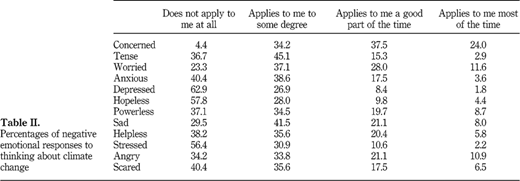
The majority of participants were more concerned about climate change now than they were three years ago (72 per cent), five years ago (79 per cent) and ten years ago (82 per cent). Table II indicates the extent to which participants indicated a negative emotion in response to thinking about climate change. The most common negative response that “Applies to me most of the time” or “Applies to me a good part of the time” were “concerned” (61 per cent), “angry” (32 per cent) and “worried” (29.6 per cent).
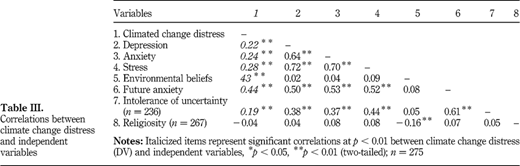
Pearson bivariate correlations revealed a small association between climate change distress and symptoms indicative of depression (r=0.22), anxiety (r=0.24) and stress (r=0.28). Table III depicts the correlations between dependent and independent variables highlighting a moderate association between climate change distress and both environmental beliefs (r=0.43) and future anxiety (r=0.44), and a small association with intolerance of uncertainty (r=0.19). A moderate to high association was found between intolerance of uncertainty and depression (r=0.38), anxiety (r=0.37), stress (r=0.44) and future anxiety (r=0.61).
Factor analysis
In order to investigate the suitability and validation of the factor structure for the climate change distress scale, an EFA was conducted on the 12 items used to measure climate change distress using a principal component analysis (PCA) extraction and oblique rotation (direct oblimin). Suitability for factor analytic techniques was verified by the Meyer‐Olin statistic of 0.9, significant Barlett's test of sphericity (p<0.001), and anti‐image correlation matrix showing multiple correlations were>0.5 and partial correlations were<0.2 (Field, 2005).
The PCA with a recommended minimum loading exclusion criteria of 0.32 (Tabachnick and Fidell, 2007) produced a two factor loading which accounted for 64 per cent of the total item variance. Factor one was named climate change anxiety (Thinking about climate change now makes me feel – tense, anxious, worried, angry, concerned, stressed, sad, scared, depressed) and factor two was labelled climate change hopelessness (thinking about climate change now makes me feel – powerless, helpless, hopeless). The relatively large number of high loading (>0.7) marker variables inferred the sample size (n=275) was sufficient for a reliable factor solution. Evidence of internal validity and adequate internal consistency are supported by Cronbach alpha's of 0.92 for the overall climate change distress scale, and 0.92 and 0.82 for the climate change anxiety and climate change hopelessness subscales, respectively. The overall distress scale and the two subscales are utilised in the ANOVA and multiple regression analyses.
Data screening
Normality assumptions for regression and ANOVA were assessed by screening multivariate residuals (Tabachnick and Fidell, 2007). Several of the scales (particularly depression and anxiety) were leptokurtic and positively skewed, as would be expected in a non‐clinical population. Although several outliers were found, they were not considered to be influential as indicated by Cooks distance<1.0. Homogeneity of variance assumptions were met as reflected by Levene's test of equality (p>0.05).
Age and gender group differences
The mean and standard deviations for males and females ratings of climate change distress, anxiety and hopelessness are set out in Table IV. An independent samples t‐test conducted for each climate change outcome measure indicated that females exhibited significantly greater levels of overall climate change distress t(267)=−3.71, p=0.000, climate change anxiety t(267)=−3.77, p=0.000 and climate change hopelessness t(267)=−2.356, p=0.019 than males.
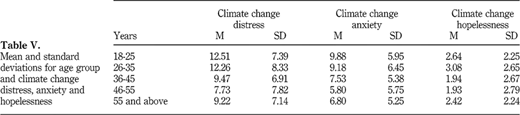
The mean and standard deviations for climate change distress, anxiety and hopelessness, according to age group are shown in Table V. Participants in younger age groups (18‐25 years and 26‐36 years) demonstrated the highest mean rating of climate change distress measures. One way ANOVA indicated a significant difference in age groups ratings of climate change distress F (4, 270)=3.13, p=0.015, climate change anxiety F (4, 270)=3.60, p=0.007, but not climate change hopelessness F (4, 270)=1.45, p=0.218.
Two way ANOVA revealed that the interaction effect between gender and age was not significant F (1, 224)=1.42, p=0.228.
Hierarchical regression analyses
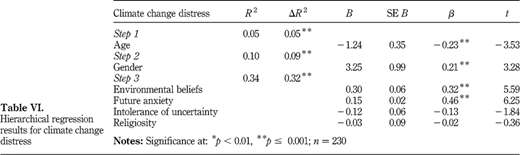
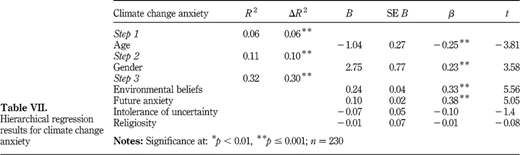
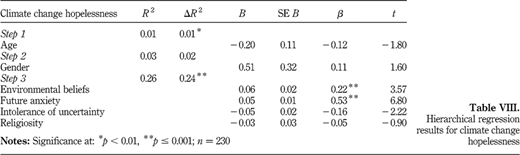
Hierarchical regression was run to check the unique contribution of environmental beliefs, future anxiety, intolerance of uncertainty and religiosity in predicting climate change variables beyond the effects of age and gender. Results showed a similar pattern for climate change distress, anxiety and hopelessness (Tables VI‐VIII).
Step 1 revealed that age was a significant predictor of climate change distress and climate change anxiety measures and accounted for 5.2 per cent (p=0.001) and 6.0 per cent (p=0.000) of variance, respectively. Step 2 determined that gender was also a significant predictor for overall climate change distress and climate change anxiety, accounting for an additional 4.3 per cent (p=0.001) and 5.0 per cent (p=0.000) of variance, respectively, beyond the effect of age. This indicated that female gender predicted greater overall climate change distress and climate change anxiety than male gender, but did not impact on climate change hopelessness. The final step showed that pro‐environmental beliefs, future anxiety, intolerance of uncertainty and religiosity significantly predicted additional variance in all climate change outcomes beyond the effects of age and gender (20.5‐24.7 per cent, p=0.000). Collectively, all predictor blocks accounted for significant variance (25.7‐34.2 per cent) across climate change outcomes. At p<0.001, final beta coefficients revealed that pro‐environmental beliefs and future anxiety were the strongest predictors of climate change outcomes.
Summary of results
The results of this analysis support the suitability and validity of climate change dependant measures revealing two subscales: climate change anxiety and climate change hopelessness, in addition to an overall climate change distress scale. All three scales were used to ascertain results in the previous analysis and are reported in summary as follows. Correlational analyses established small to moderate associations between climate change distress and depression (r=0.24), anxiety (r=0.24) and stress r=0.28), in addition to environmental beliefs (r=0.43), future anxiety (r=0.44) and intolerance of uncertainty (r=0.19). An independent samples t‐test found that females were significantly more distressed than males in all climate change measures. The highest mean climate change distress scores were found for younger participants (18‐25 and 26‐35 years) and one way ANOVA revealed a significant overall difference between age groups. Finally, hierarchical regression analyses identified that environmental beliefs, future anxiety, intolerance of uncertainty and religiosity accounted for additional variance in climate change measures (20.5‐24.7 per cent) beyond the effects of age and gender. Collectively, all predictors accounted for significant variance (25.7‐34.2 per cent) across climate change outcomes with beta coefficients revealing that pro‐environmental beliefs and future anxiety were the strongest predictors of climate change distress measures.
Discussion
The aim of this study was to establish the existence of a relationship between climate change distress and symptoms indicative of clinical levels of depression, anxiety and stress within the general population. Further analysis examined whether females and those under the age of 35 years, who held pro‐environmental beliefs, possessed high levels of future anxiety and intolerance of uncertainty, and who held religious beliefs were more vulnerable to experiencing climate‐related distress. Overall, the results indicated that the public was becoming increasingly concerned about climate change and there was a relationship between this concern and symptoms that were indicative of depression, anxiety and stress. Those who were more vulnerable included younger females who held pro‐environmental beliefs and who were apprehensive, fearful and worried about a more general remote future.
Within this study, the majority of participants self‐reported (retrospectively) that they were more concerned about climate change now than they were three, five and ten years ago reflecting the increasing concern shown in the media and the more commonly used discourses of our time relating to fear, danger and catastrophe (Hulme, 2008). As predicted, there was a small significant association between climate change distress and symptoms indicative of depression, anxiety and stress. Although it is plausible that participants who were already depressed, anxious and stressed viewed climate change through a negative bias, the direction of causality cannot be determined. It is also likely that individuals are finding information about climate change increasingly difficult to cope with and the resulting negative thoughts and feelings are contributing to the development and maintenance of clinical levels of depressive and anxious symptoms. The notion that climate change, when viewed as a global environmental threat, is leading to greater psychological distress in certain individuals is coherent with social commentary and specific examples that are now emerging in the media and psychological literature (Fritze et al., 2008; Halliwell, 2008; Miller, 2008; Searle and Gow, 2009).
Supporting the research hypothesis, females and those in younger age groups were more distressed overall about climate change than males and those over the age of 35 years. This is consistent with previous research suggesting that females are more worried than males about climate change (Sundblad et al., 2007), and that fear of the future has its highest frequency in the 20‐29 year age group (Susulowska, 1985, as cited in Zaleski, 1996). It is noted, however, that there were no significant age differences in feelings of hopelessness about climate change, in that all ages felt equally as helpless, hopeless and powerless. Greater overall distress in the younger age groups may reflect the increasing tendency to teach climate change themes in school curriculae. Knowledge of the potential catastrophic consequences of climate change, as well as the greater likelihood of these consequences occurring in a younger person's lifetime, may create an increased susceptibility to distress in those under 35 years. Future research may wish to investigate the influence of knowledge as a potential mediating factor.
Consistent with the literature and supporting our hypothesis, high levels of future anxiety and pro‐environmental beliefs were found to be the strongest predictors of climate change distress measures. This indicates that participants who possess a pro‐environmental orientation and who are apprehensive, fearful and worried about a more general remote future are more likely to be distressed about climate change. To move individuals in this group from despair and hopelessness to a sense of empowerment, they need to be encouraged to remember that the future is not all bleak, and that, on a personal level, there is a lot that can be done by taking action through managing the environment in a more positive way (APS, 2009).
Intolerance of uncertainty, while weakly associated with climate change distress was not able to significantly predict measures of climate change distress. These results do not support our hypothesis and do not reflect the unpredictability of climatic events and the uncertainty about where climate change will lead. An explanation of this result may lie in the influence of individual coping styles. An individual's ability to tolerate uncertainty may be strengthened by, or even promote the use of emotion focused coping strategies such as minimizing threats, or problem focused strategies such as taking action, which has the overall effect of an increased sense of coping and a reduction in negative emotional responses (see Lazarus and Folkman, 1984, for a full discussion on emotion focused and problem focused coping). Future research may wish to investigate the role of coping style as a mediator between intolerance of uncertainty and climate related distress.
Finally, contrary to our hypothesis, religiosity did not predict climate change distress. It appears that religiosity (as measured by the SCSRFQ‐SF) is neither a protective factor in preventing the individuals in this study from becoming distressed about climate change, nor do the apocalyptic undertones of climate change increase feelings of distress for those possessing religious faith. It may be important to note here the low levels of religious adherence in Australia compared to the USA and Europe (Atkinson, 2008) which may have influenced the results in this Australian sample. However, for the many individuals for whom climate change does hold religious significance both inside and outside Australia, future qualitative research may assist in understanding the paths that link religion to a personal emotional response towards the issues surrounding climate change.
Although the results of this survey are consistent with the research literature, the study has not been without its limitations. The correlational and cross‐sectional design is not necessarily indicative of causality, in that climate change distress has not been proven here to cause symptoms indicative of depression, anxiety and distress. Future researchers may wish to use case studies or qualitative research which target individuals, who both meet the criteria for mood disorders and attribute their emotional difficulties to climate change, in order to illustrate these causal links.
As with many psychological studies, methodological limitations also include the possibility of bias which may have resulted from the ordering of questions and from the use of uni‐directional scales. For example, questions about psychological distress follow those about responses to climate change. Repeating the survey, using filler questions or randomising questions within the sample, may alleviate the potential for question order to influence participant's answers. Also, using scales that focus on positive emotions, as well as negative emotions, allows for consideration of distress in the context of a range of other possible responses.
Although multiple regression analysis supported the hypothesized vulnerability factors for climate change distress, the results do not preclude the validity of alternative or additional factors. In this recent area of psychological interest, many questions remain unanswered. For example, future researchers may wish to investigate the influence of factors such as coping style and coping self‐efficacy (which may be useful in overcoming feelings of helplessness), the nature and extent of prior traumatic experience, or the impact of knowledge about climate change and the issues surrounding climate change. Replication of this survey with a larger sample size, with or without additional factors, would allow more robust path analyses to be obtained by using structural equation modelling techniques. The sample size was small in terms of capturing the wider population's views, but provided a snapshot of concerns that could form the basis of further research in this country, as climate change has recently been a much publicised political issue, and the Government's recommendations for combating climate changes have met with resistance to date from a large segment of the population who remain highly sceptical about the causes of the range of natural disasters and other eco‐system changes that have been noted. Unlike some countries in Europe, where many environmental protection and conservation protocols have been put in place, Australia, for so long, has benefited from a vast array of natural resources which have been exploited to the benefit of the country's economic position, and they have only recently begun to understand that environmental resources and special ecosystems will disappear without concerted action by the populace.
Conclusion
The overall results of the current study provide empirical evidence that contributes to the growing consensus that climate change is associated with negative emotional reactions in certain individuals. This study indicates that the public is becoming increasingly concerned about climate change and that there is a relationship between this concern and symptoms that are indicative of depression, anxiety and stress. An individual is more likely to be distressed about climate change if they: are female; are under the age of 35 years; have a pro‐environmental orientation; and possess personality traits such as high levels of future anxiety. Bringing attention to the existence of climate change distress, understanding the extent of these fears and what makes a person vulnerable will be helpful in the treatment and prevention of general and clinical levels of distress related to concepts of climate change.
The APA (Benson, 2008) proposes that research into climate‐related stress and coping will assist individuals and communities to manage shifting conditions in healthy and productive ways. Further investigation is required that involves an interdisciplinary approach to understand how climate‐related distress is manifesting on individual, community and societal levels and to develop strategies to assist those who are suffering. The APS (2009)tip sheet titled “Climate change: what you can do” states that “Although environmental threats are real and can be frightening, remaining in a state of heightened distress is not helpful for ourselves or for others.” The tip sheet provides 16 strategies to assist individuals to stay calm and rational and to improve a sense of coping (APS; 2009). As psychology's involvement in the field of climate change continues to grow, Fritze et al. (2008) suggest that, in the long‐term, those involved with mental health promotion will need to strike an important balance between scientific evidence, hope, morale and action at a time when climatic predictions are becoming increasingly grave.
Notes
A tip sheet is generally an A4 page with a list of things to do to cope in a particular situation.
References
Further Reading
About the authors
Kristina Searle, a Registered Psychologist with research interests in health psychology, undertook the research that this paper was based upon as part of a clinical doctoral program at the Queensland University of Technology, Brisbane. Her companion paper on climate change fears was published recently in Meltdown: Climate change and Other Catastrophes – Fear and Concerns for the Future (2009) through Nova Science Publishers, New York.
Kathryn Gow has been a Researcher and Speaker in the field of stress and coping, trauma and recovery for many years and in the past 12 years has moved into the areas of emergency services, natural disasters and climate change, editing two books with Nova Science Publishers, New York. who have classified these books within their Series on Natural Disaster, Prediction and Mitigation Series. They are The Phoenix of Natural Disasters: Community Resilience (2008) (with D. Patton as Co‐editor) and Meltdown: Climate change and Other Catastrophes – Fear and Concerns for the Future (2009). Kathryn Gow is the corresponding author and can be contacted at: kathryngow@bigpond.com