The purpose of this paper is to investigate the development of climate change adaptation curricula. Instituting adaptation frameworks that can assist professionals to respond to climate change, yet be tailored to specific sectoral needs is crucial. Professionals working at the coalface of the climate change challenge need to build new skills and create innovative solutions in social and political contexts.
Using case studies, this paper reflects on the experience of developing climate change curricula at multiple levels and the obstacles to implementation of the links between curriculum and practice. This includes reflections on the necessity of interlinking political, social and economic aspects together in delivery of such a course.
The paper finds that a strictly content – based approach to curriculum development is inadequate. The context of an issue like climate change requires attention to the specific needs of the target audience, in addition to delivery of generic content, so as to achieve the industry uptake critical to ensuring social and political objectives are implemented on the ground.
The paper concludes by examining the utility of such educational initiatives to build community resilience, forge networks between multiple sectors and contribute to achieving social/institutional, political and economic outcomes for adaptation to climate change.
Introduction
Climate change, its impacts and solutions is at the forefront of a collective global consciousness. Instituting adaptation frameworks that can assist professionals to respond to climate change, yet be tailored to specific sectoral needs is crucial. Professionals working at the coalface of the climate change challenge need to build new skills and create innovative solutions in social and political contexts. The delivery of curricula that can build the sustainability agenda in climate change contexts is a huge challenge for educational practitioners. The literature highlights that there has been much activity in the field of sustainability education, including techniques to encourage deep learning (Warburton, 2003), application of curriculum action research frameworks, place‐based inquiry pedagogies, dialogical and reflective approaches (Colucci‐Gray et al., 2006), metaphorical applications (Carew and Mitchell, 2006), problem‐based solving, and experiential learning (Ellis and Weekes, 2008). Tilbury et al. (2005, p. 20) advance a framework for “Learning for Sustainability”:
Education for sustainability is an innovative and interdisciplinary process requiring participative and holistic approaches to the curriculum […] [It] has a transformative agenda that requires and often leads to professional, curriculum as well as structural change.
However, as Sipos et al. (2008, p. 70) add (somewhat caustically):
Education is at odds with sustainability when modern economies function to damage and destroy the ecological systems that support human and non human communities. The explicit mission of contemporary school reform is to prepare students to perpetuate these problematic economies […] If current education leads to unsustainability, then education can – and should – contribute to sustainability.
It is in this context that this paper is situated.
Methodology
Using case studies, this paper reflects on the experience of developing climate change curricula at multiple levels and the obstacles to implementation of the links between curriculum and practice. In this context, and to effectively analyse the lessons learned from each case study, the paper adopts a curriculum action research framework. This seemed appropriate for three reasons. First, it allows for flexibility in approach and the capacity for ongoing iterative reflective and continuous adaptation. Second, this method is uniquely suited to the metamorphic nature of climate change adaptation per se, thus enabling incorporation over time of changes in the field relatively easily. Third, the adoption of a curriculum action research approach facilitates opportunities to develop student capacity for critical thinking, a generic skill that is a necessary part of the toolkit for any climate change adaptation practitioner.
In this context, the research for this project was designed at the outset according to the principles stated by Warburton (2003) including to:
increase understanding;
be critical in intent;
be emancipatory;
be collaborative and participatory; and
focus on case studies.
While there is an array of action research models to choose from, this project was developed sensuSagor's (2005) action research process which involved:
selecting a focus;
identifying research questions;
collecting data;
analysing data;
reporting results; and
taking informed action.
Case study 1: developing climate change adaptation training for maritime professionals
The first case study focuses on the development of climate change adaptation training courses designed with the following aims in mind:
to contribute to the education and development needs of a professional group;
to provide the starting basis for development of tertiary course curricula about climate change which will be mainstreamed into existing education and development programs; and
to result in a tool kit of supporting materials which will be able to be applied in other contexts.
This project was funded by the Department of Climate Change, a department of the Australian government and includes funds for the development and delivery of pilot courses. The concept is to offer climate change adaptation training to professionals in the maritime space, including to natural resource management, ports and shipping, fisheries, and local government personnel.
Originally, the vision for course development was to build it within three main content areas:
- 1.
Physical change and responses; the consequences of those and the infrastructure/policy requirements that need implementing.
- 2.
How to build emergency response systems to adapt to rising temperatures, which will include basic risk/hazard identification and risk assessment training.
- 3.
How to manage coastal resources/implement conservation in the face of this changing environment.
It has now evolved more to reflect the continuum from the science of climate change to addressing how to adapt to climate change. It is expected that the final curricula will include specific modules that target, or are tailored to, specific needs of each industry or maritime group.
In order to value‐add to this process, a needs analysis and desktop review of the needs of each group has been conducted. The needs analysis furnished the author with an appreciation of the multiple functions and jobs within each of these sectors and their differing needs and skills gaps. While there were obvious differences between sectors, such as ports and shipping and local government (ports and shipping personnel are much more concerned about mitigation tools), some similarities were evident. All sectors identified the need to learn how to build and deliver good communication strategies with their constituents in relation to climate change – both the issue and adaptation. All referred to the need to have more information about how to actually conduct and build adaptation action plans and strategies. Developing skills in monitoring and assessing potential impacts was also raised as a core issue of concern.
A series of expert workshops has also been convened in order to determine blocks of content from experts in the field. This process revealed some concerns about how to ensure a good range of information delivery without making course structure too dense, helping stakeholders make sense of the information in a user‐friendly way, and how to build discrete modules that could be amended over time as new knowledge arises.
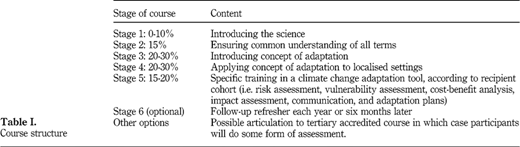
Finally, market research is being undertaken to evaluate and identify culturally appropriate modes of delivery for this course. Preliminary results show that most practitioners do not want to travel (or pay) for such a course, but want to have it delivered either by distance or face to face – so that the opportunity is created to apply on‐site the more generic information that is presented. This also creates the opportunity to create a “climate friendly” learning package, which will value‐add to the marketability of the course. A draft template for a course has evolved as shown in Table I. With regard to stage 1, some workshop participants suggested that attendees to such a course would already have accepted, that climate change is a problem and find the current science convincing, so that it should not be included, or that a pre‐course refresher is offered to those who feel they need some extra information.
Additionally, it is anticipated that course content will include the following “blocks” of content, either as discrete modules, or part of an overall course package:
The scientific and economic basis of the climate change issue.
The strengths and limitations of different models, dealing with uncertainty in policy and decision‐making contexts.
The use of climate change models in policy making.
The key issues of climate change in Australia.
Potential threats and opportunities of a changing climate.
Climate change adaptation strategies.
The economics of climate change and adaptation.
Adaptation – definitions (all with case studies).
Adaptation types and tools (with case studies).
Adaptation – sea level rise [for example, the Australian Maritime College (AMC) does work with its simulator that assesses the influence of sea level rise on the hydrodynamics of major ports].
Adaption – local issues and responses.
How to conduct risk and vulnerability assessments, and risk perception processes.
Structural responses to climate change (dealing with infrastructure).
Developing a climate change policy for your organisation.
Resourcing climate change adaptation responses, from the short‐ to long‐term.
Case study 2: developing climate change adaptation unit for a second year university course
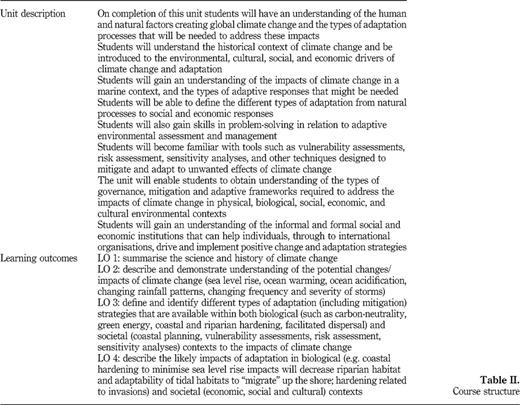
The second case study concerns the development and delivery of a unit called “Climate change and adaptation”, which is a second year unit that is in turn part of a Degree in Marine Conservation, delivered within the National Centre for Marine Conservation and Resource Sustainability (NCMCRS), in the Australian Maritime College, Tasmania. The main aim of this course is to provide the student with knowledge about, and the ability to, apply that knowledge in real life contexts of climate change adapation. Table II summarises the description of this unit and its learning outcomes.
Delivery of this course was via lectures and tutorials. Drawing on existing networks, a guest lecture series was instituted, which enabled students to get access to and insights from experts in the field of climate change adapation. This not only ensured students obtained the latest information, but also an understanding that the field itself was one that could be considered a good career option. Students were also tasked (via an assessed field trip) to apply the theory of climate change adaptation by building an adaptation strategy around the case study site, and by interacting with local government personnel in the region. This gave them some additional insight into how to go about building adaptation, and the wide suite of options that could be selected in this context.
Lessons learned
The development of these units was an important learning experience. Developing such a course is an incredibly complex enterprise beset with many challenges. An immediate issue in developing content is in deciding the balance between climate science and climate change adaptation. In turn, it is also important to decide between generic content about adaptation and the use of case studies, field trips and on‐site visits. To what extent should courses teach/train students to actually do things like risk assessment, vulnerability assessments, cost‐benefit analysis, and the like? Peer feedback on both courses indicates that some climate science needs to be presented; indeed some argued that the view of climate sceptics should also be discussed up‐front. However, opinion differed on the relative weighting between the two. Some individuals felt that the course should progress on the assumption that climate change is real, and that participants know enough about it to focus on adaptation straight away. Others felt that a good introduction to the science was integral to ensuring good understanding of adaptation.
Another prominent issue was the tension between the local and global presentation of content. Given the global nature of climate change, it is important to ensure a global overview in such a course, yet solutions are going to occur at local levels – especially in relation to adaptation. Moreover, students in such a course are already going to have a certain level of expertise, so their interest is more likely to be in learning about what can be done in their region. There are many ways to deal with this. One suggestion is to develop discrete modules on many topics and allow students flexibility to choose what is most relevant to their region. For example, learning about adaptation options for sea level rise will be more relevant to professionals in Brisbane, whereas, those in Cairns, in north Queensland, may be more concerned about the heightened threat of catastrophic cyclones. Another option is to deliver on‐site, and get participants to solve and apply the content to their own case study.
Another question is how to actually present adaptation itself? There are many definitions and approaches to adaptation. For example, Smith et al. (1998, p. 229) state that:
[…] adaptation to climate change includes all adjustments in behaviour or economic structure that reduces the vulnerability of society to changes in the climate system.
Smit (1993, p. 53) describes adaptation as involving:
[…] adjustments to enhance the viability of social and economic activities and reduce their vulnerability to climate, including its current variability and extreme events as well as longer term climate change.
The International Panel on Climate Change (IPCC) defines adaptability as:
[…] the degree to which adjustments are possible in practices, processes, or structures of systems to projected or actual changes of climate,
and note that adaptation can be spontaneous or planned, or undertaken in advance of and in anticipation of an expected change.
The adaptation field also embraces many approaches, whether they are constructed as autonomous, reactive or planned, specifically linked to an issue like sea level rise (protect, accommodate, retreat) or embedded within policies such as coastal management regimes. Is it possible to weight these differences and decide on definitions amongst this plethora of choices? Whatever is decided, it is clear that ensuring both participants and presenters have the same understanding is crucial (Nursey‐Bray, 2008).
This leads to another issue: that of delivery. In this case, the process of development has raised as many questions as it answers. For example, the question arises for both units, should such a unit be delivered on‐site (for the professional one), via distance or by students coming to the institution? Should an attempt be made to lead by example and develop a “climate neutral” course? Are there enough skilled teachers to deliver such a unit? Should there be a role for members of the stakeholders groups to become part of the delivery team? Will there be a need for a refresher course, and how do you ensure that it does not reach saturation point really quickly? This is an issue for the professional course much more than for the university one.
In both cases also, there is the question of how to ensure the units are built so that new information can be incorporated over time – climate change science and adaptation is such a moving field, that these units need to be flexible to accommodate this. While recognising that the concept of interdisciplinarity is a loaded one and means many things to different people (Klein, 1990), a solution to this is to ensure that interdisciplinarity is built into these units, both in terms of the people delivering it and in the content per se. The courses could be based on some founding assumptions, one of which is the principle of interdisciplinarity. This is defined as:
A process of answering a question, solving a problem, or addressing a topic that is too broad or complex to be dealt with adequately by a single discipline or profession… Interdisciplinary studies draws on disciplinary perspectives and integrates their insights through construction of a more comprehensive perspective (Klein and Newell, 1996, p. 395).
Adger et al. (2005, p. 78) specifically notes that:
Climate change represents a classic multi‐scale global change problem in that it is characterized by infinitely diverse actors, multiple stressors and multiple time scales.
In this context, building diversity (both content and delivery) into curriculum approaches is important, as climate change is a problem particularly suited to the practice of interdisciplinarity (Nursey‐Bray and Ferrier, 2009).
Achieving social and political outcomes for climate change adaptation
There is a need for the development of curricula that will support individuals and groups, whether they are active professionals or on their way to become practitioners. Outside of the educational benefits that will accrue from participation in such courses, courses such as those reviewed in this article, can play an important transformative role at a societal level. Resilience and adaptive capacity are both concepts that are fundamental to our understanding of how to ensure good social and political outcomes for climate change adaptation. They will be essential components of any climate change adaptation course. Adger (2000) defines social resilience as the ability of groups or communities to cope with external stresses and disturbances as a result of social, political and environmental change. In a later article, Adger et al. (2005, p. 79) discuss social resilience in the context of coastal management, noting that:
Resilient social‐ecological systems incorporate diverse mechanisms for living with, and learning from, change and unexpected shocks. Disaster management requires multilevel governance systems that can enhance the capacity to cope with uncertainty and surprise by mobilizing diverse sources of resilience.
The concept of resilience has implications for policy because it requires a shift in thinking towards an acknowledgement that humans are a part of the environment. This encourages the development of policy that provides the conditions that will enable effective adaptive governance structures to evolve and be implemented. In turn, these will encourage the social‐ecological resilience needed to address climate issues.
Folke (2006) adds, when reviewing resilience work by Berkes et al. (2003) and Smit and Wandel (2006), that the advantage of the resilience perspective is that it shifts policies from those that aspire to control change in systems assumed to be stable, to managing the capacity of social‐ecological systems to cope with, adapt to, and shape change. Managing for resilience then enhances the likelihood of achieving a sustainable response to climate change. This includes ensuring that the likelihood of change and unpredictability are built into societal development. In other words, resilience can make sure a community is able to withstand the shocks attendant upon the unpredictable nature of climate change, and build adaptive capacity (Smit and Wandel, 2006) as it permits continuous development.
In this context, climate change adaptation courses will also contribute to building the adaptive capacity of societies to respond to climate change and hence build resilience. Participating in such courses will also help participants make new contacts, build networks and forge alliances, all of which again will help build social and political outcomes. Crucially, the opportunity to apply in practice the theory about adaption that is delivered in these courses helps support on‐site trial and error and continuous improvement. Having a skilled cohort within various sectors who feel confident about how to deal with such a critical problem, will go a long way to building the learning pathways at the community level that are necessary to ensure robust uptake of adaptation polices.
Summary/conclusions
Climate change is a global problem that requires local solutions. Adaptation is one response to this challenge. This paper has presented two case studies of curricula that are currently being developed and delivered in Australia. It has reflected on the challenges, therein, in curriculum development, and on the utility of such courses to society overall. It has been argued that beyond the educational utility of climate change adaptation courses to individuals such courses play a larger transformative role. They support societies to build their adaptive capacity and resilience to the changes that climate change will bring and help promote the sustainability agenda.
Developing climate change adaptation curricula will always be a challenging enterprise. Yet, there is a need to find ways of developing modules that go beyond broad often rhetorical learning approaches tstato realise critically reflective understandings of climate change adaptation in practice (Egri and Rogers, 2003; Timpson et al., 2006). As Welsh and Murray (2003, p. 221) note, “the emancipatory potential of knowledge is the fundamental premise underlying […] teaching scholarship”.
Final lessons and future prospects
In conclusion, aside from the lessons relating to content needs described above, a number of other lessons are derived from this work that have important ramifications when considering the future prospects of curriculum development in this context. First, it is clear that in developing appropriate curricula that will be used by industry, the needs of the target audience must be considered, and curricula tailored accordingly. Second, there emerged a disjuncture between adaptation theory and practice. Curricula need to reflect this and build bridges within the exercises and practice of the final units, so as to encourage application of knowledge taught. Another insight gained was that while there is a current shortage of people skilled in the area of climate change adaptation, the pressure on professionals already in the work place are such that they are resistant to finding time to learn and develop new skills in this arena. Developing curricula that are flexible enough to incentivise and involve professionals is another challenge.
All these lessons must be incorporated into future work to ensure success. Ultimately, development of climate change adaptation curricula need to move from education in and about the environment, to curricula that motivates and equips individuals to be sustainable and critically reflective of how they live, work and make decisions and ultimately promote long‐term sustainable practice.
References
Further Reading
About the author
Melissa Nursey‐Bray is a Senior Lecturer at the Department of Geography, University of Adelaide, South Australia. Her core interest is in the investigation of ways to inform and support different communities to respond to or make decisions about environmental issues. This work included many years working in indigenous communities across Australia, developing community land and sea management plans. She now works in climate change adaptation. This work has included developing a risk assessment tool to aid responses to climate change (for local governments) and creation of climate change adaptation curricula for maritime professionals. Melissa Nursey‐Bray can be contacted at: melissa.nursey‐bray@adelaide.edu.au