The purpose of this study is to establish household‐level food security risks associated with climate variation, and how households respond to these risks in a patriarchal society such as in Northern Cameroon where subsistence women producers have less control over resources required to support the food production sector which depends entirely on the quality of the rainy season.
Primary data from 116 female‐headed households (FHHs) and 184 male‐headed households (MHHs) is examined for the three Northern provinces of Cameroon. The survey generated information on the response and coping strategies to climatic variation; and the socioeconomic impacts of climate on households. The multinomial logit model is employed to establish the determinants of the choice selection for climate risk coping options by households.
Both FHHs and MHHs are exposed to stresses related to food production and availability, low incomes and food accessibility and utilization of food supplies, heightened by the real and perceived effects of the variability of current climate. Short‐term coping choices include diversification of livelihood which in turn impacts food accessibility and consumption choices.
A seasonal pattern is revealed in household expenditure with households spending more than 70 percent of their income on food in spring. The lowest food expenditures are in summer. Market and income manipulation choices for food supply stability include a range of non‐farm income generation strategies to cope with expected shortages induced by climatic variability. The current climate variation, household demography, and farming conditions via access to credit, tenure, and extension service delivery are significant determinants of coping choices for households perceiving change in climatic patterns.
Significant seasonal patterns in household food availability, accessibility and utilization are observed with important implications for both household welfare and as precursor to long‐term adaptation to climate change.
1 Introduction
The effects of climate variability on agriculture, food and country‐wide economy effects have been studied for developing and developed countries (Alem et al., 2010; Mainardi, 2010; Mueller and Osgood, 2009; Block et al., 2008; de Haen and Hemrich, 2007; Kim and Chavas, 2003). These studies have aptly focused attention on cross‐cutting production and market risk management measures. However, for most of sub‐Saharan Africa where agriculture is of utmost importance, food producing households are particularly vulnerable to diverse shocks on their land, water and food sources; mandating a need to identify the costs, benefits and trade‐offs in choices undertaken by these households especially in the advent of environmental stress.
The challenge of households managing shocks is reinforced by a phenomenon of increasing number of female‐headed households (FHHs)[1] in countries such as Cameroon (Buvinic and Gupta, 1997; Eduke, 2004; Kamdem, 2004). These households are particularly vulnerable to income shocks because of the structural lack of support (Endeley, 2001). For such households, earned income does not allow for high value food and non‐food entitlements, the inadequacy of which leads to an increase in the inability to meet minimum survival needs. Despite the economic challenges and the exposure to food insecurity risks, these households provide an interesting test of women's capability as household‐level resource administrators and food security managers. Passing the test as food security managers is imperative on women's productive and community roles which requires that all members of their households at all times have both physical and economic access to sufficient food to meet their dietary needs for a productive and healthy life.
FHH are thought to be more vulnerable to food insecurity than those headed by men (Mallick and Rafi, 2010; Appleton, 1996; Rogers, 1996); for a number of reasons:
despite the smaller average size, they have a higher dependency ratio;
because they are headed by women, they have fewer assets and less access to resources and jobs; and
they tend to have a history of disruption and often early parenthood.
While some evidence does exist of FHH with adequate means, however because of their structural features FHH are generally more prone to poverty than male‐headed ones (Molua, 2011; Aromolaran, 2010; Buvinic and Gupta, 1997; Appleton, 1996). Since the dimensions of food security is beyond income poverty, and includes availability and utilization of food, the comparative stability of FHH and male‐headed households (MHH) to food security will therefore have to be gauged by a plethora of instruments including access to existing opportunities for public and private agricultural extension, access to affordable and ecologically sound agricultural inputs, better nutrition, land rights for women and marketing facilities.
Contemporary food security in Africa depends on a food system which is increasingly being shaped by changing environmental factors especially the changing climate system (Molua et al., 2010). While natural variations in climate have existed for millennia (IPCC, 2007), however, in the advent of anthropogenic climate change, a variety of direct problems, including increased frequency of extreme weather events, flooding, storms, drought, desertification, increases in sea temperatures and heat and cold waves are reinforcing the socioeconomic challenges to access adequate and nutritive food (Molua et al., 2010). According to Morton (2007) some of the most important impacts of a changing climate will be felt among the populations predominantly in developing countries. Their vulnerability comes both from being predominantly located in the tropics, and from various socioeconomic, demographic, and policy trends limiting their capacity to cope and adapt to change. Climate variation and change is therefore an important human security issue that poses both serious localized and global threats. And for the world's poor the impact will be most severe, disproportionately affecting their livelihoods and security (Pressman, 2002; Buvinic and Gupta, 1997; Jackson, 1996). Women comprise 70 percent of those living below the poverty line (UNDP, 2007; WEDO, 2007; UNECA, 2004; Pressman, 2003, 1988). As a result, they are most likely to bear the heaviest burdens as the stochastic climate system poses a challenge to their resource management effort (Lambrou and Piana, 2005; Oxfam, 2005; UNEP, 2005). Female producers in Cameroon are in fact an important group on whom risk aversion influences production outcomes and welfare (Molua, 2011; Fonjong and Mbah‐Fongkimeh, 2007); and on whom policy choices must be addressed.
In a male‐dominated society such as in Northern Cameroon where women have less control over productive resources (Fonjong et al., 2010; Burnham, 1996; van den Berg, 1994), the omnipresence of climatic variation raises a pertinent question whose response is required for a renewed direction in the country's food policy. What is the household‐level food security risks associated with climate variation, and how do households respond to these risks? This paper seeks answers to this question by comparing the exposure of FHH and MHH rural households to production and consumption risk induced by climate variation[2]. While a significant amount of classical theoretical and empirical research has examined rural populations' coping[3] to the exogenous stress of climate variability and change (Ziervogel and Ericksen, 2010; Barnett, 2007; Eakin et al., 2006; Eakin and Luers, 2006; Eakin, 2005; Corbett, 1988), however there has been less emphasis on the gendered dynamics in decision making in the face of climate variation. The rationale for this research hinges on both the importance of agriculture being the mainstay of the economy contributing up to 60 percent of total value of exports largely supported by subsistence female farmers depending entirely on the quality of the rainy season, and more importantly, on the lack of awareness of men's and women's specific and different roles in food security which results in gender blindness. This results in a situation where the coping needs of male farmers and as home‐managers are being taken into account, but not those of women. And as Eriksen et al. (2005) and Corbett (1988) argue, coping is a distinct component of vulnerability and understanding the dynamism of coping is critical to developing adaptation measures that support people as active agents of economic development.
2 Methods
2.1 Conceptualization on climate risk and food security
Agricultural production declines, marketing and distribution challenges and difficulties in maintaining the quality of produced food for optimal utilization are important risks associated with food security, where the parameters of production, availability, accessibility and utilization are climate dependent. While climate poses serious threats to Africa (IPCC, 2007; Stern, 2006; Hulme et al., 2001), the challenge of current climate variability exacerbates existing risks such as water stress and food insecurity. The stability of Africa's food system which is highly dependent on rain‐fed agriculture implies impacts on crop yield, livestock fertility, private and public infrastructure and an overall influence on food security (Molua et al., 2010). Climate shocks have immediate effects on land, water and physical assets, as well as long‐lasting effects on health and education and more possibly in social capital. For instance, the effects of torrential rain on road infrastructure especially secondary farm‐to‐market roads through which significant proportion of foods is conveyed from farms, affects not only their externalities and public good attributes but also mean increase in private costs, loss incomes, increased food prices and instability of the food supply.
The Food and Agriculture Organization (FAO) of the United Nations (UN) defines food security as:
[…] when all people, at all times have physical and economic access to sufficient, safe and nutritious food to meet their dietary needs and food preferences for an active and healthy life (FAO, 1996).
In this regard, the components of food security include adequate food production, access to nutritious, safe and culturally preferred foods and the stability of food systems in terms of supply and distribution (Ericksen, 2008a, b). The well‐being of households especially under climatic stress and strain will therefore depend on the continuous production, distribution, and exchange of adequate crop, livestock, and fisheries; and affordability and preferences that enable people to effectively translate their hunger into demand for nutritive food that is satisfied. However, in the face of transitory or chronic food insecurity due to climatic stresses or shocks, households' ability to cope depends on their assets or entitlements, e.g. physical, social and/or political (Adger and Kelly, 1999; Sen, 1981). There is also increasing recognition that the institutional and policy context is similarly important because it frames people's ability to make decisions (Ericksen, 2008a, b; Eakin et al., 2007; Ellis and Freeman, 2004; Bohle, 2001).
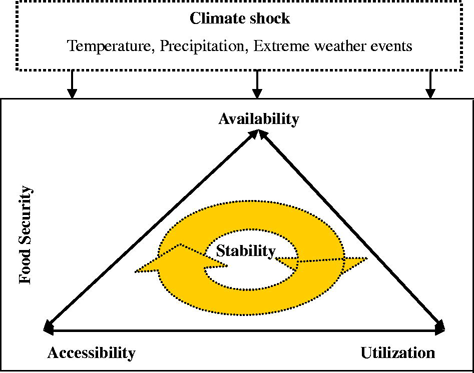
External shock such as climate variation and change poses considerable challenge to the food system components, with potential strongly significant negative impacts on low income and vulnerable households (Molua, 2011; Ziervogel and Ericksen, 2010). The resilience of the food system and the coping ability of households mean policy makers must be concerned on more than just the effects of exogenous climatic stress on agricultural production, since the social, institutional and ecological components of the food system may be vulnerable to environmental change in different ways (Molua et al., 2010; Ericksen, 2008a, b). The reconstruction in Figure 1 shows the interrelationship of the three distinct but related dimensions of food security which goes beyond food production to include food availability, food access or capacity of households to obtain appropriate foods, and food utilization, i.e. biological capacity of individuals to effectively use the food consumed. In the face of exogenous climate stress and shocks, the burden of safeguarding the stability of food supply and consumption falls on household heads, particularly on women whose work is closely related to agricultural production, family food and income generation, with the challenge reinforced particularly on the specificity of their headships.
Avoiding short‐term fluctuations in food security well‐being will require physical assets combined with other forms of capital and transformed into income‐generating activities or activities that entitle households to goods and services which insure for better well‐being through consumption, nutrition, and health (Skoufias, 2003; Fafchamps et al., 1998; de Waal, 1989). This, without doubt, will further have long‐lasting effects on health and education, land and water, and more possibly impacts on social capital. For instance, the impact of the 1982‐1984 and 1994‐1995 droughts in Zimbabwe were found to cause not only temporary hunger but this was followed by stunting of children aged between 12 and 24 months at the time of the drought – recognised as the most critical time for child growth – led to lower height in late adolescence as well as delays in school enrolment and reduction in grade completion 13‐16 years after the drought (Alderman et al., 2006; Hoddinott and Kinsey, 2001; Glewwe et al., 2000). Similarly, Ethiopia's 1995‐1996 drought had a large detrimental effect on child health (Yamano et al., 2005).
A priori, FHHs in developing Africa are subjectively expected to be exposed to income and non‐income aspects of food security. By virtue of being agrarian producers plagued with constraints faced by women farmers which restricts women's ability to participate fully in food production activities (Molua, 2007; Fonjong and Mbah‐Fongkimeh, 2007) in a sector where 70 percent of their income comes for upkeep of their household to enhance both consumption needs of adults and reproductive functions in childcare (Endeley, 2001) the low returns from their production activities thus correspondingly negatively impacts on consumption. This perception is reinforced with the assumption that the absence of income pooling with a male spouse further impedes their purchasing power and hence FHH may be worse‐off vis‐à‐vis MHH (Buvinic and Gupta, 1997). There are, however, counter examples that FHHs are no less food insecure than MHHs (Mallick and Rafi, 2010; Quisumbing et al., 2001; Appleton, 1996).
According to Appleton (1996) women‐headed households are not poorer when assessed by consumption or income. Nor do they appear consistently disadvantaged on social indicators. However, some subgroups of women‐headed households do have lower economic welfare, including those headed by widows and those in urban areas. More counter evidence in Mallick and Rafi (2010) reveal no significant differences in the food security between FHH and MHH in Bangladesh. This was largely due to the absence of social and cultural restrictions among the indigenous groups studied permitting their females greater freedom to participate in the labour force coupled with informal redistributive mechanism which led to less food insecurity. This indicates that non‐economic institutions can significantly impact economic outcomes such as food security. Even on intergenerational effects FHH are not shown to be particularly worse‐off. Rogers (1996) tests differences in spending patterns, consumption preferences, and child nutritional (anthropometric) status in female household headship in the Dominican Republic, and observed that FHH allocate the same amount or less of their budgets to food than MHHs, in absolute and proportional terms. FHH consume higher quality, more expensive and protein‐dense foods (i.e. more animal products; less of beans and rice) than MHHs. Rogers (1996) maintain that female control of household resources is often associated with consumption preferences which favor basic needs and child welfare. Average caloric adequacy per adult‐equivalent is equal or lower in FHH, but children's anthropometric status is the same or higher; it is significantly higher in low income FHH, possibly due to intra‐household allocation of food which favours children.
Whether it is the temporal or spatial differences between FHHs and MHHs as noted in Fuwa (2000), household food security is important for reliable workforce, the dignity and the well‐being of the citizenry. This will mean special policy attention, whether through transfers and external injections into the household economy such as remittances receipts which have been acknowledge playing a key role in maintaining economic parity between women and men‐headed households (Molua, 2009b). Checking food insecurity will, in sum, require better household‐level management and also government's adequate response to current food security issues through innovative policies and political commitment with better plans for the impacts of the expected more frequent climate related hazards of droughts, floods and storms on food and human security, and a re‐evaluation of production decisions and sectoral plans to adapt to changing conditions.
2.2 Analytical framework
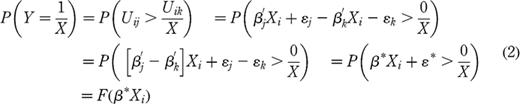
The decision of whether or not to use any method could fall under the general framework of utility and profit maximization. Assuming a rational agrarian household head who seeks to maximize the present value of income earned from his production activities over a specified time horizon, and must choose among a set of J‐options. The producer i decides to use j options if the perceived benefit from option j is greater than the utility from other options (say, k) depicted as: Equation 1 where Uij and Uik are the perceived utility by producer i in selecting coping options j and k, respectively; Xi is a vector of explanatory variables that influence the choice of the options; βj and βk are parameters to be estimated; and εj and εk are the error terms. Under a revealed preference assumption that the producer or household head selects a coping option or choice that generates net benefits and does not practice an option otherwise, we can relate the observable discrete choice of practice to the unobservable (latent) continuous net benefit variable as Yij=1 if Uij >0 and Yij=0 if Uij<0. In this formulation, Y is a dichotomous dependent variable taking the value of 1 when the household head either in the production activities or coping strategy chooses an option in question and 0 otherwise. The probability that household i will select a coping choice j among the set of options could be defined as follows: Equation 2 where ε* is a random disturbance term, β* is a vector of unknown parameters that can be interpreted as the net influence of the vector of explanatory variables influencing coping strategies, and =F(β*Xi) is the cumulative distribution of ε* evaluated at β*Xi. Depending on the assumed distribution that the random term follows, several qualitative choice models such as linear probability, logit, or probit model could be estimated. The logit and probit models have desirable statistical properties as the probabilities are bound between 0 and 1 (Greene, 2003). In a situation of diverse options to be employed by households, a multinomial logit (MNL) is appropriate (Greene, 2003). The MNL model estimates the effect of explanatory variables on a dependent variable involving multiple choices with unordered response categories. Household heads or agents may have a choice set in a restructured MNL model to include the following climate coping options:
change in household food consumption (switching of typical menu from cereal based to climate resistant tubers, per se);
change in farm practice (crop or soil based methods, e.g. Change in planting date, mulching, terraching, etc.); and
change in market orientation (reallocation of amount of own‐harvest sent to the market, sourcing of new distant markets, abandoning marketing altogether to rely on food aid, etc.).
In this study, therefore, an MNL specification is adopted to model climate variation coping behaviour of exposed agents involving discrete dependent variables with multiple choices. Thus, the probability of household i choosing coping option Yi and the set of explanatory variables Xi is specified as follows: Equation 3 where β is a vector of parameters that satisfy ln(Pij/Pik)=X′(βj−βk) (Greene, 2003). To interpret the effects of explanatory variables on the probabilities, marginal effects are usually derived (Greene, 2003). The marginal effects measure the expected change in probability of a particular choice being made with respect to a unit change in an explanatory variable (Long, 1997). Differentiating equation (3) with respect to each explanatory variable (i.e. factors, e.g. education, wealth, tenure, etc. hypothesised to influence selection of a particular farm technique (t)), provides marginal effects of the explanatory variables given as: Equation 4 Unbiased and consistent parameters estimates of the MNL model in equation (4) requires the assumption of independence of irrelevant alternatives (IIA) to hold. The validity of the IIA assumption is tested using Hausman's specification[4].
2.3 Nature and source of data
2.3.1 Description of study site
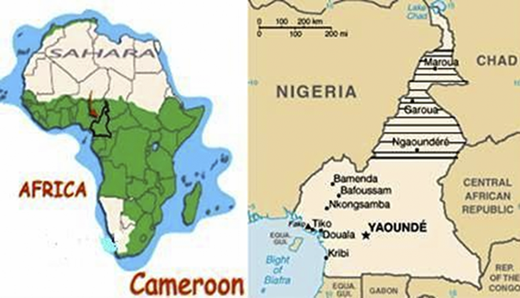
The Adamawa, north and Far north are the three northernmost regions (provinces) of the ten semi‐autonomous regions prescribed in the constitution of Cameroon. The chief towns of the three northern provinces are Ngaoundere, Garoua and Maroua, respectively. The northern region accounts for one‐third of the national population, majority of who are livestock and crop farmers. Though the region, shown in Figure 2, is characterised by high average daily temperatures, longer dry seasons and shorter rainy seasons, it essentially attempts to produce its own food and livestock throughout the year employing farm practices and coping techniques to the challenges of the existing and fluctuating environmental conditions.
Extending from the Adamawa to Lake Chad with an average elevation of 300‐350 metres above sea level, characteristic vegetation in the three region is Savannah scrub and grass, however, three types of Savannah can be distinguished: Guinea Savannah (tall grass and trees with thick woodland and grassy undergrowth in the Adamawa), Sudan Savannah (wooded grassland with thick‐bark shrubs that shed their leaves in the dry season to withstand the dry conditions in the north region); and the Sahel Savannah (where the grass degenerates until it ends up in small patches in the Far north region). Swampy land along the major rivers and in zones bordering the Lake Chad support taller and thicker vegetation.
Across the three northern provinces average annual rainfall gradation ranges from 1,400 mm in the Adamawa to 650 mm in the Far north. While precipitation in the north region averages 1,000 mm in mid‐wet season, it lowers further north at Kousseri (in the Chad Plain) to 630 mm – where the rainy season barely lasts three months. The typically dry Sudano‐Sahelian climate in the north province, which starts from the north of the Benue basin and covers the plains of Mayo‐Danay, the Diamare and the Mandara Mountain, is characterized by low precipitation, usually below 900 mm and a dry season of at least seven months. Overall, the region has two seasons: a dry season from November to April and a wet season from May to October. At the onset of the wet season the rains are usually torrential. Temperatures too experience similar gradation with Garoua in the Benue depression averaging 28°C in a year. Low atmospheric humidity increases annual temperature ranges (7°C) and the level of dryness increases with the rate of evaporation being generally very high (Seiny‐Boukar et al., 1992).
2.3.2 Sampling procedure and data collection
To understand the impact of climate on produced food needs, we purposefully study agrarian households in Northern Cameroon. Primary data is thus employed. The objective of the household survey was to generate information on identification of the sources and extent of vulnerability, and coping strategies and the choices for responding to climatic variation. 300 households and their farms are studied in the three northern provinces shown in Figure 2. In each of the three provinces in the region, 200 agriculturists were randomly selected to constitute a sampling frame. From this stratum of 600 agriculturists, a sub‐stratum of 100 farmers was then selected from each province to generate a sample size of the 300 farmers studied. The face‐to‐face interviews were administered in French, and local interpreters were used where necessary to obtain information with the use of local dialects. The information is collected with the use of questionnaire[5]. In the current study we purposefully disaggregate from the dataset, households headed by women, i.e. with no male Figure in the decision making process, and households that are male‐headed. This gives sub‐samples of 116 FHH and 184 MHHs[6]. In capturing the heterogeneity in the socioeconomic capabilities between male and female and the diverse roles of men and women in managing household‐level food security risks associated with climate variation, particular attention is given to data collection on household headship such that FHHs with farming enterprises they own and manage are compared to MHHs and their male‐owned enterprises.
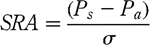
The effects of two climatic factors (rainfall and temperature) are considered on the production activity and consumption decisions. While climate and projected change is embodied on temperature, rainfall, carbon dioxide, run‐off and their interaction, however in tropical agriculture rainfall and temperature are significant limiting conditions that determine the carrying capacity of the biosphere to produce enough food for the human population and domesticated animals (Reilly et al., 1996; Rosenzweig and Liverman, 1992; Parry et al., 1988; Thompson, 1975). This study therefore assesses the balance of the effects of rainfall and temperature on agricultural holdings and household consumption needs in Cameroon. The data on rainfall and temperature is generated from the Africa rainfall and temperature evaluation system (ARTES), complimented with information from local weather observatories, and the regional area average is extrapolated with use of ArcGIS (Lokupitiya et al., 2007; Satti and Jacobs, 2003). Four seasons are identified which include spring (March, April, May), summer (June, July, August), autumn (September, October, November) and winter (December, January, February). Seasonal variability in rainfall and temperature was evaluated by calculating the standardized anomalies for rainfall and temperature using the following equation: Equation 5 where:
Ps is seasonal mean annual rainfall.
Pa is annual rainfall.
σ is standard deviation of rainfall.
For temperature calculations, rainfall in the latter equation is replaced with temperature.
2.3.3 Description of households
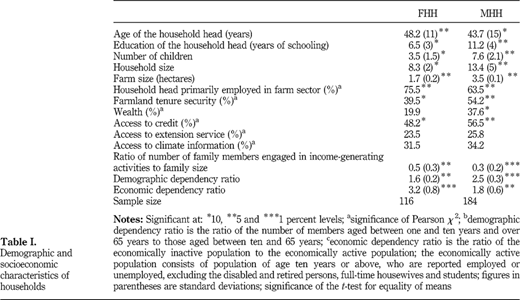
The summary information for the households is presented in Table I. About 38.6 percent of all households are female‐headed. This female headship includes de jure and de facto FHHs[7]. The classification thus broadly includes:
female respondents who identify themselves as household head on a household list, in response to the question, “Who is the head of this household?”; and
the absence of adult male in the age range 15‐65 as member of the household.
Farms are on average 1.7 hectares for the female‐owned farms and 3.5 hectares for the male‐owned farms, comprising on average two plots for the FHHs and three plots for the MHHs. The FHHs and MHHs are characteristically distinct. The average age of household heads are 48.1 and 43.7 years for the FHH and MHH, respectively. The males have higher levels of education, with bigger family sizes.
Farmland tenure defined to include ownership and user right through share‐cropping shows that 39.5 percent of FHHs have access to farmland compared to 54.2 percent of MHHs. While this may allow households to access loans from formal commercial lenders and semi‐formal microfinance sources, however, 48.2 percent of FHHs and 56.5 percent of MHHs report having access to these sources plus informal sources (e.g. family and friends) to use for farm investments or smooth household consumption. Institutional contribution through the services of the agricultural extension unit contributes to the food production and distribution by reaching insignificant few of 23.5 percent FHHs and 25.8 percent MHHs, respectively. Access to climate information largely from informal sources such as cooperative self‐help groups where information, on the expected weather at the onset of the farming seasons, received from both formal contacts with weather observatory officers coupled with generated information from indigenous sources is shared amongst 31.5 percent of FHHs and 34.2 percent of MHHs. Wealth defined to include owning a modern brick house plus flushing toilet, cell phone, refrigerator or car is reported by 19.9 percent of FHHs and 37.6 percent of MHHs.
More important are demographic and economic dependency ratios that provide indication of the burden and opportunities within households. The demographic dependency ratio is higher for the MHHs than the FHHs, the higher economic dependency ratio for FHHs aptly captures female heads as being both the main income earner and responsible for maintaining the household, most often as single earner (rather than joint) thus facing higher dependency burden.
3 Empirical findings and discussion
3.1 Coping with climate variability and adapting to perceived change
Subsistence production dominates the crop farming based on tubers (e.g. yams), cereals (e.g. millet and sorghum) and fruit vegetables (e.g. cucumber and tomatoes), for home consumption and market needs. Agricultural activities are conducted all year long, although late spring (April and May) and summer (June, July, August) are by far the heaviest agricultural season. In terms of farmland ownership 70 percent of the MHH and 55 percent of the FHHs own land, while the rest have user rights to land parcels, either in lowlands which can be irrigated from nearby streams and rivers, and upland which may consist of hillside terraces or on plains where irrigation is not possible, but rain water harvesting is employed to ensure water availability throughout the farming season.
Crop production is supplemented with livestock rearing (e.g. cattle, sheep and goat) as an important livelihood strategy. The MHHs largely report owning cows and more FHHs report owning more goat and sheep with few cows. Cow ownership is attractive in the region, even in few numbers, because they are productive in terms of milk and manure, which is an important source of fertilizer. While about 25 percent of all households stall‐feed their livestock with straw and leaf fodder, a larger proportion typically rely on open grazing on grass.
The surrounding environment is exploited for water, wood for fuel and fodder for livestock. While non‐wood forest products provide important additions to income and the diet, agriculture still remains the most important economic activity. In both the FHH and MHH there is gendered division of agricultural labour and household labour such as collection labor for environmental goods (e.g. water, fuelwood and fodder), childbearing and for household chores. Whether in FHH the male adults are reported to be responsible for heavier tasks such as plowing, while the women sow, weed and harvest, and take charge of marketing. The male figures allocate more time and effort tending the profitable tuber crops and legumes (e.g. beans, cowpeas and groundnut). Women in both the FHH and MHH report more labor time and effort to collect environmental goods, particularly in the dry periods of late autumn, winter and early spring. On average, males in both FHHs and MHHs account for less of the daily time spent in collection activities.
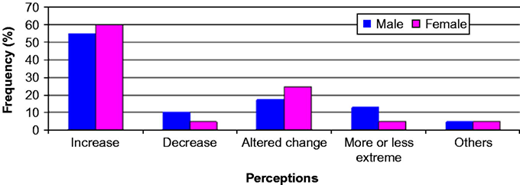
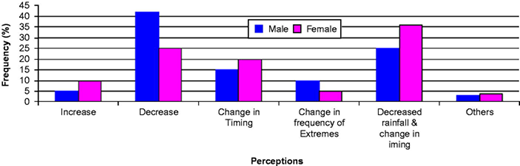
Agriculture and market activities are reported to be affected by the weather, with reports of both short‐term and long‐term average weather effects. While 80 percent of households report perceiving changes in rainfall and temperature patterns over a 30‐year period, their observations corroborate statistical significance of temporal and spatial temperature and precipitation variability in Northern Cameroon covering a 40‐year period which have been captured in some studies (Molua, 2006). For instance, Molua (2006) shows significant upward trends in temperature and dryness of 0.40°C over a 30 year period and annual declines of 0.1 percent in precipitation with significant annual variability. Inter and intra‐annual variability is already having impacts in the region, with crops and farming conditions affected differently under different ecological conditions (Molua, 2009a). In the current survey, the perception of FHH and MHH differs on the nature of climatic variability. In Figure 3, about 60 percent of FHH report increases in temperature over the period in which they resided in the region. As observed, about 25 percent of FHH report change in temperature given their experiences. The male producers concurred more significantly than females on the observation of climatic extremes. In the perception of rainfall, in Figure 4, male producers report noticing significant decrease with female producers corroborating on decreased rainfall and increased change in timing of seasonal rains.
Variations in precipitation and temperature affect crop production, food distribution and marketing differently, with the possibility that future climate change will reinforce these differences, resulting in greater incidence and severity from extreme events such as reduced rainfall, droughts and floods especially in the Sudano‐Sahelian Northern‐most region in the country, which in turn impacts water resources, area suitable to agriculture, pasture land and overall crop and livestock production. de Haen and Hemrich (2007) note extensively that such extremes could have significant implications and challenges for food security. In this rain dependent food system in Northern Cameroon, declining rainfall, reported by 40 percent of households, lead to more demand for supplementary nutrients, where in farms that are not well managed it leads to deterioration of soil ecological health. While responses to crop yields tend to vary depending on factors such as crop type, soil management and other locational conditions, with increased climatic variation this is accompanied by increased proliferation of pests and incidence of pest attacks; and the resultant effect of crop failure and livestock mortality. Reduced production levels have consequences on food availability, which is also affected by climate related price increases.
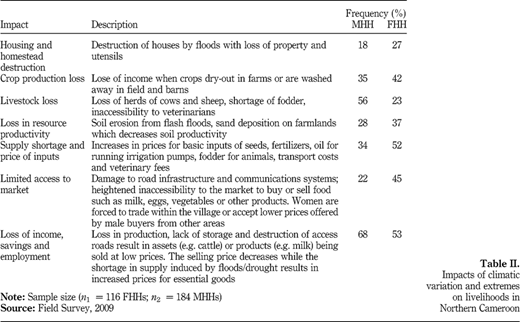
In light of these experiences and perceptions on environmental challenges, households report livelihood changes impacted by destruction of their homes from flash floods, crop and livestock loss, declining productivity, limited access to market and loss of income, and declining savings and employment. As noted in Table II, the loss in production, lack of storage and destruction of access roads result in assets (e.g. cattle) or products (e.g. vegetables, milk) being sold at low prices. The selling price decreases while the shortage in supply induced by droughts or floods results in increased prices for essential goods. The accompanying long dry conditions reduce employment opportunities, especially for women working in agricultural fields. As a result, there is a net loss in income which, in turn, leads to a loss in savings, thus making it even harder for households to cope with climatic stress.
Both FHHs and MHHs are vulnerable not only because they largely depend on agriculture, but that they employ simple technology and are exposed to multiple stresses. Risks to food production, food availability and food accessibility heightened by the effects of variability in current climate on farmland degradation are identified by more than 60 percent of households as key constraint in food production. Other identified climate related effects include loss of vegetation cover especially from cover‐crops, decline in soil and/or crop productivity, water supply deficits, declines in average income levels, depletion of food stores, and eventual migration of the farming population. The interactions of these effects tend to reinforce the challenges of rainfed agriculture on food security and well‐being of households. Some studies have shown how communities in similar situations have enhanced their security or try to reduce their vulnerability to environmental change at local levels through diverse socioeconomic and institutional strategies (Ericksen, 2008a, b; Reenberg et al., 2008; Eriksen et al., 2005; Barnett, 2007; Barrett et al., 2001; Liverman, 1999; Cutter, 1996). For example, Reenberg et al. (2008) document that households accorded decreasing importance to agriculture, increase in shifting cultivation and fishery exploitation which are increasingly supplemented by other income‐generating activities such as shop‐keeping, private business and government employment. In addition, culturally determined bonds are noted to become an important mechanism to cope with environmental or socioeconomic stress. For Northern Cameroon, however, whilst short‐ and long‐term coping strategies are employed, vulnerability to these climatic effects differs amongst FHHs and MHHs due to different levels of coping abilities given the unequal power relations and differential access to resources between these social groups.
3.2 Climate and household‐level food security management
While direct and indirect effects on rural livelihoods and household assets are observed, coping choices have included expansion of food production in marginal areas (with considerable adverse effects such as excessive drainage of nutrients) and migration to resource rich areas, change of crop varieties and types, diversification of livelihood opportunities and rainwater harvesting; however, female farmers have tended to shift to crop mixes that require less labour and capital, away from some field crops in response to rainwater reductions and increased demand for labour supply in their households. The high water requirements of several field crops lead to movement away from field crops to fruits, nuts and vegetables. The shift in crop mix appears to have significant impacts on the demand for farm inputs for farms managed by both FHHs and MHHs.
About 90 percent of all households employ more than one form of risk management and risk‐coping strategy to maximize food production, optimise incomes and protect production activities from adverse climatic conditions. Primarily, about 80 percent of FHHs diversify production and income alternatives to minimize the effects of climate risks or maximize use of all resources available to households. Ex ante and ex post risk management options differ among households, with FHHs developing more sophisticated strategies to reduce the effect of shocks. The strategies adopted by households could be divided into three broad categories:
- 1.
farm level food production choices;
- 2.
household food consumption choices; and
- 3.
market and income manipulation choices.
3.2.1 Farm level production choices and food availability
At the farm level, risk management in the crop systems involve the farmers tailoring their farming decisions to the season ahead, by adopting practices that are flexible, such as choosing certain soils, crops and varieties, and varying their proportions in mixed/inter‐cropping systems; altering the area planted by crop and location; using genotypes of varying maturity, e.g. planting early maturing short‐duration varieties; adjusting sowing time and sequence; applying or withholding suitable soil amendments, fertilizers and pesticides; varying seeding rates, plant spacing and row orientation to match seasonal expectations; adjusting water conservation practices depending on soil moisture status and climate. Information on these diverse options are either delivered by the extension service of the regional delegations of agriculture, non‐governmental organisations, agriculture‐related projects in the region and interaction amongst households and farmers who learn and imitate from more successful farmers. The adoption rates may differ between farmers in FHHs and MHHs. For example, Doss and Morris (2001) find that female Ghanaian maize farmers in FHH have different (lower) adoption rates of agricultural technology (modern seed varieties and fertilizer) than do female farmers residing in MHHs.
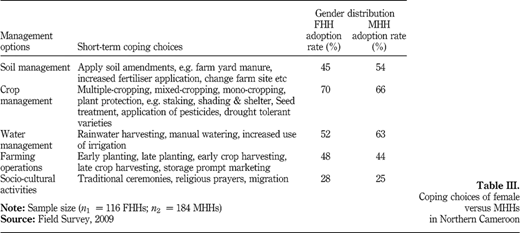
As revealed in Table III for Northern Cameroon, more men (54 percent) than women farmers (45 percent) rely on soil amendments such as farmyard manure. However, more women farm managers in FHHs (70 percent) than men farmers in MHHs (65 percent) employ crop management as an option to adapt to variable climatic conditions to insure against low food supply. An interesting observation in the study zone is that, in farm practice adjustments that require extensive use of resources such as changing farm site or rainwater harvesting, male farmers show greater response rate than female farmers. In similar savanna zones of central Senegal, climate risk‐coping strategies include crop diversification, mobility, livelihood diversification, and migration (Mertz et al., 2009). However, an important delimiting factor with some of these risk avoidance strategies is that they generally aim to lower the exposure to risk, but in so doing limit production potential and have considerable opportunity costs. This is true as in Burkina Faso where ramifications of one year's risk‐coping to drought are felt the following year in terms of lacking planting seed and labor for cultivation (Roncoli et al., 2001). Given the unequal access to productive resources and differing coping capacity these costs may become entrenched over a foreseeable future, and lower returns particularly to FHHs‐owned farms. Peterman et al. (2010), for instance, show lower productivity to be persistent in female‐owned plots in FHH in Uganda and Nigeria, and this is explained by a range of socioeconomic variables, agricultural inputs, and crop choices.
3.2.2 Household food accessibility and consumption choices
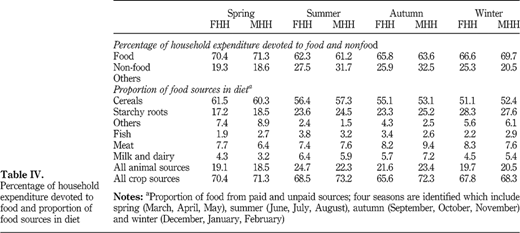
Table IV reveals a seasonal pattern in household expenditure. Though households in the region spend more than 60 percent of their income on food, the allocation to food and non‐food items vary across seasons. FHHs and MHHs spend about 70.4 percent and 71.3 percent of their income on food in spring. The lowest food expenditures are in summer. This relates to the end of the first farming season and households stock up food. The realized income from sale of market surplus is then spent on non‐food items. During the dry autumn and winter months which are lean food seasons, the expenditure on food increases and expenditure on non‐food items declines. The expenditures of FHHs in summer and autumn are higher than that of MHHs, while the MHHs tend to spend more on food in winter and spring.
The food consumption patterns are also shown in Table IV. Food expenditures are devoted to different types of foods in FHHs and MHHs, whether crop or animal sources. The proportion of food sources in household diets whether its food from market or non‐market sources also has marked seasonal undertones. In spring which is traditionally the planting season and low food reserves more than 60 percent of food sources are cereals (e.g. maize, millet, rice, etc.) and lower proportions of starchy roots (e.g. the tubers of yams, potatoes) which have the potential to be imported from other regions of the country. During the harvest season in summer food sources are relatively diversified with deceasing amounts of cereals and increased proportion of starchy tubers largely from owned farms. In autumn, households rely on purchased market food and stored food with increasing proportion of stored starchy roots being significant sources of calories. In winter, which is the peak dry period with potentials for agrohydrological drought[8] and traditionally not a cropping season, households rely largely on market sources and donated food. During this period the lowest proportions of cereals are consumed and more of starchy root tubers and other food items such as beans and cowpeas feature prominently in the diet contributing 5.6 percent in FHHs and 6.1 percent in MHHs calorie intake. During winter effort is geared towards households overcoming the lean food season, hence expenditures on non‐food items declines relative to other seasons while that on food items increases relative to the summer and autumn seasons.
Overall, the purchase and consumption patterns of relative luxury food, e.g. fish, meat, milk and dairy products, vary between the FHH and the MHH, depending on the season. Starchy roots are not preferred food items for households in the region. Cereals are relatively more important. The proportion of calories from starchy roots is lower in FHHs than in MHHs. The preference of FHHs for higher quality foods depends on the season, with the proportion of meat and animal calories being higher in spring and summer. MHHs though preferring calories which provide greater dietary bulk, tend to source for more calories from crop products in summer and autumn.
These observations corroborate previous studies (Duflo and Udry, 2004; Buvinic and Gupta, 1997). For instance Duflo and Udry (2004) find that a bigger share of the women's contribution to the household income is spent on food and on private goods for women, while a bigger share of the men's contribution to the household income is spent on alcohol and tobacco and on private goods for men. The current study however reinforces previous studies by indicating that there are seasonal dimensions to household expenditure and consumption patterns.
When households perceive current climate and meteorological conditions to be unusual, four main short‐term food‐based coping strategies are reported. These include:
- 1.
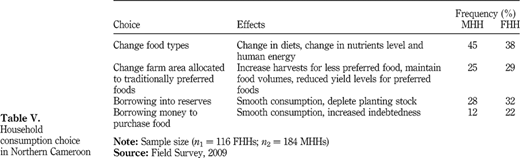
Change in food types. Some household heads report growing crops that are more resistant to climatic conditions, e.g. cassava. However, this ushers a trend of changing their diets and the effect of eating foods that were less preferred, simply as a means of adjusting to lower yields that is less comparable, at least in terms of energy. As shown in Table V, about 45 percent of MHHs report such occurrence, as opposed to 38 percent of FHHs.
- 2.
Reallocate farming area. About 25 and 29 percent of MHHs and FHHs, respectively, report limiting the farm size of traditionally preferred food crops to a manageable level. This comes when less rain is expected at the commencement of the farming season. Cutting back on farm area has a direct relation with output levels and with the amount of food that each person gets in the household.
- 3.
Borrowing into food reserves and depleting planting stock. A longer dry season and delay in the commencement of the planting season promotes the running down of food reserves faster than anticipated, with about 32 percent more vulnerable FHHs relying on the reserved planting stock from previous harvests as food.
- 4.
Borrowing food or money to purchase food. Borrowing food from a relative or friend is reported by 12 and 22 percent of the MHHs and FHHs, respectively. Local merchants extend short‐term credit to households to be repaid at a later date. For most of the households this short‐term strategy may lead to indebtedness and put the households in a more vulnerable position with regard to longer‐term livelihood options.
These are similar to observations in Burkina Faso where drought cause farm households to implement a range of food saving strategies, encourage migration, sell livestock, and even resort to borrowing and mortgaging of the following year's crops (Roncoli et al., 2001). In Kenya and Tanzania, Eriksen et al. (2005) notes some households carry out a multitude of less favoured and frequently complementary activities, such as collecting indigenous fruit for food and income.
3.2.3 Market and income manipulation choices for food stability
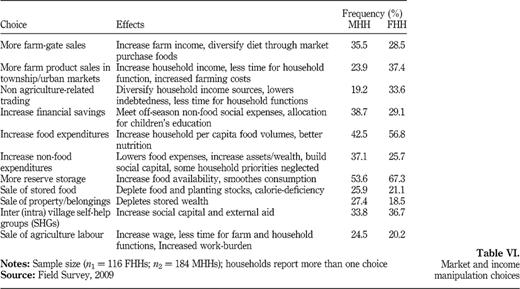
In addition to farming, household heads are involved in a variety of activities undertaking a range of investment or income generation strategies to cope with expected shortages induced by climatic variability. These include offering to work for daily wage in other farms, retail trading of grocery items and utensils, disinvesting household and personal assets, selling food stocks, reducing non‐food expenditures and producing small‐scale art and craft. To diversify their income sources and ensure food accessibility, more FHHs are noted in Table VI to rely on farm product sales in distant urban markets (37.4 percent), non‐agriculture‐related trading (33.6 percent), increase food expenses (56.8 percent), reserve storage of season's harvest (67.3 percent) and village self‐help groups (36.7 percent) whereby hereby households in different villages or hamlets tend to support each other in case of hardship. On the contrary, MHHs tend to rely more on farm‐gate sales (35.5 percent), increase their financial savings (38.7 percent), increase non‐food expenditures (37.1 percent), sale of stored food (25.9 percent), sale of property or belongings (27.4 percent) and sale of agriculture labour whether in croplands or livestock tending (24.5 percent).
Both groups of households tend to insure themselves by building up assets in “good” years to deplete these stocks in “bad” years. More important, the households employ more than one option with the attraction to combine activities with low positive covariance and income‐skewing, i.e. taking up low risk activities even at the cost of low return. Also noticeable is self‐insurance through precautionary savings and informal group‐based risk‐sharing are additional risk‐coping strategies to avoid income declines and shortfall in food purchases. These attempts at consumption smoothing address the ex post consequences of income shocks. There are however potentials for mixed outcomes. While some of the climate induced risk‐coping measures may lead to gains in income, diversification in diet through market purchase foods, lowers indebtedness and meet off‐season non‐food social expenses, there are however losses incurred through increased work‐burden, less time allocated for household function, some household priorities neglected, lower food expenses, calorie‐deficiency; and depletion of food or planting stocks and stored wealth. These trade‐offs highlight the need for managerial vigilance in optimal resource allocation for household production and consumption decisions.
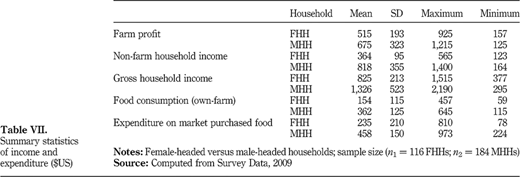
FHHs record farm profits in the range of $US 515 per hectare per household to about $US 925 for crop enterprises. As shown in Table VII, a comparative analysis reveals higher profits accruing to male‐headed farming households. Similar income disparity is observed in Goldstein and Udry (2008) with large differences in profits between plots controlled by men and those controlled by women in Ghana. To cope against this low farm returns, households tend to diversify their income sources. In Northern Cameroon, FHHs earn on average $US365 for non‐farm household income and $US825 for gross household income. When proportion of farm harvest consumed is valued, this averaged $US154 per hectare for FHHs and spending on average $US 235 for other food items purchased. Given the average size of eight persons in the FHHs and 13 in the MHHs, this finding has important implications for household welfare in this region of Cameroon. Such low incomes primarily from rainfed subsistence production systems may have repercussions beyond food accessibility and stability of supplies. For instance, examining household food security in Kenya and Malawi, Kennedy and Peters (1992) disaggregated FHHs into de jure and de facto FHHs. In both Kenya and Malawi, the de facto FHH had the lowest income; despite this low income, preschoolers' nutritional status was significantly better than in higher income MHHs and de jure FHHs. The ability to improve nutritional status in a low income environment in the de facto FHH is related to a combination of child feeding practices and other nurturing behaviour. Their findings suggest that interventions that exploit incentives to invest in children can provide more immediate improvements in child health and nutrition where sustained income growth is possible only in the long‐term.
3.2.4 Determinants of coping choices for households perceiving change in climatic patterns
The effects of climate related risk on subsistence agriculture may depend on the intrinsic characteristics of the farming systems, particularly their complexity, their location‐specificity, and their integration of agricultural and non‐agricultural livelihood strategies. In the study location, the determinants of short‐term seasonal coping activities for households perceiving change in climatic patterns is hypothesised to be influenced by household characteristics (e.g. household size, education, wealth), farm characteristics (e.g. farm size) and institutional factors (e.g. credit, tenure and extension service)[9]. The dependent variables tested include change in household food consumption, change in farm practice and change in market orientation. Both FHHs and MHHs are tested whether they relied on each of these measures against a base category of households who “did nothing”, and which of the determining socioeconomic and climatic factors better explained households' reliance on the selected strategy.
The maximum likelihood parameter estimates in Table VIII provide indication of the direction of the effect of these explanatory variables on the coping choices selected by households. The effects of current climate tested as the interaction of rainfall and temperature variations is observed to influence household decisions. The FHHs have an increased likelihood of changing food consumption patterns or their market orientation as a coping strategy to the ensuing climate variation, whilst the MHHs tend to rely strongly on farm practice management. Across both households, however, climate variation has stronger effects in influencing farm practice than either changing household food consumption or their market orientation. Since the selected choice may result in either positive or negative effects on households, the timing of the response is important so that households tend to adopt a package of measures that enhance their welfare at a particular period. Given the already diverse production and consumption measures employed, climate variation with increased uncertainties is therefore likely to demand more managerial effort from household heads in planning production and consumption choices.
Household size which is a proxy for labour availability and the consumption needs of the house positively influences change in household food consumption and change in farm practice for MHHs. However, it also significantly influences the market orientation of FHHs. Being a proxy for labour its positive value means it eases the manpower constraints required to diversify food production and consumption choices. MHHs observe that an increase in their farm sizes increases their chances of taking up new farm practice and a change in their food consumption choice. This is contrary to the FHHs where increasing the farm size does not significantly influence the taking up of new practice. This observation that farm size does not strongly influence female‐farmers' uptake of new farm practice is important, possibly because of the associated costs that accompany larger farms.
However, off‐farm employment with the possibility of additional income seems to significantly increase the chances of FHH changing their farm practice. It thus increases the possibility of experimenting on new farm methods. This is also true for MHHs as off‐farm employment is shown to significantly increase the chances of taking up new farm practice, partly explained by the relatively higher proportion of labour available to such households, with the possibility of other household members undertaking the new initiative for which the added income from the off‐farm employment may facilitate meeting the associated costs that comes with new practices.
The perception of the potential benefits from non‐farm income is attractive to the decisions household heads make in their diversification of consumption choices. However, these gains may not be entirely positive as we note potentials for other unmitigated costs in Table VI such as neglect of household priorities and investments in transportation and time into distant markets which brings trade‐offs and uncertainty on the a priori role of non‐farm income. As reported in Table VIII, while non‐farm income positively correlates with food consumption and farming choices, it nonetheless, reveals a negative relationship with agricultural market orientation in both FHHs and MHHs. Perhaps the difficulty of allocating time between farm and non‐farm activity and the low gains realized from non‐farm income is a disincentive to market intensification. On alleviating transitory food insecurity non‐farm income is significant; perhaps its immediate relief benefits are attractive to household decision making. These observations are corroborated in Eriksen et al. (2005) that find households in Kenya and Tanzania which diversified their sources of income via off‐farm employment were often less vulnerable to climatic stress than other households engaged in many low intensity activities. When these marginal amounts add to farm incomes there is the plausibility of the ensuing gains having profound impacts on the well‐being of household members especially children. For instance, Kennedy and Peters (1992) find that for Kenya and Malawi food security and nutritional status for preschooler household members are influenced by the interaction of income and gender of the head of household. They find not only is household food security influenced by total household income but the proportion of income controlled by women has a positive and significant influence on household caloric intake.
As expected higher levels of education measured as numbers of years of schooling not only increase the probability of adopting new food consumption patterns in the face of exogenous climatic shocks, but also encourages changes in farm practice and market orientation for both FHHs and MHHs. Perhaps education increases the ability of the household‐heads to receive, decode, and understand information relevant to making innovative decisions. There are some public sector efforts, civil society initiatives coupled with private efforts to enhance food security in the Sahelian northern region of the country by introducing new crops and foods in the region. While there is anecdotal evidence that adoption has been slow, it is expected that educated household heads should be the early adopters of such new methods. The significance of educated FHHs in accounting for production and consumption risks has welfare ramifications noted in previous experiments (Haddad and Hoddinott, 1994; Thomas, 1994; Folbre, 1986). For instance, Thomas (1994) shows that in a household the education of the mother has a bigger effect on her daughter's height; paternal education, in contrast, has a bigger impact on his son's height. Another avenue through which education could influence food security is through its potential to influence the income earned by the household manager. This in turn has intra‐household and intergenerational consequences (Haddad and Hoddinott, 1994; Thomas, 1990; Folbre, 1986, 1984). Haddad and Hoddinott (1994), for example, find significant influence of income on children's anthropometric status in Cote d'Ivoire whereby increases in the proportion of cash income accruing to women increases boys' height‐for‐age relative to girls.
One could argue that the positive influence from accessing credit interacts with other factors to increase the chances of education, farm size and household members to successfully change their food consumption pattern and take up new farm practice or increase their market orientation when exposed to climatic risks. Though formal credit appears to contribute only little in influencing both households' farm and market conditions, however, where accessibility is ensured formal loans especially from microfinance programmes serve investment and consumption purposes via their fungibility. informal credit too, however incomplete, helps in mitigating uncertainty engineered by climatic variation and allow especially some FHHs to cope with risky consumption incomes and farm finance.
With wealth positively correlating the possibility of taking up new farm practice this increases the coping capacity of households not least the FHHs. Wealth which highlights the effects of higher income and accumulated assets of households on their ability to bear risks, increases the chance of both FHHs and MHHs to successfully change their food consumption patterns, to withstand climate related consumption shocks, take up new production practice and better exploit the market conditions. Tenure security similarly interact to aid‐and‐abet the effects of education, credit and wealth in contributing to farm level risk‐coping, ensuring stability of production and food supplies. Wealth and tenure security do not only empower FHHs and even females in MHHs but also have significant outcome effects on their progeny and future generations (Fafchamps et al., 2009; Thomas, 1994). For instance, Fafchamps et al. (2009) find that female empowerment not only benefits child nutrition and education, but also enhances female bargaining power associated with intra‐household welfare especially for low income households. More important, access to extension services is positively related to adoption of new farm practice, whilst access to meteorological information increases the chances for exploiting the market opportunities for both FHHs and MHHs. This implies the effectiveness of household and farm factors is reinforced by institutional factors that make information available either through the agricultural extension services or the meteorological service that makes available weather information. The need to respond to changing conditions creates a demand for information useful in deciding new farm practice and market conditions for an insured food security.
4 Policy implications and conclusion
The increasing importance of FHHs in both urban and rural areas, and women being responsible for the food security and general well‐being for a significant proportion of the country's current and future workforce, makes it imperative to test their ability to cope to exogenous climatic shocks. In Northern Cameroon, though vulnerable to climate risks and food insecurity, women occupy central roles in agriculture and food production, and the returns from the farms of both FHHs and MHHs are significantly influenced by climatic variation which in turn influences the choice of crops produced and foods eaten by households. Given women's crucial roles in and contributions to food security in Cameroon, any risk management effort to reduce food insecurity must therefore take into consideration the factors and constraints affecting women's ability to carry out these roles. This implies removing the constraints and enhancing women's capacities. This calls for innovative approaches in addressing women's exposure and response to climatic stress. The initial steps in any approach should begin by recognizing women's abilities and incorporate them into new food policy with the goal of changing perception of rights to productive and consumptive resources, followed subsequently with building on and strengthening women's experiences, knowledge and coping capacity to ensure that women's needs are considered in livelihood security strategies. This should be crowned with supporting and promoting practical solutions to enhance women's coping capacity and livelihoods including alternative agricultural practices, access to credit, training and labour‐saving technologies. Therefore, any revision of government policies would have to be geared towards improving conditions for households, especially for FHHs, to increase their access to credit for better micro‐investments in their cottage enterprises, as well as in strengthening their managerial capacity through education, alternative off‐season employment for better non‐farm incomes and access to information whether it is climate or farm management information from the extension service. Packaging such initiatives into policies and programmes which provide women with opportunities to control significant proportion of resources for making independent decisions, will thus require a paradigm shift that accommodates the needs of women producers and household heads, and ensure women cope with current climate stressors and further empower them as agents of adaptation to future climate change.
The research leading to this article was funded by the International Development Research Centre (IDRC), Canada, and coordinated by the Environmental Development Action in the Third World (ENDA‐Energie), Dakar, with the supervision of the United Nations Institute for Training and Research (UNITAR), Geneva, under the Pilot Action on Advancing Capacity to Support Climate Change Adaptation (ACCCA). Further appreciation goes to the reviewers. Any flaws this article may contain are the sole responsibility of the author.
Notes
A household, here, relates to a group of persons living under the same roof, sharing the same kitchen and pot, and making common decisions on production and consumption activities.
Climate variation in this study refers to either inter‐seasonal and/or intra‐seasonal changes in the values for climate parameters such as temperature, precipitation or rainfall, wind speed and direction and humidity.
Coping here relates to the immediate actions in the face of a climate event, e.g. excessive rainfall, floods or drought and ability to maintain welfare in the face of these events. And coping capacity relates to ability to prepare for a climate event or short‐term reactive management to current climate stresses as they take place, and recover from their effects, such as through accessing alternative sources of food and income when agriculture fails. The coping experience and learning by household managers leads to potential long‐term adjustments to future uncertain changes.
As Gbetibouo (2009) notes, the IIA assumption requires that the likelihood of a household's employing a certain management measure needs to be independent of other alternative options used by the same household. Thus, the IIA assumption involves the independence and homoscedastic disturbance terms of the selection model in equation (1). The Hausman's test is premised on the assumption that if a choice set is irrelevant, eliminating a choice or choice sets from the model altogether will not change parameter estimates systematically.
The interviews took about 20‐25 minutes per farmer. The questionnaire was pre‐tested on 24 farmers (three from each of six selected divisions) in the Adamawa region. The questionnaire was restructured following the pre‐testing. The proper field survey was then commenced, and took 60 days, using about 24 trained field enumerators. The information/responses from the questionnaire were coded and entered immediately into a Microsoft Excel spreadsheet template, by two data clerks. Another team of two statisticians were then charged with verification of the computer entry and data cleaning. The statistical and mathematical analysis only commenced once the reliability and worthiness of the data was established.
In this study, FHHs are defined as homesteads for which principal production, consumption and investment decisions are taken by a female figure, who could be widowed, divorced, single unmarried women or abandoned mothers. This encompasses de jure and de facto FHHs.
de jure FHHs relates to households where women who report never married, widowed, divorced or separated as being responsible for the day‐to‐day management of the production and consumption decisions of the house. De facto FHHs are defined here as those households where reported male‐heads are continuously absent for more than a year while their spouses are present.
Agrohydrological drought is hereby defined as a condition during an agricultural season when either soil moisture or water supply from water bodies, e.g. river, streams and springs within the locale or geographical space is insufficient to cover crop or livestock water requirements and prevent farmers at the subsistence level from achieving regular and high yields.
The following variables are defined: household size (number of family members of a household), farm size(area of farm in ha), off‐farm income (income from off‐farm activities during the survey year), education (number of years of formal schooling attained by the head of the household), credit (if household has access to credit from any sources, 1 – yes, 0 – no), tenure (if land use is owned or rented/sharecropped, etc. 1 – owned, 0 – otherwise), extension (if household has access to extension services, 1 – yes, 0 – no), wealth (owning a brick modern house plus flushing toilet, cell phone, refrigerator and/or car, 1 – yes, 0 – no) (Source: Computed from Survey Data, 2009).
References
Further Reading
About the author
Dr Ernest L. Molua is a Tenured Senior Lecturer and the Head of the Department of Agricultural Economics and Agribusiness at the University of Buea, Cameroon. He obtained a PhD in Agricultural Economics from Georg‐August University of Goettingen, Germany, and an MSc in Agriculture Land Use and Natural Resource Management from the Royal Veterinary and Agricultural University, Copenhagen, Denmark. At the time of writing, he was a US Fulbright Research Fellow to the School of Forestry and Environmental Studies at Yale University, New Haven, Connecticut, USA. Ernest L. Molua can be contacted at: emolua@gmx.net