The purpose of this paper is to investigate the level of social adaptation to climate change among fishermen in the East Coast Region of Peninsular Malaysia.
A set of questionnaires was developed based on the individual adaptive capacity framework on social adaptation to climate change developed by the International Union for Conservation of Nature and Natural Resources. Based on multi‐stage simple random sampling, a total of 300 registered fishermen in the East Coast Region of Peninsular Malaysia were chosen as the respondents.
The fishermen surveyed had a high level of adaptation with regards to two aspects: first, environmental awareness, attitudes and beliefs; and second, local environmental knowledge. In contrast, they showed a low level of adaptation with regards to three aspects: attachment to place; formal and informal networks; and attachment to occupation. In addition, the fishermen had a moderate level of adaptation in relation to ten other aspects.
The findings of this study reflect social adaptation towards climate change among registered fishermen in the East Coast Region of Malaysia and results might be different if registered fishermen from other regions are included.
The study demonstrated the strengths and weaknesses of the fishermen's adaptations to climate change. Such strengths and weaknesses have resulted in a number of suggestions and recommendations, which may work as tools by which to generate well‐planned and systematic adaptation options for dealing with the threatening impacts of climate change.
Previous studies, both local and international, have consistently provided comprehensive explanatory reviews regarding climate change impacts on fishermen's activities. However, the common constraint of these studies is that aspects of adaptation are not under their radar; therefore, this study aims to fill this gap.
1 Introduction
It is widely accepted that the earth's climate is changing; sea levels are rising and weather patterns are shifting. Climate change, according to International Union for Conservation of Nature and Natural Resources (IUCN) (2009), can be caused directly or indirectly by human activities which change the composition of the global atmosphere, and are in addition to natural climate variability observed over comparable time periods. Environmental components such as sea level, sea current, temperatures and wave actions can be badly influenced by climate change. Recently, the main concerns of policy makers and researchers have been the impact of climate change on one of the main environment dependents – fishermen. Previous studies, both local and international, have consistently proven that climate change affects the socio‐economic activities of fishermen, and that adaptation is the best way to combat such changes. Although there is a great deal of literature on adaptation, however, to date there has been little discussion on fishermen's social adaptation in Malaysia. Indeed, only a few researchers have focused their primary investigations on the impacts of climate change on fishermen's activities (Yaacob and Chau, 2005; Consumer Association of Penang and Third World Network, 2011; Evelyn Teh, 2011), whereby the common constraint of these studies is that aspects of adaptation are not under their radar; therefore, this study aims to fill this gap.
1.1 Fishermen in the East Coast Region of Peninsular Malaysia
There are three main fishery regions in Malaysia, namely West Coast, East Coast and Sabah/Sarawak. In terms of registered fishermen in the East Coast Region, an increasing trend was recorded between 2007 (25,901), 2008 (29,650) and 2009 (33,118). This increase can be associated with government initiatives for providing allowances and subsidies for each registered fisherman in Malaysia. Overall, in 2009 the fisheries industry was able to provide more than 125,632 job opportunities, portraying the strength of this industry in terms of enhancing the socio‐economic aspect of the community. In addition, there are a large number of registered vessels in the East Coast Region. Each of the registered vessels in Malaysia is assigned to a category, based on their catchment area. There are four categories of vessels in Malaysia, namely A, B, C0 and C2. Interestingly, each of the registered vessels in Malaysia is allowed to buy subsidized diesel or petrol at 65 cents cheaper than the normal price; another step taken by the government to further support this industry.
1.2 The East Coast Region of Peninsular Malaysia – has the climate changed?
According to Alexander et al. (2006), recent trends regarding the global climate have shown significant changes in terms of maximum and minimum temperatures. Various studies conducted by leading organizations on climate change, such as the International Panel on Climate Change (IPCC), have concluded that the world currently has to face unprecedented environmental problems, such as high temperatures, unstable rain indices, rising sea levels, and frequent occurrences of floods, droughts, heat waves and tropical cyclones. The East Coast Region of Peninsular Malaysia is one of the affected areas. This zone consists of four states – Kelantan, Terengganu, Pahang and East Johor – that are largely associated with fishing activities, and are prominent providers of fishery products in Malaysia.
Temperature variations are the most obvious changes that can be felt in the East Coast Region. Tangang (2007) have highlighted that east coast areas such as Kota Bharu, Mersing and Kuantan have experienced temperature increases of between 1.75°C and 2.69°C in the last 40 years, while Wai et al. (2005) have reported that a 1.65°C increase in temperature was seen in Kota Bharu between 1950 and 2001. Places such as Kuala Terengganu, Kota Bharu, Kuantan and Mersing are expected to experience increases from 45.3 to 62.36 percent in terms of warm days, and from 45.85 to 70.76 percent in terms of warm nights (Kwan et al., 2011). Furthermore, Wan Azli (2010) identified that Malaysia is experiencing higher variability in terms of rainfall, abnormally severe floods, increased durations of extreme wind events, and positive trends of thunderstorm events. In addition, climate change has badly hit Malaysian coastal areas and, as pointed out by Mohd Ekhwan (2007), out of 4,809 km of coastal areas in Malaysia, almost 30 percent (1,400 km) (of which the majority are located within the East Coast Region), are facing critical erosion problems.
1.3 Impacts of climate change on the socio‐economic situations of fishermen
In line with the trends outlined above, climate change is projected to have negative impacts on fishermen's health due to its disastrous impacts in terms of decreased sanitation and hygiene, expansion of vector and pest breeding areas, deterioration of ambient air quality, and unstable weather conditions. Drawing on a study by Matsuoka and Kai (1994), climate change has also been linked to increases in malaria cases. In addition, the World Health Organization has detected a significant increase in dengue cases in Malaysia between 2000 (7,103 cases) and 2010 (46,171 cases), wherein frequent occurrence of extreme rainfall is identified as one of the causes. In addition, increases in temperature are related to increased stress, especially on those living in small houses or flats (Ministry of Science, Technology and Innovation (MOSTI), 2007). Furthermore, following Jensen (2011), the current climate trends will cause people to face “losses” in terms of their daily work, activities and routines, which will eventually lead to anxiety, depression, stress and substance abuse.
It has frequently been shown that the socio‐economic situations of fishermen is related to climate change (Shiferaw and Bantilan, 2004; Oroian et al., 2007). Extreme events caused by climate change are forecasted to pose a formidable challenge to ecological production. They also have a profound impact on the size, growth process, and population of some marine species (Roessig et al., 2005), which in turn will result in a negative association between the climate, and fishermen's income (Badjeck et al., 2009). An unstable climate also means that fewer days are available for fishermen to go out to sea. As the sea level rises, furthermore, the instability of the current, wind and waves will eventually endanger fishermen while they conduct their routine work. In line with this, Yaacob and Chau's (2005) study identified that such weather patterns have resulted in a 9‐32 percent decrease in income for the East Coast Region's fishermen. In addition, the loss of mangrove areas due to climate change has been found to endanger human life and alter the stability of community activities (Dilmaghani et al., 2011).
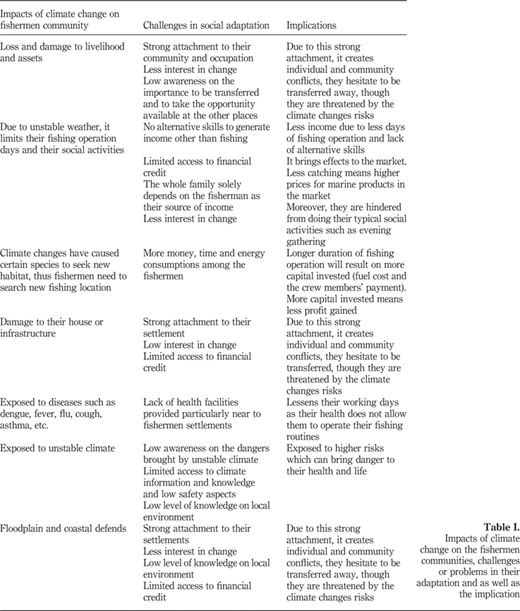
Extreme weather such as floods and thunderstorms will also cause loss/damage to livelihood assets such as houses, boats, nets and boat engines. Zone A boats (0.1‐5.0 nautical miles), for example, are more vulnerable to the threats of such weather due to their smaller size. Moreover, places that have been critically hit by climate change are required to transfer their residents to other places. In December 2011, for example, a total of 42 houses in Pengkalan Atap Village in Kuala Besut, Terengganu were hit by huge waves, resulting in 196 residents having to be transferred to safer places. Moreover, Sabak Beach, located in Kelantan, is facing critical coastal area erosions as a result of damages to hundreds of houses and a number of mosques. Moving away from their homes can generate problems for residents in terms of self‐conflicts, especially for local people who have strong attachments to their place of residence, community and occupation (Badjeck et al., 2009; Apine, 2011). In addition to this, Table I summarizes the impacts of climate change on the fishermen communities, challenges or problems in their adaptation and as well as the implication of the problems they face.
1.4 Adaptation to climate change
As defined in the National Policy of Climate Change, adaption can be understood as actions taken to aid communities and ecosystems to cope with existing and projected impacts of climate change. Climate change is particularly crucial in developing countries, which are forecasted to bear the brunt of it. As has been projected in a number of past studies (IPCC, 2007; Alexander et al., 2006; Tangang, 2007; Kwan et al., 2011) the future world will face severe and frequent natural disasters that pose serious challenges to communities. Hence, it is crucial for the relevant parties to recognize the vital relationship between assisting communities to adjust to climate change, and lessening their risk of catastrophe. In addition, according to IPCC (2007), adaptation is the best way in which to combat climate change, as opposed to efforts to reduce the emission of greenhouse gases.
Dynamics such as solid information, knowledge, apt legislative and institutional frameworks and comprehensive monitoring and evaluation approaches are fundamental for community adaptation processes. Consequently, to meet all of these requirements, a range of decision support tools, which are conducive to facilitating continuous improvements, should be made available. In addition, resilient communities should be built to protect them from menaces and curtail their vulnerability to climate change. To do this, three vital aspects – namely response, rehabilitation and rebuilding after disastrous events – must be given emphasis (IUCN, 2009).
2 Measuring fishermen's social adaptations to climate change
Strategies and formulae are needed to understand the strength of communities in terms of adapting to climate change. One such method involves measuring the level of community groups' adaptations towards climate change. In this study, fishermen's social adaptations were measured based on a framework of social adaptation towards climate change developed by IUCN (2009). Within this framework there are five aspects, namely:
- 1.
vulnerability to climate change;
- 2.
exposure to climate change;
- 3.
social sensitivity to climate change;
- 4.
individual adaptive capacity; and
- 5.
community adaptive capacity.
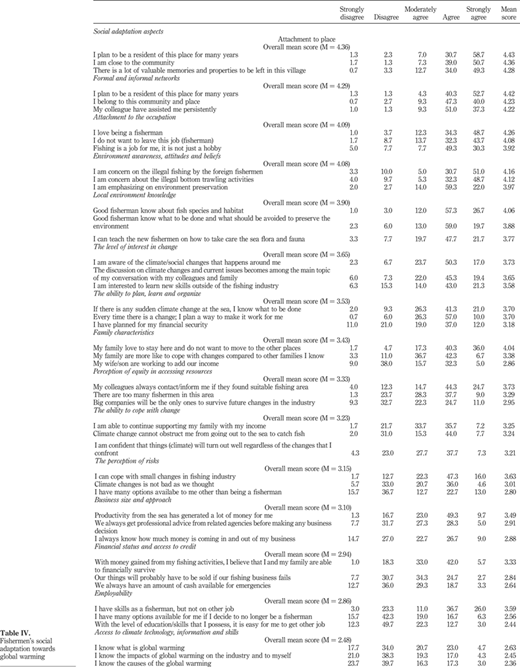
However, this study focuses on one aspect only – individual adaptive capacity. The main reason behind this selection is that the individual themselves must first be ready for and then adapt to the changes. Identifying climate change adaptation at the individual level is crucial, as failure to do so will weaken the fishermen's socio‐economic situation (IPCC, 2007). Moreover, according to IUCN (2009), adaptive capacity is indeed a major determinant of whether or not an individual is able to cope with the current climate situation. In addition, adaptive capacity is influenced by an individual's characteristics, which can influence their capacity to take advantage of opportunities that emerge due to the changes that have occurred. A total of 15 aspects fall under the banner of such adaptive capacity (Table IV).
3 Methodology
Based on multi‐stage simple random sampling, a total of 300 registered fishermen from four states in the East Coast Region of Peninsular Malaysia (Kelantan, Terengganu, Pahang and East Johor) were chosen as respondents for this study. During the first stages of the research, fisheries districts were grouped based on their states. A single fisheries district was then randomly selected from each states and this resulted in four selected fisheries districts namely Bachok/Pasir Putih, Kelantan (3.76667°N, 113.533°E), Kuala Besut, Terengganu (5.8333°N, 102.5667°E), Pekan, Pahang (3.5000°N, 103.4167°E) and Mersing, East Johor (2.4333°N, 103.8333°E). After completing the first stage of sampling, a list of registered fishermen was generated from each of the selected fishery districts. Then, simple random sampling was again employed to choose 75 respondents from each of the fishery districts. The main reason for choosing this sampling technique is that it is the simplest of the probability sampling methods: it is free of classification error, and necessitates a minimum knowledge of the population. Furthermore, simple random sampling is appropriate when a small amount of information is obtainable regarding the population, and data collection can be efficiently piloted on randomly distributed items, or where the cost of sampling is small enough to make efficiency less important than simplicity. Details on the data collection process are presented in Table II.
The findings of this study are not reflecting all fishermen in Malaysia as the respondents of this study were among the registered fishermen in the East Coast Region of Malaysia and the results might be different if the fishermen from other regions of Malaysia are included.
A specific questionnaire was developed to gather the data needed. A total of 45 questions were included in the questionnaire based on the 15 aspects emphasized by IUCN for their social adaptation framework. For each of the questions asked, the respondents were given a five‐point Likert scale which gave them a choice of answers including: strongly disagree (1), disagree (2), moderately agree (3), agree (4), and strongly agree (5). To obtain the data needed, a survey was also employed. Enumerators were hired and trained to conduct the survey. SPSS was used to conduct a suitable analysis to achieve the determined objectives.
4 Results
4.1 Respondents' demographic data
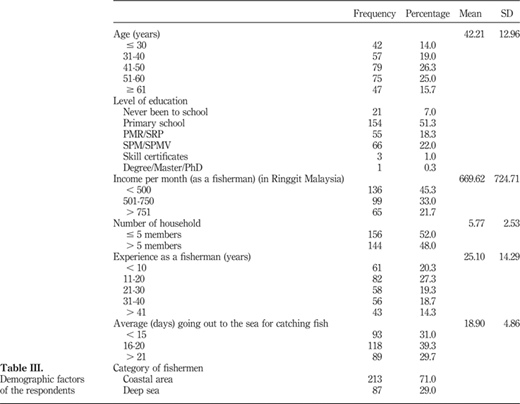
To obtain demographic data on the respondents, a total of seven questions were asked. Based on the results obtained, it was determined that 33 percent of the respondents were aged 40 and under, while of the remaining 67 percent were aged 41 and above. Slightly more than half of the respondents (51.3 percent) possessed a primary school level of education, while 22 percent of the respondents possessed an SPM/SPMV[1] level of education. Worryingly, it was revealed that the mean score recorded for monthly income was only RM669.62, which is below the poverty level set by the government[2]. The majority of the respondents (45.3 percent) earn < RM500 a month. A total of 52 percent have ≤5 family members in their homes, whilst the remaining 48 percent have >5. Based on the mean score recorded for experience as a fisherman (M=25.10 years), it can be said that the majority of the fishermen can be considered “senior” in terms of their experience levels. A total of 27.0 percent of the respondents had 11‐20 years' experience as a fisherman and spent 19 days a month out at sea. In addition, 71 percent of the respondents worked in coastal areas (Table III).
4.2 Fishermen's social adaptations to climate change
As mentioned earlier, social adaptations towards climate change were measured based on the individual adaptive capacity for climate change developed by Marshall et al. (2009). In this study, the overall mean score was categorized into three levels, namely low (M=1.00‐2.33), moderate (2.34‐3.67) and high (3.68‐5.00). The category was identified according to the equal distribution of the mean score (5−1/3). As depicted in Table III, five aspects were used to record a high overall mean score:
- 1.
attachment to place (M=4.36);
- 2.
formal and informal networks (M=4.29);
- 3.
attachment to occupation (M=4.09);
- 4.
environmental awareness attitudes and beliefs (M=4.08); and
- 5.
local environmental knowledge (M=3.90).
The remaining ten aspects were used to record a moderate overall mean score ranging from 2.48 to 3.53. The highest mean score was recorded using the aspect “attachment to place” (M=4.36), while the lowest mean score was recorded using “access to climate technology, information and skills” (M=2.48) (Table IV).
5 Discussion
The level of adaptation among Malaysian East Coast Region fishermen can be categorized according to the three levels outlined above – namely low, moderate and high. A number of recommendations arise from this.
5.1 Low level of adaptation
Three aspects were detected to have a low level of adaptation: attachment to place, formal and informal networks, and attachment to occupation. As mentioned above, all of these adaptation aspects recorded the highest mean score; nevertheless, the high mean scores of these aspects reflect a low level of adaptation. Higher levels of attachment denote that the fisherman would not wish to move to other locations, despite the opportunities that may be available there and the climate change threats persisting at their present locations. Moreover, the majority of the respondents revealed that they would prefer to remain at their current location for the foreseeable future, and they may plausibly refuse to move away from their place of residence. “Formal and informal networks” can be associated with “attachment to the place of residence” (Table IV). A high mean score for statements such as “I plan to be a resident of this place for many years”; “I belong to this community and place” and “My colleagues have assisted me persistently”; denotes that the fishermen have declined to move away due to their closeness to the local community and strong attachments to their present locations. The fishermen were revealed to have strong attachments towards their jobs, and may be reluctance to learn alternative skills to fishing. It would be very challenging to convince fishermen to take opportunities available elsewhere, particularly those who have strong attachments to their surroundings. However, in terms of increasing their level of adaptation in relation to these three aspects, a number of recommendations are highlighted, as follows.
5.1.1 Periodical adaptive assessment
As emphasized by Tugwell et al. (2007), individual demographic factors impinge upon a community's ability to absorb the effects of climate change. Periodically assessing their levels of adaptation will assist the relevant agencies in understanding the readiness of the community to be transferred and to learn new skills besides fishing. Conducting community adaptation assessments is possible, since a number of adaptive assessment tools already exist, such as those developed by leading climate‐change‐related organizations such as IPCC and IUCN. Additionally, to further strengthen the process, frequent briefings are needed on the advantages of utilizing the opportunities available.
5.1.2 Training and capacity building
Such programmes should be available in reactive (response during a disaster) and proactive (preparation against a disaster) forms. People should be prepared and know what to do, to whom they should refer, and where to go during and after a climate‐related disaster. In addition, disaster management agencies such as the Department of Public Defence, MERCY Malaysia and AMAN Malaysia possess a great deal of experience in terms of preparing and managing natural disasters within and outside of the country, and their expertise should be shared with local the community.
5.1.3 Participatory action research
A study conducted by Zakri (2011) reflected that Malaysia is far behind in terms of climate‐related research, compared to other developed and developing countries, while this study has concluded that in a five‐year period (2006‐2011), there were only 303 indexed journal articles published by the local researchers; an average of merely 35 journal articles per year. Therefore, more climate‐based research, such as participatory research, needs to be conducted.
Related organizations such as universities, fisheries and disaster agencies should make some investments into such climate‐based research in Malaysia. In addition, involving the local community in the research is crucial so that the output of the research will be in tandem with the needs, demands and ability of the target groups.
5.2 Moderate level of adaptation
Based on the results depicted, ten aspects of social adaptation can be categorized as moderate, namely:
- 1.
the level of interest in change;
- 2.
the ability to plan, learn and reorganize;
- 3.
family characteristics;
- 4.
perception of equity in accessing resources;
- 5.
the ability to cope with changes;
- 6.
perception of risks;
- 7.
business size and approach;
- 8.
financial status and access to credit;
- 9.
employability; and
- 10.
access to climate technology, information and skills.
Even though all of these aspects recorded moderate scores, they should be further strengthened. The fishermen indicated that they are aware of climate change, and that this issue is among the main topics discussed amongst their family members and colleagues. Nevertheless, we conclude that their awareness and level of knowledge on climate change is only general; this can be seen, for instance, in the fact that the majority of fishermen revealed that they do not know about the impacts and causes of global warming. Hence, it is recommended that access to climate technology, information and skills should be further strengthened. Early education and public awareness programmes are also needed, and strategies such as research information sharing and information dissemination programmes should be intensified (Kara et al., 2011). The fishermen should be exposed to such information, as its availability, accessibility and transparency will inform them on the preparations needed to face such threats.
The aspect on financial status and access to credit can be impinged by the employability factor; concerned parties should intensify their collaboration to diversify fishermen alternative skills. Agricultural‐related agencies, for example, can take further steps by educating and engaging fishermen on new agricultural activities such as farming, harvesting and animal husbandry. A study completed by Eakin (2005), found that fishermen with zero knowledge on alternative skills will have problems adjusting to climate change. Persuading fishermen to become involved in new agricultural activities should not be too difficult, however, as they were found to have an interest in learning new skills outside of the fishing industry. Furthermore, entrepreneurial skills should be instilled; within these, fishermen can be taught how to manage their activities more systematically. In addition, they would benefit greatly from increasing their knowledge regarding profits and margins, and well as receiving persistent advice from concerned parties. The scope of such programmes should also be expanded to the fishermen's family members. As there were few family members who worked to support the fishermen financially, they should be included as target groups.
5.3 High level of adaptation
Two aspects reported high levels of adaptation, namely environmental awareness, attitudes and beliefs; and local environmental knowledge. Commonly, rural and urban communities have positive environmental awareness, attitudes and beliefs (Apine, 2011; Hassan and Akhter, 2011; Saricam et al., 2011), and it can be seen as a positive sign that fishermen in the East Coast Region of Peninsular Malaysia proved to be similar in this regard. The majority of the fishermen interviewed had an average of 42 years of fishing experience. They have learned from experience and constructed positive attitudes towards the environment. They are also experts in identifying fish habitats and species, and knowing how to preserve the environment. Moreover, they are willing to teach new generations on how to preserve their environment. Even though they have good knowledge in this area, however, it should be taken into account that their knowledge on climate change is not as advanced. As mentioned earlier, consistent exposure to and possession of climate change information will aid them to prepare socially and economically for the threats created by such changes. To further enhance their awareness, attitudes, beliefs and knowledge regarding the environment, the science‐media‐policy relationship is recommended. Here, universities and relevant agencies can play a role in disseminating, sharing and educating their research findings to the community. They can share and disseminate such findings through traditional information sources such as televisions, newspapers and village leaders, as Hassan and Akhter (2011) found that communities – particularly those in rural areas – prefer such sources of information. In addition, NGOs are found to provide effective assistance in the process (Pin et al., 2011).
6 Conclusion
Fishermen are an important group in Malaysia, and their role in providing a consistent marine protein supply for their communities is crucial. However, alarmingly, they are now considered to be among the main “victims” of climate change. The results of this study have concluded that East Coast Region fishermen in Malaysia are ready to face the climate change threat in a number of aspects. It is reassuring that the fishermen have a good level of knowledge, positive attitudes, awareness and beliefs regarding the environment and plausibly these will reduce and delay the undesirable impacts of climate change. However, it was found that the fishermen were not ready to face climate change, due to the strong attachment they have with their place of residence, local community, and livelihood as fishermen. Problems will emerge from these strong attachments if they eventually need to be transferred or if they suffer due to reduced productivity from the sea and natural threats from the shifting climate.
Notes
SPM/SPMV refers to Malaysian Higher Education Certificate and Malaysian Vocational Education Certificate.
The poverty level set by the Economic Planning Unit of Malaysia (EPU) is RM720 which approximately equivalent to USD240.
References
Further Reading
About the authors
Hayrol Azril Mohamed Shaffril is a Social Research Officer at Institute for Social Science Studies, Universiti Putra Malaysia (UPM). He obtained his Master of Science in Rural Advancement from Universiti Putra Malaysia and currently is doing his PhD in the same field of study, focusing on fishermen and their social adaptation towards climate change. To date, he has completed a number of researches related to the fishermen community development. Hayrol Azril Mohamed Shaffril is the corresponding author and can be contacted at: hayrol82@gmail.com
Bahaman Abu Samah is the Director of Institute for Social Science Studies, UPM, and at the same time is an Associate Professor at the Faculty of Education, UPM. He graduated with a PhD in Agriculture Education from the Iowa State University. For more than 25 years, much of his research has focused on rural development, agriculture extension and community development. In addition, he is an expert in social science statistics and was responsible for the statistics part of this paper.
Jeffrey Lawrence D'Silva is a Research Officer at Institute for Social Science Studies, UPM. He gained his PhD in Extension Education from Universiti Putra Malaysia. His research interests focus on agriculture extension and rural development. To date, he has published more than 30 papers in both national and international journals.
Sulaiman Md. Yassin is a Principal Research Fellow at the Institute for Social Science Studies, Universiti Putra Malaysia. He is a former Vice Chancellor of University Malaysia Terengganu (UMT), a Professor Emeritus and attained his PhD in Extension Education and Communication from Cornell University, USA. He has conducted many research projects, most of them focusing on community development. During his spell at UMT, he conducted a number of research studies related to fishermen community development. To date, he has produced and presented hundreds of papers in national and international journals and seminars.