The purpose of this paper is to present a formal framework of vulnerability to climate change, to address the conceptual confusion around vulnerability and related concepts.
The framework was developed using the method of formalisation – making structure explicit. While mathematics as a precise and general language revealed common structures in a large number of vulnerability definitions and assessments, the framework is here presented by diagrams for a non‐mathematical audience.
Vulnerability, in ordinary language, is a measure of possible future harm. Scientific vulnerability definitions from the fields of climate change, poverty, and natural hazards share and refine this structure. While theoretical definitions remain vague, operational definitions, that is, methodologies for assessing vulnerability, occur in three distinct types: evaluate harm for projected future evolutions, evaluate the current capacity to reduce harm, or combine the two. The framework identifies a lack of systematic relationship between theoretical and operational definitions.
While much conceptual literature tries to clarify vulnerability, formalisation is a new method in this interdisciplinary field. The resulting framework is an analytical tool which supports clear communication: it helps when making assumptions explicit. The mismatch between theoretical and operational definitions is not made explicit in previous work.
1 Introduction
The concept vulnerability is of great importance in the climate change context. Since the United Nations Framework Convention on Climate Change (UNFCCC) commits developed country Parties to “assist the developing country Parties that are particularly vulnerable to the adverse effects of climate change in meeting costs of adaptation” (United Nations, 1992), adaptation finance and other climate policy questions have generated a large research field centered around the meaning and measurement of vulnerability (Klein, 2009; Hinkel, 2011).
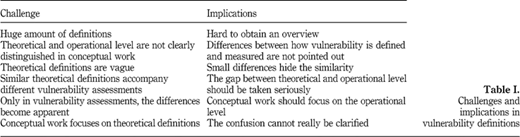
However, despite several decades of research on the vulnerability of socio‐ecological systems (SESs), scholars have not been able to agree on the meaning and measurement of it. A multitude of definitions and methodologies for assessing vulnerability cause confusion in the terminology. This “Babylonian confusion” (Janssen and Ostrom, 2006) was, justifiably, attributed to the circumstance that different disciplines (e.g. ecology, poverty and development studies) have independently defined and assessed vulnerability (Cutter, 1996). In the context of climate change, which requires an interdisciplinary approach, the term vulnerability is now being used with different meanings. The plurality of vulnerability definitions has led to intensive conceptual work, including glossaries (Parry et al., 2007), overarching frameworks (Turner et al., 2003) and the classification of different approaches to assessment (Füssel, 2007). As yet, this work has produced little agreement beyond that vulnerability is “place‐based” and “context‐specific”, and that there are two different approaches, denominated “top‐down” and “bottom‐up” (Dessai and Hulme, 2004), “end‐point” and “starting‐point” (Kelly and Adger, 2000), “biophysical” and “social” (Brooks, 2003), or “outcome” and “context” vulnerability (O'Brien et al., 2007). Challenges in vulnerability definitions and assessments are summarized in Table I.
In this situation, the work presented here makes two main contributions: it clearly separates the theoretical and the operational level and it applies a method not used before in this context. This method is formalisation, that is, linguistic analysis and an explicit representation of the structure of vulnerability. The formal framework thus developed clarifies the confusion. It is based on an extended analysis of conceptual papers and case studies from the climate change, disaster risk, and poverty literature (Ionescu et al., 2009; Hinkel, 2008b; Wolf, 2010). Mathematics was chosen as the language in which to cast the framework because of its explicitness and precision. Avoiding hidden ambiguities, mathematics can foster clear communication. Since we are aware that the audience to which the framework is addressed is mainly non‐mathematical, this paper uses diagrams instead of formulae. While the details are more precise in a mathematical formulation, this presentation still encourages making assumptions explicit – an important benefit of a mathematical kind of thinking.
2 Method
2.1 Meta‐language
This paper argues that the aim of clarification has not been met because analyses are carried out without having well‐established meta‐concepts for speaking about different vulnerability definitions and assessments. Meta‐concepts used, such as “conceptualization”, are usually not defined, leaving the conceptual work itself unclear. Therefore, we here introduce our meta‐language explicitly (see Hinkel (2008b) for details and further references).
We distinguish between ordinary, scientific and formal language. Ordinary languages are used in every day situations (e.g. English), while scientific languages are the jargons of scientific disciplines or other specialised knowledge domains. Ordinary and scientific languages are natural language, as opposed to formal language. We use the term “formal” in its weak sense of pertaining to form or structure and consider any expression in mathematical or other artificial symbolic notation to be formal. Formal languages include programming languages, and graphical languages used in diagrams.
The building blocks of languages are linguistic signs that consist of two inseparable parts (de Saussure, 1916):
- 1.
the expression, that is, a “material” part, e.g. the string of characters on a paper or the sound waves produced by a speaker; and
- 2.
the meaning, that is, what the material part stands for.
The sign is often called concept. In ordinary languages, the expression part of a sign is a word, in scientific languages a term. Usually, when one produces expressions, the recipient (e.g. you as you are currently reading this text) automatically interprets the expressions attaching a meaning to them. Ordinary language “works” because people have an intuitive understanding of words, that is, the meaning is intuitively clear. This meaning is generally not very precise.
Scientific language attaches more precise meanings to terms; in fact, the scientific method consists in making language more precise. This occurs by means of theoretical and operational definitions. Theoretical definitions are statements that define the meaning of a new term on the basis of other terms whose meanings are already established (Suppes, 1999). A theoretical definition tries to capture all relevant dimensions of the introduced concept. For example, the well‐known IPCC definition of vulnerability (Table II) names the dimensions exposure, sensitivity and adaptive capacity. Operational definitions define the meaning of a term by giving rules how to measure it. Making a concept operational means providing a methodology (an operation) that associates measurements to the concept. This methodology is the operational definition – methodologies used in vulnerability assessments are operational definitions of vulnerability (Hinkel, 2008a). For a set of definitions (e.g. a scientific language) to be meaningful, one has to start with some undefined basic terms, the primitives. Then, the meaning of other terms is defined upon these. The primitives must be intuitively clear to the users of a language, otherwise the meaning of the defined terms cannot be understood.
2.2 Formalisation
Formalisation is the process of making form explicit by translating statements from a natural language into a formal language. It is a standard process that everybody frequently applies. For example, one formalises a text into a diagram to make relations between some elements described in the text visible. Formalisation also is a common, but not necessarily explicit, process in the evolution of scientific fields or disciplines (Suppes, 1968). It usually starts with the extension of ordinary language vocabulary through the introduction of technical terms or the standardisation of the syntax of ordinary language and may (or may not) lead to the usage of mathematical expressions (Posner, 1997).
When formalisation is carried out explicitly, the process can be summed up into three steps, illustrated in the following section:
- 1.
Linguistic analysis of ordinary or scientific language statements to identify the primitives and the structure between these.
- 2.
Translation of the natural language primitives to formal primitives.
- 3.
Definition: the formal definition is assembled out of the formal primitives, reproducing the structure identified in the first step.
A benefit of formalisation, relevant to the vulnerability context, is explicitness. Uncovering form, one is forced to reveal assumptions that could otherwise remain implicit. Being explicit, one gains a better understanding about the object of the formalisation, in this case vulnerability. Also, being explicit supports clear communication. Suppes (1968) notes: “one broad aim of formalisation is to make communication easier across scientific disciplines” (p. 654). Whereas natural language words can always carry implicit connotations that differ according to the disciplinary background of the users, in concentrating on the form, hidden ambiguities can be avoided.
There is a widespread misunderstanding that formalisation means “reductionism”, that is, that essential aspects of a problem are disregarded. The issue is not whether ordinary or formal language are better in principle, but what the right mix between the two types of languages is for solving a given problem. In particular, if the natural language statements are “rich” in structure, additional insights may be gained by taking a closer look at this structure.
3 Formalisation of ordinary language vulnerability
This section formalises ordinary language vulnerability from a representative definition, illustrating the steps of the formalisation process. The resulting basic formalisation is later refined for scientific vulnerability.
3.1 Analysis
The Oxford Dictionary of English defines the adjective vulnerable as “exposed to the possibility of being attacked or harmed, either physically or emotionally” and gives the example “small fish are vulnerable to predators” (Soanes and Stevenson, 2005).
Vulnerability is the property of being vulnerable. The property is “gradable”, meaning that it allows for comparison (e.g. small fish are more vulnerable than large fish). It is ascribed to somebody or something (e.g. the small fish) – an entity. This entity is vulnerable at some point in time if it may be harmed at a later point in time. Consider the case where this point is the present. Generally, this need not be the case; the future is then relative to that point.
The grammatical construction of vulnerability to climate change is “vulnerability to a stimulus” (e.g. the predators). The harm the entity might suffer is attributed to this stimulus. To determine the entity's present vulnerability to the stimulus, one needs information about harm from the stimulus to the entity which may occur in the future evolution of the system. Since the future evolution is viewed from the present, uncertainty is an essential building block of vulnerability. An entity that is considered vulnerable is not definitely going to be harmed. For the dictionary example, consider a small fish that has survived, unharmed, for a month in a pond full of hungry predators. Yet, it was vulnerable a month ago because there was a possibility of harm; it could have been eaten by now. Summing up, the primitives of vulnerability are: an entity and a stimulus, the uncertain future evolution of these, and a notion of harm.
3.2 Translation of the primitives
Entity and stimulus
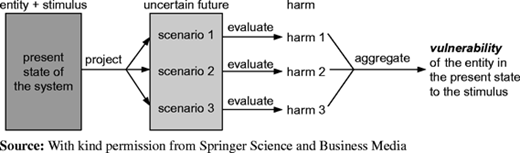
Studying the present vulnerability of an entity to a stimulus, one delineates a system by considering some information about entity and stimulus while not considering other information. The current situation of this system is described by the system's state, graphically represented by a box (Figure 1). The state contains all relevant information about the situation. The state of a fish population might be their number, but states can also be qualitative. Systematically making explicit the system under consideration in a vulnerability assessment helps communicate clearly any underlying assumptions.
Uncertain future evolution
The evolution of a system is described by a sequence of states that represent its situation at several points in time. Due to uncertainty, instead of “the” future evolution of the system, only possible evolutions can be described as viewed from the present. An evolution ranges over a time span up to a fixed time horizon. Later points in time are not considered. The time span varies from, for instance, one year in studies of vulnerability to poverty to 100 years in climate change studies. Making the time span explicit facilitates the comparison of assessments. A possible evolution of the fish population might provide the number of fish for each month from today until five years from now, as given by a population model or an expert's estimates.
The uncertain future evolution of the system can be described by projecting several scenarios: one associates a set of possible evolutions to a given state of the system. Such a description is nondeterministic; probabilistic or fuzzy descriptions are other examples. For simplicity, we use scenarios here. The mathematical framework of vulnerability also captures cases where extra information, such as probabilities, is attached to the scenarios (Ionescu, 2009; Wolf, 2010). Graphically, the uncertain future evolution is represented by a box containing several scenarios (Figure 1).
Harm
Harm is evaluated by associating a harm value to each scenario. Here, value does not necessarily mean a number, for example qualitative categories from “no harm” to “much harm” or coloured pixels in a map where “red is worse than green” are also subsumed. For the fish population one might consider how many fish the predators eat in each possible evolution. The notion of harm presupposes some comparability: in ordinary language, one uses the word “worse”. Given two harm values, one often can decide which one of them is worse (e.g. the larger number of fish eaten); they might, however, not be comparable in some cases. While it is intuitive that “more people affected” and “more monetary damage” means “more harm”, considering both criteria at the same time, evolutions are not per se comparable. To compare “more people affected and less damage” with “fewer people affected and more damage”, a weighting of the criteria is needed. As far as scenarios are comparable, the evaluation needs to fulfil certain consistency rules to represent the notion of “worse”. No scenario can be worse than itself. Given two scenarios, at most one can be worse than the other. Finally, if a first scenario evaluates worse than a second one, and this second one evaluates worse than a third, then the first one should also evaluate worse than the third. Mathematically, such conditions can be summed up concisely, and their consequences can be investigated. Figure 1 uses labels harm 1, etc. to represent the harm values.
3.3 Definition
Given the translations of the primitives, one needs to aggregate the harm values into a vulnerability value that represents the vulnerability of the entity in the present state. “Aggregate” means collect information (e.g. into colours in maps), not necessarily produce a single number. To represent vulnerability, the aggregation needs to satisfy some conditions. For example, for worse harm values it should not produce less vulnerability. This natural monotonicity condition can be stated generally in mathematics (Ionescu, 2009). In natural language it is more involved: if no harm value gets better, while some get worse, the aggregated vulnerability value should not get better. Quantitative or qualitative vulnerability values are mostly but not always comparable. Figure 1 sums up the definition of vulnerability.
4 Formalisation of theoretical vulnerability definitions
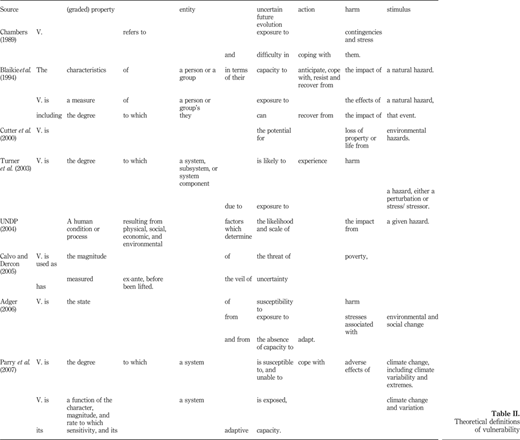
The formalisation of ordinary language vulnerability was based on a representative definition. In the scientific terminology, one representative definition does not exist. In fact, the abundance of vulnerability definitions in the literature is a source of confusion. Therefore, we analysed a range of definitions from the climate change, natural hazards and poverty literature. The columns in Table II highlight the structure of some examples; for a more detailed analysis of about 20 definitions, see Wolf et al. (2008), Wolf (2010). The analysis in the following paragraphs refers to this table. Examples in brackets are taken from it; references are not repeated to improve readability.
The analysis of the definitions shows that, as in ordinary language, vulnerability is defined as a property of an entity in some state (“characteristics”, “state”, “human condition or process”). The property is gradable (“degree”) and can be measured (“magnitude”, “measure”). The basic structure remains the same, as can be seen from the column headers in the table: the primitives of ordinary language vulnerability recur. Expressions used for the primitive entity specify real‐world entities (“a person or a group”) or abstract descriptions of an entity (“system”). General expressions (“impact”) or more specific ones (“loss of property and life”) describe harm. A wide range of stimuli is considered (“climate change”, “natural hazards”, “environmental and social change”). The uncertain future evolution is described by expressions like “potential”, “being likely”, or by additional technical terms: exposure, capacity, and susceptibility. These refer to aspects of the system's evolution. Capacity describes the entity's possibility to act, exposure refers to the possibility that the stimulus manifests in the entity's future evolution, and susceptibility describes the possibility of an impact from the stimulus on the entity. Thus, this primitive is decomposed into aspects, refining the ordinary language definition of vulnerability. Other refinements are made: vulnerability is said to be determined by “physical, social, economic, and environmental factors”, for example. The entity's capacity to act is further specified by expressions collected in the column action – from proactive to reactive actions (“anticipate or cope with”).
As the scientific definitions share the basic structure identified in the previous section and refine it, we have shown that the ordinary language definition represents a common denominator for scientific definitions of vulnerability. To adequately refine the formalisation, an analysis of the newly introduced scientific terms is necessary. Unfortunately, these terms are generally not themselves defined. For example, definitions of “adaptive capacity” define what is meant by “adaptive”, while “capacity” is assumed to be understood from everyday usage. This leaves the meaning vague and consequently the meaning of vulnerability remains vague. A refined formalisation of the scientific term vulnerability therefore cannot be obtained from theoretical definitions alone.
5 Formalisation of operational vulnerability definitions
For a more precise picture, we analysed operational definitions, that is, methodologies applied in vulnerability assessments. In other words, instead of looking at “what people mean when they say vulnerability” we looked at “what people do when they assess vulnerability”. Operational definitions are, by their very nature, precise, because they define a term by operations performed to measure it (Hinkel, 2008a). Concentrating on climate change vulnerability, it was possible to make the meaning of terms such as exposure and capacity more precise and to formalise the refinement for scientific vulnerability. For the analysis itself, and a mathematical account of the formalisation, see Ionescu (2009).
We found three types of methodology in assessments, referred to as future‐explicit, present‐based, and combined. They differ in the patterns of steps carried out. A diagram represents each type with arrows for the steps. Shafts are labelled with the method applied in the step. Arrows point from the input that the method is applied upon to its results. A branching arrow means that a method produces several results from one input, and vice versa for several arrows converging into the same head. All three types of methodology have a common starting‐point: the state of a SES, into which entity and stimulus are embedded.
5.1 Future‐explicit assessments
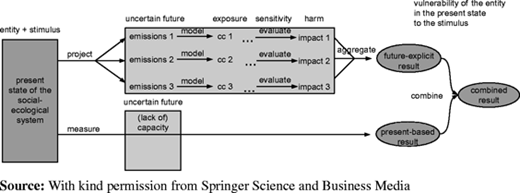
Figure 2 summarizes future‐explicit assessments. It contains the same primitives and steps as Figure 1, refining ordinary language vulnerability. An explicit consideration of the future is prominent in these assessments.
Projection subsumes many methods. For example, the IPCC SRES scenarios are based on a literature review, several models and a feedback process (Nakicenovic and Swart, 2000). Many assessments use these scenarios, which project a specific aspect of the SES's evolution: emissions. Figure 2 sketches three emissions scenarios for simplicity. Projections can also be fuzzy or probabilistic (e.g. based on statistics), but probabilities are debated in the climate change context (Schneider, 2002; Dessai and Hulme, 2004; and references therein).
Models are an intermediate step in this type of methodology. A climate model transforms each emissions scenario into a climate change scenario (cc1‐cc3), producing (multidimensional) climate data. The set of climate scenarios matches a technical term from the theoretical vulnerability definitions: the exposure of the entity to climate change. Further modelling steps are indicated by dots in the diagram.
Evaluation takes place by applying an impact model that produces (partially) comparable harm values (impact 1, etc.). The simplest impact model is a dose‐response function. Impact models assign an impact value to each stimulus value, describing the degree to which the entity is affected by the stimulus. This captures the theoretical notion of sensitivity, defined by the IPCC as “the degree to which a system is affected, either adversely or beneficially, by climate variability or change […]” (Parry et al., 2007).
Aggregation finally collects the harm values from all scenarios into a vulnerability value, quantitative or qualitative as discussed before.
The assessment result is “the vulnerability of the entity in the present state to the stimulus”. In future‐explicit assessments, a focus on the ecological component of the SES and the stimulus dominates. Some modelling steps describe the stimulus only and do not consider the entity, e.g. climate models. Since models are more readily available for the ecological than for the social component of the SES, this focus is natural. However, the entity needs to be considered in the harm evaluation step, as harm occurs to the entity. Social system and entity may be the poor cousins in this type of methodology, represented for example by a roughly specified level of adaptation (cf. the stylised farmer (Füssel and Klein, 2006)).
Examples of future‐explicit assessments include the following: Hinkel and Klein (2009) present the development of the DIVA tool for assessing global coastal vulnerability, applied by Hinkel et al. (2010). Moss et al. (2001) use a global Integrated Assessment Model to assess country‐level vulnerabilities.
5.2 Present‐based assessments
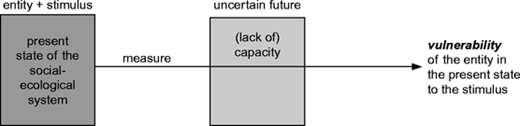
In present‐based assessments, measurements are made on the present state of the SES. These quantitative or qualitative measurements can have a negative connotation (vulnerability) or a positive one (adaptive/coping capacity). This specifies another technical term from the theoretical definitions: capacity as a measurement on the present state.
Figure 3, representing present‐based assessments, is rather simplistic: its only arrow depicts a measurement step, applied to the present state of the SES. Examples are indicators such as “literacy rate”, weighted indices, or rates of change. The label “(lack of) capacity” subsumes both connotations. The same measurement can be positively or negatively connoted, depending on the interpretation, e.g. for GDP higher values indicate more capacity or less vulnerability. Again, the assessment result is “the vulnerability of the entity in the present state to the stimulus”.
The primitives of vulnerability occur in theoretical definitions that accompany present‐based assessments, but remain implicit in the assessments. These focus on the present situation, as expressed, e.g. by Gallopín (2006): “capacity of response is clearly an attribute of the system that exists prior to the perturbation”. Nevertheless, vulnerability indicators must provide information about possible future harm, not present harm (Eriksen and Kelly, 2006), while capacity indicators might delimit a range of possible future actions: for example, a higher level of education is considered to allow an agent a broader variety of actions. The discrepancy between the explicitness of the primitives in theoretical definitions and their implicitness in present‐based assessments contributes to the confusion in the terminology.
In present‐based assessments, the focus is on the entity and the social component of the SES. The stimulus may not be represented explicitly, as in the case of “generic adaptive capacity”. However, present‐based assessments cannot completely neglect the stimulus and the ecological system since capacity exists only with respect to exposure to a specific set of impacts (Kelly and Adger, 2000).
Examples of present‐based vulnerability assessments are the “Social Vulnerability Index” by Cutter et al. (2003) for the 3,141 counties of the USA and Hahn et al.'s (2009) “Livelihood Vulnerability Index” based on a survey of 220 households in Mozambique.
5.3 Combined assessments
Combined assessments combine the previous types of methodology (Figure 4). The assessment result is again “the vulnerability of the entity in the present state to the stimulus”. How the results from the first two types are combined differs between assessments, but some conditions have to hold for the combination. As expressed by Füssel and Klein (2006), “under ceteris paribus conditions, adaptive capacity and vulnerability are negatively correlated”. A combination would not be accepted if it produced lower vulnerability values when applied to the same potential impacts and lower adaptive capacity. Mathematics can help state such conditions precisely and generally (Ionescu, 2009).
An example is the Advanced Terrestrial Ecosystem Analysis and Modelling (ATEAM) study (Metzger and Schröter, 2006) that assessed the vulnerability of various regions of Europe to the loss of ecosystem services: potential impacts are a future‐explicit result, while the measurement of adaptive capacity by indicators is present‐based. “Vulnerability” is a combined result, presented by maps.
6 Discussion
Our distinction of types of methodology confirms and extends previous distinctions from the conceptual literature, such as “end‐point” and “starting‐point” vulnerability (Kelly and Adger, 2000), “outcome” and “contextual” vulnerability (O'Brien et al., 2007), or “biophysical” and “social” vulnerability (Brooks, 2003). The qualifiers “outcome” and “contextual” are consistent with our types of methodology: future outcomes are projected, or a present context is analysed in the respective assessments. End‐point, biophysical and outcome vulnerability focus on the future, corresponding to future‐explicit assessments. For example, outcome vulnerability “directs attention towards future impacts of climate change” (O'Brien et al., 2007, p. 80). Starting‐point, social and contextual vulnerability, on the other hand, are described as a property of the entity at the present time and correspond to present‐based assessments. For example, starting‐point vulnerability is determined primarily by the existent state, “rather than by what may or may not happen in the future” (Kelly and Adger, 2000, p. 328).
The qualifiers “biophysical” and “social” refer to the focus on one subsystem of the SES. This is not a sufficiently sharp criterion to distinguish types of methodology: as vulnerability arises from the interaction between entity and stimulus, all assessments need to consider the part they do not focus upon at some point.
Combined assessments extend the three distinctions above. In the conceptual literature they occur, for example, as “integrated” vulnerability (Füssel and Klein, 2006).
The contribution that the formal framework makes is clarification, based on having identified a mismatch between the theoretical and the operational level. Theoretical definitions of vulnerability are hardly more precise than our ordinary language understanding of the concept. While they add refining technical terms, these are themselves only vaguely defined, leaving also the vulnerability definitions vague. Confusion arises because theoretical differences cannot be discussed in a precise way at the level of definitions. In fact, the similarity of theoretical definitions suggests that there are no differences in what the term vulnerability means, and the myriad of imprecise definitions of vulnerability is counterproductive to conceptual clarification. Proverbially speaking, when trying to see the forest from the trees, adding more trees does not solve the problem. At the operational level, differences are apparent: three types of methodology are used to measure vulnerability. “Future‐explicit”, “present‐based” and “combined” assessments differ in the steps made and in whether the primitives of vulnerability occur explicitly or only implicitly. All three types of methodology arrive at a result that is referred to as “vulnerability”, while information on the type of methodology applied is generally not provided, adding to the confusion.
A weakness of previous conceptual on vulnerability is that theoretical and operational definitions are not considered separately. Not only does this mask an important source of confusion, it may also enhance confusion when the same theoretical definition is classified differently. For example, the IPCC definition of vulnerability is considered outcome vulnerability (future‐explicit) by O'Brien et al. (2007), and integrated (combined) vulnerability by Füssel and Klein (2006). However, it is a theoretical definition that in and by itself cannot be classified into a scheme of operational definitions. It may occur alongside assessments that use different types of methodologies. Starting with any theoretical definition, it depends much more on the researcher's implementation than on the definition itself, which type of methodology is used in an assessment.
7 Conclusions
This paper presented a formal framework of vulnerability to climate change that makes the structure of vulnerability explicit: vulnerability is a possibility of future harm. Scientific definitions add refinements, however, theoretical definitions remain vague. Only operational definitions reveal three distinct types of methodology:
- 1.
future‐explicit assessments use models to simulate possible futures and evaluate harm for these;
- 2.
present‐based assessments evaluate current adaptive capacity or vulnerability; and
- 3.
combined assessments combine these two.
The types of methodology can be found under various labels in previous conceptual work. However, the difference between the theoretical and the operational level of vulnerability definitions is generally not addressed explicitly in previous work. A main lesson from clearly separating these is that the differences between operational definitions are not reflected by theoretical definitions. Since the formal definitions can be used to represent theoretical as well as operational definitions, the framework can serve as an interface between definitions and methodologies. Such an interface is needed because theoretical definitions do not provide much, if any, guidance for designing methodologies for assessing vulnerability.
In fact, a practical consequence from the mismatch between the theoretical and the operational level is that methodologies for assessing vulnerability must be developed based on the specific research or policy question addressed, and more specific and empirically grounded concepts should be employed. In future research, conceptual work about theoretical vulnerability definitions should be replaced by a different approach. The formalisation's focus on structure has revealed basic similarities between definitions of vulnerability: all definitions we analyzed can be expressed as instances of the formal definitions. Agreeing on the basic structure as common ground and then considering precise operational definitions for specific cases, one could overcome the inherent confusion at the theoretical level.
We thus see the formal framework as an analytical tool, which supports clear communication between researchers in the field. Providing a starting‐point for making assumptions explicit, it encourages to investigate the working understanding one has of vulnerability, which may not be taken for granted in interdisciplinary contexts. If one can agree on the very general definitions of vulnerability provided by the framework, details can be discussed on a case‐to‐case basis in a clearer fashion. We have not proposed a framework for assessing vulnerability nor a theory of “how vulnerability to climate change comes about” – both tasks must be left to the practitioners in the field. The contribution of the framework is clarifying concepts and previous assessments for the researchers who address these questions.
The research was carried out within the projects FAVAIA (www.pik‐potsdam.de/research/transdisciplinary‐concepts‐and‐methods/projects/project‐archive/favaia) and ADAM (www.adamproject.eu/). Funding under the European Commission project ADAM (No. 018476‐GOCE) is gratefully acknowledged.
References
About the authors
Dr Sarah Wolf is a mathematician and graduated from Humboldt University in Berlin. She joined the Potsdam Institute for Climate Impact Research (PIK) to work on a formalisation of vulnerability and related concepts, obtaining a PhD at the Free University of Berlin with work at the intersection between probability and category theory. She then joined the Lagom group at PIK that develops multi‐agent models to study win‐win opportunities for climate policy. She recenltly moved on to the Global Climate Forum. There, she is involved in the German Green Growth Model project, which develops an open source multi‐agent model that complements detailed sectoral models in order to assess costs and benefits of climate and energy policy measures. Sarah Wolf is the corresponding author and can be contacted at: sarah.wolf@globalclimateforum.org
Dr Jochen Hinkel is a senior researcher at the Global Climate Forum (GCF; www.globalclimateforum.net/) and the Potsdam Institute for Climate Impact Research (PIK; www.pik‐potsdam.de). He holds a PhD in Environmental Sciences (Wageningen University, The Netherlands) and a Masters in Geo‐ecology (Karlsruhe University, Germany). He coordinates the development of the DIVA model, an integrated model for assessing coastal impacts and adaptation, which is jointly developed by a number of European research institutions. At GCF he leads the research process on climate change adaptation and social learning. One major activity thereby is the European‐funded project MEDIATION (Methodology for Effective Decision‐making on Impacts and AdaptaTION; http://mediation‐project.eu/), in which he leads the work‐package that develops an integrated methodology for assessing impacts, vulnerability and adaptation for Europe. Dr Hinkel also works as a consultant on adaptation‐related questions for national and international organizations including the World Bank, the European Commission, the Deutsche Gesellschaft für Technische Zusammenarbeit (GTZ). Prior to his academic engagement, he worked as a development practitioner for the GTZ in Bolivia, as well as a software developer and information technology consultant.
Mareen Hallier graduated in Mathematics from Freie Universität Berlin, with a diploma thesis on a formalisation of resilience. As a researcher at the Potsdam Institute for Climate Impact Research, she was involved in a meta‐analysis of climate change impacts, vulnerability and adaptation in Europe. She is presently a PhD student at Freie Universität Berlin, working on the mathematics of economic multi‐agent models. She obtained a scholarship from the Deutsche Telekom Stiftung for this work.
Alexander Bisaro (Sandy) is a Research Fellow at the European Climate Forum in the Adaptation and Social Learning cluster and a Doctoral candidate at the Division of Resource Economics at the Humboldt Universität zu Berlin. He studied physics at the University of Victoria, Canada (BSc) and Sociology of Science and Technology (STS) at the Universiteit van Amsterdam, where he obtained an MSc in 2005.
Daniel Lincke is a Researcher at the Global Climate Forum and the Potsdam Institute for Climate Impact Research. His current research topics are economic multi‐agent models for identifying win‐win strategies for climate policy and the DIVA model for coastal vulnerability assessments. He graduated in Computer Science from Friedrich‐Schiller‐Universität Jena in 2003. From 2003 to 2006 he worked as a Scientific Engineer at Gfal Berlin. In 2006 he joined the Potsdam Institute for Climate Impact Research. Working on the computational aspects of a formal framework of vulnerability, he prepared a PhD thesis on programme transformation at Hamburg Technical University.
Dr Cezar Ionescu studied Control Engineering with specialization Bioinformatics at the Politehnica University of Bucharest. Since 1999 he has been with the Potsdam Institute for Climate Impact Research, where he worked on applying tools from mathematical computer science to problems of scientific computing and parallel algorithms, and also worked on the formalization of social science concepts such as “vulnerability”. His current interests include dependent type theory, category theory, economical modeling, and questions of mathematical education at the undergraduate level.
Professor Richard J.T. Klein is a Senior Research Fellow at the Stockholm Environment Institute and an Adjunct Professor at the Centre for Climate Science and Policy Research of Linköping University. He is an expert on the science and policy of adaptation to the impacts of climate change, with almost 20 years of experience in original research, science assessment and policy advice. He is the founder and editor‐in‐chief of the academic journal Climate and Development. He has been an IPCC author since 1994, and co‐director and chief scientist of the Nordic Centre of Excellence NORD‐STAR since 2011.