– This paper aims to examine rice farmers' selection of adaptation strategies to cope with and offset the effects of climate change and the determinants of those selections in Rajshahi, a severely drought-prone district of Bangladesh.
– Farm-level micro data were obtained from 550 rice growers in the 2010-2011 farming season. A multinomial logit (MNL) model was utilised to assess the determinants of adaptation strategies practised by farmers in response to climate change.
– Results from the MNL model indicate that gender, age, education of household heads, household assets, annual farm income, farm size, tenure status, farmer-to-farmer extension, access to credit, access to subsidy, and access to electricity, all affect farmers' selection of adaptation strategies for climate change.
– This is the first study of its kind to analyse the determinants of adaptation strategies for climate change by farmers in drought-prone areas of Bangladesh. This study provides direction for policy makers in order to strengthen the adaptation strategies of farmers and guide policies accordingly. These strategies have the potential to minimise the adverse effects of climate change.
1 Introduction
Climate change has emerged as one of the greatest environmental challenges facing the world today (IPCC, 2007; Anik and Khan, 2012). Bangladesh is one of the countries most vulnerable to climate change. The main reasons for its vulnerability include its tropical climate; the predominance of floodplains for the majority of the land area; the low level of elevation and proximity to sea level; the high population density; and limited technological capacities to offset climate change effects (MOEF, 2005; DOE, 2007; Shahid and Behrawan, 2008; Pouliotte et al., 2009). Climate change impacts are already occurring, as measured by increasing temperatures, variable rainfall and an increase in climate-related extreme events such as floods, droughts, cyclone, sea level rise, salinity and soil erosion (Yu et al., 2010). These extreme climate events occur in Bangladesh almost every year, and sometimes more than once a year, affecting the crop agriculture sector adversely, particularly rice production (MOEF, 2005; Yamin et al., 2005).
Rice is the dominant crop in Bangladesh and accounts for more than 60 per cent of total crop agriculture value (Yamin et al., 2005). Almost 80 per cent of the total cropped area is planted with rice, which accounts for over 90 per cent of total cereal production (Alauddin and Tisdell, 1991; GOB, 2009). One particular worry is that overall rice production is forecast to decrease by 17 per cent per annum due to climate change and climatic events (GOB, 2005). Because of the huge contribution of rice production to Bangladesh's economy and its high susceptibility to climate change and climate related extreme events, it is important to study adaptation strategies to overcome the anticipated adverse impacts. Adaptation strategy is considered an essential policy option to limit the negative effects of climate change (Stern, 2006; Kurukulasuriya and Mendelsohn, 2008; Reidsma et al., 2009). At present, however, there is no empirical research on farmers' adaptation strategies using standard econometric techniques in Bangladesh. This is the first study of its type to assess the determinants of adaptation choices practised by rice growers. In this context, the results of this study can potentially provide an informed basis upon which policy makers can devise appropriate adaptation policies, so that the adverse impacts of climate change on rice production can be limited.
2 The impacts of climate change in Bangladesh
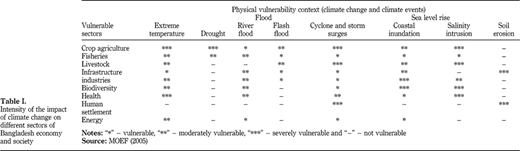
Climate change impacts are already being experienced in Bangladesh as measured by increasing temperatures, variable rainfall and climate related extreme events such as floods, droughts, cyclone, sea level rise, salinity and soil erosion (Asaduzzaman et al., 2010; Yu et al., 2010; Hossain and Deb, 2011). Table I shows the sectors affected by climate change; these include crop agriculture, fisheries, livestock, infrastructure, industries, biodiversity, health, human settlement and energy (MOEF, 2005).
It is evident from Table I that crop agriculture (mostly rice) is the most vulnerable sector to climate change and climate related events. Roy (2009) and Karim et al. (1999) also found that rice, the single most important crop, was particularly vulnerable to both droughts and floods in Bangladesh. This vulnerability warrants adaptation strategies for the country.
3 Overview of literature
Adaptation to climate change is very important if farmers are to counter its potentially unfavourable impacts (Kabubo-Mariara and Karanja, 2007; Stern, 2007; Hassan and Nhemachena, 2008; Reidsma et al., 2009). Adaptive measures when implemented can protect the livelihoods of poor farmers and ensure food security by reducing the potential negative impacts and reinforcing the advantages associated with climate change (Bradshaw et al., 2004; IPCC, 2007; Reid et al., 2007; Bryan et al., 2009).
There are a growing number of studies of farm-level adaptation strategies and their determinants (Seo and Mendelsohn, 2008; Bryan et al., 2009; Reidsma et al., 2010). However, adaptation in agriculture varies across countries. Moreover, different adaptation strategies are practiced by farmers depending on the climatic conditions, farm types and other conditions such as political, economic and institutional factors (Deressa et al., 2009; Reidsma et al., 2010; Hisali et al., 2011). More precisely, adaptation choices are context-specific and change from area to area and over time (Smit and Wandel, 2006). Therefore, country-specific or area-specific studies of climate change adaptation are required. In this study context, research studies for Bangladesh are very limited (Paul, 1998; Ahmed and Chowdhury, 2006; FAO, 2006; Rashid and Islam, 2007; Paul and Routray, 2011; Rawlani and Sovacool, 2011).
Ali (1999) identified some adaptive measures such as the construction of embankments and cyclone shelters, and the introduction of new rice varieties suitable to higher salinity levels and temperatures. Rashid and Islam (2007) identified drought, flood, soil salinity and cyclones as the major extreme climatic events that adversely affect agricultural operations and productions. Changes in behavioural patterns, human practices and international actions are suggested as anticipatory adaptive measures. Paul (1998) documented some adjustment measures such as crop replacement, irrigation, gap filling and the inter-cropping of wheat and kaon (a local food crop). Based on focus group discussions and key informant interviews, Ahmed and Chowdhury (2006) and FAO (2006) identified the excavation of deep-tube wells that facilitated irrigation, the excavation of ponds, switching to mango farming, the cultivation of short-duration and drought-tolerant crop varieties and homestead gardening as major adaptation strategies for the Chapai-Nawabgonj and Naogaon districts of northwest Bangladesh.
Rawlani and Sovacool (2011) identified agriculture as one of the six sectors most vulnerable to climate change. They focused on multiple and integrated adaptation strategies along with increased use of technology to reduce climate vulnerabilities. Paul and Routray (2011) recognised indigenous cyclone prediction, understanding cyclone warning signals, income diversification, precautionary food and money saving, selling of assets, borrowing, and migration as major coping strategies in the face of cyclones and induced oceanic storm surges in coastal Bangladesh. Habiba et al. (2012) identified agriculture as the most vulnerable sector to drought for North-Western Bangladesh. Major adaptation practices followed by farmers in the study area are agronomic management, water harvesting, water resources exploitation and crop intensification.
Most previous studies focussed on agriculture as a whole and were descriptive in nature, not rice-specific and quantitative in methodology. None of these studies have analysed the determinants of rice farmers' adaptation strategies and the barriers to adaptation which are crucial for devising an effective adaptation policy. Moreover, empirical analyses of farm-level adaptation strategies for the drought-prone areas have not been studied, though past droughts affected, on average, about 47 per cent area of the country and 53 per cent of the population (WARPO, 2005). Therefore, the objective of this study is to examine farmers' perception of climate change, barriers to adaptation and factors affecting adaptation choices in rice production systems by using the case of rice farmers in Rajshahi district of Bangladesh.
4 Methodology
4.1 Study district and its characteristics
Rajshahi district is a severely drought prone area of Bangladesh and was purposively selected for this study. The reasons behind this selection are:
it is characterised by high temperature and very low rainfall which make it severely drought-prone; and
rice farming is the major livelihood-supporting activity.
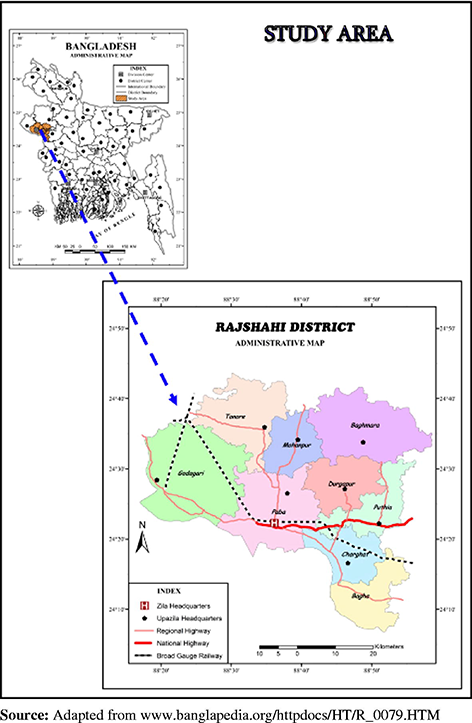
This district covers 2,407 km2 and lies between 24°6N and 25°13N latitude and 88°2E and 89°21E longitude (Siddique, 1976) (Figure 1). Average annual rainfall across the district varies from 839 to 2,241 mm. The average total rainfall for the period, 1964-2009, is 1,505 mm for the district compared to 2,408 mm for the whole country. The atmospheric temperature in the district is as high as 44°C in May and as low as 6°C in January. In terms of extreme climate events, the district is severely drought affected; however, almost free from cyclones and floods (Ahmed and Chowdhury, 2006; FAO, 2006).
Rice is the principal crop and major livelihood activity in the study area. Among different varieties of rice, rain-fed transplanted Aman (popularly known as T. Aman) is the leading rice crop which occupies 56 per cent of the total area under rice, followed by Boro (27 per cent) and Aus (17 per cent).
4.2 Data sources
Micro data from a farm-level survey conducted by the first author was the main source of data. The sample size comprised of 550 households who were selected randomly from 15 purposively selected villages of the district. Sample size for each of the villages was proportional to the farming population residing in the particular village. A structured survey questionnaire with a face-face interview was employed to collect data from the heads of farm households during the period August 2010 to January 2011. The survey questionnaire was used to collect data on socio-demographic characteristics (e.g. age, gender, education and household size), farm characteristics (e.g. farm size and tenure status), institutional accessibility (e.g. access to extension, weather information, credit, subsidy and irrigation facility) and farmers' perceptions about climate change, adaptation strategies and barriers to adaptation.
4.3 A micro-econometric model
Provided that various adaptive options are practiced by farmers, the selection of the choice model will be either a multinomial probit (MNP) or a multinomial logit (MNL) model. This study uses the MNL model to analyse the determinants that affect farmers' choices of adaptation strategies. This is because this model gives more precise estimation results than the MNP model (Kropko, 2007). Moreover, the MNL model has been successfully and commonly used in some recent studies (Hassan and Nhemachena, 2008; Kurukulasuriya and Mendelsohn, 2008; Deressa et al., 2009) while the MNP model is not usually used largely because of the practical difficulty involved in its estimation process (Cheng and Long, 2007).
Farmers' choice of adaptation strategies is a discrete and mutually exclusive choice. In the context of this study, a farmer selects a strategy from 11 alternatives. We assume that the selection of one of the strategies is independent of the other strategies. The choice of one strategy is characterised by various factors such as age, education, tenure status, and access to climate information, extension services and subsidy.
The theoretical underpinning that a farmer chooses among different alternatives lies in the theory of random utility. Under this theory, the utility of each alternative is modelled as a linear function of observed characteristics (farmer and/or alternative specific) plus an additive error term. Furthermore, farmers are assumed to select the alternative that has the highest utility.
More particularly, the utility a farmer i is associating to alternatives j and k is given by: Equation 1 Equation 2 respectively; where V ij and V ik imply the deterministic or systematic component of the utility, and ɛ ij and ɛ ik represent the stochastic component which represents the uncertainty. According to utility maximisation, farmer i will, thus, only chooses a particular alternative j if U ij>U ik for all k≠j.
A common formulation of equations (1) and (2) is as follows, assuming V( ) is a linear function of x i, observed factors to the farmer's utility: Equation 3 Equation 4 Then, if we denote Y i=j and the farmer's choice of alternative j, it can be written that: Equation 5 where β is a vector of unknown coefficients that can be explained as the net impacts of a vector of explanatory variables influencing choice of adaptation and ɛ is a random error term.
Assume that ɛ for all alternatives is independent and identically distributed (i.i.d) conditional on x i, with the Type I extreme value distribution. Then, the probability that a farmer will choose alternative j is given by equation (5): Equation 6 This is the MNL model (Greene, 2003). The MNL model significantly requires the assumption of independence of irrelevant alternatives (IIA) to hold in order to obtain unbiased and consistent parameter estimates. The IIA assumption necessitates that the probability of adopting a particular adaptation strategy by a given farm household requires independence from the probability of selecting another adaptation strategy.
The numerator is the utility (i.e. net benefit) from choice “j” and the denominator is the sum of utilities of all alternative choices. The probability of selecting a specific adaptation strategy is equal to the probability of that specific alternative being higher than, or equal to, the utilities of all other alternatives in the set of strategies. The parameters of this model can be estimated using maximum likelihood methods. However, the parameter estimates of the MNL model merely show the direction of the impact of the explanatory variables on the dependent variable. The real extent of changes or probabilities is not represented by the estimates. Moreover, parameter estimates are hard to interpret since they are derived from non-linear estimates (Greene, 2003). Therefore, the MNL model parameters are transferred into relative risk ratios (RRR). This RRR measures the effects on the relative odds of one outcome being selected relative to the baseline outcome for a unit change in any of the explanatory variables.
The limitations of the methodology employed in this study are mainly two-fold. First, this study is based on farm-level data of only 550 farmers from a select number of villages. Therefore, caution needs to be applied to generalising the results. Second, IIA is a restrictive assumption. The MNL model does not work if the alternatives are not distinct and independent (Amemiya, 1981; Long, 1997). Real choice problems have a tendency to violate the IIA assumption (Jaeger and Rose, 2008).
5 Results and discussion
5.1 Farmers' perception of climate change
Farmers should perceive first that there is climate change in order to take necessary adaptive strategies (Bryan et al., 2009). The surveyed heads of the farm households were asked about their perceptions of changes in various climate variables over the past 20 years. The major components were yearly temperature, rainfall, drought, and the availability of groundwater and surface water. Perceptions on climatic components were divided into four categories: increased, decreased, remaining the same and do not know. Farmers' perceptions on each climatic parameter change are presented below.
Temperature changes
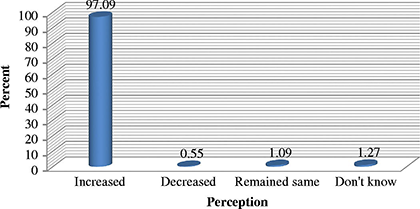
The results in Figure 2 signify that 97 per cent of the heads of the households had noticed rising temperatures while only an insignificant 0.55 per cent noticed a decrease in temperature. Temperature remained unchanged for 1 per cent of the heads of households while another 1 per cent of the heads of households surveyed had no knowledge about it.
Rainfall changes
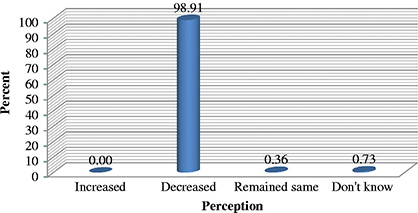
The results in Figure 3 indicate that 99 per cent of heads of the households observed a decline in total yearly rainfall. None of the heads of the households that were interviewed had perceived an increase in rainfall while rainfall remained the same to 0.36 per cent of households.
Changes in droughts
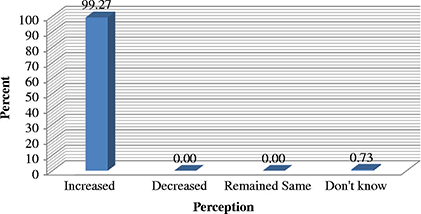
The study area is a drought-prone area. Other extreme events such as cyclone and floods are almost non-existent. Accordingly, farmers' perceptions of droughts are shown in Figure 4. Nearly 100 per cent of households noticed that the frequency of drought has increased over the last 20 years.
5.2 Farm-level adaptation strategies
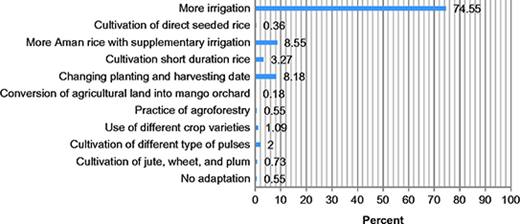
It is useful to identify adaptation strategies in order to obtain an understanding of an agricultural system's adaptive capacity (Reid et al., 2007). Farmers in the study area were asked to reveal their major adaptive strategies in response to changing climate. These are shown in Figure 5.
Farmers have adopted a variety of adaptation strategies including irrigation, direct seeded rice, greater emphasis on Aman rice with supplementary irrigation, short-duration rice varieties, changing planting and harvesting dates, the conversion of paddy land into mango orchards, agro-forestry, using different crop varieties, the cultivation of various pulses and the cultivation of jute and wheat. Irrigation is the most commonly used method (75 per cent). Other main adaptive choices are changing the planting date and supplementary irrigation for Aman rice.
5.3 Barriers to adaptation
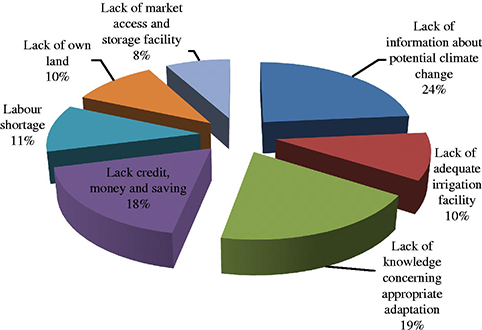
Factors such as accessibility and usefulness of climate information, the institutional environment and the socio-economic situation of households all affect farmers' capacity to adapt to climate change (Roncoli et al., 2002; Eakin, 2003; Ziervogel et al., 2006; Agrawal, 2008). Farmers perceived the most important barriers to the adoption of various adaptation strategies (Figure 6) as a lack of weather information, a lack of knowledge on appropriate adaptation strategies and a lack of credit (money or saving). Other important barriers included a lack of land ownership, a lack of irrigation water and labour shortages.
5.4 Determinants of adaptations: evidence from the MNL model
Model variables
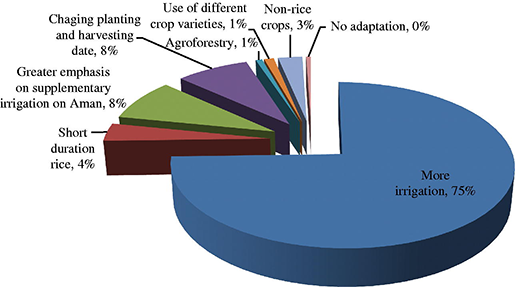
The adaptation MNL model with the 11 choices as shown in Figure 5 failed to produce realistic results in terms of demonstrating the statistical significance of the parameter estimates and marginal effects. Following Gbetibouo (2009), the model was reorganised by categorising closely related strategies into the same group. The merging of direct-seeded rice with short-duration rice, the integration of conversion of agricultural land into mango orchard with agro-forestry, and the cultivation of jute, whet, plum and different types of pulses were grouped into non-rice crops.
Consequently, the option set finally included in the MNL model had eight categories (Figure 7):
more irrigation;
growing short-duration rice;
greater emphasis on supplementary irrigation on Aman rice;
changing planting dates;
agro-forestry;
use of different crop varieties;
non-rice crops; and
no adaptation.
However, the last category is the reference category in our analysis. The dependent variable of the MNL model is thus the choice of adaptation having eight categories.
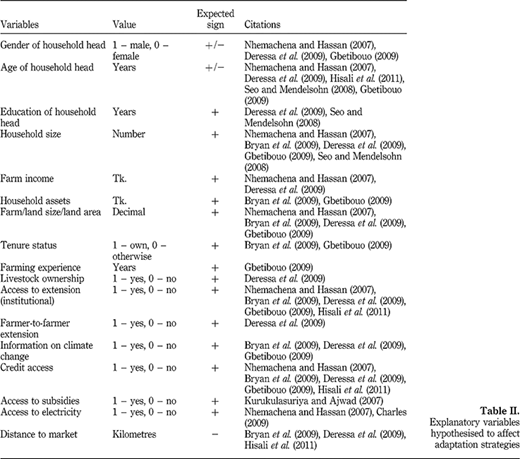
The explanatory variables for this study have been selected on the basis of the available literature. They include household, farm and institutional characteristics including: gender, age and education of the head of the household; household size; farm income; household asset; farm size; tenure status; farming experience; livestock ownership; access to institutional extension services; farmer-to-farmer extension; information on climate change; access to credit; access to subsidies; access to electricity and distance to market (Table II).
Results
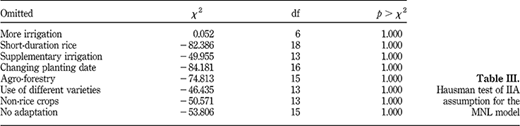
The MNL model with eight categories of adaptation choices was run and tested for the IIA assumption by applying the Hausman test. The results of the Hausman test are set out in Table III. All p-values for omitted variables are 1.00 indicating that the model has passed the assumption. If the χ2 value is less than 0.00, the estimated model does not meet the asymptotic assumptions of the test. Negative test statistics are very common in empirical work (Cheng and Long, 2007). Hausman and McFadden (1984) noted this possibility and concluded that a negative result provided an evidence that the assumption of IIA had not been violated.
Therefore, the use of the MNL model for adaptation strategies is justified. Probabilities of χ2 values are positive which indicate that the use of MNL model for the dataset is valid.
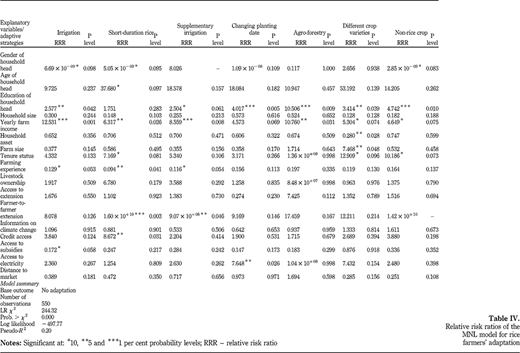
As most of the explanatory variables are dummies, the RRR can be explained as the relative probability of choosing alternative j to no adaptation which is the base category (or comparison group). Following Yip et al. (1998) and Hisali et al. (2011), RRR is presented for each adaptation choice (choice j) given a particular characteristic (xi) in Table IV as well as the factors that guide farm household choice of an adaptation choice in the face of climate change. The probability value of LR χ2 implies that all variables are jointly significant though some variables are not individually statistically significant. Following Bryan et al. (2009), only the statistically significant variables affecting adaptation choices are discussed here.
Gender of the head of the household
The results show that male-led households increase the chances of more irrigation, the use of short-duration rice and non-rice crops as opposed to using no adaptation. This is probably because male-led households are more informed about new technology than female-led households (Asfaw and Admassie, 2004; Deressa et al., 2009).
Age of the head of the household
Age of the head of the household is a proxy for experience and affects adaptation strategies to climate change (Deressa et al., 2009). Our results reveal that age is significant for short-duration rice and the value of RRR indicates a unit increase in age of the head of the household increases the possibility of the use of short-duration rice. This finding is consistent with Kebede et al. (1990) and Deressa et al. (2009).
Education of the head of the household
Higher levels of education are positively related to the adoption of improved technologies: farmers with more schooling are expected to adapt better to climatic changes and extreme climate events (Norris and Batie, 1987; Lin, 1991; Maddison, 2006; Deressa et al., 2009). Years of education for the head of the household is a significant determinant for all adaptation strategies excluding short-duration rice. The values of RRR indicate that the level of education of the head of the household increases the chances of adopting irrigation, supplementary irrigation, changing planting date, agro-forestry, different crop varieties and non-rice crop relative to the use of no adaptation.
Household yearly farm income
Annual farm income is an indicator of the financial capacity that strengthens the adoption of agricultural technology (Knowler and Bradshaw, 2007). Farm income is the most significant variable for all adaptive choices. Farm income enhances the possibility of using irrigation, short-duration rice, and supplementary irrigation, changing planting date, agro-forestry, different crop varieties and non-rice crops. Therefore, farm income has a positive and significant effect on all adaptive strategies. This is in line with the findings of Deressa et al. (2009).
Household assets
Households with more assets are in a better position to adopt new farming technologies (Shiferaw and Holden, 1998) and are more likely to adapt to perceived climate change (Bryan et al., 2009). In this study, household assets are statistically significant for the choice of different crop varieties. However, household assets reduce the odds of using different crop varieties as opposed to a no adaptation strategy.
Farm size
Farm size increases the chances of adopting different crop varieties as opposed to a no adaptation strategy. In particular, farm size increases the relative risk of different crop varieties relative to no adaptation by 7.5 times. This is due to the fact that managers of large farms are more likely to adapt because they are equipped with more capital and other resources. The positive effects of farm size on adopting different adaptation strategies found here are consistent with other studies (Bryan et al., 2009; Gbetibouo, 2009).
Tenure status
Tenure status (i.e. land ownership) is commonly believed to encourage the adoption of new technologies. Tenure status increases the chances of using short-duration rice and different crop varieties, and the cultivation of non-rice crop as opposed to no adaptation. In particular, tenure status increases the relative risk of short-duration rice by seven times, and enlarges the relative risk of different crop varieties by 12 times and increases the relative risk of cultivation of non-rice crops by ten times. This positive impact of tenure status on adaptation choices is consistent with studies by Bryan et al. (2009) and Hisali et al. (2011).
Farming experience
The level of farming experience of the head of the household increases the possibility of undertaking different adaptation strategies, since experienced farmers are knowledgeable and better informed on climate change (Nhemachena and Hassan, 2007; Deressa et al., 2009). Farm experience here is statistically significant for three adaptation strategies: irrigation, short-duration rice and supplementary irrigation. However, farming experience reduces the odds of the use of these three strategies in relation to no adaptation.
Farmer-to-farmer extension
Access to farmer-to-farmer extension services represents a form of social capital and private social networks. It therefore acts as a platform for information about new agricultural and adaptive technologies (Katungi, 2007; Katungi et al., 2008). Having access to farmer-to-farmer extension increases the chances of using short-duration rice and supplementary irrigation as compared to no adaptation. More specifically, access to extension services increase the relative risk of using short-duration rice by 1.5 times and increase the relative risk of supplementary irrigation by nine times relative to no adaptation. Deressa et al. (2009) also reported the positive impact of farmer-to-farmer extension services on the adoption of various adaptation strategies in the face of climate change.
Credit access
Household access to credit indicates the availability of funds which is positively related to the level of adoption of adaptive strategies (Yirga and Hassan, 2010). Access to credit has a positive and significant impact on the likelihood of using short-duration rice varieties. In particular, households having access to credit have an eight times higher chance of using short-duration rice as opposed to no adaptation. The positive effect of credit on adaptation is in line with the findings of Deressa et al. (2009) and Hisali et al. (2011).
Access to subsidies
Access to subsidies positively affects farm profitability (Kurukulasuriya and Ajwad, 2007). It increases farmers' ability to adapt to climate change. However, the results reveal that access to subsidies is statistically insignificant for most of the adaptation strategies apart from irrigation. This is possibly because farmers receive a subsidy on fuel for running irrigation pumps which affects irrigation utilisation. Access to subsidies decreases the likelihood of using irrigation by 0.172 times as opposed to no adaptation. A comparison of this finding cannot be made: no study has used access to subsidies as a determinant of adaptation.
Access to electricity
Household access to electricity is an important determinant of farmers' adaptation to climate change (Kurukulasuriya and Mendelsohn, 2008). The results suggest that access to electricity increases the likelihood of changing planting date by seven times as compared to a no adaptation strategy. The positive effect of access to electricity on adaptation is consistent with Nhemachena and Hassan (2007).
5.5 Policy implications
Government policy should target improving the significant determinants outlined above to boost farmers' adaptation and hence to reduce vulnerability. For example, investment in education, supply of enough agricultural inputs at affordable prices that raises farm income, creation of more financial institutions at the rural level, affordable credit for small farmers and forming social groups to improve farmer-to-farmer extension can be undertaken as public policy options in order to minimise the adverse effects of climate change in the most drought prone districts of Bangladesh.
Given the increasingly adverse impacts of climate change, this policy prescription might not be enough to assist farmers unless they are equipped with the required know-how on drought-tolerant crop varieties; provided with varieties suited to early or late sowing; and provided with information on the changes in temperature or rainfall. Improvement of agricultural extension services and proper connection with farmers for adoption of new technologies are thus essential. Therefore, extension services need to be substantially strengthened in order to deal with these adaptation issues.
Moreover, significant public and private investments in action-oriented adaptive research are required to support rice agriculture with climate change. The priority area of research should be the development of drought tolerant rice varieties. Strengthening of agricultural research and extension services is essential for continuous adaptation.
Agricultural research should also focus on the development of short duration rice varieties. Agricultural extension departments can play a leading role in disseminating information on the viability and use of newly developed rice varieties among farmers. If all of these activities are undertaken, then rice production should increase which in turn will improve the food security of the country.
6 Concluding comments
The objective of this paper was to examine farmers' selection of adaptation strategies and the barriers to adaptation faced by farmers. This was achieved by conducting a micro-econometric analysis of the determinants of farmers' adaptation choices based on farm-level micro data. Evidence from official data has revealed that temperatures have risen and rainfall has decreased in the Rajshahi district over almost the last 50 years. Farmers' perceptions of climate change are also consistent with official records and other studies. Almost 98 per cent of farm households have taken adaptive measures to limit the adverse impact of climate change on rice farming. The main adaptive strategies of farmers are more irrigation, short-duration rice, supplementary irrigation, changing planting date, agro-forestry, using different crop varieties and using non-rice crops. In the adoption of adaptation strategies, farmers had other adjustment mechanisms: loans from rural usury lenders and relatives, sale of livestock and using previous savings. Farmers also identified the main barriers to adaptation as a lack of accurate weather information, a lack of money (credit or savings) and a lack of knowledge on appropriate adaptation strategies.
The MNL model was utilised with micro data at the farm household level to evaluate the determinants of farmers' adaptation choices in the face of climate change. In the model, the dependent variable is the choice of adaptation strategy that included eight types, while explanatory variables include socio-demographic, farm characteristics, institutional accessibility and social factors. The model was tested for the IIA assumption using the Hausman test which provided evidence of non-violation of the assumption. This also justified the application of the MNL to the micro dataset. The RRR results specify that gender, age and education of the head of the household, household annual farm income, household assets, farm size, tenure status, farming experience, farmer-to-farmer extension services, access to subsidies, access to credit and access to electricity, all have a statistically significant impact on the different adaptation strategies. These significant variables, except for household assets, farming experience and access to subsidies, are expected to enhance farmers' adaptive capacities which have potential policy implications.
Though the analysis of this study is based on only 15 villages rather than being a universal survey, the employed analytical framework provides support in favour of some expected relationships and hypotheses from the literature. Moreover, there are indications that some of the observed patterns may be applicable to other drought-prone areas of Bangladesh and developing countries with similar characteristics.
References
About the authors
Md. Abdur Rashid Sarker teaches economics at the University of Rajshahi, Bangladesh. He has recently obtained his provisional award of PhD degree from the University of Southern Queensland, Australia. He holds BSS (Honours), MSS in economics from the University of Rajshahi and MSc in urban environmental management from Asian Institute of Technology. His research area includes agri-environmental issues such as climate change, water scarcity and crop production. Md. Abdur Rashid Sarker is the corresponding author and can be contacted at: rashid_econ@ru.ac.bd
Khorshed Alam is a Senior Lecturer in economics at the School of Accounting, Economics and Finance, University of Southern Queensland. He holds a PhD in resource economics from Murdoch University, Western Australia, and a Masters in economics from the Institute of Social Studies in The Netherlands. His current research interests lie in the areas of sustainability, environmental and resource economics, economic policy analysis and economics of water, energy, climate change and digital technologies. He has done consultancies for various government agencies in Australia and overseas. He has authored a book on development planning, together with more than 40 research papers.
Professor Jeff Gow is a Professor of economics in the School of Accounting, Economics and Finance at the University of Southern Queensland, Toowoomba, Australia. He is also a Research Associate at the Health Economics and HIV/AIDS Research Division (HEARD) at the University of KwaZulu-Natal, Durban, South Africa. He holds a B Ag. Econ (Honours) and M Econ from the University of New England, Armidale, Australia and a PhD from Monash University, Melbourne, Australia. His research areas include the economics of agriculture, environment and health.