– The number of poor and informal urban settlers in the world is rapidly growing, and they are increasingly vulnerable to the impacts of a changing climate. Therefore, understanding the nature and sustainability of locally adopted coping and adaptation strategies are key, yet still under-researched areas.
– Based on ethnographic research conducted in two poor, flood-prone municipalities in Pikine/Dakar, this paper identifies such coping and adaptation strategies and examines their prospects for maladaptation.
– The paper shows that poor urban dwellers are not mere passive spectators of climate change. With the very limited resources they have at their disposal, it is found that local actors respond to perennial flooding with very diverse strategies, which have varying degrees of success and sustainability. A key finding is that local coping and adaptation strategies are mainly maladaptive because they divert risks and impacts in time and space and have detrimental effects on the most vulnerable. Unless there is a broad assimilation of all groups in decision-making processes locally, individual and even collective coping and adaptation strategies may easily put the most vulnerable households at greater risk. The findings reveal that community-based adaptation is not a panacea per se, as it may not, by itself, compensate for the lack of basic services and infrastructure that is forcing the urban poor to cope with disproportionate levels of risk.
– The paper, hence, contributes to address a central question in scholarly debates on climate adaptation, vulnerability and disaster risk management: Are local coping strategies a stepping stone towards adaptation or are they on the contrary likely to lead to maladaptation?
1. Introduction
For the urban poor, the impacts of extreme climatic events are aggravating already precarious living conditions and are playing the role of multipliers of existing vulnerabilities. At the same time, climate change[1] is projected not only to intensify existing risks but also to expose new but currently hidden vulnerabilities (Moser and Satterthwaite, 2010). Over one billion urban inhabitants across the world live in overcrowded settings, in poor-quality shelters without access to water and sanitation and often without security of tenure. This number is expected to double to two billion by 2050 (UNHABITAT, 2008a, 2008b). In Africa, 72 per cent of the urban population is estimated to be living “under slum conditions” (UNEP, 2007). Due to poverty and rapid and unplanned urbanization, marginalized populations often live in informal settlements in the most precarious and unhealthy environments in urban areas, such as floodplains. They are normally the most vulnerable to adverse weather conditions because of the inadequacy of basic services and infrastructure, poverty, social inequality and inadequate social security systems (Bicknell et al., 2009; Satterthwaite et al., 2007). Climate events are thus transformed into differentiated outcomes due to environmental and social inequalities (Ribot, 2010). In this sense, the same event can have differential effects on neighbourhoods and even on households (Blaikie et al., 1994). In Dakar’s poor peri-urban areas, flooding has become a routine event in the rainy season and has been reported recurrently over the past 13 years (Guha-Sapir et al., 2014). Due to climate change, a higher frequency of heavy rainfall events in the area is likely to escalate the incidence of floods in the long term (World Bank and GFDRR, 2011). Because of low national and local government capacity and the lack of priority given to recurrent floods in peri-urban areas in Senegal, it is in these zones largely left to the inhabitants alone to deal with the immediate and long-term effects of living with perennial flooding. For the most vulnerable households, this means literally living with one’s feet in water for up to several months a year. Consequently, the adoption of both short-term coping strategies and longer-term adaptation strategies by local actors are essential prerequisites for enabling households to maintain their livelihoods.
In spite of the current and anticipated vulnerability of the world’s growing poor urban population, the scientific literature on climate change adaptation (CCA) and disaster risk management (DRM) is still predominantly concentrated on rural areas. Although the specificities of CCA and DRM in urban contexts are gaining increased attention (Simon, 2010; Satterthwaite et al., 2007; Lwasa, 2010; Moser and Satterthwaite, 2008; Pelling, 2011; Douglas et al., 2008), the perspectives of the urban poor are still largely overlooked (Moser and Satterthwaite 2010). CCA, DRM and vulnerability in an urban developing-country context have also received far less attention from governments and international agencies (Pelling and Wisner, 2008). Urban funding strategies, for example, have been slow to develop, and indicators to assess when chronic vulnerability becomes a humanitarian crisis are ill-suited and sometimes directly inappropriate in urban settings. Mortality rates are, for example, often used as an indication of the magnitude of a crisis. In urban areas, it may be more pertinent to look at crime rates, food prices, sanitation, health, etc.
Through an urban lens, this article contributes to current research on the role of community-based adaptation for increasing local resilience to climate risks (Reid and Huq, 2007; Forsyth, 2013; Allen, 2006; Few et al., 2007; Bryan and Behrman, 2013) by examining local coping and adaptation strategies and their implications for (mal)adaptation. The need for a better understanding of local place-based adaptation and coping strategies has long been considered a paramount research issue within the area of global environmental change (Adger, 1999; Agrawal et al., 2008). Both in development theory and practise, attention is turning towards an improved understanding of variations in local capacities to cope, as an alternative to the prevailing focus on local vulnerabilities to climate stresses (Few, 2003). By addressing coping options, people are, therefore, viewed as active agents rather than passive victims of circumstances (Eriksen et al., 2005). Although a range of studies have examined enabling factors permitting the capacity-building of vulnerable communities to adapt to future climate change (Yohe and Tol, 2002), limited research has considered the extent to which this capacity has been built on existing coping strategies (Berman et al., 2012; Wamsler and Brink, 2014; Wamsler, 2007; Cooper et al., 2008; Jabeen et al., 2010). It is, thus, not clear whether communities that use coping to decrease their vulnerability to current climate variability are developing their capacity to adapt to future climate change. The danger is that current coping strategies may lead to maladaptation and thus jeopardize sustainable development in the long term (Berman et al., 2012).
Based on qualitative data collected in two flood-prone municipalities of Pikine/Dakar, the aim of the article is to characterize local coping and adaptation strategies and to explore their susceptibility to undermine future adaptation and thus become maladaptive. Local urban flood response strategies are investigated from both CCA and DRM perspectives, as social responses to current climate variability and extreme events are typically used as proxies for understanding climate change vulnerability and adaptation (Burton et al., 2002). These may hence hold important lessons for the future (Smit et al., 2001). The article thus contributes to the significant discussion taking place throughout the vulnerability, disaster-risk and climate-change scholarly communities on the extent to which coping strategies should be considered a step towards adaptation or, on the contrary, may lead to maladaptation (Yohe and Tol, 2002; Eriksen et al., 2005; Wamsler and Brink, 2014; Berman et al., 2012). Moreover, the findings add to the paucity of empirical research conducted on local adaptation in urban centres in West Africa (Biconne, 2014). A key finding is that, despite their limited room for manoeuvre, the urban poor apply a wide range of individual and collective strategies to minimize risks, withstand the impacts of disasters and adapt. These allow them, in a context of weak state capacity, to react to recurrent flooding. The usefulness and sustainability of community-based strategies are, however, somewhat limited, as they are often found to be maladaptive. The paper starts by presenting the methodology and main concepts underlying the study, followed by a description of the case study areas and a characterization of the coping and adaptation strategies adopted locally. This lays the foundation for the discussion of the potentially maladaptive nature of the strategies that are followed.
2. Methodology
Detailed case studies of two flood-prone municipalities of Guinaw Rail Nord (GRN) and Dalifort in Pikine, on the outskirts of Dakar, constitute the basis for the present analysis. These case studies shed light on the coping and adaptation strategies adopted by local actors at all phases of a flood event and their prospects for (mal)adaptation. Each case studied consists of qualitative data collected in November 2012 and from January to April 2013, locally at the household and local actor levels, as well as in ministries, NGOs, international organizations and research institutions in Dakar. Moreover, reports, books and articles only accessible locally were collected. In-depth semi-structured interviews, focus-group discussions, photographs, observations and walk-through analyses constitute the main bulk of the data production methods, together with a literature review. The data produced stem from 93 interviews and 7 focus-group discussions conducted with local actors at the household and institutional levels and 18 interviews conducted with national actors. The sampling technique was based on snowball sampling and random walk sampling (Mikkelsen, 2005). The main subjects touched upon include:
the nature of the national and local DRM and adaptation contexts;
the circumstances of households’ migrations into the area;
how local actors are affected by recurrent flooding;
the type of coping and adaptation strategies followed and the background to them; and
local perceptions of the capacity for flood risk management and adaptation
3. Conceptualizing coping, adaptation and maladaptive strategies
The concepts of coping and adaptation in the face of climate stresses and change are central to both scholarship and practice in the fields of disaster risk management and adaptation to climate change. Although there is habitually an understanding in the literature that coping and adaptation differ in terms of timeframe and sustainability (Davies, 1993), the concepts are often used interchangeably. Definitions of coping and adaptation are abundant, with numerous differences in the understanding and use of the concepts between and within both the CCA and DRM discourses. This lack of clarity often leads to confusion. A clear understanding of the peculiarity of each notion is thus essential to grasp a wide range of related issues, such as those involving sustainability, coping range and adaptive capacity (Lavell et al., 2012). Coping is defined here as “the ability of people, organizations and systems, using available skills and resources, to face and manage adverse conditions, emergencies or disasters” (UNISDR, 2009). Coping is viewed as an immediate response to extreme events and threats, suggesting that people can handle a certain amount of destabilization and that, at some point, this capacity may be surpassed (Cardona et al., 2010). The following definition of climate adaptation is adopted here: “the process of adjustment to actual or expected climate and its effects, in order to moderate harm or exploit beneficial opportunities” (IPCC, 2012). This process of adjustment may thus help to limit the “coping” that is required to cope with the next disaster. Successful coping strategies may reveal the capacity of households to respond to immediate threats, but divulge nothing about how effective they will be in the long term and what they mean for future vulnerability. In the same way that the frequent use of coping strategies may exhaust the resources available for later coping needs, it also uses resources which may otherwise be available for adaptation (Adger, 1996). This underlines the need also to integrate a long-term adaptation perspective when addressing disasters, as well as the necessity to consider short-term coping strategies when examining adaptation. Given the relationship between coping and adaptation underpinning the study, Brooks and Adger’s (2004) definition of adaptive capacity is adopted here: “property of a system to adjust its characteristics or behaviour, in order to expand its coping range under existing climate variability, or future climate conditions”. This implies that an expansion in coping range – referring to the limits of a system’s ability to cope (Yohe and Tol, 2002) – may lead to increased adaptive capacity. In contrast, the inability to expand the coping range means low adaptive capacity and thus an increase in long-term vulnerability (Adger, 1996). By the same token, actions taken to cope with disasters and adapt to climate change that are considered successful at a certain point in time by certain groups may be considered unsuccessful at a different time and/or place by other groups. These actions are labelled “maladaptations”. Maladaptation is defined here as:
[…] business-as-usual development which, by overlooking climate change impacts, inadvertently increases exposure and/or vulnerability to climate change. Maladaptation also includes actions undertaken to adapt to climate change impacts that do not success in reducing vulnerability but increase it instead (OECD, 2009).
The concept of maladaptation encapsulates the relationship between coping and adaptation, conveying the potential trade-offs between the short- and longer-term considerations when addressing climate impacts, where short-term gains may lead to increased vulnerability in the medium and long term (Olhoff and Schaer, 2010). Along with increased vulnerability, Barnett and O’Neill (2010) propose the following distinctive ways through which maladaptation arises:
increase emissions of greenhouse gases;
high opportunity costs;
negative repercussions for future generations;
disproportionate and undesirable impacts on the most vulnerable; and
reduce incentives to adapt.
Out of these, it is the last three pathways through which maladaptations arise that are found relevant to the discussion of the paper.
To conceptualize and characterize coping and adaptation, a variety of different frameworks and typologies have been developed. In the context of environmental risks to livelihoods, basic coping strategies have typically been organized into five analytical categories of response: mobility (risks addressed across space), storage (risks attended to across time), diversification (between assets), communal pooling (across households) and market exchange (Agrawal et al., 2009). From a disaster perspective, timing is also often used to differentiate between the coping actions that are needed at various phases of a disaster: preventive, impact minimizing, recovery and reactive actions (Blaikie et al., 1994). Adaptation strategies have been categorized according to when the adaptation action will be undertaken: ex ante (or anticipatory) adaptation is conducted before the climate impact is observed, while ex post (or reactive) adaptation interventions occur in the aftermath of a climate impact (Smit et al., 1999). Some have discerned between structural and non-structural adaptation interventions (Parker, 1999): the former relate to infrastructure engineering interventions such as barrages and river channel modifications, whereas non-structural solutions are found in initiatives aimed at reducing hazard impacts, such as early warning systems and building regulations (Few, 2003). Different ways of classifying adaptation strategies are also dependent on the degree to which practices are linked to other aspects of the livelihoods of households and communities (Agrawal, 2010) and on the purposefulness of strategies (autonomous versus deliberately planned adaptation) (Füssel, 2007). Strategies have been described as taking different forms, including technical, institutional, legal, educational and behavioural measures, involving private or public actors (Füssel, 2007).
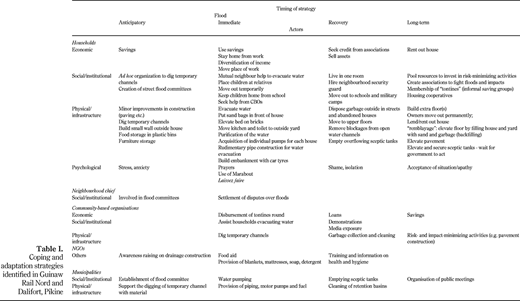
The local coping and adaptation strategies discussed in this paper are differentiated predominantly by their timing and by whether they are, by nature, strategies supporting permanent transformations. They are classified along three distinct dimensions combining elements from Blaikie et al. (1994), Smit et al. (1999) and Füssel (2007), which are considered the most relevant for the purposes of this paper. The first category used for classifying strategies is based on the nature of the actors involved in decision-making at the local level (households, municipality, etc.). Second, the coping and adaptation options chosen are differentiated according to where they are situated on the temporal scale, i.e. according to when they are realised, with reference to a flood. The time scale covers anticipatory, immediate, recovery (up to six months after a flood) and long-term strategies. Coping strategies are typically found in the immediate and short-term time span, whereas local adaptation strategies are long-term strategies which may be implemented either after or in anticipation of a flood event. Looking at this scale is relevant because the manner in which each phase of a flood is tackled is central to shaping coping and adaptation capacity. And finally, the form of the strategies adopted locally (social, physical, etc.) is distinguished. Together, these set the foundation for the discussion of the likelihood of the applied strategies turning out to be maladaptive in the long term.
4. Two flood-prone municipalities in Pikine/Dakar: Guinaw Rail Nord and Dalifort
In 2005, it was estimated that 38.1 per cent of the urban population in Senegal lived in slums. A large proportion of this population lives in Pikine, a peri-urban area with a population of almost 900,000 situated on the periphery of Dakar (UNHABITAT, 2008a). Guinaw Rail Nord (GRN) and Dalifort are among Pikine’s 16 municipalities, with a population of respectively 35,780 and 23,800, respectively (République du Sénegal, 2011). GRN and Dalifort developed from the early 1950s out of uncontrolled urban growth as a result of rural-urban migration and state-ordered evictions from Dakar city centre (Fall Salam et al., 2005). Being considered neither as urban or rural areas and developed on the Niayes depressions without any urban planning, the neighbourhoods of Pikine are the most densely populated areas of the country, with a surface occupation of 43 per cent (UNHABITAT, 2008a). The zones are characterized by the closeness of habitations, primitive shacks and brick houses built alongside more modern habitations. Critical infrastructure and state services such as waste management, sanitation, water, etc. are, at best, unsatisfactory and, at worst, non-existent (Diouf Babacar, 2009). Peri-urban populations in these settlements face different sources of vulnerability than their rural counterparts. Commoditization, an unhealthy environment, supplementary sources of environmental danger and the loss of supportive networks (social fragmentation) are all elements that emphasize the pertinence of an urban-specific understanding of vulnerability and risks (Moser et al., 1994).
Floods have recurred in both municipalities since 2000[2], with varying impacts and durations. The reasons for recurrent flooding are complex and mainly due to an anarchic and rapid process of urbanization, which reduced the permeability of ground surfaces and increased run-off rates (Parker, 1999), the increase in rainfall, obsolete and/or absent sanitation networks, the non-existence of rainwater drainage systems and the rising groundwater table of the Thiaroye Aquifer. Interviewees predominantly attributed the recurrent problems of flooding to the closeness of habitations, the lack of drainage, additional rain during the rainy season and an act of God. Although concerns such as poor health, unemployment and insecurity were also raised when asked about the difficulties of living in these areas, the majority of interviewees in GRN and Dalifort considered recurrent flooding and insufficient flood drainage to be the most destructive and far-reaching problem in their community. Many respondents explained that they moved from rural areas during the damaging droughts of the 1970s and 1980s, where there was still an abundance of land available. In Pikine, the rapid urbanization process was based on parallel land-ownership arrangements (Fall Salam et al., 2005). Later attempts at administrative reorganization mostly made land–tenure arrangements more muddled and complex (Thiam, 2013). Common to the interviewees is that they did not know that the sites were flood-prone when they acquired their land, and for the first 20-30 years, flooding was not an issue of concern.
5. Coping and adaptation strategies
Based on the described classification, in what follows, the coping and adaptation strategies pursued by local actors in GRN and Dalifort are outlined (Table I). Because the phases of flood response are closely interlinked, it may be equally relevant for some strategies to figure in several phases. The phase categories chosen here correspond to the answers given by the interviewees on their actions before, during and within six months of a flood occurring, as well as in the longer term.
5.1 Anticipatory strategies
In GRN and Dalifort, households facing flood risks follow three main types of anticipatory coping strategies. First, households take action by using physical means to stay safe from the water. Minor improvements are made to their houses (e.g. flooring/paving, roof repairs, etc.) to prevent flood water entering their home. Small walls are built in front of houses and rooms, bags of sand are piled and plastic garbage bins are used for food storage. A few households invest in individual water pumps for water evacuation. Second, a few interviewees mentioned saving for flood risk-minimization activities. Working is often impossible because of difficult access to the place of work and because of the additional chores engendered by the flooding as conveyed by an interviewee:
Instead of coming to work, women are forced to stay at home, to buy sand and gravel, to look after their sick children, to sanitize their houses, all of this by their own means, and therefore they cannot take care of their work anymore.
Consequently, a number of respondents explained putting money aside for the rainy season to compensate for the lost income during that period. The poorest households would like to “flood proof” their habitation but find it extremely difficult to make ends meet and thus impossible to plan for future floods. Lastly, households reported selling their personal belongings to be able to prepare for the floods. This means that, in many cases, the only asset households have left is their house. Engaging in anticipatory strategies at the household level is often challenging, since many have not recovered from one flood before the next one strikes. This means that the anticipation phase for flood response sometimes vanishes and creates a vicious circle of increased risks and vulnerability.
A number of activities are initiated collectively prior to a flood, including the digging of temporary channels for water evacuation, typically by volunteers and young people from the local sport associations (ASCs), and sometimes with support from the municipality. Flood-management committees are constituted on an ad hoc basis, sometimes for one street, sometimes for an entire neighbourhood, where activities related to flooding are discussed and coordinated. Often, however, these committees are not fully functional, and when they are, it is mainly prior to and during the rainy season, whereas very little is done in posterior phases. There is little collaboration between neighbourhood committees, which receive no financial support and function only on a voluntary basis. A few of the well-functioning committees save money throughout the year to be able to buy gasoline for water pumps and equipment during the floods. NGOs provide limited capacity-building support in the anticipatory phase, for example, on how to establish temporary drainage. No early warning system exists for these localities and national government-led initiatives are largely absent in this phase. At the municipal level, the mayor is responsible for disaster response, an area that is characterized by a lack of funding and insufficient human resources and technical capacity.
5.2 Immediate strategies
During the floods, the coping strategies of households are often characterized by improvisation, from the continuous day and night evacuation of the water to the placing of sandbags to prevent the water from flowing in. In cases where it is not possible to prevent the infiltration of water, households follow two different strategies. The first is to continue to cohabit with the water: “We stay in this water and wait for God”. This is done by, for example, elevating beds on bricks, sanitizing the flood water to avoid diseases, using old car tyres to walk on the surface of the water and keeping children in sight on the beds, which are also used for cooking and often are the only place for the entire family to sleep. When possible, the ground floor is abandoned for the upper floor, or the family typically occupy a single room that is often used for all household occupations. The second strategy is to move the children and other family members to relatives (often for several months) or to be evacuated to schools or military camps. Typically, the men stay in their inundated home to protect their house and belongings from the water and from looting. In addition to household-based strategies, solidarity actions are widespread during a flooding event. In addition to mutual help and collaboration between neighbours, young people from the ASCs and other local organisations provide help in digging channels, emptying water from the houses and cleaning existing water conduits. Women’s groups, including i.e. tontines (savings groups), assist the most affected members by providing them with their share of the savings rotation or collecting clothing and other basic necessities.
The municipality in GRN is active through the local flood-management committee created by the Mayor to coordinate the local flood response with regards to funding, equipment and activities with NGOs and supporting the national fire brigade with water-pumping and channel-digging. There is very little coordination between the municipal committee and the neighbourhood-level committees and local organizations. Furthermore, there is neither collaboration between municipalities nor is there an overall plan, which means that the evacuation of flood water becomes an issue of conflict between neighbouring municipalities. During the floods, a number of NGOs and international organizations (Red Cross, World Food Programme, OXFAM EVE) provide disaster relief, such as food aid, the distribution of mosquito nets, detergents and other emergency supplies.
5.3 Recovery strategies
The recovery phase is, in general, weak and often neglected. Households have exhausted their limited coping capacity, and NGOs tend to favour the acute relief phase, except for some training provided on matters of health and hygiene. Interviewees stated that it was impossible to take out loans to repair their houses or to re-establish decent living conditions because credit institutions ask for land titles as a loan guarantee. In some cases, borrowing money from informal lenders at a very high interest rate is the only option, thus resulting in an erosion of financial capital after a flood event. Remittances from family members living abroad were also mentioned as a coping strategy in the aftermath of a flood. Although some collective tasks (e.g. street-cleaning, neighbourhood private security guards) are undertaken by local community groups, mutual help is limited during this phase. The dwellers who are evacuated to military camps or schools typically stay there for far longer than the immediate flooding period (sometimes for up to a year) because they often have nothing to return to. The most vulnerable households are often forced to cohabit with the water and live in difficult conditions long after a flood event. These are defined here as the households living in the most precarious habitations, typically in wooden or metal shacks, without water, electricity or a regular source of income. Often they are composed of tenants, elderly and/or female-headed households. Some coping strategies used during prior phases, such as the creation of channels, are not followed up during the recovery phase, which means that they are filled with stagnant water and constitute health and safety risks. Because garbage collection is absent in the aftermath of a flood, abandoned houses and streets are used for garbage disposal, which also creates substantial health risks. The maintenance of motor pumps after a flood event is sometimes neglected, which means that they become inoperative for later floods.
5.4 Long-term strategies
Over the past 50 years, the inhabitants of GRN and Dalifort have developed an ability to live in these high-risk areas. The initial adaptation strategy for many of the inhabitants of these two municipalities is to settle or build a house where it is not allowed or recommended to do so. Since then, the few adaptation strategies adopted by residents are mostly autonomous, as no adaptation plan exists for the area. They can mainly be divided into two categories: residents who stay in flood-prone areas and residents who leave permanently. “It is like houses on stilts” stated one interviewee to describe the use of a widespread autonomous local adaptation strategy called remblayage (backfilling) by inhabitants. This consists of elevating the outside and inside floor with garbage, gravel and sand and is thus considered as an urban alternative to houses on stilts for house preservation. This means that many houses are filled up, which gives the impression that they are sinking in the sand, to the point where some windows are at ground level and often the ground floor becomes uninhabitable. This widespread adaptation strategy was until recent years also supported by the municipality. For households with some financial means, houses are then heightened to compensate for the lost space. According to the municipality, partly as a result of this modus operandi, 40 per cent of all houses in GRN are abandoned. A number of households have also moved by their own means, either abandoning their houses or renting them out. Tenants who typically do not have many alternatives to living in a flood-prone area then assume the responsibility for house maintenance before and after a flooding event. House owners often use this strategy to preserve their house from destruction, while waiting for hypothetical government compensation and a sustainable solution to the flooding.
There is an abundance of community-based support networks and associations in GRN and Dalifort, which seek to provide permanent support to residents. All have different functions and are being activated differently to support the community in dealing with flood events. Some are intended to surmount the long-term consequences created by living in a precarious flood-prone area, such as housing cooperatives for relocation, flood management and neighbourhood committees and informal neighbourhood groups that pool resources for risk- and impact-minimizing activities. And several are created to support residents in dealing with their more general life circumstances, such as women’s groups, youth groups, ASCs, Groupements d’intêrets économiques (GIE) etc., while others play an advocacy role vis-à-vis the authorities and external actors. Having outlined the diverse coping and adaptation strategies followed locally at different temporal scales, the following discusses their implications for maladaptation.
6. From coping to maladaptive strategies
The following addresses the circumstances in which coping and adaptation strategies adopted locally become maladaptive. Hence, the aim is to show when individual and collective strategies followed by private actors and the support provided by external actors:
have negative repercussions for future generations;
have disproportionate and undesirable impacts on the most vulnerable; and
reduce incentives to adapt.
6.1 Private actors
Individual autonomous strategies may work well if flooding occurs only rarely, as households have the time to recover. However, repeated and unpredictable exposure to risks can drastically reduce the ability of even those households with high adaptive capacity to cope or respond effectively to risks (Agrawal et al., 2009). This is the case in GRN and Dalifort, where individual coping strategies are often exhausted by preceding floods, and it becomes increasingly difficult for households to mobilize sufficient resources to cope. This means that recovery and adaptation may never be attained. These households are thus caught in a vicious circle of increased risks and vulnerability. The extensive use of backfilling as an adaptation strategy, exemplifies the detrimental implications of individual strategies. Although allowing households to stay in their houses for longer and in a reduced form, it is a relatively costly, localized and unsustainable option. A resident of GRN gave voice to the futility of this strategy:
[…] we don’t solve the problems, but we move them and then we create new problems. Each year we spend money buying sand, this money just disappears in the water and next year the problems are even worse, but what else can we do?.
Problems are thus only diverted in time, to the following flood event, where the process can start all over. Furthermore, by accumulating a lot of sand in one place, the water is merely displaced to lower lying areas and houses. Flood-related problems are thus merely displaced to other houses, which is damaging for households that cannot afford to follow the same procedure. This displacement in space is often a source of conflicts, which are sometimes continued long after the floods. This reveals a failure in collective interest and may ultimately affect the social structure of a neighbourhood. Long-awaited durable solutions promised by the government for the area, together with insecure tenures, has created a generalized attitude where a number of households chose not to make substantial investments in their houses and are caught in a waiting position. Some are even moving back to their flooded homes, choosing not to relocate on their own or renting out their uninhabitable houses to access potential future state compensation. House-owners have thus been in a waiting position for years, anticipating potential relocation and state compensation, where durable investments in construction are thus considered futile by many, reducing residents’ incentives to cope and adapt on their own, thereby engendering maladaptation. In addition to being a potential source of conflict, the individual, short-term and reactive strategies identified substantiate existing research, which finds them typical in responding to disasters in Africa, but inadequate in reducing risks (Pelling and Wisner, 2008). The study found that individual coping strategies were mainly maladaptive, as they merely divert flood-related challenges in time and space, while having undesirable and detrimental outcomes for the most vulnerable households. Individual coping strategies are also found to be maladaptive by having negative repercussions for the following generations. The application of short-term solutions may result in family houses being lost and the area becoming uninhabitable, which exacerbates the perpetuation of generational cycles of poverty.
Residents also engage in a number of diverse collaborative strategies to help them cope with their everyday lives and manage flood-related risks and impacts in both the short and long term. This is visible in the existence of numerous local groups, organizations and networks of individuals, which are being activated differently to support the community in dealing with general life circumstances and flood events, often to the common benefit of all. However, whether collective strategies are necessarily conducive to adaptation is questionable. Sometimes maladaptation is a direct consequence of collectively initiated strategies, as seen in the chaotic digging of temporary channels, which, in worst cases, created erosion and other damages. This is also the case where poor tenants in GRN had no influence on the digging of a channel in front of their house, initiated by the local flood management committee. The channel created important health and security risks for them by sending all the neighbourhood’s sewage water and garbage in front of their doors. This is an example of a locally initiated, collective coping strategy, where the most vulnerable population groups are excluded from taking part in local decision-making and thus suffer from the disproportionate and undesirable impact of these initiatives. At the local level, a prerequisite in acquiring access to decision-making is to take part in local groups and networks, which is seldom possible for the poorest in GRN and Dalifort. This example shows that, although collective strategies often provide important support for the majority, when the weakest groups are not participating in risk-minimizing activities, they may also cement existing vulnerabilities and local disparities, thus creating maladaptation.
The benefits of collective strategies undertaken prior to and during flood events are often limited to coping support, as these are often not exploited and developed further in posterior phases. Examples of this tendency include the non-refilling of temporary channels, engendering health and security risks. Furthermore, flood management committees are not used to advocating for long-term adaptation solutions with the authorities. Consequently, the fact that most collective coping actions are undertaken before and during a flood event and seldom in later phases means that they may become ineffective or at worst maladaptive by increasing vulnerability. Moreover, the numerous community groups are often under-resourced, short-lived and very localized, operating mainly in isolation, competing with one-another for the limited resources available and with little inter-group learning or collaboration. This also limits the prospects for these groups to play a more significant role in supporting the transformation of coping capacity into adaptation capacity.
In conclusion, it was found that the urban poor apply a variety of individual and collective strategies to minimize risks, withstand the impacts of disasters and/or adapt. This confirms findings from Biconne (2014), Moser et al. (2010) and Wamsler (2007) and in other contexts. Individual coping strategies are found to be mainly conducive to maladaptation by diverting problems in time and space and by having detrimental effects on the most vulnerable. In Pikine, collective strategies are mostly limited to coping support, as strategies need to be more cohesive and applied at all stages of a flood event, to enable adaptation. The findings add to the body of research which stresses that the ability to adapt is closely linked to the ability to act collectively and that this ability is therefore determined by how vulnerable people are treated within societal structures (Adger, 2001). The research thereby confirms existing findings stating that inequalities and the lack of inclusiveness of coping and adaptation strategies influence local ability to achieve resilience and pose disaster risk management and adaptation challenges at the local level (IPCC, 2012; Wamsler and Brink, 2014). The following focuses on the role of external support for (mal)adaptation.
6.2 External support
With a few exceptions, it was found that NGOs operating in the area have mainly focused their support on the immediate relief phase. As a result of the easily monetizable nature of the food aid and gasoline provided, its substantial provision in the acute relief phase often becomes an issue of struggle for local populations. Although considered necessary by some, these activities are often the subject of criticism by residents. Many interviewees expressed mistrust in the criteria chosen for the targeting for food aid and stated that this type of relief is used mainly for political purposes and merely creates conflict and jealousy among neighbours. The fight against flooding is often replaced by the competition over external support for households and local organizations alike. This means that, instead of using external support to pool resources to solve a collective problem, internal conflict and division are stimulated and dependency increased. Residents stated having seen countless NGOs and international organizations pass through their areas, which they describe as having become NGOs’ “Experimentation Laboratory”. They criticize them for conducting surveys and promising long-lasting solutions to their problems, all to no avail. As a result they feel disillusioned and demotivated to engage in dialogue with outsiders. This fatigue may have negative repercussions for people’s incentives to collaborate with actors from outside their locality, as suggested during a focus group session:
[…] they can investigate us, mention us, but we see nothing happening. This is why inviting us to this meeting does not put us at ease – we are in a hurry to leave the meeting. Usually when we were invited to a meeting the room was full, but not anymore.
This example evokes the alienation felt by many residents, which engenders some level of apathy. This suggests that the incentive to engage with outsiders is reduced, while the schism between poor peri-urban residents and external actors is increased.
The municipality and local actors in GRN complained about the lack of influence they have on the kind of assistance that is made available. They disapprove of the fact that it is more often based on organizations’ mandates than on the expressed needs of the local population, as one resident of GRN asserted: “They come with their food, but we don’t need food. Our houses are flooded – we need to get the water out, that’s all”. It was found that the current approach followed by external actors engenders the risks of dependency and thereby reduces communities’ incentives to adapt on their own. The present findings thus add to body of research which emphasizes the need to strengthen residents’ own ability to cope, contrary to the dependency being created at present (Blaikie et al., 1994). The support provided engenders not only dependency but also division and apathy in the communities, while playing a limited and short-term role for their coping and adaptation prospects. All in all, the findings confirm the observation of the widespread dominance of short-term over long-term considerations in decision-making as a recurrent barrier to adaptation (Dovers and Hezri, 2010). Consequently, it was found that external actors’ current one-sided focus on acute flood-relief efforts is maladaptive.
7. Conclusion
The distinction between local coping and adaptation strategies along different temporal scales and their context-specific application, offers a useful lens for understanding the implications of poor urban dwellers’ coping capacity for future adaptation. The evidence from Pikine has shown that a contributory cause of maladaptation is migration, where households have settled in hazardous areas to escape droughts and poverty. Their present coping and adaptation capacity is therefore partly determined by past maladaptation. Maladaptive strategies have since been reproduced at lower scales. However, by identifying and classifying the multitude of coping and adaptation strategies adopted by the inhabitants of Pikine and local actors, the article has also shown that the urban poor are not mere passive victims of climate change. The case presented exemplified that despite their limited room for manoeuvre, the urban poor in precarious flood-prone environments are active in applying a wide range of individual and collective strategies to minimize risks, withstand the impacts of disasters and adapt. These allow them, in a context of weak state capacity, to react to perennial flooding, although their usefulness and sustainability is somewhat is limited. As a result, a number of strategies are found to be maladaptive by having:
negative repercussions for future generations;
disproportionate and undesirable impacts on the most vulnerable; and
by reducing incentives to adapt.
Support activities initiated by external actors are also found to be maladaptive, by decreasing local incentives to adapt and by cementing existing local disparity. A key finding is that, unless there is a broad assimilation of all groups in decision-making processes locally, individual and even collective coping and adaptation strategies divert risks in time and space and may easily put the most vulnerable households at greater risk. A better representation and inclusion of the most vulnerable households and individuals in flood-related decisions is thus essential to prevent existing disparities and vulnerabilities from being reinforced and thus engendering maladaptation.
The findings presented contribute to develop knowledge on community-based adaptation and provide a helpful foundation to compare pro-poor approaches across different geographical contexts. The evidence presented calls attention to the importance of understanding the way urban communities are already coping with – and adapting to – climate change and variability to address the present and future adaptation challenges in poor urban areas. However, the findings from Pikine have also shown that community based adaptation is not a panacea per se, as it may not, by itself, compensate for the lack of basic services and infrastructure, that are forcing the urban poor to cope with disproportionate levels of risk and thus adopt maladaptive strategies. Further research is now needed on the role of government institutions and decentralized actors, in supporting the transformation of local coping capacity into adaptation capacity, so as to avoid the pitfalls of maladaptation in poor peri-urban areas.
References
Support for the research was partly provided by grants from Otto Mønsted Fond, Augustinus Fonden and Julie Von Müllens Fond.
Notes
Climate change is defined as: “a change in the state of the climate that can be identified by changes in the mean and/or the variability of its properties and that persists for an extended period, typically decades or longer. Climate change may be due to natural internal processes or external forcings, or to persistent anthropogenic changes in the composition of the atmosphere or in land use” (IPCC 2012).
Floods reported in 2000, 2002, 2003, 2008, 2009, 2010, 2011, 2012 and 2013 (Guha-Sapir et al., 2014).