– This paper aims to present an investigation of the climate adaptation planning and implementation process undertaken by the municipal government of Cape Town, South Africa, situating the findings within the broader literature on governance-related barriers to adaptation.
– By developing an in-depth case study using methods of organizational ethnography, the research traces phases of climate adaptation planning and implementation in Cape Town. Applied thematic analysis surfaces issues of coordination, decision-making, resource constraints and tracking progress as key constraints to urban climate adaptation.
– While considerable progress has been made on developing a citywide climate adaptation plan for Cape Town, implementation is constrained by poor monitoring and feedback within and between departments and a lack of oversight and impetus from central authorities within the government hierarchy.
– Further research is needed on the interface between technical and political decision-making, governance arrangements that facilitate coordination and iterative adjustment and the organizational uptake of externally commissioned work on climate adaptation.
– The paper points to the need for a climate adaptation coordination function situated higher up in the municipal government structure than the environment department to implement, monitor, evaluate and revise measures to reduce climate risks and vulnerabilities citywide.
– The paper is of value to those seeking to understand local government decision-making, as it pertains to climate adaptation and those looking for means to address climate risks and vulnerabilities in cities, especially in South Africa.
1. Introduction
Climate change is one of the critical sustainable development challenges facing cities in both developed and developing country contexts (Parnell et al., 2007; Rosenzweig et al., 2011; Revi et al., 2014; UN-HABITAT, 2011). Urban climate adaptation is understood to be a process of adjusting the urban system to actual and/or expected climate conditions in a way that seeks to moderate or avoid harm or exploit beneficial opportunities (IPCC, 2014). This may entail making incremental adaptations, i.e. adjustments that aim at maintaining the urban system as it is, or transformative adaptations that change the fundamental attributes of the city (Wise et al., 2014). The planning of urban climate adaptation thereby involves developing an understanding of how the city works (including an account of prevailing dysfunctions), what the climate is and could be and how the climate impacts on the city’s workings, both directly and indirectly. To do so requires the involvement of multiple actors who hold different knowledge about and decision-making power over the interactions between the city and the climate and how these could be altered. The implementation of urban adaptation similarly requires the coordination of actors who hold relevant expertise, resources and mandates to operationalize selected interventions, as well as those tasked with oversight and evaluation of the measures being implemented to feedback into and adjust future choices and actions. As such, climate adaptation is not simply a technical process but a social and organizational one.
This paper investigates the organizational dimensions of urban climate adaptation through the case of Cape Town, South Africa, a city wrestling with deep developmental challenges that make it highly sensitive to prevailing and changing climatic conditions. First, a brief review of literature dealing with the governance aspects of urban climate adaptation is presented. The methodological approach of the study is then presented, followed by relevant contextual information on Cape Town that shapes the local adaptation agenda. The next section describes three sequential phases in climate adaptation planning driven by municipal government, positioning these within broader efforts to build a climate change agenda. The subsequent sections critically reflect on the progress made in adapting Cape Town to changing climate conditions and discuss which barriers to adaptation are evident and why.
2. Governing urban climate adaptation
A growing number of city governments have begun taking steps to understand the local climate-related risks they face, plan possible interventions for reducing these risks and some have begun implementing a number of climate adaptation measures (Anguelovski et al., 2014; Birkmann et al., 2010; Carmin et al., 2012a, 2012b; Carter, 2011; Coffee et al., 2009; Hardoy and Romero-Lankao, 2011; Hunt and Watkiss, 2011; Rosenzweig and Solecki, 2014). However, many cities face considerable barriers when attempting to depart from their business-as-usual that hamper the planning and implementing of climate adaptation measures. A growing literature suggests that barriers relating to governance are the most pernicious, notably:
securing political commitment for climate adaptation;
operating within an organizational culture that stifles innovation, collaboration and learning;
competing short-term priorities and interests;
coordinating and allocating responsibilities between local, regional and national levels of government;
coordinating and collaborating between government, private and civil society actors; and
reorienting existing funding and resources or accessing new financial flows for climate change adaptation (Berkhout, 2012; Biesbroek et al., 2014; Burch, 2010; Clar et al., 2013; Ekstrom and Moser, 2013; Funfgeld, 2010; Granberg and Elander, 2007; Measham et al., 2011; Pasquini and Shearing, 2014; Roberts, 2008; Runhaar et al., 2012; Satterthwaite, 2011; Storbjork, 2010; Uittenbroek et al., 2013, 2014; Winsvold et al., 2009).
Very little of the empirical work underpinning these findings has been conducted in African cities (with the notable exceptions of Anguelovski et al., 2014; Kithiia, 2011; Leck and Roberts, 2015; Roberts, 2008; Ziervogel and Parnell, 2012). This paper adds to the body of literature by focusing on the emergent process of local climate adaptation planning and implementation in a South African city, giving particular attention to questions of who is involved in adaptation planning and how are climate adaptation plans integrated into existing city decision-making procedures and operational practices. The research reported here responds to a call made by Biesbroek et al. (2013, p. 1,119) to “go beyond asking the questions of ‘if’ and ‘which’ barriers to adaptation exist and begin asking ‘how’ and ‘why’ barriers emerge”. The research also responds to propositions made by Winsvold et al. (2009) regarding how different modes of governance facilitate or inhibit coordinated action and learning necessary for effective climate adaptation.
3. Methodological approach
Cape Town was selected as the case for this study on the basis that it is recognized as an early adaptor, with work on assessing climate risks and planning adaptation well underway (Cartwright et al., 2012a; Mukheibir and Ziervogel, 2007; Ziervogel and Parnell, 2012). Also, a formal partnership between the City of Cape Town (CCT) municipal government and the University of Cape Town, under the Mistra Urban Futures Programme, enabled a high level of access to and engagement with CCT staff, documents and working practices (Patel et al., 2015; Pieterse, 2013; Smit et al., 2015).
The account that follows is based on a series of semi-structured, key informant interviews and focus group discussions undertaken with 29 CCT officials and councillors, a close review of CCT policy and planning documents and participant observation undertaken between March 2012 and December 2013 as an embedded researcher working within the CCT’s Environmental Resource Management Department (ERMD). Using organizational ethnography (Ybema et al., 2009) and applied thematic analysis (Guest et al., 2012) methods, the analysis of data was exploratory and inductive in nature, with the aim formulating propositions on the organizational nature of urban climate adaptation that can be tested in future research.
In addition to the formulation of propositions, part of the rationale for this paper is to get a detailed account of Cape Town’s adaptation process to-date into the public domain. Much of the information contained in this account resides in unpublished documents and in the memories of those that have been directly involved, making it inaccessible to most. However, for lessons to be shared and built on, the story needs to be consolidated and made available. Particularly so as Cape Town is drawing increasing attention from those seeking to better understand urban adaptation. Without accounts such as this one, the same questions are repeatedly asked of busy city officials and partial, over-simplified accounts are being (re)produced.
4. Context of climate adaptation in cape town
The Cape Town metropolitan municipality spans 2,460 square kilometres, ranging from coastal lowlands to mountains peaking at 1,086 metres above sea level. The city is home to a population of approximately 3.84 million people (CCT, 2014). Despite ongoing efforts to redress the injustices of apartheid, Cape Town displays very high levels of inequality in terms of housing standards, income levels, employment opportunities, access to and quality of public services, disease burden and the threat of violence and crime. This inequality still has a distinct racial, as well as spatial, character (McDonald, 2008; Sinclair-Smith and Turok, 2012; Swilling, 2010; Turok and Watson, 2001). It is estimated that 20.5 per cent of households live in informal dwellings and 47.0 per cent of households are living in poverty (defined as a household income of R3200 or less per month) (CCT, 2014).
Cape Town is also home to unique and world-renowned ecosystems, rich in biodiversity, with six vegetation types endemic to the city. However, many of the Cape’s native species are under extreme threat of extinction due to habitat fragmentation, the proliferation of invasive species and poor land management practices (Rebelo et al., 2011). The natural and cultural heritage of Cape Town underpins a large tourism industry. Alongside tourism, key local economic sectors include financial services, manufacturing, trade, property development and community services (CCT, 2014). Cape Town also has a significant informal economy accounting for an estimated 9-11 per cent of employment (CCT, 2014). Cape Town’s unemployment level has increased over recent years to 24.9 per cent (CCT, 2014).
Cape Town has a mediterranean climate with warm, dry summers and cool, wet winters driven largely by the presence of the South Atlantic high-pressure system during the summer and passing mid-latitude cyclones in the winter (Tadross et al., 2012). Cape Town experiences a number of negative impacts from the intersection of climate and development conditions, including water stress, fires, heavy rainfall events that trigger flooding, storm surges that damage the coast, heavy winds that damage infrastructure, health threats from cold, wet winters, heat stress and air pollution, and species loss that threatens local biodiversity (CCT, 2006; Mukheibir and Ziervogel, 2007). Many of these impacts are expected to worsen as the climate changes and the city continues to grow (Brundrit and Cartwright, 2012; CCT, 2006; Tadross et al., 2012). The combination of biophysical diversity and socio-economic inequality underpins highly differentiated climate vulnerabilities within Cape Town, adding considerable complexity, as well as urgency, to the task of substantially and progressively adapting the city.
Much of the responsibility for managing these climate impacts falls to the municipal government. The organizational structure of the CCT consists of 221 politically elected city councillors, led by an Executive Mayor, and approximately 25,000 city officials employed within the city administration. The local government administration is led by a City Manager and divided into 12 Directorates, each with multiple departments and branches. At the time of concluding this research, in 2014, the Democratic Alliance, South Africa’s main opposition political party at the national level, had a 61.5 per cent majority to lead Cape Town’s City Council. This is significant in terms of Cape Town being a stage for national political contestations over economic development strategies and public service delivery models. The CCT operates an annual budget of just over 30 billion South African Rands, approximately US$ 2.8 billion (CCT, 2012a). The size of the city’s public budget has a strong bearing on the resources available for undertaking climate adaptation, particularly as national and international climate funds have been slow to materialize and difficult to access.
5. Tracing the process of climate adaptation in Cape Town
The story of climate change adaptation at the city scale in Cape Town begins in earnest in 2006, when the CCT commissioned local experts to develop a framework for adaptation planning.
5.1 Phase 1: a framework for adaptation planning
Highlighting the risks that climate change poses to the Cape Town and the wider region, the Framework for Adaptation to Climate Change in the City of Cape Town (FAC4T) laid out an eight-step process of climate adaptation planning to be undertaken by the CCT:
assess current climate trends and future projections;
undertake a vulnerability assessment;
formulate a strategy;
develop adaptation options;
evaluate priority adaptation strategies;
scope and design projects;
implement; and
monitor and evaluate.
The local climate impacts that foreground the adaptation framework are mapped onto seven sectors within city management: water, stormwater management, biodiversity, fire management, coastal zones, livelihoods and health (CCT, 2006). Within each of these sectors, a set of possible adaptation measures are suggested, some specific, such as removing plantations, and others broad, such as improving sanitation. However, rather than introducing an entirely new set of measures, FAC4T suggests building on existing city activities that are not seen as adaptation but contribute to adapting the city to its variable and changing climate, which should then be carefully monitored and evaluated as a basis for iterative modification. Mukheibir and Ziervogel (2007) are at pains to point out that the framework they put forward is not based on an assessment of the municipal government’s capacity to plan and implement an adaptation programme. They flag a number of potential challenges and barriers to adaptation planning and implementation, relating to local climate knowledge and understanding, limitations of available assessment tools, budgetary constraints, short political cycles, uncertainties associated with future scenarios and the absence of a legislative framework to enforce adaptive approaches and measures.
FAC4T recommends three major next steps in the adaptation planning process. The first is further research to reduce uncertainties associated with local climate projections. The second is conducting detailed vulnerability assessments of key areas, estimating likely timelines of various climate-related impacts. The third is the formal adoption of the adaptation planning framework by the CCT, committing to develop and implement a Climate Adaptation Plan of Action (CAPA) based on, but not limited to, the adaptation measures suggested in the report. This was the expert advice given to the CCT in late 2006. The FAC4T did not get much attention from politicians in the City Council or those in the city administration outside of the ERMD that commissioned it.
5.2 Phase 2: developing a climate adaptation action plan
Again drawing in external capacity and expertise, ERMD hired a local consultant to draft the CAPA, in consultation with key officials in other city departments. Effectively this involved taking the structure provided by FAC4T and working to expand the details of climate impacts, vulnerabilities and adaptation measures, drawing on a review of additional literature and eliciting additional inputs and feedback from city staff in a number of relevant departments. For many asked by ERMD to provide input, climate change remained a vague and distant threat, largely divorced from their mandates and day-to-day operations and thereby considered an unwelcome distraction from more immediate pressures. This meant that input and feedback was not forthcoming and proved difficult to collect. This begins to reveal the difficulties of mainstreaming the climate adaptation agenda across the organization.
In developing the citywide CAPA, the number of city management sectors being covered expanded to nine, from the seven discussed in FAC4T, to better reflect the division of mandates within local government. Fire was dropped, while transport, housing and spatial planning were added. Disaster risk management and education and communication were not included as stand-alone sectors in this first version of the CAPA but, recognized as critical cross-cutting issues, were interwoven across each of the sectors covered in the adaptation plan (CCT, 2009a). While these sound like somewhat banal details, they reveal the unfolding organizational process of mapping climate adaptation onto the workings of city government.
In addition to including more information on sector-based climate impacts, one of the key contributions of the CAPA introduced was the idea of sequencing adaptation options. The report offered a hugely expanded set of adaptation options under each of the nine sectors and split these up into four categories: first resorts “no regret” options, second resorts options that require new or additional funding within the CCT, third resorts options that require further research and institutional partnerships and forth resorts future measures (CCT, 2009a). Also, picking up on Mukheibir and Ziervogel’s (2007) caveat that FAC4T was not based on an institutional analysis, the CAPA suggests it necessary to increase the city’s institutional capacity to adapt to climate change by creating a permanent position for a climate adaptation workstream co-ordinator, establishing an adaptation working group with senior representatives from across various relevant city line functions, developing and maintaining relationships with research institutes to stay current with the climate science and investing in educating and communicating with staff across the city about climate change so that climate considerations can be integrated into all relevant work and withstand the effects of staff turn-over and competing agendas.
The recommendations listed in the first version of the CAPA document (CAPA v1) were noted internally as lacking in specifics that linked closely enough to CCT operational practices across the relevant departments required to implement the plan. This proved a significant blow to the process that slowed progress significantly by requiring another round of consultations. The recommendations did, however, carry through and add a level of detail to those listed in FAC4T. The recommendations were for the CCT to develop an early warning system, develop a drought plan, get more stakeholder involvement in the disaster risk management plans, get more and/or better downscaled climate information, monitor climate change impacts, review and amend adaptation measures in light of new information, revise the placement and capacity of city infrastructure and services, protect natural buffer zones and ecosystem services, undertake climate change education and communication among city staff and the wider public, build capacity to include climate change considerations into all relevant city decision-making processes and focus on poverty alleviation to reduce the vulnerability of those worst affected by climate impacts. Missing from CAPA v1 were any details on how such outcomes would be achieved, who would undertake the necessary activities and with what resources, an omission that seriously constrained uptake and implementation. A final draft of CAPA v1 was concluded in mid-2009. A new consultant, this time from outside of Cape Town, was hired to follow-up with the relevant departments and researchers to further develop the plan and connect it with CCT operations.
5.3 Phase 3: getting sector-based adaptation measures into departmental plans
Through 2010 and into early 2011, CCT staff in each of the relevant departments and branches were engaged on the rationale for climate adaptation planning and the content of the CAPA as relevant to their function. These discussions aimed at refining and prioritizing a set of sector-based adaptation measures to be captured in a stand-alone plan that would be owned and managed within each of the relevant departments and branches and become a chapter or section in the integrated, citywide CAPA version 2 (CAPA v2). However, the consultant was unable to deliver on these objectives, in part due to a lack of climate adaptation experience and a lack of familiarity with the practices and internal dynamics of the Cape Town municipal government. This draws attention to the difficulties of both the substantive and organizational aspects of adaptation planning and action. The task of completing the sector-based adaptation plans was then added to the workload of an existing ERMD staff member. More work was done with the various departments and branches to develop an adaptation plan that tied into their core mandate and existing areas of work.
In this phase of CAPA v2 development, the list of sectors changed again slightly. Economic development was dropped early on because staff losses meant there was no one in the department to work with on it. Disaster risk management was added as a sector with a stand-alone plan, instead of being a cross-cutting theme as was the case in the CAPA v1. The City’s Disaster Risk Management Centre has a clear and strong mandate for risk reduction, including weather and climate-related risks, provided by the national Disaster Management Act (Republic of South Africa, 2002), and so became an important ally to ERMD in the CAPA process.
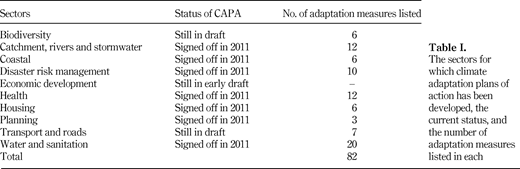
In 2011, when the contract of the ERMD staff member driving this phase of the CAPA process came to an end, ten sector-based plans had been initiated, of which seven had been completed to the point of being signed off by the departmental directors and presented to the relevant Portfolio Committee (consisting of city councillors), two were near final drafts and one was in an early draft, as shown in Table I.
A total of 82 adaptation measures are contained within the nine CAPAs that were completed or in final draft. The listed adaptation measures range from the general, e.g. ensure climate change considerations are taken into account in city’s low-cost housing programme and land identification, to the very specific, e.g. model the flood risk associated with the interaction between freshwater flooding, storm surge and sea-level rise to assess the impact on flood levels at coastal river mouths.
Since 2011, there has been progress made on implementing some measures listed in the sector-based CAPAs, although there is no clear, traceable record of this. The level of progress varies between departments, in part linked to the level of ambition and novelty reflected in the plan. Some plans mainly list activities that were already budgeted or underway, while others focused on new, additional activities. There is no functional CAPA reporting and review mechanism in place, either via the departmental directors in the city administration or the council portfolio committees. While the need for effective monitoring and evaluation is highlighted in both the FAC4T guidance and CAPA v1, it was left out of CAPA v2. Another key challenge encountered in developing the sector-based CAPAs was that no new budget was made available for implementing measures identified in the plans.
The three sector-based CAPAs that were initiated but not signed off in 2011 remain incomplete to-date in 2014. This despite the development, implementation and review of the CAPAs being explicitly committed to in the statutory Integrated Development Plan 2012-2017 (CCT, 2013) and the Environmental Agenda 2009-2014 (CCT, 2009b). It is interesting to note that the South African National Climate Change Response White Paper was finalized and adopted in late 2011. As such, much of the progress made by the Cape Town municipal government pre-dates a firm mandate to address climate change from national government. Since the national climate change directive came into being, progress on climate adaptation has slowed within CCT, highlighting a notable disconnect between these processes.
5.4 Furthering the climate change agenda on other fronts
The development of CAPA v1 and v2 did not take place in a vacuum. To the contrary, a number of other climate change-related initiatives were being undertaken within the CCT during the same period. Picking up on the second recommendation put forward in the FAC4T, at the same time as the CAPA development was underway, the CCT commissioned a sea-level rise study to develop localized scenarios of coastal inundation, assess the risks and economic impacts associated with such inundation and identify adaptation measures to address these (Brundrit and Cartwright, 2012). Coinciding with a series of large winter storms causing extensive damage to stretches of Cape Town’s coastline, this work drew attention from various city politicians and officials, as well as from the media, academics and members of the business community. This attention and awareness helped somewhat in engaging key players in the CAPA deliberations.
In 2008, an Energy and Climate Change Committee of councillors was established, with a mandate to address issues of climate mitigation and adaptation (CCT, 2011). However, energy efficiency and renewable energy items have dominated the committee’s agenda, so it has not provided an effective forum for adaptation reporting and oversight. In 2009, an Energy and Climate Change sub-committee of the CCT Executive Management Team (EMT) consisting of senior officials was also established. This EMT sub-committee has three streams of work, one of which is adaptation and climate resilience (Lewis and Jooste, 2012). However, like the political committee, their deliberations have primarily been focused on energy-related issues to the detriment of the broader adaptation agenda.
The CAPA development paralleled four other decision-making processes that also entailed widespread efforts to coordinate inputs from numerous CCT departments. The CAPA process gained from and fed into the preparation and adoption of the CCT’s Energy and Climate Change Plan and a series of Multi-hazard Disaster Risk Management Plans, as well as the CCT Spatial Development Framework and City Development Strategy. Both of the longer-term, strategic-level documents, formally adopted by the City Council in 2012, contain numerous explicit references to climate change as a key consideration in the development of Cape Town.
During this time, the municipal government also sought to strengthen partnerships to provide research support to these ongoing planning and strategy processes. The CCT partnered with the African Centre for Cities (ACC) at the University of Cape Town and Sustainable Energy Africa, a local non-governmental organization, to establish the Climate Change Think Tank. The Cape Town Climate Change Think Tank was designed around a model of multi-stakeholder deliberations and knowledge co-production being promoted by the ACC to bridge the gap between research, policy and practice addressing urban challenges in Cape Town (Anderson et al., 2013). In addition to energy and mitigation-oriented research work, the adaptation component of the Think Tank focused on issues of legal liability for climate damages and municipal mechanisms for financing climate adaptation, as well as on decision support tools for managing risks to the city’s coastal zone from sea storm surges and rising sea levels (Cartwright et al., 2012a). Research done under the auspices of the Think Tank was presented to and discussed with a group of CCT officials, councillors, NGO representatives and academics.
6. Emerging themes on adaptation planning and implementation in Cape Town
Reviewing the relevant documentation, together with the data collected from interviews and focus group discussions with a range of CCT staff, yields a number of key insights relating to intra-organizational coordination, the technical and political aspects of decision-making, the effects of resource constraints and the challenge of tracking and adjusting adaptation measures.
6.1 Intra-organizational coordination
The CAPA plan and process has not achieved high visibility in the municipal government as a whole. Despite considerable investment over a number of years from within the environment department, the CCT’s climate adaptation plans remain on the fringes of departmental activities and budget allocations. Many within CCT are unclear on who is responsible for its implementation, monitoring and reporting. Consequently, the onus falls back on ERMD to push the process. As yet, there are no clear CAPA reporting and feedback channels, either vertically through the CCT administrative and political hierarchy or horizontally between departments. This reinforces the low visibility of the CAPA.
Somewhat surprisingly, considering the peripheral nature of the adaptation plan, all interviewees and focus group participants stated a preference to keep the CAPA rather than have it discontinued. One reason given is the role the CAPA has played in heightening awareness among city staff to prepare for changing climate conditions that impact their work. A second reason is that the CAPA has provided a mechanism to link up with the work of other departments that have inter-related mandates but have historically worked very separately. However, the CAPA has also brought to light conflicts between various departments based on their priorities and mandates. For example, conflicts over land use between those tasked with protecting biodiversity and those tasked with providing low cost housing. These conflicts give rise to protectionism and a tendency to avoid inter-departmental planning processes.
6.2 Technical and political aspects of decision-making
While the discussion above focuses on coordination between administrative departments, the decisions surrounding climate adaptation are not only technical but also political in nature, especially when it comes to public spending priorities. It is mid-level city officials that have been working to get climate change onto the CCT agenda and into departmental plans and budgets. However, there is ample evidence that climate change does not yet feature in the City Council as a political priority, which undermines progress on implementation. In the seven instances where sector-based climate adaptation plans have been presented to political committees with a request for support and oversight, none of the portfolio committees have subsequently requested progress reports. In the three instances where the plans have not yet been completed, there has been no pressure from the political committees to have them presented. This, despite the existence of the aforementioned City Development Strategy and Integrated Development Plan and the establishment of both the Energy and Climate Change Committee (political) and Sub-Committee of the EMT (administrative), designated to progress issues of climate adaptation and mitigation.
The lack of certainty and accuracy in climate change projections and the distant time horizons are often used as reasons for delaying investments in climate adaptation when weighed against more immediate pressing concerns, such as crime, poor public transport and waste management. This is particularly true in highly unequal cities like Cape Town where, for example, it is politically difficult to justify investments in retrofitting existing stormwater infrastructure in well-serviced areas to increase drainage capacity in light of climate projections when large parts of the city remain under serviced and suffer regular flooding.
6.3 Resource constraints
The lack of budget to undertake new climate adaptation activities and upgrade infrastructure specifications in light of changing climate risks is a real constraint in Cape Town. Because the adaptation planning process, in the form of the CAPA, did not have any new budget secured for implementation, it has not been prioritized within the departmental structures. The CCT financial management system, designed to strictly adhere to a conservative interpretation of the Municipal Financial Management Act (Republic of South Africa, 2003) to ensure clean financial audits, makes it very difficult to reallocate budget between departments without a high level directive that is not forthcoming in light of climate concerns. The budget problem extends beyond the municipal government to the allocation of subsidies made by national government. A clear example of this is the national housing subsidy, allocated to municipalities to deliver low-cost housing, which does not yet adequately account for thermal efficiency requirements related to ceiling insulation and fenestrations, which become increasingly critical in light of rising temperatures and stronger winds.
Many commented on the need for more research to underpin adaptation planning, for example, on the linkages between changing temperature patterns, local air quality and respiratory diseases, and the impact of increasing temperatures on transport infrastructure and water quality. But a lack of budget to contract researchers, difficulties in accessing and releasing data and in finding people with matching research interests and expertise, all constrain the production of such research. The aforementioned Climate Change Think Tank was established in response to these needs and resource constraints. The research commissioned and events convened under the auspices of the Think Tank contributed to increasing knowledge on the local dimensions of climate change. However, levels of participation and debate were often less than hoped for by the organizers (Cartwright et al., 2012b).
The three phases of climate adaptation planning in Cape Town revealed a large gap between the science of climate change adaptation and the practice thereof. The outputs produced by academics and consultants have taken considerable translation to get from research-based prescriptions of best practice to actionable plans fitted to the structures and practices of municipal government. The loss of senior CCT staff with considerable experience and expertise is also deemed an important factor undermining action on climate adaptation, particularly mentioned in the sectors of healthcare and water management. Considerable institutional memory is lost with the departure of senior staff, which sets complex, long-running and contested planning and strategy processes back considerably.
6.4 Challenge of tracking and evaluating climate adaptation
One area where the FAC4T and early CAPA work clearly indicated a need is that of adaptation monitoring and evaluation. The need to monitor climate risks and vulnerabilities, track the implementation of adaptation measures and assess their outcomes was included in the FAC4T adaptation planning framework, but it provided no guidance on how to do it. This need to monitor and evaluate carried through CAPA v1, but those involved in CAPA v2 were unable to find a way of making it operational within and between the various CCT departments.
The adaptation monitoring and evaluation challenge emerges on at least three fronts. The first is knowing what exactly to measure, especially because many of the adaptation actions listed in the CAPA are not specific enough to be measured. CCT officials raised the point that it is not necessarily desirable to only include items in the CAPA that are measurable because then the scope and ambition of the plan is often dramatically constrained. The second challenge relates to resource constraints. CCT departments have very limited budget for measurement, monitoring and purchasing data collected and managed by others (e.g. the South African Weather Service). They are therefore heavily reliant on partnerships with research organizations that can leverage external funding. However, these data collection and analysis exercises are often patchy and once-off. The third challenge pertains to evaluation. CCT officials report having very limited time between other pressing demands to analyse collected data, as well as often lacking the methods and tools for such analysis. In addition, there is a disincentive to report failures because this risks budget cuts. Rather, there is a tendency to inflate successes, masking the inherent challenges of adaptation and limiting opportunities for learning. The lack of monitoring links closely with the lack of a reporting mechanism and budget allocations mentioned above, relegating the CAPA to a position of low visibility and low priority within the CCT organization.
One of the benefits of the focus group discussions in this study noted by participating CCT officials was the opportunity to hear about the adaptation plans of other departments, both in terms of the content of the plan and the planning and implementation process. It provided an opportunity to compare experiences of what is proving difficult (e.g. loss of senior staff) and what was working well (e.g. getting climate risks listed in the CAPAs added to the CCT’s specialist risk registers).
7. Relating the empirical findings to literature on adaptation barriers and governance
Revisiting the potential challenges and barriers to adaptation raised by Mukheibir and Ziervogel (2007) finds that the evidence provided above confirms what they cautioned against. The findings show that indeed budgetary constraints, political short-termism, uncertainties associated with future scenarios and the absence of a legislative framework to enforce adaptive measures have all contributed to limiting progress on adaptation in Cape Town. The findings highlight that even with advanced warning of the challenges or barriers, they are extremely difficult to avoid or overcome.
Ziervogel and Parnell (2012) identify an additional barrier, that of ambiguity in who holds what roles and responsibilities when it comes to climate adaptation, both within local government and between the different spheres or levels of government. This ambiguity, together with the “silo approach” that government structures perpetuate, they argue, undermines coordination and collaboration and thereby the efficacy with which holistic and robust responses to addressing climate risks and vulnerabilities can be implemented (Ziervogel and Parnell, 2012, p. 237). The evidence collected in this study strongly supports this proposition. However, what Ziervogel and Parnell (2012) do not point specifically to, which has emerged in this study, is the issue of tracking adaptation progress, of monitoring and evaluating the implementation and outcomes of climate adaptation measures, as a critical mechanism for coordinating action and learning that is largely missing in the CCT case and thereby undermining progress with implementation.
Winsvold et al. (2009) characterize three typical modes of governance that present different ways to coordinate the learning and action required for climate adaptation. It is possible to view the CCT municipal government as a hierarchical set of actors (i.e. branches, departments, directorates and committees). Doing so reveals that the Cape Town case supports Winsvold et al. (2009) claim that one of the weaknesses of the hierarchical mode of governance, characterized by top-down coordination from a central authority, is the poor feedback of knowledge pertaining to the problem (local climate impacts) and the implementation of solutions (prioritized adaptation measures) from subordinate units to the central authority. However, the Cape Town case challenges Winsvold et al. (2009) proposition that one of the strengths of the hierarchical mode of governance is ensuring widespread implementation of an extensive range of adaptation-related activities through coercive enforcement from a central authority. While this may be theoretically true, it has not proved the case in Cape Town because the climate adaptation planning process has not been introduced or prioritized by a central authority, whether the Mayoral Committee, the Energy and Climate Change Committee or the Executive Management Committee within the CCT. Rather, it has been initiated by the CCT environment department, a subordinate unit within the city administration. This has made it difficult to mainstream climate adaptation into the work of other departments and has hampered implementation. This supports similar findings made by Measham et al. (2011) and Anguelovski et al. (2014), suggesting that sustained political leadership is needed for adaptation planning to gain traction across the operations of local government. However, Uittenbroek et al. (2013), based on experience in Dutch cities, caution that even the appearance of successful mainstreaming into existing policy domains such as urban planning does not ensure the implementation of adaptation measures.
Establishing the Climate Change Think Tank to link various CCT actors up with local researchers, commission new research and serve as a forum for reporting, review and advice (Cartwright et al., 2012a), has been one attempt at addressing the institutional constraints of mainstreaming adaptation from below in a hierarchical government organization. It constitutes a shift between the hierarchical mode that CCT operates in to the network governance mode, which supports Winsvold et al. (2009) ultimate argument that a well-developed ability to shift between governance modes to leverage the strengths and limit the weaknesses of each mode to coordinate learning and action is necessary for effective adaptation.
8. Concluding on the question of institutional inertia
Returning to the title of the paper, the question of institutional inertia in a changing climate, the CCT can hardly be accused of being inert in terms of the first two stages in the policy and planning cycle, those referred to as agenda-setting and formulation by Clar et al. (2013) or understanding and planning by Ekstrom and Moser (2013) and Uittenbroek et al. (2013). On the contrary, it is highly dynamic on these fronts, with multiple new policies and plans adopted by the City Council that explicitly include reducing climate impacts as a key consideration. However, when it comes to the implementation, the monitoring and the evaluation of new policies and plans, this is where inertia sets in. This is partly explained by the hierarchical nature of the governance mode in which metropolitan municipal governments operate and the fact that attempts at climate adaptation are coming from the lower levels of the hierarchy, rather than the central, powerful apex made up of the senior officials and councillors. The Cape Town case shows that there is value in looking more closely and carefully within local government to evaluate progress in implementing climate adaptation and disaggregating local government into numerous actors operating collectively, but not always in a coordinated and collaborative manner.
A detailed analysis of the Cape Town adaptation process reveals that having an adaptation plan is a necessary but insufficient marker of progress on lowering climate risks in a city. One needs to look much more closely and critically not only at what is proposed within the climate change plan but also how it has come about and who is taking ownership of the process to implement and enforce the measures contained within it. Three propositions emerging from this research to be investigated further are that:
urban adaptation requires both technical and political processes of decision-making, which often conflict;
the multi-sectoral nature of urban climate adaptation makes coordination difficult yet essential to prioritize and sequence adaptation measures, evaluating outcomes and adjust accordingly; and
city governments rely of external expertise to undertake adaptation planning, but the external nature of what is produced inhibits the traction required for implementation.
References
Further reading
About the author
Anna Taylor is a Researcher at the African Centre for Cities, University of Cape Town. Her research focuses primarily on the decision-making processes involved in governing climate adaptation at the city scale, particularly in southern Africa. More broadly, she is interested in processes of bridging science, policy and planning to build climate resilience and adaptive capacity in cities. Anna is also a Research Associate with the Stockholm Environment Institute’s Oxford Centre. Anna Taylor can be contacted at: anna.taylor@uct.ac.za
This work was supported by Mistra Urban Futures, a global research and knowledge center in sustainable urban development, funded by the Swedish International Development Agenday (SIDA) and the Mistra Foundation for Strategic Development. The author specially thanks colleagues at the City of Cape Town, who shared generously of their time and knowledge, and also to the journal editors and three anonymous reviewers for their helpful comments.