


The purpose of this paper is to suggest an approach to post‐Kyoto climate negotiations that could provide a way out of the apparent deadlock between developed and developing countries. This is an urgent issue as the world already appears to be close to a level of climate change that could be considered “dangerous”.
The paper explores the potential that control of short‐lived greenhouse gases such as methane, tropospheric ozone, and soot could have, in addition to steep cutbacks in industrialized nations, to both mitigate global warming and overcome political stalemate in the international climate negotiations.
Although rarely mentioned in climate discourse, reducing emissions of short‐lived greenhouse gases offers a cost‐effective way of actually reducing the radiative forcing in the atmosphere, while at the same time producing substantial subsidiary benefits such as improved urban air quality. The paper suggests leveraging this potential in the post‐Kyoto treaty in order to “buy time” to address the arguably more difficult problem of essentially eliminating fossil‐fuel related CO2 emissions, which will ultimately be required to truly bring climate change under control. While high‐income countries work on steep cutbacks of all greenhouse gas emissions, middle‐income nations could make significant additional contributions by undertaking commitments to control only short‐lived greenhouse gases until they reached a threshold level of per‐capita GDP, at which point they would cap and begin reducing all greenhouse gas emissions.
This paper recognizes that political tradeoffs will have to be made in negotiating the next climate treaty, and offers a way of approaching these tradeoffs that could minimize resulting environmental damage.
Introduction
The UN Framework Convention on Climate Change (UNFCCC), negotiated in 1992, sets as its objective the stabilization of greenhouse gas concentrations at a level that would avoid “dangerous anthropogenic interference with the climate” (Article 2). The Kyoto Protocol, negotiated under the auspices of the UNFCCC, expires in 2012 and is widely regarded as a necessary but incomplete first step on the path toward achieving this objective. It put in place an international cap‐and‐trade framework that can be built on in future negotiations, but it restricted the emissions of relatively few countries and did not set long‐term emissions targets. Global emissions have risen 23 per cent since the treaty was negotiated in 1997 (Marland et al., 2007; BP, 2007).
Coincident with the accelerating rise in emissions and global temperature over the past decade have been scientific studies of the impacts on vegetation, wildlife, and the world's glaciers and ice sheets to climate change. These indicate that even relatively small increases in the global average temperature can lead to significant changes in the climate (Intergovernmental Panel on Climate Change – IPCC, 2007a), and it seems increasingly clear that impacts on society are likely to be more immediate and serious than previously indicated (IPCC, 2007b). As a result, it is now reasonably clear that global emissions need to peak and begin declining no later than 2020 to give a reasonable probability of avoiding the most serious climatic consequences (Meinshausen, 2006). The successor agreement to the Kyoto Protocol will therefore be critical in determining whether the world will avoid a dangerous level of climatic change.
The post‐Kyoto treaty must possess two key characteristics: it must be stringent enough to avoid dangerous climate change and it must be structured in a way that provides incentives for participation of the world's major emitters. It is unclear which of these requirements will be the most difficult to achieve. Increasing scientific evidence of positive feedback mechanisms and of the Earth's sensitivity to past climatic changes has suggested that dangerous and irreversible climate change can be expected at a warming between 2 and 2.5°C above pre‐industrial temperatures[1]. The atmosphere already contains enough long‐lived greenhouse gases to raise global temperature by over 2°C[2]. Of that, 0.8°C of warming has already been realized, 0.6°C will be realized as the climate system comes to equilibrium, and the remainder is being offset by the cooling effect of (relatively short‐lived) sulfate aerosols (IPCC, 2007a). Clearly, the Earth is already flirting with a dangerous level of climate change and steep and deep emissions cuts will be necessary if the threshold is to be avoided.
Despite the urgency of the threat, summoning the international political will to agree and enforce these strict limits could prove even more difficult than making the cuts themselves. The USA, the world's largest emitter over the twentieth century, has declined to ratify the Kyoto Protocol on the basis that it does not restrict emissions from developing countries that are also big emitters. Conversely, these developing countries, particularly China and India, have given little indication that they would accept any limit to their CO2 emissions. Russia, the world's third largest emitter, recently announced that it would not undertake any future limits to emissions under a post‐Kyoto agreement.
In this difficult political environment, it is inevitable that compromises will have to be made. Creative approaches to crafting the new international agreement will ensure that necessary political tradeoffs are made in a manner that minimizes damage to the environmental effectiveness of the agreement. The following sections describe the current deadlock in the negotiations process and the part that short‐lived greenhouse gases play in the global warming problem. Then an approach is outlined through which mitigation of these short‐lived gases could be incorporated into a future agreement and the equity, cost‐effectiveness, and climatic effectiveness of such an agreement are examined in turn.
The first mover problem and the current climate impasse
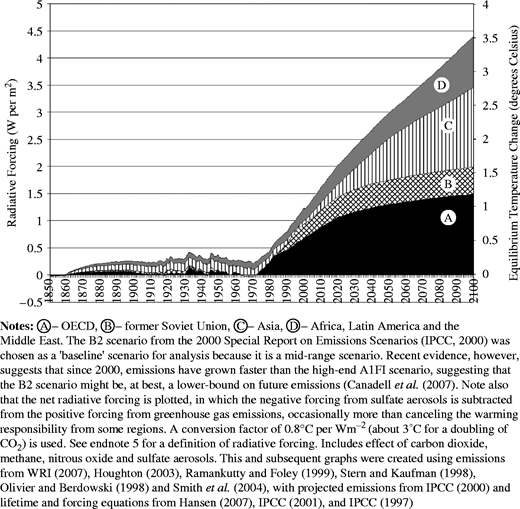
All discussions of international climate agreements raise ethical issues regarding responsibility for past and future warming and the equity of the cost distribution of proposed solutions. As shown in Figure 1, the pattern of regional contributions to global warming over time shows that accumulated emissions from the OECD and former Soviet Union, with 20 per cent of the world's population, currently account for roughly 75 per cent of the warming problem. Per‐capita emissions show an even greater disparity, with an American's carbon footprint currently five times the global average and 200 times that of someone living in one of the poorest countries. Indeed, the UN estimates that the average air conditioning unit in Florida is responsible for more CO2 in a year than a Cambodian is in a lifetime, and that use of an average dishwasher in Europe results in emission of as much CO2 in a year as three Ethiopians (UNDP, 2007).
These huge differences in per‐capita emissions are significant because they are a product of economic development in high‐income countries that has been powered by use of inexpensive fossil fuels. Developing countries ask why, when global warming ranks relatively low on a long list of humanitarian and economic priorities, and when greenhouse gas emissions are today closely correlated with the energy consumption that drives economic growth and welfare improvement, they should not do the same.
However, Figure 1 shows that even under a relatively modest emissions growth scenario, non‐OECD countries will account for about 70 per cent of the climate forcing in 2100, and an even larger part of the growth in emissions over the next 100 years. Over the twenty‐first century, with no internationally‐agreed constraint, the developing countries will emit four to five times the amount of carbon dioxide emitted by the developed economies over the last century and a half. Clearly, even were it politically feasible to do so, high‐income nations will be unable to solve the climate change problem alone: even were the OECD countries to completely cease emissions in 2013 after the expiry of the Kyoto Protocol, a “dangerous” level of greenhouse gas concentrations would be reached before 2050.
Much of the recent debate on achieving a stabilization of greenhouse gas concentrations has focused on how emissions reductions should be shared between developed and developing nations, particularly the large, rapidly growing developing countries (Posner and Sunstein, 2008; Baer and Athanasiou, 2007; Sugiyama and Deshun, 2004). Given their high per‐capita emissions, greater wealth and greater responsibility for greenhouse gases currently accumulated in the atmosphere, the developed countries clearly bear the ethical burden of moving first to reduce greenhouse gas emissions, as reflected in the provisions of the UNFCCC and the Kyoto Protocol.
However, reducing emissions in developed nations will require a substantial and expensive restructuring of the energy infrastructure, a program that governments are understandably reluctant to undertake without a meaningful commitment from the big emitters among developing nations that they will join in the effort to keep global warming constrained to some agreed level. To effectively prevent dangerous climate change, the next climate agreement must cover all major emitters and so must effectively broker a compromise between the interests and responsibilities of developed and developing nations.
Greenhouse warming: a multi‐gas problem
Adequately addressing climate change will require confronting all aspects of the problem. International attention has so far focused primarily on CO2 emissions from fossil fuels because CO2 is the single most important greenhouse gas, one of the longest‐lived, and is most closely linked with economic development and so is seen to pose the most intractable problem. Large reserves of fossil carbon (particularly coal), which will likely be used to support future economic development in the absence of emissions caps, mean that a large part of the projected increment in greenhouse warming between 2000 and 2100 results from energy‐related CO2 emissions.
These reasons justify early and strong control of CO2 emissions, but nevertheless, CO2 accounts for only around half of the current positive forcing from greenhouse gases[3] (IPCC, 2007a), and at least a fifth of this CO2 forcing is attributable to land‐use change and deforestation rather than fossil fuel burning. Other important greenhouse gases include methane, nitrous oxide, the halocarbons, soot, and tropospheric ozone.
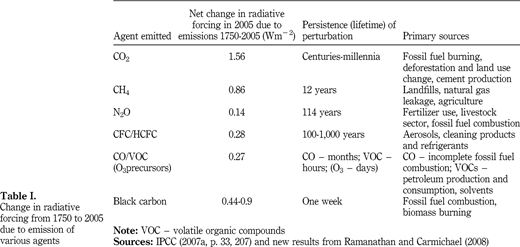
As can be seen from Table I, radiative forcing from anthropogenic emissions of methane amounts to more than half the forcing from CO2 emissions. Similarly, the warming influence of black carbon (soot) emissions appears to be large, especially if the albedo effect of soot deposition on snow, glaciers and ice is accounted for. Models used by the IPCC estimate warming from soot at 0.44 Wm−2 (IPCC, 2007a), but a more recent review by Ramanathan and Carmichael (2008) that includes observational evidence suggests that it could be as high as 0.9 Wm−2. Tropospheric ozone, a product of the emission of several of the gases in Table I, also has a significant positive influence on radiative forcing. Half of the forcing attributable to CO and volatile organic compound (VOC) emissions, and almost a quarter of the warming from methane emissions comes from the effect these gases have of increasing tropospheric ozone concentration. Under baseline scenarios this effect is likely to persist in coming decades – one study found that changing levels of short‐lived, radiatively active particles would likely account for 20 per cent of the globally‐averaged warming in 2050 (CCSP, 2008).
Crucially, as indicated in Table I, several of these greenhouse gases (i.e. methane, soot, and tropospheric ozone) have relatively short atmospheric lifetimes. Unlike carbon dioxide, which once in the atmosphere creates a radiative perturbation that will persist for centuries, these pollutants are removed far more rapidly. This means that reducing these emissions will have a near‐immediate effect on the atmospheric concentration of these gases, and so, by extension, on climate forcing. This characteristic can be utilized in planning a successful climate stabilization strategy.
Figure 2 shows the breakdown, by gas and period of emission, of radiative forcing at various points in the twenty‐first under the B2 emissions scenario. The green bars show the forcing effects from gases that have yet to be emitted – in other words, the portion of forcing that can be altered by emission reduction strategies put in place in the near future. Because of its relatively short lifetime, strict control of methane emissions between 2000 and 2050 could, in theory, entirely eliminate the warming effect of this gas. Soot and ozone are not shown in Figure 2, but control of the contributing emissions would result in a similarly rapid decrease in forcing. Carbon dioxide, on the other hand has a far longer atmospheric lifetime, so a similar degree of control would result in a reduction in radiative forcing of only 38 per cent by 2050.
Problematically, reducing emissions of CO2 today will only slow or halt the rate of increase in concentration over the next few decades and so offers little opportunity to actually reduce the amount of committed warming. Since the world already has a level of greenhouse gas concentrations that take it perilously close to the 2‐2.5°C threshold likely to lead to dangerous climate change, and in that the world community shows little sign of reining in the growth in fossil fuel emissions, concentrating some near‐term attention specifically on the short‐lived pollutants can provide a valuable climatic “breathing space” while nations work to develop and deploy technologies that will bring fossil‐fuel CO2 emissions to near zero, as must happen over the next century if climate is to be stabilized.
Proposed architecture for the post‐2012 agreement
The fundamental objective of the next agreement should be to limit the maximum commitment to future warming to no more than 2‐2.5°C above pre‐industrial temperature. This upper limit represents the recent crystallization of scientific understanding around the idea that a warming above this level would likely cause large areas of the Greenland ice sheet to melt, would put the West Antarctic ice sheet at substantial risk, and would cause widespread disruption to global ecosystems and the hydrologic cycle (SEG, 2007; IPCC, 2007b; MacCracken, 2008a).
The 2‐2.5°C limit corresponds to a net radiative forcing in the atmosphere of between 2.5 and 3.1 Wm−2 above pre‐industrial, although uncertainty over the climate sensitivity parameter means this value could be somewhat higher or lower[4]. This compares to a current net forcing of 1.6 Wm−2 above pre‐industrial, a combination of a positive forcing of 3.2 Wm−2 from increased greenhouse gas concentrations, and a negative forcing of 1.6 Wm−2 from the estimated cooling influence of sulfate aerosols (IPCC, 2007a)[5]. It will be important that temperature and forcing limits of acceptable climate change are defined in a future climate agreement in order to provide direction to the process of negotiating long‐term, global emissions limits.
The architecture proposed in this paper for the needed post‐Kyoto agreement is based on the existing cap‐and‐trade framework, with expanded membership, deeper emissions cuts, and a longer commitment term. As in the Kyoto framework, national responsibilities for emissions reduction are differentiated based on per‐capita GDP, but cuts in the emissions of short‐lifetime pollutants are leveraged to take advantage of the timely and cost‐effective mitigation options offered by control of these greenhouse gases, and to catalyze the participation of key middle‐income countries in a way that, we suggest, should be acceptable to both middle‐ and high‐income nations (see MacCracken, 2008b for a succinct summary of proposal commitments).
Nations would be grouped into three categories, replacing the present system of Annex 1 (generally referred to as developed nations) and Annex II (generally referred to as developing nations). This reflects the large variation in economic development that exists in the Annex II group. The following threshold values are suggested as category definitions, roughly following World Bank (2008) groupings of low‐ and lower‐middle‐income, upper‐middle‐income, and high‐income nations:
- 1.
high‐income nations, having a per capita GDP of more than $10,000 in 2005;
- 2.
middle‐income nations, having a per capita GDP of between $3,000 and 10,000; and
- 3.
low‐income nations, having a per capita income of less than $3,000.
Graduation between groups would be based on both these economic thresholds, and on additional per‐capita emissions thresholds that could be defined as part of the negotiations.
The responsibilities for emissions limitations[6] would vary by category and time, such that:
- 1.
High‐income nations, because of their historic contribution to the present level of greenhouse gas concentration, their generally high per‐capita emissions, and their greater economic capacity, would assume responsibility for the largest emission reductions in the near‐term, committing to steep cuts in emissions of all greenhouse gases. Net emissions (so allowing credit for documented biologic or geologic sequestration) need to be roughly 80 per cent below year 2000 emissions by 2050, a level consistent with the recommendation of the Stern (2007) report. While a fraction of these cutbacks could be accomplished by financing emissions reductions in middle and low‐income nations, part of the burden of high‐income nations is to demonstrate that a high‐income society can function with a very low level of emissions; otherwise, there is no practical or moral basis for expecting action by others. Because of this, purchasing of emissions credits from low‐ and middle‐income countries should be capped at perhaps 10‐15 per cent of emission reduction commitment. Beyond 2050, it is likely that further emissions cuts on the order of 50 per cent will be required to keep warming below the threshold level, but this time frame will likely be beyond the scope of the post‐Kyoto agreement.
- 2.
Middle‐income nations, including major emitters such as China, India, Indonesia, and Brazil, that are presently responsible for the rapid growth in annual global emissions, will be critical to the success of the climate‐stabilization effort. These nations would have a two‐part commitment:
The first part would be binding commitments to sharp reductions (on the order of 80 per cent by 2050) in emissions of CH4, soot, and the pollutants that contribute to formation of tropospheric ozone. These commitments are key to the lifetime‐leveraging strategy, as they will cause early and substantial reductions in radiative forcing but can be done at relatively low cost and will have substantial benefits beyond climate mitigation (Ramanathan and Carmichael, 2008; CCSP, 2008; Tol et al., 2003). For example, many cities in the developing world suffer from air pollution problems that could be partially alleviated by reducing soot and ozone concentrations. Such measures would be consistent with Millennium Development Goals and could be politically acceptable to governments and people in middle‐income countries. Other actions such as capturing methane from landfills or pipelines, and improving combustion efficiency to reduce soot emissions are efficiency measures that can have a relatively short payback time. Action on these “low‐hanging fruit” commitments, which nevertheless have substantial climate benefits, would help to persuade hesitant high‐income countries that the key middle‐income nations are serious about participating in the global fight against climate change.
The second part of the commitment would be sectoral intensity targets for fossil fuel emissions, in place of an absolute cap. Nations in this category would agree to adopt targets that would steadily improve the carbon‐intensity of energy‐intensive industries such as aluminum, paper, cement, steel, petrochemicals, and glass, ultimately aiming toward the highest industry standards. These improvements will likely have positive impacts on competitiveness, especially if global energy prices continue to increase, and several governments, notably China, already have energy‐intensity targets in place (Pew Center on Global Climate Change, 2007).
- 3.
Low‐income nations would have the least restrictive commitments. They would have no absolute cap on emissions but would adopt aspirational targets consistent with sustainable development and the Millennium Development Goals. These could include reducing soot from burning traditional biofuels (generating substantial public health improvements) as well as targets for avoided deforestation. Nations that join the agreement by setting and working toward such targets would benefit from participation in the global carbon market through a certified emissions reduction program similar to the current clean development mechanism (CDM).
As countries develop economically, they would, over time, “graduate” into the stricter emission‐reduction regimes. For example, a low‐income country under this proposal would agree to cap and reduce short‐lifetime emissions (at a moderate rate of approximately 1 per cent per year) once it passed the threshold per‐capita GDP definition of a middle‐income nation. Similarly, middle‐income countries would agree to reduce their long‐lived greenhouse gas emissions at a comparable rate once their per‐capita GDP was high enough to qualify.
In order to incentivize low‐carbon development and to improve the equity of the proposal, we suggest that there be double graduation thresholds: one based on per‐capita GDP and one on per‐capita emissions. A country would have to pass both before entering the more restrictive regime. This would provide some incentive for a country to follow a low‐carbon development path because such a low‐emission country would be able to delay increased regulation beyond the per‐capita GDP threshold.
Maintaining equity while reducing greenhouse gas emissions
At the heart of the current climate impasse is a recognition that, since the start of the Industrial Revolution, the developed nations have used the abundant and inexpensive energy from fossil fuels to power their economic development, and in doing so have caused the lion's share of the current climate problem. At the same time, a scenario in which the rest of the world achieved the OECD‐level of current per‐capita emissions (Marland et al., 2007) before reducing them would be disastrous for the climate, resulting in a temperature increase far in excess of the 2‐2.5°C threshold of dangerous climate change. In this context, any agreement that effectively prevents climate change by restricting the emissions of middle‐ and low‐income countries might be considered “unfair” to the developing world because it will impose a constraint on development, for a global good, that richer nations did not face. To responsibly address this concern, it is important that equity considerations are at the heart of the post‐Kyoto agreement. Having an architecture that is widely regarded as “fair” (i.e. one that is consistent with certain fundamental and widely‐held equity principles) is not simply desirable, it is a basic prerequisite if the agreement stands any chance of being agreed to by the governments and public of negotiating countries.
The most commonly cited principles of equity in discussions of climate mitigation include the responsibility to mitigate (those with largest emissions mitigate the most) and the capacity to mitigate (those with the most resources mitigate the most) (Lange et al., 2007). Because of the historic link between fossil‐fuel use and economic growth, these two measures are somewhat correlated (richer countries tend to have higher per‐capita emissions) but this link is not absolute. By linking the graduation thresholds that separate countries with increasingly‐restrictive emission‐reduction requirements to both per‐capita emissions (a measure of responsibility) and per‐capita GDP (a measure of capacity), these two equity considerations are explicitly incorporated into this proposal. Even though countries in each class are not further differentiated on the basis of responsibility or capacity (each member has to reduce the same proportion of emissions), the transparency of this basic system is preferable to a more complex emission‐reduction formula that would be liable to manipulation and dilution.
Additional equity in this proposed agreement comes from assigning primary responsibility for the early reductions in long‐lived greenhouse gas emissions, particularly fossil‐fuel CO2 emissions to the high‐income nations. The dominance of energy‐related CO2 emissions in policy discussion reflects an acknowledgement that this issue is both critical to limiting long‐term climate change and is the most difficult to solve. This proposal would shift the burden for early reductions in these emissions (which do need to happen if climate change is to be contained to an acceptable level) as much as possible onto the high‐income nations. These countries would be responsible for the basic development and deployment of low‐carbon energy sources and would bear the burden of demonstrating how economically‐developed societies could exist with very low per‐capita carbon emissions.
In contrast, middle‐income countries would initially participate in the global climate agreement by controlling only the short‐lived greenhouse gases, reductions of which tend to have ancillary benefits, and to be more cost‐effective. Additionally, most of these emission‐reductions can be achieved using technology that already exists. These nations would only tackle more challenging CO2 reductions later on, once the technology is better established and, presumably, less expensive.
Promoting cost effectiveness
In combination with equity, cost effectiveness will be a crucial test for evaluating a climate agreement architecture. While it is perfectly possible that a non‐cost‐effective architecture could be negotiated, effective implementation and compliance, already a problem with the Kyoto Protocol, will be even more unlikely if costs are significantly higher than they could be. Including mechanisms to improve the cost effectiveness of the agreement will also likely improve the chances of the agreement being attractive to the governments of high‐income nations, which will bear a large fraction of the initial costs of climate mitigation.
True cost effectiveness requires that the marginal cost of emissions abatement be equalized across all countries, industries, and gases. This can be achieved either through a wide‐reaching cap and trade system, or by implementing a universal carbon tax. Cost effectiveness also requires that abatement of different greenhouse gases be interchangeable, achieved in the current agreement by comparing regulated gases through conversion to CO2‐equivalents using the 100‐year global warming potential (GWP).
In this proposed lifetime‐leveraging architecture, however, reductions in emissions of short‐lived gases are explicitly specified as a way of actually reducing radiative forcing. The short atmospheric lifetime of some of these pollutants (particularly soot and tropospheric ozone) as well as their complex chemistry means that they are fundamentally different from, and so not readily exchangeable with, the long‐lived greenhouse gases such as CO2.
To the extent that there will not be a single, universal abatement price, the approach suggested here will not be absolutely cost‐effective. However, good evidence already exists that reducing soot and ozone concentrations will be some of the least expensive ways of limiting global warming. Both of these are air pollutants and are already regulated in developed countries because of their impacts on human health and natural systems. The technology to reduce concentrations of these pollutants already exists and has been deployed in rich countries, so transfer to other parts of the world should be relatively inexpensive. Additional benefits from reducing mortality and morbidity from air pollution make it likely that these measures would have a negative net cost. For example, Ramanathan and Carmichael (2008) estimate that simply replacing biofuel cooking in South and East Asia with clean technologies would reduce black carbon heating in the regions by 75 and 30 per cent, respectively, and would dramatically reduce the hundreds of thousands of annual deaths and respiratory illness from indoor air pollution.
Because of the importance of this issue, two key aspects of cost‐effectiveness, emissions trading and clean development are discussed more fully in the following sections.
Emissions trading
Under the Kyoto Protocol, all regulated gases can be traded interchangeably by conversion to CO2‐equivalents using the 100‐year GWP (UNFCCC Decision 18, COP 7). The CO2‐equivalent of a given gas takes into account both the degree to which different molecules intensify the greenhouse effect, and the relative lifetimes of each gas. For example, out to 20 years after emission, a unit mass of atmospheric CH4 is 72 times as effective at trapping heat as a comparable mass of CO2; however, because the injected CH4 is removed much more rapidly than the CO2, the equivalency drops to only 25 when considering the cumulative effects over 100 years (IPCC, 2007a).
Several studies (Reilly et al., 1999; Manne and Richels, 2000) have documented the limitations of comparing gases using only the CO2‐equivalent metric, noting that it particularly tends to undervalue the contribution of methane over the timescales of interest. For example, Reilly et al. (1999) compared two scenarios in which emissions were reduced by the same amount of CO2‐equivalents, in one case using only CO2 and in the other using the cost‐effective mix of Kyoto gases. When emissions cuts were substantial, they found the multi‐gas approach produced a temperature rise in 2100 less than half of the supposedly‐equivalent, CO2‐only approach.
Essentially, equating gases based on the 100‐year GWP significantly reduces the value of reductions in the emissions of methane because its atmospheric lifetime is only 12 years (IPCC, 2007a). However, because this rapid removal means cuts in emissions can lead to an early decrease in the global warming influence, we suggest that methane‐reduction is in fact more valuable than indicated by the CO2‐equivalent (100‐year GWP) calculation, precisely because of its relatively short lifetime.
Applying this principal generally, it is clear that emission reductions of short‐ and long‐lived greenhouse gases (or aerosols) are not truly interchangeable; control of the former reduces the stock of gas in the atmosphere, while control of the latter prevents an increase in the stock over the timescales of interest. In a world where preventing dangerous climate change looks set to become increasingly urgent and increasingly difficult, this difference cannot be overlooked.
The authors propose that emissions trading be limited to the greenhouse gases with lifetimes of centuries or longer (CO2, HFCs, N2O etc) for which the CO2‐equivalent metric produces a good approximation of the relative warming influences over the timescales of policy interest. In the interests of cost‐effectiveness, we suggest that methane could also be traded with longer‐lived gases but conversion should be based on the 20‐year GWP, which better captures the value of the rapid reduction in radiative forcing that methane emission reduction produces. The complicated chemistry, localized distribution, and difficulty of ensuring a permanent reduction of the very short‐lived pollutants (specifically tropospheric ozone and soot) means that they are generally unsuited to an international trading program[7].
While it is true that international trading of permits can lead to more cost‐effective outcomes, limits do need to be imposed on the extent of trading. The authors propose that emission reduction requirements for countries in a given income category be traded freely between other countries in that group, but that there be a limit of 15 per cent of the reduction requirements that can be met using certified emission reduction credits from countries with less strict regulation (equivalent to the CDM under the current regime). This is because it is essential that there be a strong push from high‐income nations to develop the technologies that will allow them, and eventually all nations, to sharply reduce their emissions over the next few decades, and also because of the problems with additionality that have been identified with the CDM as it currently stands.
Supporting clean development
Because this proposed framework encourages the participation of low‐ and middle‐income countries by not imposing caps on the long‐lived greenhouse gas emissions in the near‐term, the mechanisms to support clean development will need to be particularly strong and effective. CDM financing will need to increase substantially, which will to some degree occur naturally as the carbon market expands and the accreditation process is streamlined. In addition, given the importance of robust certification measures of emission reductions, particularly for the large, rapidly‐developing middle‐income countries, the CDM process for these nations should be reformed so as to remove current perverse incentives for the countries and industries that stand to profit from it, and to provide real baselines, rather than the current hypothetical, and hence ultimately unverifiable baselines.
The CDM for middle‐income countries would be reformed to move away from the project‐by‐project approach and toward national accounting measures for these middle‐income countries. Participating countries would agree on a national baseline for business‐as‐usual emissions for any greenhouse gases that are not capped under the agreement. Reductions below this baseline would be credited and could be sold to regulated countries to satisfy their emission‐reduction goals, or could be banked by developing countries themselves against future reduction requirements once they pass the threshold level of per‐capita GDP and per‐capita emissions. This system, where credits are issued based on relation to a hypothetical but given baseline would ensure the credits represent a real and quantifiable reduction in emissions.
Negotiating the business‐as‐usual baseline will undoubtedly be difficult: the baseline will need to be at once high enough to persuade developing countries to aim for an emissions pathway below that level, and yet low enough that global emissions collectively do not exceed 2.5°C of warming. Critically, however, this baseline could be used to incentivize the participation of important middle‐income countries: a baseline higher than the projected business‐as‐usual essentially amounts to giving away valuable carbon‐credits. While clearly not ideal environmentally, this tool could theoretically be used to encourage participation of certain large‐emitters whose non‐participation would threaten the entire agreement process.
This modified CDM could provide some financial incentive for a country to follow a lower‐carbon development pathway, but other mechanisms could help to facilitate this. CDM trading should be closely tied to technology transfer, so that the process results not just in the development of carbon credits, but in increased capacity in the host country that could generate further reductions. One way of doing this is to have a premium on those carbon credits that are tied to verified capacity building and technology transfer in the receiving country. Credit value would be generated not only for the emissions they help reduce, but for also the positive domino effect of technology transfer in further emission reductions.
In addition, improvements in sectoral efficiency for energy‐intensive industries will be an important part of the middle‐income countries' climate commitment. This should improve the environmental effectiveness and substantially lower the overall cost of the agreement by avoiding a widescale deployment of inefficient technology that would have to be removed and replaced once CO2 emissions begin to be regulated. Many of the key middle‐income countries already have domestic policies that mandate just such efficiency improvements. The Chinese Government, for example, in its 11th five‐year plan (2006‐2010), has set a national target for improving energy intensity by 20 per cent by 2010 (Pew Center on Global Climate Change, 2007). In India, the Bureau of Energy Efficiency (2008) was established in March 2002 as a statutory body under the Indian Ministry of Power to coordinate energy efficiency measures and reduce the energy intensity of India's economy.
While the existing CDM does have several problems, the advantage of a project‐based approach is that it does not rely on the central government for inventorying emissions or for the implementation of national emissions‐control policy. Since many of the LDCs lack the institutional capacity to comprehensively monitor and control emissions, the traditional, project‐based CDM could be continued in the low‐income countries that become party to the post‐Kyoto agreement. This would allow these nations access to the carbon‐trading mechanism but would likely only have a limited adverse climatic effect relative to the national baseline approach; to date only 280 out of 3,250 CDM projects have taken place in the least‐developed countries (UNEP, 2008).
Incentives for participation and compliance
Mechanisms for encouraging participation (countries to sign the agreement) and compliance (countries to implement what they agree to under the agreement once signed) are major weaknesses of many proposed climate agreements (Aldy et al., 2003). This is at least partly because the agreement will be between sovereign nation states and so these methods are inherently limited. To some degree, participation and compliance will need to be motivated by the desire to limit climate change. But, as many have noted, this is unlikely to be enough incentive for major middle‐income emitters to join an ambitions climate agreement, and might not be enough to keep countries sticking to difficult and costly emission‐reduction measures, even though committed to under and international agreement.
Part of the advantage of the lifetime‐leveraging strategy is the fact that the early commitments from middle‐income countries are related to measures that would likely be undertaken anyway as part of a development strategy. These include reducing air pollution, and improving combustion efficiency. This should ideally make participation more attractive to middle‐income nations and, to a limited degree, reduce the extent of specific participation incentives needed to bring these key countries on board.
The most important specific measure in the proposed agreement that would encourage participation by low‐ and middle‐income countries is the certified emissions reduction program. With the carbon market expected to grow to $3.1 trillion by 2020 (Point Carbon, 2008), and potentially substantially larger under a stronger post‐2012 agreement, revenues from the CDM‐type program will probably be substantial, even if it is responsible for a maximum of 10‐15 per cent of emissions reductions. As suggested above, national baselines for key middle‐income nations could be negotiated on a country‐by‐country basis as a way of incentivizing participation. In addition, any adaptation funding, either from specific pledges from OECD countries, or from a tax on traded emissions, could be made contingent on participation in the international agreement.
Encouraging compliance could be even more difficult than encouraging participation. Countries should have short‐term (five years or so) targets to meet, which could steepen over the course of the agreement, in order to ensure they are on their way to achieving the long‐term emissions reduction plan set out in the agreement. These targets could be used to evaluate whether or not a country is in compliance. Countries consistently out of compliance could become vulnerable to tariffs (scaled based on carbon‐intensity) on energy‐intensive imports, at the discretion of in‐compliance, signatory countries. The authors believe that trade measures, which are now widely discussed as one of the only ways of imposing climate externalities beyond national borders and which were incorporated into the Lieberman‐Warner Climate Security Act, are better used to address compliance issues rather than participation issues. Used this way, they stand a better likelihood of being WTO‐compliant (Tarasofsky, 2008; World Bank, 2007) and of being generally perceived as fair.
Can lifetime‐leveraging prevent dangerous climate change?
Preliminary analysis indicates that with ambitious (but very likely achievable) reductions in emissions, the lifetime‐leveraging architecture described above can limit the increase in radiative forcing enough to prevent warming of more than 2‐2.5°C. In carrying out this evaluation, we developed a relatively simple pulse‐response model to calculate the time history of radiative forcing under various emissions scenarios based on the lifetime‐leveraging approach[8].
For example, total warming commitment could be constrained to less than 2.5°C if the OECD countries undertook an ambitious target of reducing all greenhouse gas emissions 80 per cent by 2050 and a further 50 per cent by 2100, and middle‐income countries undertook the same targets for the short‐lived greenhouse gases. If these middle‐income countries develop relatively efficiently under the intermediate B2 growth path (IPCC, 2000) and begin reducing long‐lived greenhouse gas emissions by 1 per cent per year once they reach $10,000 per‐capita GDP then, assuming an intermediate climate sensitivity of 0.8°C/Wm−2 (close to 3°C for a doubling of CO2), warming should peak at less than 2.5°C above pre‐industrial temperatures[9].
Figure 3 shows the fossil‐fuel‐related carbon emission pathway, per‐capita emission pathway, and annual emission reductions below baseline for the four modeled world regions under this scenario. Although the developing regions of Asia, Africa and Latin America are responsible for the largest below‐baseline reductions (Figure 3(c)), these do not begin until fairly late in the twenty‐first century, and are therefore likely to be less costly than the earlier reductions undertaken by the OECD. Asia (as an average region) does not begin reducing CO2 emissions until almost 2050, and the other developing regions until 2065. These regions will thus likely benefit from the technologies and experience developed by the OECD countries during their earlier emissions reduction. Per‐capita emissions for all regions are converging toward equal values by 2100 (Figure 3(b)), and could be stabilized at the same amount in the early part of the twenty‐second century.
This modeling result admittedly does not take into account the effects of emissions leakage, whereby fossil‐fuel intensive industries move from a regulated region to a non‐regulated region to avoid the cost of compliance. A recent study of the effects of existing energy efficiency and emission‐reduction measures on energy‐intensive industries found that evidence for emissions leakage to date is equivocal at best (World Bank, 2007). Nevertheless, emissions‐control regulations have so far been fairly lenient compared to what they will likely have to be in the future, and it could still be that emissions leakage would substantially reduce the efficacy of any agreement that did not impose caps on the emissions of all countries.
The structure of the proposed agreement, however, in which emissions reduction requirements are tied to GDP thresholds, could provide a negative feedback that would limit the impact of emissions leakage. The relocation of energy‐intensive industry to developing countries constitutes economic development that will raise the GDP of the host nation, meaning that the threshold income level at which fossil‐fuel emission regulation begins will be reached sooner than in the baseline scenario. A simple spreadsheet model used to estimate the strength of this feedback effect suggests that even if up to 50 per cent of “cut” emissions were to leak to non‐regulated regions, cumulative emissions over the twenty‐first century would increase by only 7 per cent. Since the climatic effect of emissions depends most strongly on the cumulative amount, rather than the timing of emissions (Matthews and Caldeira, 2008), it is unlikely that including the effect of emissions leakage would substantially reduce the climate‐stabilizing benefits of the lifetime‐leveraging architecture.
Summary and conclusion
Over the last decade, as the rate of climate change has accelerated, many natural systems, including the Arctic sea ice, the Antarctic ice shelves, and the Greenland ice sheet, have surprised scientists with the speed of their response to warming. The effects of climate change have been detected in ecosystems on every continent (Rosenzweig, 2008) and, given the inertia in the system and the possibility of substantial carbon‐cycle feedbacks, it is becoming increasingly difficult to argue that the world is not already close to a degree of climate change that could generally be considered dangerous, if not catastrophic (SEG, 2007).
Given this context, the post‐Kyoto climate agreement will be critical in determining the climatic burden that we place on future generations. The lifetime‐leveraging architecture proposed in this paper has the double benefit of using the often‐overlooked, short‐lived greenhouse gases to both substantially decrease radiative‐forcing (“buying time” to fully get to grips with more intractable CO2 emissions), and to overcome the negotiations deadlock between high‐ and middle‐income countries.
Reductions in the atmospheric burdens of tropospheric ozone, methane and soot represent an opportunity to significantly reduce the human‐induced radiative forcing that is causing global warming. Moreover, much of the reduction in these emissions can be done at little cost, and in a way that is consistent with the broad development strategy of middle‐income nations. In fact, the benefits of reducing soot and ozone concentration in term of improved public health will likely be larger than the benefits of mitigated climate change. This targeting of short‐lived pollutants, combined with aggressive cuts in emissions from high‐income countries, aspirational goals and CDM‐participation from low‐income countries, and improvements in energy intensity to slow the growth of energy‐related CO2 emissions in middle‐income countries, should be enough limit peak temperature increase to less than 2‐2.5°C above pre‐industrial temperatures. If this can be done, and the radiative forcing then be gradually reduced from the peak levels in following decades, the objective of the UNFCCC, namely to avoid “dangerous anthropogenic interference with the climate”, may be achieved.
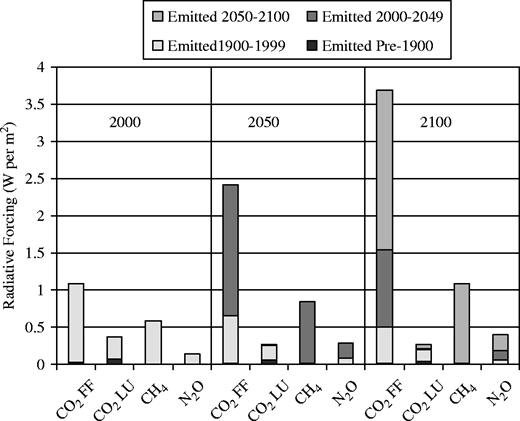
Radiative forcing under the B2 emissions scenario from carbon dioxide from fossil fuel burning (CO2 FF) and land use change (CO2 LU), methane (CH4), and nitrous oxide (N2O). Colors correspond to the date of emission
Radiative forcing under the B2 emissions scenario from carbon dioxide from fossil fuel burning (CO2 FF) and land use change (CO2 LU), methane (CH4), and nitrous oxide (N2O). Colors correspond to the date of emission
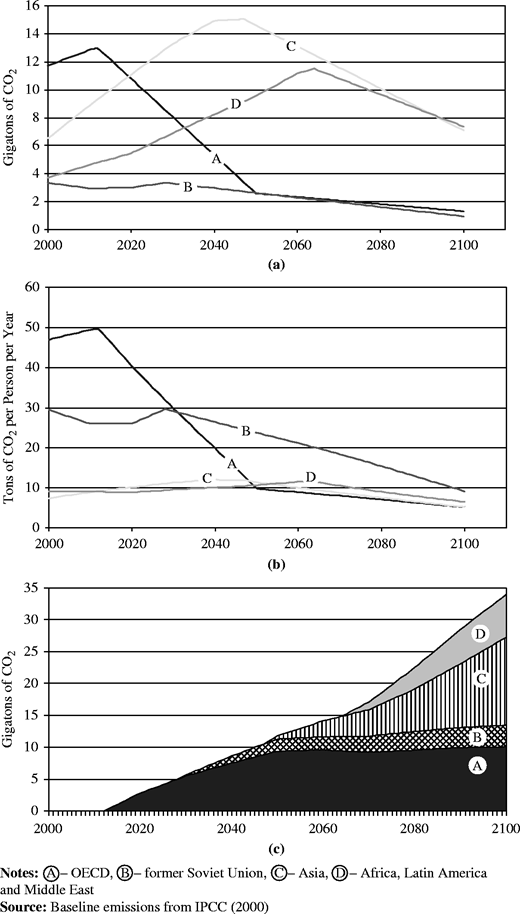
(a) Annual emissions of CO2 from fossil fuel burning for four world regions under the proposed emissions reduction scenario; (b) per‐capita emissions of CO2 from fossil fuel burning for four world regions under the proposed emissions reduction scenario; (c) below‐baseline (B2) reductions in CO2 emissions from fossil fuel burning for four world regions under the proposed emissions reduction scenario
(a) Annual emissions of CO2 from fossil fuel burning for four world regions under the proposed emissions reduction scenario; (b) per‐capita emissions of CO2 from fossil fuel burning for four world regions under the proposed emissions reduction scenario; (c) below‐baseline (B2) reductions in CO2 emissions from fossil fuel burning for four world regions under the proposed emissions reduction scenario
Thanks to Steve Smith and Navin Ramankutty for providing emissions data used for modeling. Thanks also to Nina Rinnerberger, Ivan Valencia, Bhuwan Thapa, Takanobu Terada, Claudia Vinay, and Lars Christiansen for valuable suggestions on the policy aspects of this proposal and for their comments on the draft.
Notes
The views expressed in this paper represent the views of the authors and not necessarily of any institutions with which they have been or are affiliated.
All temperature increases in this proposal are given as the warming above the preindustrial baseline, even if this is not mentioned each time.
Calculated using radiative forcing given by the IPCC (2007a, p. 204) and assuming a climate sensitivity of 0.8°C/Wm−2 (approximately 3°C for a doubling of CO2).
Radiative forcing is a useful measure for directly comparing diverse factors that affect the Earth's climate. Measured in Watts per meter squared (Wm−2), the value describes the equivalent change in net solar irradiance at the tropopause (top of the troposphere) caused by a given climate driver (for example, an increase in greenhouse gas concentration or a change in albedo).
Note that, because it takes several decades for the global temperature to equilibrate with a change in radiative forcing, breaching the forcing threshold will not immediately lead to breaching of the temperature threshold. Rather the threshold is a stabilization target, indicating that the value should not be exceeded for a substantial length of time (more than a decade or so).
In the longer‐term, the world should aim for stabilization at a maximum (and ideally well below) 3.1 Wm−2 of positive forcing (rather than net forcing), which would likely require the removal of some long‐lived greenhouse gases from the atmosphere. Exceeding the forcing threshold with long‐lived greenhouse gases and then relying on the cooling effect of short‐lived sulfates places an indefinite burden on future generations, requiring them to either continue emissions of sulfates that might otherwise be controlled to improve public health, or to launch a geoengineering project to otherwise sustain their cooling effect.
Because emissions of halocarbons are covered under the Montreal Protocol and subsequent conventions, their limitation is not considered here. It is instead assumed that limitations in halocarbon emissions will be aggressively pursued under that agreement (Velders et al., 2007).
For example, ozone is not emitted directly, but is formed from the reaction of NOx and volatile organic compounds. Soot is distributed extremely heterogeneously in the atmosphere and the effect of emissions reductions on atmospheric warming depends partly on the ambient black carbon concentration and on the underlying surface albedo, hence differs from region to region, making international trading of emissions reductions problematic.
The model used is a simple four region Excel model that accounts for emissions of CO2 from fossil fuel burning and deforestation, CH4, N2O, and the direct and indirect effects of sulfate. Past emissions are assembled with datasets from WRI (2007), Houghton (2003), Ramankutty and Foley (1999), Stern and Kaufman (1998), Olivier and Berdowski (2001) and Smith et al. (2004), with projected emissions from IPCC (2000) and lifetime and forcing equations from Hansen et al. (2007) and IPCC (2001, 1997). The complicated chemistry and spatial heterogeneity of tropospheric ozone and soot make them too difficult to include in such a simple model so reductions in radiative forcing will in fact be larger than suggested above under the proposed scenario; for an indication of the likely magnitude of these effects, see CCSP (2008).
Although the B2 scenario is intermediate in the suite of SRES storylines, the growth in emissions since 2000 has exceeded the high‐end A1FI scenario (Canadell et al., 2007). However, the B2 storyline might be roughly consistent with developing countries undertaking commitments to improve energy efficiency, as proposed above.
References
Further Reading
About the authors
Frances C. Moore is currently a student at the Yale School of Forestry and Environmental Studies, where she is studying the international climate negotiation process. Prior to coming to Yale, Frances worked as a Research Assistant at the Earth Policy Institute and at the Climate Institute, where she researched and wrote about climate change issues. She is co‐editor of Sudden and Disruptive Climate Change: Estimating the Real Risks and How We Can Avoid Them and holds a BA, summa cum laude, in Earth and Planetary Science from Harvard University. Frances C. Moore is the corresponding author and can be contacted at: frances.moore@yale.edu
Michael C. MacCracken is Chief Scientist for Climate Change Programs with the Climate Institute in Washington, DC. He received a BS in Engineering from Princeton University in 1964 and PhD. in Applied Science from the University of California Davis/Livermore in 1968. From 1968‐1993, Mike conducted research on climate change and air pollution with the University of California's Lawrence Livermore National Laboratory. From 1993‐2002, Mike was detailed as senior global change scientist to the interagency Office of the US Global Change Research Program, serving as the first executive director of the Office from and then as executive director of the USGCRP's National Assessment Coordination Office from 1997‐2001. Since 2002, Mike has also served on the synthesis team for the Arctic Climate Impact Assessment (2002‐2004), review editor for the North America chapter of the Fourth Assessment Report of IPCC (2005‐2007), president (2003‐2007) of the International Association of Meteorology and Atmospheric Sciences (IAMAS), and a coordinating lead author on the recent report/Confronting Climate Change: Avoiding the Unmanageable and Managing the Unavoidable/prepared at the request of the UN Commission on Sustainable Development.

