


The purpose of this paper is to explore the feasibility of developing an adaptive strategy to address the impact of climate change in the context of flooding.
The paper analyses flood risk and highlights the need for an adaptive strategic plan for flood risk management under the impact of climate change. It introduces a framework for the development of an adaptive strategic plan. The paper identifies organizational issues (at the local government scale) associated with having an adaptive strategic plan and developing a methodology to address these issues. It also identifies the need for a strategic decision support system (SDSS) and conceptualizing the system in order to support adaptive planning principle.
This study identifies lack of adaptability as a gap in traditional strategic planning for addressing flood risk associated with climate change. An adaptive strategic plan has adequate flexibility, promptness and responsiveness to adapt itself to new realities as they emerge and can sustain itself and remain relevant in a changing environment. The study introduces a SDSS that is necessary to support the adaptive element of an adaptive strategic plan.
This study distinguishes between a strategy for adaptation and an adaptive strategy. Most research on the topic of adaptation to climate change have been focused on developing strategies that offer adaptive solutions to pressing problems such as flooding. For instance, they may recommend more investment on non‐structural methods for flood mitigation, as they are more adaptive than alternative structural methods and therefore more sustainable under climate change. An issue that has attracted less attention is the fact that the strategic plans themselves (or in a sense the decision‐making framework) need to be equally adaptive. Some of public institutions do not have adequate flexibility and promptness to change and rectify high‐level strategic plans. The study identifies the lack of an SDSS, which allows new scientific findings to be converted to new policies in a short period of time, as a reason for absence of promptness, responsiveness and flexibility in such organizations. This study makes an attempt to address this issue by suggesting a frame work that will enable a government institution to become more responsive to change.
1 Introduction
Scientific evidence, such as increase in intense tropical cyclone activity, sea‐level rise, and widespread temperature increase over the globe, indicates that global climate change is likely inevitable. It is expected that climate change will result in more severe weather, significant impact on flood probability and an increase in potential damage, among other consequences (IPCC, 2007).
Addressing the risk associated with climate change generally requires dealing with three types of uncertainties. This includes scenario, model, and parameter uncertainties:
- 1.
Scenario uncertainty is due to lack of adequate knowledge of phenomena and inadequate understanding of the processes that influence the phenomena.
- 2.
Model uncertainty is due to necessary model simplification of real world processes.
- 3.
Parameter uncertainty could have two different sources. It can be due to lack of data or parameter knowledge; or due to inherent variability attributable to true heterogeneity in the parameter population.
The authors view is that we are in a better position in relation to assigning a probability to the model and parameter uncertainty than scenario uncertainty. The complexity in relation to the latter uncertainty comes from the fact that it is path dependent (Grübler and Nakicenovic, 2001). Which climate change scenario will eventuate will depend on world community behaviour and world community behaviour depends on which climate change scenario is happening. Schneider (2001) suggests assigning subjective probabilities to scenario uncertainty. In this light, Schneider (2006) suggests “we must frame our decisions simply in a traditional risk management framework, balancing the costs of action against the risks of inaction.” Grübler and Nakicenovic (2001) disagreed with Schneider's suggestion of assigning subjective probabilities. They argue that scenarios describing possible future developments in society, economy, technology, policy and so on, are not repeatable and therefore the statistical approach that is used in the natural science cannot be used in this case.
Given the above‐mentioned debate, strategists face the dilemma of developing prediction‐ or resilient‐oriented strategies for climate change impact risk assessment. The former approach predicts the likelihood of the impact of climate change and uses a risk‐management approach to reduce and manage this risk. The latter approach has a focus on adapting to present day climate variability and increasing the resilience and coping capacity to be able to live with uncertainty. From a flood risk‐management perspective, Mirfenderesk and Abbs (2008) concluded that even if we ignore scenario uncertainty, the model and parameter uncertainties associated with climate change produce such widely varying results that it is very difficult to develop a prediction‐oriented strategy based on the benefit to cost‐ratio and risk‐management concepts. This finding supports the argument that building adaptive capacity into strategic plans is necessary for sustainable management of risk associated with climate change.
An analysis of the traditional management strategies for risk management indicates a lack of sustainability as being an issue. Sustainability is defined as the capacity to create, test and maintain adaptive capacity. Adaptive capacity describes the ability of a society to successfully respond to changes in its environment, in this case, hydrological risks. To achieve such responsiveness the approach needs to have the capability of predicting the uncertainties. Traditional strategy development processes are generally capable of dealing with statistical uncertainties, such as uncertainty associated with flooding (in the absence of climate change). The main characteristic of this type of uncertainty is that its likelihood can be estimated reasonably well and therefore is manageable. In this approach, a vision is formed and then strategy, action plan, monitoring, evaluation and performance‐measure programs are developed, ensuring achievement of the vision. Development of a strategy in this system can be described as drawing a road map in charted terrains. Successful implementation of action plans is expected to materialize the stated vision (with a reasonable degree of confidence). Although the strategy itself is subject to review, the monitoring, evaluation and performance‐measure programs to some degree have a compliance exercise nature. The review process improves the strategy but is not expected to change it dramatically under normal conditions.
Climate change and its associated uncertainty have posed a serious challenge to the above‐mentioned approach. The challenge comes from the fact that there is going to be less confidence in estimation of the likelihood of future uncertainties (in some cases it will be almost impossible to make this estimation). Under such circumstances, the robustness of non‐adaptive strategic plans becomes questionable. Successful implementation of action plans (although it means success in meeting the objectives of the strategy) may not necessarily take us closer to the ultimate goals as articulated in the vision statement. Given the influence of economical, environmental and socio‐political issues on the way that climate change impacts are being shaped, the planning community will gradually come to the insight that the conventional science and engineering approaches to risk management may not be adequate for the challenges that climate change posed.
Equally conventional institutional arrangements, which are more focused on the creation of a single optimum state, lack the required flexibility and responsiveness. Building responsive institutional arrangements that are able to monitor change and formulate and implement appropriate response in a short period of time seems to be an integral part of a robust sustainable risk management process in the era of climate change.
One of the objectives of this study is to introduce a planning process, alongside required governance and institutional arrangements, to address the above‐mentioned risk management issue. This planning model is based on the concept of adaptive management aiming at the development of a systematic framework for continually improving management practices. The model shows how a parallel adaptive management approach can be incorporated into a traditional planning development process. Progress towards such an adaptive management system cannot be charted in advance. Planning is more similar to sailing in un‐charted waters. Navigating this journey requires new approaches that embrace the inherent uncertainty and complexity associated with climate change and its inter‐relation with our social, economic, and environmental systems.
2 Adaptive management of risks in the climate change era
This study uses flood risk on the Gold Coast (Australia) as a context to provide some insight into the subject of adaptive risk management in a climate change era. To explain how this adaptation can be achieved, the study has identified that risk should be dissected into three elements as follows:
- 1.
Subject matter risk (in this case flood risk). This risk can be addressed through development and successful implementation of an adaptive strategy. Addressing this risk gives rise to two other risks.
- 2.
Implementation risk. This is the risk of unsuccessful implementation of the strategy.
- 3.
Adaptation risk. This is the risk of developing a strategy that is not able to create, test and maintain sustainability in the face of uncertainties associated with climate change impacts.
The second and third risks have always been associated with any strategic planning irrespective of the impact of climate change. What has changed is the degree of their importance. Under the impact of climate change, the level of the third risk has increased significantly in a way that requires a new approach for its management. One of the aims of this study is to introduce a new approach to address the third risk effectively.
2.1 Flood risk
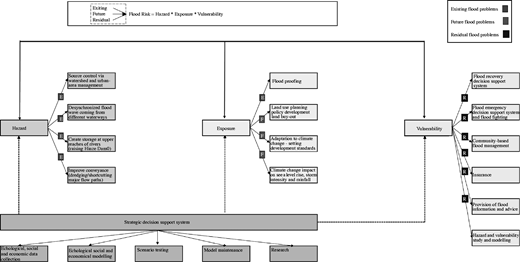
Figure 1 shows the layout of an initial strategy that is designed to manage flood risk on the Gold Coast. The most basic and uncontroversial definition of risk is probability times consequence (Helm, 1996). This is the same approach that has been taken by IPCC (2001). However, in the context of natural hazards management risk is considered to be the probability of climate hazard times vulnerability times exposure, Granger and Hayne (2001), Handmer (2000) and Chrichton (1999). In this study, risk is defined in terms of its components, e.g. hazard, exposure and vulnerability: Equation 1 Exposure to hazard means the presence of people/properties in flood risk areas and vulnerability means a lack of resistance/preparedness by the community. This plan is developed around best practice principles, addressing three types of flood risks:
- 1.
existing;
- 2.
future; and
- 3.
residual risks.
Existing risk applies to existing buildings and development on flood‐prone land. It is the risk a community is exposed to as a result of its location on the floodplain. Future risk is the risk a community may be exposed to either as a result of new development on the floodplain or change in environmental forces as a result of climate change. Residual risk refers to the risk remaining after mitigation. What has been discussed at this stage is the input of engineering and science in the risk management process. The framework shown in Figure 1, subject to successful implementation, could have managed the risk only in a world where everything could be predicted (in a statistical sense). This framework, as it stands, lacks the element of adaptation and therefore is not a sustainable response in a climate change era.
2.2 Implementation and adaptation/sustainability risks
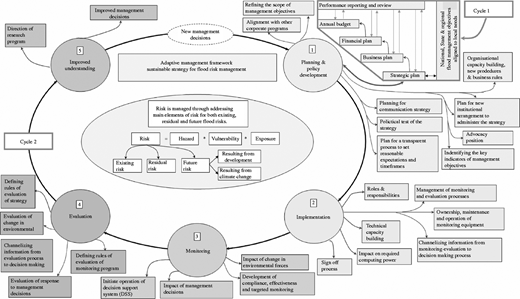
Figure 2 shows a framework that shows how the implementation and adaptation risks can be addressed. The diagram in Figure 2 shows two cycles. The first cycle (shown in a polygon on the top right corner of the diagram) aims at managing implementation risk and the second cycle (on the left) is aimed at managing the adaptation/sustainability risk.
The first cycle starts once the initial strategic plan is developed. In this cycle, the strategic plan cascades into the business plan, financial plan and annual budget. A performance and review process creates a feedback loop through which the success of the action plans (that emerge from the business plan) in meeting strategic objectives is checked. The review process embedded in this cycle identifies any likely shortcomings of the business or financial plan and hence manages the associated risk. This cycle is what the skeleton of a non‐adaptive plan would look like. In the absence of climate change, the same review process would be able to identify the shortcomings of the strategy as well and manage the sustainability issue. The problem is that this cycle has a focus on achieving a single optimum state for the subject matter and does not have the flexibility of an adaptive management framework. It generally exercises the review of the strategic plan in a passive mode and action will be triggered generally once the signs of failure start emerging. The dynamics of climate change necessitate a more responsive system with a flexible active review process where the shortcomings of the strategy will be identified by planning, monitoring and evaluating a set of experiments. This is what the second cycle in Figure 2 can offer.
This cycle is associated with the adaptive element of the plan. The steps of this cycle are shown by five circles that are located around the central oval. The five steps of the process, e.g. planning and policy, implementation, monitoring, evaluation, and improved understanding, creates a feedback loop that iteratively feed new information into the decision‐making process for strategic planning and policy development. The difference between these two cycles is the areas of their focus. The focus of the first cycle is to check the action plan and ensure that it is fully and successfully implemented. The objective of having this cycle is to manage the implementation risks associated with the flood management strategy. The focus of the second cycle is to check the strategic plan and policies and ensure that the strategy is adaptive/sustainable. The objective of this cycle is to manage the sustainability risk of the flood management strategy.
The adaptive cycle that is embedded in the second cycle will not allow us to sit idle waiting for failure to trigger rectification at the strategic level, but to be proactive, experiment, make mistakes, learn from the mistakes and continuously improve the strategic plan. There is a large body of knowledge on the topics of flood management strategy and implementation risk management. This study does not investigate these two topics any further. The following sections of this paper investigate the issue of sustainability of strategic plans that are designed to manage risk under uncertainty.
3 Adaptive management, planning and governance
The ability of a governance system to adapt to uncertain and unpredicted conditions is a new notion. Adaptive governance is an extension to adaptive management. Once the concept of adaptive management is adopted, the organization will need to navigate towards a new state, allowing for adaptive strategic planning, adaptive policymaking and adaptive implementation and administration of strategies and policies. This means moving towards a state that supports and sustains an optimal management capacity. This new management capacity allows institutional arrangements to be evolved to meet stakeholders expectations in an uncertain environment. Adaptive governance need to be investigated at a number of levels and dimensions, for instance at policy level, planning level, implementation, administration, etc. the focus of the following sections of this study is to scope the formulation of a methodology for adaptive planning at the strategic level and to make an initial assessment of the required institutional changes for the implementation of the plan at local government level.
Strategists need to design plans that not only address the environmental, economic and social needs today but also plans that are flexible enough to quickly adapt to our rapidly changing environment. Adaptive approach, which is explored in this study, allows planners to develop strategies that can quickly adapt to a range of unpredicted conditions that are associated with climate change impacts. Adaptive planning is an extension to adaptive management and uses the same principle. Adaptive management provides an alternative approach to traditional planning procedures for the design and implementation of programs and projects that allows movement forward in the face of inevitable uncertainties, particularly where management decisions are controversial.
Although there is a large body of knowledge on the topic of adaptive management in ecological science (Holling, 1978; Walters, 1986; Walters and Holling, 1990; Hilborn and Walters, 1992; Gunderson, 1999; Wilhere, 2002), this powerful tool, to the best knowledge of the authors, has not been used as frequently in strategic planning and policy development levels. This study uses the concept of adaptive management to address the issue of sustainability of strategic planning under climate change conditions. The issue of sustainability comes from the inherent uncertainties, in some areas lack of data associated with climate change impact projections. Adaptive management addresses this risk through the integration of this uncertainty into the decision‐making process at the policy, strategy, programme and project scales. Such integration is achieved through:
Provision of a systematic process for improving future management actions by learning from the outcomes of implemented actions. Hence, to ensure that the risk is managed.
Allowing for behaviour adjustment and mid‐course corrections, as our understanding of environmental and socio economic processes and responses improves.
Provision of a framework that allows decision making even though there is uncertainty.
An adaptive management framework includes an institutional structure that, in combination with monitoring and evaluation, can be used to judge progress in achieving plan objectives. Figure 2 shows a diagram showing five steps in the adaptive management process: planning, implementation, monitoring, evaluation and new management decisions based on improved understanding (adjustment).
Planning is expected to take the greatest amount of time and resources. During the planning stage, the scope of the management problem and management objectives and actions are defined. Once the planning stage has been completed, the program is implemented and monitored using protocols that are developed in the planning stage. Evaluation of monitoring data occurs periodically unless indicators reflect significant changes prior to the allotted time period. The results of the monitoring are evaluated and disseminated to the appropriate parties. Management objectives and actions are modified based on the results, if necessary.
The following gives a more detailed explanation of the adaptive cycle and its steps. It also provides a brief description of the required institutional arrangements for the successful implementation of this cycle.
3.1 Planning and policy development
At this stage:
An assessment of the adequacy of the existing policy and business rules associated with risk management of the subject matter is made.
Any change or any new policy, procedure and business rules that may be needed for the implementation and maintenance of adaptability of the plan is identified.
The scope of the management problem, management objectives and actions are defined.
Key indicators for each management objective are identified.
Management plan and monitoring program are designed.
New institutional arrangements that are required for supporting the plan are suggested.
Alignment of the strategy and its components with other corporate programs is ensured.
Actions that council needs to take to inform state and federal governments (advocacy) are identified.
A communication strategy is developed to ensure the visibility of the plan and to maintain communication and input from the stakeholders and broader community.
A transparent process is developed to set reasonable expectations and timeframes.
3.2 Implementation
Implementation is a dynamic process through time. It includes:
Management of the monitoring process.
Management of evaluation process.
Adjustment and refocusing to new tasks and projects as appropriate.
Determination of roles and responsibilities of various sections of the organization in regards to the ownership and maintenance of the strategy and implementation of its elements.
An assessment of the existing technical capability of the organization and identification of the need for upgrading the organizational capabilities and how this can be achieved.
A review of ownership, maintenance and operation of the monitoring equipments across the city.
Determination of the signoff procedure for approval and endorsement of materials that are produced as a result of the implementation of the strategy or specific activities associated with implementation of the strategy.
Establishment of a framework that lays out how information from monitoring and evaluation efforts will guide decisions about future decisions and actions.
3.3 Monitoring
This phase of the plan provides a step‐by‐step procedure for developing an effective monitoring program to support the adaptive management plan. The monitoring program will provide a measure of program success that can be used to determine if our goals and objectives are being met. The monitoring program focuses on collecting data in three areas:
- 1.
The status of the environment. In this area, the strategy outlines methods for monitoring the changes in environmental forces (due to climate change).
- 2.
The status of the economical and ecological consequences and social acceptability of alternative management solutions.
- 3.
The results of management actions. In this area, the strategy defines the rules for collecting information on the socio‐economic and environmental impacts of management decisions.
The monitoring program needs to be able to evaluate the adequacy of the plan to capture changes and makes required refinements when necessary. The monitoring program will be designed in a way that it will be capable of resolving critical uncertainties and channel information into effective decision making. In general, there are three types of monitoring: compliance monitoring, effectiveness monitoring, and targeted studies.
“Compliance monitoring” is aimed at ensuring that planned actions (for instance flood‐sensitive catchments management) are executed. “Effectiveness monitoring” evaluates the success of the plan in meeting its stated objectives. “Target studies” is a more detailed version of effectiveness monitoring. Target studies provide the opportunity to experiment and proactively assess the environmental, social and economic responses to management decisions. Effectiveness monitoring and target studies are generally designed to remove critical uncertainties and improve knowledge about the response of the environmental, social, and economic system.
3.4 Evaluation
This phase of the plan defines the rules for periodic evaluation of the data that are gathered in the monitoring phase. The purpose of evaluation is to determine whether the plan is working as intended, what impacts it is producing and the reasons why it is producing the identified impacts. At this stage, information is collected, analysed and disseminated to the next stage of the plan to make judgements and recommendations for future actions. This phase of the plan evaluates the appropriateness, efficiency and effectiveness of the strategy in meeting the long‐term vision. Unlike the monitoring program that is generally continuous, evaluation needs to be either triggered or regulated to happen in certain intervals or a combination of both. This issue is case‐dependent and needs to be addressed during the strategy development phase.
The evaluation program is expected to achieve a number of objectives such as:
examining the adequacy of monitoring program;
examining the adequacy, appropriateness, efficiency and effectiveness of the strategy in managing the subject risk;
addressing the issue of uncertainty by continuous evaluation of management responses and the change in environmental forces;
evaluating responses to management decisions;
evaluating the impact of change in environmental forces;
addressing the issue of uncertainty; and
prioritizing emerging uncertainties, resulting from new findings in relation to climate change impacts.
3.5 Improved understanding (new management decisions)
At this phase of the plan, the system has gained an improved understanding of the driving forces and is in a position to improve the accuracy of the basic assumptions on which the initial plan was based. At this stage, the strategy will determine the process for making new management decisions in the light of improved understanding of the environmental forces and the impact of previous management decisions. The strategy will also determine if and how the direction of the research program should be changed.
Once new management decisions are made the adaptive cycle shown in Figure 2 will be iterated. The iteration is triggered if indicators show significant changes. The rules of triggering the system will be defined during the strategy development phase.
4 Strategic decision support system
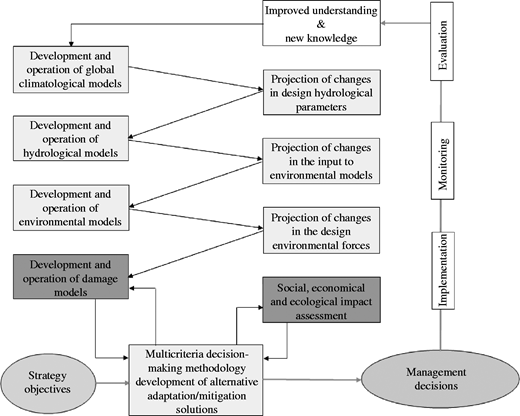
Adaptation requires technical know‐how. This technical know‐how needs to be structured in a way that can quickly convert new scientific facts and learning from the adaptive management cycle to alternative solutions so management can make decisions in a short period of time. The integration of computer modelling with qualitative and analytic discussions offers opportunities that can lead to better qualitative understanding of the system and the generation of alternative solutions. Figure 3 shows the structure of a strategic decision support system (SDSS) that is developed, using a suite of computer models, to support the strategic planning framework for managing flood risk on the Gold Coast. This SDSS will support and operate in tandem with the adaptive management framework shown in Figure 3.
Following is a brief description of how SDSS works. SDSS comprises of a number of hydrological, hydrodynamic, flood damage, economic, and social models. These models, similar to the rings of a chain, are connected to each other. The out put of each model is the input to the next. The final outcome of this system is a number of solutions with known ecological, social and economic impacts. The process starts with collection of new climate change information associated with various emission scenarios and various predictions associated with each scenario. These input data are then converted to flood levels through using climatological, hydrological and hydrodynamic model elements of the SDSS. The obtained flood levels are then fed as input to damage model to calculate damages associated with flood level predictions. At this point, a number of solutions can be formulated for flood management. A solution could simply be setting a flood planning level above‐which new developments will be allowed to happen. Obviously, the flood planning level will depend on the chosen climate change scenario. A social, economic and ecological impact assessment will help decision makers to find the most suitable flood planning level out of the suggested solutions. A multi‐criteria decision‐making process (embedded in the system) allows for comparing the impacts that can be measured in monetary terms and those that cannot be easily quantified (such as intangible losses). Once the decision is made the social, economic, and social impacts of the decision will be monitored. The outcome of this monitoring program will be fed back to the system in the next cycle of running the decision support system. The next cycle commences, once new knowledge of climate change is made available.
5 Summary and conclusion
There are a number of reasons that requires new ways of strategic thinking when dealing with the issue of climate change, such as:
Predicted changes to the characteristics of the socio‐economic and environment systems due to climate change are highly uncertain.
Climate change happens along with other local, regional and global changes. How to account for these future changes and how they will interact with climate change to produce impacts is a problem to be addressed.
Some of the social and ecological impacts of climate change induced flooding cannot be easily measured by monetary terms alone. Therefore, it is difficult to compare these impacts to those that are quantified in monetary value. Finding a common metric for all types of effects remains a problem to be addressed.
This study suggests a method in which an adaptive management concept is used to create a robust framework for developing strategies and policies that are sustainable and resilient against future uncertainties and takes into consideration socio‐economic impacts of climate change (in the context of flooding). This framework advocates policy‐based experimentation in order to reduce the ecological, social and economic cost of learning about the impacts of climate change. The study identifies a number of modifications to the current institutional arrangements at a local government level that are necessary for successful implementation and sustenance of such an adaptive management strategy. This study distinguishes between a strategy for adaptation and an adaptive strategy. It identifies the following differences between adaptive and non‐adaptive strategic plans: in the former, monitoring happens in a proactive mode. It has a focus on strategy effectiveness through targeted studies and learning occurs from mistakes made during these studies. In the latter strategy monitoring happens in a passive mode. It has a focus on compliance and learning occurs when signs of failure are detected.
The study introduces a SDSS that comprises of a set of environmental and socio‐economic models. The system enables conversion of new scientific findings about climate change into new policies in a short‐time frame. Hence, it supports the adaptive element of the strategic plan by improving the promptness, responsiveness, dynamic and flexibility of decision‐making process. Integration of the decision support system with the suggested strategic framework allows decision makers to consider uncertainties associated with climate change, socio economic impacts of climate change and interaction between future climate changes and other local changes more effectively.

SDSS for the support of sustainable strategy for flood management on the Gold Coast
SDSS for the support of sustainable strategy for flood management on the Gold Coast
The authors of the paper would like to thank the managements at Planning, Environment & Transport Directorate at the Gold Coast City Council for their support of this project and Ms Margaret Parker for editing the manuscript.
References
About the authors
Hamid Mirfenderesk is the Team Leader of the Waterways & Flood Management Section, Gold Coast City Council. He also works as a casual Lecturer at the Queensland University of Technology and holds an Adjunct Associated Professor position at the Griffith University. He has more than 20 years engineering and academic work experience in the fields of hydraulics, water resources, flood management, environment, coastal and structural engineering, and strategic planning. He holds a PhD in Coastal Engineering, Master of Science in Civil Engineering, and a Graduate Diploma in Information Technology from the University of New South Wales. He also has a Bachelor of Engineering Science in Civil Engineering from the Tehran University. Hamid Mirfenderesk is the corresponding author and can be contacted at: h.mirfenderesk@gu.edu.au
David Corkill is the Manager of the Strategic & Environmental Planning & Policy Branch in Council's Planning Directorate Gold Coast City Council. David holds qualifications in Urban and Regional Planning, Coastal Resource Management, and Business Management. Since the late 1980s, he has been involved in many land use planning and natural resource management projects at the local, regional, and state level within South East Queensland, Australia.

