


The purpose of this study is to analyze smallholder farmers’ perceptions on climate change and its stressors, their adaptation strategies and factors that influence their adaptation to climate change.
The study was conducted in Kweneng district, located in the south eastern part of Botswana. Multi-stage sampling was used to obtain a representative sample from three sub-districts in the district. A structured questionnaire was used to collect data by using face-to-face interviews.
Majority of farmers perceived an increase in mean annual temperature and the number of hot days and a decrease in mean annual rainfall and the number of rainfall days over the past 10 years as indicators of climate change. The prominent adaptation strategies included changes in planting dates for crops and supplementary feeding for livestock. The logistic regression results show that gender, age, household size, poverty, shortage of land, mixed farming and knowledge about climate change significantly influence adaptation.
The findings indicate that climate change policy should target agricultural diversification at the household level and dissemination of information on climate change and adaptation strategies.
Policy recommendations can be suggested: government climate change interventions should target agricultural diversification at the household level, and this study provides insights on what influences adaptation strategies and what should be targeted to build resilience in the agricultural sector.
1. Introduction
The impacts of climate change are prominent worldwide (Oppenheimer et al., 2014), especially in drylands, where its adverse effects are exacerbated by high rainfall variability (Kgosikoma and Batisane, 2014) coupled with high temperatures. Thus, climate change threatens agricultural productivity through increased temperatures, changes in precipitation patterns and increased occurrences of extreme weather conditions (Nelson, 2009), new crop and livestock pests, limited supply of irrigation water and the increased severity of soil erosion (Adams et al., 1998). In addition, climate change may create new and suitable conditions for weeds, insects and pathogens to proliferate, resulting in further decline in agricultural productivity. The competition between weeds and crops for space, water and nutrients from the soil has already been attributed to the highest crop losses globally, about 34 per cent (Oerke, 2006), and may be exacerbated by climate change. Similarly, the productivity of livestock sector is declining because of heat stress, poor nutrition (Muntifering et al., 2006) and shortage of drinking water, which can be attributed to climate change.
Agriculture in Africa supports livelihood of 80 per cent of the population (FAO, 2016), representing over 800 million inhabitants in 2010 (FAO, 2012). Hence, it is a dominant economic activity, particularly to rural households in drylands such as Kgalagadi-Namib region, as it is the main source of food, income and employment. Given the high vulnerability of rural communities in drylands to climate change, it is essential to build resilience to climate change in the agricultural sector through the adoption of climate smart agricultural practices. Sustainable adaptation practices ensure that farmers achieve their food, income and livelihood security objectives in the face of changing climatic and socioeconomic conditions and volatile short-term changes in local and large-scale markets (Phuong, 2011; Kandlinkar and Risbey, 2000), thus reducing vulnerability to climate change (Nhemachena and Hassan, 2007) and poverty (Halsnaes and Traerup, 2009).
The local farming communities have always adapted to perceived environmental risks, and evidence suggests that farmers worldwide acknowledge changes in climatic conditions and its threat to their livelihood. Most farmers in African countries have observed long-term increased temperatures, declining and pattern change in precipitation and increase in drought frequencies changes in rain patterns as a results of climate change (Hassan and Nhemachena, 2008; Gbetibouo, 2009). Farmers’ vulnerability and perception to climate change is influenced by factors such as soil fertility, lack of finance, access to water for irrigation and access to climate information (Maddison, 2006). In addition, farmers with high education and farming experience (Gbetibouo, 2009; Hassan and Nhemachena, 2008) and access to extension services and mass-media are likely to have high awareness of climate risks (Sampei and Aoyagi-Usui, 2009) and better adaptive capacity. Farm size, tenure status, access to market and credit availability are other major determinants of adoption in Africa (Maddison, 2006).
Farmers’ awareness and perceptions of changes in climatic conditions shape their response to risks associated with climate change. In Botswana, knowledge on farming communities’ perception to climate change and determinants of adaptation practices adoption is limited, except in the Okavango region. As a result, this study was conducted to:
determine farmers’ perceptions on climate change and its stressors in Botswana;
identify farmers’ adaptation strategies to climate change; and
determine factors that influence farmers’ adaptation to climate change.
Understanding how Batswana farmers have coped over the years will help policy-makers implement sustainable adaptation strategies that will help reduce climate change impacts in future.
2. Methodology
2.1 Study area
The study was conducted in Kweneng district, located in the south eastern part of Botswana, in 2014. The target population for the study was the Kweneng district subsistence or smallholder farmers who are highly vulnerable to drought, a key stressor of climate change. Kweneng district is semi-arid with annual rainfall ranging between 300 and 500 mm and mean summer temperature ranging between 24°C and 27°C (Kgosikoma et al., 2012). Kweneng district is generally dominated by non-calcareous sandy soils, and the vegetation type is classified as central bush savanna. Agriculture is the main economic activity in this district, which is essential for local food security and communities’ livelihoods.
2.2 Data collection
A structured questionnaire was used to collect primary data from farmers by using face-to-face interviews to make sure farmers understand and are able to respond to the questionnaire, thus maximizing the response rate. This approach is widely used to collect data in ecology and natural resource management (White et al., 2005), including ecological knowledge of resource users. Face-to-face interviews are commonly used when collecting primary data from smallholder farmers because a high response rate is obtained compared to other methods of data collection (Hox and De Leeuw, 1994). In addition, other methods such as telephone or mail survey are not ideal as poor smallholder farmers would not necessarily have access to these.
The questionnaire captured farmers’ demographic characteristics, perceptions on climate change including changes in rainfall, temperature and extreme weather events in the past 10 years, and important indicators of climate change. It also captured how climate change has affected crop and livestock production in the past 10 years and the strategies used by farmers to cope with climate change. According to Reyes-García et al., 2015, four main types of local indicators can be derived from local knowledge to explain climate change. These are local observations of climate change (including changes in temperature, precipitation and wind) and its impacts on the physical, biological and socio-economic systems.
Empirical evidence suggests that local people with long history of interaction with their environment develop intricate and complex systems of first-hand knowledge on weather and climate variability, as well as climate change (Orlove et al., 2000; Stigter et al., 2005; Fernández-Llamazares et al., 2015; Marin, 2010). According to Huntington et al., 2004; Rosenzweig and Neofotis, 2013; Fernández-Llamazares et al., 2016, there is an overlap between local knowledge and scientific information, highlighting the critical role of local perceptions in climate change deliberations. Furthermore, farmers are asked about determinants of adaptation strategies.
The study used a multi-stage sampling procedure to obtain a representative sample of the population from three sub-districts of the Kweneng district. The first stage involved listing of villages in the district and then purposively selecting villages dominated mainly by agricultural activity. Within the selected villages, simple random sampling was then used to select a sample of 100 farmers interviewed for this study. The sample size was determined by following the minimum sample size calculation as suggested by Peduzzi et al. (1996). The minimum number of observations included is N = 10 k/p, where p is the smallest of the proportions of negative or positive observations in the population and k is the number of covariates or independent variables. For this study, k = 14 and p = 0.2 (proportions of negative observations), and the minimum number of observations (sample size) is 25. However, according to Long (1997), if the resulting number is less than 100, you should increase it to 100 for the logistic regression model.
2.3 Theoretical framework
In the present study, the dependent variable is binary, that is, either the farmer used an adaptation strategy or did not use. A relevant statistical model when the dependent variable is binary is the logistic regression model. Following Uchezumba et al. (2009), the choice of binary logistic regression techniques was based on two reasons: first, the technique can be used to analyze the relationship between a categorical response variable and a set of both continuous and categorical variables and second, the technique is best suited for modeling non-linear distribution, which is not appropriate with ordinary least squares. Following Gujarati (2003), a logistic regression model is specified as:
where Pi is the probability of household i adopting at least one adaptation strategy, Yi is the level of adaptation by the same household i, Xi is a set of explanatory variables influencing the participation of household i in the cattle market and the βi,s are the parameters to be estimated.
The term can be denoted as Zi, so that equation (1) becomes:
Given that the probability of adopting at least one adaptation strategy (Pi) is as given in equation (2), then the probability of not adapting any strategy (1 − Pi) can be expressed as specified below:
The odds ratio Pi/1 − Pi is, therefore, is given as:
Taking the logarithm of equation (4), the logit model takes the form:
where Li is the logit and εi is the error term, and the other variables are defined as before. The marginal effects for the binary variables is calculated by predicting the outcome probability for each observation given that adaptation = 1 and then again for each observation substituting adaptation = 0. The sample average of the difference between those outcome probabilities is the average marginal effect or just marginal effect. The marginal effect for the categorical variables on the probability of household i adapting to climate change is determined by taking the partial derivative of the probability of the outcome with respect to explanatory variable for each observation in the data set. The sample average of that is then reported as the average marginal effect.
The binominal logit model was used to determine the factors that influence farmers to adapt to climate change. The diagnostic tests of the model showed high correlation of 0.80 between some covariates in the initial model, resulting in some variables being dropped. The model was tested for common regression model problems, that is, model specification, model fit and multicollinearity, and there were no indications of any of these problems. The variance inflation factor (VIF) often used to identify multicollinearity indicated that the largest VIF was only 2.86. A VIF of 10 indicates presence of multicollinearity, which requires attention. The probability model was correctly specified and fit the data well according to the Hosmer and Lemeshow’s goodness-of-fit test and the STATA “linktest” diagnostic tests, which produced statistically insignificant results (probability > χ2 = 0.9707; p > | z | = 0.329), indicating that the model fits the data well and has no specification error. A model with Huber–White robust standard errors was adopted to counter any heteroscedasticity problems.
2.4 Empirical framework
To evaluate the determinants of adaptation to climate change, the following general logistic regression model was used:
where ln(Pi/1 − Pi) is the logit for adaptation to climate change choices; Pi represents adaptation; 1 − Pi is not adapting and Xis represents covariates as previously stated. The empirical model, with the explanatory variables selected based on theory, is presented as:
The explanatory variables hypothesized to influence farmers’ ability to adapt can be broadly categorized into demographic characteristics (FD), endowment and (FE) and perceptions on adaptation constraints (FP) and are described in Table I and subsequently discussed.
Description of explanatory variables hypothesized to influence adaptation
| Variable | Full variable name | Description | Hypothesized sign |
|---|---|---|---|
| GENDER | Gender of a household head | Binary, 1 if men and 0 otherwise | + |
| AGE | Age of a household head | Categorical | − |
| HHSize | Household size | Continuous | + |
| YrOFFARMIN | Years of farming | Continuous | + |
| EDUC | Years of education for a household head | Continuous | + |
| AGRICINC | Income from agriculture | Continuous | + |
| NON_AGRIC_INC | Income from other sources | Binary, 1 if there are other sources of income, 0 otherwise | + |
| MIXEDFARM | Farmer practices mixed farming | Binary, 1 if mixed farming is practiced, 0 otherwise | + |
| KNOWCLIMATE | Farmer knows about climate change | Binary, 1 if farmer knows about climate change, 0 otherwise | + |
| LACK_KNWLGD | Lack of knowledge on adaptation strategies an important constraint to adaptation | Binary, 1 if important, 0 otherwise | − |
| LACK_CREDIT | Lack of access to credit an important constraint to adaptation | Binary, 1 if important, 0 otherwise | − |
| POVERTY | Poverty an important constraint to adaptation | Binary, 1 if important, 0 otherwise | − |
| LACK_WATER | Lack of access to water an important constraint to adaptation | Binary, 1 if important, 0 otherwise | − |
| LACK_LAND | Lack or shortage of agricultural land is an important constraint to adaptation | Binary, 1 if important, 0 otherwise | − |
3. Results
3.1 Farmers’ perceptions on climate change and its stressors
The farming community in Kweneng had observed several indictors and impacts associated with climate change (Table II). The majority of the respondents in the study indicated that the temperature and the number of hot days have increased over the past 10 years by 97 and 91 per cent, respectively. Almost all farmers in Kweneng have also observed decline in rainfall, and 95 per cent of them have noticed a decrease in rainfall days. Most agro-pastoralists in Kweneng were concerned with reoccurrence of drought, particularly that their observed trends indicated increased drought frequency. Based on most farmers’ perceptions, flood occurrence has not changed much in the past 10 years. The observed changes in climatic conditions reported by farmers were associated with reduced crop and livestock productivity.
Farmers’ perceptions of climate change and its impacts on production as a percentage of the total respondents (N = 91)
| Percentage | ||||
|---|---|---|---|---|
| Perceived climatic changes and its impacts on agriculture during the past decade | Increase | No change | Decrease | Unsure |
| Mean temperature | 97 | 0 | 1 | 2 |
| Number of hot days | 91 | 5 | 1 | 2 |
| Mean rainfall | 2 | 1 | 97 | 0 |
| Number of rainfall days | 3 | 1 | 95 | 1 |
| Occurrence of drought | 82 | 11 | 1 | 5 |
| Occurrence of floods | 1 | 74 | 14 | 11 |
| Crop productivity | 14 | 3 | 76 | 0 |
| Livestock productivity | 18 | 1 | 73 | 3 |
Farmers attributed decreased crop and livestock productivity to several stressors associated with climate change. Most farmers identified drought and low rainfall as the major risks to agricultural productivity (Figure 1). In addition, high temperature was reported to cause poor growth of crops and livestock because of heat stress. A moderate proportion of farmers mentioned pests and diseases as climate change stressors that result in reduced agricultural productivity. Poor vegetation was mentioned by only a negligible proportion of Kweneng farmers as a climate change stressor that leads to decline in crop and livestock productivity.
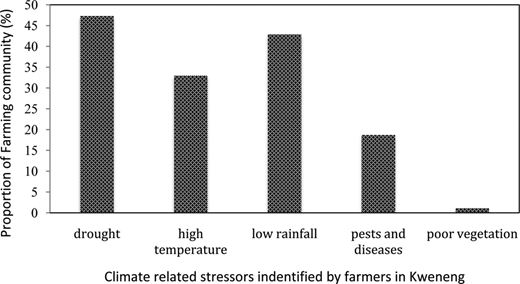
Climate change-related stressors that reduce agricultural productivity as perceived by farmers
Climate change-related stressors that reduce agricultural productivity as perceived by farmers
3.2 Adaptation strategies used by farmers
From a sample of 91 farmers, the majority of the farmers (82 per cent) had adapted to climate change. The adaptation strategy used by the majority of the crop farmers in Kweneng district was to change of planting dates to be aligned with the current rainfall patterns (months). Other crop-related adaptation strategies included change in crop varieties planted, switching from crop to livestock production, implementation of soil conservation techniques, use of irrigation and use of shades and shelters and changes in the use of chemical fertilizers, pesticides or insecticides. Livestock production adaptation strategies farmers perceived as appropriate in the region were vaccinating farm animals, supplementary feeding, fencing and shading (housing) (Table III).
Adaptation strategies used by farmers
| Adaptive strategy | Frequency | (%) |
|---|---|---|
| Crop sector | ||
| Change of planting dates | 64 | 85 |
| Change crop variety | 12 | 23 |
| Switching from crops to livestock | 1 | 1 |
| Implementation of soil conservation techniques | 20 | 27 |
| Use of irrigation | 3 | 4 |
| Change use of chemical fertilizers, pesticides or insecticides | 15 | 20 |
| Livestock sector | ||
| Supplementary feeding | 5 | 5 |
| Vaccinations | 1 | 1 |
| Use of shades and shelters | 3 | 4 |
3.3 Determinants of adaptation to climate change
From the results of the logistic regression model, the determinants of adaptation to climate change are gender, age, household size, mixed farming, knowledge about climate change, poverty and shortage of land. The results indicated that female-headed households are 16 per cent more likely to adapt to climate change than male-headed households. Moreover, the results revealed that increased households’ size and age of head negatively influenced farmer’s adaptive capacity. Mixed farming and knowledge on climate change increased farmer’s adaptive capacity by 18.3 and 26 per cent, respectively. Other significant determinants of adaptation to climate change identified by farmers in Kweneng were poverty and shortage of land, which individually reduced adaptive capacity by about 20 per cent (Table IV).
Determinants of smallholder farmers’ adaptation to climate change
| Variable | Coefficient (robust standard error) | Marginal effect |
|---|---|---|
| GENDER | −1.846 (1.088)* | −0.162* |
| AGE | −1.180 (0.654)* | −0.104* |
| HHSize | −0.251 (0.105)** | −0.022** |
| YrOFFARMIN | 0.016 (0.024) | 0.001 |
| EDUC | 0.064 (0.154) | 0.006 |
| AGRICINC | 0.0004 (0.0003) | 0.00004 |
| NON_AGRIC_INC | 1.318 (1.084) | 0.116 |
| MIXEDFARM | 2.082 (1.015)** | 0.183** |
| KNOWCLIMATE | 2.957 (1.421)** | 0.260 |
| LACK_KNWLGD | 1.359 (1.091) | 0.119 |
| CREDIT | 1.716 (1.608) | 0.151 |
| POVERTY | −2.304 (1.022)** | −0.203** |
| WATER | 1.838 (1.344) | 0.162 |
| LAND | −2.264 (0.931)** | −0.199*** |
| N Wald χ2 (15) Probability > χ2 | 91 25.19 0.05 |
Notes:
***;
** and
* indicate significance at 1%, 5% and 10% probability levels, respectively
4. Discussion
4.1 Farmers’ perceptions on climate change and its stressors
Majority of agro-pastoralists in Kweneng associated observed increased temperature with climate change. This view is augmented by increased number of hot days experienced in that area and consistent with projections that temperatures in semi-arid of southern Africa will increase by between 3.4°C and 4.2°C, which is more than the 1981-2000 average under the A2 scenario by end of the twenty-first century (Niang et al., 2014). In addition, farmers suggested that annual rainfall and number of rainy days have decreased because of climate change. Subsequently, farmers mentioned that drought frequency has increased, and their observations are supported by other studies in the region (Makhado et al., 2014). High proportions of farming community in Kweneng associated observed climate changes with decreased agricultural productivity, including both crop and livestock sectors. This could be explained by the fact that agricultural production systems in Botswana and southern Africa are largely dependent on rainfall (Makhado et al., 2014) and thus vulnerable to rainfall variability, as suggested in other studies (Kolawole et al., 2016). Similarly, it has been demonstrated that rainfall variability drives both crop yields (Kolawole et al., 2016) and livestock productivity (Kgosikoma and Batisane, 2014) elsewhere in Botswana. The livelihood of smallholder livestock farmers in communal lands of Botswana is therefore more vulnerable to climate change, partly because of compounding effect of land degradation and partly because of insecure land tenure (Dougill et al., 2010).
As suggested by farmers in Kweneng, drought and low rainfall are the primary climate-related stressors to agricultural sector. Similarly, it was reported that drought and low rainfall have high negative impact on crop failure, especially maize and sorghum in the Okavango region of Botswana (Kolawole et al., 2016). Frequent drought also causes decline in livestock body condition and eventually increased mortality, as observed in other drylands (Opiyo et al., 2015. In addition, high temperatures are also associated with low output from agriculture sector because of high water demand and heat stress. In the livestock sector, exotic higher-producing breeds that are suited to farming in temperate climate are more vulnerable to heat stress, and their productivity is likely to decline more than indigenous breeds (Archer, 2011). Simulations demonstrated that increased temperature by 2°C and 3°C leads to reduced maize yields by 21 and 36 per cent and sorghum yields by 16 and 26 per cent, respectively, in Botswana (Chipanshi et al., 2004), which is consistent with farmers’ perception.
4.2 Adaptation strategies used by farmers
The food security and livelihood of agro-pastoral communities are threatened by climate change, and innovative interventions are necessary to improve agricultural resilience. Kweneng farmers reported using a variety of adaptation strategies to minimize the risks of observed climate change in their production, just like other farmers in Botswana (Kgosikoma and Batisane, 2014; Mogotsi et al., 2011) and other drylands (Opiyo et al., 2015). They indicated that planting dates had been adjusted in response to late rain onset and further enhanced by change in crop variety. Drought-tolerant and early-maturing crop varieties are highly recommended for drylands and have been applied by other farmers in southern Africa (Wiid and Ziervogel, 2012). Investment and research innovation are needed to develop new crop varieties, including hybrids that are highly tolerant to temperature, moisture stress and other relevant climatic conditions (Smit and Skinner, 2002). Some farmers also suggested the use of soil conservation technique to protect the soil from degradation and maintain its productivity as an adaptive strategy.
Overall, smallholder livestock adaptive capacity among Kweneng farmers was low as only few practices were suggested, and therefore, more needs to be done to build adaptive capacity in this sector. Supplementation was suggested by few farmers, and that could be because government subsidizes livestock feed during drought periods. In addition, indigenous browser plants have high potential as feed (Aganga et al., 2000) to be used to supplement livestock.
4.3 Determinants of adaptation to climate change
The logistic regression model results highlighted several factors as determinants of adaptation to climate, including gender of the household head. Contrary to expectation, female-headed households are more likely to adapt to climate change than male-headed households, and this could partly be attributed to willingness of women to change their livelihood strategy in an effort to support their families. In addition, age of household head negatively affected the adaptation to climate change. A plausible explanation is that older farmers may be more conservative and more risk-averse compared to younger farmers, resulting in a lower likelihood of adopting new technologies (Gbetibouo, 2009). The results also indicated that large family size also increased farmers’ vulnerability to climate change as a unit increase in the household size resulted in a 2.2 per cent reduction in the probability of adapting to climate change. That is because a large family has high consumption demand, and this put enormous pressure on little resources available during drought periods, and some families may be forced to divert part of the labor force to off-farm activities in an attempt to earn income.
The results showed that knowledge about climate change increases the probability of adaptation by 26 per cent. Similar findings were reported by Atinkut and Mebrat (2016), who found a positive and significant relationship between access to information on climate change and adaptation. As a result, improved extension services that provide technical support on agriculture and climate change services will significantly reduce vulnerability to climate risk (Harvey et al., 2014). Farmers need to be educated on the vulnerability of specific species/crops and the appropriate species/crop mix, including drought-resistant breeds/crops so that they can adopt appropriate adaptation practices to minimize the adverse impact of climate change (Kabubo-Mariara, 2008).
Diversification of herd composition or crops is an essential component of adaptation to climate risk in the agricultural sector (Smit and Skinner, 2002) because of improved access to market and basic food (Opiyo et al., 2015). The results of this study also confirmed that agro-pastoralists with diversified agricultural practices (mixed farming) are more (18.3 per cent) resilient to climate shocks than those who practice either crop or livestock production only. Unfortunately, smallholder farmers normally have limited resources to enhance diversification and as a result are more vulnerable to climate risks (Harvey et al., 2014). Poverty was therefore identified by farmers as a strong determinant of adaptation to climate change. Limited access to resources such as land also contributed significantly toward low adaptive capacity of smallholder farmers.
5. Conclusions
This study has shown that most farmers in Kweneng district are aware of the increasing temperatures and decrease in rainfall and have attempted to adapt different strategies to mitigate the effects of the changing climate. The predominant adaptation strategies used by crop farmers were changes in planting dates in line with shifts in rainfall season onset, changes in crop varieties planted, changes in the use of chemical fertilizer, pesticides and insecticides, implementation of soil conservation techniques and irrigation. The adaptation strategies pointed out as appropriate for use by livestock farmers were supplementary feeding, vaccination and provision of shading or livestock housing. However, smallholder livestock adaptive capacity among Kweneng farmers was low as only few practices were suggested, and therefore, there is a need to build adaptive capacity in this sector.
The binary logit model results indicated that gender, age, household size, poverty and lack of access to credit significantly and negatively affect adaptation to climate change, whereas diversified agricultural practices and knowledge of climate change significantly and positively influence adaptation. Given the significance of knowledge about climate change on adaptation, government should implement programs that will help increase access to information on climate change and the appropriate adaptive strategies. Policy options to facilitate the availability of credit; investment on yield-increasing technologies; opportunities for off-farm employment; research on the use of new crop varieties and livestock breeds that are more suited to drier conditions; and investment in irrigation should be implemented to help increase production and decrease the vulnerability of farmers toward climate change.

