


It is globally accepted that climate change is presently the greatest threat to the sustainability of human livelihood and biodiversity. Most farmers in the study area are highly aware of climate change and its consequences on the farming system; however, mitigation strategies are clearly lacking. Among the mitigation, mechanism to reduce the threat is achieved by increasing the amount of carbon sinks and reducing greenhouse gas emission through the adoption of agroforestry practices. The purpose of this study is to determine if awareness on climate change leads to the adoption of agroforestry practices, and to examine the determinants.
A total number of 117 questionnaires were administered to the farmers in the district using stratified random sampling technique. Data were captured and analysed using STATA and XLSTAT software. Descriptive statistics and Heckprobit sample selection model were used to determine the objectives of the study.
The result established that climate change awareness does not lead to the adoption of agroforestry in the study area in which information source and member’s association were statistically significant at (p < 0.1) and (p < 0.05), respectively, and determine the adoption of agroforestry practices, while farming experience (p < 0.1), age (p < 0.05), extension visit (p < 0.05) and education (p < 0.1), were the determining factors that influence the awareness of climate change in the study area.
Regular number of extensions visit, information and training on agroforestry should be provided to the farmers in the study area.
Farmers’ association should be strengthened among the rural farmers.
The causal effect or relationship of climate change awareness on mitigation through the practice of agroforestry in South Africa, especially in the study area, has not been measured. This research set a pace in the area of climate change awareness leading to mitigation strategies through the use of agroforestry practices as an option to be used in the rural farming area of South Africa.
1. Introduction
It cannot be gainsaid that agricultural production is exposed to climate change, for farmers have divulged that it poses a very big challenge to them. Equally, the threatening impact of climate change on livelihood, food production, health status, and other aspects of rural livelihood has been confirmed by various researches. For instance, Deschênes and Greenstone (2007) avow that the effect of climate change is perceived on food security, natural resources, economic activities, physical infrastructures, and environmental degradation. Likewise, different researchers, but from related field submit that the threat is caused by natural phenomenon and human activities which have consequently given rise to greenhouse gases. Ironically, just as agricultural production contributes to climate change, yet it is also affected by it. In Sub-Saharan countries, South Africa inclusive, the impact of climate change, as reported by Oduniyi (2018), has reflected on financial capital, and which is attributed to low profit and low cooperative finance. According to Grain South Africa (GSA, 2015), maize industry is one of the largest supply of food production that yields about 25 to 33 per cent of the country total gross agricultural production, and this form the staple food for the majority. However, there is currently a significant reduction in the production of maize as a result of climate change impact. Correspondingly, Vogel et al. (2010) predicted an increase in temperature which will result in 28 per cent restriction in some area suitable for crop production in 2020. Consequently, to address this increase in temperature, the adoption of agroforestry is one of the effective measures that can be used to mitigate climate change.
Even though climate change adaptation and mitigation strategies provide a broad mechanism that enables the farmer to survive the detrimental effects of climate change, yet this paper focuses on how to mitigate the negative impact of climate change on farm produce. Congruently, climate change mitigation refers to activities embraced to deal with the causes of climate change. It refers to the activities or efforts used to reduce the number of greenhouse gasses released. Food and Agricultural Organisation, (FAO, 2005) defines climate change mitigation as a systematised method whereby people pursue or strive to lessen the amount of climate change by reducing the emissions of carbon and other greenhouse gasses. However, climate change mitigation strategies are rarely adopted in Africa because of inadequate resources and low technical skills needed to adopt the process. Despite the fact that majority of the farmers in the study area are aware of climate change yet they fail to implement mitigation strategies. Subsequently, this negligence has become a major concern for agricultural policy in Africa, South Africa inclusive. As earlier stated though agriculture is known to contribute to the cause of climate change, yet it is affected by the same phenomenon. Equally, agriculture has the same potential to fight climate change, by reducing the greenhouse gasses. As a party to the Paris climate agreement, South Africans are indebted to take cognisance of climate change, its impact, and causes, besides being committed to mitigation and adaptation efforts which focus largely on agriculture and land use management so as to lessen greenhouse gas emissions and increase carbon sequestration. Thus, climate change mitigation is achieved by increasing the sequestration of carbon in the atmosphere using vegetation absorption (forestation) and/or other practice or form of carbon sinks.
Forestation, an act of cultivating forest (trees) is a good example of climate change mitigation, a process whereby agroforestry can be used in the agricultural field to reduce the greenhouse gases. Following this, several studies have been conducted to assess the carbon sequestration potential of agroforestry. Agroforestry practices or technology is defined as the combination of agriculture, incorporating trees (forest) cultivation. The practice is an intensive land use management and it is profitable for agricultural production. For instance, Nair et al. (2010) postulate a rough estimate or an appraisal which ranges from 0.29 to 15.21 Mg of C/ha/year above ground and 30-300 Mg C/ha below ground, up to a depth of 1metre. Likewise, numerous works of the literature reveal that agroforestry unifies a method of producing trees and crops and/or livestock in a single system on the same piece or unit of land (Rahim and Hasnain, 2010). Zomer et al. (2014) refer to agroforestry as the inclusion of trees within the same farming system. Still, a definition put forward by The Food and Agriculture Organisation of the United Nations (FAO) posits that agroforestry is a system that embraces both traditional and modern land use systems where trees are cultivated together with crops and/or animal production systems in agricultural settings. Subsequently, agroforestry is classified into agrisilviculture, silvopastoral and agrosilvopastoral. Also, Briggs (2012) and Nerlich et al. (2012) aver that the system of planting trees, crops, and livestock in the same farm has been practiced in many countries.
It should be noted that agroforestry has been in practice in South Africa since the late 1800 s (Menzies, 1988; Hailey, 1957), even up until the era of apartheid (Ayisi et al., 1999). The practice of agroforestry in South Africa is equally confirmed by Guiney (2016), though not significant in number. In the same manner, Zerihun et al. (2014) submit that largely agroforestry practices are not considerable, besides it is less developed; moreover, the research on the practice is poor and available information is difficult to obtain and outdated. Furthermore, according to Bester (2013), formal national policy or strategy needed to promote and support the development and implementation of agroforestry in South Africa is deficient. Hence, it is baffling that despite the benefits of agroforestry practices, which include soil conservation and management, increase biodiversity, and especially its positive contribution to the process of atmospheric carbon sequestration (climate change mitigation), the rate at which agroforestry is practiced in South Africa remains low (Alao and Shuaibu, 2013). Numerous literature studies have affirmed the low level of agroforestry adoption as a mitigation strategy in South Africa.
Thus, it is obvious that majority of the farmers in South Africa do not use any mitigation strategy to adapt to climate change, an observation which is equally found in most developing countries. For instance, irrespective of the fact that most of the farmers in the study area are aware of climate change, they nevertheless did not adopt mitigation strategies, as significant it is to stem and managing the detrimental impact of climate change. Considering its effectuality, it is expected that awareness should lead to mitigation practices. Accordingly, a simple resourceful and efficient mitigation strategy identified in Africa among other strategies is agroforestry practices or technology. In other words, the argument is despite the fact that these farmers are obviously aware of climate change and its consequences, then why have they not bothered to alleviate the aftereffects? Hence, the paper seeks to examine if awareness of climate change leads to the adoption of agroforestry practices. Second, the research seeks to investigate the factors that prevent farmers from adopting agroforestry practices since it is noticed that farmers rate of adoption of the practice or system is low or limited. Consequently, it is believed that the outcome of this research will help the farmers, government and other key stakeholders to develop policies and programmes on agroforestry system (climate change mitigation) which can enable further reduction of greenhouse gasses to sustain biodiversity, increase food production and thus, enhance farmers’ livelihoods.
Research hypothesis: The hypothesis is written in a null form (H0: β = 0).
There is no significant relationship between climate change awareness and adoption of agroforestry practices in the study area.
2. Methodology
2.1 Study area
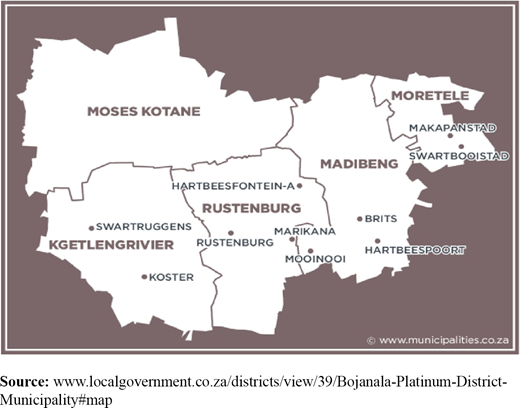
The study was carried out in Bojanala District Municipality in the North West Province of South Africa. The district comprises five local municipalities: Moses Kotane, Moretele, Kgetlengrivier, Madibeng and Rustenburg; these municipalities represent the seat of power in the district. The district is bounded by Waterberg Municipality from the North, on the South is Dr Kenneth Kaunda District Municipality, while the city of Tshwane is at the East and Ngaka Modiri Molema District Municipality is at the west. The population of the municipality is about 1.5 million with a total land area of 18,333 km2 according to the census result in 2011. The mainstays in the area are mining, agriculture and community services. This area is selected purposely because of the availability of the small and emerging farmers, in addition to their being accessible.
2.2 Method of data collection
This study subjected both primary and secondary data to evaluation. Data were collected between 2017 and 2018 by administering a structured questionnaire to respondents in the study area. The questionnaire consisted of a logic flow of questions involving demographics characteristics, climate change awareness and agroforestry-related issues. The questionnaires were explained to the local extension officers before the survey because they understood the farmers better and can translate the questionnaires into a local language. Face-to-face interviews and focus group discussion were conducted in each local municipality where each session lasted for 25 min.
2.3 Population, sampling procedure and sample size
The list of small and emerging maize farmers in the districts was obtained from the Department of Agriculture, Forestry and Fisheries to determine the population of the small and emerging maize farmers in the study area. The sample size was determined using the Raosoft sample size calculator. The sample size calculator took into account the confidence level, the response distribution and the margin of error as indicated below:
The study adopted a stratified random sampling technique to group the population of the farmers from the five local municipalities into strata, after which a random sample was used to select from each stratum. A specific number of respondents was selected from the population of each local municipality. A total of 117 questionnaires were administered to respondents in the districts to ensure an objective outcome of the research (Figure 1).
2.4 Statistical analysis
Heckprobit sample selection model was used to analyse the data because of its accurate and appropriate statistical method, and referred to a probit model with sample selection. The model is a two-step method used to estimate a sample selection when the two dependable variables are dichotomous. The model is akin to a censored probit or double probit model or bivariate probit model with selection. The model has two separate probit models with correlated disturbances, just as the seemingly unrelated regression models (SUR), and each probit model represents Stages 1 and 2 respectively. Stage 1 probit model in the selection equation and the Stage 2 probit model in the outcome equation. To this effect, there exist two binary dependent variables, yj, j = 1, 2, whereby the two decisions are interrelated.
where y∗ are unobservable and related to the binary dependent variables yj by the following rule:
For j = 1, 2. That is, if the errors between the two probit models are independent of one another.
2.5 Model selection
The study used Heckprobit sample selection model to estimate the factors responsible for climate change awareness and the adoption of agroforestry practices for mitigation strategies, simultaneously, among the respondents. STATA statistical software (version 13.0) was used to analyse the data, while a probit model with selection (Heckprobit sample selection model) generated the results for the study. The model is appropriate for the study; first, because the two dependable variables are dichotomous in nature. Second, the model allowed the ascertainment of the two steps leading to farmers’ climate change awareness in a single model, in addition to taking into consideration the adoption of agroforestry leading to mitigation strategies.
The model can be expressed as follows:
Equation (4) above, is the first stage of the Heckprobit sample selection model, which represents the selection equation, where Y is the dependent variable representing the probability of awareness of climate change; β0, β1, β2, β3, β4, β5 and βn, are the coefficient while factors affecting farmers awareness to agroforestry are represented as X1, X2, X3, X4, X5 ⋯ ⋯ ⋯ Xn where μ is the residual term:
Equation (5) is the second stage Heckprobit sample selection model which represents the outcome equation, where Z is the dependent variable which represents the probability of adoption of agroforestry practices. ∂0, ∂1, ∂2, ∂3, ∂4, ∂5 and ∂n, are the coefficient that will be estimated, while examining the factors affecting farmers adoption of agroforestry, X1, X2, X3, X4, X5 ⋯ ⋯ ⋯ ⋯ Xn where φ is the residual term.
3. Results and discussion
While Table I shows the description of the variables used in the model, Table II pictures the summary for the descriptive statistics in which the mean, standard deviation, minimum and maximum values of the variables used in the model are identified. The result represented in Table III evinces that 90.6 per cent of the respondents did not adopt agroforestry practices whereas about 74.4 per cent are aware of climate change. Majority of the respondents (72.6 per cent) belongs to an association (farmers group). Likewise, about 59.0 per cent had no formal education, while 83 per cent claimed that they were never visited by an extension agent, however, farmers association (60.7 per cent) is the major source of income. Majority of the respondents are between the ages of 41 and 50, and a consequent 38.5 per cent. Additionally, about 41 per cent of the respondents in the study area, a percentage which captured most of the respondents, had between 6 and 10 years of farming experience.
Description of variables used in the heckprobit sample model
| Explanatory variables | ||
|---|---|---|
| Variables | Description and unit of measurement | Expected sign |
| Farming system | Binary, 1, with agroforestry and 0, without agroforestry | + |
| Farm Size | In hectare | + |
| Gender | Binary, 1 if the farmer is male and 0 if female | +/− |
| Age | Continuous, the age of the respondent in years | + |
| Education | Binary, 1 if a farmer has formal education and 0 if otherwise | + |
| Land Acquisition | Binary, 1 if the land is inherited and 0 if otherwise | +/− |
| Members’ Association | Categorical according to the association in the study area | + |
| Farming Experience | Categorical, numbers of years of farming | + |
| Access to Credit | Binary, 1 if a farmer has access and 0 if no | + |
| Extension Visit | Binary, 1 if a farmer has access and 0 if no | + |
| Information Source | Categorical according to the sources in the study area | + |
Summary of the descriptive statistics for the variables used in the model
| Variables | Mean | SD (n − 1) | Minimum | Maximum |
|---|---|---|---|---|
| Farming experience | 1.932 | 1.048 | 1 | 7 |
| Farm size | 1.658 | 0.697 | 1 | 3 |
| Gender | 1.274 | 0.448 | 1 | 2 |
| Age | 59.75 | 13.01 | 23 | 73 |
| Education | 1.590 | 0.494 | 1 | 2 |
| Farming system | 1.419 | 0.495 | 1 | 2 |
| Land acquisition | 0.316 | 0.467 | 0 | 1 |
| Climate change awareness | 0.744 | 0.439 | 0 | 1 |
| Agroforestry adoption | 0.094 | 0.293 | 0 | 1 |
| Extension visit | 1.709 | 0.456 | 1 | 2 |
| Access to credit | 0.564 | 0.498 | 1 | 2 |
| Members’ association | 1.274 | 0.448 | 1 | 2 |
| Information source | 2.521 | 0.826 | 1 | 4 |
Descriptive statistics
| Adoption of agroforestry | Awareness of climate change | |||
|---|---|---|---|---|
| Response | Frequency | (%) | Frequency | (%) |
| No | 106 | 90.6 | 30 | 25.6 |
| Yes | 11 | 9.4 | 87 | 74.4 |
| Total | 117 | 100 | 117 | 100 |
| Education | Members’ association | Extension visit | ||||
| Response | Frequency | (%) | Frequency | (%) | Frequency | (%) |
| No | 69 | 59.0 | 32 | 27.4 | 83 | 70.9 |
| Yes | 48 | 41.0 | 85 | 72.6 | 34 | 29.1 |
| 117 | 100 | 117 | 100 | |||
| Source of Information | ||
| Source of information | Frequency | (%) |
| Media | 20 | 17.1 |
| Extension | 21 | 17.9 |
| Farmers association | 71 | 60.7 |
| Local NGO | 5 | 4.3 |
| Total | 117 | 100.0 |
| Farming experience | ||
| Farming experience in years | Frequency | (%) |
| 1-5 years | 45 | 38.5 |
| 6-10 years | 48 | 41.0 |
| 11-15 years | 17 | 14.5 |
| 16-20 years | 4 | 3.4 |
| 21-25 years | 1 | 0.9 |
| 26-30 years | 1 | 0.9 |
| 31-35 years | 1 | 0.9 |
| Total | 117 | 100.0 |
| Age | ||
| Age categories | Frequency | (%) |
| 18-30 | 2 | 1.7 |
| 31-40 | 15 | 12.8 |
| 41-50 | 45 | 38.5 |
| 51-60 | 42 | 35.9 |
| 61-70 | 10 | 8.5 |
| 71-80 | 3 | 2.6 |
| Total | 117 | 100.0 |
As presented in Table IV, the likelihood ratio test for the heckprobit selection model is not significant. According to Van den Broeck et al. (2013), if the correlation between the error terms of the awareness and adoption stage is significant, then the problem of selection bias is indicated, which justifies the use of the heckprobit sample selection model. However, in this study, where the likelihood ratio test is insignificant, the probit regression model is estimated for the two stages equation (awareness and adoption stage) independently. This result is presented in Table IV where the coefficient and the z-value are shown. The first stage of the heckprobit model indicates that, farmer’s experience (p < 0.1), age (p < 0.05), extension visit (p < 0.05) and formal education (p < 0.1) are statistically significant to climate change awareness which is expected to result in climate change mitigation through the adoption of agroforestry practices. Table IV shows that the farmers’ years of experience and age maintain a positive correlation and, as a result, influence the awareness of climate change in the study area. The accumulation of experience possessed by a farmer determines the awareness of climate change, besides age also plays a significant role with respect to the farmer’s experience, or otherwise. Equally, according to Oduniyi (2018), Ndambiri et al. (2012) and Deressa et al. (2008), age was found to be statistically significant to climate change awareness. Ajuang et al. (2016) also assert that age significantly affects climate change awareness. While, Nhemachena and Hassan (2007) opine that farmers who are well experienced due to the number of years spent in the farming activities are more aware of climate change, and can also perceive its occurrence; given this, they have better information and knowledge on changes in climatic conditions in relation to crop management practices.
Model estimation for probit model and heckprobit sample model
| Probit model | Heckprobit model | |||
|---|---|---|---|---|
| Variables | Coef. | z | Coef. | z |
| Climate change awareness | ||||
| Farm Size | −0.2579695 | −1.32 | −0.2621498 | −1.32 |
| Gender | −0.1159813 | −0.37 | −0.2024174 | −0.63 |
| Farming Experience | 0.3043395 | 1.73* | 0.2931186 | 1.65* |
| Age | −0.7176982 | −1.39 | −0.4078696 | −2.24** |
| Land Acquisition | 0.2316214 | 0.77 | 0.1841664 | 0.59 |
| Extension visit | −0.4180120 | −1.20 | −0.9364000 | −2.10** |
| constant | 4.18138 | 1.89 | ||
| LR chi2 (6) = 9.81 | ||||
| Prob > chi2 = 0.1331 | ||||
| Log likelihood = −61.701446 | ||||
| Pseudo R2 = 0.0736 | ||||
| Agroforestry adoption | ||||
| Farm Size | −0.1524594 | −0.54 | −0.0769908 | −0.24 |
| Farming System | −0.2024174 | 0.09 | 0.0874180 | 0.22 |
| Age | 0.1898053 | 0.93 | 0.1898053 | 0.93 |
| Members’ Association | 0.7832894 | 2.13** | 0.7130806 | 1.74* |
| Information Source | −0.3610024 | −1.68* | −0.4938050 | −2.19** |
| constant | −1.3817480 | −1.44 | −1.6522490 | −1.17 |
| /athrho | −0.0657091 | −0.08 | ||
| rho | −0.0656147 | |||
| LR chi2 (4) = 9.25 | ||||
| Prob > chi2 = 0.0553 | ||||
| Log likelihood = −28.98218 | ||||
| Pseudo R2 = 0.1376 | ||||
| LR test of indep. eqns. (rho = 0): | ||||
| chi2 (1) = 0.01 | ||||
| Prob > chi2 = 0.9341 | ||||
| Number of obs = 117 | ||||
| Censored obs = 30 | ||||
| Uncensored obs = 87 | ||||
| Wald chi2 (5) = 8.48 | ||||
| Log likelihood = −85.07406 | ||||
| Prob > chi2 = 0.1315 | ||||
Notes:
*p < 0.1;
**p < 0.05; ***p < 0.01 at 10, 5 and 1 per cent level of significant respectively
As presented in Table IV, the results of the analysis show that the extension visit is statistically significant (p < 0.05), with a negative association or coefficient (−0.9364). This implies that as the extension visitation decreases, the more the farmer’s become aware of the change in climate. A possible explanation for the increased awareness can be attributed to the fact that the farmers have access to information, which proves to be more effective in creating awareness than extension visit. Nonetheless, extension visit provides a vital source of information on climate change as well as agricultural production and management practices. The innovation and information obtained by the farmers on production activities are determined by the extension agents; thus, extension contacts are the carriers of change (Idris et al., 2012). IFPRI (International Food Policy Research Institute, 2007), also advises that improving access to extension services for farmers has the potential to significantly increase farmers’ awareness of changing climatic conditions.
The investigation also evinces that education is statistically significant (p < 0.1) with a positive coefficient (0.5000); this denotes that education has a positive association, and it increases the likelihood or probability of climate change awareness in the study area which can result into the adoption of agroforestry practices for mitigation strategies. The implication is that the level of education has a significant difference in the farmers' awareness of climate change. Climate change awareness and level of education enhance informed decision-making and play a significant role in increasing the adoption of agroforestry practices to mitigate climate change. This result aligns with Bayard et al. (2007) findings, that education significantly, but negatively, affects climate change awareness. Likewise, the studies carried out by Deressa et al. (2009), Deressa et al. (2010) and Maddison (2006), record similar evidence, whereby education of household heads increases the probability of awareness to climate change.
The second stage of the analysis is shown in Table IV, and it points to the fact that farmers who are members of an association, i.e. farmer’s group (p < 0.1) and sources of information (p < 0.05), are statistically significant and influences the adoption of agroforestry practices in the study area. Farmers’ association has a positive influence and consequently determines the adoption of agroforestry practices amongst the respondents, an upshot which can be attributed to the fact that information is usually shared during the meetings, which the members find easier to understand because there is no language barrier. This finding correlated with the submission of Owombo et al. (2014); the researchers argue that farmers’ association has a positive influence, and determines agroforestry techniques adoption among the respondents in Edo State, Nigeria. In the same vein, Kabwe et al. (2009) state that club membership has a positive impact on the adoption of agroforestry in Zambia.
Equally, the investigation carried out also indicates that the source through which information is disseminated to the farmers in the study area determines the adoption of agroforestry practices. Majority of the farmers, specifically 60.7 per cent of the respondents sourced information from farmers’ association as depicted in Table III. The research indicates that farmers comprehend and use information shared amongst one another (association) better. This result corresponds with the postulations of Phiri et al. (2004) and Keil et al. (2005). Both studies aver that the source of information on any technology is a vital instrument for the adoption of agricultural practices especially the ones related to ecological benefits (Table V).
Test of homogeneity
| Margin | Delta-method Standard error | Z | p > |z| | |
|---|---|---|---|---|
| constant | 0.120067 | 0.0665663 | 1.80** | 0.071 |
Notes:
Predictive margins; Model VCE: OIM; Number of obs = 117; Expression: Pr (agroforestry adoption = 1), predict ()
Based on a priori expectation, it is a plausible fact that since farmers are aware of climate change, the rate of adopting mitigation strategy should be high, through the adoption of agroforestry practices, but this is not so. However, the overall result revealed in Table IV is a depiction that the relationship between climate change awareness on the adoption of agroforestry practices for mitigation strategies is negative and not significant. This shows that despite the increased level of awareness on climate change among the rural households farming, it did not bring about an increase in the adaptation of agroforestry practices for mitigation strategies in the study area. It is clearly evident that climate change awareness has no significant impact on the utilisation of mitigation strategies. Subsequently, awareness does not influence or determine the adoption of agroforestry practices. Guiney (2016) affirms that agroforestry systems are not used in South Africa, not even on a limited scale; and this view is equally supported by a recent report on climate change mitigation published by African Climate Reality Project, research which states that South Africa lacks clear climate change mitigation goals. This contrasted with what is stipulated in the policy regarding global mitigation objective agreed upon by stakeholders, under the Paris Agreement (Worthington, 2017).
4. Conclusion and recommendation
The study reveals that the awareness of climate change is not a determining factor for the adoption of agroforestry practices for its mitigation in the study area. Subsequently, the examination validates the null hypothesis (H0: β = 0), that there is no significant relationship between climate change awareness and adoption of agroforestry practices in the study area. The study further confirms that awareness does not necessarily lead to or bring about the adoption of technology. It was however discovered that information source and member’s association were the significant variables that determine the adoption of agroforestry practices in the study area, while farming experience, age, extension visit, and education were the determining factors that influence the awareness of climate change. Thus, the study recommends that information on agroforestry practices should be disseminated through effective means among farming households. Farmers’ association should be bolstered. Additionally, the channel of information dissemination should be improved to facilitate the utilisation of agroforestry practices in the study area. Thus, the paper suggests that there might be other driving factors influencing the adoption of agroforestry practices for climate change mitigation strategies besides awareness. By researching other determinants, this can provide further insight for research on how to drive adoption of new technology or practices beyond awareness.
The authors would like to express sincere gratitude to the anonymous reviewers for improving the quality of this paper. In addition, the support of those who have contributed to the success of this paper is noted. This research was funded by the University of South Africa, [UNISA]. Ethical clearance letter was collected from the college of postgraduate and research unit, of the University of South Africa (UNISA) and from the Provincial Department of Agriculture in the study area to care for both the study’s participants and the researchers.

