


Environmental studies have developed slowly within social sciences in Latin America. This paper seeks to assess and systematize the contribution of social sciences in the research on the human dimensions of global environmental change (HDGEC) in the region outlining its state of the art and process of development.
The approach taken is the organization of a manual compilation and systematic review of publications on topics related to the HDGEC in order to investigate major research topics covering the period between 2001 and 2008.
Although it is possible to identify an emergent body of the literature and scholarship in the region, the involvement of Latin American social science in the HDGEC research is still timid and tentative and not yet institutionalized. The evidence from this compilation has shown that this literature is fragmented bringing difficulties for the homogenization of criteria for analysis and assessment.
The paper is one of the very few attempts to assess and analyze the research on HDGEC in Latin America through an international perspective. It provides an overview of its development building upon the progress of environmental studies in the region and looks to its challenges ahead in order to call for more involvement of social sciences in these research activities.
Introduction
The environmental studies had developed slowly within social sciences[1] in Latin America. The emergence of socio‐environmental movements and the social conflicts embedded in these processes combined with serious environmental problems across the region placed the environment in the social sciences agenda in the 1970s (Hogan, 2007). In the beginning attention was directed to identify the environment components of an unequal society. Unlike the experience of social sciences in many developed countries, the concern of social scientists with ecosystems and the environment appeared later and attention given to biodiversity and ecological important areas emerged with the effects of degradation and environmental protection in the livelihood of traditional populations (Hogan and Tolmasquim, 2001, p. 9).
The last two decades have been marked by the expansion of research and teaching activities in the environmental field in the region. Many environmental centers, interdisciplinary research programs and journals dedicated to the environmental area have been created and fostered in Latin American countries. In addition, these activities have been mostly concerned with environmental problems at the local, regional and national levels (Hogan and Tolmasquim, 2001).
The environmental field within the social sciences was subject of many reviews (Dunlap and Catton, 1979; Lowe and Rudig, 1986; Buttel, 1987, 1996, 1997; Hannigan, 1995; Pulido, 1996; Dunlap, 1997; Redclift and Woodgate, 1997; Mol and Spaargaren, 2000; Lima and Portilho, 2001). The scientific research on environment and society includes a variety of topics and these reviews show that the number of topics has been increasing over the years. This body of the literature and intellectual production has been trying to answer calls for more interdisciplinary studies (Ferreira et al., 2006a, b; Brunn and O'Lear, 1999; Miller, 2002). Some authors argue that incorporating the environmental issues in the social sciences has not resulted in a new paradigm (Alonso and Costa, 2002). Instead of a field of environmental studies, these issues have created sub‐areas of research distributed according to different theoretical approaches.
On the other hand, the likely impacts of global environmental changes (GECs) have rapidly penetrated and shaped contemporary academic debates within environmental studies (Giddens, 2008, 2009), initially in the developed countries and later on in the developing world, including Latin America (Hogan, 2009). The attention given to measures in order to mitigate greenhouse gases (GHGs) emissions and to adapt to the impacts of climate change has been gradually increasing (Adger et al., 2009; Bicknell et al., 2009; Hogan and Marandola, 2009).
As a matter of fact, human behavior is responsible for a variety of large‐scale environmental changes, ranging from systemic developments like climate change to cumulative impacts like loss of biological diversity or changes in the land cover (Parry et al., 2007; International Human Dimensions Programme (IHDP), 2007; Wilbanks and Kates, 1999). Addressing these large‐scale environmental issues and finding ways to foster sustainable development require a concerted effort on the part of researchers who focus on human behavior.
The United Nations Intergovernmental Panel on Climate Change (IPCC), the National Research Council (NRC) in the USA and the Stern Review in the UK, among other international scientific bodies, have systematically appraised the state of climate change research, and have called for a more robust engagement of social sciences to tackle the social and human dimensions of environmental problems. This, in turn, has led the scientific community, policy makers and practitioners to undertake a number of “stock‐taking” projects[2]. These projects have been seeking to map and synthesize the history of past and existing ad hoc environmental research activities by social scientists, in the hope that reflecting upon this compounded knowledge would spur more necessary social science research.
Building on these efforts, this paper seeks to contribute in this direction. It is part of a larger ongoing research project trying to systematize and assess the intellectual production over environmental issues within social sciences in Latin America[3]. Based on preliminary finding, this paper contributes by providing an overview of the development of the human dimensions of global environmental change (HDGEC) research in Latin America and unpacks its state of the art with a particular focus on Brazil. We are interested in understanding the development of human dimensions research within these countries and identify what is essential for supporting social science participation in climate research within the social science community (Hogan, 2007, p. 162).
This paper joins in a series of efforts to assess the existing human dimensions research as an inherent part of the HDGEC research agenda is the study of GEC research itself, and the analysis of science as an inherently social activity (Gallopín et al., 2001; Janssen et al., 2006; Janssen, 2007). Core questions like how scientists frame their problems and how particular worldviews shape the scientific research in the construction of models or scenarios are some examples of these activities (Biermann et al., 2008, p. 13).
First, we present some brief methodological notes followed by an attempt to define HDGEC. Then we present the state of the art of the human dimension research in Latin America building upon what we found about Brazil and some other countries. In the last section we discuss the findings and present our final remarks. We argue in this paper that although it is possible to identify an emergent body of the literature in the region on the interaction between environment and society, the involvement of Latin American social science in the human dimension research is still timid and tentative. Evidence shows that the roles played by international collaboration and international research programs as well as the active role on the part of funding agencies are crucial in securing human dimensions research and inducing the engagement of Latin American social science communities in the discussion. Finally, we call for more involvement of Latin American social science in the research on the HDGEC by providing some areas that should be better developed.
Methodological note
In order to analyze the research on HDGEC in Latin America, we organized a manual compilation and systematic review of publications on topics and themes related to the human dimensions research taking into consideration the diversity of approaches and different conceptual and methodological frameworks. The main objective of this work is to investigate the major research topics in the research on HDGEC identified through the compilation. The background of the bibliographical compilation is largely determined by the outcomes of the ongoing research project “Environmental issues, interdisciplinary, social theory and intellectual production in Latin America”. The assumption is that publications can be considered as one of the main indicators of researchers' active involvement in research activities.
It is not the purpose of this paper to provide an exhaustive collection of the human dimensions field, including all its authors and publications, but to have an overview of its development and process of institutionalization (Ferreira, 2006). However, most research results in this domain are published in journals in English, Spanish and Portuguese languages. The manual compilation includes HDGEC‐related publications such as papers published in Latin American and international peer‐reviewed journals and peer‐reviewed books. It consists of publications that have a clear focus on HDGEC addressed in the context of Latin America. We considered only documents that had at least one scholar affiliated to a Latin American organization covering the period between 2001 and 2008.
The documents were retrieved during 2008 from scientific databases such as the ISI Web of Science, Redalyc, Scielo, Springer, Scientific Direct and Blackwell Synergy and web sites from organizations[4], from which we had previous knowledge that their work were related to HDGEC. The retrieving process has been taken in English, Spanish and Portuguese languages.
The focus of this paper is on social sciences and on disciplines concentrating on interactions between humans and the environment, rather than on the natural aspects of environmental change (Hogan, 2007; Ferreira, 2006). In our search, we were limited by the selection of citations particularly on the “human dimensions” of environmental change. On the other hand, we did not include the comprehensive and more abundant literature available on natural sciences. We were also guided by the need to select the “global” component within the environmental change field. These inputs required an in‐depth evaluation of the data to assess the linkages or implications for certain aspects of environmental change on a global scale.
We created a set of keywords that cover major areas of HDGEC (Table I). The title, keywords and abstract of each document were retrieved by keyword based and checked manually. Only publications in the area of HDGEC were kept. The decision to include or exclude a publication in the database was based on the information provided in the title and abstract of the publication (Janssen et al., 2006; Janssen, 2007).
Defining human dimensions of global environmental changes
Definitions of “global environmental change” can vary widely and be interpreted in many contexts (Adger et al., 2005). However, there is a common agreement that GEC is understood as changes in the physical and biogeochemical environment (e.g. Earth, oceans and atmosphere) either caused naturally or influenced by human activities such as deforestation, fossil fuel consumption, urbanization, land use, agricultural intensification, freshwater extraction, fisheries over‐exploitation and waste production. It includes climate change, stratospheric ozone depletion, and losses of biodiversity, changes in hydrological systems and the supplies of freshwater, land degradation and stresses on food‐producing systems. It also refers to the suite of interacting physical, chemical, biological and human processes that transport and transform materials and energy and thus provide the conditions necessary for life on the planet (International Geosphere‐Biosphere Programme (IGBP), 2001).
There is much debate in the literature on what constitutes “human dimensions” research. For example, the IHDP on GECs defines the HDGEC as “the set of biophysical transformations of land, oceans and atmosphere, driven by an interwoven system of human activities and natural processes”. This definition comprises the causes and consequences of people's individual and collective actions, including changes that lead to modifications of the Earth's physical and biological systems. These changes affect the quality of human life and sustainable development on a worldwide scale (Parry et al., 2007).
In this paper, research on the HDGEC concerns:
[…] human activities that alter the Earth's environment, the driving forces of those activities, the consequences of environmental change for societies and economies, and human responses to the experience or expectation of global change (NRC, 1999a, p. 293).
It covers an integrated approach of natural and social dimensions and:
[…] encompasses analysis of the human causes of global environmental transformations, the consequences of such changes for societies and economies, and the ways in which people and institutions respond to the changes. It also involves the broader social, political, and economic processes and institutions that frame human interactions with the environment and influence human behavior and decisions (NRC, 1999b, p. 295).
In sum, human dimensions research aims at understanding how human activity drives GHGs emissions, regional air quality, land cover change and alterations in terrestrial and marine ecosystems; predicting the course of the activities that drive those transformations; estimating how changes in climate, land cover, ecosystems and atmospheric chemistry affect food, water, natural resources, human health and the economy; analyzing the ways that societies manage environmental resources; and analyzing the feasibility and possible costs and implications of technical, economic, behavioral and policy responses to those environmental changes (Miller, 2002). HDGEC research builds basic understanding of human‐environment interactions and provides information and responsive tools to decision makers (Brunn and O'Lear, 1999).
Although research on the social and policy aspects of environmental change has a long history, human dimensions research only became formally linked to the global change research in the late 1980s (NRC, 1999a; Miller, 2002). It is greatly acknowledged that GECs cannot be understood, much less dealt sensibly, in the absence of substantial contributions from the social sciences and the analysis of the social aspects of these processes (Pachauri, 2008; Hogan, 2007; Miller, 2002).
Throughout the decades, human dimensions researchers have been trying to understand major human causes of changes in the global environment and how they vary over time, across space, scales and the human consequences and impacts of GEC for water, health and agriculture (Pachauri, 2008; Miller, 2002). For instance, the global change research community has made considerable progress in recent years on several important questions, such as the social causes of deforestation in regions like the Amazon River basin and the role of social, political and economic institutions in land use decisions; and the relationships between population and land use (and land cover) change (Lahsen and Nobre, 2007). There have also been expressive improvements in the ability to combine social, physical and remote sensing data within geographic information systems, often with the explicit purpose of understanding how processes at local scales are nested in regional, national and global scales (Brondizio and Moran, 2008).
The first calls for social science involvement came from physical sciences that clearly saw that human activities was one of the main drivers of climate change (Hogan, 2007). In the beginning, these attempts encompassed multiple methodological approaches to human phenomena in formulating a research agenda as the frameworks for conducting human dimensions research have been developed by different organizations and scholars with various training, experience and agendas (Urich et al., 2005).
International research on human dimensions of global environmental change
There has been a remarkable high level of scientific activity in the arena of GEC and relative success on its human dimension (Pachauri, 2008; Urich et al., 2005; Hogan, 2007). Examples are the IGBP, the World Climate Research Programme (WCRP) and the IPCC, programs that have involved a great degree of international cooperation among researchers in the atmospheric, Earth and biological sciences (Pachauri, 2008; Miller, 2002). From the early days of scientific concern about global warming and ozone depletion there has also been some interest in the social implications of these processes because people are seen as both the cause of the effects and the subjects of their consequences (Wilbanks and Kates, 1999).
There was an early attempt in 1990 by the International Social Science Council to develop a Human Dimensions Programme (HDP) to parallel the IGBP and the WCRP that only had limited success. More recently there has been renewed interest and a new version of HDP has been established to build upon the work of the original organization in 1996, the IHDP. As well, the IPCC has become more aware of the need to consider human dimensions in its assessment reports, as is the United Nations Environment Programme for the preparation of its Global Environment Outlook report (Urich et al., 2005).
According to Hogan (2007, p. 162), there have been two related initiatives that have been important in establishing the scientific agenda, promoting exchange and disseminating results of human dimensions research. The first one is the Open Meeting of the Human Dimensions of Global Environmental Change Research Community[5]. The second one is the participation of the national academies of science. In many countries these academies have established national committees and created specific financial support programs (Hogan and Tolmasquim, 2001). Together, these two initiatives are responsible for most part of the significant work on human dimensions that is available so far, particularly in Latin America.
Human dimensions of global environmental change in Latin America
Although social science concerned with the environment have evolved in different ways across Latin America, it was around the 1960s when social scientists started to give attention to environmental problems and it spread rapidly to other societal domains. The institutionalization of the research field on environment and society in Latin America begins between the years of 1980s and 1990s (Ferreira, 1997) and assessments on the intellectual production of the region show the adoption of different theoretical and methodological approaches (Ferreira et al., 2006b).
Hogan (2007, 2009) states that although many social scientists have begun to study the social aspects and consequences of environmental change, they were “unprepared” to incorporate global challenges in the scope of their work. A possible reason is that consequences of GEC such as the sea‐level rise among other aspects of environmental change take place in temporal and spatial scales that are not reflected in the research paradigms of social sciences in general (Miller, 2002).
It is clear that the scales that direct work in the social sciences are different than those applied for the natural sciences and from those at which GECs can be observed and analyzed (Wilbanks and Kates, 1999). Much of the work carried out by environmental social scientists in Latin America is still attempting to understand historical changes and how it shapes contemporary societies (Hogan and Tolmasquim, 2001, p. 10).
Bertero et al. (1998), based on Kuhn's explanations of the so‐called “normal” or incremental science argue that a scientific subject needs paradigms to consolidate it as a field of research. For these authors the paradigm allows the construction and the development of a scientific protocol in the area of research (Gallopín et al., 2001; Bertero et al., 1998). In Latin America, contrasting with the experience of many scientific fields, the social sciences have not come to study the environment through the gradual development of their major paradigms; it was the emergence of environmental grassroots movements combined with serious environmental problems that placed the environment on the social science agenda (Hogan, 2007).
When reviewing the environmental social science literature in the region it is clear that most attention is given to environmental problems at the local and regional and how it interacts with national level policies and institutional frameworks. Topics related to GEC or even climate change are far from being considered as a priority for social scientists. However, it is possible to identify an increase in number and relevance of studies focusing on that in the recent years as the issue is getting more attention from the media and spreading rapidly into the policy realm (Hogan and Marandola, 2009).
In this context, HDGEC as a research field has not been a priority for social scientists concerned with environmental issues in Latin America and social sciences lack behind when compared to the natural and exact sciences (Hogan, 2009, 2007). In many cases the frameworks for HDGEC research sit uncomfortably within the dominant research traditions of social science academia (Hogan, 2007; Miller, 2002) and high quality examples of fully implemented and successful[6] application of these frameworks are scarce (Grant et al., 2002).
The creation of graduate interdisciplinary programs focusing on environment and society can be considered relatively new in the region and some countries are more advanced than others. Although it has been growing over the last decade or so, there are few research programs trying to link the environmental social science with GEC. The same happens when analyzing the number of dedicated journals and relevant academic conferences where GEC appears to be a less‐explored theme (Hogan, 2007).
Looking back
Our compilation over HDGEC in Latin America has dealt with slightly more than 50 documents that included papers in national, regional and international journals, and some books. All of them have a clear focus on HDGEC and present at least one scholar affiliated within a Latin American organization.
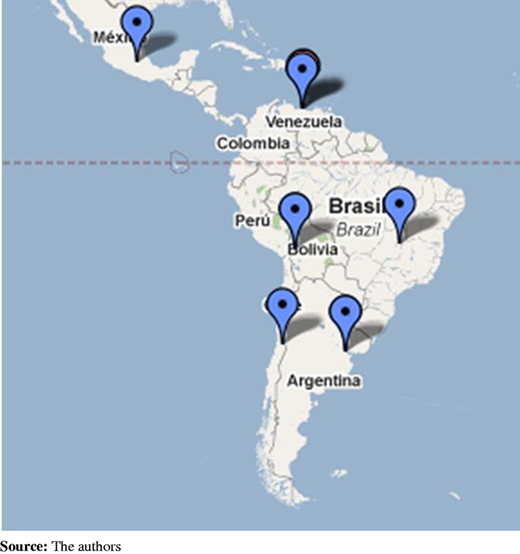
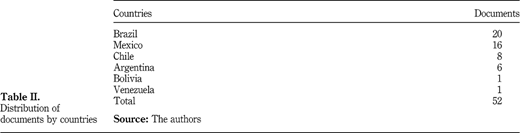
In terms of geographic distribution, Brazil, Mexico, Chile and Argentina are the countries where we could found more documents[7]. Other countries like Bolivia and Venezuela have been contemplated in our quest although they just present one document each (Figure 1). Apart from Mexico, we have not found any published paper from Central America and the Caribbean with clear focus on HDGEC in the selected databases (Table II).
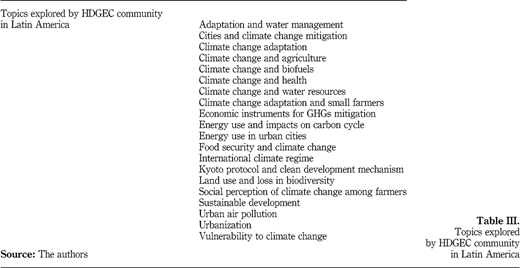
The analysis of the dataset shows that the topics explored by human dimension researchers in Latin American countries vary considerably and take into account specificities of each country and/or region (Ferreira et al., 2006a, b). It includes a wide range of topics and the work is carried out by a number of disciplines within social sciences, including geography, demography, anthropology, sociology, political sciences, international relations and economics among some others. Table III[8] below provides a picture of what we have found in the analysis of our compilation.
Previous assessments on HDGEC research have shown that it is easier and more effective to engage the environmental social science communities taking as starting points topics that are already object of research rather than introducing new subjects or new research areas (Hogan, 2007; Urich et al., 2005; Hogan and Tolmasquim, 2001; Miller, 2002). The environmental social sciences in Latin America are familiar with most of the human dimensions research agenda and most of them have been already object of extensive research in the region (Ferreira, 2006; Ferreira et al., 2006a, b; 2007a, b). However, these topics have not been researched under the frameworks of the GEC research communities (Hogan, 2007, 2009).
On the other hand, it is possible to identify that a considerable share of the work has been undertaken in partnership with or connected to international research communities from the developed countries especially in the USA and Europe. We were not able to identify collaboration with other regions of the world that could share the same developing challenges (e.g. Africa or Asia). Even when looking at collaboration among Latin American researchers, evidence from our compilation shows equivalent ties between Latin American and American or European research communities in comparison with HDGEC research communities in Latin America.
This is likely related to funding opportunities. Funding plays a significant role in setting agendas and shaping research communities. The international experience shows that a proactive role on the part of funding agencies is crucial for fostering and engaging the environmental social science communities in the GECs discussions (Nobre et al., 2008; Hogan, 2007; Lahsen and Öberg, 2006). Many Latin American countries lack from resources to invest in new and interdisciplinary areas of research. And when they do, the experience shows that funding for GEC research is traditionally channeled for the natural sciences that have a long history in dealing with these issues. Without funding incentives, natural scientists only engage with social scientists on a case‐by‐case basis.
So far, there are many ongoing projects that could be linked to HDGEC research in various Latin American countries where it is possible to identify a growing body of scholarship, scientific and intellectual production (Ferreira et al., 2007a, b). Nevertheless, these research communities are not aware of the international efforts that have been taken on a global scale and most of the time lack from the institutional incentives to do so (Nobre et al., 2008). On the other hand, it is also recurrent that the research communities engaged in the GEC related issues is not within the human dimensions frameworks.
In an interdisciplinary and complex field such as the human dimension of GEC, international cooperation is very important (Nobre et al., 2008; Urich et al., 2005). As stated before, it takes time and resources to engage the environmental social science community that are already familiar with environmental change within the frameworks of HDGEC research. Insights from international research programs such as the IHDP indicate lines in the same direction[9].
Moving forward
It is common knowledge that the world is highly complex and dynamic. Its environment and social systems are changing fast. Water, land and ecological systems interact with current and future climate change and variability and new patterns of population growth, urbanization and market relationships (Leach et al., 2007). All these raises major policy, research and development challenges in Latin America. Conventional approaches to these issues in the region have often been attached to disciplinary boundaries and there has been little dialogue between the natural and social sciences (Hogan, 2007).
This section seeks to call for greater Latin American social science involvement in human dimensions research. In doing so, we contribute by addressing some key challenges for the research on HDGEC in the region. By challenges we mean areas that need to be better explored and that should receive greater attention from researchers in the area of environment and society. For the purpose of this paper, we identified four main elements[10].
(1) Sustainability research
Research on GEC has significantly improved the understanding of the structure and function of the biosphere and the impact of human activities (NRC, 1999a, b; Pachauri, 2008). The so‐called “sustainability science” seeks to understand the human‐environment interaction in order to meet the needs of society while sustaining the life support systems of the planet (Kates et al., 2001). These objectives, in turn, require improved dialogue between science and decision making (Nobre et al., 2008; Lahsen and Nobre, 2007).
Therefore, it is now crucial to explore new forms of engagement and understand how to use new knowledge in decision‐making processes and policy formulation at multilevels (national, regional or global). In order to succeed in this task, it is necessary to deepen the understanding on how societies can be more resilient to climate variation and extreme weather events (Adger et al., 2005, 2009). It requires a thoroughness representation of the future, for instance, constructing scenario, finding new ways to present the future that take into account reflexivity of society (societal learning) and building on existing research activities (Kates et al., 2001). It has to improve the understanding of problems and issues that the scientific community is already familiar to (Hogan, 2007). The research agenda should move social sciences to the context of the complexity of climate change.
(2) Scales and cross‐scales
The issue of scales is very important. Experience shows that recognition and successful exploitation of cross‐scale opportunities has been important for improving well‐being in different areas such as public health and education, agriculture, environmental policies and management strategies (Cash et al., 2006). Scales can be the spatial, temporal, quantitative or analytical dimensions used to measure and study any phenomenon, and “levels” as the units of analysis that are located at different positions on a scale (Gibson et al., 2000). The challenge lays in address a particular problem in the appropriate scale(s) (Miller, 2002). Many global environmental problems are not merely larger versions of local problems and local‐scale solutions cannot simply be scaled‐up to higher levels (Adger et al., 2005).
Nowadays, there are many tools and approaches to analyze scale and scale‐related phenomena. However, there is still relatively little understanding of the dominant mechanisms of cross‐scale interaction, especially when analyses go beyond the more conventionally studied spatial, temporal and jurisdictional scales (Cash et al., 2006). Researchers should be aware of the dynamics between scales in order to avoid:
[…] failure to recognize important scale and level interactions altogether, the persistence of mismatches between levels and scales in human‐environment systems, and the failure to recognize heterogeneity in the way that scales are perceived and valued by different actors, even at the same level.
Cash et al. (2006) called these the scale challenges of “ignorance”, “mismatch” and “plurality”[11].
(3) Development and climate change
In Latin America, it is essential to identify the linkage between development and climate change at its different levels and scales. Many drivers of global change such as land use change are strongly connected to development activities (Brondizio and Moran, 2008; NRC, 1999a, b). This is not easy. It happens in complex and dynamic systems and there are many feedback mechanisms between society, economy and ecosystems (Kates et al., 2001; Wilbanks and Kates, 1999). The research should focus on what instruments of governance are needed (and are possible and accepted) to address the problem and at what scale/level should they be applied (Adger et al., 2005, 2009).
(4) Governance and environmental justice
Latin America is the region with the widest gap between rich and poor (UN, 2007). Therefore, it is important to recognize that ethical and social justice aspects are important and must be considered for new institutional arrangements and responses to environmental problems (Adger et al., 2006). The role of institutions and governance structures that provide policy learning are examples of research questions that can lead to better policies and development pathways for the region (Nobre et al., 2008).
Conclusion
This paper provided an overview of the state of the art of the human dimensions research in Latina America and its development over the last two decades. Our analysis did not intend to provide an exhaustive comprehension of the human dimension of GEC research in Latin America but to provide an overview of its development in the region.
The evidence from our compilation has shown that this body of work is fragmented bringing difficulties for the homogenization of criteria for analysis and assessment. There have been also few attempts to describe or analyze the HDGEC in the region; and its contribution in the scope of environment and society studies is still limited. Scholars from many different disciplines and academic training including geography, demography, anthropology, sociology, political science, economics, international relations, political ecology and other interdisciplinary fields such as environmental sciences perform the study on HDGEC in Latin America.
We found that HDGEC research in the region is not yet institutionalized as a research field. Although there is a growing body of scholarship around environment and society issues, environmental social science communities are still focusing and preoccupied with pressing environmental issues at the local and regional level. One can argue that there is an apparent inertia as researchers that could be linking their work with the global human dimensions community and applying HDGEC frameworks keep having their common and traditional set of issues to work on. A possible explanation is that these researchers are already involved in other national and international research networks that are not yet connected to the HDGEC community and they tend to work on topics that they are already familiar with.
Our finding suggests some interesting aspects that can be explored and developed in further research activities. We argue that the Latin American human dimensions research has accompanied the international debate on HDGEC worldwide. We can also note that some regional specificity such as poverty, traditional and indigenous populations, biodiversity, social inequality and social vulnerability are contemplated in the research works that have been analyzed so far. Topics like Amazonian studies, social conflicts, protected areas and international regimes and negotiations are good examples of that.
Considerable amount of the work that has been analyzed is undertaken connected to international research programs or American and European research centers. Collaboration with other regions such as Asia and Africa was not identified in our quest.
Funding seems to play a key role in shaping research communities and setting research agendas particularly in the area of HDGEC. The international experience shows that a proactive role on the part of funding agencies is crucial for engaging the social science communities in human dimensions research. Also, it is possible to identify that funding is still largely performed separately between the natural and social sciences when related to GEC. Without clear funding guidelines in the direction of interdisciplinary approach between these two main areas, systemic collaboration between social and natural sciences will simply not happen.
We identified four main challenges to be explored by the research on HDGEC in Latin America: sustainability research, scales and cross‐scales, development and climate change and governance and environmental justice. Finally, our research raises some questions that might be subject of future studies, like what are the disciplinary biases in an interdisciplinary field like the HDGEC? These, among many other questions might be useful for further research.
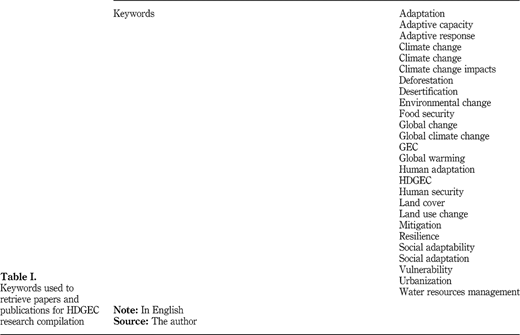
Keywords used to retrieve papers and publications for HDGEC research compilation
Keywords used to retrieve papers and publications for HDGEC research compilation
The authors acknowledge financial support received from the São Paulo Research Foundation and the Brazilian Federal Agency for Support and Evaluation of Graduate Education. They also thank the Department of Environmental Policy Analysis, Institute for Environmental Studies at the Vrije Universiteit Amsterdam, The Netherlands for the hospitality provided during visiting fellowship of one of the authors, as well as useful comments received from an anonymous reviewer.
Notes
Earlier versions of this research have been presented at the Climate 2009 Online Conference, 2009; the XXVIII International Congress of the Latin American Studies Association in Rio de Janeiro, 2009; and the IHDP Open Meeting 2009, 7th International Science Conference on the Human Dimensions of Global Environmental Change, Bonn, 2009.
In this paper the term social sciences covers a broad range of research activities usually associated with disciplines such as economics, sociology, political science, psychology, anthropology, geography and history and interdisciplinary fields such as environmental science, human ecology, administration and management.
One example is the World Bank Exploring the Social Dimensions of Climate Change program.
The project is looking at the theoretical, methodological and institutional frameworks applied in these interdisciplinary environmental studies.
It included universities, research centers, research programs and projects.
It was first organized at Duke University in 1995. Then, it was followed by meetings in Austria (1997), Japan (1999), Brazil (2001), Canada (2003) and Germany (2005, 2009).
In this context, successful refers to articles published in peer‐reviewed journals.
It is important to highlight that the authors of this paper are affiliated to a university in Brazil and it might have brought a bias to this study, as it is easier to gather information on Brazil. So, it does not necessarily mean that Brazil has more scientific production on HDGEC than the other countries.
The table only presents topics that have been identified in our compilation.
These insights came from personal communication with IHDP core‐project members. For more information about the IHDP, visit www.ihdp.org. For a brief review of the international experience and a portrait of the Brazilian case, see Hogan (2007).
There are many more elements that could be explored and considered as challenges when looking ahead but for the purpose of this paper we identified four challenges to be considered as the most important for the future of HDGEC research in Latin America.
For a review on scales and cross‐scales and examples, Cash et al. (2006).
References
Further Reading
About the authors
Rafael D'Almeida Martins is a PhD candidate in Environment and Society at the Center for Environmental Studies (NEPAM), University of Campinas (UNICAMP) in Brazil. He co‐coordinates the Earth System Governance Research Network and was a visiting research fellow at the Institute for Environmental Studies, Vrije Universiteit Amsterdam, The Netherlands in 2008‐2009. He has also received a scholarship from the Canadian Bureau for International Education through the emerging leaders in the Americas Program to visit the Department of Public Administration and Politics at Ryerson University, Toronto, Canada in the Spring of 2010. Rafael D'Almeida Martins is the corresponding author and can be contacted at: rafael@cepps.org.br
Leila da Costa Ferreira is a Professor of Environmental Sociology at the University of UNICAMP and senior research fellow at the NEPAM. She was the President of the Brazilian National Association of Graduate Studies and Research in Environment and Society during 2004‐2008 and she is an Associate Faculty of the Earth System Governance Project. She has been publishing on environmental sociology and sustainability in Brazil and Latin America for more than 15 years.

