


Climate change impacts and scientific evidence are now irresistible based on time scales, consequences and perspectives. Civil society leaders and business people are now agreed on emission reduction targets to mitigate the effects of climate change but the question remains: how to make sure that durable, lasting, and real mitigation options are taking place? The purpose of this paper is to ask, does climate change mitigation option (via carbon tax) exert a greater improvement within the tradeoff between climate change and economic values?
This study tries to lessen the gap between mitigation options and economic development activities using computable general equilibrium techniques focusing on alteration of carbon tax instruments.
The findings indicate that much strong carbon tax policy compensates GDP compositions, places economic burden, shrinks enterprise savings and investment.
This paper describes the most favorable policy option and may find use in formulation of climate change mitigation options and policy concerns for prioritizing needs.
1 Introduction
Climate change presents significant risk to people. Reference is made recently to evident on climate and associated environmental projections by IPCC (2007). Climate change which results from increased greenhouse gases (GHGs) in the atmosphere– is the greatest social, economic and environmental threat of this century. The principle GHG is carbon dioxide (CO2). Since 1750, mankind has extracted fossil fuels, and used them to power our rapid industrial development and accounts for about major part of the human induced warming effect. Carbon dioxide concentrations in the atmosphere have risen one third since the industrial revolution and are set to double in the next 100 years (IPCC, 2007). Temperatures which have varied less than 1°C since the dawn of civilization are projected to rise 2‐4°C over the next century. This is a very rapid transformation in comparison to the longer‐ term warming series naturally experienced over past millennia. Scientists forecast that such rapid transform causes major and rigorous damage to the economic and environmental systems upon which mankind depends for its endurance. The ongoing climate change caused mainly through our rapid exploitation of fossil fuels and industrialization and needs to solve with collective intelligence, creativity and efforts.
The scientific evidence of climate change is now irresistible and accredited a solemn problem (Naomi, 2004). The range of time scales, consequences, perspectives, methods of addressing issues still open for dispute, but now scientists worldwide have publicly agreed that human‐based greenhouse gas emissions are a serious problem facing the world now and the planet on which we live. Even if all the world's government, civil society leaders and business people agree on the emission reduction targets necessary to mitigate the effects of global climate change, the questions still remain: How are we going to make sure that durable, lasting and real reductions are taking place? The systems of enforcing mitigate effects are still in debate, especially when we use market mechanisms and preferences. The climate change impacts and awareness of policy resources for implementation are the most frequently voiced in mainstreaming policy within development activity but specific operational guidance on how to take it into account is still lacking.
Proper policy relevant adaptive framework to climate change, networking and communication among stakeholders and policy makers is extremely obvious to contribute to shaping the nationally appropriate policies. Bridging the gap between the climate change mitigation or adaptation and development activities are ongoing, however, is not easy. The two communities have different priorities; often operate on different time scales. Specific information is substantially required on the significance of climate change for development activities along with operational guidance on how best to adapt to its impacts, within other pressing social priorities. Operational tools for dealing climate change impacts and detailed analysis on technical, institutional and other operational barriers are necessary to integrating climate change mitigation policy. Appropriate policies are required to aim at improving prioritization loom. The two components are to be clear for prioritization approach:
- 1.
evaluate policy concern for priotizing needs within the framework of knowing how markets, preferences and technology change in the distant future; and
- 2.
selection of policy alternatives over which impacts are most relevant to investment decisions (Lobell et al., 2008).
Here, we present a priotizing needs for assessing the impact and country specific mitigation alternatives options using economic principles. Two priotizing components we focused in our study:
- 1.
alternative carbon mitigation options with market structures and economic variables (i.e. GDP components); and
- 2.
selection of proper policy alteration and welfare index for policy concern.
The impact assessment is done using an applied computable general equilibrium (CGE): non‐linear optimization (CONOPT3) model on Malaysia. It follows that how to minimize negative economic impacts while pursuing environmentally sound objectives. The model is applied to assess policy instruments to limit environmental degradation following its economic consequences. A key question for our study is: does climate change mitigation option (via carbon tax[1]) exert a greater improvement within the tradeoff between climate change and economic values? We apply a variety (three) of carbon mitigation simulations and their quantifications and try to quantify each of simulation’ economic merits significantly. Our policy scenarios are simulated to illustrate the virtual impact of interaction between carbon tax on the macroeconomic and environmental variables. All parameter were calibrated to obtain the actual baseline solution. Scenario 1a quantifies the impact of initial imposition of carbon tax. Implementation of this scenario would allow us to see the possible virtual impacts on various economic variables with welfare improvement. Scenario 1b represents a more aggressive of initial imposition of carbon tax where tariff and export duty were reduced slightly to improve fixed capital investment. Results from this scenario explain how much environmental impact would tradeoff with welfare index and export earnings. Scenario 1c finally represents three time initial imposition of carbon tax together with higher welfare index and how higher government earnings to offset the slowdown of real GDP.
2. Model, data and techniques
The basic model consists of industries, institutional agents, primary factors production and rest of the world (Al‐Amin et al., 2009). There are four domestic final demand sectors in our study. They are household, enterprise, government and agent that allocate savings over investment demand from all production sectors. To capture features of intra‐industry inputs for a particular sector, domestic products and products from the rest of the world (ROW) within the sector are assumed to be imperfect substitutes and their allocations are determined according to Armington CES (constant elasticity of substitution) function. Supply side, output allocation between domestic market and ROW are according to Powell and Gruen's constant elasticity of transformation (CET) function. Demand side, household sector is assumed. Household is assumed to maximize utility according to Stone‐Geary utility function subject to income constraint.
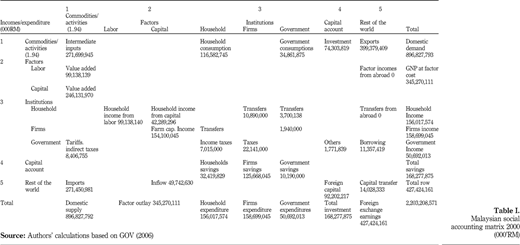
Consumption demand for a sector's product is also a CES function of the domestically produced and imported product. Sectoral capital investment is assumed to be allocated in fixed proportions among various sectors and is exogenously determined. Government expenditure is also exogenously determined. In terms of macroeconomic closure, factors are assumed mobile across activities, available in fixed supplies, and demanded by producers at market‐clearing prices. All data are derived based on the Malaysian social accounting matrix (Table I). Factor incomes are distributed on the basis of fixed shares (derived from base‐year data) and outputs are demanded by the final demand agents at market‐clearing prices. Environmental components are estimated using the IPCC (1996) and Malaysian emission inventory guidelines (Hamid et al., 2008). Our CGE modeling approach is closed to the World Bank model which is followed by Dervis et al. (1982) and Robinson et al. (1999). However, our model has extended for environmental policy analysis using carbon emission block into the model (Al‐Amin et al., 2009)[2].
3. Results and discussion
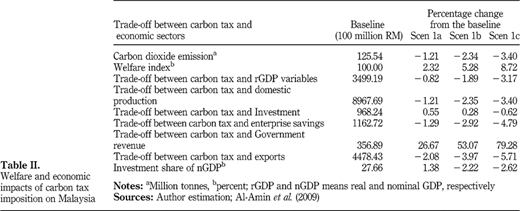
The results in Table II provide insight into the nature of tradeoff between carbon dioxide mitigation and economic cost in the model scenarios. We estimated that the CO2 emission coefficient per ringgit (US$1=RM 3.5) of domestic production (i.e. industrial sectors) is 0.14 kg or 0.014 million MT of CO2 per RM100 million of production. Our initial carbon tax (scen 1a) reflects the negative GDP tradeoff by 0.82 percent per 1.21 percent of carbon mitigation or 2.32 percent increase of welfare index into the economy. The higher negative of GDP (3.17 percent in scen 1c) is to be compensated for higher welfare index (8.72 percent) or higher minimization (3.40 percent) of carbon concentration[3].
Specifically, our findings illustrate that larger carbon mitigation requires a higher carbon tax. An increasing in the rate of carbon tax (1a<1b<1c) decreases the GDP variables at an increasing rate (Figure 1). The virtual scenarios locate that different degrees of carbon mitigation options (i.e. 1a<1b<1c) decrease export revenues (2.08 percent<3.97 percent<5.71 percent), household expenditure (2.32 percent<3.84 percent<7.48 percent), and enterprise savings (1.30 percent<2.92 percent<4.80 percent) in different rates; however that negative impacts are compensated by positive welfare indexed by 2.3, 5.28 and 8.72 percent, respectively, from the virtual simulations (Table I). The aggregate production and investment tends to decrease at a proportional rate by 1.21 percent<2.35 percent<3.4 percent and 0.56 percent>0.28 percent>−0.62 percent as the carbon emissions target becomes more stringent (1.21 percent<2.35 percent<3.40 percent).
The investment scenario in 1a and 1b indicating positive trends even though carbon mitigation option is coping by higher carbon tax. The investment scenarios first and second scenarios place that different degrees of carbon mitigation options (i.e. 1a<1b) are not compensated by negative impacts on the investment. The results are not paradoxical compared to other economics indicators (as we find other macroeconomic indicators are negative for imposing different degrees of carbon tax). The core reason is that the government investment ratio in the Malaysian economy is fairly high GOV, 2006; (i.e. compared to other emerging economies), and upward trend of government revenues from carbon tax is compensated by government investment into the overall economic investment. However, in scenario 1c is experienced by negative investment. In this scenario high negative GDP (3.17 percent) could not be endured much compensation and resulted in negative investment by 0.62 percent.
4. Discussion
In this study we explore preferred simulation's economic merits on the Malaysian economy and provide insight into the nature of the tradeoff between carbon mitigation option and economic cost of improving welfare index[4]. Here, we present two priotizing components:
- 1.
alternative (i.e. scen 1a, 1b or 1c) carbon mitigation options within the economy for sound economic and environment objectives; and
- 2.
selection of proper policy alteration and welfare index within the economic structures.
Our initial carbon tax schemes reflect the negative GDP variables are tradeoff by carbon mitigation option. Considering higher carbon tax policy (such as version b or c of scenario 1), illustrates that the macroeconomic impacts could be strongly negative. Carbon mitigation by 2.35 percent (scenario 1b) must compensate with GDP by 1.90 percent and more mitigation of carbon emission such as by 3.40 percent must be compensated with more negative GDP by 3.17 percent. Therefore, higher negative of GDP is to be compensated for higher welfare indexing.
The key question accordingly arises – which scenario is most appropriate for carbon mitigation options on Malaysia? Is scenario 1b better is than scenario 1a or scenario 1c is better than scenario 1a considering on economic and environmental indicators? Which scenario should be adopted by policy makers? As carbon tax policy implementation is generally political; however our outcome tries to bridging the gap between carbon mitigation option and development priority supporting on the environmental sound objective and economic structure. This study significantly lessens the gap between carbon mitigation option and development activities focusing on three different virtual economic scenarios. We try to indicate that strong carbon tax policy (scenario 1c or 1b) more compensate GDP compositions and burden would be placed on enterprise and investment which are the main components of economic development. However, initial carbon tax reforms (scen 1a) could be placed on Malaysia; as a case study rather than carbon permit or carbon credit. This option would reasonably sound to constant further environmental burden (i.e. carbon reduction by 1 percent) into the economy and convey message to policy makers, who are considering simultaneously economic development and trade policy together with carbon taxation instrument.
5. Conclusion
Our findings indicate that much strong carbon tax policy (i.e. scenario 1c or 1b) compensates GDP compositions, those results in economic burden, shrink enterprise savings and overall economic investment. Therefore, which carbon mitigation option should be taken by Malaysian policymakers? This paper describes the most favorable policy option and we argued for most suitable carbon mitigation policy. Two conclusions can be drawn from our results. First, the expected carbon mitigation would not much compensate GDP and domestic production and exports. Particularly the strong carbon tax policy option should not be too burden to enterprise. Secondly, imposing initial carbon tax, despite many negative impacts (especially the negative saving effects), administering a carbon tax in Malaysia is still defensible for its long run benefits and still plausible if softening measures were undertaken. It encourages firms to lower carbon intensities or increasing energy efficiency or utilization of renewable energy or low‐carbon fuel in industrial production process.
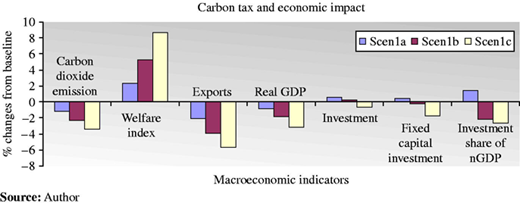
The imposition of carbon tax and possible virtual impact on various economic variables GDP compositions
The imposition of carbon tax and possible virtual impact on various economic variables GDP compositions
This work was prepared under UKM‐GUP‐ASPL‐07‐06‐011 led by Professor Chamhuri Siwar and UKM‐OUP‐PI‐25‐111/2009 led by Professor Joy Jacqueline Pereira at Universiti Kebangsaan Malaysia (UKM). The authors would like to thank UKM Climate Change Niche Area prominence: “A strategic direction for a research university grants” for financial support.
Notes
In the literature on environmental economics and policy, several ways of minimizing the negative effects of carbon emissions have been proposed by various researchers (Beghin et al., 2005; Li, 2005). These include: carbon taxation, energy taxation, tradable emission permits, and regulation. Until now Malaysia has implemented energy taxation, emission permits and environmental regulations except carbon tax. Following that the study focuses on carbon taxation as an instrument for controlling the level of emissions.
Detailed mathematical formulation of carbon tax can be found on Al‐Amin et al. (2009).
Detailed mathematical formulation and composition of carbon concentration can be found by Al‐Amin et al. (2009).
The first part of our study, i.e. mathematical approach and quantification of initial imposition of carbon tax has been published (Al‐Amin, 2009). The second part of our study meaning the current study is simulated to see the tradeoff between carbon dioxide mitigation and economic welfare.
References
Further Reading
About the authors
Abul Quasem Al‐Amin is currently an Assistant Professor at the University of Malaya and associated with research on development and environment in policy modeling using computable general equilibrium approach; data envelop analysis and econometric tools. Beside these, his research interest includes on modeling international trade and environment, macroeconomic stability, ecological economics, optimal pollution taxation and developing GTAP database. He is currently associated with climate change research with NC‐2 (Second National Communications of Malaysia), Asia Pacific network on Global Climate Change (APN), Institute for Global Environmental Strategies (IGES) Japan, Swaminathan Research Foundation (MSSRF) India, University of the Philippines Los Baños (UPLB) Philippines, Institute of Meteorology, Hydrology & Environment (IMHEN) Vietnam, and Royal University of Phnom Penh (RUPP) Cambodia. Abul Quasem Al‐Amin is the corresponding author and can be contacted at: amin_cant@yahoo.com
Abdul Hamid Jaafar is currently an Associate Professor in the Faculty of Economics and Business, Universiti Kebangsaan Malaysia. His research interest includes on welfare economics and others on external shocks and food price increase, bio‐diesel and climate change modeling, taxation policy and resource economics.
Chamhuri Siwar is currently a Principal Fellow and Emeritus Professor in the Institute for Environment and Development (LESTARI), Universiti Kebangsaan Malaysia. He is one of the prominent figures on trade, poverty issues and microfinance in Malaysia. His research interests include climate change assessment, carbon taxation policy and environmental and resource economics.

