


This paper aims to highlight the drivers and trends of carbon dioxide (CO2) emissions from fossil fuels of 21 Mediterranean countries, and suggest some policy recommendations to help mitigate them and fostering energy partnership within the studied area.
Simplified Kaya identity was used to analyse the drivers and trends of CO2 emission from fossil fuels. Data used were retrieved from the US Energy Information Administration and Carbon Dioxide Information Analysis Centre. The analysis considers Northern rim countries and Southern‐Eastern rim countries (SERCs) as separate groups, as well as all together.
The total fossil fuel emissions between 1980 and 2005, the emissions growth rate in 1980s, 1990s, and 2000‐2006 were assessed. The findings put emphasis on the drivers and trends of fuel emissions considering per capita emission, gross domestic product and carbon intensity.
Despite their low contribution to global anthropogenic CO2 emissions (∼7 percent), the growing energy demands in the Mediterranean countries – especially in the SERCs – shows that there is an urgent and tremendous effort that needs to be addressed at national and regional levels in order to slow down the increasing emissions without impacting the development growth. This paper puts special emphasis on the importance of regional energy and climate‐related frameworks as a systematic approach to endure the impacts of climate change through sustainable ways.
Introduction
Since the emergence of the industrial era, mankind started influencing the atmosphere by overexploiting fossil fuel sources. The worldwide economic growth of the last two centuries was obviously sustained by burning fossil fuel sources. In fact, global anthropogenic greenhouse gases (GHG) emissions increased by 70 percent between 1970 and 2004 (Intergovernmental Panel on Climate Change (IPCC), 2007a). As a result, a global warming was recorded which is likely able to interfere with physical and biological systems. One of the IPCC (2007b) conclusions was that climate change will exacerbate the intensity and frequency of extreme weather events and their consequences. Among the GHGs, CO2 remains the most important in terms of quantity released and it relative radiative forcing near to 1.6 W m2 (IPCC, 2007c).
The green movements emerging in late 1970s and early 1980s, and periodic oil crisis drifted the awareness of world leaders, scientists, and general public to dramatic impact of oil‐based economy on earth systems. The genuine reaction to such movements was the approval of the United Nations Framework Convention on Climate Change during the Earth Summit in Rio 1992, followed by the adoption of the Kyoto Protocol during COP3 in December 1997 which is entered into force in 16 February 2005 (IGES, 2009). The Fourth Assessment Report (4th AR) of IPCC (2007a, b, c) confirm with high confidence the “unequivocal” fact that anthropogenic activities are interfering with the climate system and causing global warming, since the GHGs enhance the heat‐trapping capacity of the atmosphere (IPCC, 2007c).
Despite the efforts made by industrialised countries to reduce their emissions, global anthropogenic emissions have been growing about four folds faster since 2000 compared to the value recorded during 1990s (IPCC, 2007c). Current emissions are tracking above the most intense fossil fuel scenario (A1FI) established by the IPCC (2000), and are moving away from stabilization scenarios of 450 ppm (part per million) and 650 ppm (Raupach et al., 2007; GCP, 2007). From a historical perspective, non‐industrialized countries, with 80 percent of the world's population, still account for about 20 percent of the cumulative emissions since 1751, while the poorest countries in the world, with 800 million people, contributed to less than 1 percent of global cumulative emissions (Raupach et al., 2007).
For the purpose of this paper, the Mediterranean region includes the Mediterranean Sea and the surrounding countries. It positioned between latitudes 30o to 45o North and 10° West to 37° East and embraces 21 countries distributed over Northern Africa, Southern Europe and Middle East (Figure 1). Historically speaking, the Mediterranean climate is recent and established during the Pliocene (Raven, 1973). It can be described as a region that receives rain from the mid‐latitude cyclone principally during the winter season and undergoes a hot drought period during the summer season (Aschmann, 1973; Joffre and Rambal, 2002).
In terms of climate change the Mediterranean region is considered a hot spot by many climate scientists and experts including those of IPCC and MetOffice (UK). In fact, since 1970, South‐Western Europe recorded a temperature rise of about 2°C (IPCC, 2007c). Most likely changes to be observed are:
an increase in air temperature in the range of 2.2 to 5.1°C over the period 2080‐2099 compared to the period 1980‐1999 (scenario A1B);
a significant decrease in rainfall, ranging between −4 and −27 percent (scenario A1B);
an increase in frequency and severity of drought periods and extreme events, such as heat waves, droughts or floods; and
an increase of the sea level, which – according to some specific studies – could reach 0.35 meter in the Mediterranean by the end of this century (Plan Bleu, 2008; IPCC, 2007c).
To help developing flexible adaptation strategies to mitigate global climate change; local, national and regional emissions drivers and trends need to be characterized (Canadell et al., 2009). This paper seeks to highlight the contribution of the study area to global climate change with special focus on CO2 emissions from fossil fuels. Local and regional diversity of social, political, economic and environmental aspects have also been considered.
This research paper intends to trigger a common Mediterranean energy consensus that may strongly find out the way to overcome the key climate challenges in sustainable ways. Therefore, the Mediterranean countries including in this study were allocated in two main groups; Northern Rim countries (NRCs) which regroups Spain, France, Italy, Malta, Slovenia, Croatia, Bosnia‐Herz., Former Serbia‐Montenegro, Albania, and Greece, and Southern‐Eastern Rim countries (SERCs) which embraces, Turkey, Cyprus, Syria, Lebanon, Israel, Egypt, Libya, Tunisia, Algeria, and Morocco (Figure 1).
Methods and datasets
Analyses were done for all aforementioned Mediterranean countries together, as well as for NRCs and SERCs separately. Available data from the Energy Information Administration (EIA) were used for the period 1980‐2005 (EIA, 2008) and data pre‐1980 were obtained from Carbon Dioxide Information Analysis Centre (CDIAC, 2008). The simplified Kaya identity (F=P.g.h) was used to analyse the drivers and trends of CO2 emissions from fossil fuel as described in Yamaji et al. (1991), Raupach et al. (2007), and Canadell et al. (2009); where F represents fossil fuel emissions, P: population; g: per‐capita gross domestic product (GDP/P); and h: Carbon intensity of the economy (F/GDP).
Population data from 1980 to 2006 were obtained from EIA (table published 8 December 2008) based on data gathering from the United Nations Statistics Division (2008). GDP was acquired from the International Monetary Fund (IMF, 2008) based on the purchasing power parity (PPP) and market exchange rate (MER). PPP gives more weight to developing economies; consequently wealth differences between countries are lower. However, the growth rate of PPP is greater than that of MER. All GDPs are expressed in US $2,000. Carbon intensity of the economy is the C emitted to produce 1 US$ of GDP (F/GDP). This measure is the product of the energy consumed per dollar of economic activity (the energy intensity of the economy (E/GDP) and the C emitted per unit of energy (the C intensity of the energy; F/E).
Two important notes to be consider in this paper, in on hand; the missing data, from 1980 to 1991, were replaced by the value recorded in 1992 for Bosnia and Herz., Croatia, former Serbia and Montenegro, and Slovenia. In other hand, significant economic activities in most SERCs are based on traditional and non‐marketable energies such as biomass (fuel‐wood gathered from forests).
Results
Population
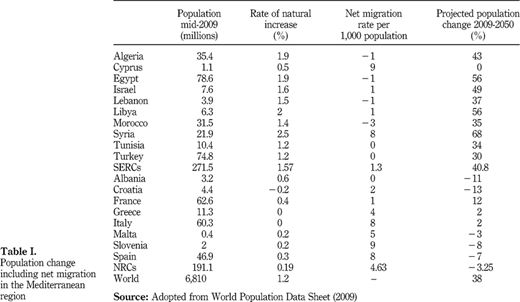
The Mediterranean population shares about 6 to 7 percent of the world population. These figures are expected to remain unchangeable during the 21st century. Though, according to Makhlouf (2002) and 2009 World Population Data Sheet (PRB, 2009) there is a general increase in the Mediterranean population with natural growth rate fluctuate from −0.2 to 2.5 percent by mid 2009. These values are unevenly dispersed over the study area. For instance, (Table I), within NRCs it range from −0.2 percent in Croatia to 0.6 percent in Albania. While within SERCs, it ranges from 0.5 percent in Cyprus to 2.5 percent in Syria. Thus, the average rate of natural increase is about 1.7 percent in SERCs and 0.19 percent in NRCs (global average is 1.2 percent). These estimates are subject to variations since they exclude the net migration rates which are about 0.463 percent in NRCs and 0.13 percent in SERCs. In addition, more than one third of the Mediterranean population is living within a distance of 100 km from the coastal areas. In some countries such as Italy, Libya, Tunisia, Malta, Greece, and Cyprus more than 70 percent of the population is strictly Mediterranean (Burke et al., 2001).
If the population growth follows similar trend, the SERCs will embraces around 72 percent of the Mediterranean population by 2100 in stead of only 58 percent in 2007 (Figure 2). According to EIA, 2008, these figures reflect unbalanced future challenges between both Mediterranean rims. On the other hand, seven countries embrace 82 percent of the Mediterranean population; France, Italy and Spain account for 73 percent of NRCs population, while Egypt, Turkey, Morocco, and Algeria account for 83 percent of the SERCs' population. In terms of CO2 emissions, these countries are likely expected to contribute substantially to the Mediterranean GHGs emissions.
Emissions and trends from fossil fuel
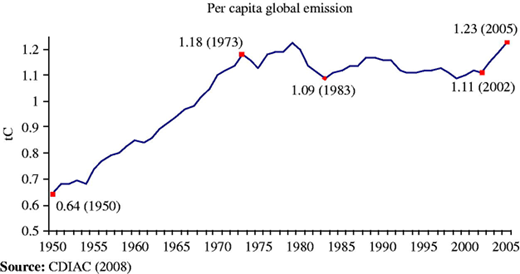
Since 1751, massive amounts of carbon have been released to the atmosphere from the consumption of fossil fuels (95 percent), cement production (4 percent), and gas flaring (1 percent). Half of these emissions have occurred since the mid 1970s. It is worthy to highlight that the world fossil fuel emissions in 2005 were of the highest ever recorded, 7,985 millions metric tonne of carbon (MtC) (CDIAC, 2008). Accordingly, the estimated average of global per capita emissions has drastically increased from 0.64 metric tonne of carbon (tC) in 1950 to 1.18 tC in 1973. This last value fluctuated slightly till 2002 then boosted again to reach 1.23 tC in 2005 (Figure 3).
In this context, the Mediterranean countries were responsible for 7 percent of the global cumulative CO2 emissions from fossil fuels for the period 1980‐2005. The share of NRCs emissions has decreased from 79 to 61 percent, while the share of SERCs has steadily increased from 21 to 39 percent for the same period (CDIAC, 2008).
The Mediterranean annual average emissions from fossil fuel were ∼554 MtC per year for the period 2000‐2005 (and only ∼447 MtC per year during 1990‐2000), of which 348.5 MtC per year occurred in NRCs[1] and 205.64 MtC per year in SERCs. From an economic point of view, five developed countries were responsible for 60 percent (66 percent for 1980‐2000) of the total Mediterranean emissions and 15 developing countries were responsible for the remaining 40 percent. For the same period, the Mediterranean top five emitters (Figure 4) were leaded by Italy with an annual average emissions of 462 MtC (448 Mt of CO2 ranking tenth worldwide in 2006 according to PRB, 2009) followed by France with 410 MtC, Spain with 356 MtC, Turkey with 209 MtC, and Egypt with 142 MtC (EIA, 2008; CDIAC, 2008).
Though France reduced its emissions during the 1990s, these slightly increased since 2000. Egypt and Turkey doubled their emissions since the 1980s. Moreover, severe increase has been observed for Spain since 2000.
Figure 5 shows clearly the difference between NRCs and SERCs regarding population and fuel emission trends. Except for France, the emissions in 2005 were above the average value for the period 1980‐2005. This is particularly the case for Spain, Italy and Greece in NRCs and for Turkey, Egypt, Morocco, Algeria, and Syria in SERCs. Consequently, there is an urgent need for integrated energy strategies to be adopted by aforementioned countries to slow down this increase of emissions.
The drivers and trends of fossil fuel emissions in the Mediterranean basin for the period 1980‐2006 are shown in Figure 6. Before 1990, the emissions steadily increased steered by population growth. However, after 1990, the emissions profile rise beyond population growth curve and tend to track per capita GDP. Thus, carbon emissions seem to be driving by per capita GDP (for PPP and MER) rather than by population growth. Indeed, since 1990 the SERCs experienced a raise in socioeconomic index due to the development of energy market based essentially on fossil fuel. A quite similar trend could be seen in NRCs due partially to the emerging new countries in economic transition, in addition to recent emissions from Spain and Italy.
Generally, the carbon intensity (C intensity) in the Mediterranean region has been improved since 1990, with most of the improvement driven by NRCs. Figure 7 highlights the C intensity of GDP using PPP and MER for the Mediterranean countries in 2005. Using PPP, the C intensity of all Mediterranean countries together remains less than the world average (around 0.5 tC/1US $1,000) due particularly to NRCs improvement (a good improvement as well reported for Morocco and Tunisia, while poor values have been recorded for Libya, Former Serbia & Montenegro, and Syria). However, using MER, all the Mediterranean countries together or as separate groups go ahead of the world total average. In this regard, MER revealed the real unbalanced economy within the Mediterranean countries.
The world total primary energy consumption has increased with an average rate of 2 percent per year for the period 1990‐2005 as reported by the International Energy Agency (IEA, 2008). This increase will continue for the next few decades driven by a raise in energy demand. According to EAI & IEA data, the Mediterranean countries account for a fair share (8 to 9 percent) of the total world primary energy consumption. The largest share is consumed by the NRCs (72 percent) and the remaining by the SERCs (Plan Bleu, 2008). Using the sectoral approach of the IEA in the Mediterranean region, the CO2 emissions from energy consumption increased from 1,563 Mt CO2 in 1990 to 2,063 Mt CO2 in 2005 and expected to reach 3,019 Mt CO2 by 2020. The growth rate for NRCs was 1.2 percent for the period 1990‐2005 and is expected to continue at the same rate by 2020 in the baseline scenario. While, the growth rate for SERCs was 3.5 percent for the period 1990‐2005 and is likely going to reach 4.8 percent by 2020 in the baseline scenario. According to CDIAC (2008) the trend of primary energy consumption for the years 1980 and 2006 revealed a 10 percent fall among NRCs and about 10 percent raise among SERCs. These expectations remain valid regardless of the prospected adaptation and mitigation options.
Conclusions and future prospects
“Energy” is a core driver of economic development. Shifting to green economy simply means reinforcement of green energy systems. Although the Mediterranean countries contribute to only ∼7 percent of global GHG emissions, its will face major energy and climate challenges due to raise in energy demand and unstable fossil fuel prices worldwide, in addition to relevant socio‐economic and political differences. Within these circumstances, the increasingly supported answer is to develop proper policy measures aiming to enhance and promote energy efficiency (EE), renewable energies (RE), and reducing GHG emissions. Barcelona Accord and the Union for the Mediterranean, in addition to the Kyoto protocol and future post 2012 provide legal frameworks to promote cooperation in energy system between both rims of the Mediterranean Sea. EU has already set a specific target for energy and climate policies measures (achieving a 20 percent reduction in the EU GHGs emissions and a 20 percent share of RE, by 2020) which could be an important driving force for SERCs sustainable development (Mediterranean Solar Plan (MSP), 2010).
Recently, a Mediterranean policy database for RE and EE system was established to foster development of regional capacity building, transfer of know‐how and most important the implementation process in SERCs. A significant progress has been achieved through a number of initiatives (RCREEE, MEDREC, OME […]) after the set up of “Priority Action Plan 2008‐2013” during the Euro‐Ministerial Conference on Energy, 2007. These initiatives focus on infrastructure projects; development of sustainable systems, integrating SERCs energy markets though supporting programmes, cooperation in the field of EE and RE […] (MSP, 2010). In short term this could provide a possible control over the increasing demand on primary energy consumption and subsequently over fossil fuel burning.
The positive impact of climate change is the increasing awareness regarding the relationship between development and the quality of surrounding environment. Within the study area, it is likely to be considered as a win‐win‐win approach; mitigation opportunities for NRCs, an economic opportunity for SERCs, and an opportunity for Mediterranean ecosystems as well. Thus, reach the aforementioned goals several adaptation and mitigation measures have to be considered and implemented accordingly. Schäfer (2008) has stated that a 50 percent worldwide share of RE is possible by 2040. This assumption is based on ambitions growth rate of RE supported by an optimistic deployment of green technology and unprecedented progress on international cooperation focused on environment protection and global equity. An extrapolation of the cumulated results of the study conducted by Plan Bleu (2008) shows that over the whole Southern rim, by 2015, the aggregate for the whole actions would allow an annual saving of 33.6 to 38.3 million metric tonnes oil equivalent (Mtoe) and a decrease in CO2 emissions in the range of 119 to 139 million tons.
The assessment of mitigation costs and potential impacts of climate change in the Mediterranean region will depend to the future socio‐economic growth, shifting to new technologies, and consumers' willingness. Indeed, investing today in green and low carbon energy is likely to guarantee the low cost adaptation and mitigation in other related sectors such as agriculture, water, forestry, tourism, industry, and transport. The decisions taken today will draw the sensitivity and the vulnerability index of the Mediterranean basin in the coming decades. The most likely approach is to develop a common Euro‐Mediterranean climate framework to promote attractiveness of intra‐Mediterranean investment in green energy sector.
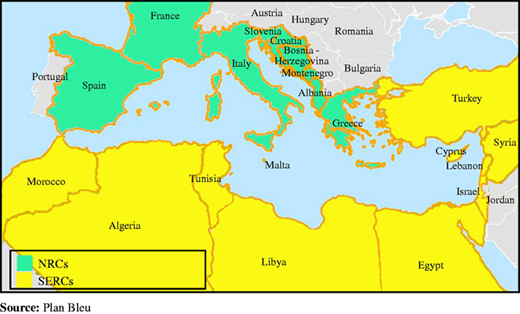
Mediterranean countries included in this study with differences between NRCs and SERCs
Mediterranean countries included in this study with differences between NRCs and SERCs
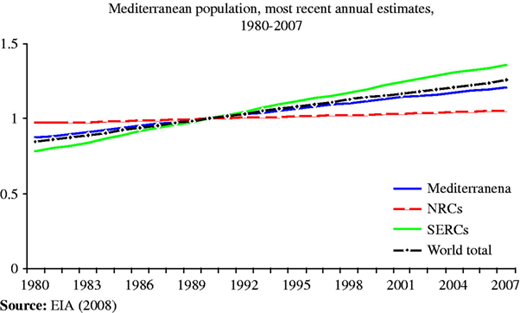
Population trend in the Mediterranean region compared to the world total trend (all normalized to 1 in 1990 for the purpose of comparing trends), 1980‐2007
Population trend in the Mediterranean region compared to the world total trend (all normalized to 1 in 1990 for the purpose of comparing trends), 1980‐2007
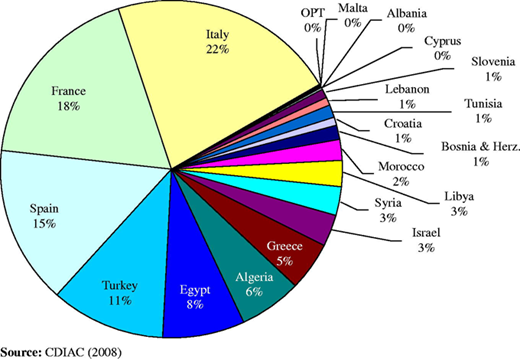
National CO2 emissions from fossil fuel burning, cement manufacture, and gas flaring for the period 2000‐2005
National CO2 emissions from fossil fuel burning, cement manufacture, and gas flaring for the period 2000‐2005
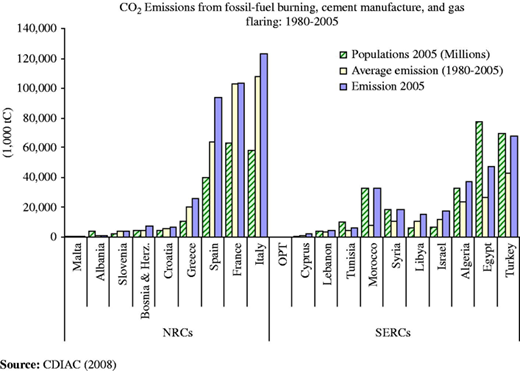
Mediterranean population (millions), their average emission for the period 1980‐2005, and their emissions in 2005, and (1,000 tC)
Mediterranean population (millions), their average emission for the period 1980‐2005, and their emissions in 2005, and (1,000 tC)
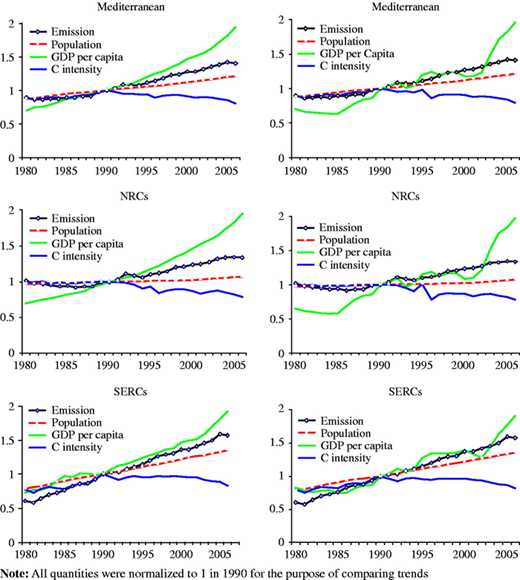
Drivers of fossil fuel emissions as per the Kaya identity for the period 1980‐2006, emissions=population×GDP per capita×carbon Intensity, using both PPP (left column) and MER (right column) to express GDP
Drivers of fossil fuel emissions as per the Kaya identity for the period 1980‐2006, emissions=population×GDP per capita×carbon Intensity, using both PPP (left column) and MER (right column) to express GDP
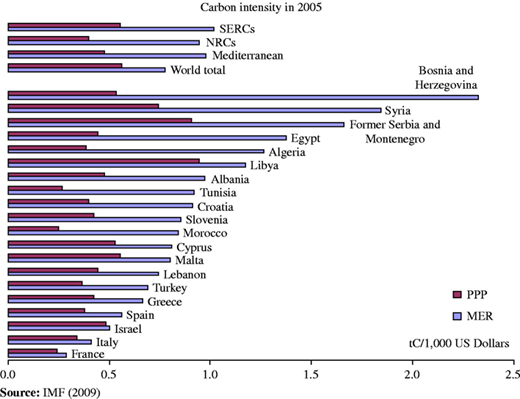
Carbon intensity of GDP using PPP and MER for the Mediterranean countries in 2005
Carbon intensity of GDP using PPP and MER for the Mediterranean countries in 2005
The authors acknowledge the help provided by Ms Katalin Petz and Ms Livia Minca for reviewing the English writing of this paper.
Notes
Analysis for Serbia‐Montenegro were not performed due to missing values data.
References
Further Reading
About the authors
Abdeltif El Ouahrani is a PhD Candidate in the Department of Biology, Faculty of Sciences, University Abdelamlek Essaadi (Morocco). He holds an MSc in European Forestry (University of Eastern Finland), MSc in Forest Management, (SLU University, Sweden) and MSc in Plant biotechnology (University Abdelamlek Essaadi, Morocco). His research focuses on forestry, climate change, energy and sustainable development issues in the Mediterranean region. During the last three years, he has contributed to more then ten international scientific meetings discussing issues related to forestry matters, wood technology, and climate change, that includes 4Degrees Conference (Oxford University, UK), forest day 3 (Copenhagen, Denmark), and Klima 2009 ((online), Hamburg University, Germany). Abdeltif El Ouahrani is the corresponding author and can be contacted at: elouahrani@gmail.com
Joaquin Molero Mesa is a Professor in the Department of Botanica, University of Granada (Spain), and Head of the group RMN170 Florae, vegetation and Eth‐botany. He is well known as a Botanist and has carried out many environmental projects in Andalusia (Southern Spain). He is also the Spanish Coordinator of European project GLORIA (Spain) coordinated by Grabbher G. University of Vienna, Austria.
Abderrahmane Merzouki is a Professor in the Department of Biology, University Abdelmalek Essaadi (Morocco) and a member of the group RMN170 Florae, vegetation and Eth‐botany, Department of Botany, University of Granada (Spain). He has conducted many researches on the impact of climate change on mountain regions, mainly Alpin ecosystem GLORIA project: Sierra Nevada (Spain). He has also carried out research on climate change in Ibero‐Rifain biosphere supported by AECI (Spain).

