


The paper is an excerpt from a more comprehensive study by the Florida Department of Environmental Protection comparing the technical elements of offset projects in forestry, agriculture, and waste management, as well as some miscellaneous project types. The authors compare and contrast design elements of three specific offset projects: afforestation/reforestation, manure management, and landfill gas capture. The technical review for each offset project is concluded with a look at the potential applicability for that project in Florida in the context of the protocols evaluated.
Offset projects that may be employed in Florida are first broken up into comparable design elements specific to the selected offset project type. Focusing on the design elements, a discussion of the similarities and differences among the protocols for each offset project is presented. Each section begins with general findings then moves on to assessments of the detailed design elements. Finally, the project's general applicability to Florida is considered, highlighting specific strengths of particular protocols from the analysis of the design elements.
Protocols tend to vary from highly specific requirements to a more general set of recommendations. Interestingly, no one program's set of protocols is the most opportunistic for Florida, but rather various protocols may have distinctive strengths depending on the project type.
Many comparative studies of offset protocols evaluate protocols in the context of program‐level policies. This study uniquely values the technical details in the protocols and does not consider policy or program‐level issues.
1 Introduction
Accounting for offsets is one of the more challenging issues involved in the development of any greenhouse gas cap‐and‐trade program. Offsets open up a large number of financial opportunities for the various offset providers in sectors and locations not included in the greenhouse gas policy. But offsets can be a perceived risk to the environmental integrity of any greenhouse gas reduction program based on the credibility of the protocol. The offset protocol is the collection of procedures, equations, record keeping requirements, and methodologies that must be followed for an offset program to grant greenhouse gas reduction credits to a particular project. There are various protocols in existence with differing degrees of requirements and acceptable methodologies for each project type. The variability found in the plethora of protocols is evidence of the ongoing debate about the appropriate degree of detail for broad and specific requirements.
To help focus this debate, we prepared a comparative study of offset protocols for 15 selected offset project types from 11 different regulatory and voluntary programs (Figure 1) (Stevens et al., 2010). The project types chosen include agriculture, forestry, and waste management projects, as well as a group of miscellaneous project types. The 15 selected offset project types are those expected to be most applicable to Florida. This article discusses three of those 15 offset project types from the original study: afforestation/reforestation, manure management, and landfill gas capture.
In this comparative study, the use of the word greenhouse gas “program” applies to any greenhouse gas reduction system, whether mandatory or voluntary, or in the form of cap‐and‐trade or other emissions reduction scheme. The use of the word “protocol” applies to specific, technical requirements as they pertain to a project type. In some cases, protocols exist as part of a greenhouse gas reduction program. In other cases, the protocols are part of an emissions reporting tool that is not tied to any specific greenhouse gas reduction program. At times protocols are separate from a program, but they are employed by one or several emissions reduction programs.
This study qualitatively compares the technical elements of the selected offset protocols. It highlights the similarities and differences among the protocols for each particular type of offset project for each design element. For afforestation/reforestation, as an example, the study compares what types of land are eligible under the different protocols; what the protocols require in terms of frequency of monitoring, record keeping, and reporting; and even what calculation approaches are specified to be used. The study does not evaluate the technical merits of one calculation approach versus another, but it does indicate the procedural and administrative requirements for the design elements. This allows comparative, relative implementation costs to be identified, as protocols with more (or more detailed) design elements will typically be more expensive to implement.
Generally speaking, the study does not discuss the larger, program‐level issues like accrediting independent verifiers, issuing traceable credits, or approving project applications. There may be some issues, like permanence, that are sometimes addressed at the program‐level and sometimes at the level of the individual offset protocols under that program. In these cases, we address these issues at the protocol level and not at the program‐level. There are numerous other studies available for a comparative review of the program‐level aspects of the greenhouse gas trading or reporting programs as they exist or as they should theoretically exist (United States Government Accountability Office, 2008; Kollmuss et al., 2008; Kling et al., 2009; Keeler and Thompson, 2008).
This study also outlines the potential for applicability in Florida for each type of offset project. The discussion includes a brief overview of the amount of eligible land or eligible activity level in Florida, along with a rough estimate of the amount of possible greenhouse gas reduction. These portions of the document occasionally make reference to a protocol or group of protocols with design elements that are advantageous for Florida. Advantageous, in this context, means the design elements are more beneficial, more cost effective, or just clearer and simpler with respect to applicability and implementation in Florida – all while maintaining the environmental integrity of the earned offset credits. Design elements that are advantageous are those that would maximize offset project availability so as to achieve real reductions in greenhouse gas in the most cost‐effective manner. Protocols and available offset projects are continuously being updated. This document is current through early winter 2010 and does not include analysis of protocols released after January 2010.
2 Afforestation/reforestation
Afforestation and reforestation refer to the conversion of non‐forested land to forested land in an effort to increase the amount of carbon stored in the biomass. Afforestation refers to land that has been non‐forested for some time, typically ten years or more, prior to the afforestation project. Reforestation is usually defined as returning land to a forested condition after some severe disturbance where the forest is not naturally regenerating. These terms are not used consistently from protocol to protocol, so this discussion uses the term “afforestation” to refer to afforestation, reforestation, or both.
There are nine fully developed protocols and one protocol under development for afforestation/reforestation considered in this study (Figure 1; Table I). All of the examined offset programs either include a fully developed afforestation protocol or have an afforestation protocol under development. This analysis summarizes the afforestation protocol elements listed in Table II.
2.1. General findings
The protocols share similar concepts, but vary in their details. For example, all of the protocols calculate the total sequestered carbon as the sum of a number of discrete carbon pools, such as above ground biomass and soil carbon. But which carbon pools to use, and how those carbon pools are defined, vary from protocol to protocol. For example, Clean Development Mechanism (CDM) uses five well‐defined carbon pools. Regional Greenhouse Gas Initiative (RGGI) lists three required pools, one conditionally required pool, and two optional pools. The New South Wales (NSW) protocol includes wood products as a carbon pool. And Agricultural Ontology Service (AOS) simply requires accounting for above‐ and below‐ground biomass (with soil carbon as an option). There are also differences between similarly named pools. Not every “above ground trees” carbon pool encompasses the same biomass; some may include shrubs and grasses in the above‐ground carbon pool. And “down dead wood” may be different from “litter” or “mulch.”
Some afforestation protocols are distinct from a carbon registry system while others are interrelated to carbon reduction programs. The protocols that do not have a registry component generally do not include specifics regarding crediting periods, permanence, or reversals. They focus instead only on the methods for counting carbon. Other protocols rely upon existing methods, but supplement them through specifying permanence, crediting periods, etc. For example, CDM provides detailed, registry‐independent methods for assessing afforestation projects, and VCS is a registry built upon using and tailoring the CDM methodologies. The CDM does not issue offset credits, but VCS is an offset program that does issue credits. The ACR is a carbon registry that implements an afforestation protocol using CDM and VCS tools and methodologies. Similarly, RGGI issues offset credits through a tailored version of the DOE methods. There appear to be three broad families of afforestation protocols: CDM/VCS, DOE/RGGI, and CCX/International Organization for Standardization (CCX/ISO).
The protocols are all fairly similar regarding what types of land are eligible for afforestation projects. Details vary, but the land must be in a non‐forested condition for some period of time prior to project implementation. This is primarily to address additionality and to ensure that existing forests are not cut down just to make eligible land for regrowing forests. The afforestation protocols, however, all seem to assume terrestrial land. None of the examined protocols specifically address wetland areas. Some protocols (in the details of their tables and models) may have embedded growth characteristics for wetland tree species, but none have modules or carbon pools specifically addressing wetlands as a carbon reservoir.
2.2. Protocol elements
2.2.1. Eligibility
All of the examined protocols restrict afforestation projects to land that is not currently a forest. This helps to ensure additionality by not giving offset credits to recently harvested forests. It also eliminates the incentive to cut down a forest only for the purpose of regrowing it to earn offset credits, because afforestation offset credits are only given to projects that convert non‐forested land to forested land. Many of the offset programs, however, also feature protocols for conservation or forest management or both. These other project types can be applicable to existing forests.
The typical afforestation protocol requires that the land be in a non‐forested state for at least ten years prior to the project start date, although several protocols just require the land to be non‐forested prior to the project (AOS, CDM, DOE, EPA CL). “Non‐forested” is explicitly defined in some protocols (e.g. <10 percent tree canopy cover). In addition, many protocols have a minimum parcel size requirement for afforestation projects. Some protocols allow aggregation of multiple small holdings to meet the minimum size requirements, while others do not.
Almost all protocols require some sort of land management practices to be followed, but each protocol addresses land management differently. Some just specify the types of trees that must be planted (e.g. trees that meet a minimum height of 2‐5 meters and provide a crown cover of at least 10‐30 percent at maturity). Some require the land to be certified to a sustainable forest management program (CCX, RGGI). Some have restrictions on livestock grazing or broadcast fertilization or native species or community impacts (ACR, CDM, CAR, RGGI).
Commercial harvesting is another area addressed in different ways by different protocols. For example, AOS assumes there will be harvested biomass, but does not specify details. Biomass energy is counted as greenhouse gas emissions under CDM and ACR, with some exceptions if the biomass carbon stock returns to at least the original stock within ten years. The NSW protocol envisions harvesting at staggered time intervals so as to maintain a permanent, minimum level of carbon stocks. In general, the protocols that prohibit or restrict harvesting provide an exception for disease control.
2.2.2. Carbon sequestration quantification
Offset credits from afforestation projects depend upon the measurement of how much carbon is sequestered in the forest ecosystem. All of the protocols calculate the total sequestered carbon as the sum of a number of discrete carbon pools. Each pool uses different equations, models, and parameters. Typical pools include above‐ and below‐ground biomass, standing dead wood, litter, and soil carbon. Several protocols use just these five pools (CDM, EPA CL, VCS), but others contain many more (CAR, DOE), plus some optional pools (such as shrubs and grasses, mulch, and understory) (RGGI). In addition, NSW accounts for wood products as a carbon pool.
Much of the complexity of an afforestation project involves the direct measurement procedures for calculating the carbon stored in each pool. Carbon scientists have developed many different models and tables and equations. The methodologies range from simple and inexpensive (using default factors for various tree species) to complex and costly (in‐field measurement and modeling). Many protocols rely upon existing measurement procedures developed by other agencies. The VCS, for example, requires the project sponsor to propose measurement procedures, but automatically accepts all CDM‐approved tools. The ACR uses the CDM and VCS tools. The NSW relies upon Australia's national carbon accounting toolbox model, which is a regional implementation of the FullCAM model. The CCX references protocols found in peer‐reviewed scientific journals (Journal of Forest Science and Oecologia). The ACR and CCX both require emissions accounting as per ISO procedures.
Although the specifics of the individual models and equation sets are beyond the scope of this analysis, the goal of the measurement procedures under each protocol is the same – to obtain accurate data before an afforestation project can earn carbon offsets. Most protocols require sufficient procedures and sample sizes to ensure the reporting value is within 10 percent of the true mean at a 90 or 95 percent confidence level. The NSW has an unusual accuracy requirement; the project sponsor must be able to demonstrate at least a 70 percent probability that the net increase in carbon stocks exceeds the amount of carbon represented by the awarded offset credits.
Frequency of required monitoring varies from protocol to protocol. Most use a two‐tier system, with annual certification reports linked to generation of offset credits supplemented by less frequent in‐field verification reports. In‐field verification, often through an independent third‐party, is usually required every five or six years. The VCS employs a novel approach where the verification frequency is optional, but more frequent verification lowers the non‐permanence risk which impacts the amount of offset credits earned for a project. CAR is noteworthy because it requires monitoring for 100 years after the last credit has been earned by an afforestation project.
2.2.3. Offset crediting
There are two primary methods to calculate the net sequestration of carbon prior to awarding offset credits. The first is a stock change approach, where each year, the sum of the carbon present in all the carbon pools is compared to the total carbon from last year. The difference is net storage of carbon, which is eligible for offset credits. About half the protocols follow this approach (CCX, CDM, NSW, RGGI, DOE).
The other half (AOS, ACR, CAR, EPA CL, VCS) establish a baseline activity level at project initiation that forecasts how much carbon would be sequestered on the land without the afforestation project, usually expressed as an annual greenhouse gas emission rate. Then, each year (or at some other specified frequency), the sum of the carbon present in all the carbon pools (i.e. actual greenhouse gas emissions) is compared against the baseline scenario greenhouse gas emissions. The difference is then eligible for offset credits.
Only about half of the protocols investigated specify a crediting period (ACR, CCX, CAR, EPA CL, VCS). In some cases, like CDM, this is because the protocols are independent of a carbon registry and only address how to measure carbon sequestration. The CDM does not directly issue carbon offset credits, so there is no need to set up a crediting period. The VCS, on the other hand, does provide offset credits; subsequently, VCS specifies a crediting period for an afforestation project.
There is no common theme to crediting periods. Some default to 20 or 35 years but allow the crediting period to be extended if the baseline is revalidated (ACR, EPA CL). Some protocols run only until the end of an offset program's trial period; in other words, each project would have a different crediting period, running from its implementation date to the end date of the program (CCX). The CAR features a 100 years crediting period, and VCS offers variable crediting periods with longer periods lowering the non‐permanence risk.
Accounting for leakage, reversals, and permanence is an important feature of an afforestation protocol. Leakage occurs when an afforestation project leads to an increase in deforestation activities outside of the project boundary. Some protocols do not address leakage (AOS, NSW, RGGI, DOE). The EPA CL requires inclusion of leakage in the calculation of greenhouse gas emission reductions, but it does not provide a specific quantification method. The CAR determines a leakage risk percentage at project outset, and ACR assesses leakage on a case‐by‐case basis. The CDM and VCS account for leakage in the most robust fashion. The CDM essentially prohibits leakage through including a methodology to identify sources of leakage and methods to account for it. The VCS adopts the CDM methods but goes a step further – VCS requires leakage calculations to be “double approved” through two independent assessments.
Reversals and permanence are related concepts. A reversal occurs when newly forested land loses carbon sequestered in its biomass through fire, drought, pests, or other damage to the trees. Permanence means the newly forested land will remain a forest in the future and the sequestered carbon will remain in the biomass. Several protocols address reversals and permanence through establishing a reserve or buffer pool of carbon offsets (ACR, VCS). The administrating agency typically controls the reserve, and releases carbon offsets from the reserve to account for biomass losses (carbon emissions) resulting from fires, drought, pests, etc. The afforestation project's obligation to the reserve is based upon its risk – the higher the risk of reversals or non‐permanence, the more credits the project must place into the reserve pool.
Another approach taken by the protocols is to simply reduce the number of offset credits earned by the afforestation project. For example, to account for reversals, AOS applies a 90 percent assurance factor (i.e. 10 percent deduction) to the carbon credits earned for above‐ground biomass. The RGGI protocol also reduces the carbon credits awarded by 10 percent, but allows this penalty to be waived if the project retains long‐term insurance to guarantee replacement of any lost carbon. Long‐term guarantees are another feature of many protocols to address permanence. Several protocols (CCX, CAR, RGGI) require land to be placed under legally binding, permanent conservation easements (or the equivalent).
2.3. Applicability to Florida
Afforestation is one of the top recommended policies in the Governor's energy and climate change action plan. The plan recommends policies to encourage afforestation (“forests on land that has not historically been forested”) and reforestation (“promoting forest cover and associated carbon stocks by regenerating lands previously forested”) (Governor's Action Team on Energy and Climate Change, 2008).
The action plan sets out what it considers to be achievable goals for an afforestation and reforestation policy:
The afforestation goal is to increase the area of forested lands in the state by 50,000 acres annually through 2025. For reforestation, the goal is to implement reforestation activity on all harvested acres by 2025 (Governor's Action Team on Energy and Climate Change, 2008).
If these goals were met, the afforestation policy would net 850,000 acres cumulative by 2025, reducing greenhouse gas by a cumulative total of 30 million metric tons (MMt) CO2e. The reforestation policy would similarly net 2,514,300 acres cumulative by 2025, for a greenhouse gas reduction of 104 MMt CO2e (Governor's Action Team on Energy and Climate Change, 2008). The action plan recommends accomplishing these goals through landowner assistance, incentive programs, or both. A greenhouse gas emissions offset program with a robust afforestation protocol would complement the action plan by providing financial incentives for landowners to promote forests.
The Florida Department of Environmental Protection (FDEP) division of state lands contracted with experienced carbon scientists to prepare a carbon capture and sequestration study of Florida Board of Trustees (BOT) lands (Kling et al., 2009). This study discusses the factors that impact the value of carbon offsets for afforestation projects, and it includes recommendations to evaluate the existing offset protocols through a series of pilot projects. It is not immediately clear that any one protocol would be more applicable to Florida forests, and each program has its own methods to ensure credibility. A series of pilot projects, as recommended by the state lands study, would provide valuable experience, especially with respect to determining offset project implementation costs.
Wetlands, seagrass, and mangrove restoration projects could all be significant carbon sequestration projects in Florida, often storing more carbon than other ecosystems (Kusler, 1999). There are millions of acres of wetlands in Florida (Governor's Action Team on Energy and Climate Change, 2008); there are over 2.2 million acres of wetlands just in the land owned or co‐owned by the BOT (Kling et al., 2009). The existing afforestation protocols, however, do not usually address aquatic areas, where there can be some complicating factors. Methane emissions may compromise the benefit of the carbon sink in wetlands, and more research is needed to provide statistically significant sequestration rates of wetland activities (Kling et al., 2009).
Florida has a wide variability of types of forested land and a mix of tree species that is perhaps not well represented in the existing methodologies. It is clear that a broader afforestation offset program – one that is applicable to more species and land types – would be beneficial for Florida because it would maximize the amount of land potentially available for offset projects. Flexibility could be provided by a mechanism similar to the VCS sliding scale for non‐permanence risk that requires more offset credits to be deposited into the reserve account for riskier projects and for projects that are less well monitored. This flexibility could provide for offset projects in many different areas of the state. Each individual project could determine the most cost‐effective method of generating offset credits by balancing the value of the offset credits against the cost of more frequent verification and the risk of the proposed project. This would help increase the eligibility of Florida lands for afforestation projects.
3 Manure management
Manure management projects typically involve implementing practices that reduce methane emissions from the handling of agricultural material such as animal waste, silage, dead animal stocks, and organic waste. Example projects include incorporation of manure into digestion systems, feed regime changes for farm animals, and changes in storage methods of waste. Projects of this type are most often referred to as “manure management”, “organic waste digestion”, or “dietary modifications”.
In recent years, the livestock population in the USA has been fairly constant, yet the number of farms has declined (United States Environmental Protection Agency, 2004). There has been a shift from small farms too much larger concentrated animal feeding operations (CAFO). A CAFO is an animal feeding facility that typically contains more than 1,000 animals and must obtain a national pollutant discharge elimination system permit (United States Environmental Protection Agency, 2004). A CAFO can also be designated as such by a state even if it has less than 1,000 animals due to certain conditions such as the potential the facility may have for discharging pollutants into US waters, depending on the animal type. According to the FDEP, wastewater facility regulation database, there are approximately 50 dairy CAFO within the state of Florida (FDEP, 2009b).
An enormous amount of animal waste is produced at a CAFO. The production of manure at a single animal farm is roughly that of a small to medium city (United States Environmental Protection Agency, 2004). From that waste, a large percentage of nitrogen is lost to the atmosphere in the form of nitrous oxide. Manure also releases methane, carbon dioxide, hydrogen sulfide, and criteria air pollutants. Manure management, organic waste digestion, and dietary modifications can reduce the environmental effects of these pollutants. The most common type of manure management is the use of anaerobic digesters. Digesters capture methane and other emissions from manure and can offset electricity consumption and associated emissions from non‐renewable fossil fuels.
In total, eight of the selected programs have manure management offset projects as seen in Figure 1 and Table I (AOS, CCX, CDM, CAR, GE AES, RGGI, DOE, and EPA CL). In addition, there is one program (ACR) currently developing a protocol for manure management. The design elements discussed for the selected manure management protocols are listed in Table II.
3.1 General findings
Most of the protocols are linked to or reference other protocols or sources. The CCX uses the intergovernmental panel on climate change (IPCC) tier two approach and emission factors used in the EPA greenhouse gas inventory (United States Environmental Protection Agency, 2009a, b, c) in determining its baseline emissions. The CDM clearly takes its lead from the Kyoto Protocol in determining its basic criteria, but each project type has its own set of protocols and rules, which must first be approved by the designated national authorities. The CAR derives its emission reduction calculation method for manure management from the CDM, and uses EPA CL for manure management protocols and the RGGI model rule. The GE AES protocol references EPA Method 1 for its accuracy requirements for the location and set up of the system flow meter. It also refers to Title 40, Section 60.18, of the code of federal regulations (CFR) for determination of its confidence levels of combustion efficiency. The RGGI protocol also incorporates EPA test methods for mass and concentration calculations, and references the EPA greenhouse gas inventory for other types of manure. Additionally, RGGI requires the analysis of a facility's livestock population to be carried out using the American Society of Agricultural and Biological Engineers standard. The DOE protocol references and adopts many of EPA's emission factors and standards and IPCC technical guidelines as well.
When comparing the various protocols that support a manure management system, there are some conceptual similarities but specific variations. For instance, most protocols require a manure management project to come from a “business as usual” perspective when performing a baseline determination analysis, but may have differences in these calculations. Methane destruction or combustion through the use of anaerobic digestion is the most common focus for a manure management offset in all of the protocols.
The AOS, CCX, and GE AES provide credits for methane destroyed by flare or combusted to generate electricity or heat. All other protocols reviewed provide credits for methane destroyed by flare or otherwise combusted, but the other protocols do not specifically address combustion for generation of electricity or heat.
3.2 Protocol elements
3.2.1. Eligibility
All eight protocols for manure management share many similarities for eligibility. Each protocol requires the project be additional to practices already in place at the farm or facility. They all also require the project be beyond federal, state, or local regulation. The differences concerning eligibility in the protocols occur at the technical, project‐level detail. The EPA CL, RGGI, GE AES, and CAR all specifically accept only some form of anaerobic digestion for biogas capture or destruction for this project type. The CDM, CCX, AOS, and DOE, on the other hand, allow for other methods of manure management to be considered as eligible (e.g. enteric fermentation projects, changes in livestock waste storage, or feed regime changes).
The eligible practices are outlined clearly in most of the protocols. For those protocols, which only allow for anaerobic digestion projects (RGGI, EPA CL, GE AES, CAR), their eligible practices focus on waste management, digester system requirements, type of feedstock, and the fate of biogas. Typical projects for protocols that accept practices outside of anaerobic digestion include changes in livestock practices (AOS, DOE), treatment of waste by either a separation process or composting (CDM), or alternative waste storage (CCX). Some protocols allow for the inclusion of non‐manure feedstock into the digestion process (AOS, CCX, CAR, RGGI).
3.2.2. Greenhouse gas reduction
In order to determine the level of emission reductions achieved by an offsets project, a baseline must be initially determined at the onset of the project. For this aspect of many of the offset protocols, baseline is a projected or historical “business as usual” scheme. For the eight programs reviewed for manure management, five (AOS, CCX, RGGI, CAR, DOE) take a basic “business as usual” approach in deriving their emissions baseline. The EPA CL uses a software tool to calculate the emissions baseline dependent on current practices. The CDM and GE AES require the application of a stepwise procedure, which involves a multiple scenario analysis. From these scenarios, the project developers model their baseline emissions from information on manure management practices in the area for livestock type, collection methods, and farm size.
When it comes to quantifying greenhouse gas reduction, each protocol takes a slightly different approach to evaluate emissions reductions. The AOS, RGGI, EPA CL, and GE AES evaluate their emission reductions as the difference between the baseline and projected emissions. The DOE, however, estimates reductions using farm data, estimation methods, EPA default values, and models. The CAR employs methods of three other protocols (CDM, RGGI, EPA CL) for its reduction analysis. The CCX calculates its reductions as a function of the project's biogas system.
Most of the offset programs have some measure of accuracy associated with a particular aspect of their protocol for manure management. The accuracy requirements are in place to keep a level of quality control and credibility in each project. In total, seven of the eight protocols reviewed have distinguishable accuracy measures in place for various elements of their manure management offset (all but CDM). Of these seven, only two actually specified a confidence level or percentage for their accuracy requirements (CCX, GE AES). The other protocols either gave generalized accuracy instructions or referenced other standards for accuracy. The only protocol without any accuracy specifications is the CDM. The accuracy requirements apply to different aspects of the project in the protocols. For AOS, CAR, RGGI, and DOE, the accuracy requirements apply to data quality of reported emissions. For CCX, GE AES, and EPA CL, the accuracy requirements address process efficiencies and quality assurance of facility data.
3.2.3. Offset credits
Offset credits are not awarded in the voluntary reporting programs (DOE, EPA CL), but credits are awarded in all of the other programs. For those protocols that do award offset credits, the common criteria are start date, location, and amount of emissions reduction. The protocols that specify a method for reversal are AOS, CDM, CAR, and EPA CL. Each of these has some sort of penalty or prior arrangement for not permanently achieving the project goal. The other protocols assume methane destruction through anaerobic digestion is non‐reversible.
Both CDM and CAR (CAR points to CDM) require retirement of credits for reversal of greenhouse gas emissions within a specific timeline. For AOS, reversals are quantified using specified methodologies, however, it does not specify how the credits will be compensated for in the event of emission reversals. The EPA CL adds any leakage of emissions back into its reduction calculations as a reduction of credits. The EPA CL also requires any non‐permanence associated with the project to have replacement guarantees for losses in the future.
Since a project's permanence is so closely related to emission reversal, this element is handled in much the same way by most of the protocols. The CCX views the combustion of methane as a permanent solution. The CDM is based on the Kyoto Protocol which only requires a project to be “long‐term” and not necessarily permanent. The CAR, GE AES, RGGI, and EPA CL all require emissions stay out of the atmosphere for a specified amount of time as part of their permanence requirements.
The monitoring of multiple variables in each project is an essential requirement to ensure offset credibility. The AOS refers to manufacturer's specifications for testing and monitoring of equipment, but it does not specify a monitoring schedule of its own. Many of the protocols have developed their own standards of monitoring their progress. The CAR, GE AES, and EPA CL require monitoring of some aspect of the process, equipment, or chemical composition within a specified time schedule (e.g. monthly, annually).
3.3. Applicability to Florida
According to Florida Department of Agriculture and Consumer Services (FDACS), Florida is ranked 12th in the nation for total beef cows and 18th in the nation in total cattle. Cattle and calves on Florida farms and ranches totalled 1,690,000 head in 2006 (FDACS, Division of Marketing and Development, 2009). In its state agricultural response team lesson plan, FDACS noted that Florida's livestock inventory includes 26 million poultry, 350,000 horses, 1.5 million beef cattle, 140,000 dairy cattle, and 100,000 swine (Sapp and Wang, 2007).
Since manure management applies outside of just dairy or beef farms, other livestock facilities in Florida could be considered for offset purposes. Federal state, and local environmental regulations are requiring many producers to change the way they manage manure. Any methods or activities required by regulation would not be considered as additional, and therefore not eligible for offset credits. The challenge is to identify management strategies and technologies that will go beyond environmental regulations in ways that are cost effective.
The Governor's energy and climate change action plan recommends anaerobic digestion of manure for use as an energy source (Governor's Action Team on Energy and Climate Change, 2008). Coupled with its nutrient management recommendations, the action plan is most like the protocols of GE AES, EPA CL, and CCX in which the captured biogas is used for some form of energy production. But GE AES is the only protocol that also addresses nutrient management of the residual from the anaerobic digester after treatment of manure.
If implemented, the action plan estimates that nutrient management could yield a total reduction in greenhouse gas of roughly 2.6 MMt CO2e between the years 2009 and 2025. The action plan similarly estimates that manure management recommendations, if implemented, could provide approximately 0.8 MMt CO2e in total greenhouse gas reductions from 2009 to 2025.
In light of new EPA CAFO rules (United States Environmental Protection Agency, 2010), balancing nutrient land application with crop requirements will be required for many farms. Certain technologies and management practices are strategies that farms across the USA are using to successfully match manure nutrients with crop nutrient uptake. One of these requirements eliminates unnecessary supplements, which in turn reduces excess phosphorous and nitrogen in animal feed and, in many cases, provides a cost savings. It also corresponds to decreased concentrations of nutrients in manure, which can provide increased flexibility for land application and reduced risk of nutrient loss to air and water (National Dairy Environmental Stewardship Council, 2005).
Other technologies used for nutrient management are efficient solid‐liquid separation systems, like weeping walls or double screen separators, which give producers greater control over manure nutrients. These solids may be recycled on the farm as bedding or soil amendments, or sold to neighboring farms or homeowners. Another tool to reduce pollution and costs on farms for manure management is composting. Composting can reduce separated manure solid volume by more than 50 percent and produce product suitable for sale. Selling compost is a means by which producers can reduce land application of manure and meet nutrient management plan objectives (United States Environmental Protection Agency, 2004).
The common use of anaerobic digesters in manure management can be enhanced for greater greenhouse gas reduction by using the captured gas. The digesters produce biogas from manure, which may be combusted or used to supply energy that can be used to run the farm. In regions where farms can offset their electricity purchases with biogas‐derived power, the expected payback falls within three to seven years (United States Environmental Protection Agency, 2002). The protocols, which are based solely on the anaerobic digestion of manure, however, require millions of dollars to implement on current working farms (United States Environmental Protection Agency, 2004). The payback time for initial startup may be too distant in the future for some smaller operations. The AOS, DOE, and CDM protocols would offer Florida farmers options for managing manure that may be more cost effective in the short and long terms.
These three discussed programs have protocols for feed regime changes and anaerobic digestion, but they do not all suggest using the biogas produced for electricity generation. If this biogas was used to produce electricity at the farm, it would assist in sustaining farm production until project payback was achieved. The DOE and AOS both add changes to manure storage practices as one of their manure management offset possibilities, while CDM's alternatives are biological treatment of manure, solids separation, and composting. The AOS also approves cattle life cycle changes as a manure management option, which the other two do not.
4 Landfill gas capture
Landfill gas capture is an offset project offered in several programs and reporting standards in the waste management category. Landfills were the second leading source of methane emissions in the USA in 2007 (second to enteric fermentation), contributing approximately 23 percent of all anthropogenic methane (United States Environmental Protection Agency, 2009a). The bacterial decomposition of organic material in landfills and the oxidation of the solid waste results in byproducts of primarily methane and carbon dioxide. If the landfill gas is not collected for destruction, it leaks back into the atmosphere from the landfill site. There are methods of collecting and destroying landfill gas that involve piping collected gas to flares, onsite combustion for generation of electricity or heat, or sending the gas in pipelines offsite for other uses.
There are protocols for landfill gas capture in AOS, CCX, CDM, CAR, GE AES, NSW, RGGI, DOE, and EPA CL referenced in Table I. These protocols have varying degrees of combustion options and validation requirements, but all of the listed protocols require some type of collection and destruction of landfill gas. The NSW program offers the option of collecting methane from landfills and using it to replace fossil fuels for both renewable energy and greenhouse gas emission reduction credits. This option in NSW does not include project‐specific details in the protocol and will, therefore, not be discussed in this section. A protocol for landfill gas capture is also being developed in the ACR. This analysis summarizes the landfill gas capture protocol elements listed in Table II.
4.1. General findings
For landfill gas capture, there was limited referencing of other protocols within each evaluated protocol (e.g. GE AES referring to CDM methodologies). The ISO was referenced in three of the eight protocols (CCX, CAR, GE AES) and the CDM in two (CAR, GE AES). The GE AES protocol was mainly a review and blend of the CDM, EPA CL, CCX, and ISO projects protocols. The AOS, CDM, RGGI, DOE, and EPA CL protocols seemed mostly original.
The level of detail concerning eligible project types, calculation, monitoring requirements, and other elements varied a great deal among the protocols. Some protocols were mostly simplistic and short (DOE, RGGI, EPA CL) while others included detailed parameters and required or suggested methodologies. A few of the protocols listed specific ways to quantify combustion from gas utilization, such as electricity generation and thermal energy (AOS, CCX, CDM), while others left that to another protocol but included the emissions in this project type (GE AES, EPA CL). Some protocols did not address nor include gas utilization effects, such as CAR and RGGI. One protocol offered two methods for offset requirements differing on cost and complexity, with the more complex methods providing more generous greenhouse gas emission reduction estimates (GE AES).
4.2. Protocol elements
4.2.1. Eligibility
While not explicitly stated in an identical manner, the protocols all include the same regulatory eligibility. Under all of the protocols, any landfill eligible for the landfill gas capture offset project must not already be required by federal, state, or local regulations to employ landfill gas capture. More specifically, the New Source Performance Standards (NSPS) for municipal solid waste landfills (40 CFR 60, subpart WWW), emission guidelines for municipal solid waste landfills (40 CFR 60, subpart Cc), and the National Emission Standards for Hazardous Air Pollutants for new and existing landfills (40 CFR 63, subpart AAAA) are all federal regulations requiring control of non‐methane organic carbon (NMOC). The control of NMOC is similar to the control of methane, often requiring landfill gas capture. Because of this, landfills that are already required by federal rule to control NMOC would not be eligible to qualify as a landfill gas capture project. A landfill may, however, be eligible if it installs collection devices that go beyond regulatory requirements. For a more thorough discussion on the federal rules mentioned for landfills and emission thresholds, see the EPA CL section on “regulatory eligibility”.
Most of the protocols allow for the same types of gas collection use within the project eligibility. The common collection uses are: flaring, combustion for electricity or thermal energy, or pipeline for natural gas distribution. Several protocols clearly include all three (AOS, CDM, CAR, GE AES, DOE). Some of these protocols explicitly state which gas utilization projects they accept; others imply project acceptability through general wordage, and may need further clarification (e.g. EPA CL allows “gas utilization projects”, RGGI allows “thermal destruction” projects).
From the protocols allowing electricity or thermal energy generation for gas utilization, some include specific methodologies to quantify and include the emissions from this gas utilization into the project emissions or credits or both (AOS, CCX, CDM). Some of the protocols include the emissions from the gas utilization project, such as the displaced emissions from burning fossil fuels, but point to a different protocol for the quantification methodology (GE AES). Further, some of the protocols do not include the gas utilization project emissions or credits (CAR, RGGI) or they quantify and accredit the emissions in a separate protocol (EPA CL).
4.2.2. Greenhouse gas reduction quantification
A significant section of each protocol addresses the appropriate monitoring technology, methodologies, and quality assurance/quality control procedures for the verification of the landfill gas projects. The landfill gas flow rate and methane concentrations are the two main parameters requiring monitoring in all of the protocols besides DOE. The DOE protocol does not go into specific requirements such as monitoring and measurement in the landfill gas capture section, but rather only requires landfill gas flow rate and methane concentration to be reported. All of the other protocols discuss different levels of requirements for the monitor types. For example, five of the seven protocols with specific monitoring sections require continuous metering of landfill gas (AOS, CCX, CDM, CAR, RGGI). For methane concentration, two of the seven protocols require the more costly continuous metering (CDM, RGGI) while most of the other protocols only prefer it.
The monitoring methodology generally outlines the required locations and maintenance of the monitoring equipment. These varied from specific (CDM, CAR, GE AES) to more suggestive and general (AOS, CCX, RGGI, EPA CL) monitoring plan requirements. The DOE does not address a monitoring plan in the landfill methane section of the reporting protocol.
The baseline calculation is typically used to predict business as usual emissions absent the offset project. In this case, it would be the emissions of methane or other gases to the atmosphere without collection and combustion (or above the collection and combustion already required). Much like the monitoring methodology, there are varying levels of details in the suggested calculations of the baseline. The EPA CL is the only protocol to specifically require modeling for the baseline. Most of the protocols, however, do require results from the monitoring in their baseline calculations.
An important variable in the baseline calculation is the global warming potential of methane. The global warming potential for methane is either 21 metric tons CO2e per metric ton methane (AOS, CCX, CDM, CAR, GE AES, EPA CL) or 23 metric tons CO2e per metric ton methane (RGGI, DOE). This variation in global warming potential results in a 9 percent difference in earned offset credits for methane destruction. The 21 metric tons CO2e per 1 Mt methane derives from the IPCC second assessment: climate change 1996 and has continued to be quoted as the 100‐years global warming potential of methane in the 2007 IPCC fourth assessment (IPCC, 2007).
4.2.3. Offset crediting
Leakage is the increase in greenhouse gas emissions due to but outside of the project. For this type of offset project it is not widely expected. The only type of leakage required to be monitored by one protocol results from activity shifting due to the project (EPA CL). Every other protocol does not expect or require any monitoring or reporting of potential leakage.
More pertinent to landfill capture projects are the sources of greenhouse gas emissions caused by the onsite project (i.e. burning of fossil fuel necessary to combust the landfill‐generated methane). There are varying degrees of requirements to quantify project emissions among the protocols. Generally, protocols use a table with a list of sources and sinks for each section of the project or optional control methodology (all programs except RGGI, DOE, and EPA CL). The table provided will then identify if this source or sink is included in the baseline or project credit calculation or both. Typically, the tables will also describe how to calculate or monitor emissions and how to include project sources and sinks in any baseline or credit calculations. Only one protocol (RGGI) does not include project emissions at all.
The final important calculation for landfill gas projects is the determination of project credits or emissions reductions. These typically (but not always) involve the difference between the baseline emissions and those avoided by the project. The amount of emissions avoided is based on the combustion efficiency of the device. Some of the protocols use flat destruction efficiency rates (RGGI, EPA CL) while others require or offer calculation or source testing to determine site‐specific destruction efficiencies (AOS, CCX, CDM, CAR, GE AES). The DOE protocol implicitly includes a destruction efficiency by requiring measured or modeled project emissions. The details that go into the emission credit reduction formulas may cross reference other sections of the protocol, therefore, a full reading and understanding of the entire protocol is necessary for those employing it.
4.3. Applicability to Florida
The Governor's energy and climate change action plan included “landfill gas‐to‐energy” as a recommended offset project for Florida (Governor's Action Team on Energy and Climate Change, 2008). It was the eighth ranked recommended offset project of 28 in terms of greenhouse gas cumulative reduction between 2009 and 2025 at 8.65 MMt CO2e. It is important to note, only 2.6 percent of that greenhouse gas reduction is from avoided emissions from fossil‐fuel electricity generation, and the majority is from landfill gas capture.
There are at least 34 landfills in Florida equipped with gas collection and combustion devices; 33 of these landfills are required under the federal Clean Air Act to have these gas collection and combustion devices (FDEP, 2009a). There are, however, as many as 90 other landfills in Florida which do not require air permits that may be eligible for landfill offset projects (Grasel, 2009). Currently, there are five landfill gas capture projects either registered or listed with CAR in Florida (CAR, 2010a, b).
According to United States Environmental Protection Agency (2009b), Florida currently has 11 landfills employing landfill gas to energy projects, averaging around 6.3 million tons of waste in place. They range from 0.4 to 16.3 megawatt capacities, with greenhouse gas emissions reductions from 0.001 to 0.703 MMt CO2e per year. These landfill gas projects include reciprocating engines, steam turbines, microturbines, boilers, combined cycles (not cogeneration), or direct thermal use such as leachate evaporation. Considering mostly classes I and II landfills in Florida, there are at least 23 landfills, ranging from 1.0 to 18 Mt of waste in place, considered as “candidates” for landfill gas to energy projects (Lee, 2009). There are an additional 30 landfills that are considered “potential” for landfill gas to energy projects, but more information on the landfill sites are needed to determine exact eligibility.
This basic inventory of landfills and landfill gas to energy projects in Florida illustrates there is some potential for landfill gas capture offset projects in Florida. Most of the protocols quantify gas utilization effects, such as fuel replacement emissions reductions, and greenhouse gas outside of methane (AOS, CCX, CDM, GE AES, NSW, DOE). The three that do not (CAR, RGGI, EPA CL) may be easier to implement because they are simpler and do not include carbon dioxide or nitrous oxide emissions. It is arguable how valuable the inclusion of these other gases to landfill gas capture projects are. Overall, the simpler protocols may be easier to implement (CAR, RGGI, EPA CL), but the more complex ones may be more accountable (AOS, CCX, CDM, NSW, DOE). Given this divergence, protocols that offer varying levels of complexity and requirements (like the GE AES) may be more suitable for Florida landfill methane projects.
5 Conclusions and recommendations
While the study did not argue the scientific or technical merits of the various offset project protocols, it did compare the different protocols on a detailed, element‐by‐element basis. This comparison included a rough estimate of implementation cost through highlighting the specific requirements of each protocol element and displaying the requirements in detailed tables. These tables are included in the full document (Stevens et al., 2010). Programs with more procedural or administrative requirements for a given design element would naturally have higher implementation costs.
These analyses have uncovered many offset protocol design elements that could be advantageous for Florida. The study indicates some options for protocol design that could maximize the economic benefit to Florida of a greenhouse gas offset program through maximizing the amount of credits able to be generated in Florida and the overall amount of credits made available for capped sources. Protocols that offer a sliding scale of implementation costs, where the offset provider can earn more greenhouse gas reduction credits for selecting a more expensive, rigorous verification methodology are particularly attractive as they allow individual providers to tailor the cost of the offset project versus the value of the earned offset credit.
There is no one program of protocols that is most suitable to Florida for all of the project types evaluated, but in general the study concluded that programs offering more flexibility would have a larger potential benefit. For example, since Florida is composed of a wide variety of tree species, the protocols that accept a broader range of tree types would be more applicable for afforestation and reforestation projects in Florida (e.g. VCS). Manure management protocols that allow other methods of greenhouse gas reduction besides only anaerobic digestion present less expensive offset project options (e.g. AOS, CCX, CDM, DOE). And landfill gas capture protocols that offer a choice of complexity and requirements and resulting offset credits may be more attractive to offset project applicants in Florida as well (e.g. GE AES). Florida's unique land features and environment provide fertile ground for more research for certain offset projects, particularly in the forestry sector regarding wetlands and diverse tree species.
This study is only a technical discussion; it is informative to policy‐makers, but it does not represent policy or recommendations for policy. It is best seen as a roadmap to guide the stakeholder discussion by pointing out the relative merits of different possible approaches to greenhouse gas offset projects, and identifies areas where additional research and development of protocols would be useful for common offset projects to be employed in Florida.
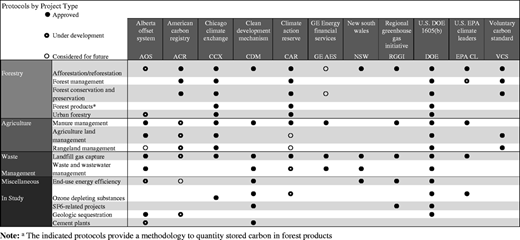
The protocols by project‐type table display all approved, developing, and considered protocols for the selected greenhouse gas reduction or reporting programs for all offset project types in the original study
The protocols by project‐type table display all approved, developing, and considered protocols for the selected greenhouse gas reduction or reporting programs for all offset project types in the original study
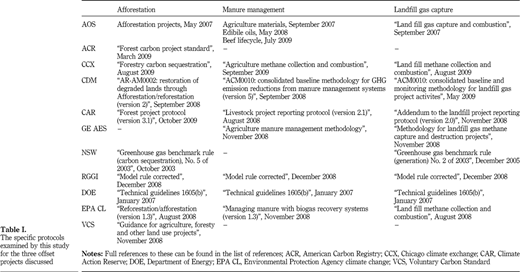
The specific protocols examined by this study for the three offset projects discussed
The specific protocols examined by this study for the three offset projects discussed
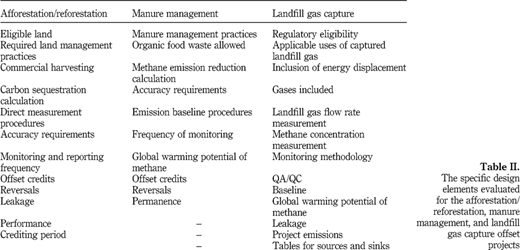
The specific design elements evaluated for the afforestation/reforestation, manure management, and landfill gas capture offset projects
The specific design elements evaluated for the afforestation/reforestation, manure management, and landfill gas capture offset projects
References
Further Reading
About the authors
Kelly A. Stevens graduated with her Bachelor of Science degree in Meteorology from Oneonta State University in New York in 2004 before moving to Tallahassee to complete her Master of Science degree at Florida State University in 2007. She is currently pursuing a Master's degree in Public Administration at FSU while working full‐time at the FDEP. She has been with FDEP since November 2006 as a meteorologist in the Division of Air Resource Management in the Office of Policy Analysis and Program Management. She is involved in air quality modeling, regulatory implementation, policy development, and greenhouse gas projects at DEP. Kelly A. Stevens is the corresponding author and can be contacted at: Kelly.Stevens@dep.state.fl.us
Greg DeAngelo graduated with a Bachelor of Science degree in Environmental Engineering from the University of Florida in 1993. Following graduation, he worked for five years with air pollution consulting firms in Raleigh‐Durham, North Carolina, assisting the EPA in the fields of regulatory development, emission factor improvement, climate change, and software development. He began his career in public service in 1999, working for the environmental departments of North Carolina and Florida, where he has been involved in permitting, compliance, emissions inventory, developing regulations, implementing policy, and greenhouse gas projects. He has been licensed as a Professional Engineer in Florida since 2002.
Shenita Brice graduated with her Bachelor of Science degree in Chemical Engineering from Florida State University in 2008. She currently works as an an Environmental Engineer within DEP's Office of Policy Analysis and Program Management. She plans on pursuing her Engineer in Training certification in the Spring of 2011. She is involved in various regulatory projects, policy analysis, and greenhous gas projects at DEP.

